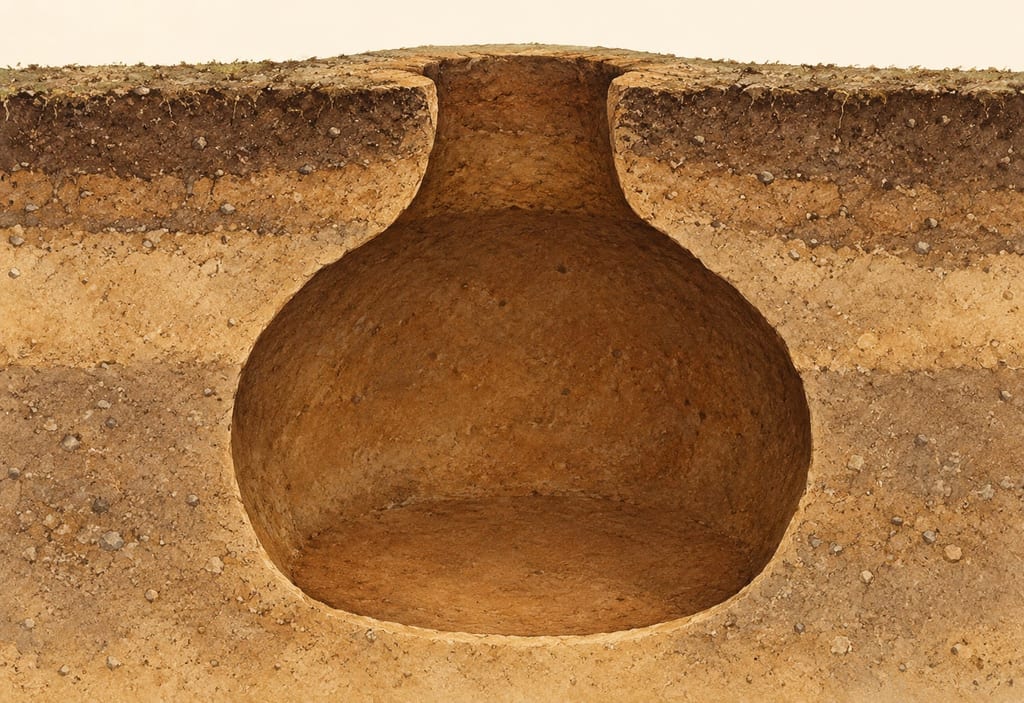
Jōmon flask-shaped storage pit
At Sannai Maruyama in Aomori, some Jōmon storage pits had a narrow mouth and broad floor, with larger examples reaching two metres deep; nuts or chestnuts are the proposed stores.
 FermenteaWhere food goes to change
Built structures · Place · Pits and cavities
At Higashimyo in Saga, 155 round Early Jōmon storage pits were about 40–70 cm wide and 1 m deep. More than 700 baskets were recovered; Saga City interprets acorn soaking as a possible use, not a documented arrangement.
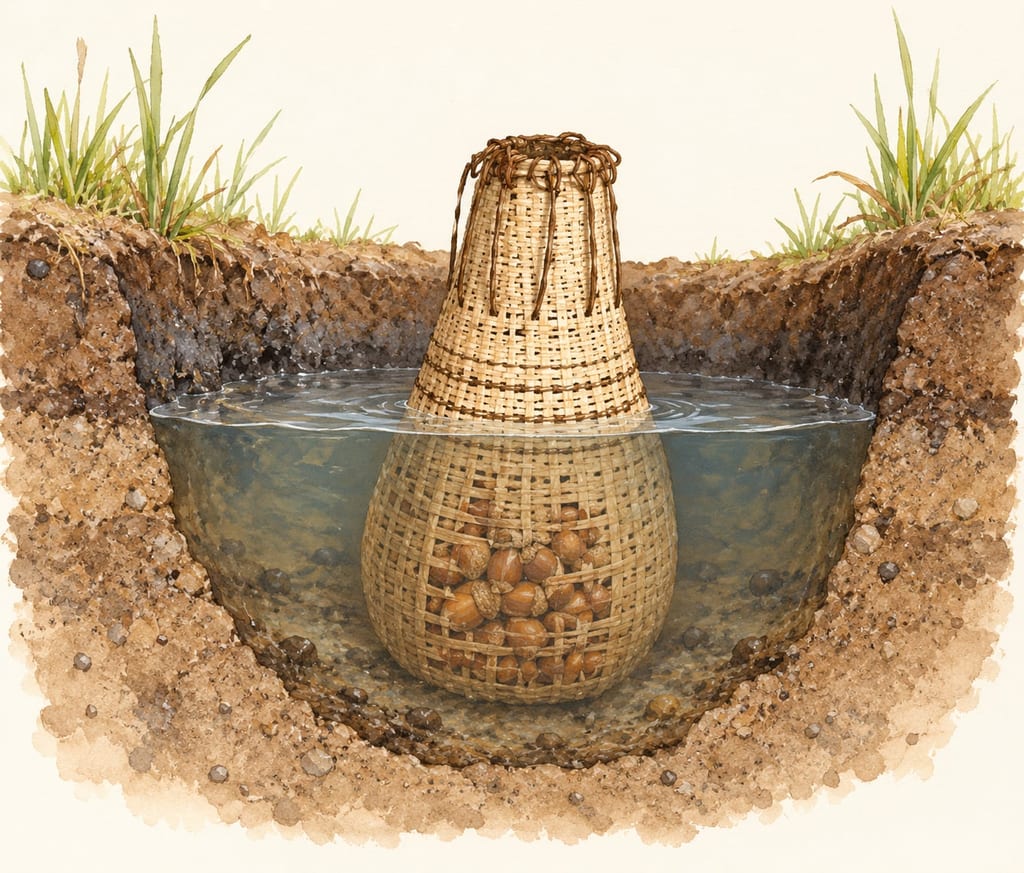
Higashimyo Site lies in Kinryu-cho, Saga City, in northern Kyushu. The site preserves a late Early Jōmon settlement from about 8,000 calibrated years ago. The national cultural-properties register describes a settlement organized across higher habitation ground, shell-midden slopes and a low wetland. In that wetland, about two to three metres below the local reference elevation, archaeologists identified 155 storage pits described as round, about 40–70 centimetres in diameter and approximately one metre deep.
The wetland setting preserved plant and wooden remains that rarely survive at other sites. More than 700 woven baskets were recovered in the pit group. These findings make Higashimyo an unusually rich source for understanding storage and plant use in early Jōmon life.
Saga City describes the baskets as tools that may have been used with dug holes: nuts such as acorns were placed in baskets and soaked in water. That could have supported storage or the processing of nuts, but the source presents this as an interpretation. The national register describes the pit group as round, about 40–70 centimetres in diameter and one metre deep; it does not document a single recipe, a specific water level, or the placement of one particular basket in one particular pit.
A city image shows reconstructed baskets, while the national database also records excavated basket finds. Neither source establishes that all 155 pits had the same shape or that every basket was used in a pit. The page therefore treats the cutaway illustration as one proposed arrangement, not a reconstruction of a known individual feature.
The archaeological record supports a wetland storage-pit group and a large basket assemblage. The city’s proposed soaking use is relevant to nut handling, but none of the sources consulted documents fermentation. The national register gives an approximate round pit form and dimensions, while the sources do not specify lining or covers or the exact relationship between particular baskets and pits.
Saga City describes the Higashimyo site as an Early Jōmon settlement about 8,000 years old and interprets woven baskets as tools for placing nuts in dug holes and immersing them in water. The National Cultural Properties Database describes a final Early Jōmon site with 155 round storage pits in a low wetland at elevations around -2 to -3 metres, about 40–70 cm in diameter and approximately 1 metre deep, and over 700 baskets recovered from the pit group.
A build is made where it stands: moving it means building it again.
Reference point for OpenStreetMap archaeological-site feature 567791406, named Higashimyo Site. Locates the mapped site extent, not a separately surveyed storage pit; the feature cites Saga Prefecture's heritage record.
At Sannai Maruyama in Aomori, some Jōmon storage pits had a narrow mouth and broad floor, with larger examples reaching two metres deep; nuts or chestnuts are the proposed stores.
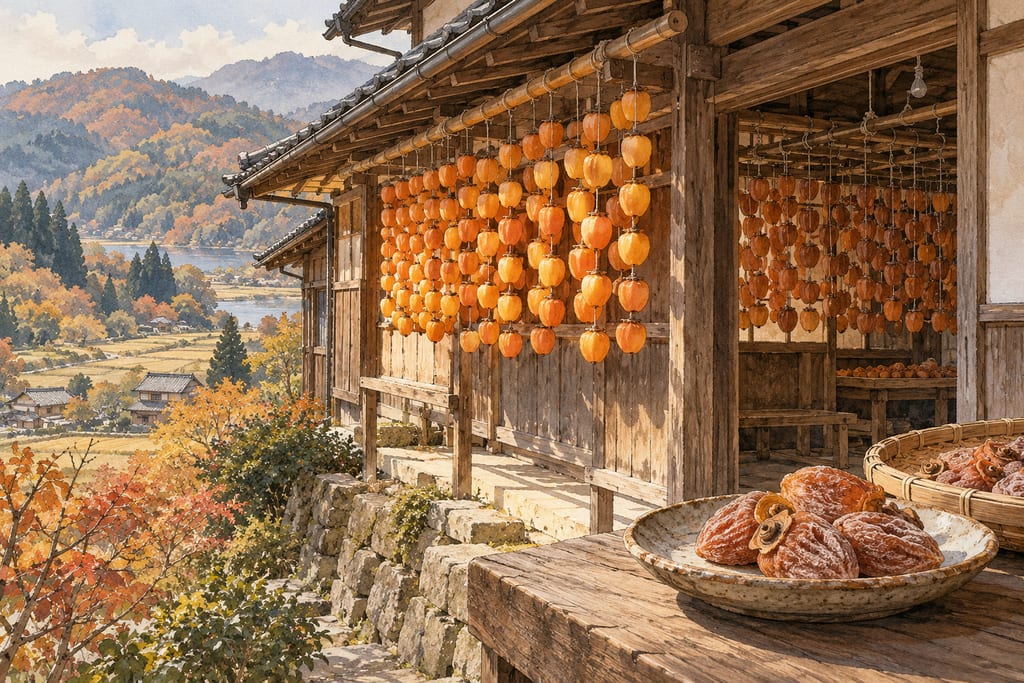
A wooden hut attached to a house in Shimane Prefecture, Japan, where persimmons are hung in the sun and wind and then dried indoors for hoshigaki.
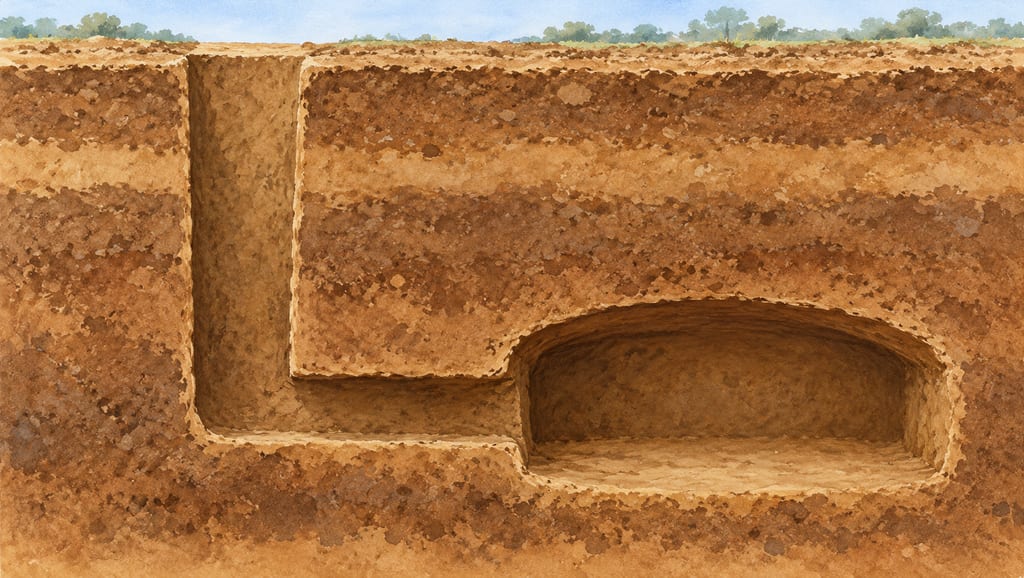
A source-bounded account of Edo’s subterranean kōji chambers: shafts led through narrow passages to low rooms cut into Kantō loam for cultivating kōji. Excavated examples vary by site.
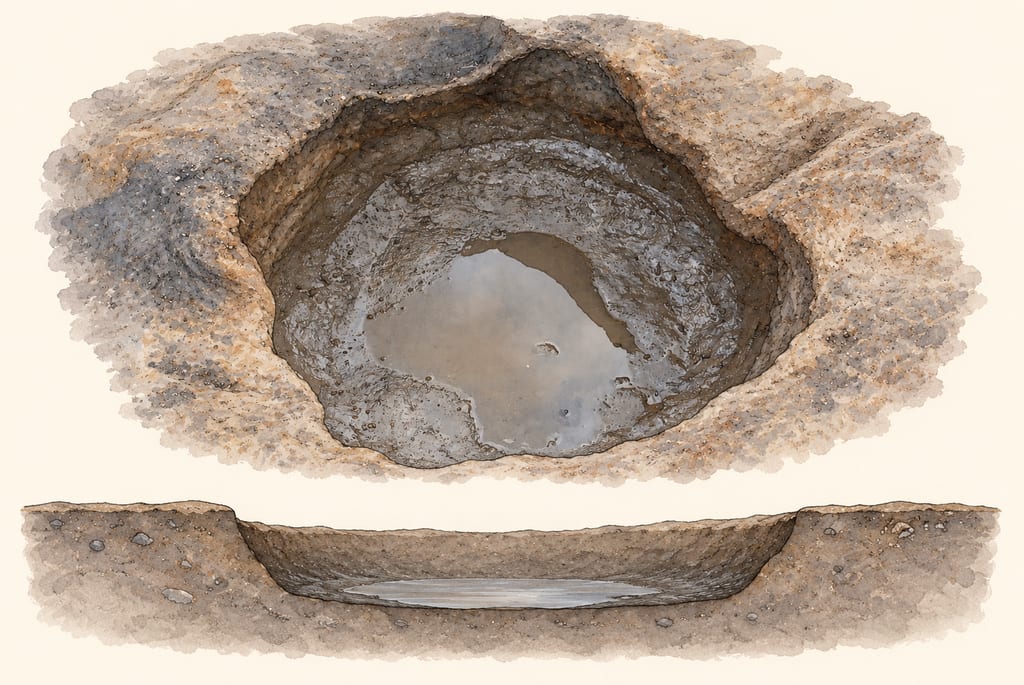
At Maeda Site in Aira, southern Kyushu, a late Middle Jōmon wetland held 72 pits associated with more than 100,000 acorns. The pits were dug in a groundwater-fed valley; their use may have included storage or soaking and sorting.
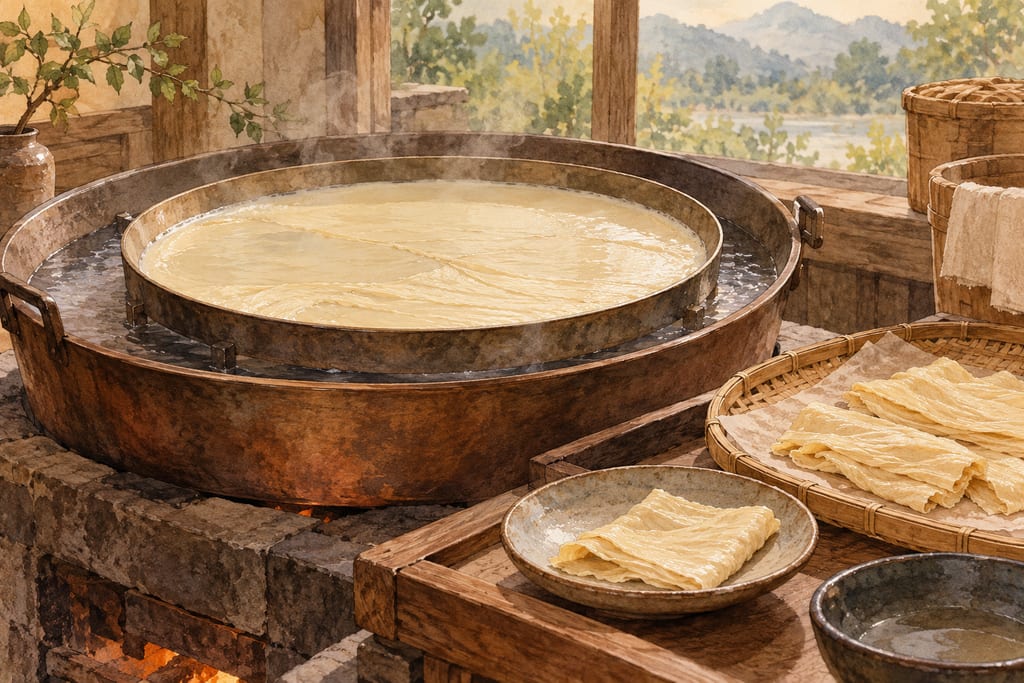
A wide shallow pan of soy milk standing in a controlled hot-water bath, so that the bath heats evenly while the open surface forms film after film of yuba.
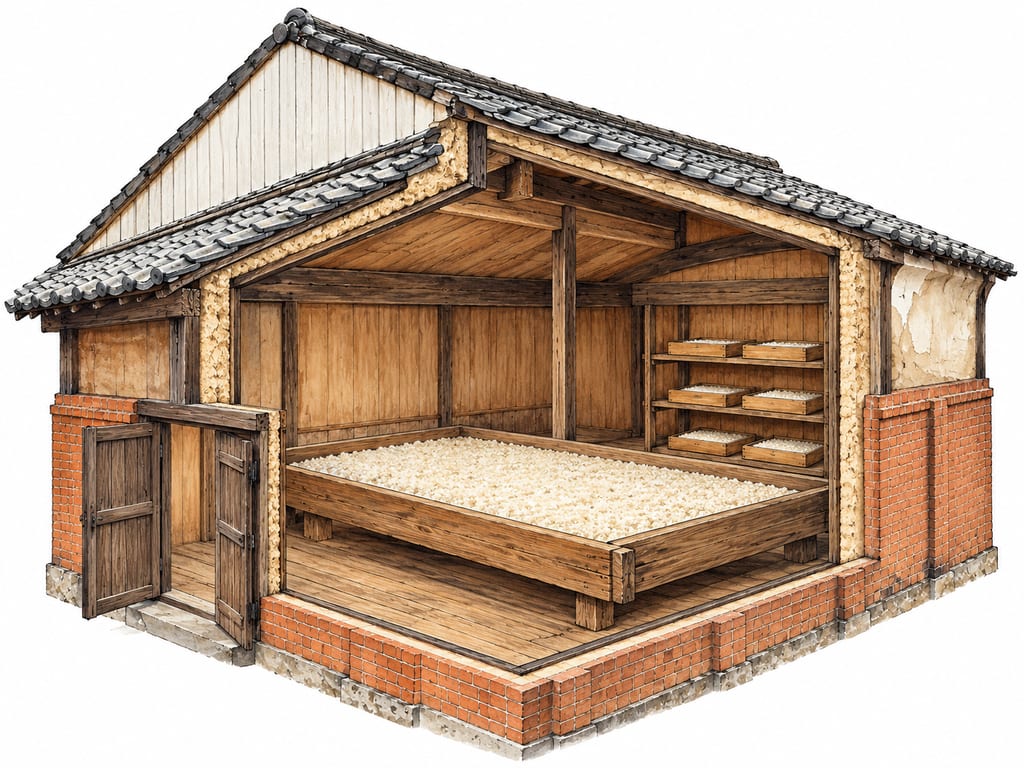
A Japanese koji-making work area may combine a broad toko bed, tana shelves for trays and an insulated koji-muro room. The terms describe distinct scales; sources document more than one working arrangement.

At North Abydos in Egypt, a fixed early Dynastic brewery comprised parallel semi-subterranean installations with rows of ceramic mash vats; excavation reports revise their number, scale and estimated batch capacity.

Ají amarillo is the orange-yellow Peruvian chilli cultivar group of Capsicum baccatum, used to colour and season huancaína sauce and ají de gallina. Published heat estimates do not establish one range for the named cultivar.

Toasted almonds are whole sweet almond kernels dry-roasted until golden to brown. Heat replaces their marzipan note with a roasted, nutty one; they thicken and flavour romesco.

Kodiak salmon, halibut and cod cut as seg'aq and hung on an initaq rack to become tamuuq, with kac'amaasaq and kupcuunaq named as different results.

Aniseed is the dried ripe fruit of Pimpinella anisum, an aromatic Apiaceae spice commonly called a seed. It adds a sweet, warm aroma to breads such as Moroccan krachel and South African mosbolletjies, and is distinct from star anise.

A fixed Late Chalcolithic installation in Areni-1 cave combined a shallow clay pressing basin with a large jar set into the cave floor and storage vessels nearby.

Ripe avocado flesh is the soft, buttery, fat-rich pulp of Persea americana, eaten raw. It is low in acid, so it is a fresh ingredient that needs care in chilled dishes.

A portable dome and pan used over a hearth, with embers on the lid and heat from below. Regional peka and saç forms share this principle while differing in materials, pan shape and how the food is cooked.
No community contributions have been published for this entry yet.
Sign in to contribute. Published comments and photos are free to read.
Saga CityUse · Basket · History
Higashimyo Site: From Jōmon life to today and the future (東名遺跡)Saga City dates the site to about 8,000 years ago and describes preservation of wooden tools, bones and nuts.
The city says more than 700 woven baskets were found and describes the proposed use of digging holes, placing acorns or other nuts in them, and soaking them in water.
The city page explicitly presents basket use and soaking as an interpretation rather than a directly observed procedure.
Cited in: A wetland storage zone; A proposed basket-and-pit use; Storage, not established fermentation
Agency for Cultural Affairs, National Cultural Properties DatabaseGeography · Structure · History · Archaeology
Higashimyo Site (東名遺跡)The national registry locates the site in Saga City, Saga Prefecture and identifies it as the final phase of the Early Jōmon.
The site dates to about 7,000 years ago, approximately 8,000 years calibrated.
The lowland at roughly -2 to -3 metres contains a group of 155 storage pits.
More than 700 woven baskets were recovered from the pit group.
The detailed site description characterizes storage pits as round, approximately 1 m deep and 40–70 cm in diameter.
Cited in: A wetland storage zone; A proposed basket-and-pit use; Storage, not established fermentation
Saga CityGeography
Higashimyo Jōmon Museum (Higashimyo Site) visitor informationSaga City gives the site and museum location as Kinryu-cho, Chifu, Saga City, within the Kosegawa reservoir.
OpenStreetMap contributorsGeography
Higashimyo Site — mapped archaeological siteSite reference latitude 33.294179, longitude 130.3087272. Reference point for OpenStreetMap archaeological-site feature 567791406, named Higashimyo Site. Locates the mapped site extent, not a separately surveyed storage pit; the feature cites Saga Prefecture's heritage record.