A waterlogged valley of pits
Maeda Site lies south of Sumiyoshi Pond in Aira City, Kagoshima Prefecture. Excavations in 2019 and 2020 identified remains from several periods; the feature group described here belongs to the Late Middle Jōmon, about 4,500 years ago. On the western side of the settlement hill, a shallow valley held a waterlogged wetland and 72 pits associated with acorns.
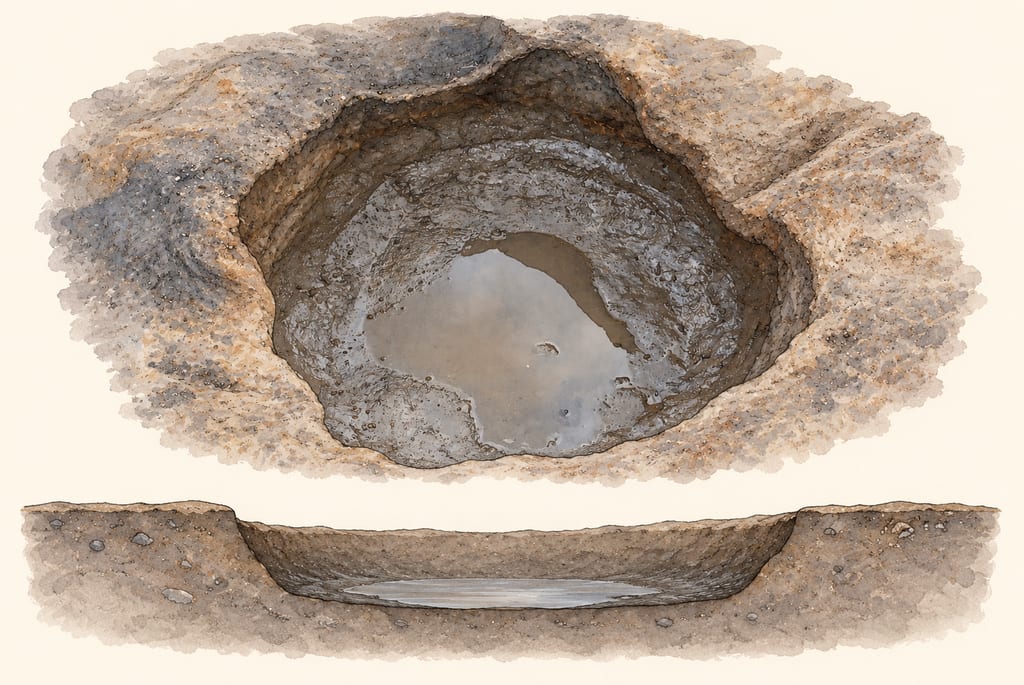
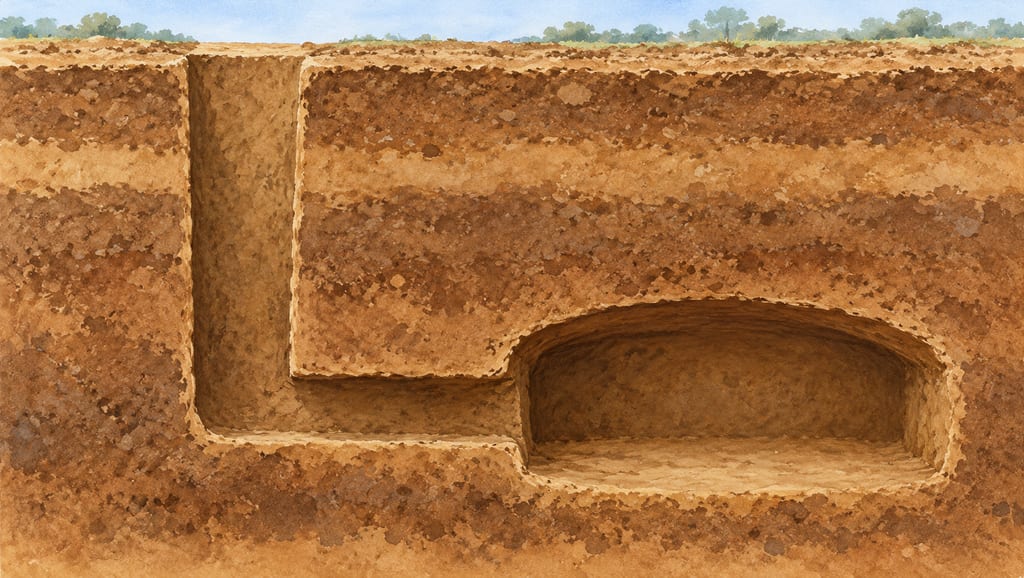
The site’s wet conditions help explain why plant remains survived: Aira City reports that water seeped continually into the pits and returned within roughly a day after pumping. The Archaeological Association describes the pit group as dug into hard gray Yonemaru tephra. It reports a valley roughly 5.6–12 metres across at the upper end and about one metre deep; these are measurements of the landform, not of each pit.
Sources for this section
Acorns, baskets, and uncertain handling
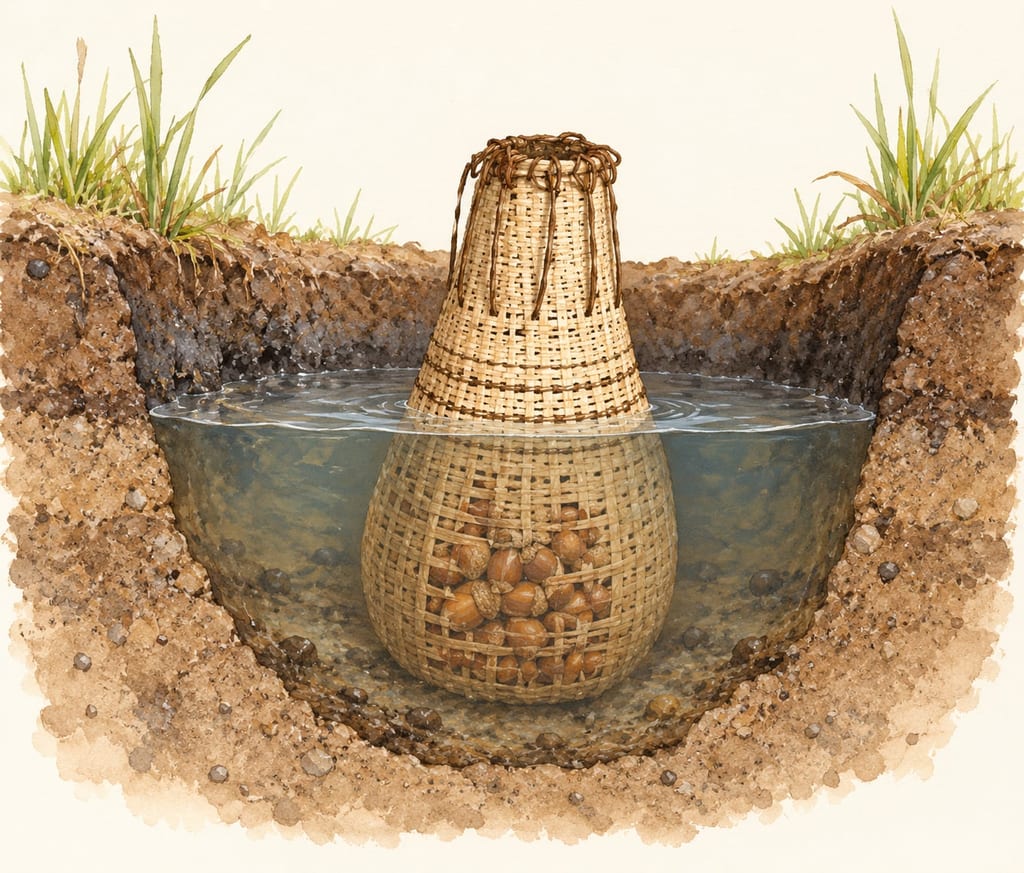
More than 100,000 acorns were recovered across the wetland, with over 99% identified as Quercus gilva (Ichii-gashi). The archaeological interpretation is that acorns were stored in pits. Aira City lists possible purposes such as storage, protecting against insect damage, or floating out light insect-damaged nuts; the Archaeological Association also presents soaking and flotation as possibilities. Those functions are interpretations, not demonstrated recipes or proof that every pit was used the same way.
Fourteen woven baskets were recovered in pit contexts, and their exact role is unresolved. One reported pit, SK117, was about 98 centimetres in diameter and 22 centimetres deep; that measurement should not be treated as the standard shape for all 72 pits. The evidence describes a wetland installation rather than an enclosed fermentation vessel.
Sources for this section
What the evidence does not show
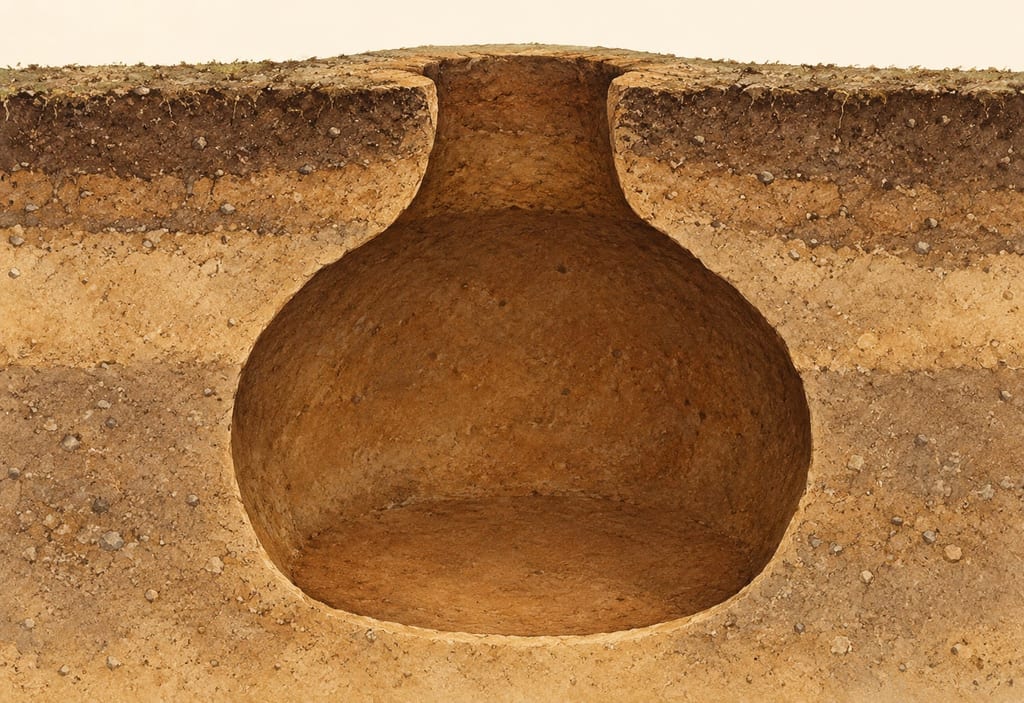
The sources do not establish a uniform profile, a lining material, a lid, the use of a basket in each pit, or a fermentation process. The waterlogged context is documented, but it is not proof that the acorns were intentionally fermented. This page keeps the site-specific storage interpretation and the proposed soaking or sorting function distinct.
Sources for this section
History
The Aira City cultural-property account identifies 72 late Middle Jōmon pits in the low wetland at Maeda Site and notes waterlogged preservation of plant remains. The Japanese Archaeological Association’s report dates the group to about 4,500 years ago based on pottery and describes possible acorn storage or soaking/flotation sorting.
Site
SettingA shallow valley-shaped wetland west of the hill settlement, south of Sumiyoshi Pond, with groundwater seepage.
GroundPits were dug into gray Yonemaru tephra; Aira City describes continuous water seepage and waterlogged preservation. No added lining is documented.
ClimateNot specified in the pit evidence.
FootprintThe lowland valley was about 5.6–12 metres across at its upper end and approximately 1 metre deep; SK117 was about 98 cm in diameter and 22 cm deep. These are distinct measurements and not a standard pit design.
NotesThe archaeological association groups 72 acorn pits; the sources do not establish that all had the same dimensions, profile, basket use, or contents.
A build is made where it stands: moving it means building it again.
How it is built
Risks and precautions
Archaeological description only; the cited excavation accounts provide no construction, soil-stability, or safe-access guidance.
Materials
- Ground in the low wetland — The 72 pits were dug in the valley-shaped lowland and into hard tephra; the sources do not identify an added lining.
- Acorns, predominantly Quercus gilva — More than 100,000 acorns were recovered. Their storage in pits is supported; proposed soaking and flotation sorting are possible interpretations.
- Woven baskets — Fourteen baskets were recovered from pits; their exact role is uncertain.
- At the Maeda Site, a low wetland west of the hill settlement contained a group of 72 pits in a shallow valley with groundwater seepage.
- The valley is approximately 5.6–12 metres wide at its upper end and about one metre deep; these measurements describe the landform, not an individual pit.
- More than 100,000 acorns were found across the lowland, over 99% identified as Quercus gilva. The pits are interpreted as acorn storage features; possible soaking and sorting functions remain hypotheses.
- Fourteen woven baskets were recovered in pit contexts, but their exact use is unresolved. The evidence does not establish a standard pit shape, lining, cover, or a basket in every pit.
Places
Maeda Site, Aira City
Historical attestation · Locality evidenceAira City locates the site south of Sumiyoshi Pond; its linked map pin provides the site coordinates. This dates the pit group context, not every pit.