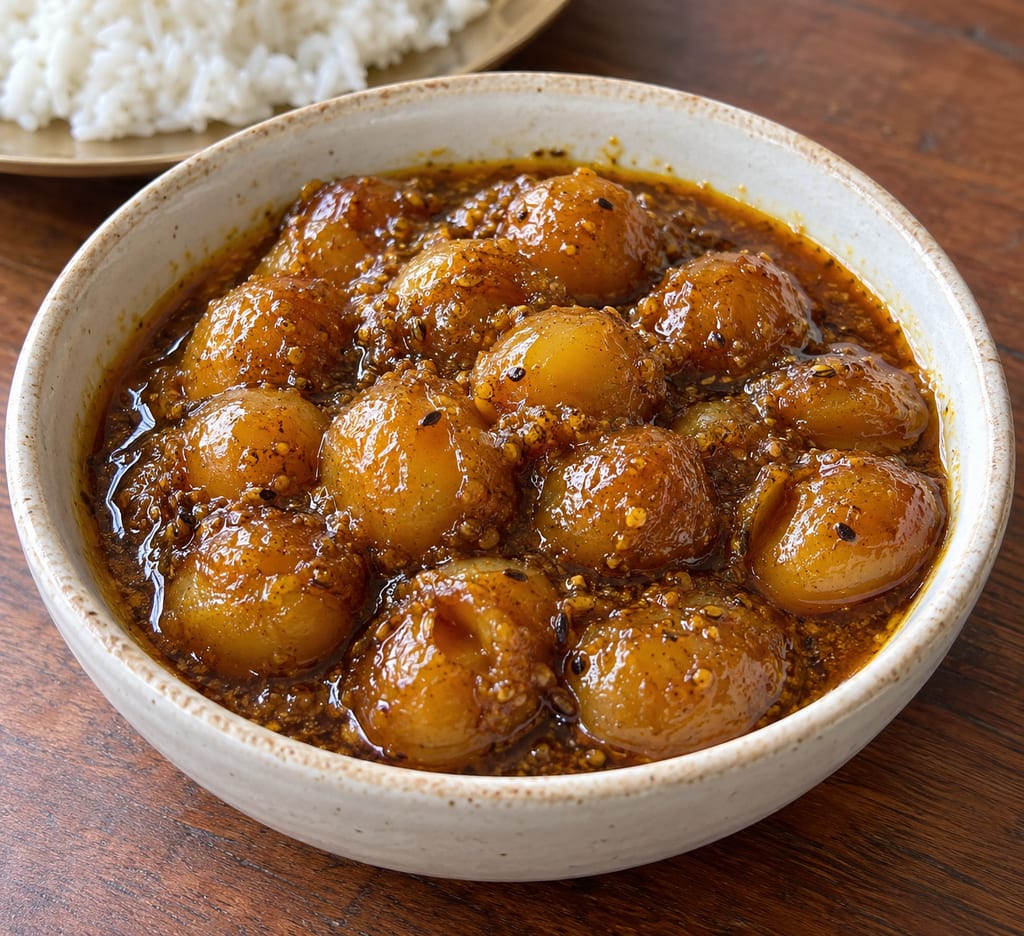
Lapsi ko achar with mustard oil
Ripe Nepali lapsi is boiled, peeled and cooked with mustard oil, salt, sugar and roasted spices to make a sweet-sour achar served alongside a meal.
 FermenteaWhere food goes to change
Fat or oil
Mustard oil is an aromatic pressed seed oil used to cook and season foods such as Nepali achar. Its seed and pressing method vary with the product.
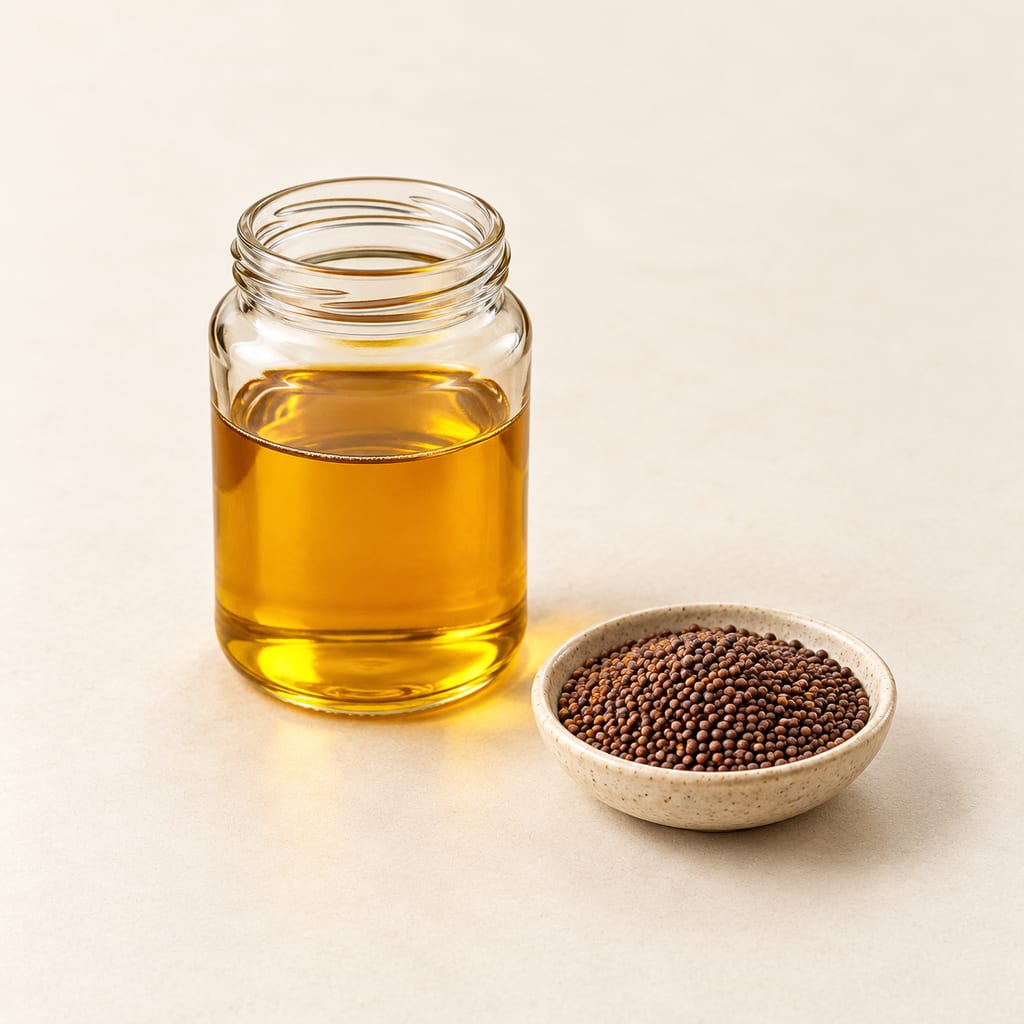
Mustard oil is one of those ingredients whose name appears simpler than the bottle. It can mean a seed-pressed cooking oil, a pungent volatile flavoring distilled from mustard, or a product intended for topical use. In the Nepali cooking contexts and Indian standards discussed here, mustard oil commonly means expressed oil: liquid fat pressed from mustard-family seeds, used for its savory aroma as well as for frying, seasoning and pickling. Its color varies with seed and process; its defining culinary character is a penetrating pungency, direct when raw and rounder after heating.
The name alone does not identify a single species or style. Indian food standards encompass oil from several *Brassica* groups, while botanical and food-science writing also distinguishes brown mustard (*Brassica juncea*), black mustard (*B. nigra*) and white or yellow mustard (*Sinapis alba*). These plants are related, but they are not interchangeable labels for a particular bottle. Neither “tori ko tel” in a Nepali account nor “mustard oil” in a recipe supplies the seed’s Latin name. For Nirmala’s lapsi achar, the exact seed species, origin and pressing method remain unknown.
In Kathmandu Valley communities, roasted mustard oil has long been both a kitchen staple and a neighborhood trade. Newar and Manandhar mill families in Basantapur and Khokana pressed seed close to the households that cooked with it. Imported vegetable oils, urban change and mechanized production have since made that local work harder to sustain. The smell of the mill and the taste of its oil remain part of how customers remember the food they grew up eating.
The contrast between a local press and a factory bottle can be sensory as well as economic. Customers describe local mill oil as more aromatic than shop oil. At a Khokana cooperative, workers first crush mustard seed, roast it on a cast-iron plate above a wood fire, then feed it into a press. The roasting stage there lasts about 30 minutes. Pressing leaves a firm cake called *peena*, which the mill sells for animal feed or fertilizer. Elsewhere in the Valley, older mills used large wooden presses; contemporary mills may use imported machinery. Local harvests no longer supply every mill, and imported seed now sits alongside seed reserved for occasions such as Dashain.
That process gives mustard oil a story partly about technique and partly about who owns the work. Small mills transformed a crop into kitchen oil close to where people lived, while press cake returned value to animals or fields. Modern machinery changes throughput and extraction practices; the wider market changes which mills can survive. “Traditional” therefore names particular living techniques and institutions, not one frozen recipe with a single origin date.
The process also changes the oil before a cook ever pours it into a pan. Crushed seed roasted over fire before pressing makes a different starting material from the seed a Uttar Pradesh producer says it presses below 40°C, settles and bottles the same day. At the Khokana mill, roasting can bring a deeper toasted note to the finished cooking fat, though the precise flavor depends on the seed and process. In tested high-erucic mustard seed from Nepal, roasting formed canolol, a phenolic compound, and some moved into extracted oil. That chemical finding explains part of what seed heating changes; it does not give a sensory score to the Khokana oil.
In 2019 Basantapur, only three of the ten remembered mustard-oil mills were still operating. A Khokana cooperative manager recalled four community mills twenty to thirty years earlier and two then. These closures were felt in the kitchen as well as in the workshop: a household wanting that freshly roasted, locally pressed oil had fewer places to get it. The numbers belong to the 2019 reporting moment. The living point is how a familiar taste depends on the people and machinery that keep pressing seed nearby.
The pressed oil is the seed’s fixed oil: mainly triglyceride fat released by mechanical pressure or other extraction. Seeds may be cleaned, crushed, roasted or otherwise prepared before pressing. Khokana's crushing and roasting are one route to that fat; other seed preparation and extraction routes yield oils with different aroma and appearance. India's FSSAI distinguishes expressed oil from solvent-extracted oil in its food standard. Cold-pressed or *kachi ghani* labels describe processing, not botanical species. FSSAI’s 2021 compendium permits those labels when the oil has at least 0.20% natural allyl isothiocyanate by weight.
There is another product that can be called mustard oil: essential or volatile mustard oil. It is not a bottle of the same culinary fat made more pungent. In mustard seed, glucosinolates are sulfur-containing compounds stored with the enzyme myrosinase. When seed tissue is broken and meets water, myrosinase can convert particular glucosinolates into pungent breakdown products. In brown mustard, sinigrin can yield allyl isothiocyanate (AITC), the sharp, volatile compound associated with mustard’s nose-clearing bite. Essential flavoring can be produced through aqueous processing and steam distillation; the United States FDA explicitly distinguishes this from expressed mustard oil used for cooking.
That distinction helps explain why mustard seed, mustard paste and mustard oil do not taste identical. A ground seed mixed with water enables an enzyme reaction that develops pungency. A seed-pressed oil is principally fat and may retain pungent aroma compounds, especially in characteristic unrefined styles, but the behavior of prepared mustard paste cannot simply be assigned to every oil. Brown and black mustards tend to give more intense, persistent pungency than white mustard in mustard products, yet seed and process both matter. Prepared mustard condiments can seem sharper or softer even at similar measured AITC levels because the surrounding food changes perception. That sensory result helps explain the condiment, while the seed source and pressing style remain better clues to the cooking oil in a bottle.
Heat enters mustard-oil cookery at different stages. Khokana mills roast crushed seed before pressing; Nirmala warms finished oil with fenugreek and turmeric before adding cooked lapsi. The first step shapes the pressed ingredient, while the second lets hot fat take up spice aroma and carry it into the sweet-sour fruit. In the Nepal Tourism Board’s chhoyela recipe, some mustard oil dresses the cooled meat directly and another portion carries a hot spice tempering. The choice of when to add the oil therefore matters within a dish, as well as at the mill.
Mustard oil can be cooking medium, seasoning, or both. When used to fry or sauté, it carries fat-soluble flavors from spices into the surrounding food and contributes its own pungent, sometimes toasted note. Its force makes it useful in amounts where a neutral oil might disappear. Some preparations heat the oil first; whole spices sizzle in it, releasing aroma into the fat before vegetables, meat or fruit are added. Other cooks mix it raw into chopped ingredients or a pickle, where its pungency stays more immediate. Timing and heat let the same ingredient produce different sensory effects.
Nirmala’s 2016 lapsi achar shows mustard oil as one part of a cooked, sweet-sour condiment. The author remembers tasting the pickle in Bhadaure village near Pokhara and later making her own version in Kathmandu. In her method, mustard oil first carries fenugreek and turmeric; cooked lapsi, sugar, salt and roasted ground spices then make the condiment. The oil gives soft fruit an assertive savory aroma, while ripe fruit and sugar balance its sourness. The cooked mixture is spooned into jars and eaten as a condiment. The author does not identify the seed variety or pressing style, so the oil's strength may vary with the bottle chosen.
Nepali recipes show how varied that seasoning role can be. In an aloo ko achar recipe printed in Nepali Times in 2002, boiled potatoes are combined with ground sesame, salt, chilli and lemon juice; fenugreek is fried in mustard oil until dark, turmeric is added, and the hot oil is mixed through the potato. Lemon gives a sharp counterpoint, sesame adds nutty body, and tempered oil carries the spice aroma across each piece. The potato and sesame make a heavier, nuttier base than lapsi’s sweet-sour fruit.
The Nepal Tourism Board’s heritage cookbook records another structure in chhoyela: lean buffalo meat is boiled, cooled and cut, then dressed with mustard oil and spices. A second portion of oil is heated with fenugreek, dried chilli and turmeric and poured over the meat, which is served cold. One dish uses oil both in the dressing and in a final hot tempering; mustard oil remains prominent even after the meat has cooled. The cookbook locates the name in Newari and notes the preparation’s association with Kathmandu Valley, while also documenting its wider circulation. The cooled meat keeps the oil's aroma present even after the hot tempering has passed.
A 2016 Khokana feature adds a family and festival register: writer Srizu Bajracharya recalls tori-ko-tel in hakku chhoela and kachhila eaten during Nakhatyas, and describes the oil’s aroma as a childhood memory. The article reports that Newars seek the oil for greens, wah, baara, choela and kachhila. Those memories and dishes show several ways to bring out the oil: raw dressing, hot tempering and oil used during cooking are separate choices. Across them, mustard oil is not a generic badge of “Nepali taste”; it is a specific aromatic fat whose timing and amount change the dish.
When buying mustard oil for food, first establish what the product actually is. Look for an explicit food-use identity and a label that makes clear whether it is expressed culinary oil, distilled flavoring, a blend or a product marked for external use. If the package does not disclose species, seed origin, extraction or refinement, those attributes remain unknown. A dark, roasted aroma may fit a Khokana-style oil; a brighter raw pungency may fit another process. Neither appearance nor pungency can certify botanical identity or composition.
Like other edible oils, mustard oil’s quality changes with exposure to light, air and heat. Sunlight can hasten oxidation and dull the flavor of stored mustard oil. For everyday quality, keep the cap closed and the bottle away from direct sun and hot storage areas; use the product within the time recommended on its label. These practices protect flavor; the product label is the appropriate guide to its storage period.
Legal status is local, not universal. The U.S. FDA’s 2026 import alert concerns expressed mustard oil and explains that it may contain high erucic acid; the agency treats expressed cooking oil differently from steam-distilled mustard flavoring used as a food flavor under specified conditions. The alert is guidance for FDA field personnel and applies to imports and regulatory handling in the United States. It should not be paraphrased as a global ban or a finding that every mustard oil in every market is unsafe. India’s FSSAI defines expressed mustard oil and a separate low-erucic-acid category; its cited 2021 compendium gives the low-erucic category a maximum of 2% erucic acid as a proportion of total fatty acids. Food-use requirements differ by market, so a bottle's local labeling and intended use matter.
Mustard oil comes from mustard-family seed, but the word “oil” alone does not reveal the precise seed or processing. Readers who avoid mustard should check the food label and the requirements where they live.
Mustard oil rewards attention to its particular bottle and its place in a dish. Its aroma may be sharp, warm, grassy, toasted or penetrating depending on seed and method. Heat can temper that first impression; a raw addition can keep it vivid. In lapsi achar it supports roasted spices and balances the fruit’s sweet-sour flesh, while the fruit, sugar, salt and cooking water—not the oil alone—shape the condiment. Knowing what the ingredient can do is useful; knowing what the label and recipe do not say is part of cooking with it well.
mustard
Documents Khokana and Basantapur mills and kitchen use in the Valley; does not establish the seed source for every mustard oil.
Ripe Nepali lapsi is boiled, peeled and cooked with mustard oil, salt, sugar and roasted spices to make a sweet-sour achar served alongside a meal.
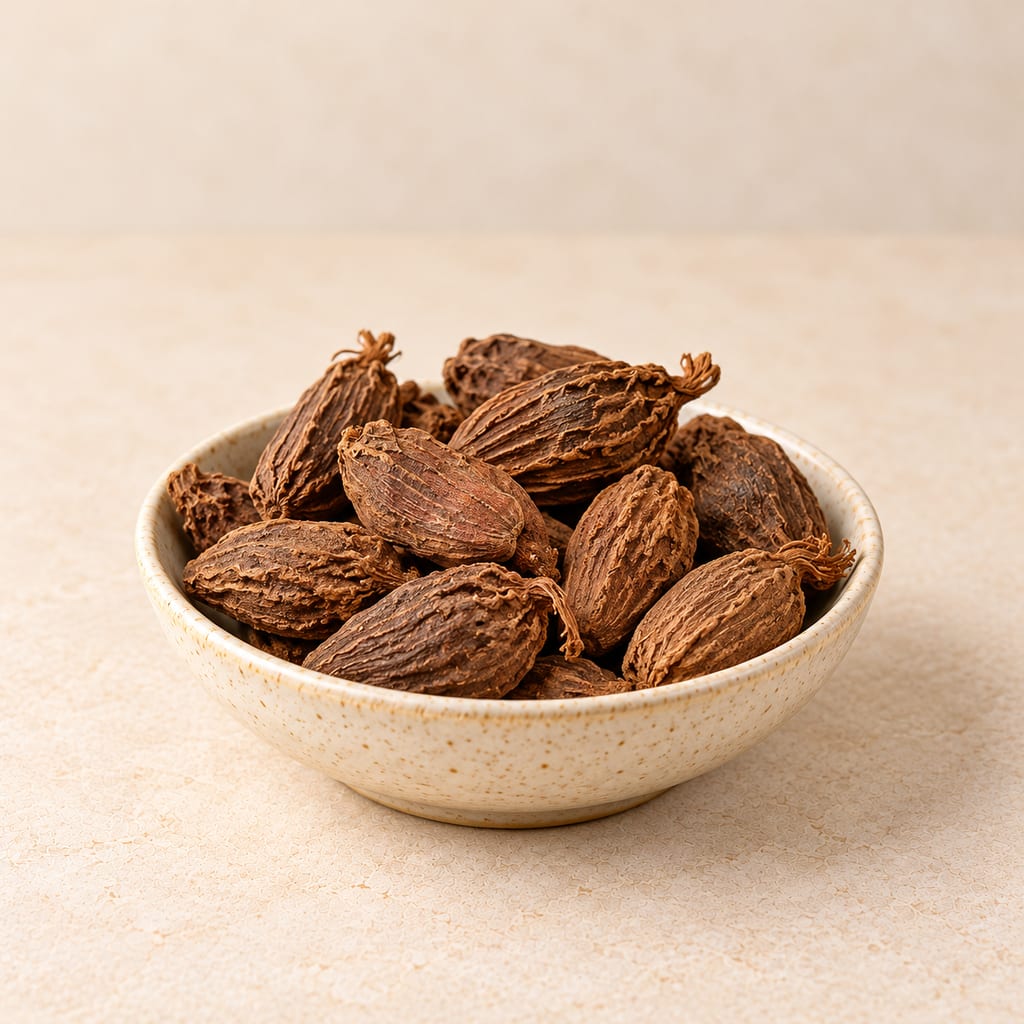
Alainchi is the large or black cardamom of the eastern Himalaya, the dark, smoke-dried pods of Amomum subulatum. Its camphor-cool, smoky seeds season Himalayan and North Indian cooking and a sweet Nepali lapsi achar.
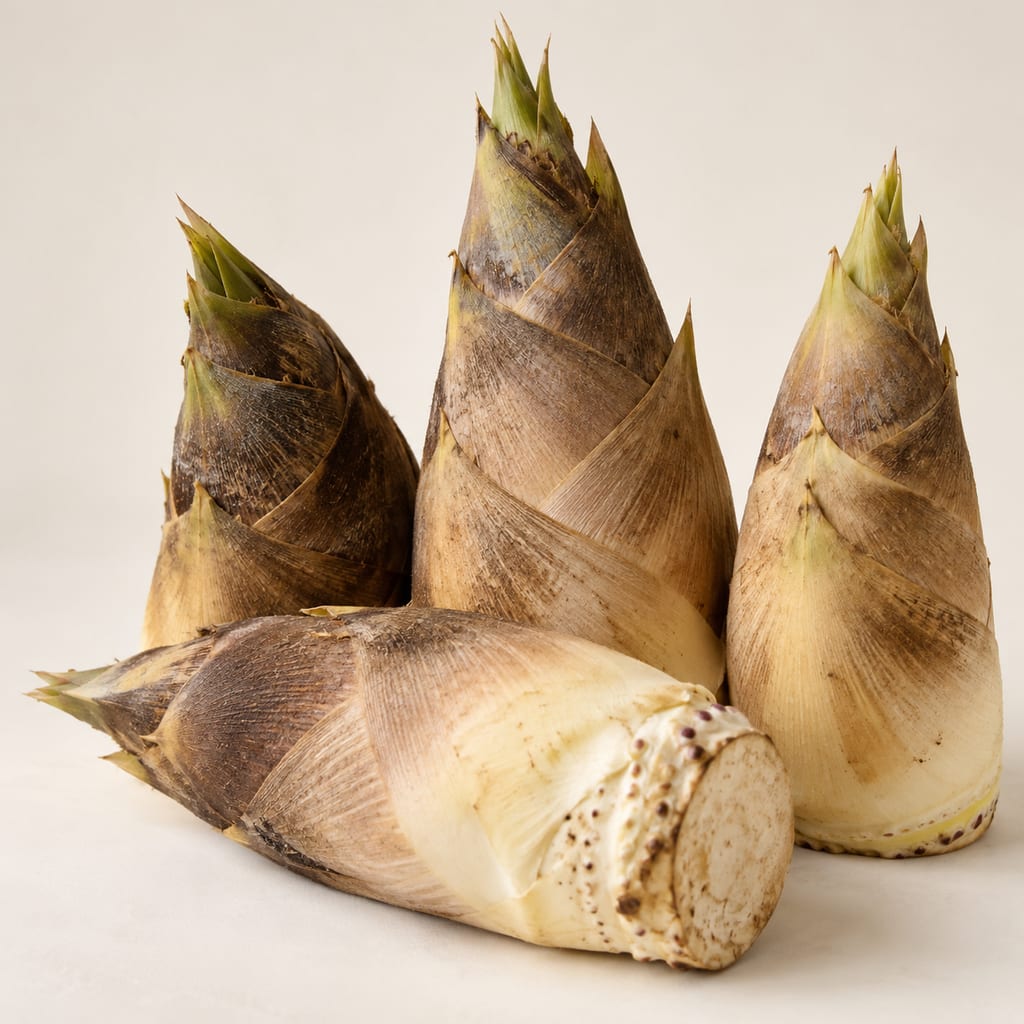
Bamboo shoots are the young culms of many bamboo species, eaten after boiling or leaching in Asia, and fermented into sour and preserved foods in the Himalayas, northeast India and Burma.
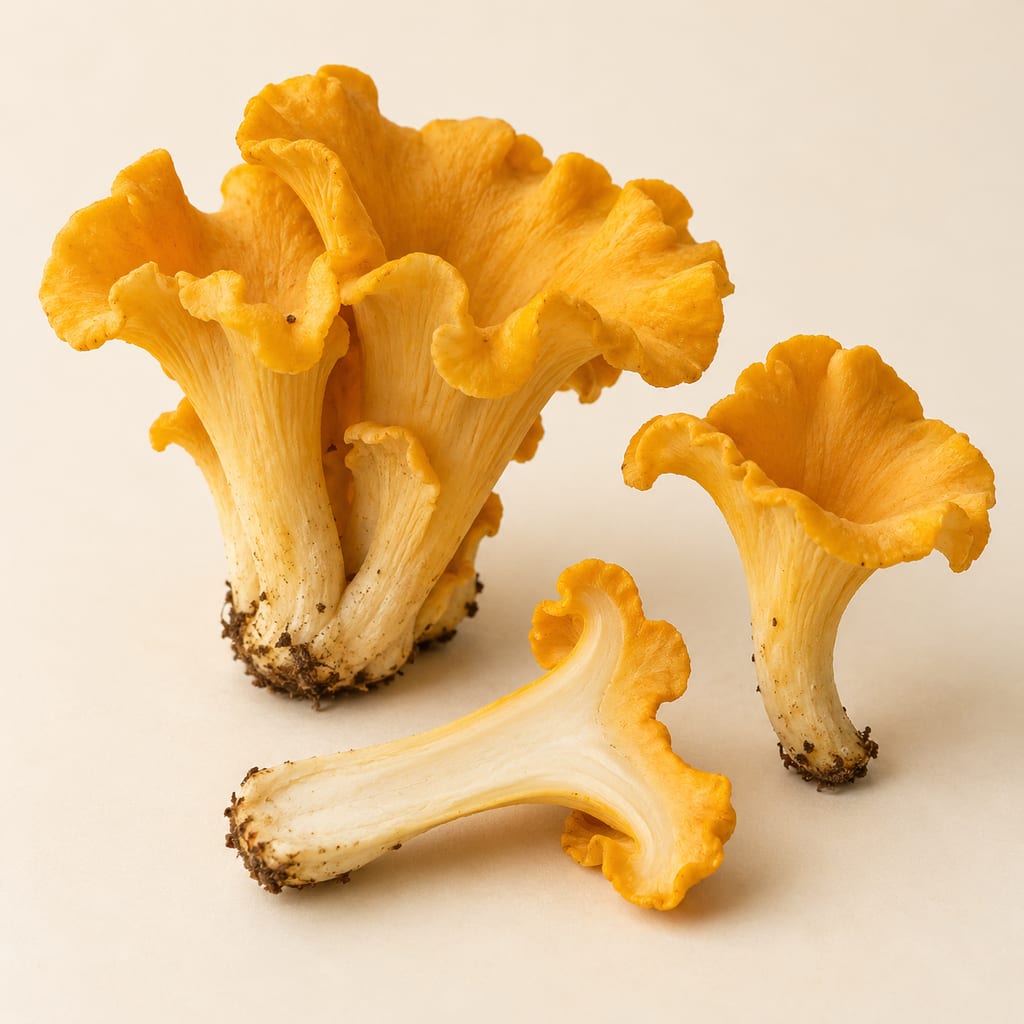
Cantharellus odoratus, the fragrant chanterelle, is a North American and Central American oak-woodland fungus. It was sold in a Veracruz market in the 1980s and in Guatemala in 2002, and its name is still disputed.
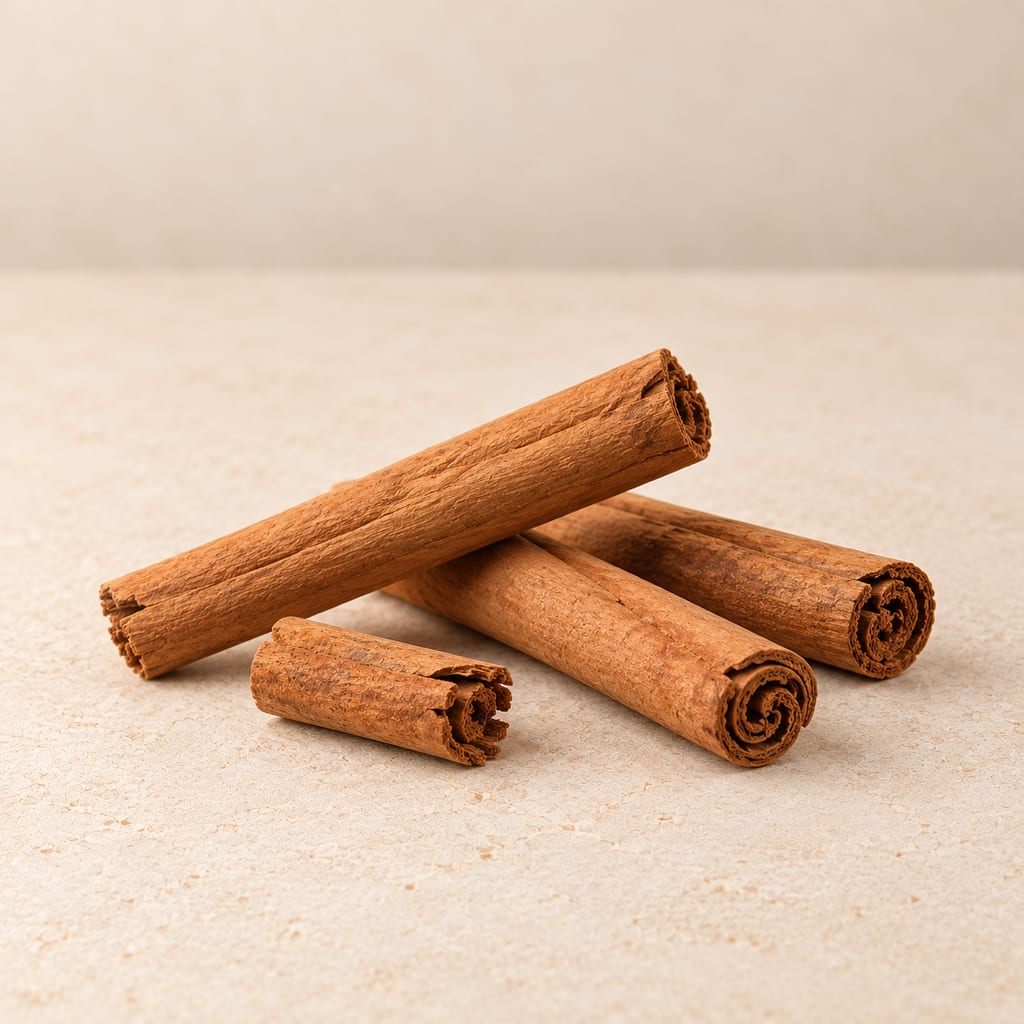
Cinnamon is the dried inner bark of Cinnamomum trees, rolled into quills or ground; Ceylon cinnamon comes from C. verum of Sri Lanka and cassia from related species.
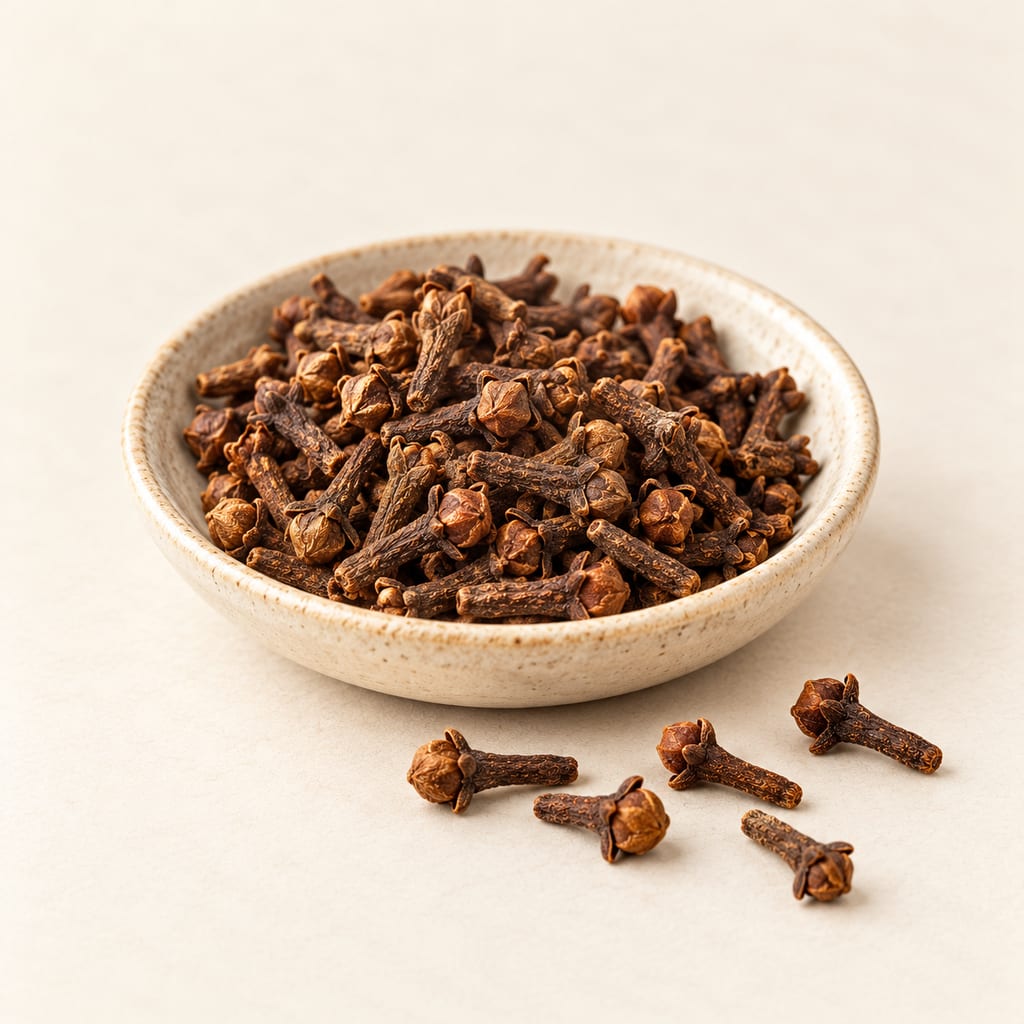
Cloves are the dried unopened flower buds of Syzygium aromaticum. Whole buds infuse liquids and can be removed; ground clove disperses its intense aroma through food.
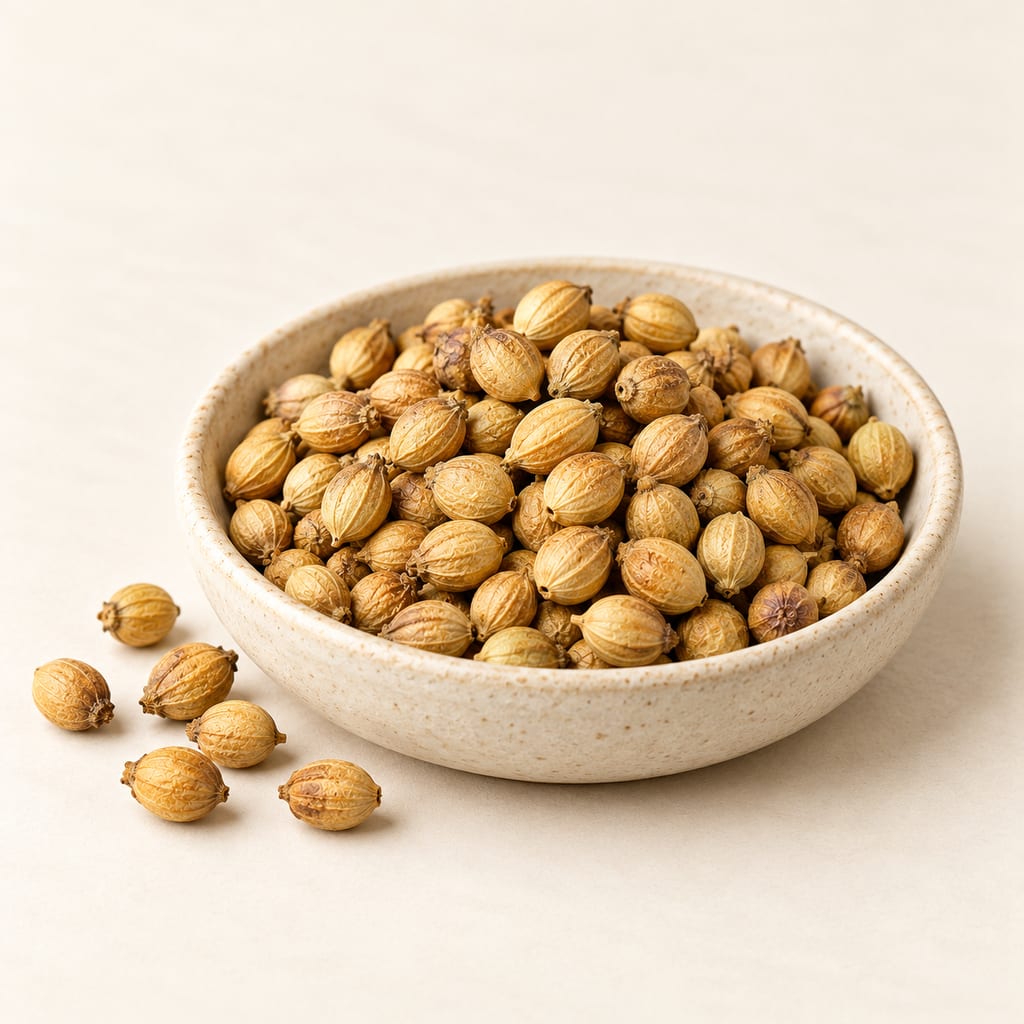
Coriander seed is the dried, aromatic fruit of Coriandrum sativum, used whole, cracked or ground in spice blends, pickles and cooked dishes.
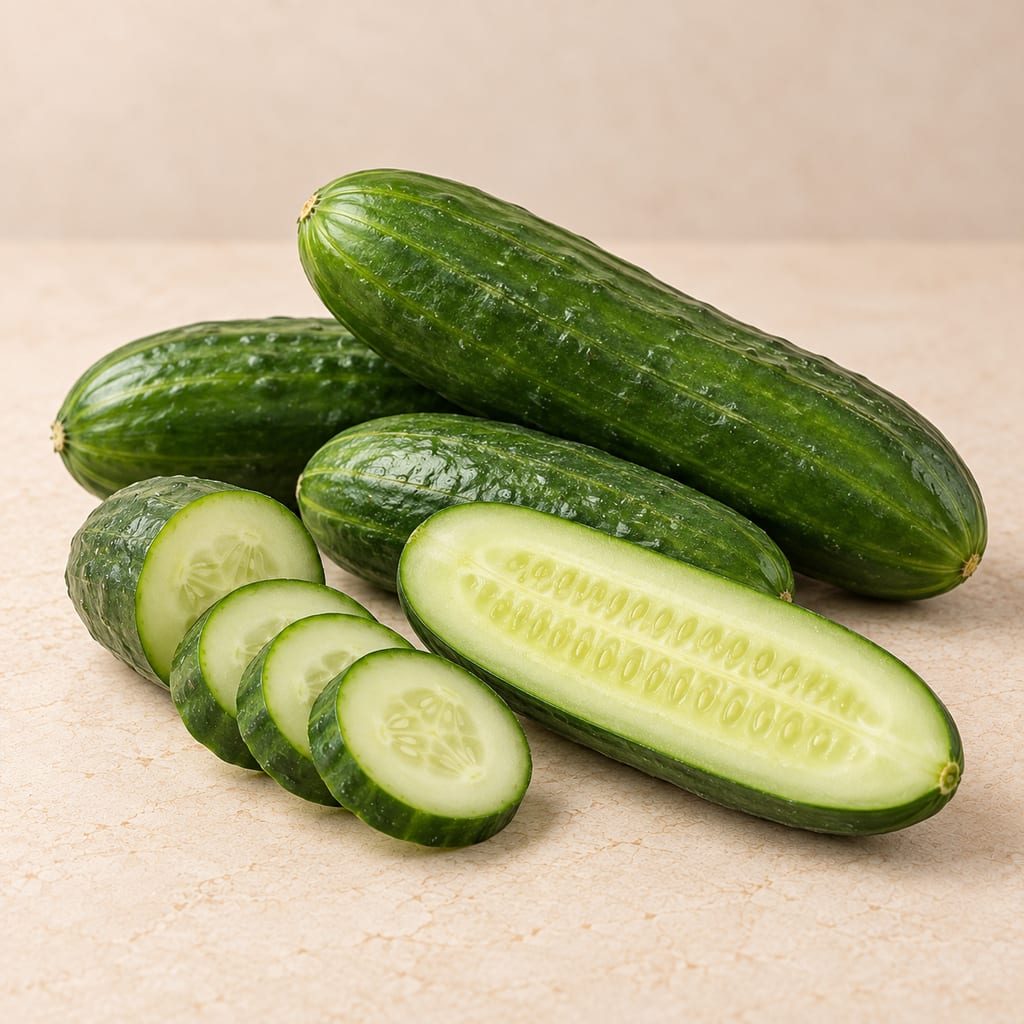
Cucumber is the watery fruit of Cucumis sativus, domesticated in India, and the classic raw material of brine pickles from New York dills to Nepali khalpi and Korean oi-sobagi.
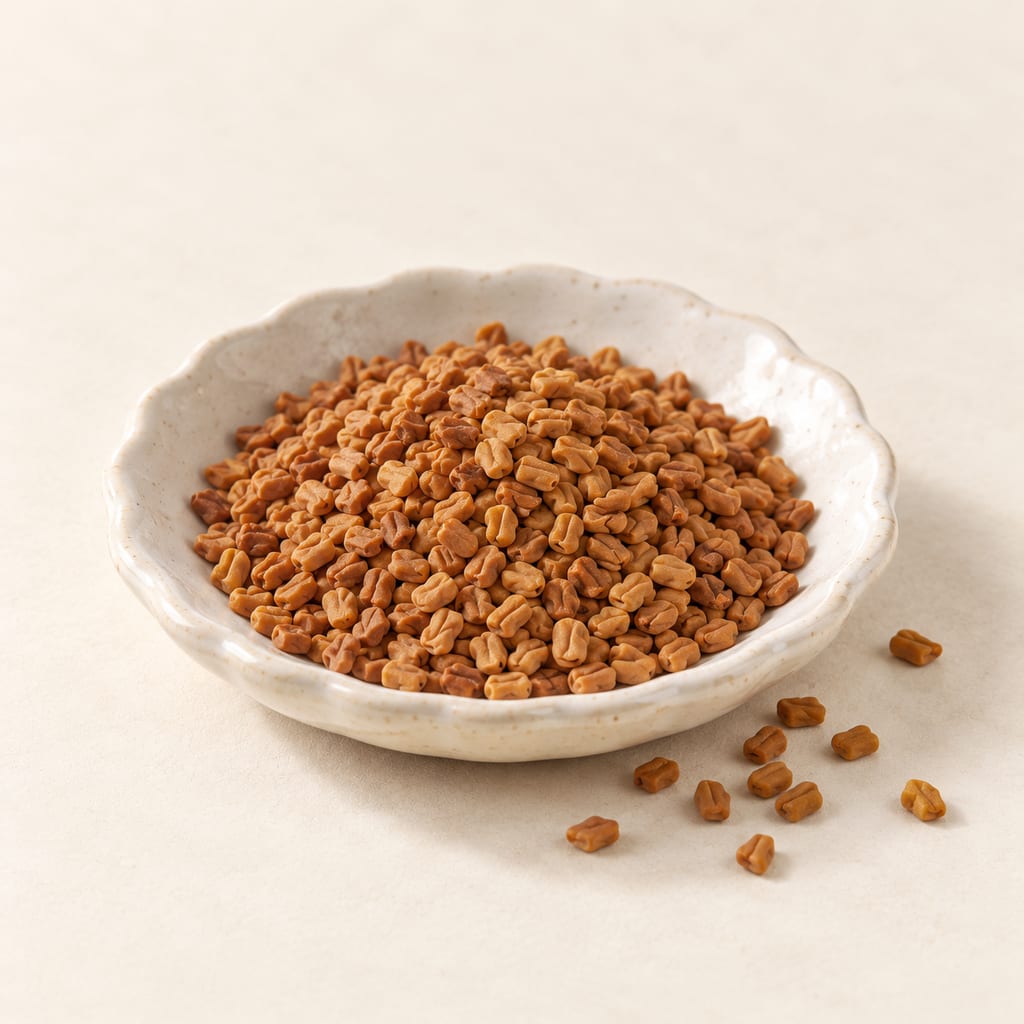
Fenugreek seed is the bitter, fragrant dry seed of Trigonella foenum-graecum, used in tempering, pickles, breads and spice mixtures.
No community contributions have been published for this entry yet.
Sign in to contribute. Published comments and photos are free to read.
Food Safety and Standards Authority of IndiaIdentity · Processing · Safety
Food Safety and Standards (Food Products Standards and Food Additives) Regulations, 2011: Compendium, Version XVIPages 97–98 define expressed mustard oil and a separate low-erucic category; set a maximum of 2% erucic acid for that category; and state the Kachi Ghani/cold-pressed label condition of at least 0.20% natural AITC. This 2021 compendium includes amendments; it is not presented as the current consolidated rule.
Cited in: Identity and forms; What pressing makes—and what the name can hide; Choosing and keeping it thoughtfully
Molecules 23(1), 231 (2018); DOI 10.3390/molecules23010231Identity · Science
Brassicaceae Mustards: Traditional and Agronomic Uses in Australia and New ZealandGeneral distinctions among brown, black and white mustards; glucosinolate/myrosinase/AITC chemistry; comparative pungency and effects of water, heat and toasting. General mustard science, not evidence about Nirmala’s bottle.
Cited in: Identity and forms; What pressing makes—and what the name can hide
Nirmala’s DelightCulinary use · Recipe context
How to make Lapsiko Achar (Hog Plum pickle)Dated personal account of tasting lapsi achar in Bhadaure and making a version after returning to Kathmandu; use of mustard oil and a smoke cue in the spice/fruit method. Generic oil identity only; no validated storage process.
Cited in: Identity and forms; What pressing makes—and what the name can hide; Oil in the dish: aroma, heat and achar
The Kathmandu PostHistory · Regional use · Processing
Mustard oil, once king of the kitchen, sees fewer buyersInterview-based account of Kathmandu Valley/Newar and Manandhar mill practices; Khokana seed crushing and roasting, reported 30-minute roast, pressing and peena by-product; local and imported seed and changing mill economy. Not a comprehensive national history.
Cited in: A pressed oil with a place in Nepali kitchens; What pressing makes—and what the name can hide; Oil in the dish: aroma, heat and achar
U.S. Food and Drug AdministrationSafety · Regulation
Import Alert 26-04: Detention Without Physical Examination of Expressed Mustard OilAlert revised 2026-04-15 distinguishes expressed cooking oil from steam-distilled volatile mustard flavoring; explains U.S. import detention scope and erucic-acid rationale. Agency field guidance, not a global ruling.
Cited in: What pressing makes—and what the name can hide; Choosing and keeping it thoughtfully
USP Food Chemicals CodexIdentity · Science
Mustard OilFCC description distinguishes expressed mustard oil from essential oil that forms via aqueous maceration and enzymatic sinigrin hydrolysis. Full source access was limited; verify before relying on exact wording.
Cited in: What pressing makes—and what the name can hide
Journal of Food Science; PubMed record PMID 32844444Science · Flavour
Relationship between mustard pungency and allyl-isothiocyanate content: A comparison of sensory and chemical evaluationsAbstract and metadata describe sensory time-intensity and HPLC AITC measurement, supporting a relationship between AITC concentration and perceived pungency in mustard products; not a study of Nirmala’s oil.
Cited in: What pressing makes—and what the name can hide
Future Postharvest and FoodHandling · Storage quality
Monitoring the Influence of Sunlight on the Oxidative Stability, Color, and Fatty Acid Composition of Sunflower, Sesame, Groundnut, Mustard, and Rice Bran OilsStudy reports sunlight-related oxidative and quality changes in the tested edible oils including mustard oil. Findings do not set a shelf life for every mustard-oil product.
Cited in: Choosing and keeping it thoughtfully
Pennsylvania State University ExtensionHandling · Storage quality
Storing Staple Ingredients in the KitchenGeneral vegetable-oil quality and storage guidance, including protection from heat and light; not mustard-oil-specific and no numeric shelf life transferred into this draft.
Cited in: Choosing and keeping it thoughtfully
Journal of Agricultural and Food Chemistry, 60(30), 7506–7512Processing · Science · Flavour
Isolation and identification of a potent radical scavenger (canolol) from roasted high erucic mustard seed oil from Nepal and its formation during roastingStudy found roasting high-erucic mustard seed forms canolol and that around half of the canolol formed in seed was extracted into oil. Specific experimental finding, not a health claim or universal flavor profile.
Cited in: A pressed oil with a place in Nepali kitchens; What pressing makes—and what the name can hide
USHBHA Sarso Tel (producer)Processing · Flavour
About USHBHA — Our Story; The Kacchi Ghani ProcessProducer describes its own Unnao ghani oil as slow pressed below 40°C, naturally settled and bottled the day pressed; producer account for its product, not a general cold-press standard.
Cited in: A pressed oil with a place in Nepali kitchens; What pressing makes—and what the name can hide
Nepali Times, issue 85, 15–21 March 2002Culinary use · Regional use
PotatoThe publisher's readable article carries the aloo ko achar recipe: boiled potato and sesame dressed with mustard oil in which fenugreek is darkened, followed by turmeric; lemon juice adds sourness.
Cited in: Oil in the dish: aroma, heat and achar
Nepal Tourism Board with Hotel Association of Nepal, Chefs Association of Nepal, and Restaurant and Bar Association of NepalCulinary use · Regional use
Experience Nepal: Globalizing Nepalese Heritage Cuisine Recipe Book (Nepali Heritage Cook Book)The Nepal Tourism Board original PDF's indexed Chhoyela pages list 5 tbsp mustard oil in the buffalo-meat dressing and 2 tbsp in a fenugreek/chilli/turmeric garnish; boiled meat is served cold; Newari name and Kathmandu Valley association are stated. Original PDF search extraction read 2026-10-26; direct fetch timed out.
Cited in: What pressing makes—and what the name can hide; Oil in the dish: aroma, heat and achar
ECS Nepal, Features Issue 177 (August 2016)Regional use · History · Flavour
Khokana’s Famed Tori-ko-telFirst-person feature recalls tori-ko-tel in hakku chhoela and kachhila during Nakhatyas, and reports the oil sought for saag, wah, baara, choela and kachhila; local memory and reported practice, not a national survey.
Cited in: Oil in the dish: aroma, heat and achar
