The dried spice
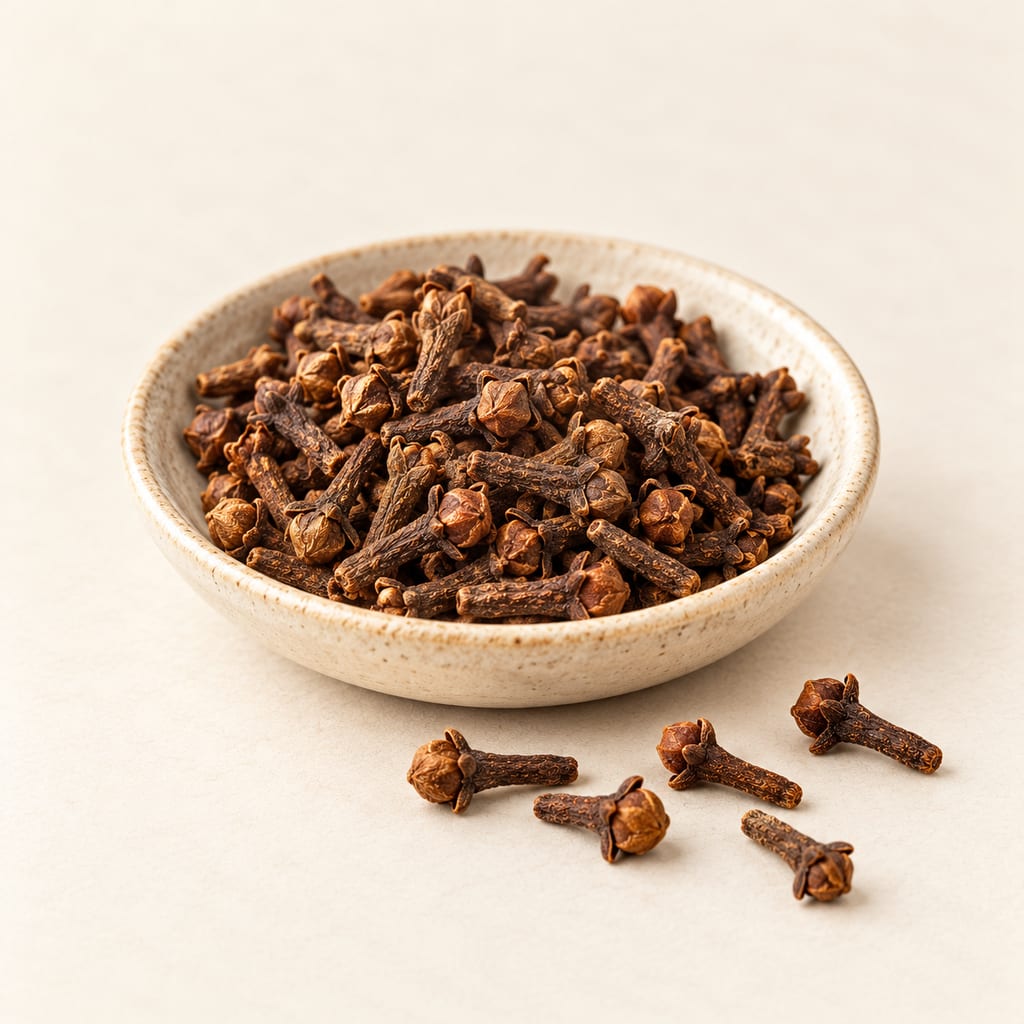
Cloves are the dried, unopened flower buds of Syzygium aromaticum, an evergreen tree in the myrtle family, Myrtaceae. Each whole clove keeps the bud’s narrow stalk and rounded cap: a small, dark, nail-shaped spice with a warm, penetrating aroma. The rounded end is a flower still closed around its inner parts, not a seed. The tree is native to Maluku in eastern Indonesia, although its spice is now cultivated and used far beyond those islands. In the kitchen this hard little bud may enter a pot intact or be ground into a powder; those forms suit different preparations.
Sources for this section
From Maluku into kitchens
Cloves belong to a long history of Asian exchange. Kew identifies Maluku as the plant’s native range. Guanmian Xu documents a clove route running north from Maluku to China as well as the better-known westward trade. In Song-period China, imported cloves belonged among fragrant materials used in incense and sachets. That is evidence of a valued aromatic, not of a particular culinary recipe. The spice could enter the household as fragrance as well as food, and the demand for its scent helped connect distant markets to the islands where the tree grew.
By the late Ming period, incense manuals and practical household encyclopaedias carried clove-containing mixtures. Xu describes Zhou Jiazhou’s Record of Incenses, published in 1643, in which cloves, clove twigs or clove bark appear repeatedly in mixtures for burning, perfuming clothes and scenting the body. These were not all made from the dried flower bud used in cooking, and they do not establish how a present-day cook should season a dish. They show how one tree’s fragrant parts entered several kinds of daily and ceremonial use. A clove’s place in a spice jar is only one part of its cultural history.
In the early seventeenth century Chinese junks continued to sail to Maluku while Dutch and English companies contested access to the islands. Cloves were one object of that commerce. Some Dutch officials argued over whether to exclude Asian traders; later arrangements could even favour Chinese ships. Control of supply was therefore disputed in a region that already had its own routes and buyers. The small dried bud could travel widely because it concentrated a sought-after scent into a portable spice, though a surviving trade record cannot trace a modern jar to any single voyage.
As clove cultivation spread to other tropical places, the spice became an ordinary pantry ingredient in many regions while its botanical origin remained Maluku. A present-day dish cannot be assigned to one ancient route simply because it contains clove. What travels with the bud is a capacity to take different roles: a fragrant material, a traded crop, and a strong seasoning whose use depends on a cook’s local ingredients.
Sources for this section
A flower bud dried at the right moment
The part used as the spice is a flower before it opens. A clove cluster develops at the ends of the tree’s branches. As a bud grows, its color changes; growers pick it while it is full-sized but still closed. The sepals form the four pointed parts visible around the bud’s cap, while the unopened petals enclose the flower. Once the flower opens, the parts that made the compact, intact bud are no longer gathered in the same form. The result is not a seed, bark, or fruit, although the aromatic tree produces several useful plant parts.
The accepted botanical name is Syzygium aromaticum (L.) Merr. & L.M.Perry. Older books and trade material may use names such as Eugenia caryophyllus or Caryophyllus aromaticus. Those names refer to the same familiar clove tree in historical literature, but Kew’s Plants of the World Online accepts S. aromaticum. Its native range is Maluku, a group of islands in Indonesia’s eastern archipelago. Today, cloves are grown beyond that original range in other suitable tropical climates; the country printed on a jar is a harvest origin, not a different species.
In the field, harvest timing is a quality decision. Kerala Agricultural University describes picking when the base of the calyx turns from green to pink, before the petals open. These are regional crop instructions rather than a universal calendar: flowering and harvest dates vary with climate and elevation. The useful point for the cook is that the spice begins as a fleshy, closed bud, not as the crisp brown object in the jar.
After picking, the buds are separated from the stem clusters and dried promptly. Kerala Agricultural University describes spreading them in a thin layer in the sun and raking them for even color and to prevent mould; time depends on weather and method. As water leaves, the bud shrinks and darkens to a firm brown. Properly dried cloves are crisp rather than pliant. Slow holding in heaps can cause fermentation and pale, shrivelled cloves, a quality defect noted in the crop guidance. This processing is drying, not the deliberate fermentation used to make a cultured food. The buds are not typically fermented to create clove flavor.
Sources for this section
Aroma held in the bud
The familiar aroma is carried by volatile compounds in the bud’s essential oil. Eugenol is a major contributor to clove’s characteristic warm, sweet-spicy, slightly medicinal scent; other compounds also contribute, and their balance varies with plant material and processing. A whole bud therefore offers more than a single purified note. Technical assessments of extracted clove oil describe eugenol alongside other constituents, but a measurement of distilled oil is not a measured composition for every dried bud in a jar.
Drying reduces the bud’s water content and gives the picked flower a firm form that can be stored and moved. The aromatic oil remains within the dried plant material. Crushing a bud makes its scent immediately apparent at the mortar; in a liquid, a whole bud can be steeped and then lifted out. Ground clove instead spreads through dough, a sauce or a spice blend and cannot readily be separated again. The distinction matters to the texture and control of the finished dish, without requiring a claim that one retail form always retains aroma longer than another.
Clove essential oil is an extracted and concentrated product, not a substitute measure for dried buds in a recipe. Bud oil and leaf oil are also separate materials in the EFSA assessment. Their composition and use context differ from the intact spice. In a kitchen, the useful sensory guide is the aroma of the spice actually being used: a crushed bud should smell recognizably of clove, while a powder that contributes little scent to a dish will contribute little of the intended character. Use the dried food spice at the amount called for by the recipe rather than translating a laboratory oil percentage into a cooking dose.
Sources for this section
How cooks use whole and ground cloves
Whole cloves are convenient in liquids and mixtures that can be strained. They appear in spice infusions, pickling mixtures, mulled drinks, stocks and braises; some cooks press them into an onion before simmering, then remove the onion and buds. Ground cloves work in spice blends and baked goods, where a whole bud would be awkward and its flavor needs to be spread through the dough. They occur in blends such as garam masala, Chinese five-spice and pumpkin-pie spice, and in preparations including masala chai and Vietnamese pho. The proportion and companions vary from blend to blend.
The whole bud is a visible piece of seasoning. It can be counted into a pot and counted or strained out before serving, which is useful when an unexpected hard fragment would be unwelcome. Its cap can separate during a simmer, so an infusion is best passed through a strainer if it must be free of pieces. Ground clove becomes part of the food itself. A pinch mixed into a batter cannot be retrieved later, making the recipe’s stated measure especially useful when the other flavors are delicate.
Cloves can accompany both sweet and savory ingredients. Fruit preserves and spiced syrups put their warm aroma against tartness and sugar; meat, beans or broth give the same spice a different setting. Cinnamon, cardamom, ginger, pepper and citrus may accompany it, but no one combination defines clove cookery. The Ecuadorian drink and Nepali fruit preparation below offer two documented examples with different ingredients and stages. They show the bud doing work in a specific recipe, rather than standing for a universal flavor formula.
Sources for this section
Cloves in two Fermentea recipes
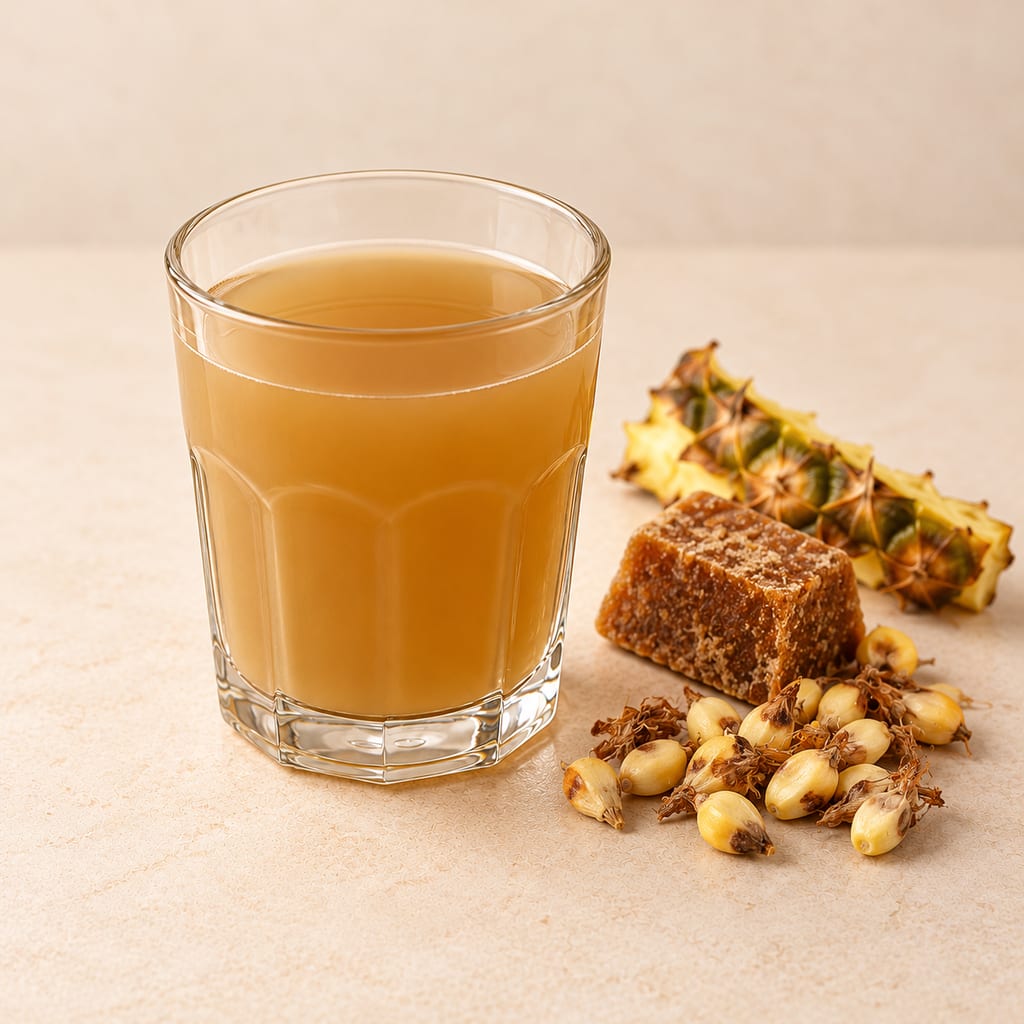
In the Ecuadorian Chicha de jora recipe published by the Asociación de Chefs del Ecuador, twelve whole cloves are listed with allspice, cinnamon, ishpingo and pineapple peel. The method first boils the spices in water, then cooks in the dissolved jora flour; panela and pineapple peel are added after cooling, and the mixture is left to ferment. The clove belongs to the initial spice infusion. It is not the fermenting culture and is not evidence that cloves cause fermentation. The twelve-bud quantity is specific to this recipe’s five litres of water and its full spice mixture, not a general dose for chicha or for a household pot of any size.
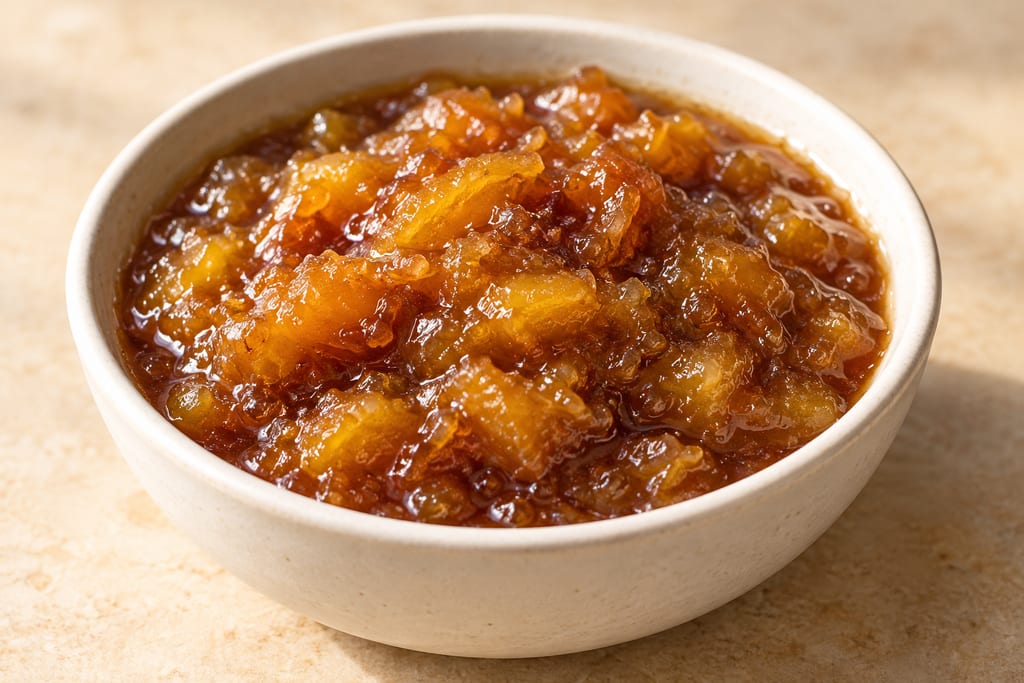
A Suryabinayak municipality page for lapsi ko achar describes ripe lapsi pulp cooked in a sugar syrup with aromatic spices, including clove, cardamom and cinnamon. The source’s list prints “2/2 grams” after a combined group of spices, so its allocation is ambiguous; this page does not assign an exact clove mass. In the method, the strained syrup is combined with the pulp and spices and cooked while stirring for ten to fifteen minutes, then bottled. Here the clove’s role is seasoning a tart fruit preserve, with sugar and the fruit’s own flavor shaping the result. It is not a claim that one spice ratio is traditional throughout Nepal: this is one municipality’s documented preparation.
Sources for this section
Buying, keeping and recognizing quality
A well-dried whole bud should be firm and crisp, with an intact cap and a recognizable clove aroma. Kerala Agricultural University describes properly dried cloves as brown and resistant to bending. Agricultural grade and retail appearance vary, so color alone is not a complete quality test. Pale, shrivelled material can result from poor curing, while visible dampness or mould is reason to reject a jar. The finished spice should be dry to the touch; it should not look like the fresh, pinkish bud picked from the tree.
Keep the dried spice clean and dry in a closed container. That simple practice protects the quality gained by careful curing and keeps cooking moisture out of the jar. Whole cloves allow the cook to inspect the shape of the original bud; powder cannot reveal whether the source buds were intact. Ground clove is useful where the recipe needs it, but buy a quantity suited to actual cooking rather than assuming a large jar will always be needed. A best-before date is a packer’s quality guide rather than a universal rule for every household.
The strongest clue to its culinary role is still the dish. A whole bud in a spiced drink may be removed after the liquid has taken its aroma; a powder folded into a sweet dough stays in every slice. Neither form is a separate botanical species. Both begin with the same closed flower, picked at a narrow stage and dried so the tree’s fragrance can reach the kitchen.
Sources for this section
Places
China
Historical attestation · Country evidenceClove aromatic use and trade attested in Chinese records; this is not the native range or the earliest use.
Ecuador
Documented preparation · Country evidenceA contemporary Ecuadorian chicha de jora formula uses whole cloves as a spice; this is not evidence of where that batch of cloves grew.
Nepal
Documented preparation · Country evidenceA municipality records cloves in a lapsi achar formula; the clove-specific mass is ambiguous.