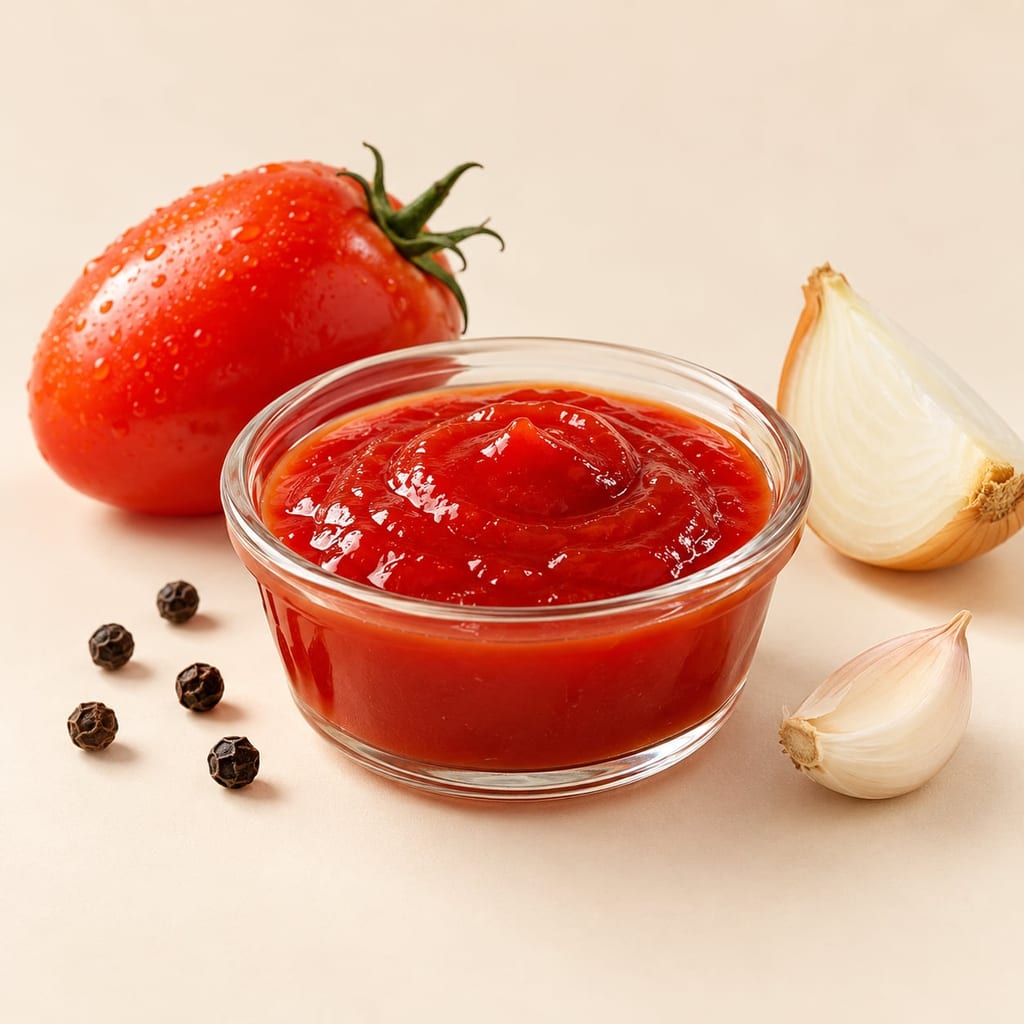
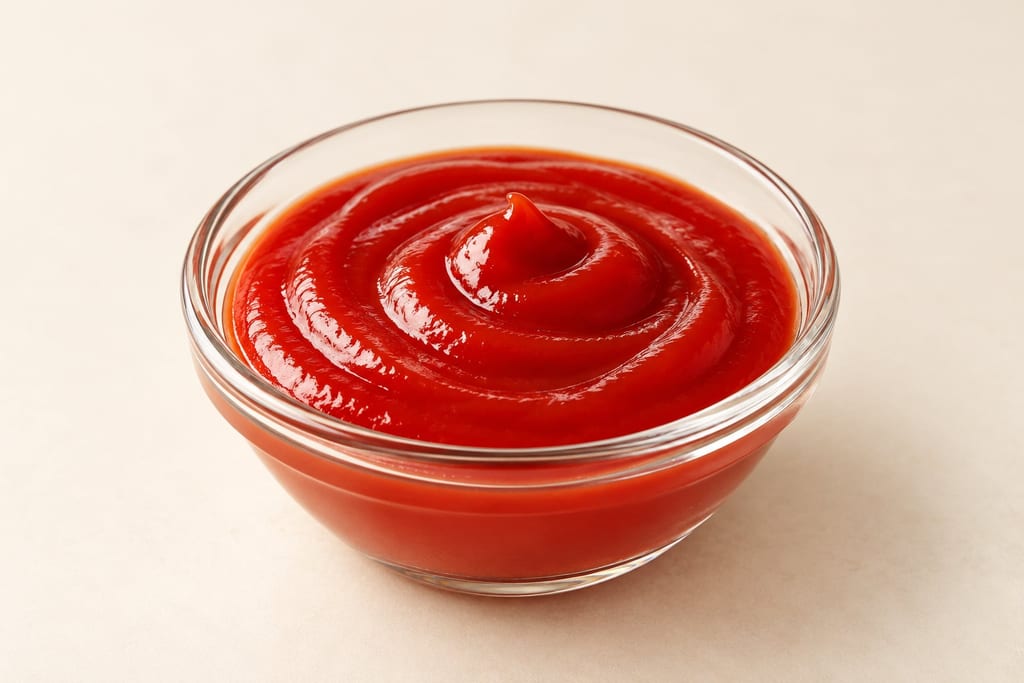
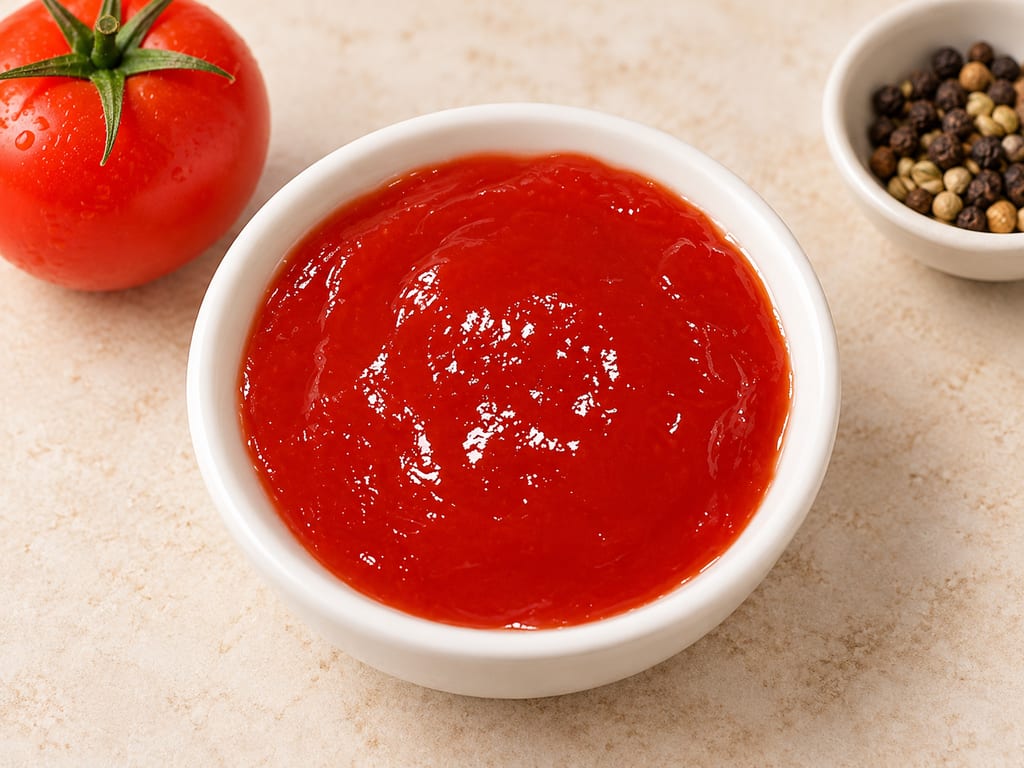
A rounded house ketchup cooked from tinned plum tomatoes, onion, vinegar, sugar and a little warm spice, then blended, sieved and reduced to about 600 g.
This ketchup is cooked from whole tinned tomatoes rather than from paste, and it is meant to taste like it. The aim is a rounded house sauce: sweet and sharp in balance, smooth enough to sit on a chip, with cooked plum tomato in front and the spice kept to a background warmth. It is not trying to be any particular bottle. The smooth ketchup made from tomato paste on this site does that job; this one trades a little repeatability for character.
Two routes lead to ketchup at home. The whole-tomato route cooks tomatoes with aromatics, blends and sieves them, then boils the purée down. It leaves room for seasonal fruit and an individual flavour, at the cost of more variation from batch to batch and a longer stay at the stove. The concentrate route disperses a consistent paste in a measured mixture of water, vinegar and sugar, cooks it briefly and sets the final weight, which makes it the easier way to a repeatable commercial-style sauce. Choosing whole tomatoes means letting the fruit lead and judging the end point by weight and texture.
This is an untested formulation. It has not yet been cooked in a series, tasted against a reference or checked for how long it keeps. It is a refrigerator and freezer sauce, never a canning recipe.
The kit is plain and worth gathering before the tin is opened: a scale, a heavy stainless-steel saucepan, a flexible spatula to keep the base and corners clear, a blender rated for hot food, a fine sieve and small clean containers for the finished sauce. A thermometer earns its place when checking how quickly the batch cools and how cold the fridge really runs. A digital pH meter is useful for anyone keeping records across future batches, but a reading on its own never turns an invented recipe into a tested canning process.
Ketchup once named a wider family than the red bottle. Friedrich Accum's Culinary Chemistry, printed in London in 1821, gives a mushroom catsup, a walnut catsup and a ‘tomata catsup’ within a few pages of one another. His tomato version begins by mashing a gallon of ripe tomatoes with a pound of salt and pressing out the juice, which places it among the salted seasoning liquids of its day rather than beside the thick sweet-and-sour sauce poured now. The word survived; the plan changed to tomato cooked down to a dense purée and balanced with sugar, vinegar and salt.
An old cookery book is good evidence of what people made and called ketchup, and poor guidance on keeping food today. Accum's generation rested mixtures at room temperature and stored them in corked bottles; neither habit belongs in a modern home recipe, and nothing in this one borrows from them.
That plan reads plainly on modern labels. Heinz's British Tomato Ketchup lists tomatoes, spirit vinegar, sugar, salt, spice and herb extracts and spice, and states that 148 g of tomatoes went into every 100 g of ketchup: more fruit by weight than the sauce it became, because water was cooked off on the way. Kagome's ketchup in Japan lists tomato, three sugars (sugar, a glucose-fructose syrup and glucose), brewed vinegar, salt, onion and spices; its official page gives 27.9 g carbohydrate and 3.3 g salt equivalent per 100 g and no separate sugars figure, so the carbohydrate number cannot be read as sugar. The tested home-canning Tomato Ketchup published by the National Center for Home Food Preservation in the United States combines ripe tomatoes and onions with cider vinegar, sugar, salt, cayenne and whole cloves, cinnamon, allspice and celery seed. Across three countries and two scales of production the skeleton is the same.
This ketchup follows that skeleton with a cook's choices. Tinned plum tomatoes are the default because a given brand of tin varies far less than fresh fruit does with variety and season, and they arrive already cooked. Onion and a little garlic soften into the body, vinegar brings the sharpness, sugar and salt set the balance, and allspice, black pepper and an optional pinch of clove give warmth without pushing the sauce towards a spiced chutney.
Ketchup is made by concentration. About 1,054 g of ingredients go into the pan (800 g tomatoes with their juice, 70 g onion, 100 g vinegar, 75 g sugar, 7 g salt, 2 g garlic and three-tenths of a gram of spice) and about 600 g come out. Roughly 450 g has to leave, most of it as steam and a little as seeds and fibre held back by the sieve. As the water goes, everything that stays becomes stronger: the tomatoes' own sugars and acids, the added sugar and salt, and the solids that give the sauce its body.
That is why the finished weight, not the clock, is the control. ‘Simmer for 20 minutes’ cannot be repeated reliably, because a wide pan loses water far faster than a narrow one and a brisk flame faster than a gentle one. Weight can be repeated. If this batch finishes at 500 g instead of 600 g, every retained ingredient is 20% more concentrated (600 ÷ 500 = 1.2), and a balanced sauce turns too sweet, too salty and too sharp at once. Weighing the empty pan first, or decanting into a tared bowl, turns a vague reduction into a number that can be written down.
Texture is judged cold. Hot sauce flows more freely than it will once chilled, so the test is a cooled spoonful: a little sauce on a cold plate, left to cool, shows whether it holds its shape and whether a rim of watery liquid seeps from its edge. A grainy reduction that leaks liquid behaves differently on a chip from a glossy one that clings, and only a cool sample tells them apart.
Nothing in the formula thickens the sauce except reduction, and that is deliberate. Early trials should settle tomato concentration, blending and reduction before anyone reaches for starch. A spoonful of starch can suit a sauce modelled on a starch-thickened bottle, but it changes the texture the reduction is meant to deliver, and it changes how heat travels through a jar, one more reason a thickened variant can never borrow a tested canning time.
The 800 g of tinned peeled plum tomatoes, juice included, are the sauce. Plum tomatoes are fleshy, and the juice in the tin counts as part of the batch, so everything goes in. Check the tin's label for added salt and note it, because a salted tin shifts the finished balance.
Onion, 70 g finely chopped, is cooked until completely soft so that it blends away into body and a cooked, savoury sweetness instead of leaving a raw edge. The 2 g of garlic stays in the background. The vinegar, 100 g labelled 5% acidity, is the main source of sharpness: white vinegar gives a cleaner, more commercial edge, cider vinegar a fuller and fruitier one, and a malty vinegar would leave a different impression again, closer to the British brown sauces than to ketchup. A vinegar of stated strength is what lets the next batch be compared with this one.
Sugar and salt set the balance. Seventy-five grams of white sugar in about 600 g of finished sauce is a nominal 12.5% added sugar (75 ÷ 600 × 100), before the tomatoes' own sugars are counted; the smooth paste ketchup on this site adds 18% (90 ÷ 500 × 100), so this one carries less added sugar by design. The 7 g of fine salt comes to about 1.2 g per 100 g of finished sauce (7 ÷ 600 × 100 = 1.17), again before any sodium already in the tin. Sugar softens the impression of acid without removing any, which is why a sharp sauce can be sweetened into balance while its acid stays exactly where it was. Salt lifts the whole balance and is easily mistaken for stronger tomato.
The spices are measured in fractions of a gram: 0.15 g of ground allspice and 0.15 g of black pepper, with clove as an optional very small pinch. At this level they are meant to read as warmth and familiarity rather than as identifiable spice. Clove is the one to watch, because a little more than a pinch pulls the sauce towards a strongly spiced fruit sauce; that is why it is optional and the last thing to increase. A fine scale makes these amounts repeatable in a way a pinch is not.
The first simmer, usually around 20–30 minutes, has one job: to make the onion completely soft in the crushed tomatoes. An onion that is still firm will not blend smooth. Stir often, since tomato solids catch on the base of the pan as the liquid falls, and add a small splash of water if it starts to stick. A heavy stainless-steel pan spreads the heat and does not react with the acid.
Vinegar, sugar, salt and spices go in next for around 10 minutes of gentle cooking, which dissolves the sugar and salt completely and lets the spices cook into the liquid before blending. Acetic acid, the acid of vinegar, is volatile and leaves partly with the steam, so adding the vinegar after the first simmer shortens the time it spends boiling, though the final reduction will still carry some away.
Blending and sieving come before the last reduction. Once the onion is soft, the blender turns tomato, onion and garlic into one purée; the sieve then removes seeds, stray skin and fibre that would leave the sauce grainy. Reducing after sieving means only the part you keep is boiled down, and its thickness can be read directly. Hot purée needs care: steam trapped in a closed blender jug builds pressure, so vent the lid or use a stick blender in the pan.
The final reduction sets the sauce. Cook the sieved purée down, stirring frequently as it thickens, until a cooled spoonful is right and the weight is near 600 g. Then cool it promptly in small portions: shallow, small containers lose heat much faster than one deep jar, and the Food Standards Agency's advice is to get cooked food into the fridge within one to two hours.
Taste the sauce chilled, the way it will be eaten, and only then decide what to change. A spoonful on its own is a different test from ketchup on a salted chip, so try both. The formula's adjustments are simple. For less sweetness, reduce the sugar in the next batch. For a cleaner, more commercial direction, use white vinegar and reduce the onion and allspice. For a fuller house style, use cider vinegar. Extra clove moves the sauce quickly into spiced fruit-sauce territory.
Change one variable per batch and write it down; if sugar, vinegar and onion all move together, there is no telling which change mattered. A batch that tastes too sweet, too salty and too sharp at once may not be mis-seasoned at all. Check its weight before touching the recipe, because over-reduction concentrates all three together and the cure is to stop the reduction earlier. Record the tomato brand, the vinegar, the starting and finishing weights and the pan, so that a good batch can be made again.
A house ketchup with clear tomato flavour does the everyday work of chips, sausages and burgers. It is also worth treating as a cooked seasoning. Kagome, the Japanese tomato company, publishes recipes in which its ketchup is cooked rather than simply poured. In its Napolitan, a ketchup-sauced spaghetti that Kagome styles after the neighbourhood Chinese diners of Japanese towns, the ketchup goes onto the bare surface of the pan beside the other ingredients and is fried over medium heat until it has reduced to about two-thirds, driving off water before it coats the noodles; the recipe calls this yaki-ketchup, fried ketchup. In its omurice, the rice omelette, ketchup also goes into a sauce cooked for one to two minutes with Kagome's Worcester-type sauce, water and butter until it thickens, then poured over the omelette.
Both recipes treat ketchup as a concentrated tomato seasoning that keeps cooking in the pan, which makes them a fair test for a home batch: a sauce that tastes right on a spoon can behave differently once it is fried. This ketchup can also be the body of the curry ketchup on this site, where it is loosened with water and seasoned with curry powder, paprika, onion powder and a little more sugar and vinegar.
Treat the finished sauce as fresh prepared food. Refrigerate it in small, clean containers in a fridge running between 0 and 5 °C, ideally at 4 °C or colder, and plan to use it within 48 hours or freeze it early. That window is a house convention for an untested recipe, borrowed from the Food Standards Agency's general advice to eat leftovers within 48 hours or freeze them. It is not a measured shelf life for this ketchup. Heinz's own British shop tells buyers to refrigerate its 460 g bottle after opening and eat it within 8 weeks, but that instruction belongs to a factory product with its own formulation and process, and a home batch does not inherit it.
Plenty of acidified ketchups keep their quality far longer than two days in practice. That still gives no grounds for granting an invented recipe a month in the fridge on the strength of how it tastes, a single pH reading or a comparison with a shop bottle. Clean jars, a hot fill, vinegar and a sealed lid do not, on their own or together, amount to a tested shelf-stable process.
Freezing is the flexible route. Freeze in small containers so one meal does not mean thawing everything, leave room for expansion, label each with the recipe version and the date, and keep the freezer at about −18 °C. Smooth tomato sauces are practical candidates, though a thawed portion may separate slightly or change in thickness and need stirring. Thaw in the fridge and use within 24 hours of thawing completely. The Food Standards Agency describes the freezer as a pause button, and the US Department of Agriculture's freezing guidance draws the same line: freezing is a way of storing food, bacteria are not killed and can revive as it thaws, and no freezer rescues a sauce mishandled before it went in. While the recipe is still being developed, freeze a few small containers from one batch straight away. They make steadier comparison samples later than a working jar opened again and again; note how each was thawed and any change in texture.
Pantry storage needs a different recipe. The National Center for Home Food Preservation publishes a USDA-tested Tomato Ketchup for canning: 24 lb of ripe tomatoes with onions, cayenne, cider vinegar of 5% acidity, whole spices, sugar and salt, yielding 6 to 7 pints, cooked down to the concentration the recipe prescribes, packed hot into pint jars with 1/8-inch headspace and processed in a boiling-water canner for 15, 20 or 25 minutes depending on altitude. Its Blender Ketchup and Country Western Ketchup are separate tested processes again. None of those times can be borrowed for this formula or for a fresh-tomato batch of it. The ratio of tomato to onion, the acidity and the way heat travels through a jar belong to the tested process, and a hot jar, a sour taste, a sealed lid or a pH reading cannot stand in for one. The same holds for anything built on this sauce: a banana ketchup, a brown sauce, a starch-thickened version or an extra-thick reduction inherits no canning time either. If shelf-stable ketchup is the goal, choose a tested recipe first, make it exactly as written, and change only what its own directions expressly allow.
This is a modern house formulation, not an established regional recipe. Its historical account distinguishes Friedrich Accum's 1821 salted tomato catsup from later sweet-sour tomato ketchups; the historical directions are evidence of past usage, not current preservation guidance.
This original formulation has no measured finished pH or recipe-specific shelf-life test. General FSA leftovers guidance applies to cooled, promptly refrigerated cooked food, but does not validate this recipe.
Hazard source
Divide into small portions, cool cooked food and refrigerate within one to two hours; keep the fridge between 0 and 5 °C. General FSA guidance says eat leftovers within 48 hours or freeze them. These are general leftovers directions, not a validated shelf life for this formulation.
Control source
This is an untested development formulation: it has not been kitchen-tested, tasted against a target or assessed for shelf life.
Do not store at room temperature or can this formula. Its vinegar amount and the vinegar label do not establish finished acidity or a safe canning process. Use a separately tested canning recipe and follow its complete directions.
The general 48-hour leftover window is not a measured keeping time for this ketchup. Freeze portions promptly if they will not be used within that window.
Put the 800 g tinned peeled plum tomatoes with all their juice, 70 g finely chopped onion and 2 g peeled garlic into a heavy stainless-steel saucepan. Crush the tomatoes and simmer gently until the onion is completely soft, usually around 20–30 minutes. Stir often so nothing catches, and add a small splash of water only if the pan starts to stick.
Add 100 g white or cider vinegar labelled 5% acidity, 75 g white sugar, 7 g fine salt, 0.15 g ground allspice, 0.15 g ground black pepper and, if using, one very small pinch of ground clove. Cook gently for around 10 minutes more.
Blend until smooth with equipment suited to hot food, without trapping steam in a closed blender jug, then pass the purée through a fine sieve.
Return the sieved purée to the pan and reduce it, stirring frequently, until a cooled spoonful has the texture you want. Weigh it: about 600 g is the starting target. The time this takes depends on the pan and the heat, so judge by weight and texture rather than the clock.
Cool promptly in small portions and refrigerate. Taste a chilled sample before changing anything in the next batch, and freeze whatever you will not use within the 48-hour house window early, while it is fresh.
Places
Unknown
Relationship not established · Place not established
No source establishes a regional origin or traditional preparation for this modern house formulation; the name describes a recipe style only.
A smooth tomato ketchup formulated as a 500 g comparison batch using a UK Heinz product label as its target. This original home formula is untested and is not the company recipe or a preserving process.
Tomato ketchup is a smooth, sweet-sour tomato sauce whose modern form grew from an older family of savoury ketchups; this version follows a tested home-canning recipe.
Ajvar is a cooked Balkan pepper preserve built around roasted red peppers, peeled, drained, ground and slowly fried with oil and seasoning. Leskovac’s protected version is a pepper specialty; regional versions vary.
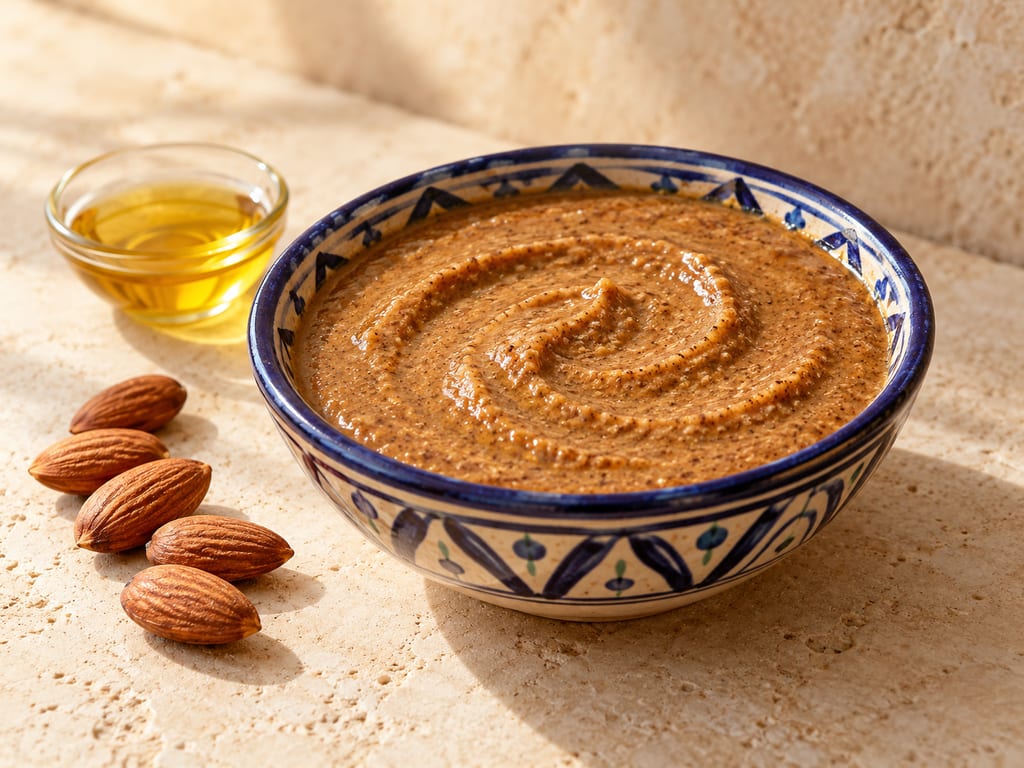
Amlou is a nutty, lightly sweet Moroccan spread of roasted almonds, culinary argan oil and honey. The almonds are ground first, then loosened with oil and sweetened; the balance can range from a thick spread to a dip.
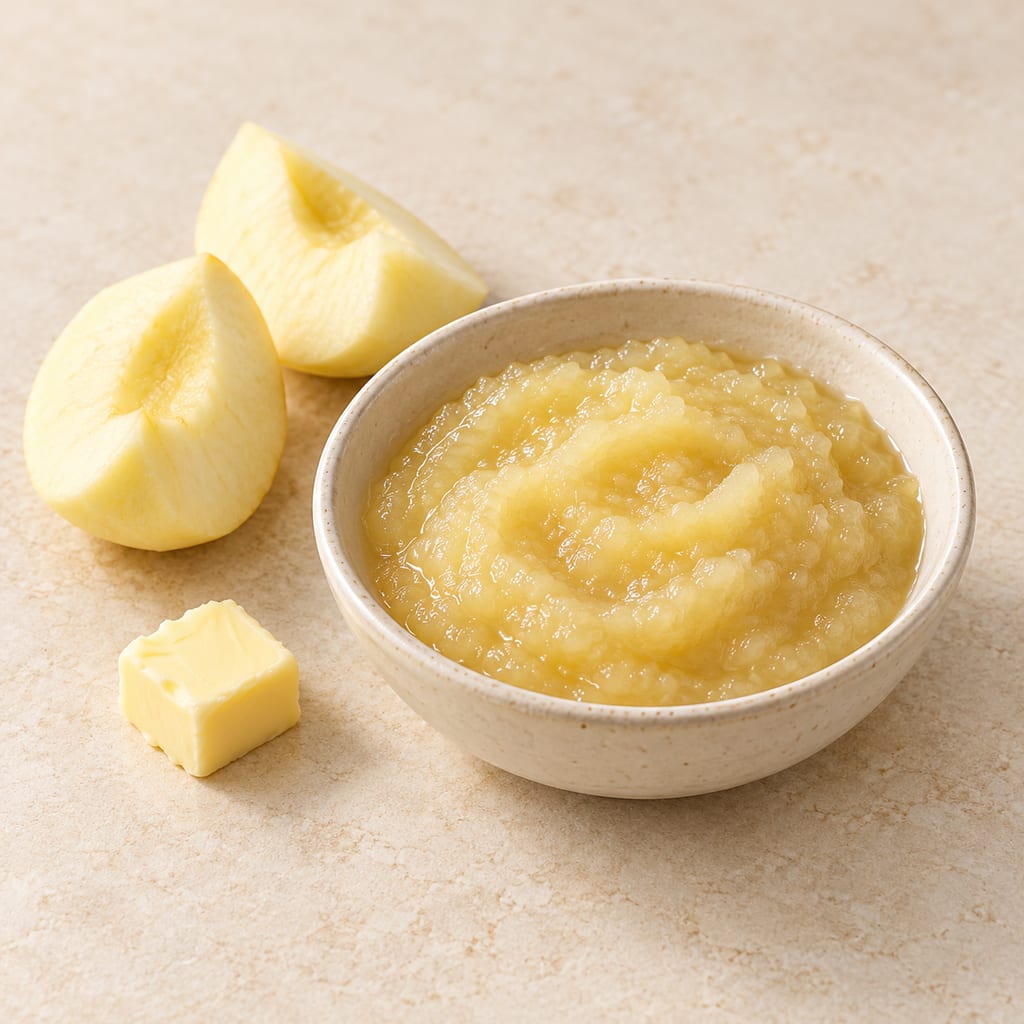
Apple sauce for goose and pork is a plain English accompaniment: cooked apples pulped with water, then sweetened with sugar and finished with a little butter.
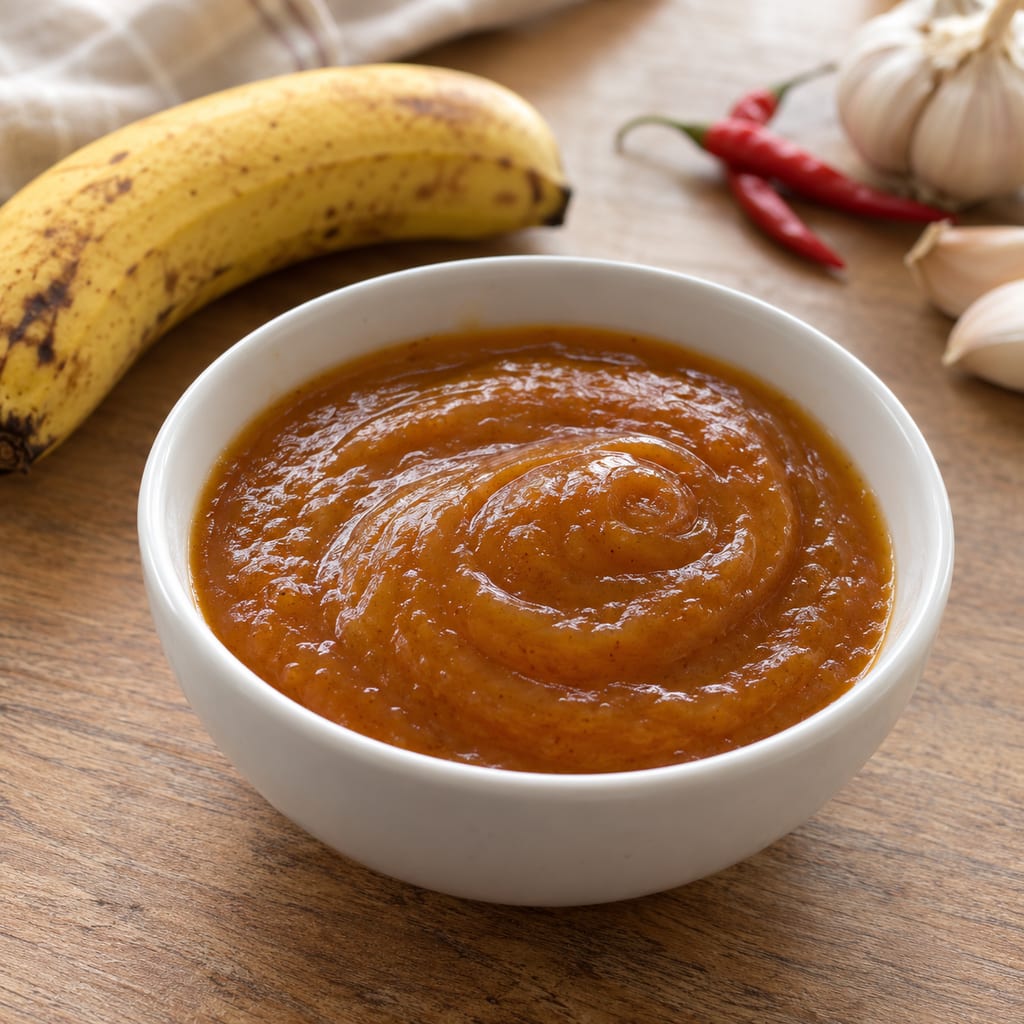
A sweet-hot table sauce of ripe banana simmered with vinegar, sugar, onion, garlic and fresh chilli, in the manner of Philippine banana ketchup. An untested development batch of about 500 g.
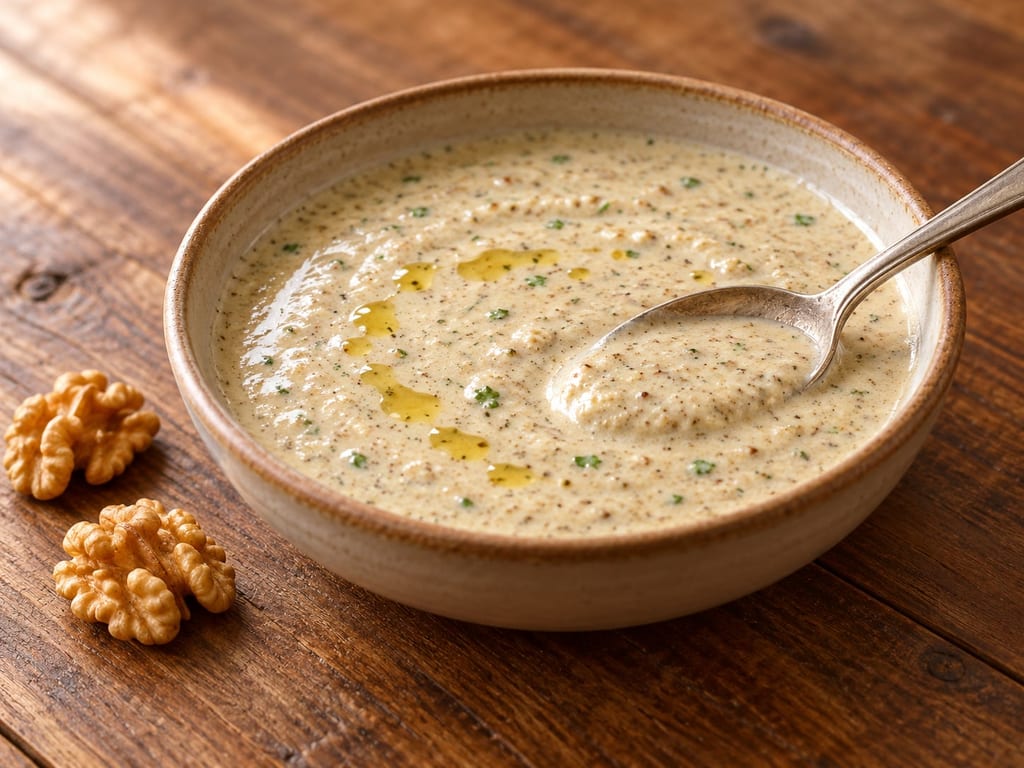
A Georgian walnut sauce of ground walnuts, garlic, vinegar and spices, thinned with water or broth. It is served with poultry, vegetables and bread, and is the sauce of the dish satsivi.
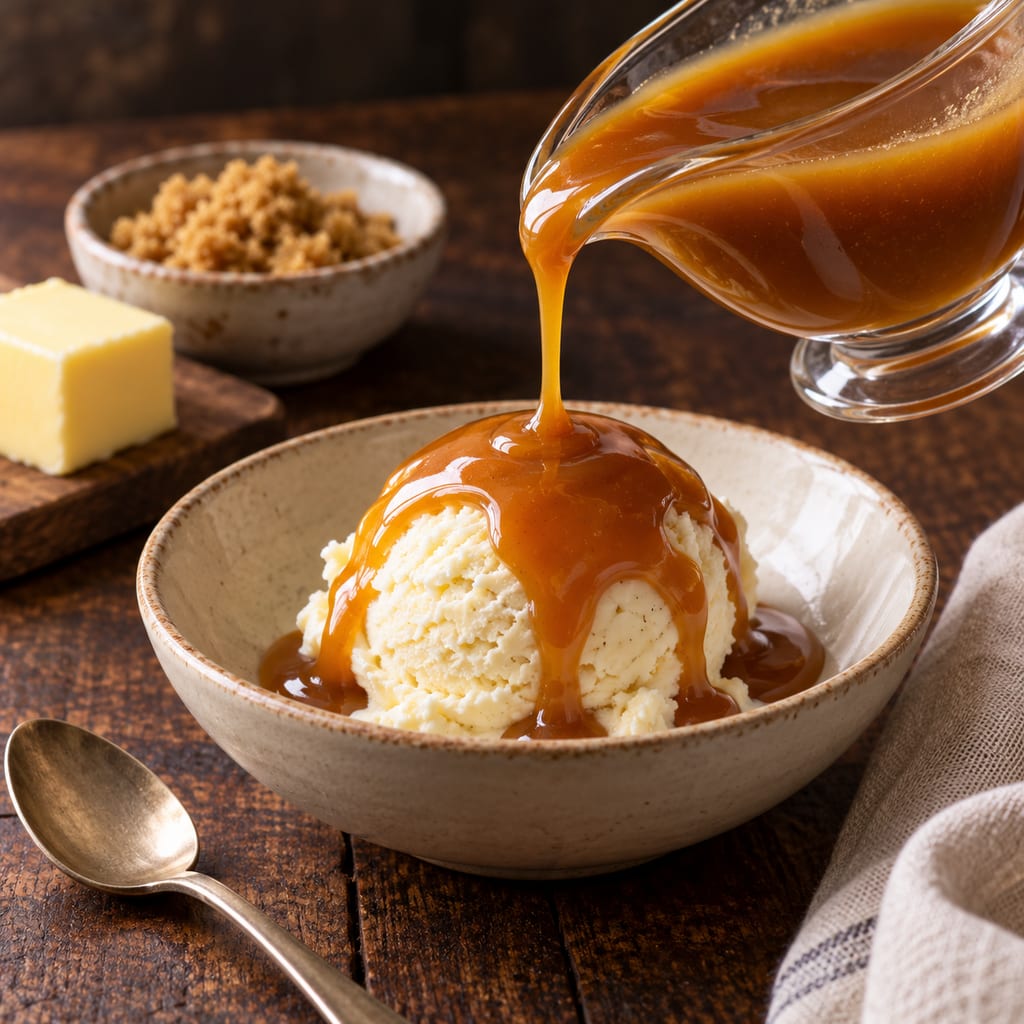
A pourable dessert sauce of brown sugar, butter and cream, with a little corn syrup and salt. It is the sauce form of the butterscotch confection and is made without water, unlike caramel.
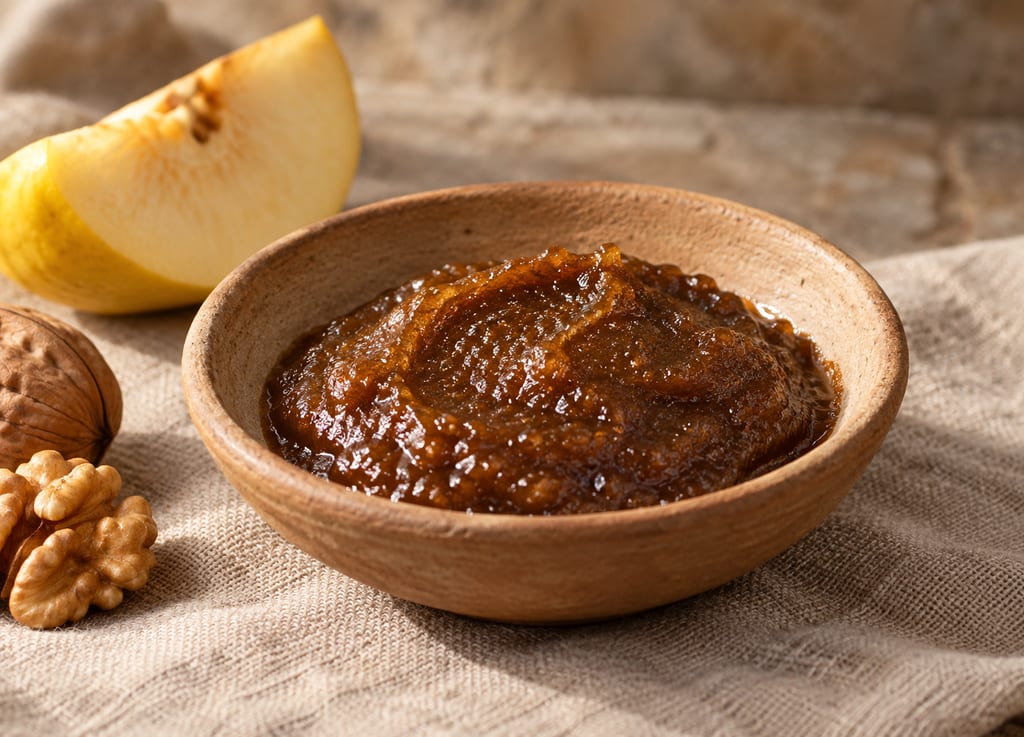
Byzantine murrī is a cooked imitation of murrī from the medieval Arabic repertoire, made from scorched honey, toasted bread, walnuts, quince, carob and spices rather than from a long grain fermentation.
Community
No community contributions have been published for this entry yet.
Share what you made
Sign in to contribute. Published comments and photos are free to read.
Cited in: A ketchup that tastes of its tomatoes; From salted juice to sweet-sour sauce; How a pan of tomatoes becomes ketchup; What each ingredient is for; Keeping it, and what it is not