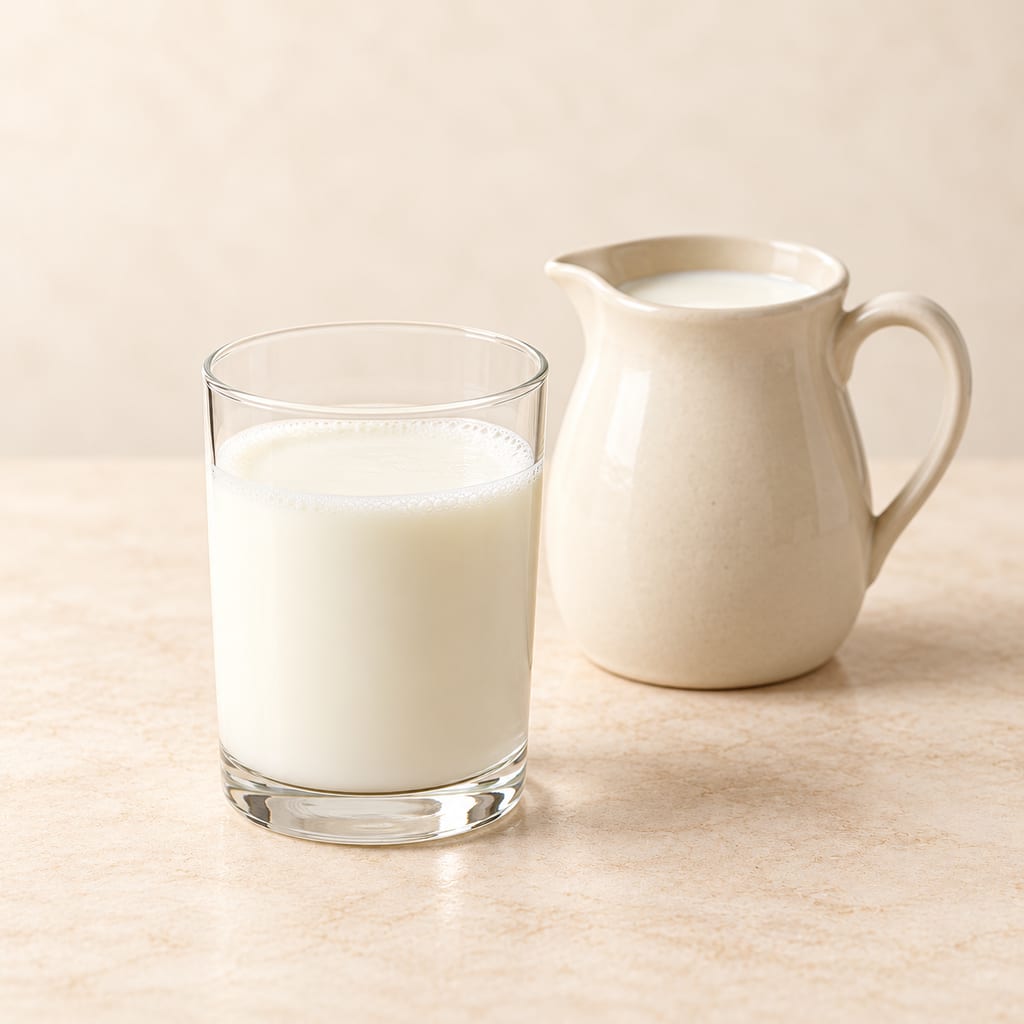
Cultured buttermilk, direct-set
Milk thickened with a packet of buttermilk culture makes a tangy drink and a baking ingredient. This warm-incubated version uses whole milk.
 FermenteaWhere food goes to change
Substrates
Whole milk retains its milkfat and brings fat, casein, lactose, minerals and water to the table; species and processing still shape how it tastes and sets.
Whole milk is milk sold with its milkfat largely retained rather than reduced to make 2%, 1%, or skim milk. In the United States, the federal standard for beverage milk defines milk as the lacteal secretion from healthy cows, practically free from colostrum. It requires at least 3.25% milkfat and 8.25% milk solids other than fat. The same standard allows fat adjustment and says milk may be homogenized; “whole” therefore names a composition category, not a promise that the milk is raw, straight from the cow, unstandardized, or untouched by processing. Standards and label conventions vary by country, so the U.S. figure should not be universalized.
In a glass, whole cow’s milk is opaque, white to cream-coloured, fluid but faintly coating on the tongue, and softly sweet. The fat gives it more body than skim milk; the lactose, or milk sugar, supplies the gentle sweetness. Fat content is not the only source of variation. Breed, feed, season, stage of lactation, farming conditions, and processing can change milk’s composition, colour, and flavour. “Whole milk” is thus a useful buying description, but not a guarantee that every carton will behave identically in a pot.
The term also needs a species boundary. In everyday U.S. grocery use, “whole milk” usually means cow’s milk unless another animal is named. Yet milk is produced and used from buffalo, goats, sheep, camels, yaks, and other mammals. These are not culinary synonyms. Their fat, protein, lactose, minerals, and casein proportions differ, affecting flavour and how a milk sets or ferments. This ingredient page treats whole milk primarily as whole cow’s milk while explaining where other species matter; a recipe that specifies sheep’s milk or buffalo’s milk should keep that identity explicit.
Milk existed before people milked animals: it is the mammalian food made to nourish young. The human story begins when communities began keeping animals that could provide it. Archaeological evidence does not point to one simple “invention of milk drinking.” A large study of pottery residues and archaeological sites found that dairying appeared in different places at different times and with different intensity. It documented milk use in parts of southwest Asia in the early Neolithic and residue evidence from seventh-millennium-BCE northwest Anatolia, while also showing that its spread across Europe was uneven. The authors stress that the archaeological record is incomplete: milk processing in containers that leave no pottery residue would be harder to see.
The first milk economies were not necessarily built around a bowl of fresh cow’s milk. People kept several dairy species, and made use of milk according to animals, climate, handling, and local foodways. Sheep, goats, cattle, buffalo, and camels all appear in the long history of dairy; the relative importance of each differs across regions. Where fresh milk could not be easily kept, boiling, souring, fermenting, or turning it into cheese and other products helped make it usable. That does not mean every region followed a single progression from fresh milk to cheese, or that all populations relied on milk in the same way.
Milk also intersects with human lactase persistence: the ability to continue producing lactase, the enzyme that digests lactose, into adulthood. The relationship is a history of food culture and human biology, but not a tale of one gene “causing” dairying. The research record finds widespread but regionally variable prehistoric milk use, while the timing and causes of lactase-persistence selection remain debated. Fermenting milk and making cheese alter lactose levels and food texture through processes in their own right; they are not merely workarounds that made dairying possible for one population. A responsible history keeps the evidence about animal keeping and milk residues distinct from hypotheses about why particular human genetic traits became more common.
Industrial dairy changed the scale and regularity of fluid milk supply. Milking, cooling, transport, separation, heat treatment, and packaging now connect farms to households; a carton labelled whole milk is a standardized retail ingredient, not an unchanged Neolithic object.
Milk is made in a mammal’s udder during lactation. At the dairy, milking removes it from the animal and hygienic handling protects it from contamination. A University of Guelph dairy-science text describes farm milking as commonly taking place twice daily, by hand or by machine, and says milk is withdrawn at about 37°C and promptly chilled below 4°C. Those are the text’s description of practice, not a universal prescription for every farm system. Cooling slows microbial growth; it does not pasteurize milk.
Retail fluid milk may be clarified to remove extraneous particles, separated so cream can be removed, and standardized to a desired fat level. To make lower-fat milk, a processor can skim some or nearly all of the cream, then blend a measured amount back into the milk stream. Whole milk, reduced-fat milk, skim milk, cream, butter, and cheese all begin with the same basic raw material but differ in which fractions are retained, recombined, or transformed.
Pasteurization is a heat treatment used to destroy milkborne pathogens. In the United States, one recognized high-temperature, short-time combination heats every particle to 161°F (72°C) for 15 seconds in properly designed equipment; other time–temperature combinations are also specified. This is a regulated industrial process, not a direction to improvise a home pasteurization step. Pasteurized milk still requires proper handling, and contamination can occur after heat treatment. Pasteurization and homogenization solve different problems: the first is microbial control; the second is physical stabilization of fat.
Homogenization forces milk through a small opening under pressure. It breaks the fat globules into smaller droplets, increasing their number and surface area. Proteins and other milk components form a new coating around the droplets, so they rise less readily and a cream line is less likely to form. The result is a more uniform-looking drink. Homogenized milk is still milkfat dispersed in a water-based liquid; it has not had the fat removed. The altered fat interface can matter in cheesemaking, where the shape and texture of curd are part of the desired result.
Most milk is water, but its small fraction of solids gives it its food value and its usefulness in cooking. Cow’s milk composition varies, though FAO gives approximate figures of about 3–4% fat, 3.5% protein, and 5% lactose. An FAO table comparing species gives average cow milk per 100 grams as 3.3 grams of protein, 3.3 grams of fat, and 4.7 grams of lactose, with ranges based on the underlying food-composition data. These are reference averages, not a promise about a particular herd or carton.
Milk fat is carried in tiny globules suspended in the watery phase. More than 95% of milk lipid is in these membrane-surrounded globules. This structure keeps milk fluid for a time, though untreated milk can cream as globules rise. Fat contributes richness and tenderness; in cheese, some is trapped in the protein network. When cream is churned, globules join into a continuous fat structure: butter is not simply “thicker milk.”
Milk proteins have different jobs. Caseins gather into microscopic micelles, while whey proteins remain more soluble. Rennet helps caseins form a gel that traps fat and water; cutting and warming the curd releases whey. The method determines what stays in curd: whey carries much lactose and some soluble protein and minerals. Heat and acid can instead bring whey proteins into the curd.
Lactose is the sugar in milk. Lactic-acid bacteria use it as food and turn it into lactic acid during cultured dairy making. Rising acidity changes the conditions around casein and helps a cultured curd form, while acid also influences flavour and moisture release. A direct-acid recipe, such as quick mozzarella with citric acid, changes milk acidity by adding acid; it does not ask a starter organism to ferment lactose. Minerals, especially calcium associated with casein, also influence coagulation and curd structure. The milk is therefore a system of interacting components, not just “white liquid” into which a culture or rennet is dropped.
Whole milk is useful when a preparation needs both the casein-rich liquid that can set into curd and the fat that gives the finished food body. NMSU explains that the milk’s fat level, the amount of moisture left in curd, and the culture all shape a cheese’s texture and flavour. Lower-fat milk can make a different cheese even when the remaining steps look similar. This is why a recipe’s milk specification matters: changing whole milk to skim is not simply subtracting richness from an otherwise identical batch.
The quick mozzarella recipe in this collection uses a gallon of whole milk with citric acid, liquid rennet, and salt. The milk supplies the proteins that coagulate and the fat that becomes part of the curd; citric acid establishes an acidic starting condition, and rennet helps form the curd. After whey drains, the curd is heated and stretched. USU’s source formula names whole milk but does not specify its species or a milk brand. Fat, protein, mineral balance and processing can affect the moisture and stretch of a particular batch, so the recipe’s measured gallon does not promise identical curds from every carton.
The NMSU “Feta-style” fresh cheese is a different application. It specifies pasteurized, non-homogenized whole milk with a mesophilic starter and rennet. The starter has time to acidify the milk before curd cutting; the drained whey is then salted and heated to make a hot whey brine for the curds. NMSU’s explanation of milk’s role supports the comparison: the milk proteins and fat become concentrated in curd, while much of the water and lactose travel with the whey. Here whey is not discarded; it becomes the liquid used for the hot brine. The recipe’s “Feta-style” name matters: this home extension preparation is not itself proof of Greek protected-origin Feta.
The same ingredient also becomes cultured buttermilk in the USU preservation resource: whole milk is combined with buttermilk starter culture, or with activated buttermilk for reculturing. The culture converts lactose to acid and changes the liquid’s taste and texture. Once cultured, it is no longer plain whole milk; the ingredient has become the product. This distinction helps clarify what milk contributes: in cheese it supplies curd-forming solids and fermentable sugar, while in cultured milk the protein remains dispersed or thickened in an acidified liquid.
Animal species changes the milk before a cheesemaker ever opens a culture packet. FAO describes buffalo milk as much richer in fat than cow milk on average and higher in its casein-to-protein ratio. Sheep milk tends to have more fat and protein than goat or cow milk, and its greater solids make it especially useful for cheese and yoghurt. Goat milk is compositionally similar to cow milk, but that similarity does not make it identical in taste or performance. Camel milk has its own flavour and nutritional profile; yak milk is richer in solids than cow and goat milk; horse and donkey milk are relatively low in casein and are mostly consumed fermented rather than made into cheese.
These are broad comparisons, not fixed formulas. Breed, diet, season, lactation stage, animal age, farming conditions, and sampling all affect composition. If a recipe names a species, it may be because that milk is a customary part of the food, or because its solids and protein balance suit the method. Buffalo milk’s richness is part of its role in certain mozzarella traditions; sheep milk’s composition suits many brined cheeses. Replacing one with another can change yield, curd strength, moisture, fat release, flavour, and the way a cheese stretches or sets. The evidence supports describing these as meaningful variations, not promising one-to-one substitution.
“Whole” does not erase those distinctions. Whole buffalo milk is not whole cow milk with a regional label, and whole sheep milk is not merely a richer version of the same fluid. Their solids and protein balance differ. A cheese made with one species may hold more fat, drain differently or develop a different curd from a cheese made with another. Where the source leaves the species unnamed, the milk’s exact behavior remains a property of the actual batch and method.
For ordinary drinking and cooking, whole milk is the version that keeps the milkfat rather than removing much of it. For cheesemaking, follow the recipe’s exact qualification: pasteurized or raw, homogenized or non-homogenized, cow or another species. NMSU notes that homogenized grocery milk can be used but may give cheese a different texture from traditional cheese; its feta-style method specifically calls for non-homogenized milk. UAF’s fresh mozzarella method specifies pasteurized milk that is not ultra-pasteurized. Those directions belong to their respective methods, not as blanket rules for every cultured dairy product.
Pasteurization does not make a carton immune to later contamination, and homogenization is not a safety treatment. FDA material identifies raw milk as a potential vehicle for pathogens and describes pasteurization as the heat process used to control them. Handle milk and fresh curd with clean equipment and hands, avoid contaminating utensils, keep perishable milk refrigerated, and follow the package’s storage instructions. Do not treat a recipe’s warming step, a clean smell, or a curd that sets properly as a safety test. A dairy allergy is different from lactose intolerance: pasteurization does not remove the milk proteins that cause an allergy, and ordinary whole milk still contains lactose unless specifically treated or cultured.
Milk can be drunk, cooked into custards, sauces and batters, cultured into yoghurt or buttermilk, coagulated into cheese, separated into cream, churned into butter, or concentrated and dried. Its water carries ingredients; proteins set custards and curds; lactose feeds cultures and contributes browning; fat rounds out flavour and softens texture. A cultured drink retains much of milk’s liquid structure, while fresh cheese concentrates selected solids into curd.
There is no single “best” whole milk for every use. A neutral fresh carton is convenient for a sauce; a specific recipe may demand non-homogenized milk for its curd behavior; sheep or buffalo milk belongs to preparations whose identity and method call for those animals. Read the label, match the species and processing condition to the source method, and understand that these choices shape the food rather than merely changing its richness.
milk
Whole milk is a broad ingredient; no single geographic origin is established.
Milk thickened with a packet of buttermilk culture makes a tangy drink and a baking ingredient. This warm-incubated version uses whole milk.
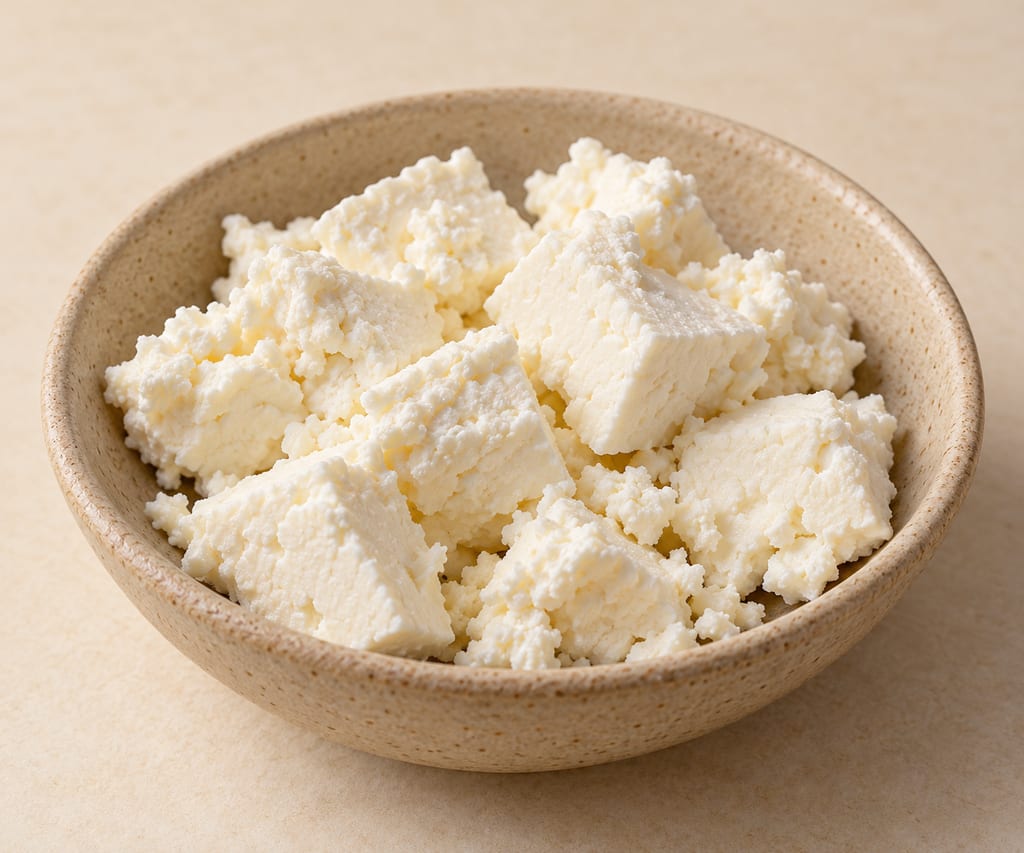
Whole milk set with a mesophilic starter and rennet makes a fresh, crumbly feta-style cheese. Its curds pass through hot salted whey before molding.
No community contributions have been published for this entry yet.
Sign in to contribute. Published comments and photos are free to read.
U.S. Electronic Code of Federal RegulationsProcess · Safety
U.S. regulation, 21 CFR § 131.110, “Milk,” displayed edition 6 October 2026U.S. milk standard: minimum 3.25% milkfat and 8.25% milk solids other than fat; permitted standardization and homogenization.
Cited in: What “whole” tells you; Choosing it, handling it, and using it
Food and Agriculture OrganizationProcess
FAO, “Milk composition,” Gateway to dairy production and productsApproximate milk composition and differences among dairy animal species.
Cited in: What “whole” tells you; A layered liquid: water, fat, proteins, sugar, minerals; Other animals, other milk
Food and Agriculture OrganizationProcess · History
FAO, Milk and Dairy Products in Human Nutrition, chapter 3, table 3.1Table 3.1 comparative water, fat, protein and lactose values by species, and species-specific dairy uses.
Cited in: What “whole” tells you; A food older than the modern dairy industry; A layered liquid: water, fat, proteins, sugar, minerals; Other animals, other milk
University of GuelphProcess
Goff, Hill and Ferrer, “Milk Composition,” Dairy Science and Technology eBook, University of GuelphMilk composition, casein and whey proteins, lactose, fat and minerals.
Cited in: What “whole” tells you; A layered liquid: water, fat, proteins, sugar, minerals; Other animals, other milk
University College LondonHistory
Evershed et al., “Dairying, diseases and the evolution of lactase persistence in Europe,” Nature 608 (2022), 336–345; author-accepted manuscript hosted by UCL DiscoveryVariable prehistoric dairying evidence and the distinction between milk use and lactase-persistence selection.
Cited in: A food older than the modern dairy industry
University of GuelphHistory
Goff, Hill and Ferrer, “Brief History of the Dairy Industry,” Dairy Science and Technology eBook, University of GuelphHistorical development of dairy production and processing.
Cited in: A food older than the modern dairy industry
University of GuelphProcess
Goff, Hill and Ferrer, “Animal Husbandry and Farm Practices,” Dairy Science and Technology eBook, University of GuelphFarm milking conditions and cooling of milk after withdrawal.
Cited in: From the animal to the carton
University of GuelphProcess · Safety
Goff, Hill and Ferrer, “Overview and Fluid Milk Products”Fluid-milk separation, standardization and handling before sale.
Cited in: From the animal to the carton; Choosing it, handling it, and using it
University of GuelphProcess
Goff, Hill and Ferrer, “Homogenization of Milk and Milk Products”Homogenization reduces fat-globule size and slows cream separation.
Cited in: From the animal to the carton
U.S. Food and Drug AdministrationProcess
FDA, “Dairy Product Manufacturers” (pasteurization definition and times/temperatures)One regulated U.S. high-temperature short-time pasteurization combination is 161°F for 15 seconds.
Cited in: From the animal to the carton
U.S. Food and Drug AdministrationProcess · Safety
FDA, “Raw Milk Misconceptions and the Danger of Raw Milk Consumption”Raw milk can carry pathogens; pasteurization is a microbial control step, distinct from homogenization.
Cited in: From the animal to the carton; Choosing it, handling it, and using it
University of GuelphProcess
Goff, Hill and Ferrer, “Milk Lipids” and “Milk Composition,” University of GuelphMilkfat globules and their physical behavior in fluid milk.
Cited in: A layered liquid: water, fat, proteins, sugar, minerals
University of GuelphProcess · Ingredient context · Safety
Goff, Hill and Ferrer, “Cultured Dairy Products and Cheese”Milk’s transformation into cultured dairy and cheese and the role of curd and whey separation.
Cited in: A layered liquid: water, fat, proteins, sugar, minerals; The milk chosen for a job; Choosing it, handling it, and using it
New Mexico State University ExtensionProcess · Ingredient context · Safety
Making Homemade Cheese, NMSU Guide E-216NMSU home cheese methods, including distinct Queso Fresco, Neufchâtel and MT1 Feta-style processes.
Cited in: A layered liquid: water, fat, proteins, sugar, minerals; The milk chosen for a job; Other animals, other milk; Choosing it, handling it, and using it
Utah State University ExtensionIngredient context
Utah State University Extension, Wasatch County, “Mozzarella Cheese,” March 2021Whole-milk quick mozzarella formula and the named roles of citric acid and rennet.
Cited in: The milk chosen for a job
Utah State University ExtensionIngredient context
Utah State University Extension, “Buttermilk – the old fashioned way”Home cultured-buttermilk method using whole milk.
Cited in: The milk chosen for a job
www.uaf.eduSafety
University of Alaska Fairbanks Cooperative Extension, Julie Cascio, “Making Fresh Mozzarella,” revised July 2024Source-specific milk choice and handling for fresh mozzarella.
Cited in: Choosing it, handling it, and using it