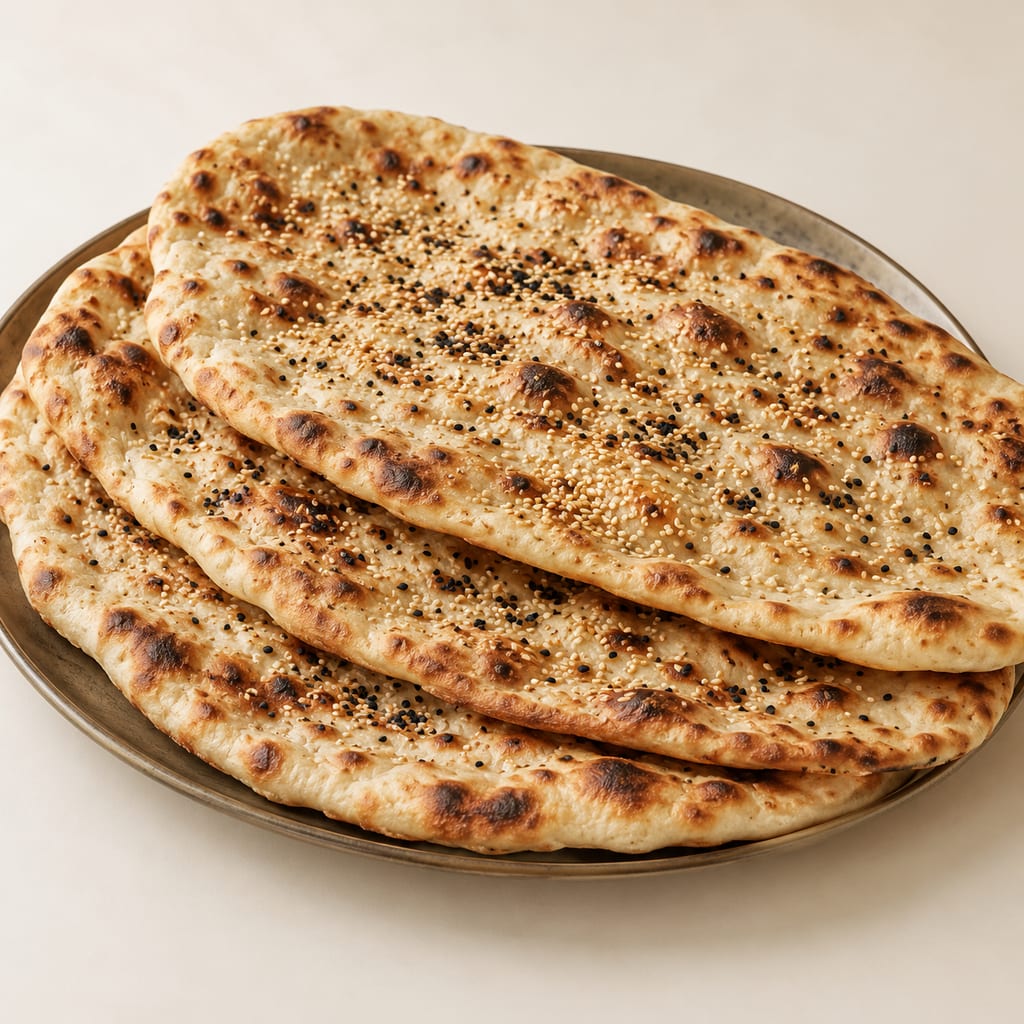
Taftoon
Persian yeast-raised flatbreads, rolled thin, seeded and cooked in a dry skillet.
 FermenteaWhere food goes to change
Modern adaptation
نان افغانی · Naan-e-Afghani · Nan-e-Afghani
A long oval Afghan wheat bread, leavened with yeast, grooved along its length and baked until crisp outside and chewy within.
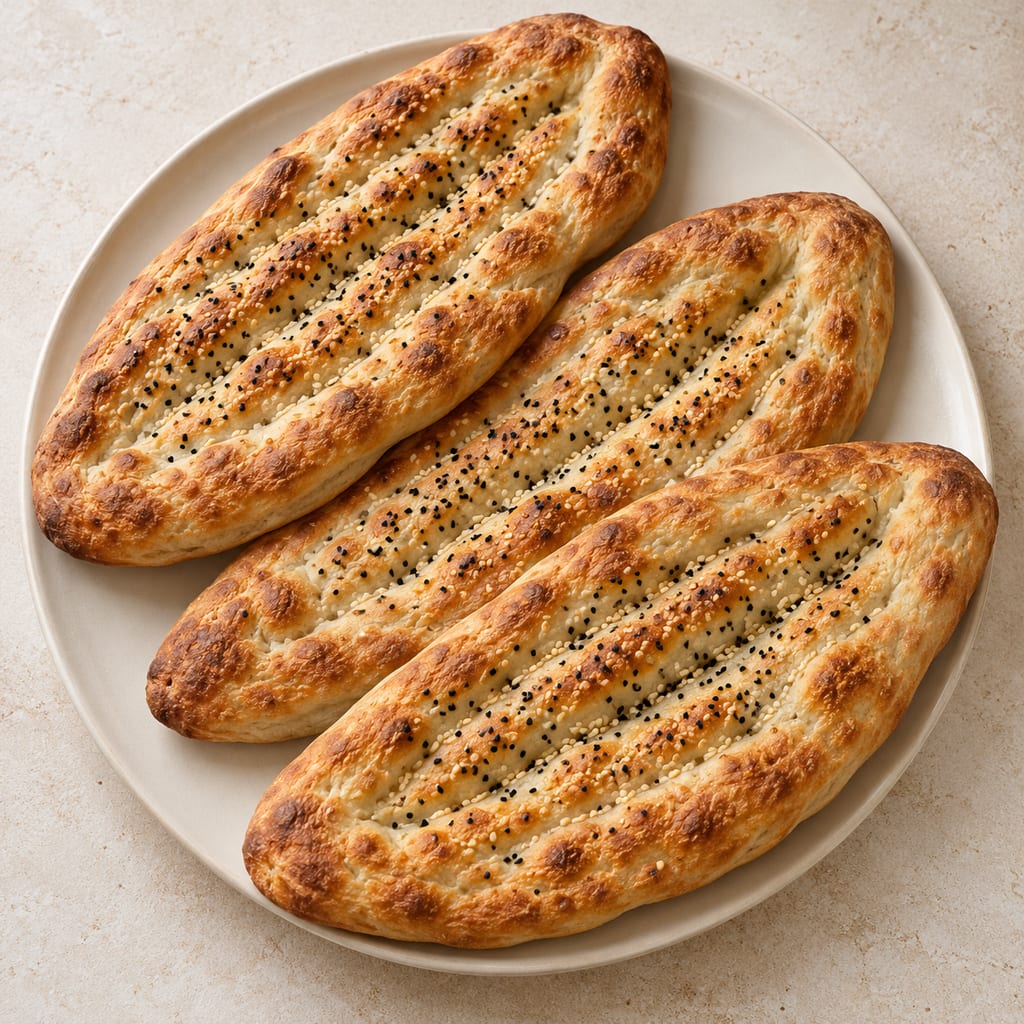
Afghan naan is a leavened wheat flatbread made in a family of breads with several shapes, thicknesses and baking traditions. This version is an elongated oval, scored with three long grooves and baked until its outside is golden and crusty while the inside stays chewy. The recipe comes from Humaira Ghilzai, an Afghan author, through King Arthur Baking’s tested home-oven version. It adapts a bread associated with Afghan households and bakeries to ordinary baking sheets and an oven, while keeping the oval form, long scoring and optional sesame topping.
The name naan travels widely across Persianate, Central Asian and South Asian food traditions. A shared word does not mean a shared dough or cooking method. Encyclopaedia Iranica describes Afghan bread in several forms, made from different grains and baked in different settings; the formula here is one wheat-based, yeast-raised household preparation. It should be read as Afghan naan in a specific home method, not a universal recipe for every bread called naan.
Bread is central to everyday Afghan meals. Ghilzai describes naan served whether rice is present or not, and pairs this version with fried eggs, a meat stew, feta and cherry jam, or cardamom black tea. Iranica likewise notes the prominence of bread and tea in daily eating. Community accounts distinguish bread by thickness and shape: Afghan naan is generally oval, obi naan is thicker and more disk-shaped, and lavash is much thinner. These distinctions help explain why a thick, grooved oval is not simply interchangeable with every other flatbread.
Bread also carries social meaning beyond its ingredients. In their writing about Afghan food and diaspora, Durkhanai Ayubi and Mina Sharif connect naan and kebab with shared family meals and memories of home. Bread can be used to scoop or carry accompanying food, so its shape, flexibility and freshness matter at the table as well as in the oven. This loaf is cut into strips or squares after baking, an easy way to share it beside stew, eggs or other meal dishes.
Afghan naan belongs to a long history of breadmaking in a region where people have used wheat and other grains, and where bread has been baked on the walls of clay ovens, on griddles and beside campfires. Iranica documents those different techniques and forms, but does not offer a secure first date for this particular modern recipe. It would be misleading to assign naan a single inventor or claim that one contemporary oval is the only historical Afghan form.
The reliable history here is about continuity and variation: bread remains part of daily life, while local flours, ovens, shapes and leavening differ. A neighborhood bakery and a domestic oven make different conditions for the same general family of dough. The King Arthur formula is modern and test-kitchen adapted. It uses instant yeast and conventional oven sheets; those details should not be retrojected onto every earlier or traditional naan. The method preserves the author’s household expression without pretending it is a reconstruction of an undocumented historical formula.
In Afghanistan, neighborhood bakeries called naanwayi are commonly organized around a tandoor, a deep clay oven. A contemporary Afghan food overview describes bakers shaping the dough and attaching it to the oven’s hot inner wall, then retrieving the baked loaf with a long tool. Some families prepare dough at home and carry it to a local bakery. That arrangement makes breadmaking a shared neighborhood service as well as a household task: one specialist oven bakes dough from many homes.
A home baking sheet cannot reproduce the tandoor’s wall contact, intense radiant heat or the baker’s rapid transfer. The King Arthur recipe makes an explicit domestic adaptation: shape the dough into long ovals and bake it on parchment-lined sheets in a preheated 450°F oven. It produces a useful loaf with a golden crust, but not the exact scorch, oven profile or aroma of a tandoor. This distinction lets readers use the method without mistaking a workable home version for an identical bakery process.
This dough is leavened with instant baker’s yeast. As yeast ferments sugars available in the dough, carbon dioxide accumulates in the elastic network formed by hydrated wheat proteins; this gas expands the dough during the covered rise. Kneading develops a smooth, elastic dough that can hold some of that gas, while the warm-water addition hydrates the flour and brings the mixture together. The recipe calls for a somewhat sticky dough rather than a stiff one, so flour should be measured without packing it into the cup.
The first rise lasts about an hour, until the dough is nearly doubled, and the shaped loaves rest for another 20–30 minutes before baking. These are separate stages: the first builds volume in the dough, while the shorter rest relaxes it after division and shaping. Temperature, yeast activity and flour absorption affect the pace, so the stated visual cue matters alongside the clock. The method does not call for sourdough starter or a long cold fermentation, and this yeast-raised version should not be blended with a sourdough formula.
All-purpose wheat flour gives the dough its structure and chew. Water hydrates flour proteins and starch, allowing a dough to form; the recipe’s 454 grams (2 cups) is added gradually because the dough should remain soft and slightly sticky. Salt seasons the bread and affects dough behavior. Instant yeast provides the leavening. A modest amount of vegetable oil enriches the dough and helps make it supple, without turning this into a laminated or fried bread.
Nigella seeds give the loaf its characteristic aromatic topping in Ghilzai’s account; sesame is an optional second seed. The method presses the seeds lightly into the surface before baking so they stay attached. The source does not call for dairy, egg, sugar, butter, or a glaze in the dough. Keeping the ingredient list simple preserves the recipe’s wheat, yeast and seed character. The actual recipe’s stated yield is three large loaves, each about 9 by 15 inches, and the source divides the dough into portions of roughly 375 grams.
The source gives both a food-processor route and a stand-mixer or hand-mixed route. In a processor, combine flour, salt and yeast first, then stream in the oil followed by warm water until the dough gathers into a smooth mass. By hand or mixer, stir the dry ingredients together, add oil and then incorporate water gradually. Knead until the surface feels smooth and elastic while the dough remains somewhat tacky. If it sticks heavily to a processor bowl, scrape down the sides and continue mixing briefly; avoid correcting stickiness by adding an unmeasured amount of flour.
Transfer the dough to a lightly greased bowl, cover it and let it rise until nearly doubled, about one hour in the tested method. The cue helps account for differences in room temperature and dough conditions. The dough should have visibly expanded and feel aerated rather than remaining a dense lump. This recipe does not prescribe a specific proofing temperature. The covered bowl limits drying at the surface; an uncovered skin can resist later stretching and create uneven texture.
After the first rise, gently deflate the dough and divide it into three pieces of about 375 grams. Work with one portion at a time on a lightly floured surface. Dipping the hands in warm water lets the sticky dough stretch without burying it under extra flour. Shape each piece into an elongated oval approximately 14–15 inches long and 8–9 inches wide. These dimensions make broad loaves that sit within the baking-sheet format and are easy to tear for a shared meal.
Cut three deep lengthwise slashes into each loaf with a bowl scraper or butter knife, stopping before cutting through. The slashes create the bread’s recognizable grooved surface and allow expansion in those lines. If a cut reaches all the way through, the loaf may split as it is moved or baked. Place each oval on parchment on its own sheet, cover, and let it rest for 20–30 minutes. The dough should relax before it enters the oven; the rest is not an additional first rise.
The seed topping combines nigella with optional sesame. Mix them in a small bowl, scatter them over the loaves and press gently so they adhere to the damp dough. This is a restrained topping rather than a heavy crust of seeds. Ghilzai describes the nigella as contributing a smoky hint; exact flavor varies with the seed and its freshness, so the recipe does not need another spice mixture or an oil wash.
Bake in the preheated 450°F oven, using convection if available, for 18–22 minutes until the loaves are golden brown and crusty outside. The recipe uses three lined sheets rather than a tandoor or a baking stone. If using convection, the air movement and heat distribution may alter browning slightly, so observe the source’s color and crust cues. Remove the bread when it is golden rather than waiting for deep dark char that belongs to a different heat source or personal preference.
Serve naan warm, cut into strips or squares. Its oval shape makes it easy to tear and pass around. Ghilzai suggests it with fried eggs, shorwa, or feta with cherry jam, and pairs it with cardamom black tea. The bread’s flexible crumb works well for scooping up stew or accompanying rice. In Afghan cooking, naan is one element in a meal whose other dishes vary by region, household and occasion; no single stew or garnish defines the bread.
The shape, crust and chewy interior are useful at the table. A thinner lavash-like bread may wrap fillings differently; a thicker obi naan may make a more substantial disk. This loaf sits between those in its home recipe: thick enough to carry food, scored into an elongated form, and baked to a crisp surface with a yielding center. It is not filled or brushed with butter in this source method. Pairings can be adapted, but the recipe itself stays plain apart from seeds.
Afghan bread is not one shape. Iranica describes both leavened and unleavened breads, and flours from wheat, barley, corn, lentils and millet. A community profile distinguishes oval naan from the thicker round obi naan and the very thin lavash. The Afghan food overview notes further local differences, including elongated and round forms, and the use of tandoor ovens. These variations are related by their role as bread, not by a single dough formula.
This recipe is a wheat, instant-yeast, oven-baked oval with nigella and optional sesame. An enriched naan-e-roghani, a thinner lavash, an unleavened griddle bread or a tandoor-baked round would require separate methods. Ingredients and cooking surfaces change the crumb, thickness, crust and serving role. The recipe should not be silently altered into a soft restaurant-style butter naan or a charred wall-baked version. A different bread may be a useful companion recipe, but it is not the same preparation merely because it shares the word naan.
King Arthur Baking advises wrapping leftover naan well and keeping it at room temperature for several days, or freezing it for longer storage. It suggests reheating in an oven or toaster oven before serving. Keep the warm loaves wrapped in a clean dish towel as they cool if you want them to remain moist; the towel is a serving and cooling aid, not a storage substitute for a sealed package.
Flour is a raw agricultural ingredient and can carry harmful bacteria. The FDA advises against tasting raw dough or batter and recommends keeping flour and dough away from ready-to-eat foods, washing hands and surfaces, and baking according to the recipe. This dough is fully baked in the source method; do not taste it raw during mixing or shaping. Wheat flour contains gluten, and this formula is not gluten-free. The source does not provide a special allergen-free substitution, so changing the flour would change the recipe and its structure.
The home-oven route keeps the central decisions clear: mix a soft wheat dough, give the yeast time to raise it, divide it evenly, stretch it long, make the grooves deep without severing the loaf, then bake it on lined sheets in a hot oven. These choices link the bread’s form to its eating qualities. A long oval gives substantial pieces to tear; the grooves mark and divide the surface; yeast makes a softer interior than an unleavened sheet; the high oven sets and browns the crust.
This method is a documented American home adaptation by an Afghan author, not a historical claim that Afghan bakeries use baking sheets. It is useful where a tandoor is unavailable and is explicit about its equipment and bake. The result should be understood on its own terms: large oval naan with a crisp exterior, chewy interior and seed aroma, suited to a shared meal. The source’s timing and yield are retained; the page does not invent additional dough temperature targets, a fermentation schedule beyond the tested steps, or a safety guarantee from appearance.
Afghan naan is part of a broad Afghan bread tradition that includes leavened and unleavened breads, varied grains, and tandoor, griddle and campfire methods. This recipe is a modern tested home-oven version by Afghan author Humaira Ghilzai; it is not a reconstruction of every Afghan bakery method. The available sources do not establish a first date or inventor for the named bread.
Yield 3 large flatbreads · Scaling: source batch only
Flour is a raw food and can carry harmful bacteria; raw dough should not be tasted.
Hazard sourceDo not taste raw dough; keep flour and dough away from ready-to-eat foods, wash hands and surfaces, and bake as directed.
Control sourceContains wheat and gluten.
Do not taste the raw flour dough.
Country-level association for the Afghan bread family; the source records multiple regional breads and methods, not one exclusive formula.
Persian yeast-raised flatbreads, rolled thin, seeded and cooked in a dry skillet.
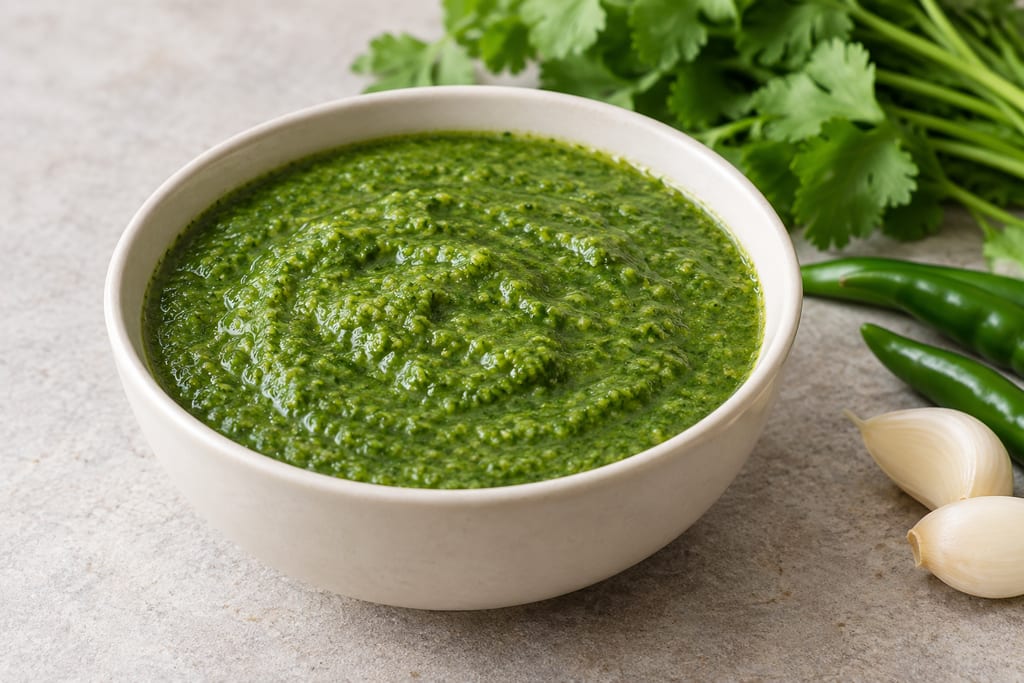
Afghan coriander chatni is a sharp, hot herb sauce with garlic and vinegar. A 2008 Afghanistan manual records green or red pepper and optional walnut; heat and household versions vary.
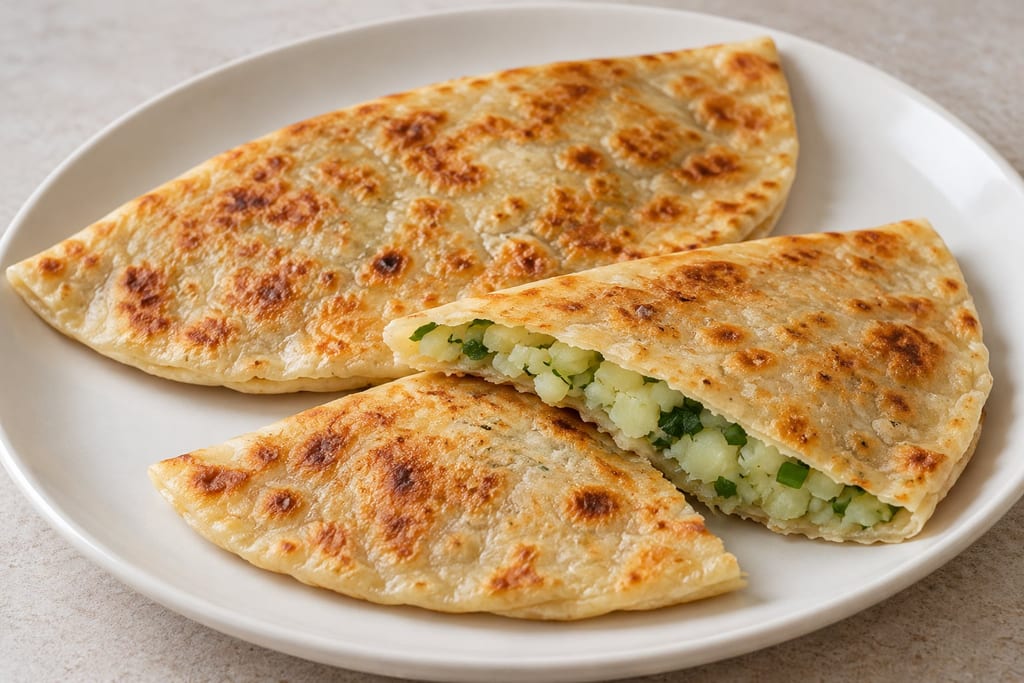
A thin, unleavened Afghan flatbread filled with mashed potato, scallion and cilantro, folded and pan-browned. This version uses a dough made from scratch.
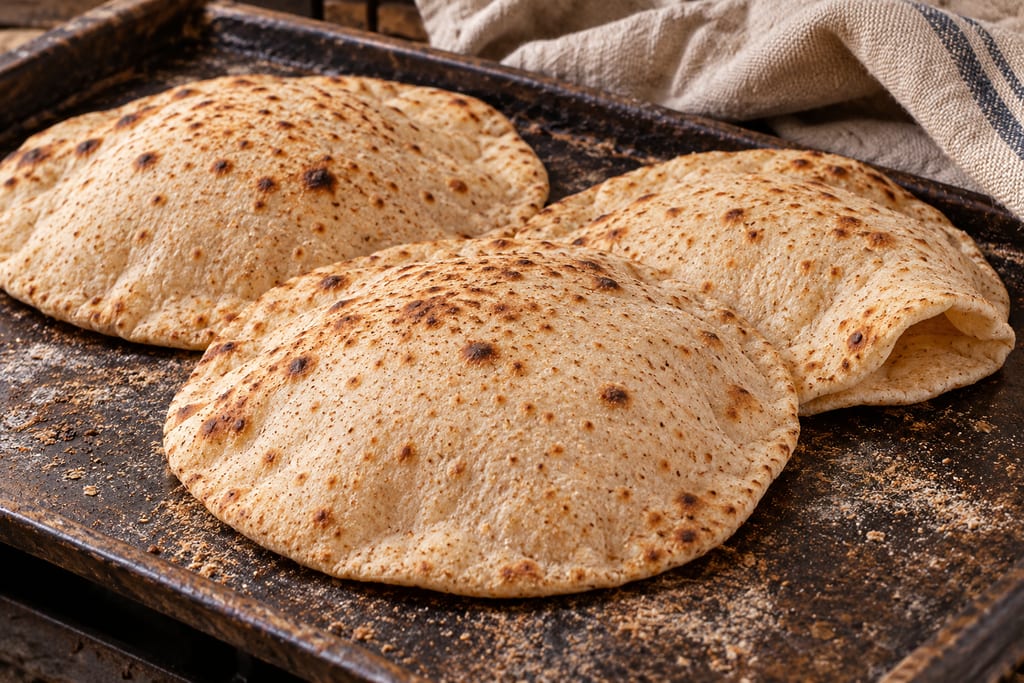
This home adaptation of Egyptian aish baladi uses a refrigerated yeast biga, whole-wheat dough, bran dusting and a very hot baking surface to make 16 pocketed rounds.
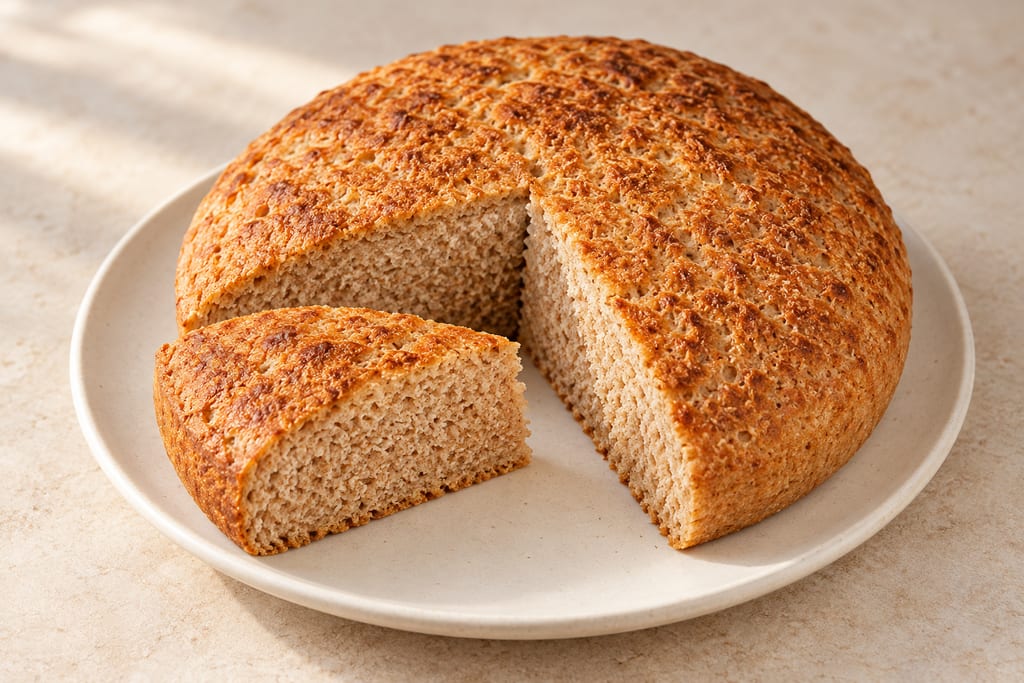
This oven-baked Amdo balep uses yeast, whole-wheat and white flour, a long covered rise and a two-sided bake in a heavy oven-safe pot.
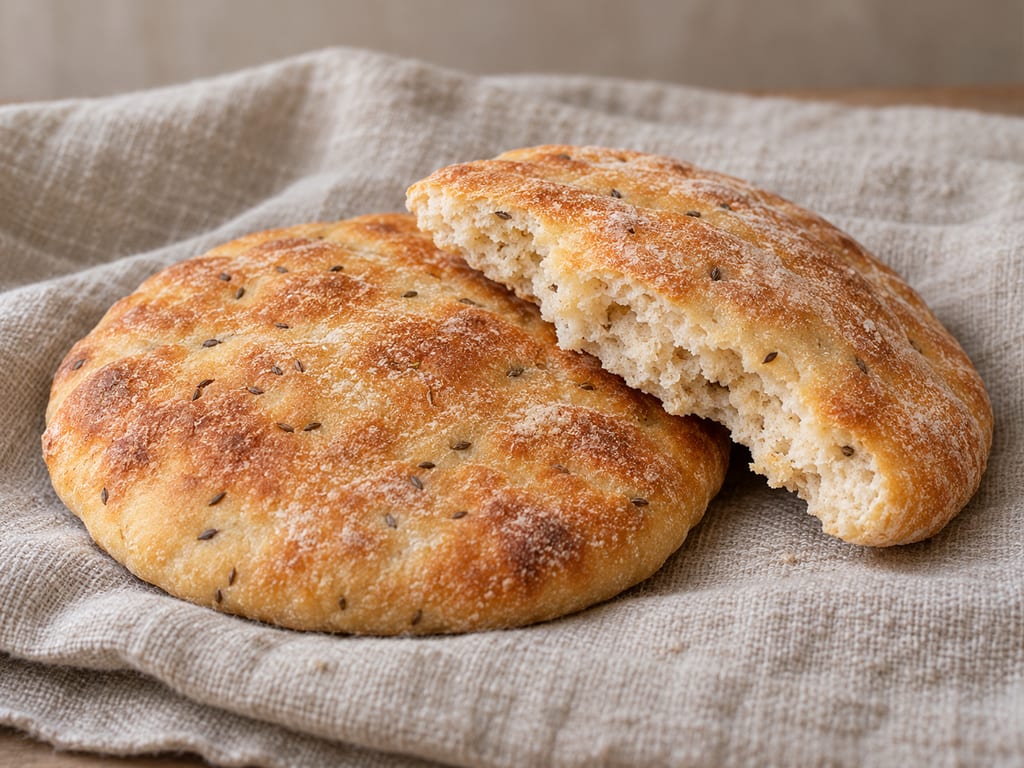
A measured, yeast-raised Ayacucho chapla home method shared by Thermomix Peru presenter Roxanna Salaverry. It makes thin, anise-scented rounds baked at 240°C; the historic qunchu-leavened form is documented separately.
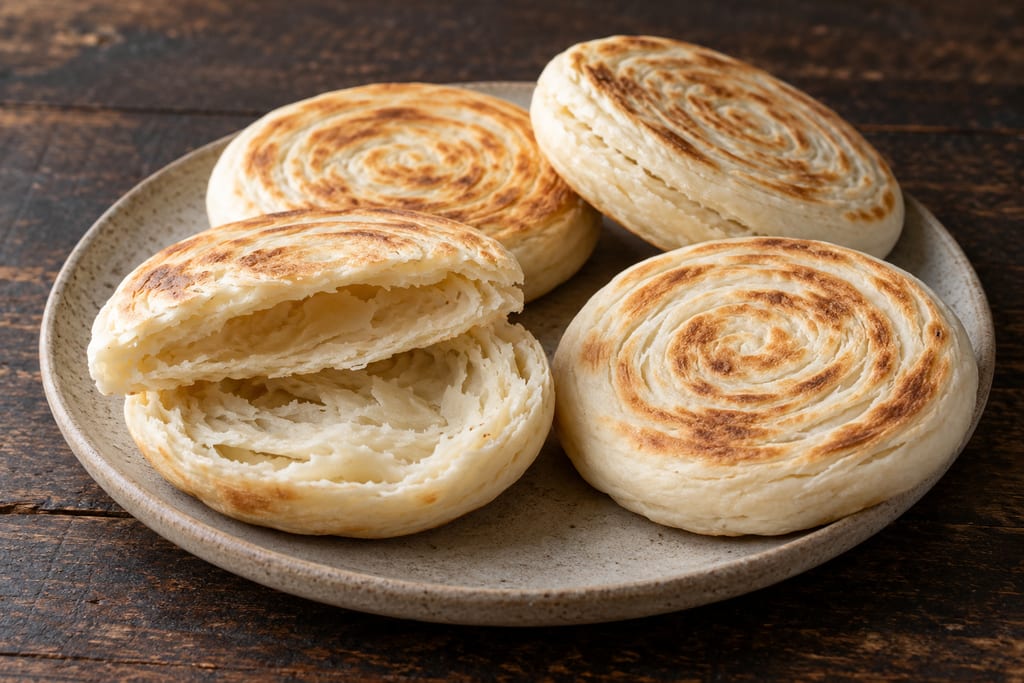
This Shaanxi-associated yeast flatbread uses a simple water dough, coiled shaping and a skillet bake. It is the bread used in roujiamo, not the filled meat dish.
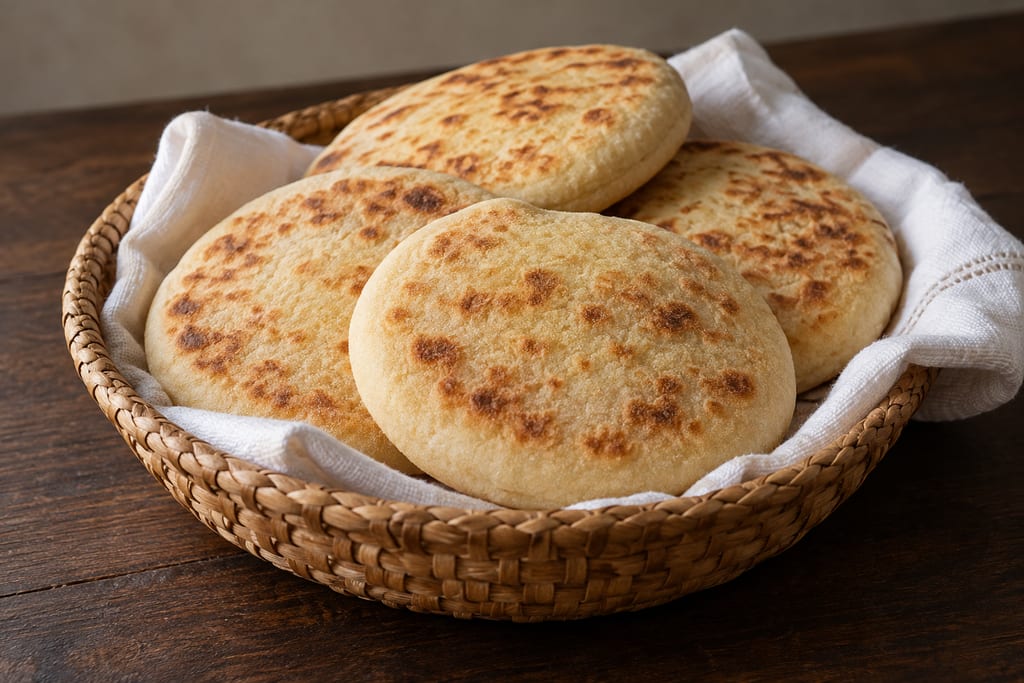
A Moroccan yeast-raised semolina pocket bread cooked on a dry pan or griddle; this measured batch makes about twenty 4-inch rounds.
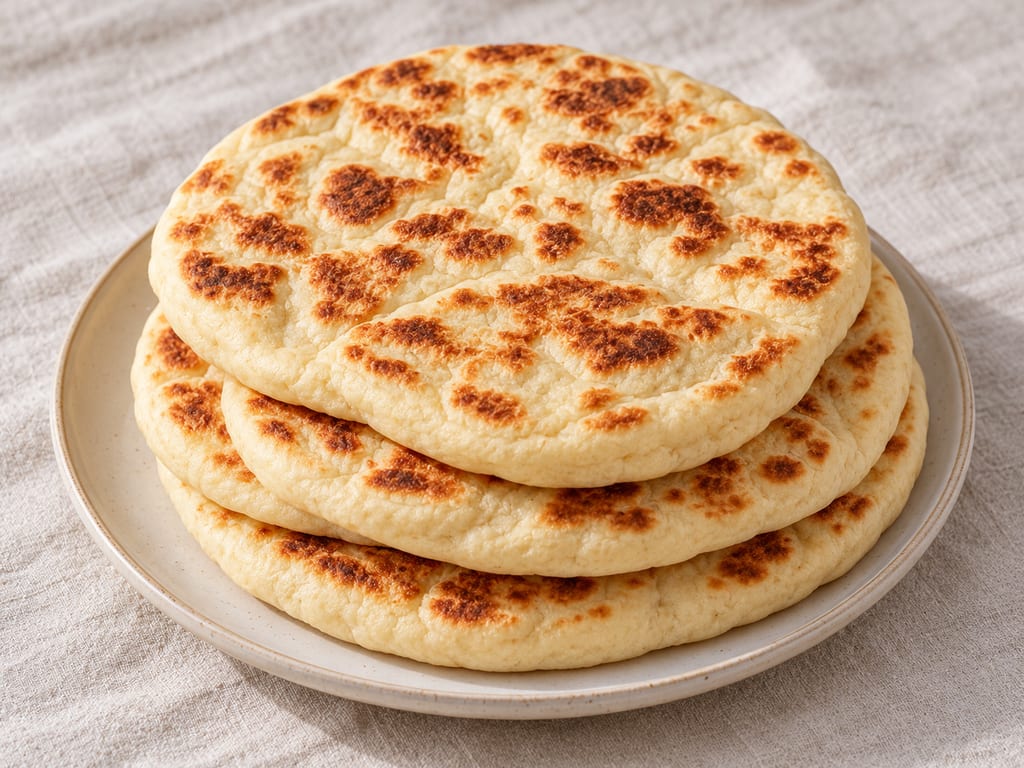
This Turkish bazlama uses yeast, plain yogurt and olive oil for a soft dough cooked in a skillet. Shape it into twelve small or six larger rounds, flip as bubbles appear, and wrap the breads to keep them soft.
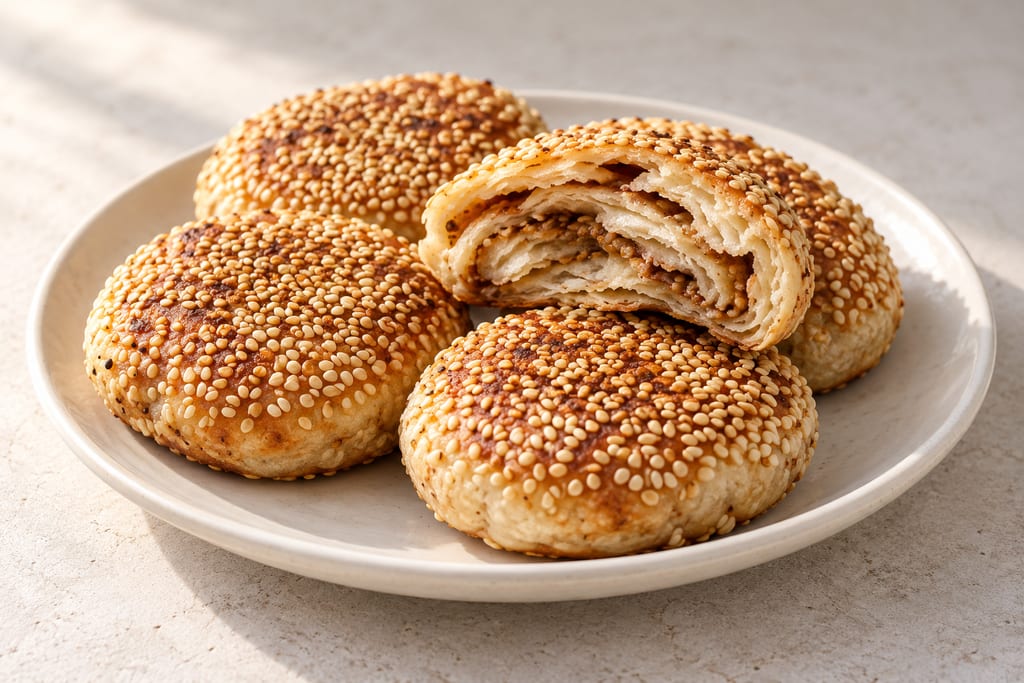
A Beijing-style yeast dough is layered with seasoned sesame paste, sealed into small buns, briefly pan-fried, seeded, and baked.
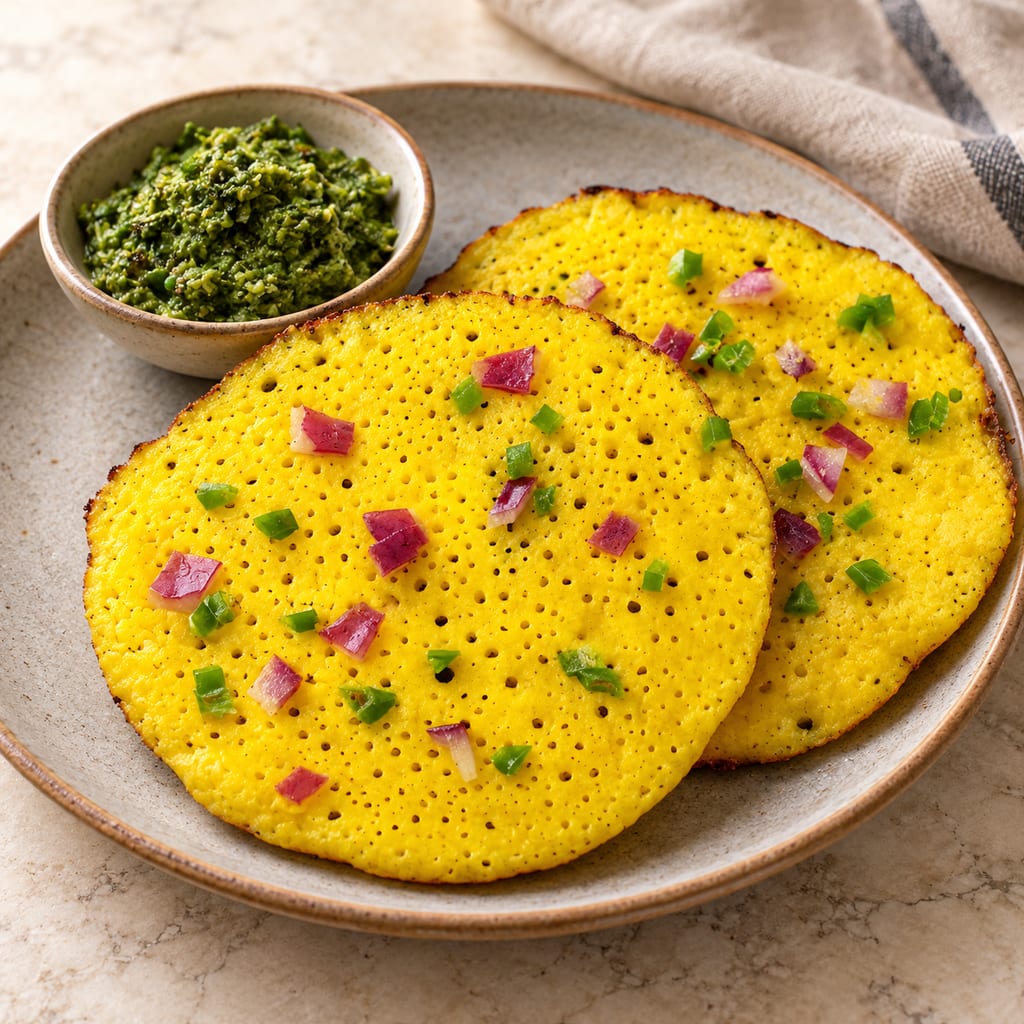
Spongy rice-and-coconut pancakes associated with Goa, cooked on one side from a batter that a multicooker's yogurt programme lets rise overnight.
No community contributions have been published for this entry yet.
Sign in to contribute. Published comments and photos are free to read.
King Arthur BakingMethod · Ingredients · Uses · Home adaptation
Afghan NaanTested home oven formula and method; ingredient quantities, rise, shape, grooves, seed topping, bake, serving and storage; Afghan author’s account of household use.
Cited in: Naan in an Afghan meal; Bread, hospitality and everyday life; A tradition without a single origin date; The naanwayi and the tandoor; How the dough rises; What each ingredient contributes; Mixing and judging the dough; Shaping the long oval; Seeds and oven baking; Serving the bread; Keeping leftovers and handling flour; A practical home adaptation
Encyclopaedia IranicaHistory · Geography · Uses
Cooking iv. In AfghanistanBread’s central role in Afghan daily diet; regional bread differences; leavened and unleavened breads; wheat, barley, corn, lentil and millet flours; traditional tandur, griddle and campfire cooking.
Cited in: Naan in an Afghan meal; Bread, hospitality and everyday life; A tradition without a single origin date; The naanwayi and the tandoor; How the dough rises; Serving the bread; Variations that deserve their own names
Al JazeeraCulture · Uses · Diaspora
Yearning for Afghanistan, in one mealAfghan authors describe naan with kebab, family memory and the place of bread in Afghan cuisine and diaspora households.
Cited in: Bread, hospitality and everyday life; A practical home adaptation
About AfghanistanGeography · Technique · Regional variants
NaanContemporary overview of neighborhood naanwayi bakeries, tandoor wall baking, shape differences and an oven adaptation based on Humaira Ghilzai.
Cited in: A tradition without a single origin date; The naanwayi and the tandoor; Variations that deserve their own names; A practical home adaptation
Michigan Department of Health and Human ServicesCulture · Serving
Exploring the Afghan CultureCommunity resource distinguishes naan, obi naan and lavash by shape and thickness and describes bread as a staple at meals.
Cited in: Bread, hospitality and everyday life; Serving the bread; Variations that deserve their own names
U.S. Food and Drug AdministrationSafety
Flour Is a Raw Food and Other Safety TipsRaw flour can contain harmful bacteria; raw dough should not be tasted and flour should be handled with food-safety hygiene.
Cited in: Keeping leftovers and handling flour