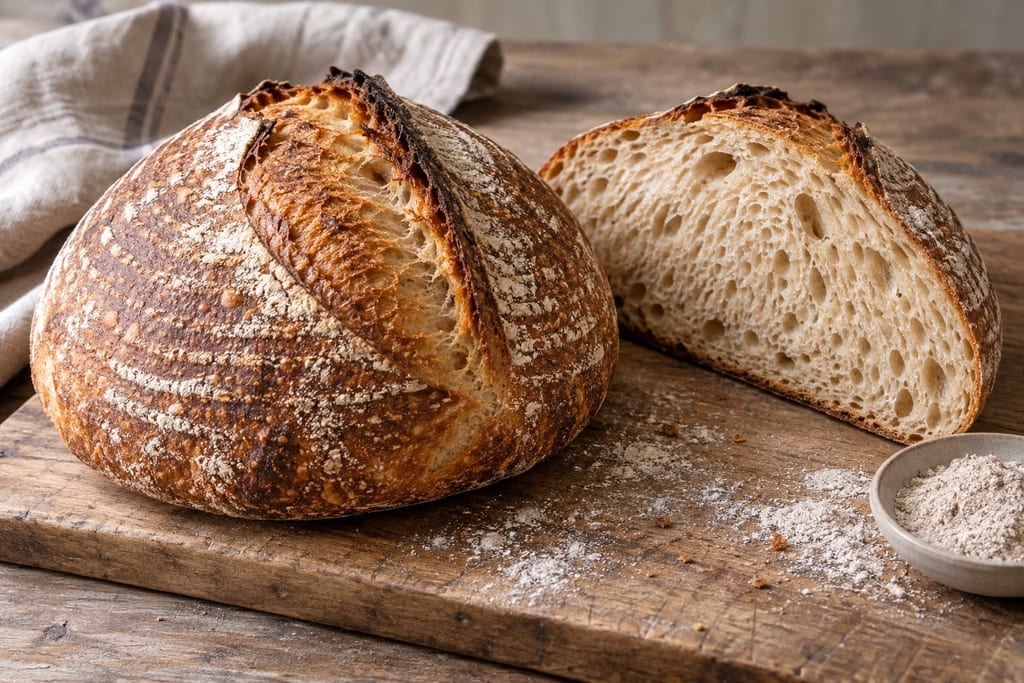
Vermont-style rye levain bread
Jeffrey Hamelman's Vermont sourdough builds a liquid wheat levain before adding a modest measure of rye flour blend. The dough is folded, shaped and baked as two crusty loaves with a tender, open crumb.
 FermenteaWhere food goes to change
Salt
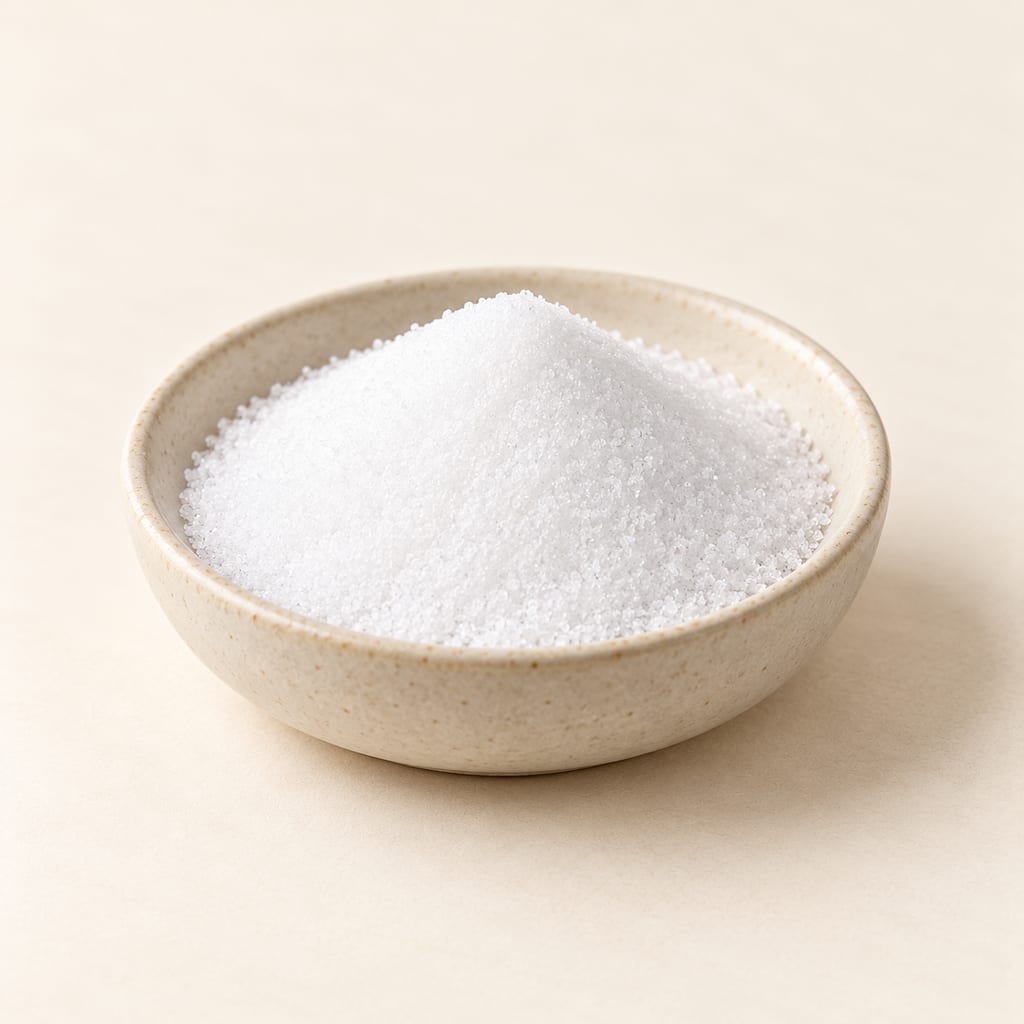
Table salt is fine-grained food-grade sodium chloride for everyday seasoning and measured cooking. Products may include iodine or an anti-caking agent.
At O Areal, near present-day Vigo, and at Caunos in Turkey, archaeologists have found the remains of Roman marine salt works. The pans and channels turned seawater into a harvestable mineral through evaporation. Nearby fish-salting workshops show why a dependable salt supply mattered: fish could be preserved and sold beyond the day of the catch. The excavated workshops are far more numerous than surviving salt pans. Salt dissolves, vessels are reused, and coastal structures disappear or are rebuilt, so the places where people consumed salt are often easier to see than the places where they made it.
Those sites and Roman legal evidence complicate the familiar picture of a single state monopoly on marine salt. In the late Republic and the first two centuries of the Empire, public ownership appears to have been an exception among the marine works for which evidence survives. Towns and private owners could hold salt works, while fish processors of different sizes could obtain large quantities. This is a claim about a particular place and period, not proof that Roman salt was always cheap or that the same arrangements held in later states. It gives the kitchen ingredient a more vivid history than a general story about salt taxes.
The use of that salt ranged beyond seasoning. Roman accounts and archaeological sites connect it with fish preservation, animal husbandry, cheese making and other crafts. Salting fish was a way to reorganize time: the catch could be worked into a product with a different keeping life and route to market. A little salt at a modern table and a large supply for a coastal workshop have the same chemical identity, but they are different food practices. The thin white grains in a shaker should not be projected onto an excavated pan; the ancient makers were producing salt, not a standard modern table-salt grade.
Salt works depend on water, land and weather as much as on mineral deposits. A coastal pan needs conditions that allow water to evaporate and crystals to be gathered. Rock salt can instead be mined; underground deposits can also be dissolved to make brine. These pathways were used in different regions and periods. Their record is incomplete because salt itself rarely stays where it was used. The particular pans, containers and texts behind a historical claim matter more than a sweeping assertion that one route or one government explains the whole trade.
Table salt is the fine-grained, food-grade form of sodium chloride, NaCl. Sodium and chloride ions repeat in a regular crystalline arrangement; halite, the naturally occurring mineral, has a cubic crystal system. A pinch of processed salt will not necessarily show neat cubes. Grains may be grown in brine, crushed or screened to the size wanted by a manufacturer. The small grains spread readily through a wet mixture and disappear quickly on the tongue, giving the familiar clean saline taste without the coarse crunch of a finishing flake.
The name identifies a kitchen product and grain form rather than a separate chemical species. Sea salt, mined rock salt and refined table salt are all principally sodium chloride, but their other constituents, size, shape and processing vary. A sea origin does not by itself make a grain coarse or iodine-rich; a rock origin does not by itself make a salt suitable for a shaker. The finished product and its label are what a cook can compare. In a clear broth the fine grain becomes invisible; across a buttered slice of bread it can season the surface evenly without the visible decoration of flakes.
Crystal form changes the way a measured spoonful behaves. For several measures within Morton’s product range, a substitution uses more coarse kosher salt than fine table salt by volume. That is a product-specific comparison, not a universal teaspoon formula for all brands. For a dough or brine specified by weight, weigh the named quantity. If the recipe gives a volume, use its named salt type or a conversion supplied for the actual products being exchanged. The point is not that one salt is chemically stronger; differently shaped grains pack differently in the spoon.
Modern salt may begin as mined halite, natural brine or seawater. In solution mining, water dissolves an underground deposit and the brine is brought to the surface. Evaporation separates salt from that water. A vacuum pan uses reduced pressure to boil brine at a lower temperature; crystals are then separated, dried and graded. Solar evaporation relies on sun and wind in a suitable climate. Each route can lead to food salt, but the way the harvested crystals are washed, refined and sized determines the particular grade on the shelf.
The trade has a scale far beyond the kitchen. Brine, rock, solar and vacuum-pan salt supply markets as different as road de-icing, chemical manufacture and food processing. Its industrial categories make clear why a production total cannot be read as the amount eaten at table. Food-grade salt is a selected portion of a much larger mineral industry. In the kitchen the useful distinction is more immediate: the salt must be intended for food and have the grain form the preparation calls for.
A fine, regular grain is especially convenient where the ingredient must disappear into a mixture. Manufacturers can sort crystals by size and use additives to keep them free-flowing; the result is a salt that pours from a shaker and distributes through flour, soup or a brine. A coarse crystal or a delicate flake may be equally suitable food salt but gives the cook a different tactile tool. These are manufacturing and handling differences, not evidence that salt from one geological source has a different underlying NaCl molecule.
Some fine table salts contain an anti-caking ingredient to help the crystals pour after ordinary exposure to humidity. The additives vary across products. Some iodized table salt formulations, including Morton’s, contain calcium silicate; the ingredient belongs to that named product rather than every table salt. A cook making a clear pickle or following a tested preserving recipe should read the ingredient list and use the salt form specified there. The additive and the crystal shape are separate characteristics: a fine salt can be iodized or not, and a product can contain an anti-caking agent or be sold without one.
Iodized salt carries an iodine compound in addition to sodium chloride. Iodization makes a widely used seasoning a dietary source of iodine; it does not create a new species of salt crystal. In the United States, manufacturers may add iodine to salt or table salt but are not required to; retail packages carry the corresponding iodide statement. A package marked “iodized” therefore tells the buyer something specific. A salt without that marking should not be assumed to supply iodine merely because it came from the sea.
An iodized and a non-iodized fine salt will both season a soup or loaf through their main ingredient, NaCl. The reasons to choose one may be nutritional, a recipe specification or a desired product label. The presence of iodine does not tell the cook whether the grains are fine, flaky or coarse; conversely a fine grain does not reveal whether iodine was added. Reading those two pieces of information separately is more useful than treating “table,” “sea,” “kosher” and “iodized” as mutually exclusive salt species.
In wheat dough, salt has work to do before anyone tastes the baked bread. Dissolved sodium chloride changes the handling of yeast-leavened wheat dough and its gluten network; lowering salt can also alter bread volume and texture. The baker sees the practical result in how a dough stretches, holds gas and moves through fermentation. Salt also moderates yeast activity. Its effect is part of the whole formula, alongside flour, hydration, mixing and temperature; the same percentage can behave differently in different doughs.
Sourdough and baker’s-yeast breads do not respond identically to a salt reduction. In tested wheat and rye breads made by different dough methods, salt reduction changed volume, firmness, porosity and sensory qualities in different ways. This is why a salt adjustment is a recipe change rather than simply less seasoning at the end. The fine grain of table salt makes it easy to distribute through dough, but its chemical role comes from the dissolved salt. It is neither a starter culture nor a source of fermentable sugar.
Cut cabbage illustrates another role. Salt helps draw water from the vegetable, creating a brine in which the pieces can be submerged. The brine and the acid that develops as lactic acid bacteria use vegetable sugars shape the fermentation environment. Salt does not itself ferment the cabbage. A tested vegetable-fermentation method specifies an amount and basis for measuring it; changing the salt level or swapping spoonfuls of unlike crystals can change that environment. Follow the recipe’s mass or defined measure rather than relying on bubbles, smell or a casual taste to judge preservation safety.
Preservation calls for a more exact distinction than everyday seasoning. Brining, vegetable fermentation, fish salting and dry curing all use salt, but each has other controls and a particular ingredient form. Table salt is sodium chloride and must not be confused with curing mixes that add nitrite or nitrate. A tested method specifies the correct substance and amount for its food and process. The same mineral can thus be a small finishing seasoning in one dish and a measured process ingredient in another, with very different consequences for improvisation.
A fine food-grade salt belongs where quick, even distribution matters: bread dough, a batter, soup or a weighed brine. For a tomato, bread crust or chocolate finished just before eating, a larger flake can remain visible and crisp instead. The choice is about the eating moment. Fine salt can finish a dish too, but it will disappear faster against moisture and lacks a flake’s structure. In a dry seasoning mix, the small grain spreads across other powders; in water it dissolves to the same sodium and chloride ions as a large edible crystal.
A mass measurement remains the clearest way to move between grain forms. In a dry-salted cabbage ferment, the grains dissolve as juice emerges from the cut vegetable; a pickle brine begins as a measured salt-water solution. Once dissolved, the salt has no memory of its original grain shape, but the total amount and the recipe’s method still matter. If a recipe calls for a volume of an unspecified brand, there may be no exact cross-brand replacement. For brines and doughs where the salt amount affects the process, keep the stated amount and measurement basis.
Keep the shaker or bag closed and dry. Dry crystalline salt is chemically stable, while moisture can make it cake and shorten its useful free-flowing life. A cool, dry place or airtight container near cooking moisture helps preserve the grain’s easy flow. A label date on an iodized or seasoned product concerns that formulation; it does not mean the NaCl crystal itself has suddenly spoiled. Follow the particular maker’s handling guidance, especially if the salt carries added ingredients.
The cited Roman marine salt works attest salt production at particular sites, not a single origin for the modern fine table-salt grade.
Jeffrey Hamelman's Vermont sourdough builds a liquid wheat levain before adding a modest measure of rye flour blend. The dough is folded, shaped and baked as two crusty loaves with a tender, open crumb.
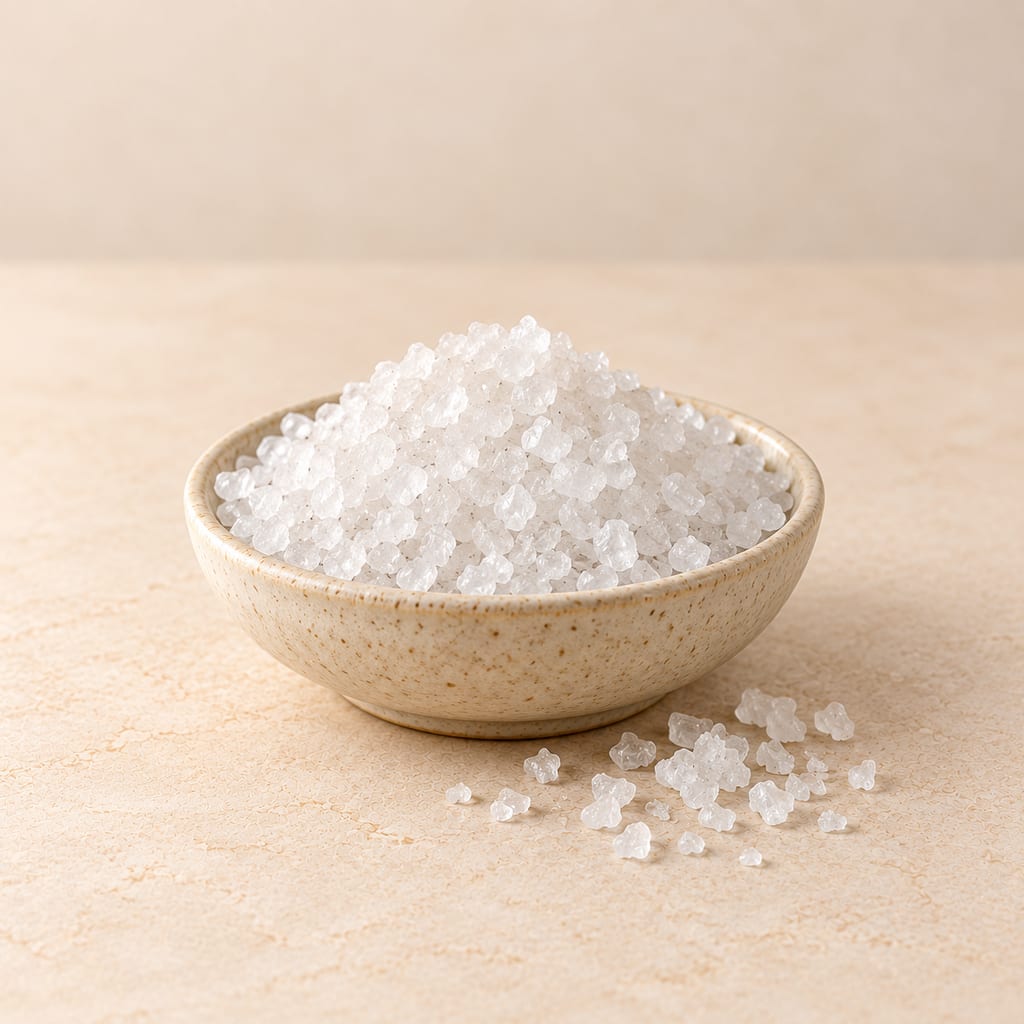
Coarse salt is food-grade salt in large grains, from sea, rock deposits or brine, used for curing, brining, pickling and packing fish.
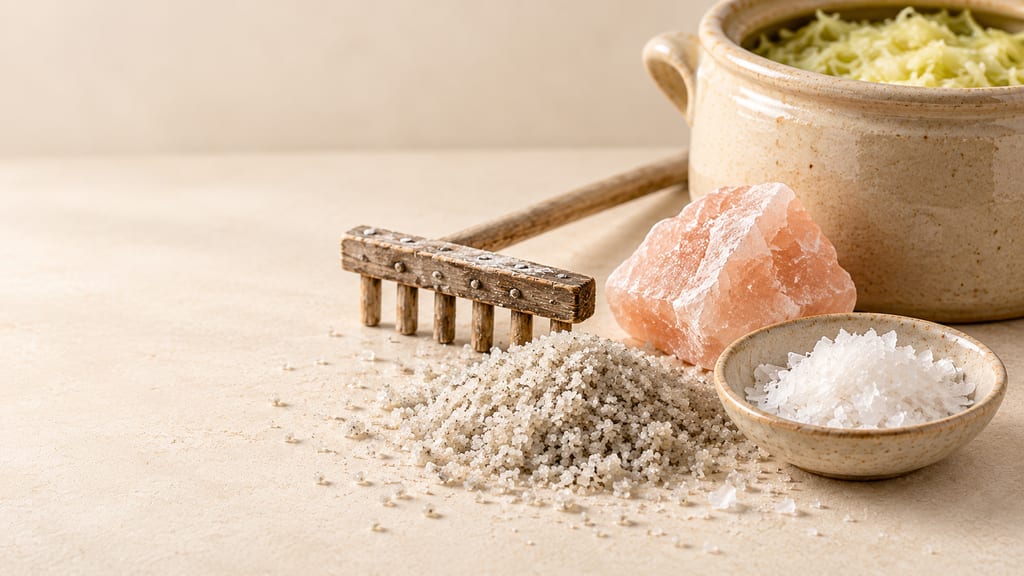
Salt seasons a meal, shapes fermentation and preserves food. Its history follows the people who mine, harvest, trade and transform it, and the choices hidden inside an ordinary packet.
No community contributions have been published for this entry yet.
Sign in to contribute. Published comments and photos are free to read.
Cambridge Crystallographic Data CentreIngredient · Editorial
So what are some crystals that you can find around you?NaCl identity and cubic crystal form.
Cited in: The mineral in the shaker
U.S. Geological SurveyIngredient · Editorial
Mineral Commodity Summaries 2025: Salt2024 U.S. salt type/use categories; world production figure not used.
Cited in: From deposit and brine to fine grains
Quaternary Science ReviewsIngredient · Editorial
Marine salt production in the Roman world: The salinae and their ownershiparchaeological basis and limits on claims of Roman state ownership.
Cited in: Salt works beside the Roman sea
U.S. Food and Drug AdministrationIngredient · Editorial
Questions and Answers Regarding Fortification PolicySection B9 explicitly states U.S. iodine addition to salt is optional and describes iodized/table salt retail labeling.
Cited in: Iodine, additives and the label
Journal of the Science of Food and AgricultureIngredient · Editorial
Impact of sodium chloride on wheat flour dough for yeast-leavened products. I. Rheological attributestested salt levels and wheat-dough rheology.
Cited in: Salt in bread and fermentation
Critical Reviews in Food Science and NutritionIngredient · Editorial
The impact of salt reduction in bread: a revieweffects of salt reduction on dough handling and bread quality.
Cited in: Salt in bread and fermentation
Food Technology and BiotechnologyIngredient · Editorial
Effect of Various Sodium Chloride Mass Fractions on Wheat and Rye Bread Using Different Dough Preparation Techniquescomparative yeast, natural sourdough and starter-sourdough bread outcomes.
Cited in: Salt in bread and fermentation
Morton SaltIngredient · Editorial
Salt Conversion ChartProduct-specific table/coarse kosher salt substitution by volume.
Cited in: The mineral in the shaker; Choosing and keeping table salt
Morton SaltIngredient · Editorial
Food Salt FAQIodized table salt ingredients and dry product handling.
Cited in: Iodine, additives and the label; Choosing and keeping table salt
Morton SaltIngredient · Editorial
Industrial Product Information FAQDry salt chemical stability and caking from moisture; product-specific storage.
Cited in: Choosing and keeping table salt
Morton SaltIngredient · Editorial
Salt Selection GuideDifferent food applications and methods for fine, coarse and other salt grades.
Cited in: From deposit and brine to fine grains; Salt in bread and fermentation; Choosing and keeping table salt
Oregon State University Extension ServiceIngredient · Editorial
Pickling vegetables (PNW 355; revised July 2019, reviewed 2024)Sauerkraut and fermented-pickle method distinguishes lactic-acid production from added-acid pickling; salt draws juice from cabbage, keeps produce submerged, and table salt may cloud brine while flake/kosher salt vary in density.
Cited in: Salt in bread and fermentation
Morton SaltIngredient · Editorial
Morton Tender QuickNamed meat-curing mix contains sodium chloride, sugar, sodium nitrate and sodium nitrite; maker warns that curing salts cannot replace regular salt in other recipes and instructs use at the stated recipe rate.
Cited in: Salt in bread and fermentation