Fully ripe dark olives are mixed with salt and turned weekly as salt draws out moisture. Distinct from existing brine-fermented and lye-treated olives.
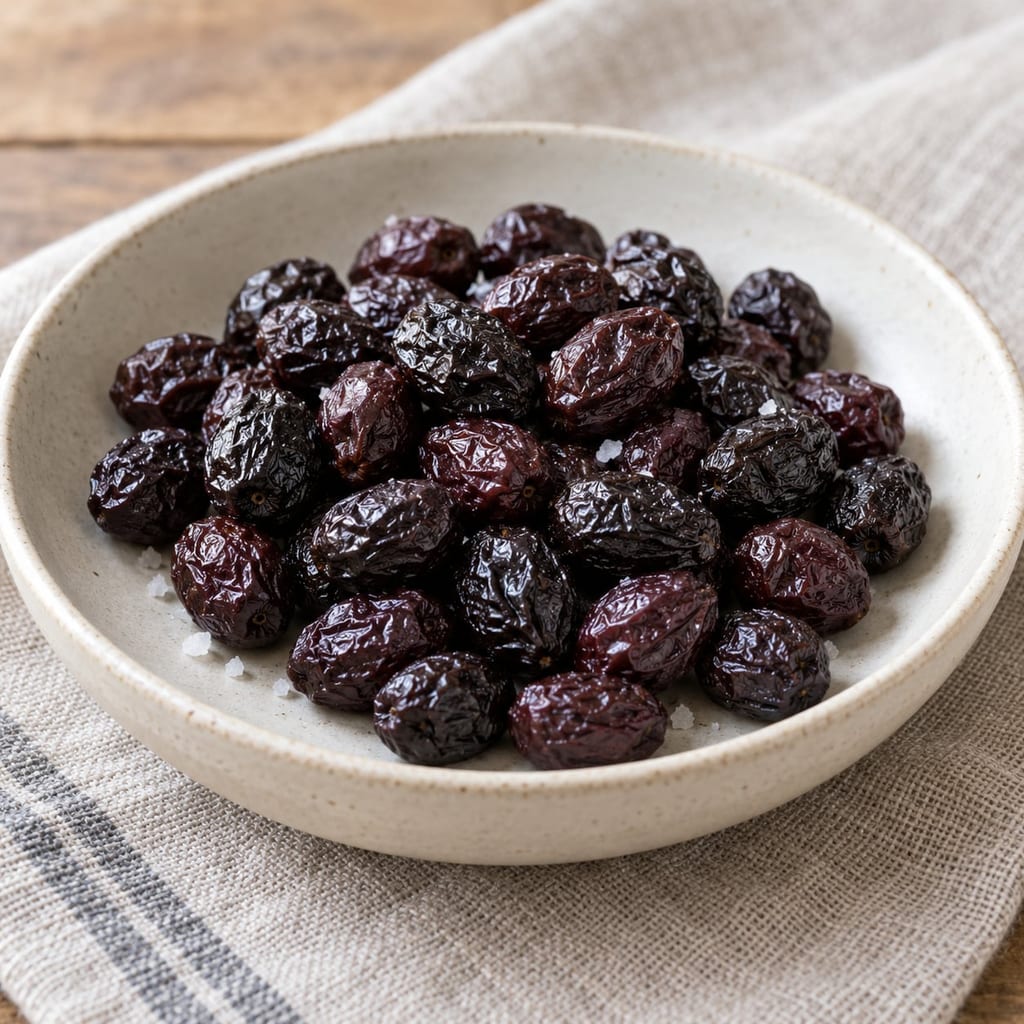
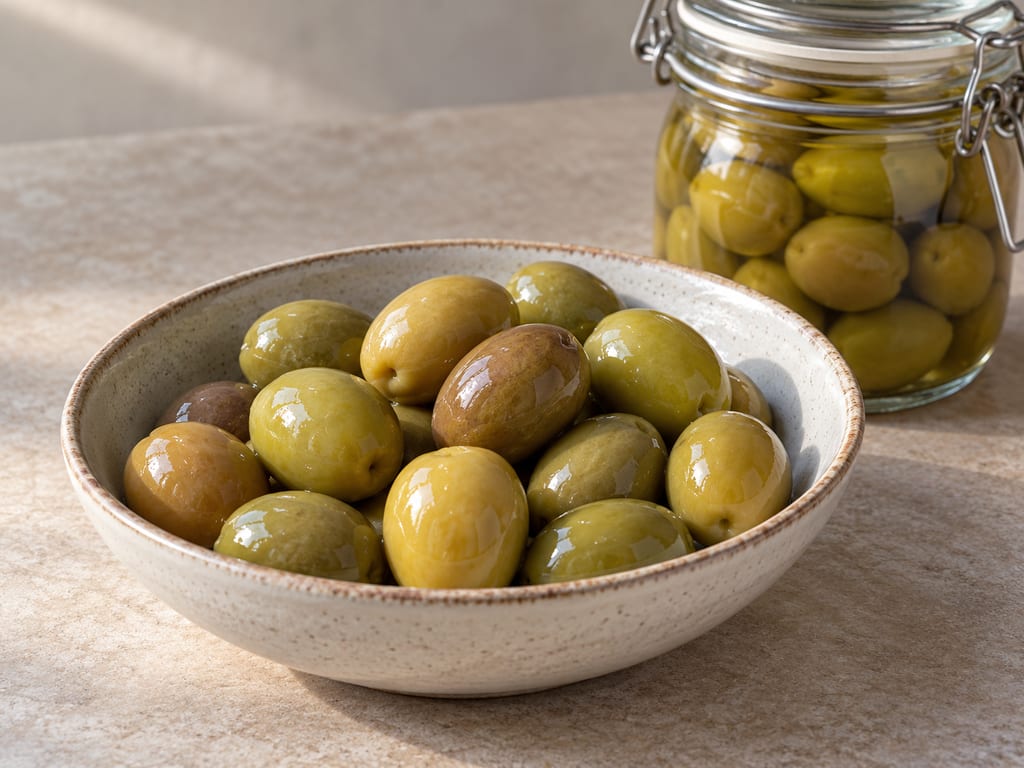
Dry salt-cured olives are small, fully ripe dark olives packed in salt rather than in brine. Over several weeks the salt draws the bitter juice and water out of the fruit, and the olives shrivel into wrinkled, intensely flavoured fruit with a firm, dense texture. They are eaten as they are, or dressed with oil and herbs.
This is a different product from the brine-fermented and lye-treated olives that appear elsewhere on the site. The University of California pickling guidance describes it as a dry salting method for home use, and the page keeps it distinct from those processes.
Salt draws water out of the olive flesh, and the bitter phenolic compounds leave with that water. Each week the olives are poured out and returned with more salt, so the salt is redistributed and the fruit dries evenly. A layer of salt on top and a clean cloth over the container keep the surface covered during the early weeks.
The method holds the container at 60 to 80 °F (16 to 27 °C) and turns the olives weekly for about a month. The reader should expect the olives to shrink and darken, and should treat that as the drying doing its work rather than as proof that they are ready.
Sele is the name used in Gemlik, on the southern shore of the Sea of Marmara, for black olives prepared in salt. In the 2023 European Union application for the name Gemlik Zeytini, olives and salt are layered without added water. The application separates this kuru sele, dry sele, from yğlı sele, an oily finishing style, and both from salamura, the brined style. The word sele therefore names a family of related presentations, not every Gemlik olive. The application proposes a protected area in Bursa province including Gemlik, İznik, Mudanya and Orhangazi; registration was not independently confirmed.
A 2017 study examined dry-salted Gemlik olives harvested in Gemlik district, using coarse salt, containers and repeated turning, and calls the method traditional. That is a description, not a dated record, and neither source says where or when the style began. Without a surrounding brine, salt contacts the olives directly as moisture leaves the fruit, and the described process has fermentation and drying occurring together.
In the study's microbial counts, lactic acid bacteria were below detection on day 2, at 1.3x10^3 cfu/g on day 5 and below detection on days 10, 20 and 31. These are observations from one trial, not a general account of sele. The study's storage arm included research pasteurisation, and mould appeared in some samples; neither validates a shelf life or a canning direction for home use.
After the cure the olives are sifted, dried overnight at room temperature, and then stored. The source gives storage limits of one month in a cool place, up to six months refrigerated, or up to a year frozen, and recommends an extra pound of salt per ten pounds of cured olives for airtight storage.
Mould, a sour smell or soft fruit is a reason to discard the batch. The storage limits are the source's and are given here as recorded, not as a guarantee for any particular batch.
Source documents this preparation; no unsupported date or origin is claimed.
Ingredients
Scaling: source batch only
Small fully ripe dark olivesUse mature small fruit.
907 g2 lb as recorded
Pickling saltInitial amount; source adds layers and later storage salt.
454 g1 lb as recorded
Pickling saltAdditional salt for airtight storage after curing, as specified by the source.
1 lb per 10 lb cured olives
Method
Risks and precautions · Standard risk
Spoiled olives
Guide says do not taste/eat olives that become moldy, soft or bad-smelling.
Hazard source
Follow source salt ratio, weekly remixing and storage directions; discard questionable olives without tasting or salvage.
Control source
Research draft; professional validation is not recorded.
Do not taste or salvage moldy, soft or bad-smelling olives.
Sort similar small dark olives and discard defective fruit.
Mix with the source’s initial salt amount in a draining container; add a 1-inch salt layer.
Cover with clean cheesecloth; hold at 60–80°F (16–27°C).
After a week, pour olives into a clean pail and back, adding salt; repeat weekly for the next month.
Sift salt, dry overnight at room temperature and follow source’s separate storage directions.
For airtight storage, mix in an additional 1 lb salt per 10 lb cured olives. The source gives storage limits of 1 month in a cool place, up to 6 months refrigerated, or up to 1 year frozen.
Conditions
Temperature15.6–26.7°C
Temperature controlAmbient, monitored
Places
Unknown
Documented preparation · Place not established
The source documents a home dry-salting method for olives, not a historical origin.
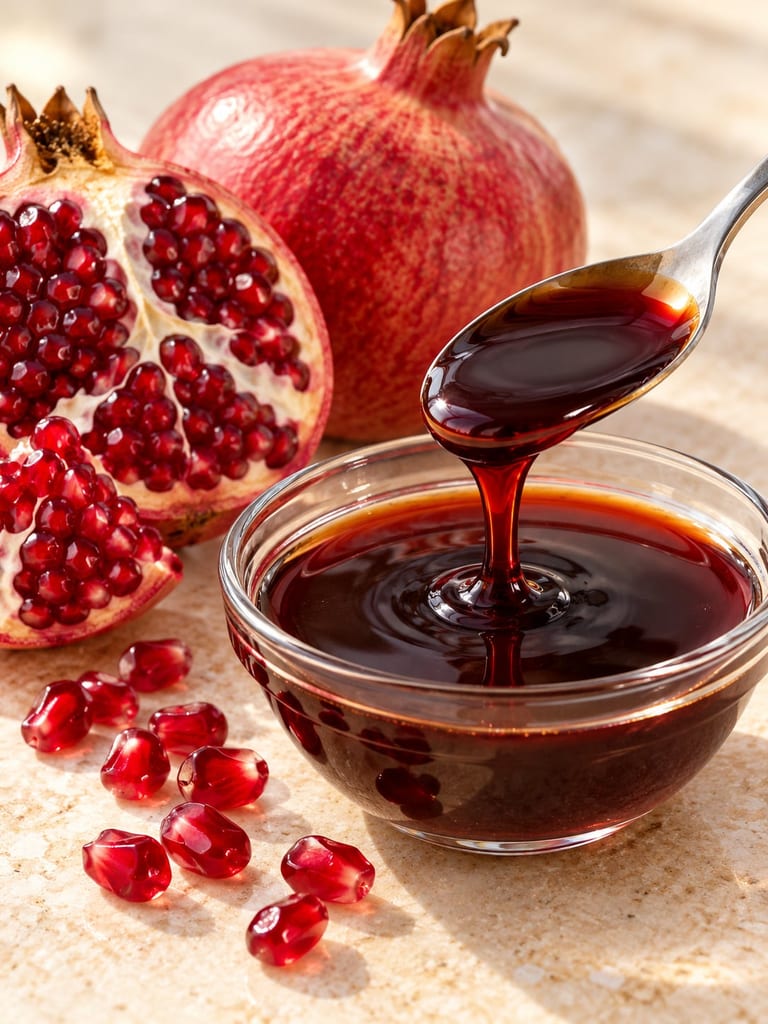
The registered Hatay method presses pomegranate arils and slowly concentrates the strained juice. Its 100 kg source batch and experienced-producer endpoint are retained; no home-scale time or shelf-life is inferred.
Ayran is Turkey’s cold, savoury yogurt drink: plain yogurt is loosened with water and lightly salted, then whisked smooth or aerated into a soft cap of foam.
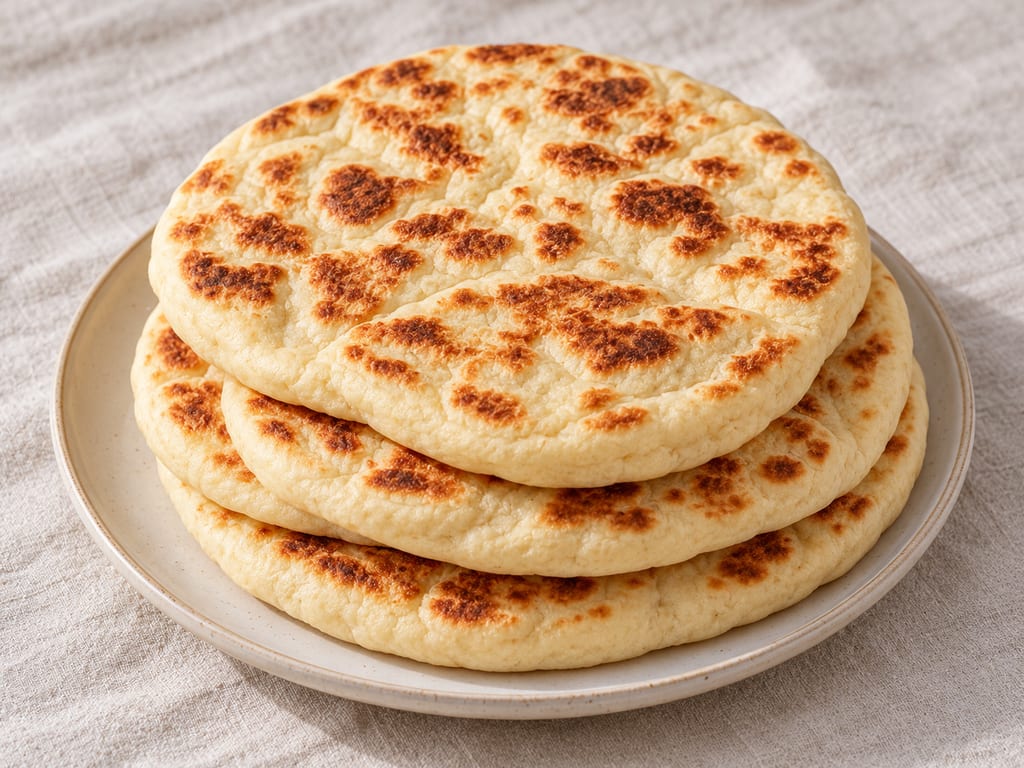
This Turkish bazlama uses yeast, plain yogurt and olive oil for a soft dough cooked in a skillet. Shape it into twelve small or six larger rounds, flip as bubbles appear, and wrap the breads to keep them soft.
Beyaz peynir is a Turkish white cheese matured in brine. Sheep milk, alone or mixed with other milks, gives a close-textured cheese cut into blocks and packed in cans.
Çubuk turşusu is a registered pickle from Çubuk district in Ankara. Its cucumber variant is sold as Salatalık Turşusu, and a commercial specification sets its brine and room-temperature period.
Garum, Greek garos and Latin liquamen, was the fish sauce of the ancient Mediterranean: fish and viscera salted and left in the sun, then drained off as a savoury liquid.
A yeast-and-yogurt dough is rolled into a large thin sheet, filled with spinach, onion and feta, folded closed, then cooked on an oiled griddle. This is Özlem Warren’s spinach-and-cheese family-style version.
Berries, greens and fish eggs were kept in seal oil by Indigenous Alaskan communities. The oil seals the food from air, and the result depends on preparation and the surrounding conditions.
Steam-blanched frozen mushrooms are whole, button, quartered or sliced mushrooms given a short steam treatment, cooled promptly, packed with headspace and kept frozen.
Frozen raw mushrooms are cleaned mushrooms frozen without a preheating step, the variant a Japanese forest-volunteer manual describes beside its cooked version.
Fruit and some other foods were placed in honey in ancient Mediterranean kitchens. The honey's concentrated sugar does the preserving, and wet ingredients weaken it.
Green olives debittered in a sodium hydroxide solution, then rinsed repeatedly and held in brine, by the University of California's published home-pickling method.
An experimental sweet mushroom preserve developed in Indian food-processing research, made by cooking mushroom pulp with sugar, added pectin and citric acid until concentrated into a thick, spreadable jam.
Community
No community contributions have been published for this entry yet.
Share what you made
Sign in to contribute. Published comments and photos are free to read.