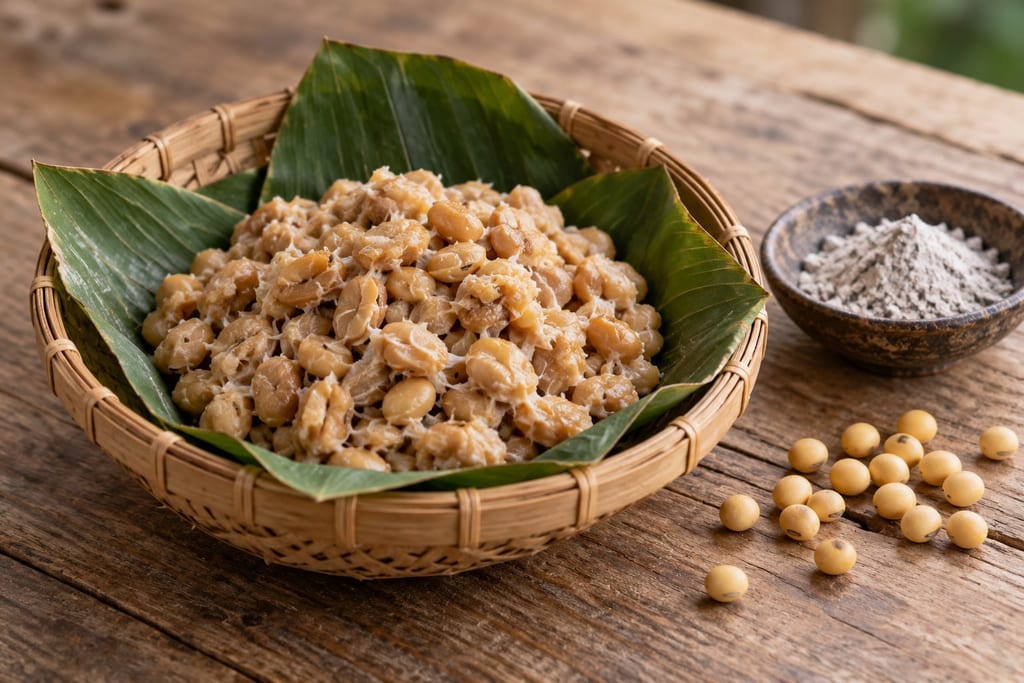
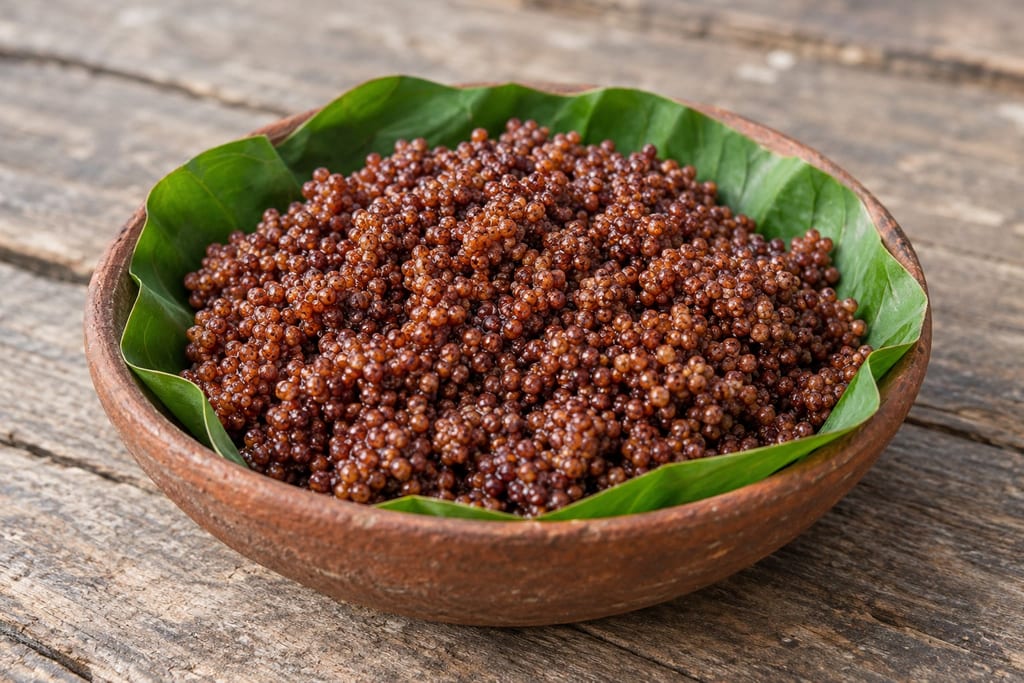
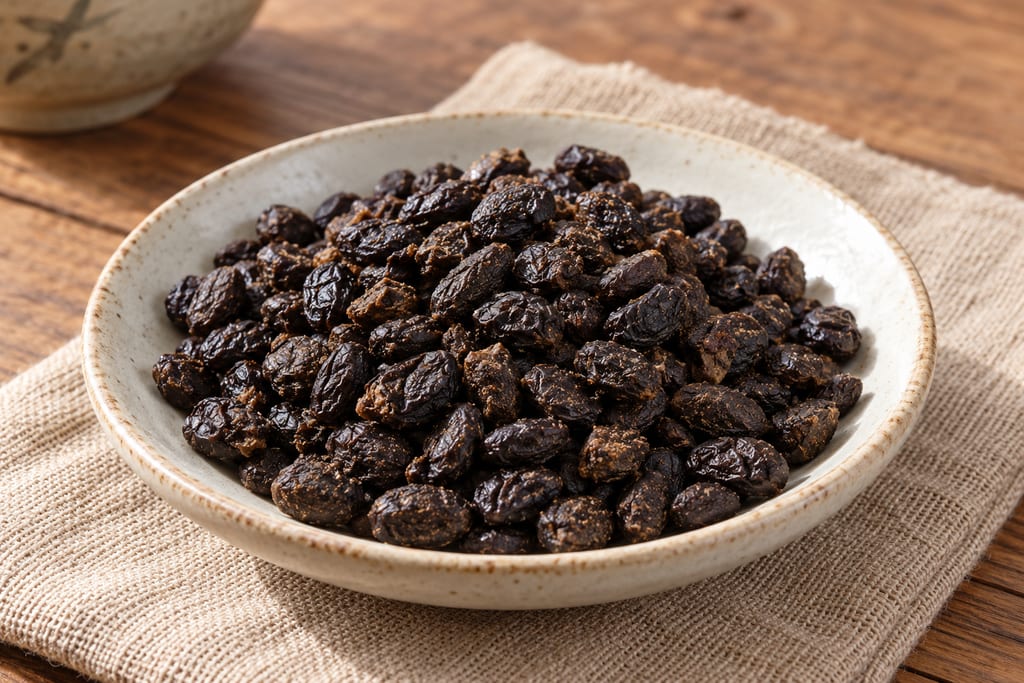
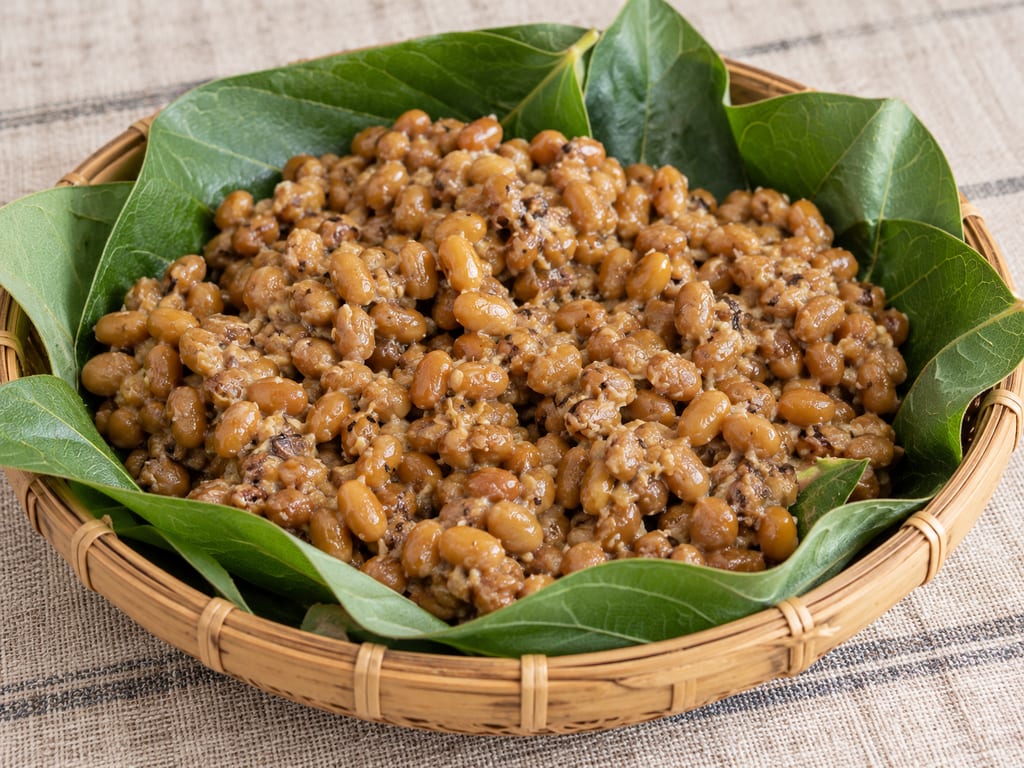
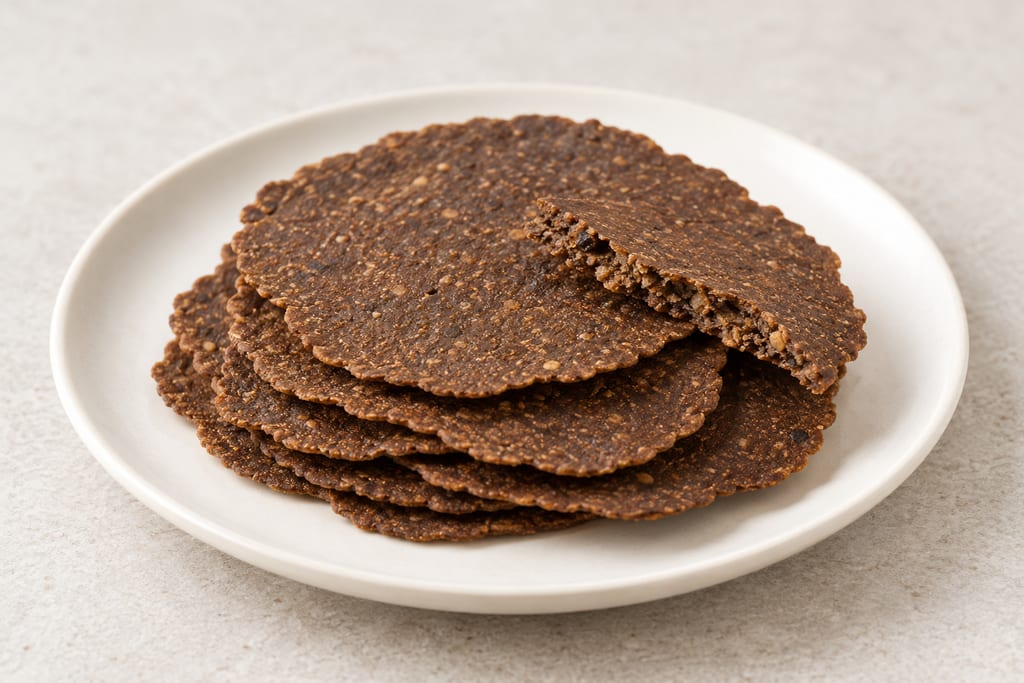
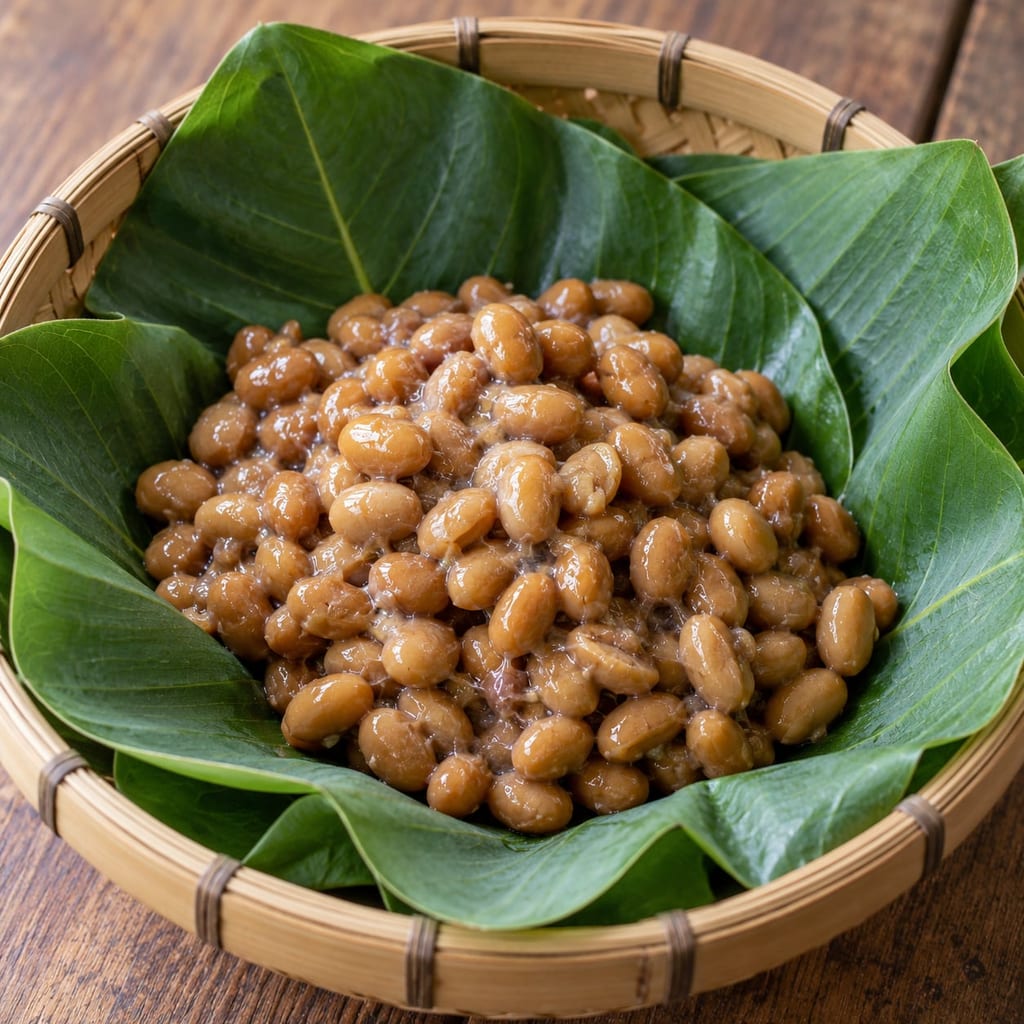
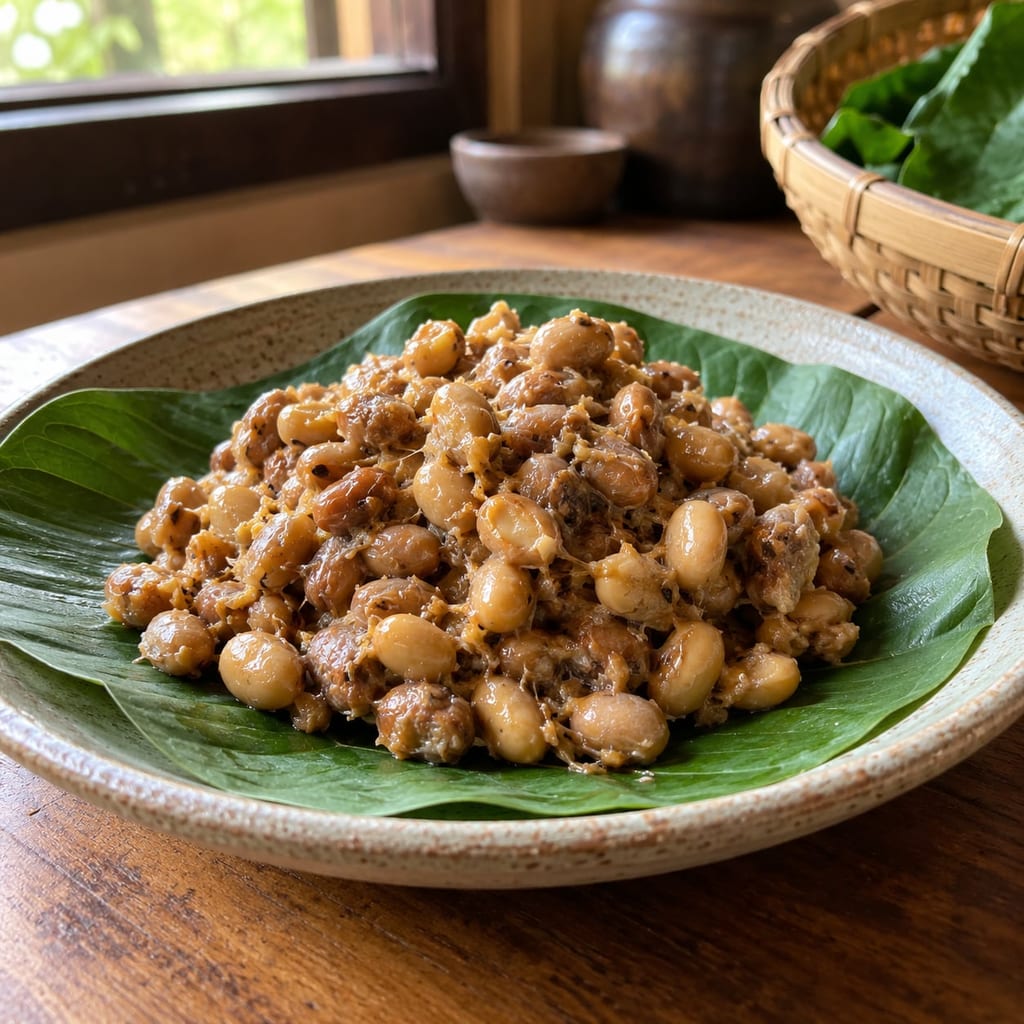
A sticky fermented soybean food of the eastern Himalaya, made here with a measured addition of firewood ash as an alkaline aid to the bacteria that drive it.
Kinema is a traditional fermented soybean food associated with the eastern Himalayan region, particularly eastern Nepal, Sikkim and the Darjeeling hills of India, and parts of southern Bhutan.
Its characteristic features include softened soybean pieces, a savoury flavour and a sticky surface created during bacterial fermentation.
The name is commonly written kinema and in Nepali script as किनेमा.
The principal ingredient is soybean, Glycine max (L.) Merr.
Kinema is related in its broad fermentation biology to Japanese natto, although the foods differ in history, preparation and customary use.
Traditional kinema is commonly produced through spontaneous fermentation, often with cooked beans wrapped in leaves or placed in baskets.
This page preserves a particular experimental firewood-ash preparation, not a claim that every Himalayan household deliberately adds ash to its kinema.
The distinction matters because ash alters the chemical environment and may introduce substances that are not present in a culture-controlled soybean ferment.
Kinema belongs to the food traditions of the eastern Himalayas.
It is strongly associated with Limboo communities and the historical region of Limbuwan in eastern Nepal.
The name has been connected with the Limboo expression kinamba, associated with fermented flavour.
Historical interpretations place kinema within long-standing soybean foodways and sometimes propose an origin around 600 BCE, during the period associated with Kirat traditions.
However, the archaeological and documentary evidence is insufficient to establish that date as a proven invention year.
The most appropriate historical wording is that kinema is a longstanding traditional food whose precise origin remains uncertain.
Modern ethnographic and food-science research has documented its preparation and consumption among communities in eastern Nepal, Darjeeling, Sikkim and Bhutan.
Its preparation has frequently been associated with household expertise and the work of women.
Kinema is not simply a preservation technology; it is also an ingredient in familiar meals and a marker of regional food identity.
Soaking overnight · Boiling 60–90 minutes · Fermentation 24–70 hours at 35°C · Experimental drying 10 hours at 70°C
The drying stage belongs to the experiment's analytical sample preparation. It should not be interpreted as a validated preservation treatment or an unrestricted shelf-life guarantee.
Soak the soybeans. Place the beans in water and soak overnight. The study does not give a specific soaking-water volume or numerical soaking temperature.
Cook until soft. Drain and boil the soybeans in fresh water for 60–90 minutes, until sufficiently soft for the subsequent processing stage.
Split the beans. Drain the excess water. Lightly crush or split the cooked soybeans, preserving recognisable bean pieces.
Add the experimental ash treatment. Mix in firewood ash at 1% of the bean portion. For the documented 200 g basis, this is 2 g. The published material was part of a controlled experiment; its safety cannot be generalised to unidentified household ash.
Pack for fermentation. Divide the soybean mixture into 200 g portions and place them in pierced plastic pouches, following the experimental arrangement.
Incubate. Ferment at 35°C. The study examined different fermentation intervals between 24 and 70 hours. It does not establish one universally safe or optimal household endpoint.
Prepare the dried research samples. Following fermentation, the study dried its material for 10 hours at 70°C before storage and analysis.
The experimental research examined how fermentation time affects kinema's bioactive constituents.
Measurements included total phenolic content, total flavonoid content and antioxidant activity assessed using the DPPH method.
These measurements are useful for comparing biochemical changes under defined conditions.
They do not provide a complete assessment of microbial safety.
An increase in a measured antioxidant-related activity does not establish that a batch is free from pathogens.
Likewise, an optimisation procedure that identifies a favourable fermentation interval for a chemical variable does not necessarily identify the safest time for household consumption.
This distinction is essential when converting food-science experiments into recipes.
The experimental parameters can be reproduced as research evidence, while the absence of a validated consumer process must remain explicit.
Kinema and Japanese natto both involve cooked soybeans and protein-degrading bacteria.
Both may develop a sticky texture associated with extracellular polymers.
However, their production traditions differ.
Contemporary natto is often manufactured with a selected Bacillus subtilis natto starter.
Kinema has commonly been produced through spontaneous fermentation in traditional household environments.
Natto is frequently eaten directly with rice and seasonings.
Kinema is often incorporated into cooked savoury dishes.
The relationship between the two foods is relevant to comparative fermentation science, but one should not be presented as a direct copy of the other without historical evidence.
Research on eastern Himalayan fermented soybeans discusses a broader geographical group sometimes called the kinema–thua nao–natto triangle.
This includes related bacterial soybean fermentations across parts of South, Southeast and East Asia.
It is a useful way to compare technologies and food cultures, not proof that all the products originated in one recorded location.
It is often served with steamed rice and other elements of a Himalayan meal.
Cooking may involve onions, chillies, tomatoes and other locally available seasonings, although the current experimental record does not provide a measured curry formula.
The fermented beans contribute savoury flavour and a distinctive texture.
When cooked into a sauce, they can provide both body and umami.
Fresh kinema may have a pronounced aroma and sticky appearance.
Some producers dry kinema for later use.
Drying changes its moisture content, texture and storage behaviour, and the process used should be documented rather than assumed.
Kinema's spontaneous fermentation can support a mixed microbial community.
Studies of naturally fermented kinema have identified Bacillus species including B. subtilis and, in some samples, members of the B. cereus group.
The latter includes organisms associated with foodborne illness.
Warm fermentation of cooked soybeans is therefore not intrinsically safe merely because it produces a familiar food.
The ash addition introduces a separate chemical concern.
The research does not validate the use of arbitrary firewood ash, nor does it provide a household specification for contaminant limits in that ash.
The fermentation study also does not establish a pathogen-reduction endpoint or validated ambient storage life.
Traditional accounts mention fresh kinema keeping for a short period and dried kinema being stored longer, but these observations are not universal safety guarantees.
For an educational website, the responsible presentation is to preserve the experimental method while clearly distinguishing it from an independently validated household preparation.
The 2024 review describes kinema as a Himalayan soybean food with documented preparation across Eastern Nepal and neighboring regions. The recipe below follows a separate experimental protocol.
Ingredients
Yield 200 g soybean portion before cooking · Scaling: source batch only
Kinema is an alkaline soybean fermentation and the study describes spontaneous fermentation; cooked soybeans can support spore-forming bacteria during warm holding.
Hazard source
The process paper does not provide a validated safety control plan for this household application. Do not use wild starter or assume the reported fermentation time establishes safety.
Control source
This experimental recipe is not professionally validated. Spore-forming bacteria may persist after cooking; neither a pungent aroma nor a sticky texture demonstrates safety.
Soak the soybeans. Place the beans in water and soak overnight. The study does not give a specific soaking-water volume or numerical soaking temperature.
Cook until soft. Drain and boil the soybeans in fresh water for 60–90 minutes, until sufficiently soft for the subsequent processing stage.
Split the beans. Drain the excess water. Lightly crush or split the cooked soybeans, preserving recognisable bean pieces.
Add the experimental ash treatment. Mix in firewood ash at 1% of the bean portion. For the documented 200 g basis, this is 2 g.
Pack for fermentation. Divide the soybean mixture into 200 g portions and place them in pierced plastic pouches, following the experimental arrangement.
Incubate. Ferment at 35°C. The study examined different fermentation intervals between 24 and 70 hours.
Prepare the dried research samples. Following fermentation, the study dried its material for 10 hours at 70°C before storage and analysis.
Conditions
Yield200 g soybean portion before cooking
Fermentation24–70 h
Temperature35°C
Temperature controlIncubated
Places
Eastern Nepal
Traditional preparation · Region evidence
The review associates kinema with Eastern Nepal and neighboring Himalayan communities; this is a regional food association, not a claimed origin point.
Laboratory protocol; study location not specified. The process paper reports experimental conditions but the cited excerpt does not establish its place of preparation.
Finger millet fermented with marcha in surveyed Darjeeling and Sikkim communities. Tongba is the later warm-water extraction from the fermented grain. The cited accounts do not establish a complete or validated home batch.
An ethnographic record of marcha (murcha), a dry starter cake used in Eastern Himalayan cereal fermentations. This page documents source-specific community knowledge and is not a recipe for making or storing starter.
Soybeans boiled soft and fermented in a leaf-lined basket by the hearth, then in many Naga households pounded, wrapped in leaves and fermented again into a dark, pungent seasoning paste.
A Chinese fermented soybean condiment in which Bacillus-led bacteria, not moulds, drive the fermentation. Documented in Zunyi, Guizhou, and kept separate from mould-led douchi.
A Mizo alkaline soybean ferment made by holding cooked beans in leaf-lined containers, sometimes with wood ash, until they turn sticky, soft and pungent; eaten fresh or used as a seasoning.
Black soybeans cooked, inoculated with a named Bacillus subtilis culture and fermented warm and humid into northern Thailand's thua nao, then optionally dried into thin discs.
A sticky fermented soybean food of Manipur, made by packing cooked soybeans in leaf-lined bamboo baskets and keeping them warm, related to but distinct from Bekang and Akhone.
Natto is a Japanese fermented soybean food with a sticky coat and long strings, made by steaming soybeans and inoculating them with a natto Bacillus starter, then keeping them warm.
Steamed soybeans fermented by a named strain of Bacillus subtilis into Japan’s sticky, strongly savoury whole-bean food, bound by the thread-forming polymer the bacteria secrete.
Community
No community contributions have been published for this entry yet.
Share what you made
Sign in to contribute. Published comments and photos are free to read.
overnight soak, 60–90 minute boil, 200 g portions, 1% firewood ash, 35°C fermentation for sampled 24–70 h and 70°C drying for 10 h
Cited in: A sticky fermented food of the eastern Himalayas; Origins and cultural background; Traditional kinema preparation; Why firewood ash is added in this experiment; Ingredients; Equipment; Method; What the study was investigating; Kinema and natto: related but distinct; Regional and household variations; How kinema is eaten; Recognising the expected product
Kinema's Himalayan regional associations and contrast between traditional leaf-wrapped methods and scientific study protocols
Cited in: A sticky fermented food of the eastern Himalayas; Origins and cultural background; Traditional kinema preparation; Why firewood ash is added in this experiment; Ingredients; Equipment; Method; What the study was investigating; Kinema and natto: related but distinct; Regional and household variations; How kinema is eaten; Recognising the expected product
Need for process-specific review; natto guidance is not kinema validation
Cited in: A sticky fermented food of the eastern Himalayas; Origins and cultural background; Traditional kinema preparation; Why firewood ash is added in this experiment; Ingredients; Equipment; Method; What the study was investigating; Kinema and natto: related but distinct; Regional and household variations; How kinema is eaten; Recognising the expected product; Safety concerns