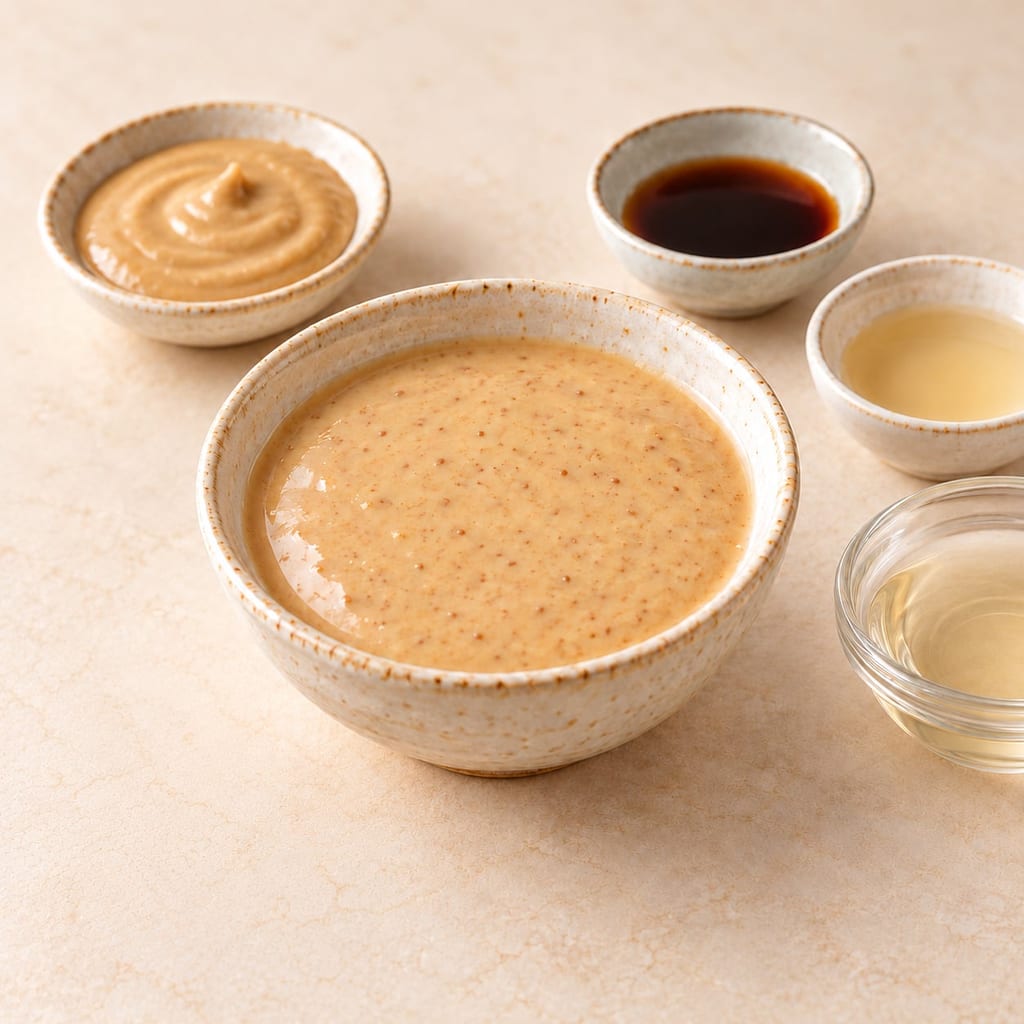
Goma dare sesame sauce
A creamy Japanese sesame dipping sauce with soy, rice vinegar and dashi. Gradual mixing turns the thick sesame paste into a smooth sauce.
 FermenteaWhere food goes to change
Modern method
黒蜜 · Kuromitsu
A dark Japanese syrup made by simmering black sugar with water and optional extra sugar. Drizzle it over mochi, ice cream or other desserts.
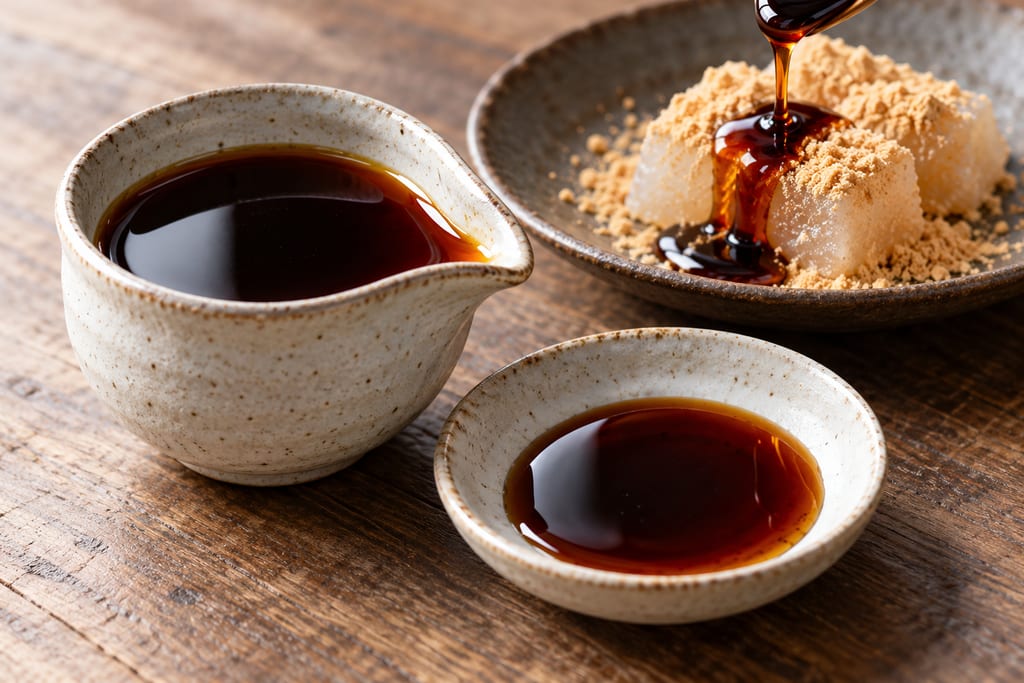
Kuromitsu is a dark Japanese sugar syrup made from kokutō (黒糖), an unrefined cane sugar particularly associated with Okinawa.
The name 黒蜜 literally combines kuro, black, and mitsu, syrup or honey. Despite its frequent English translation as black honey, kuromitsu is not bee honey.
It has a deep, bittersweet flavour reminiscent of molasses, toffee and caramel, although its precise character depends on the sugar used.
Kuromitsu is especially important in Japanese sweets, or wagashi. It is poured over agar-based desserts, mochi, cold jelly preparations and other relatively mildly flavoured foods.
The recipe here is a modern saucepan preparation that combines black sugar with water and optional granulated sugar.
It is not fermented. Its principal transformations are sugar dissolution, water evaporation and changes in syrup viscosity.
Sugarcane is a tropical crop, Saccharum spp., with a long history of cultivation and trade across Asia.
Okinawa's climate has supported sugarcane cultivation, and black sugar became an important local agricultural product.
Unlike highly refined white sugar, traditional black sugar retains more of the constituents of concentrated cane juice.
Its colour, mineral composition and flavour reflect the method used to concentrate and process the juice.
Okinawan kokutō is therefore not simply ordinary white sugar dyed brown.
The exact history of every black sugar syrup sold in Japan is not established. The documented recipe does not date the invention of kuromitsu or identify a single town where the syrup first appeared.
The sauce is nevertheless firmly associated with Japanese sweets and Okinawan black sugar.
The contemporary recipe preserves that ingredient identity while allowing practical substitutions.
Ingredient — Quantity
Black sugar, kurozatō or kokutō — 3.5 oz (approximately 99 g)
Granulated sugar — ½ cup, optional
Water — ½ cup
Reported yield: Approximately 200 ml.
Preparation: 5 minutes.
Cooking: Approximately 20 minutes.
Reducing or omitting the granulated sugar changes both the flavour and final volume. The stated 200 ml yield belongs to the documented full formulation, not necessarily every variation.
Black sugar contains sucrose together with smaller amounts of other cane-derived compounds.
Those additional constituents contribute the dark colour and complex flavour.
Its mineral content is greater than that of highly refined sugar, but it remains principally a concentrated sugar product.
It should not be marketed as probiotic merely because some unrefined ingredients may retain microorganisms before processing. This recipe is boiled, and no live-culture fermentation stage exists.
Commercial black sugars vary significantly.
A block of Okinawan kokutō may taste different from dark muscovado or a common brown sugar.
Muscovado is a documented substitution, but not an exact sensory equivalent.
If the black sugar is supplied as a solid block, divide it into manageable pieces.
No exact size is specified.
Smaller pieces simply dissolve more readily.
Place 3.5 oz black sugar, ½ cup water and the optional ½ cup granulated sugar in a small saucepan.
Stir gently.
Heat over medium heat.
Stir until the sugar begins dissolving.
Bring the mixture to a boil.
The source does not specify a numeric syrup temperature.
Once boiling, lower the heat.
Maintain a gentle simmer.
Simmer for 15–20 minutes, stirring gently.
The sugar should dissolve completely.
The syrup should become slightly thicker.
Do not continue heating simply to obtain the viscosity of cold syrup while it is still boiling hot.
Remove the saucepan from the heat.
Allow the syrup to cool.
Its viscosity increases as temperature decreases.
Pour into a clean, airtight jar or bottle.
Refrigerate.
The original recipe recommends refrigerated storage for up to one week.
As the mixture heats, sugar dissolves in water.
During simmering, some water evaporates.
The relative concentration of dissolved sugar increases, producing a more viscous liquid.
The syrup also becomes more concentrated in flavour.
This process is not fermentation.
It does not require bacteria or yeast.
No final sugar concentration, expressed as degrees Brix or water activity, is specified.
Therefore, the documented cooking time cannot be used as proof of shelf stability.
The recipe should be treated as a refrigerated dessert syrup.
Kuromitsu can contain flavour compounds associated with heated sugarcane juice, but the household method is not necessarily a classical high-temperature caramelisation process.
The black sugar already has a dark colour and complex flavour before it enters the saucepan.
The purpose of the recipe is principally to dissolve and concentrate it.
Excessive cooking may introduce bitterness or cause scorching.
That would not necessarily improve the traditional flavour.
Okinawan black sugar is the preferred ingredient.
Muscovado or dark brown sugar may be substituted where kokutō is unavailable.
The original recipe also allows reducing or omitting the additional granulated sugar.
That makes a darker, potentially less conventionally sweet syrup in which the black sugar's complex flavour is more prominent.
These variations belong to one recipe page because the underlying preparation remains a simple cooked sugar syrup.
A flavoured syrup containing ginger, citrus or other ingredients would be a further adaptation, not the documented original formula.
Kuromitsu is commonly poured over warabi mochi, a Japanese jelly-like sweet often dusted with roasted soybean flour.
It is also served with anmitsu, a dessert containing agar jelly, fruit and other toppings.
Kuzu mochi, ice cream and shaved ice are additional documented uses.
The syrup's bittersweet depth contrasts particularly well with desserts that are not intensely sweet on their own.
A small quantity can provide both sweetness and aroma.
Syrup remains thin while hot: It may thicken on cooling.
Undissolved crystals remain: Stir until fully dissolved.
The syrup becomes excessively thick: Too much water may have evaporated.
Burnt flavour develops: Heat may have been excessive.
Crystals appear during storage: Sugar crystallisation is possible and does not automatically indicate fermentation.
Mould develops: Discard the product.
The syrup should not bubble spontaneously after cooling and storage. Unexpected gas formation may indicate contamination.
Hot sugar syrup can cause severe burns.
Use a suitable saucepan and avoid tasting directly from the hot mixture.
The recipe provides no validated final water activity or shelf-stability specification.
Keep refrigerated and use within the publisher's stated short storage period.
A Japanese dessert syrup using black sugar. The recipe does not date the syrup’s origin.
Yield 200 mL · Scaling: source batch only
Refrigerate the cooled syrup; a jar of syrup is not a shelf-stable canned product.
The author suggests up to one refrigerated week, without a measured final sugar concentration or storage study.
Culinary association of this preparation; no exact birthplace is established.
A creamy Japanese sesame dipping sauce with soy, rice vinegar and dashi. Gradual mixing turns the thick sesame paste into a smooth sauce.
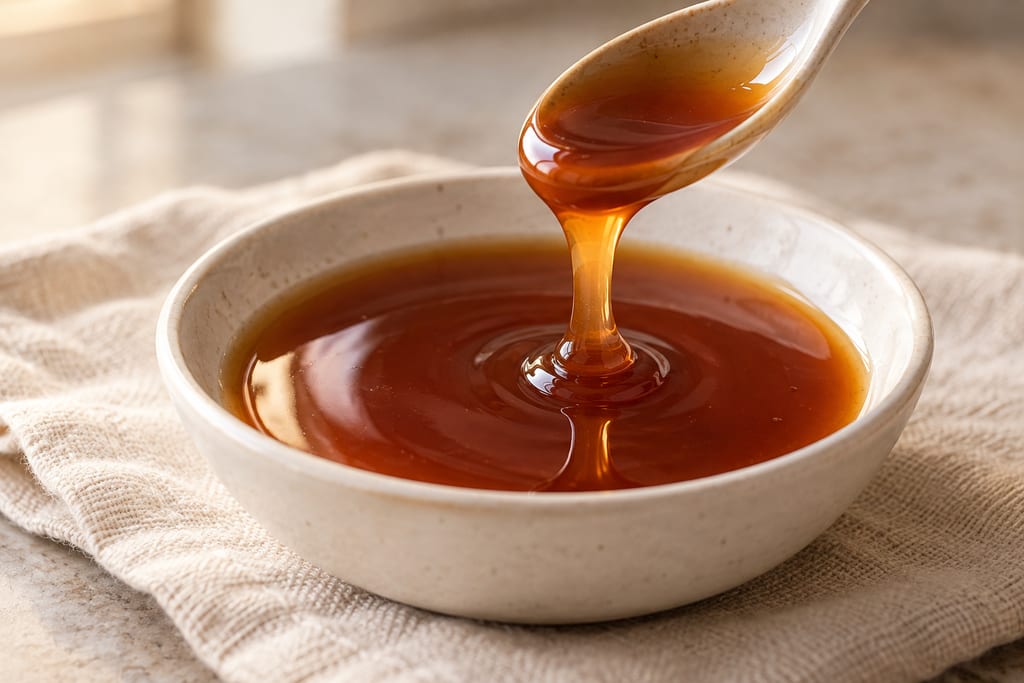
A glossy Japanese glaze thickened with starch, sugar, soy sauce and mirin. Spoon it over cooked rice dumplings while the glaze is still fluid.
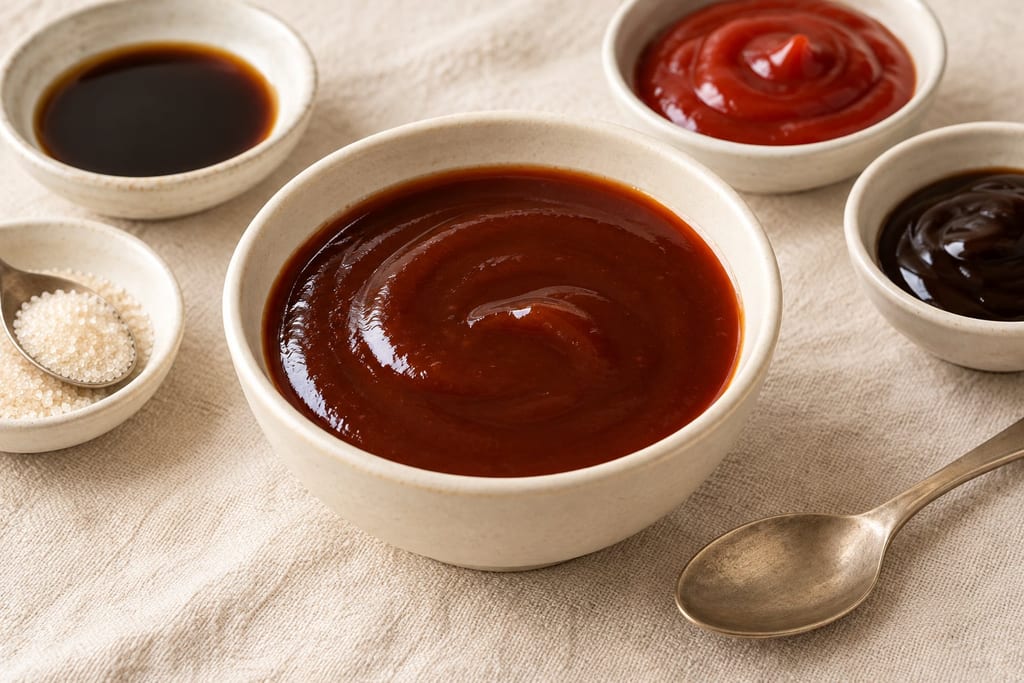
A sweet, tangy Japanese sauce mixed from Worcestershire sauce, ketchup, oyster sauce and sugar. Serve with breaded cutlets or croquettes.
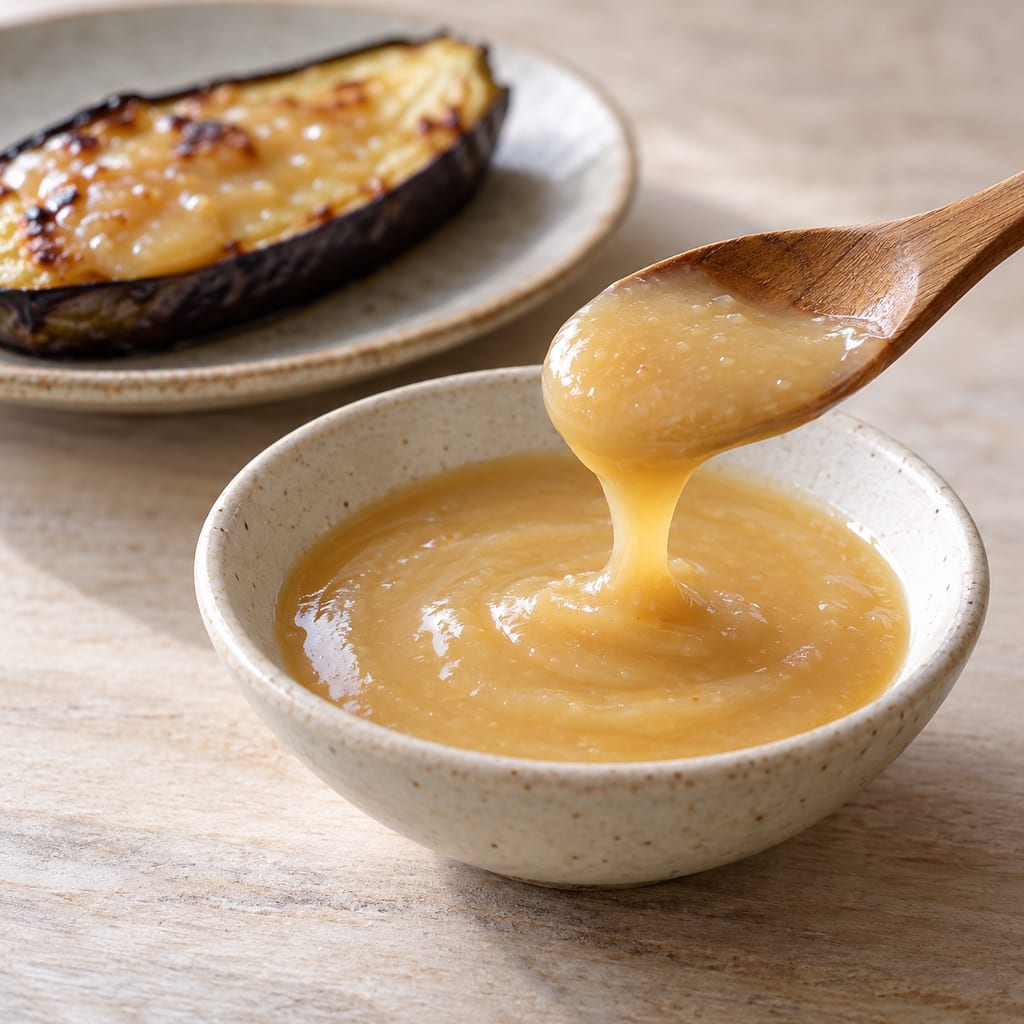
A Japanese-style glaze of pale rice miso, water, sugar and rice vinegar, heated gently until it coats a spoon and spread over cooked aubergine, tofu or vegetables.
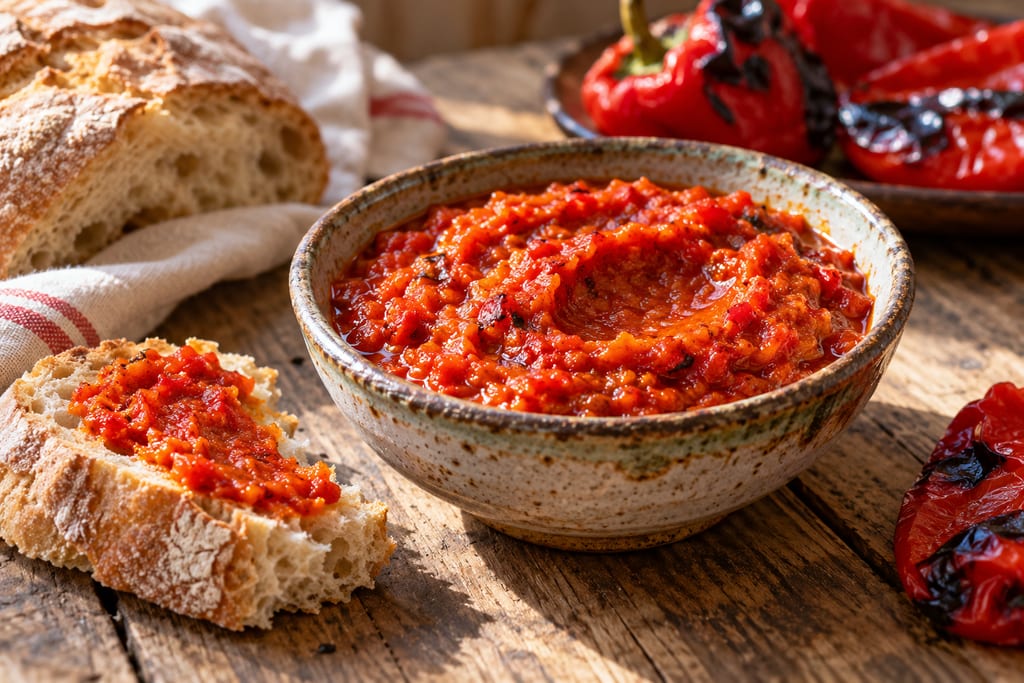
Ajvar is a cooked Balkan pepper preserve built around roasted red peppers, peeled, drained, ground and slowly fried with oil and seasoning. Leskovac’s protected version is a pepper specialty; regional versions vary.
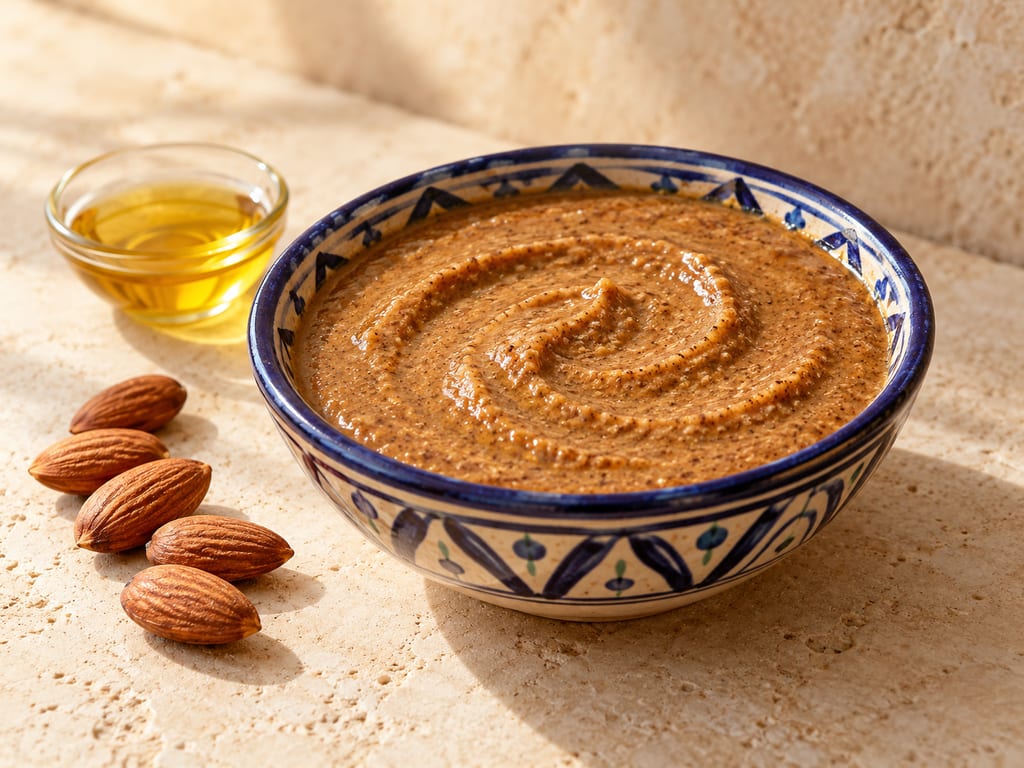
Amlou is a nutty, lightly sweet Moroccan spread of roasted almonds, culinary argan oil and honey. The almonds are ground first, then loosened with oil and sweetened; the balance can range from a thick spread to a dip.
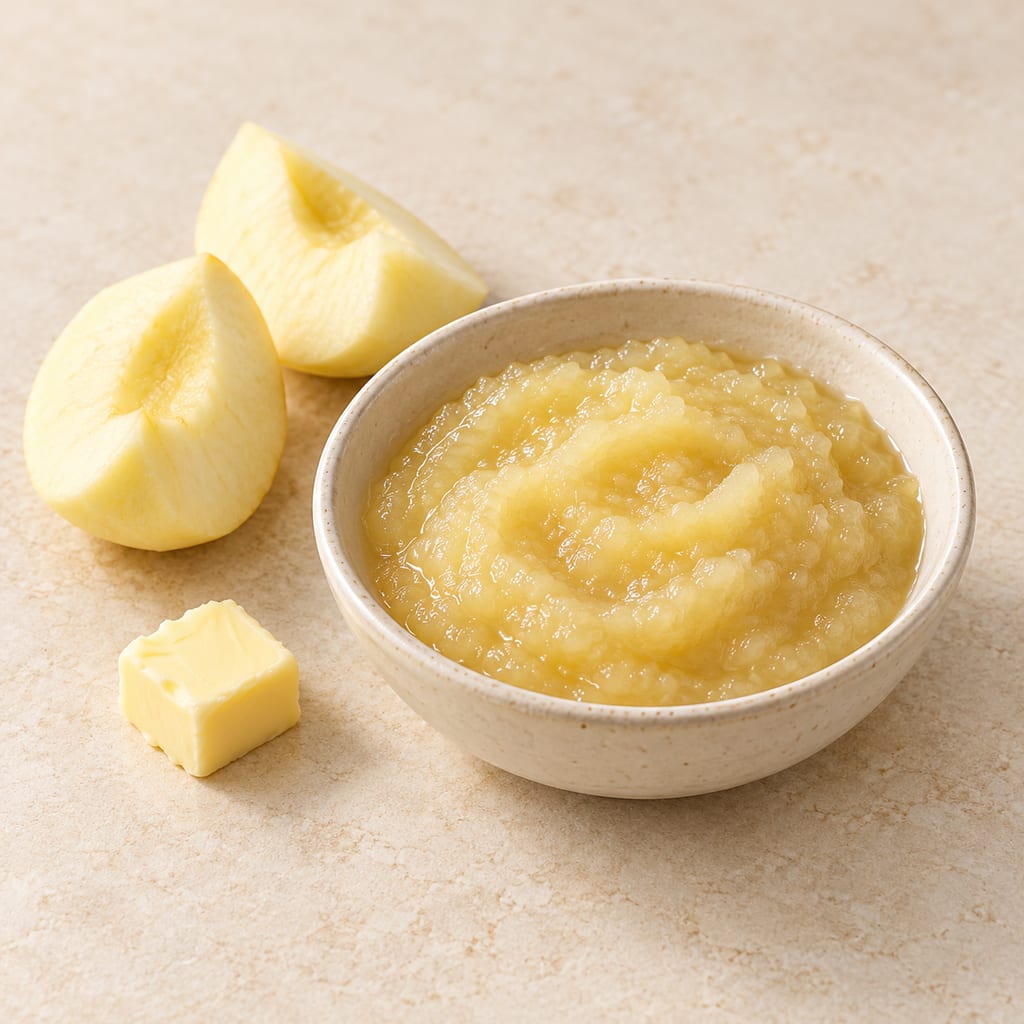
Apple sauce for goose and pork is a plain English accompaniment: cooked apples pulped with water, then sweetened with sugar and finished with a little butter.

A warm dip of garlic, anchovy and olive oil, often enriched with butter, that Piedmont serves over a flame with raw and cooked vegetables and bread.
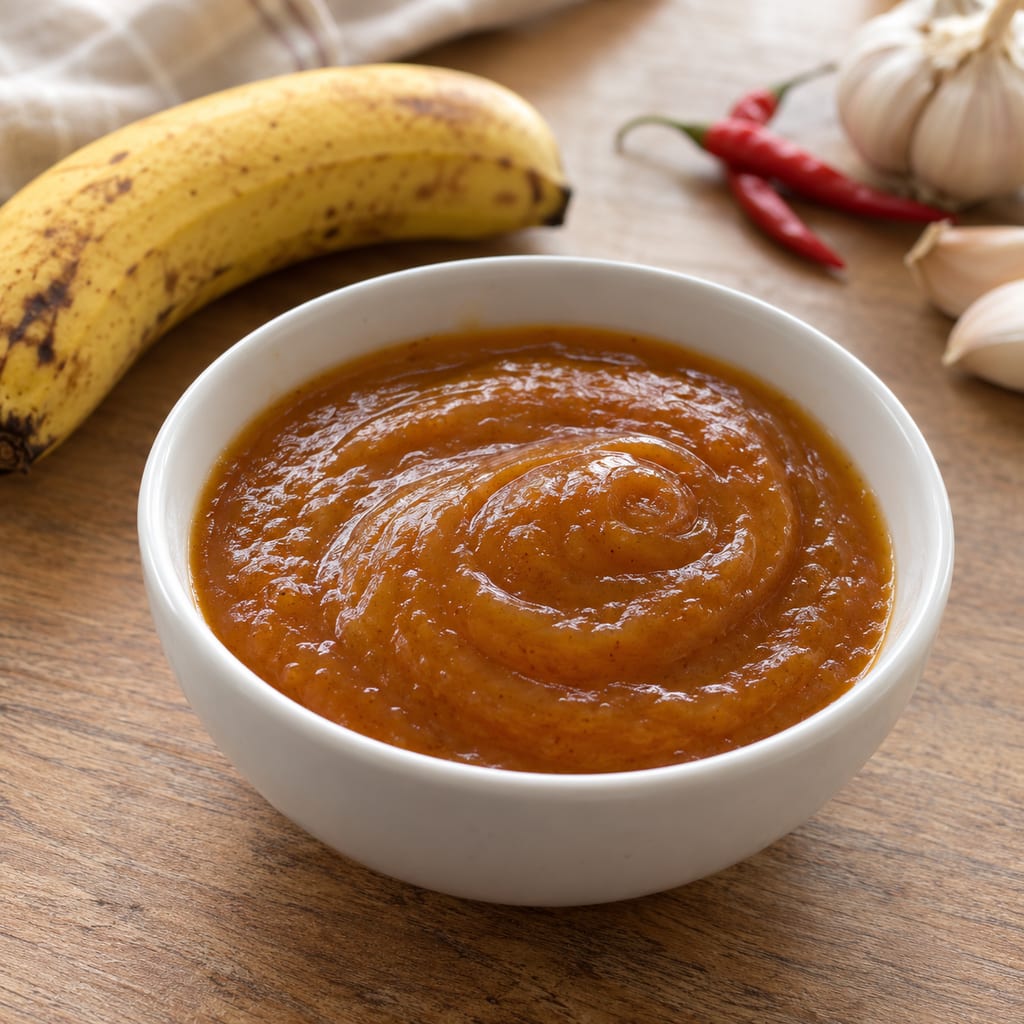
A sweet-hot table sauce of ripe banana simmered with vinegar, sugar, onion, garlic and fresh chilli, in the manner of Philippine banana ketchup. An untested development batch of about 500 g.
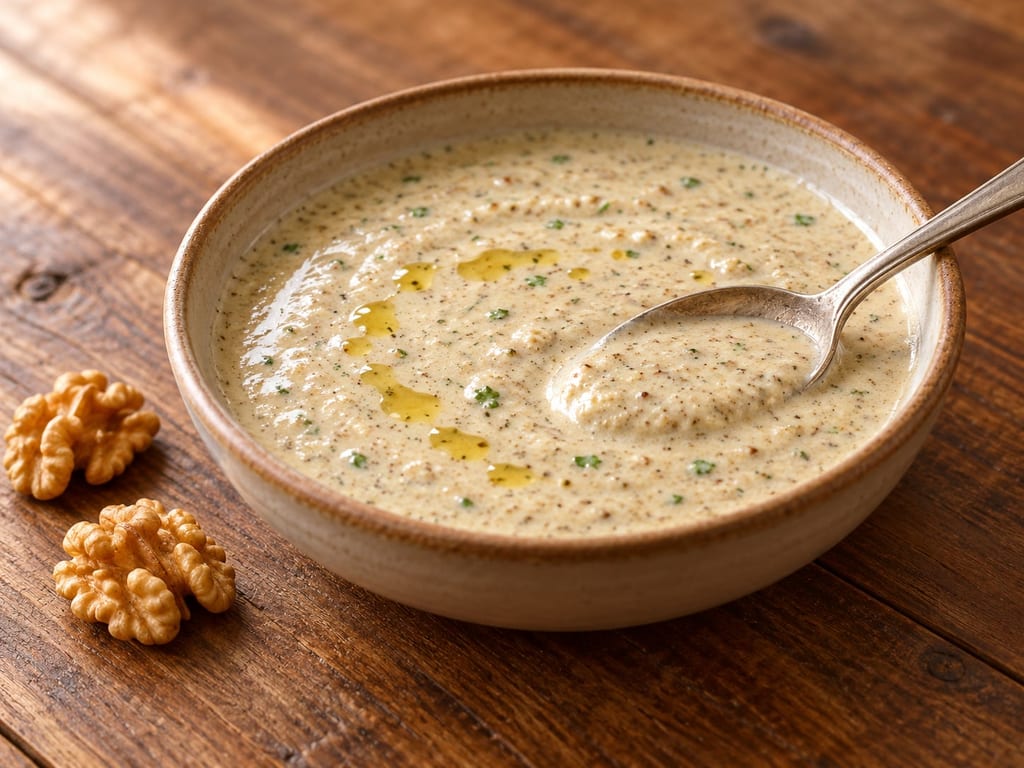
A Georgian walnut sauce of ground walnuts, garlic, vinegar and spices, thinned with water or broth. It is served with poultry, vegetables and bread, and is the sauce of the dish satsivi.
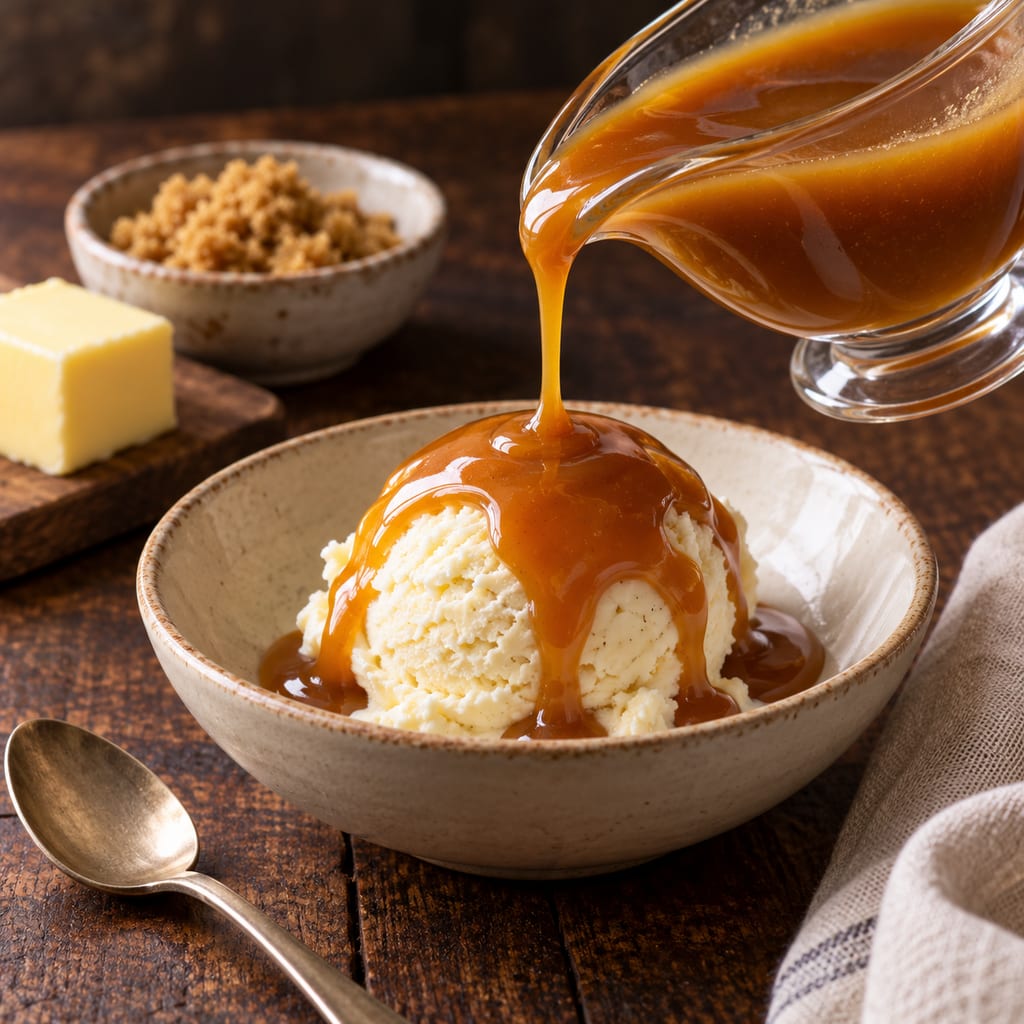
A pourable dessert sauce of brown sugar, butter and cream, with a little corn syrup and salt. It is the sauce form of the butterscotch confection and is made without water, unlike caramel.
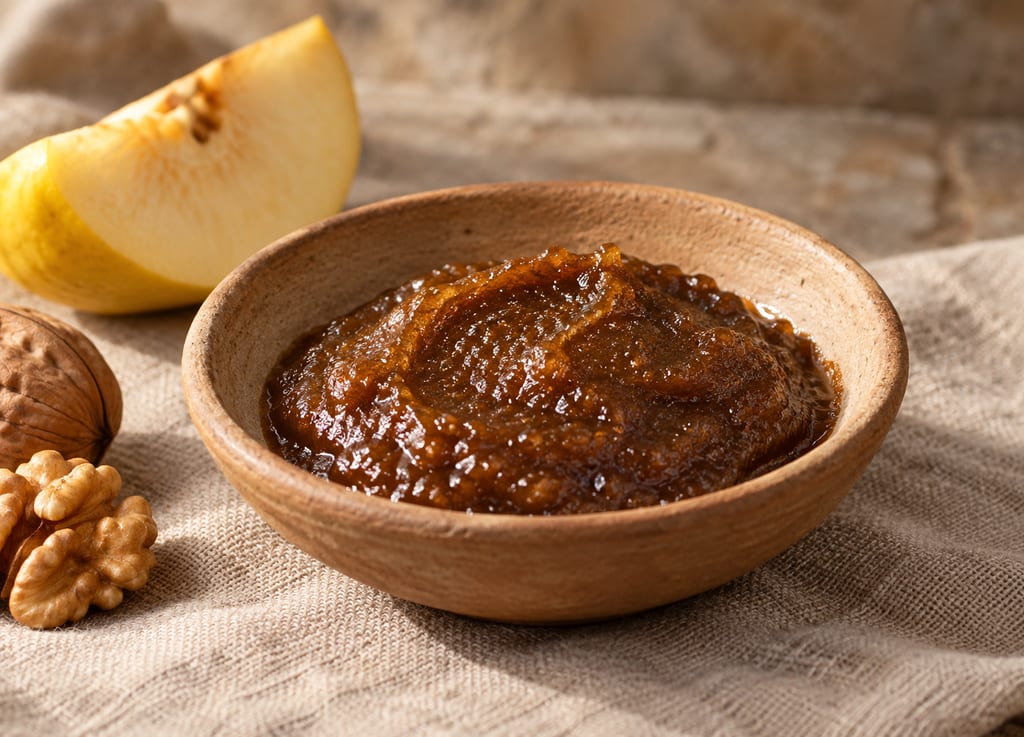
Byzantine murrī is a cooked imitation of murrī from the medieval Arabic repertoire, made from scorched honey, toasted bread, walnuts, quince, carob and spices rather than from a long grain fermentation.
No community contributions have been published for this entry yet.
Sign in to contribute. Published comments and photos are free to read.
Just One Cookbook; Namiko Hirasawa ChenInspiration · Process · Geography
Kuromitsu (Black Sugar Syrup)Card: 3.5 oz black sugar, ½ cup granulated sugar and ½ cup water; stated yield 200 mL. Bring to boil, simmer on low 15–20 minutes while stirring, then cool.
Added sugar may be reduced or omitted. Author advises an airtight container in the refrigerator for up to a week; this is attributed recipe guidance.
Cited in: What is kuromitsu?; Okinawan black sugar and its history; Ingredients; Why black sugar matters; 1. Break up the black sugar if needed; 2. Combine ingredients; 3. Bring to a boil; 4. Reduce heat; 5. Concentrate the syrup; 6. Cool; 7. Transfer; The chemistry of syrup concentration; Is kuromitsu caramel?; Regional and ingredient variations; How kuromitsu is served; Quality and troubleshooting; Safety
Context
Just One Cookbook — Anmitsu and Kuromitsu ServingSupporting account in the written batch for this record.
Cited in: What is kuromitsu?; Okinawan black sugar and its history; Is kuromitsu caramel?; How kuromitsu is served
Context
Just One Cookbook — Warabi MochiSupporting account in the written batch for this record.
Cited in: What is kuromitsu?; How kuromitsu is served