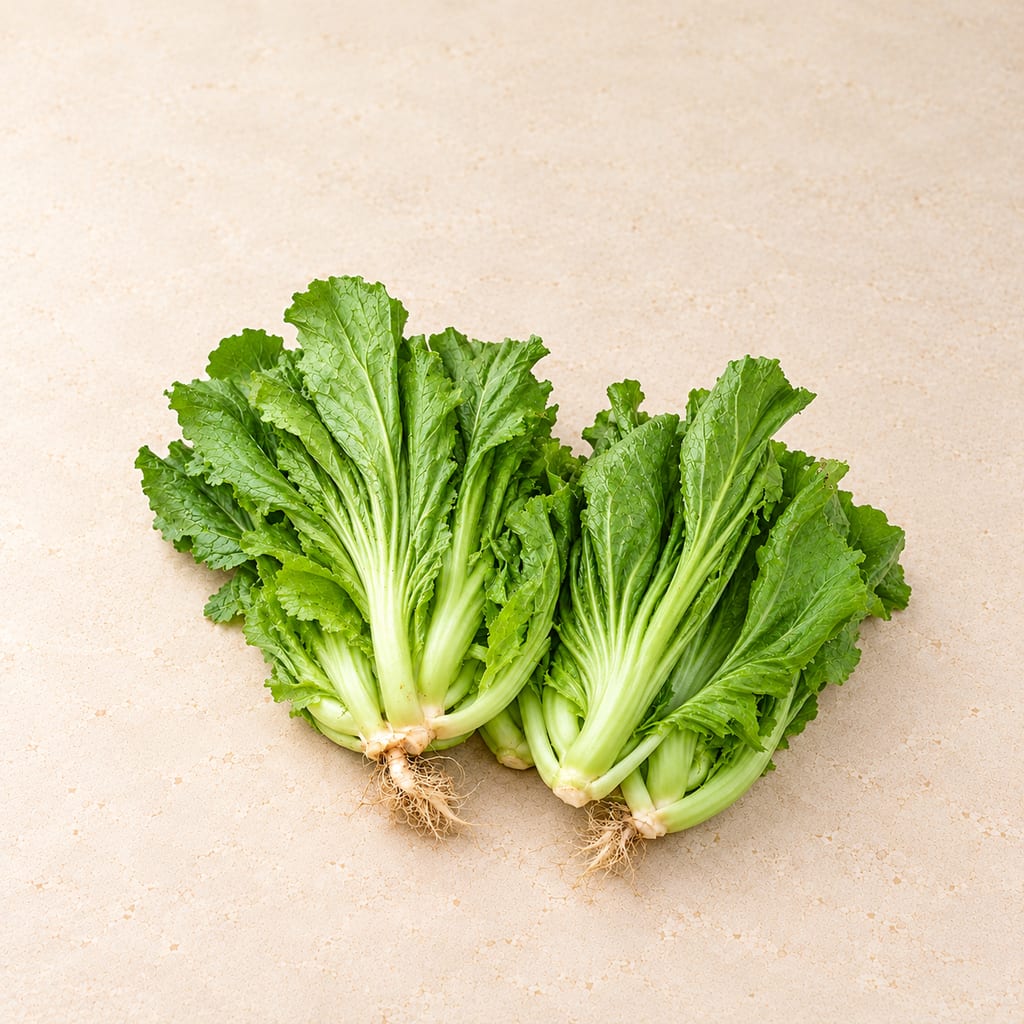
Mustard greens
The leaves of Brassica juncea, a hardy cool-season crop with a sharp, sulfurous bite, eaten fresh and cooked and fermented across Asia as pickled greens, kimchi and gundruk.
 FermenteaWhere food goes to change
Traditional method
Gundruk
Mustard leaves wilted, bruised and packed tight into an earthenware vessel to sour without salt, then sun-dried into dark tangled pieces that carry Himalayan meals through the year.
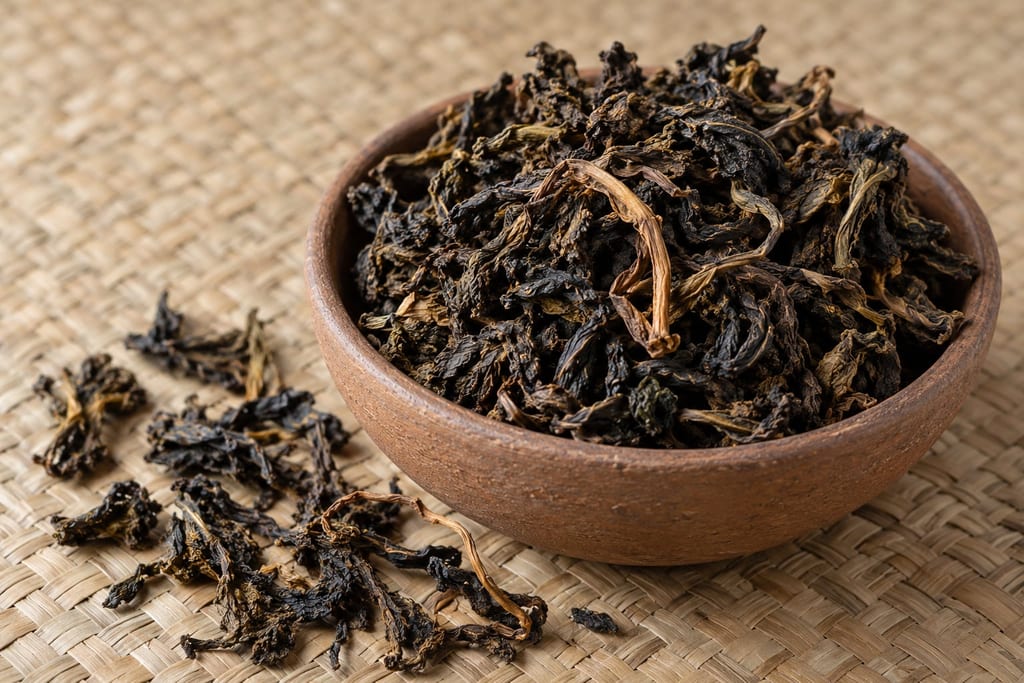
Gundruk and sinki are traditional Himalayan foods that combine vegetable fermentation with drying.
They are closely related technologies but are not the same food.
Gundruk is made principally from leafy vegetables, including mustard, radish greens and certain other locally available brassicas.
Sinki is made from radish taproots.
Both involve deliberate vegetable souring, followed by dehydration to produce an ingredient that can be stored and cooked later.
The important biological process is lactic-acid fermentation.
Microorganisms metabolize available vegetable carbohydrates and produce organic acids, particularly lactic acid.
The fermentation changes flavor, texture and acidity. Subsequent drying removes water and creates a more portable food.
This two-stage arrangement distinguishes these products from many familiar European vegetable ferments, which are often kept submerged in acidic brine.
Gundruk and sinki are traditionally made without large additions of salt in many documented methods.
This is a particularly important distinction. Salt cannot be assumed to provide their primary microbial control.
Instead, acid production, exclusion of excess oxygen, substrate characteristics, subsequent drying and appropriate storage all influence the outcome.
These foods are strongly associated with Nepal, Darjeeling, Sikkim and neighboring eastern Himalayan communities.
They belong to agricultural food systems in which leafy greens and radishes may be abundant in one season but less available later.
Fermenting and drying vegetables allows households to retain a distinctive source of sour flavor beyond the fresh growing season.
The technologies are documented in ethnographic food studies and scientific investigations conducted during the late 20th and early 21st centuries.
Their precise invention dates are unknown.
Some popular descriptions treat gundruk as an ancient national food and assign a very old origin, but surviving evidence does not support a precise calendar date.
The strongest historical conclusion is that these are established, inherited regional preservation practices that continue in contemporary households.
Their popularity also reflects their compatibility with rice, dal and other staple foods.
A small amount of dried sour vegetable can transform the flavor of a meal without requiring a large quantity of fresh produce.
The ingredients of gundruk are flexible within a recognizable group of leafy vegetables.
Published studies identify mustard leaves, Brassica juncea, and leaves associated with other brassicas, including cauliflower and traditional leafy mustard varieties.
Radish leaves may also be used.
Leaf thickness, maturity and variety affect fermentation.
Young leaves are tender and contain relatively little structural fiber. Mature leaves can have stronger flavors and tougher tissues.
The amount of fermentable carbohydrate also varies with species, growing conditions and harvest maturity.
Sinki differs because it uses the storage root of radish, Raphanus sativus.
Radish roots contain substantial water, soluble sugars and structural tissue.
Their dense texture requires different preparation from leafy greens.
This difference is large enough that a sinki process cannot be represented merely as gundruk made with a different vegetable.
A documented traditional sequence begins by cleaning the harvested leafy vegetables.
The leaves are wilted before fermentation.
One original microbiological study describes wilting for 1–2 days.
Wilting reduces the amount of free moisture and softens tissues, making it easier to compact the leaves.
The leaves are then crushed or bruised.
Crushing damages plant cells and releases some intracellular liquid and soluble nutrients.
The prepared greens are pressed firmly into an earthenware vessel or another suitable container.
The aim is to minimize large air spaces and establish conditions favorable to the desired fermentation.
The vessel is closed and held for souring.
One documented traditional production method gives approximately 15–22 days of fermentation, followed by 2–4 days of sun drying.
Other regional accounts describe shorter fermentation periods, including approximately 7–15 days.
The differences reflect source-specific practices; they should not be averaged into a single purported traditional standard.
Once fermented, the leaves are removed and dried.
The finished gundruk consists of dark, curled or tangled pieces that retain a pronounced sour flavor.
They can be stored and later rehydrated or cooked.
The dominant desired process is lactic-acid fermentation.
Lactic acid bacteria are common on vegetable surfaces and in traditional fermentation environments.
Species historically identified in gundruk studies include organisms classified as Lactobacillus plantarum, Lactobacillus fermentum, other lactobacilli and Pediococcus pentosaceus.
Some taxonomic names have changed, and modern scientific descriptions may use Lactiplantibacillus plantarum or other revised genera.
The central metabolic reaction converts fermentable sugars into lactic acid.
As acid accumulates, the pH falls.
This change inhibits many organisms that prefer less acidic conditions, although the level of inhibition depends on the particular microorganisms and other process factors.
Plant enzymes and microbial activity also alter the texture and aroma of the leaves.
The characteristic sourness is therefore a real chemical product of fermentation, not simply a change produced by drying.
An important original study published in 2020 investigated the fermentation of Brassica juncea leaves over 16 days.
The fermenting material remained at approximately 20–22°C.
The study recorded a pH decrease from 6.59 to 3.71, with the lowest value measured on the ninth day.
Titratable acidity, expressed as lactic acid, increased from 0.095% to 1.200% by day twelve.
The lactic acid bacterial count increased from 6.03 to 9.55 in the study's reported counts, whose multiplier and exponent did not survive the handover of this research after three days.
The population subsequently declined and stabilized at a lower level.
These measurements give a useful picture of fermentation development.
They show early microbial growth followed by acid accumulation and later changes in population.
But they describe the particular leaves, vessel and conditions in that experiment.
They do not establish that every gundruk batch should be held for exactly sixteen days or will reach precisely pH 3.71.
An unsuccessful batch cannot be made safe by waiting until the same calendar day.
Sinki is traditionally associated with a pit-fermentation method.
The process begins with radish roots that are wilted before further preparation.
The original comparative food-microbiology literature describes wilting for 2–3 days.
The roots are crushed or otherwise broken down, dipped in lukewarm water, squeezed and packed tightly.
The preparation site is especially distinctive.
A traditional account describes a dry-ground pit with a diameter of approximately 2–3 feet. The pit is cleaned, coated with mud and warmed by lighting a fire inside.
After the ashes are removed, the pit is lined with bamboo sheaths and paddy straw.
These materials provide a separation between the vegetable and the soil.
The prepared radish is packed tightly into the pit.
Dry leaves cover the vegetables, and boards or stones provide weight.
A mud covering closes the top.
The recorded fermentation period is 22–30 days.
After fermentation, the radish is removed, cut into smaller pieces and sun dried for 2–3 days.
The finished sinki is stored for later cooking.
This is an excellent example of environmental engineering using locally available earth, straw, leaves and wood.
The pit is simultaneously a processing vessel, thermal environment and physical enclosure.
However, the traditional process is not automatically safe to reproduce in an untested garden pit.
Soil can introduce pathogens, and the scientific safety of the finished product depends on more than its traditional construction.
The pit creates conditions different from open-air drying.
Compacted vegetable material retains moisture needed for bacterial metabolism.
Restricted airflow can favor fermentative organisms over some aerobic competitors.
The surrounding earth may buffer fluctuations in temperature.
The lining and surface covering influence contamination, moisture movement and the interaction between the vegetable and its enclosure.
Fermentable radish sugars provide nutrients for lactic acid bacteria.
As acid accumulates, the mixture becomes sour.
Microbiological investigations identify lactic acid bacteria including L. plantarum, L. brevis, L. casei and Leuconostoc fallax in traditional sinki research.
These organisms are not necessarily present in identical proportions in every household batch.
The process should also not be confused with an animal-protein fermentation pit.
Vegetable souring depends on its own substrate, microbial community and physicochemical conditions.
Both foods undergo a second preservation stage after souring.
Drying removes water that many microorganisms need for growth.
As the fermented material dries, its acidity and flavor remain part of the concentrated ingredient.
The combination of acidification and dehydration offers preservation benefits beyond either process alone.
However, a dry surface does not guarantee that the center of a thick piece has dried sufficiently.
Traditional sun drying is also weather-dependent.
Unexpected rain, high humidity, insect contamination or prolonged dampness can interfere with preservation.
Drying needs to be understood as a controlled stage rather than a purely cosmetic step.
Modern producers can measure moisture and water activity to establish whether a product is suitable for intended storage conditions.
The cited traditional studies do not provide one universal finished water-activity target for gundruk or sinki.
Gundruk is commonly prepared as a soup, sometimes called gundruk ko jhol.
The dried leaves are rehydrated or simmered with other ingredients.
Tomato, onion, garlic, chili and potato are among common contemporary accompaniments.
The sour greens provide an acidity that can balance richer foods.
Gundruk can also be used in pickles or cooked vegetable dishes.
With rice and dal, it contributes a contrasting flavor that makes a relatively simple meal more varied.
Its value is not solely nutritional. It provides a distinctive preserved taste that would otherwise be unavailable from fresh leaves.
Sinki is also used in soups and pickle-like dishes.
Its radish origin gives it a different texture and flavor from gundruk.
The dried root pieces may require soaking or simmering to soften them.
A simple preparation combines sinki with water and seasonings, producing a sour broth.
Other versions include vegetables, chili and aromatic ingredients.
The source material does not establish one universal recipe with fixed quantities of every seasoning.
Traditional households adapt the dish to available ingredients.
The fermentation itself supplies much of the characteristic acidity, so a sinki dish does not necessarily require an additional souring agent.
Gundruk and sinki belong to a wider group of fermented vegetables.
Khalpi is a fermented cucumber preparation documented in Sikkim and nearby areas.
Goyang and inziangsang are further regional examples involving leafy vegetable fermentation.
These are separate named foods, not merely alternative spellings of gundruk.
The broad principle of vegetable acidification is shared with sauerkraut, kimchi and other lactic-acid vegetable ferments.
Nevertheless, different salt regimes, containers, vegetable structures and later drying stages can produce substantially different products.
The absence of added salt in many Himalayan methods is especially important when comparing them with salted cabbage fermentation.
Sources describe gundruk as developing sourness, a softened or changed leaf structure and an aroma characteristic of fermented vegetables. These observations do not establish that a household batch has acidified sufficiently or is safe.
Sinki develops a pronounced sour radish flavor and a texture influenced by crushing, fermentation and drying.
Excessive surface mold, putrefactive odors, signs of animal contamination or unexpectedly slimy decomposition suggest problems.
A batch that does not acidify sufficiently may remain vulnerable to unwanted microbial growth.
The measured pH of 3.71 in one experimental gundruk preparation is evidence of successful acidification in that experiment, not a guarantee that an unmeasured household batch is equivalent.
Traditional descriptions are incomplete for modern food-safety validation.
The cited papers provide specific temperatures and durations for particular methods but do not establish a universal safe process for every vegetable, pit or vessel.
Successful acidification is important, especially in methods without added salt.
The final dried product must also remain protected from moisture and contamination.
Where commercial production is intended, producers should use a validated process with appropriate pH, microbial and water-activity controls.
Randomly fermenting vegetables underground is not equivalent to following a well-established community technique.
Gundruk and sinki remain excellent examples of genuine two-stage preservation: microorganisms create acidity and flavor, then drying concentrates and preserves the transformed vegetables.
Gundruk belongs to agricultural food systems in which leafy greens and radishes may be abundant in one season and much less available later, and fermenting then drying them lets a household keep a distinctive source of sour flavour beyond the fresh growing season. Its popularity also reflects how it is eaten: with rice and dal, a small amount of dried sour vegetable contributes a contrasting flavour that makes a relatively simple meal more varied, and its value is not solely nutritional but a preserved taste that fresh leaves cannot give. The two-stage arrangement is what distinguishes it from many familiar European vegetable ferments, which are often kept submerged in acidic brine; here the vegetable sours in a closed vessel and is then dehydrated, and the broad principle of vegetable acidification shared with sauerkraut and kimchi conceals substantial differences in salt regime, container, vegetable structure and the later drying stage. The absence of added salt in many Himalayan methods matters most of all when comparing them with salted cabbage fermentation.
Scaling: source batch only
Many documented methods use no large salt addition, so salt cannot be assumed to provide the primary microbial control and the preservation depends on acid production, exclusion of excess oxygen, substrate characteristics, drying and storage together. A batch that does not acidify sufficiently may remain vulnerable to unwanted microbial growth.
Hazard sourceThe measured pH of 3.71 in one experimental preparation is evidence of successful acidification in that experiment, not a guarantee that an unmeasured household batch is equivalent, and an unsuccessful batch cannot be made safe by holding it to the same calendar day.
Hazard sourceA dry surface does not guarantee that the centre of a thick piece has dried sufficiently, and traditional sun drying is weather-dependent: unexpected rain, high humidity, insect contamination or prolonged dampness can interfere with preservation.
Hazard sourceExcessive surface mould, putrefactive odours, signs of animal contamination or unexpectedly slimy decomposition indicate a failed batch rather than a stage of the process.
Hazard sourceWilt and bruise the leaves so that intracellular liquid and soluble nutrients are available to the lactic acid bacteria, then pack them tightly to minimise air spaces
Control sourceEstablish that the batch has actually acidified rather than relying on elapsed days, which matters most in methods without added salt
Control sourceTreat drying as a controlled stage rather than a cosmetic step, and keep the dried product protected from moisture and contamination
Control sourceFor commercial production, use a validated process with appropriate pH, microbial and water-activity controls, and measure moisture and water activity against the intended storage conditions
Control sourceSalt is not the control here: many documented Himalayan methods add none, so a batch that fails to acidify has no second barrier protecting it.
The documented fermentation periods differ between accounts by about a factor of three, from approximately 7 to 15 days up to 15 to 22 days; they are different local practices, not points on one range.
The laboratory figures for Brassica juncea gundruk — pH 3.71 on day nine, acidity rising to 1.200 per cent by day twelve over a 16-day run at 20 to 22°C — describe the leaves, vessel and conditions of that experiment and do not tell you what an unmeasured vessel has done.
A dried surface does not mean a thick piece has dried through, and the cited studies publish no finished water-activity target for either gundruk or sinki.
The lactic acid bacterial counts published in the 2020 study lost their multiplier and exponent in the handover of this research, so no cell count from this account can be used as a reference point.
Sourness, texture change and fermented aroma are descriptive observations, not validated household tests of sufficient acidification or safety.
A country-level association, which is as fine as the sources support: they place gundruk in Nepal and the neighbouring eastern Himalayan hills without identifying communities or localities. The row records that these are established inherited regional preservation practices continuing in contemporary households. It makes no claim about origin, and the account is explicit that popular descriptions treating gundruk as an ancient national food with a very old origin are not supported by surviving evidence.
A state-region row for the documented association with Sikkim, where the comparative study of eastern Himalayan fermented vegetables collected material. It names no community and no locality. The related fermented cucumber preparation khalpi is also documented in Sikkim and nearby areas and is a separate named food, not a variant of gundruk.
A hill-region row for the documented association with Darjeeling. As with the other rows it records where the practice is documented at regional level and claims nothing about the method used by any particular household, nor that practice there is identical to practice in Nepal or Sikkim.
The wider eastern Himalayan region, with which these two-stage vegetable preservations are associated as a group across national borders. The row exists because the comparative studies sample at that level. It does not attribute the practice to any named community, and goyang and inziangsang, the other regional leafy-vegetable ferments the account mentions, are separate named foods rather than local versions of gundruk.
The leaves of Brassica juncea, a hardy cool-season crop with a sharp, sulfurous bite, eaten fresh and cooked and fermented across Asia as pickled greens, kimchi and gundruk.
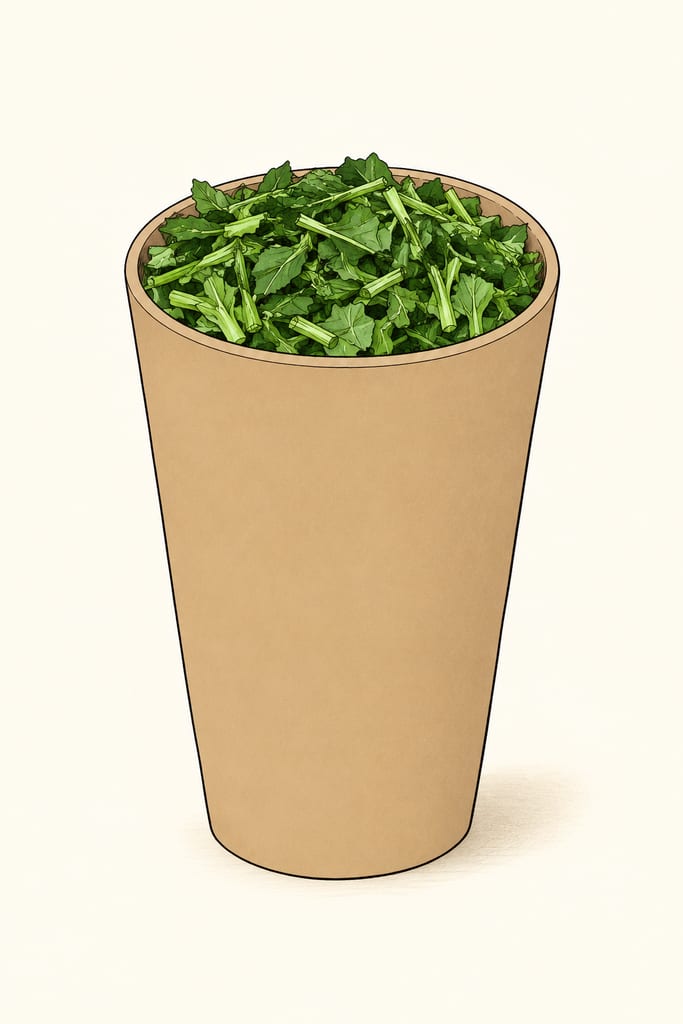
Gundruk pots and dhungro are fermentation containers documented in Nepal and one Darjeeling household. FAO describes earthenware; a 2024 figure identifies a bamboo-made airtight dhungro buried in a pit within a cow-dung heap.
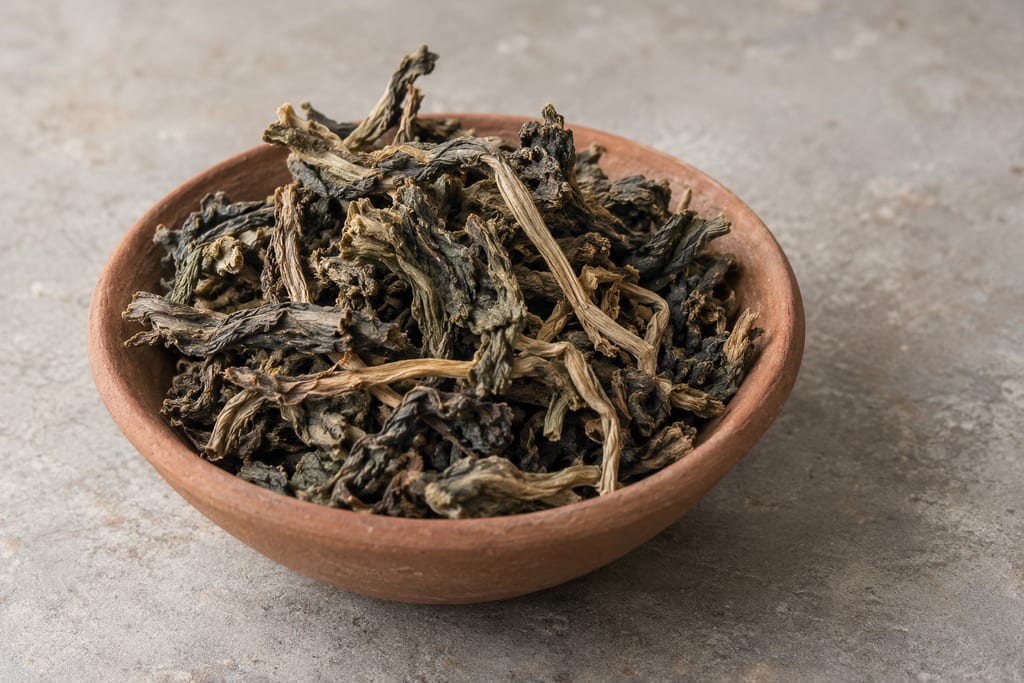
Radish greens wilted, packed into an earthen pot with warm water and fermented without salt, then sun-dried into Nepal's dark, sour gundruk.
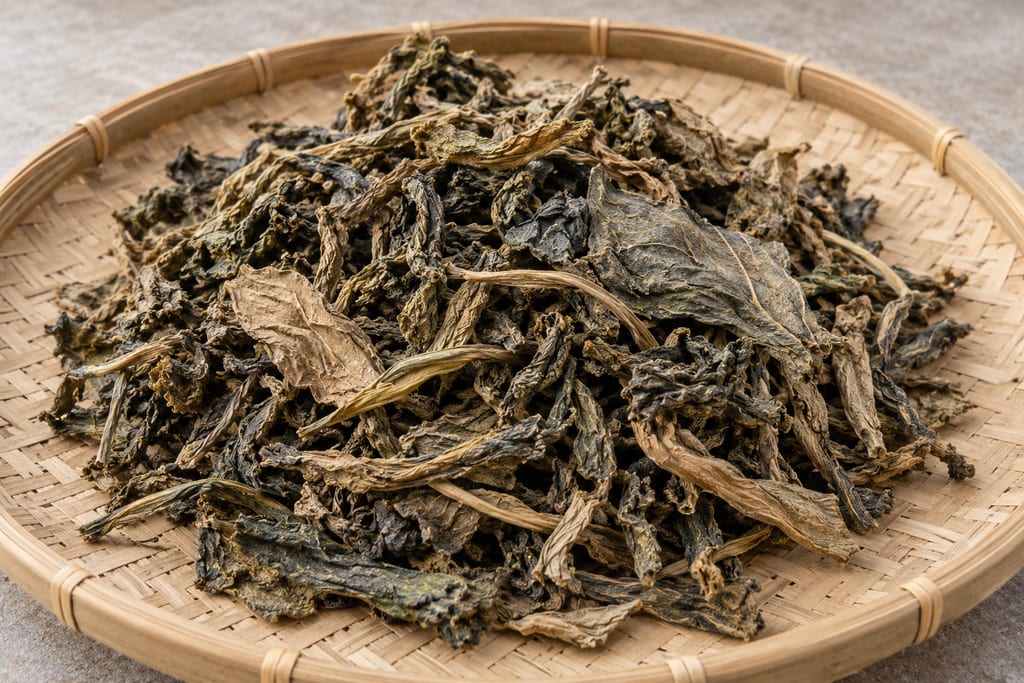
Wilted and shredded Brassica rapa rayo-sag leaves, packed under warm water in earthenware, fermented five to seven days, then sun-dried as Nepali gundruk.
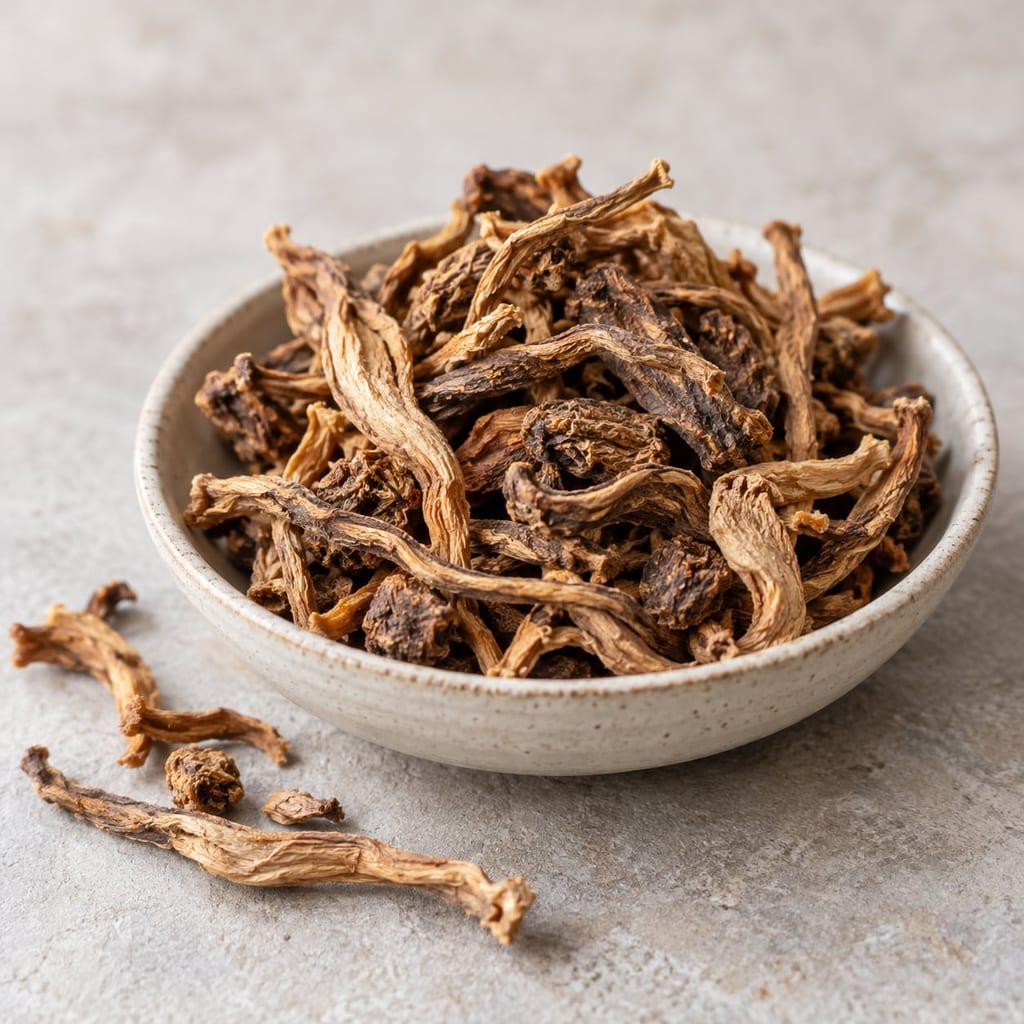
Sinki is a salt-free, fermented radish-taproot product dried after fermentation. Published jar and pit accounts use different conditions; neither supplies a validated home-preservation endpoint.
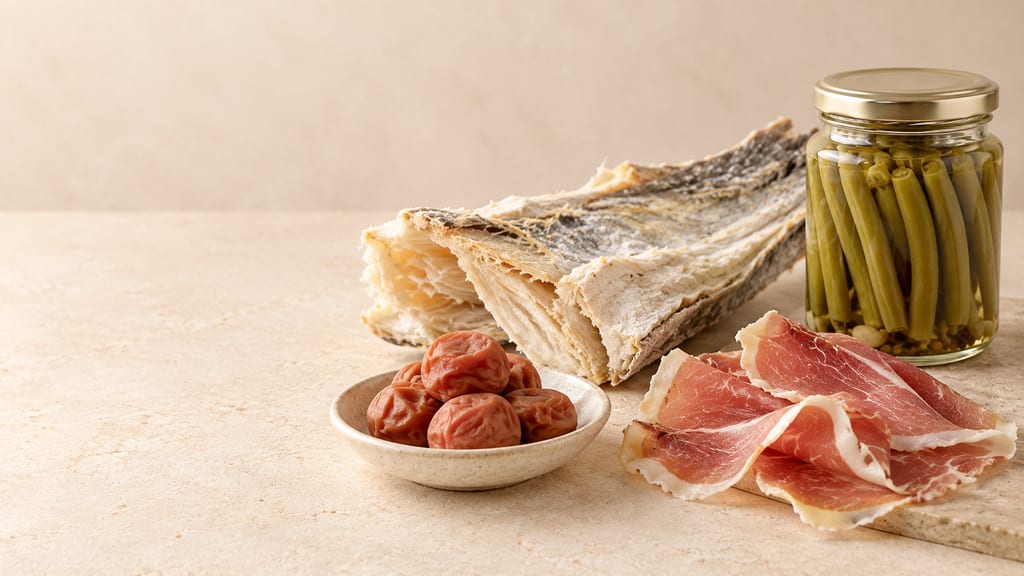
Every preserved food is a stack of barriers against microbes, enzymes, air and time. This is how they work, what a recipe's numbers measure, and how cooks worldwide build them.
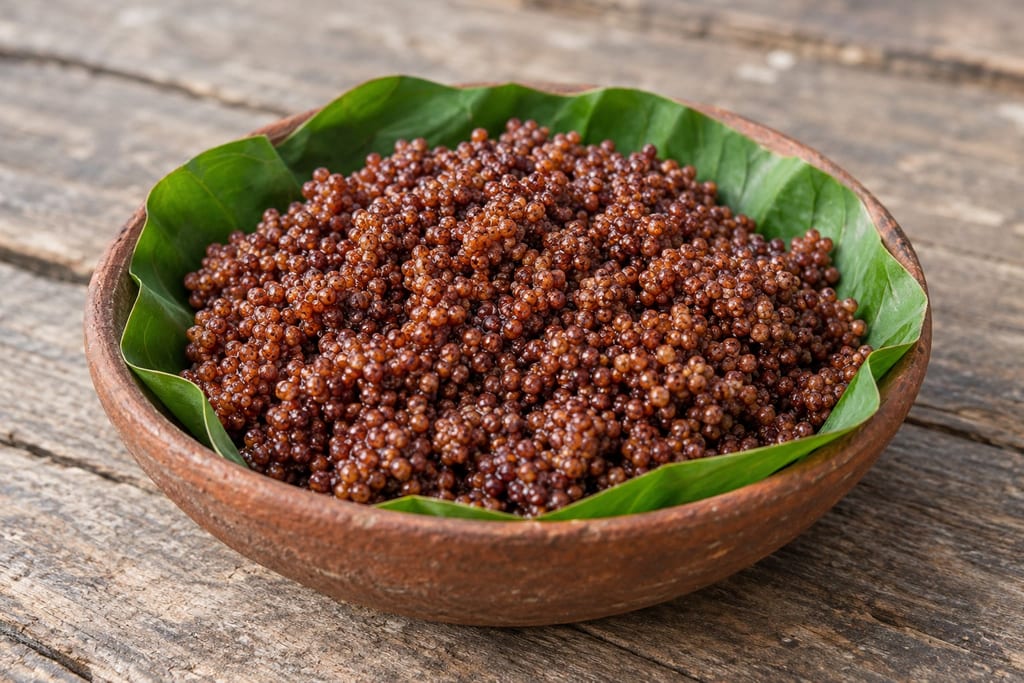
Finger millet fermented with marcha in surveyed Darjeeling and Sikkim communities. Tongba is the later warm-water extraction from the fermented grain. The cited accounts do not establish a complete or validated home batch.
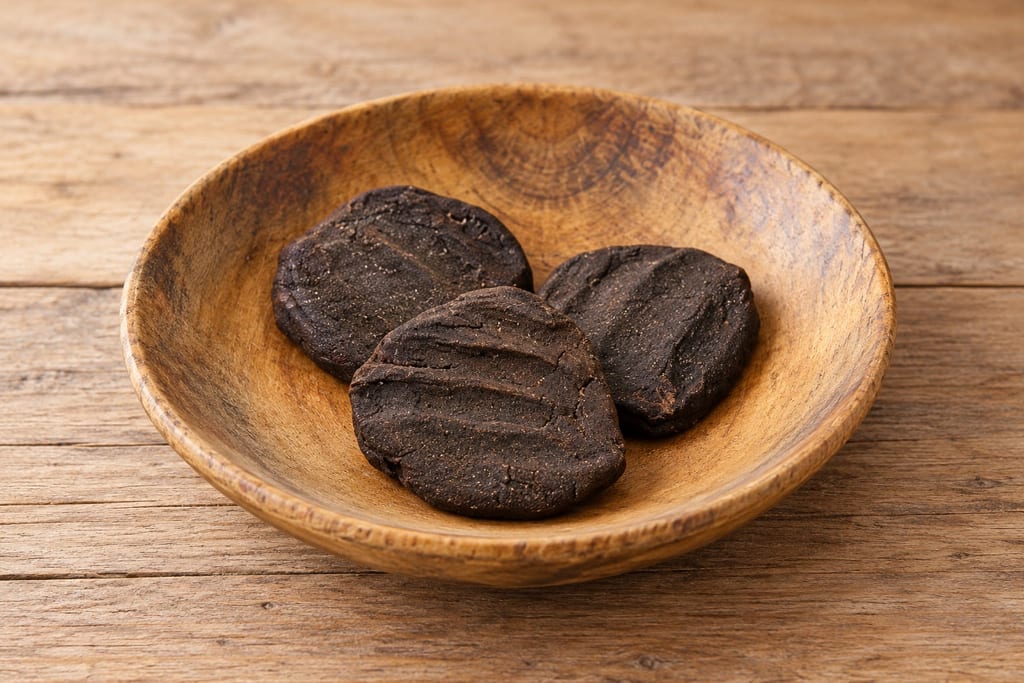
Dried cakes of pounded taro leaves from the Ao Naga in Nagaland, yellowed in a bag, then dried by hot ash or sun and used to flavour meat dishes.
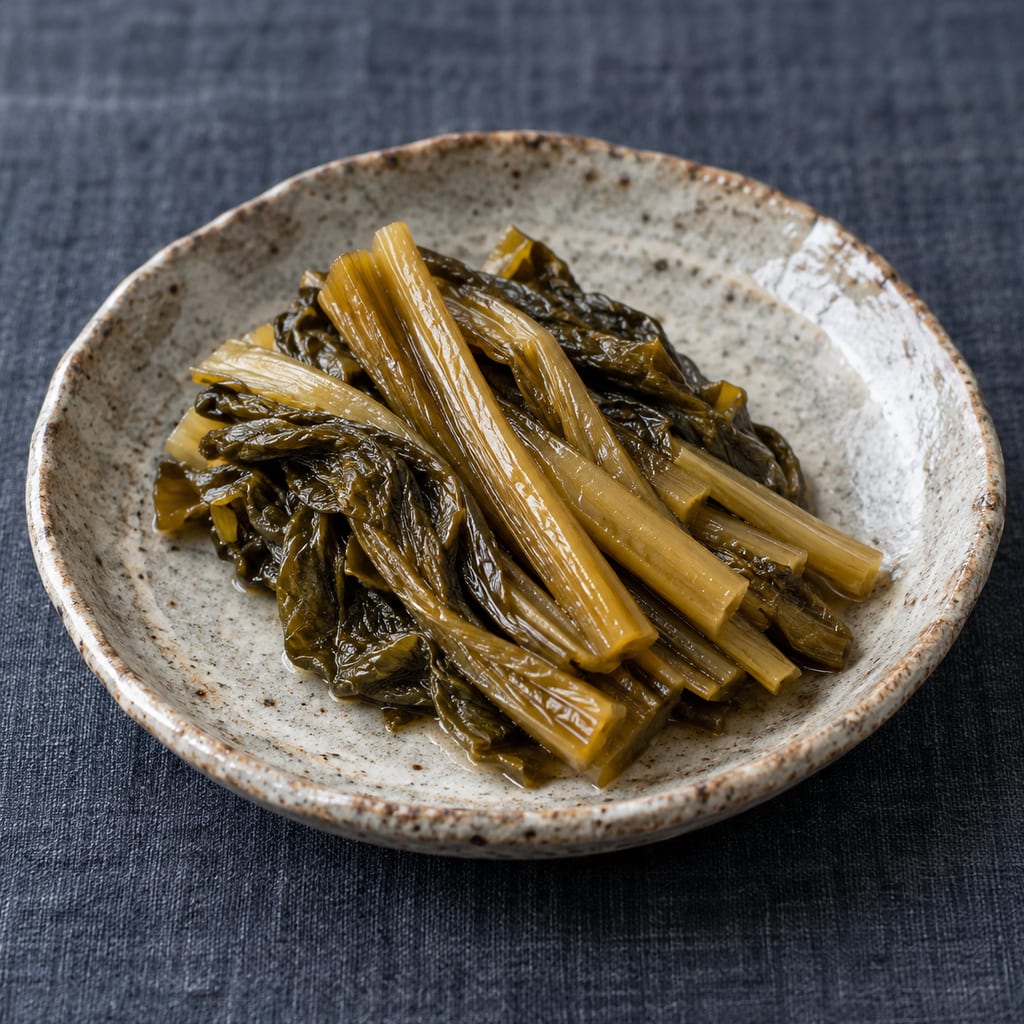
Takana mustard greens from Aso in Kumamoto are salted and pressed into a fresh spring pickle, or aged into a sour furuzuke that is fried and mixed into takana rice.
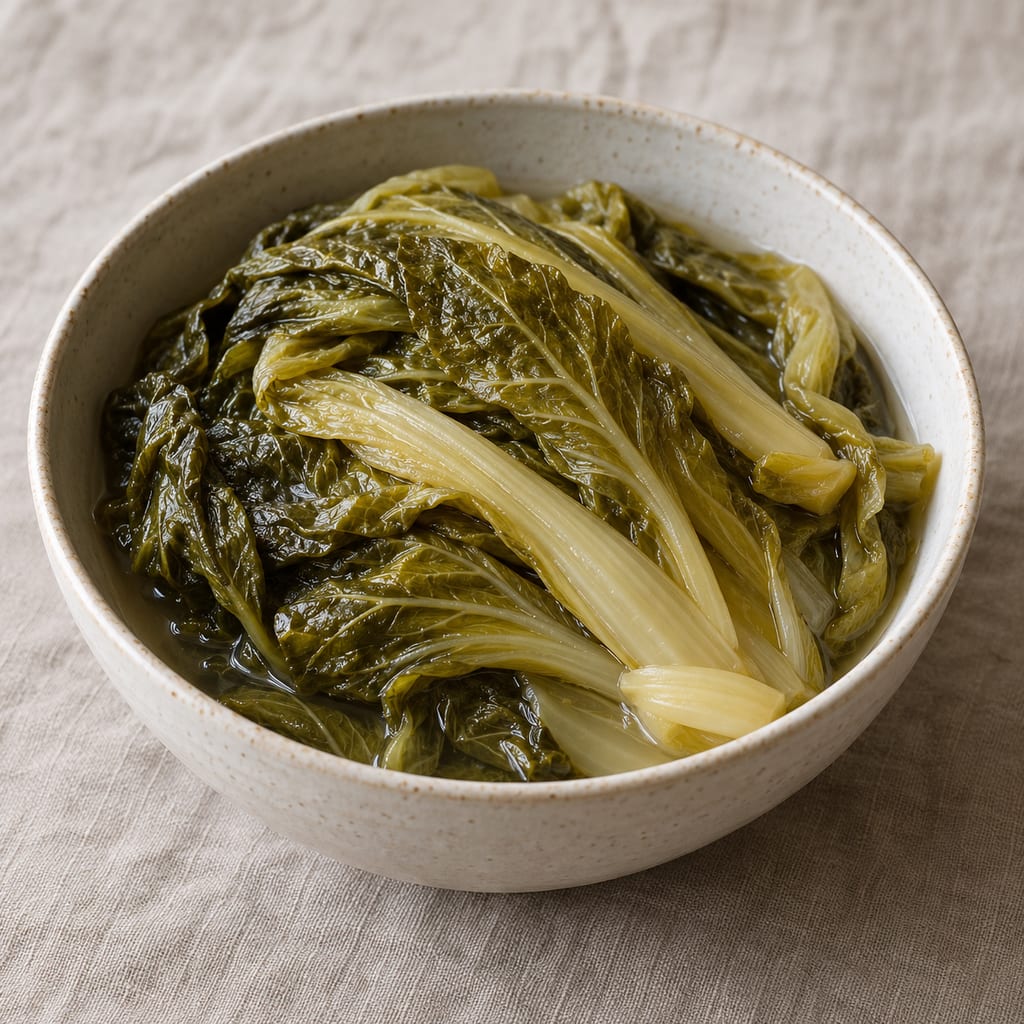
Wilted flat mustard leaves ferment with rice water and salt as a Filipino appetizer and cooking ingredient.
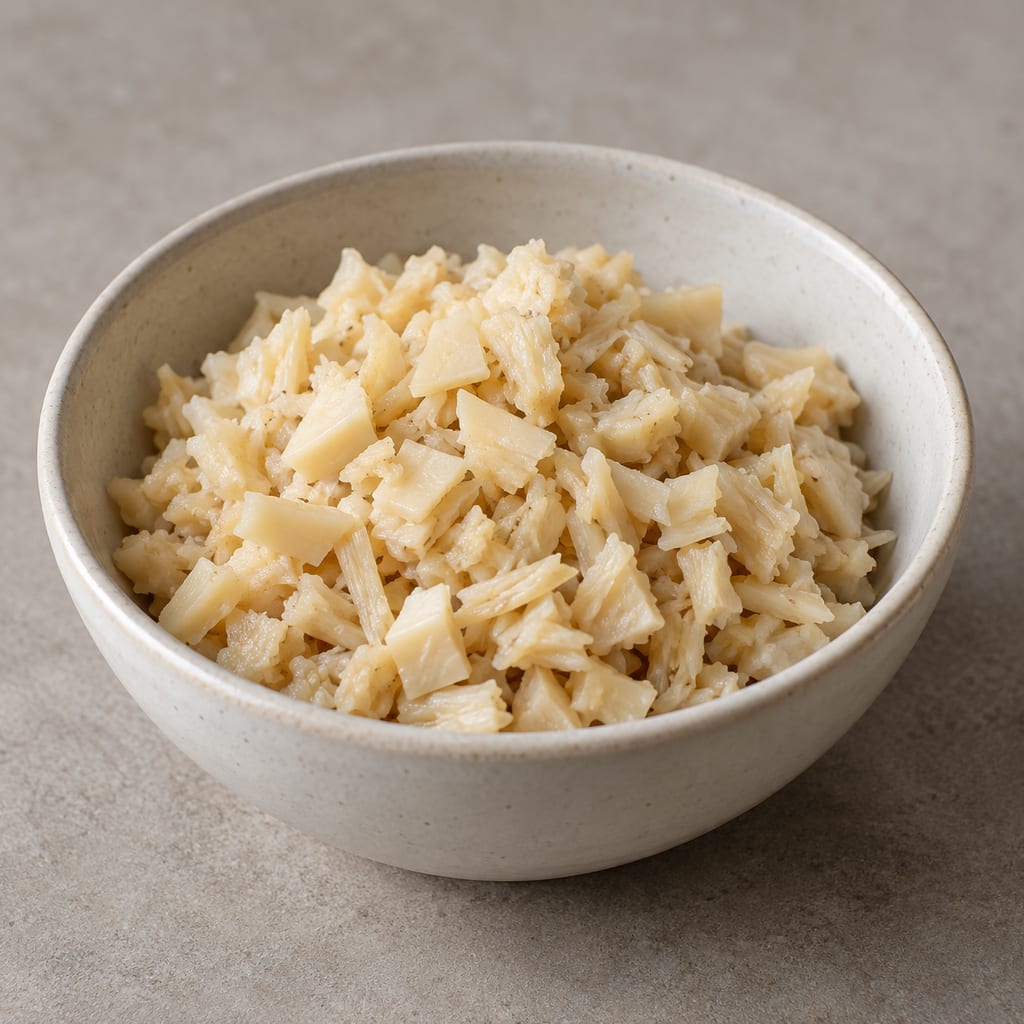
Finely chopped young bamboo shoots packed in leaf-lined baskets, sealed in a forest pit and weighted for one to three months, from Arunachal Pradesh.

Pit-fermented bamboo shoots from Arunachal Pradesh, cut smaller and sun-dried for five to ten days, used in curries.
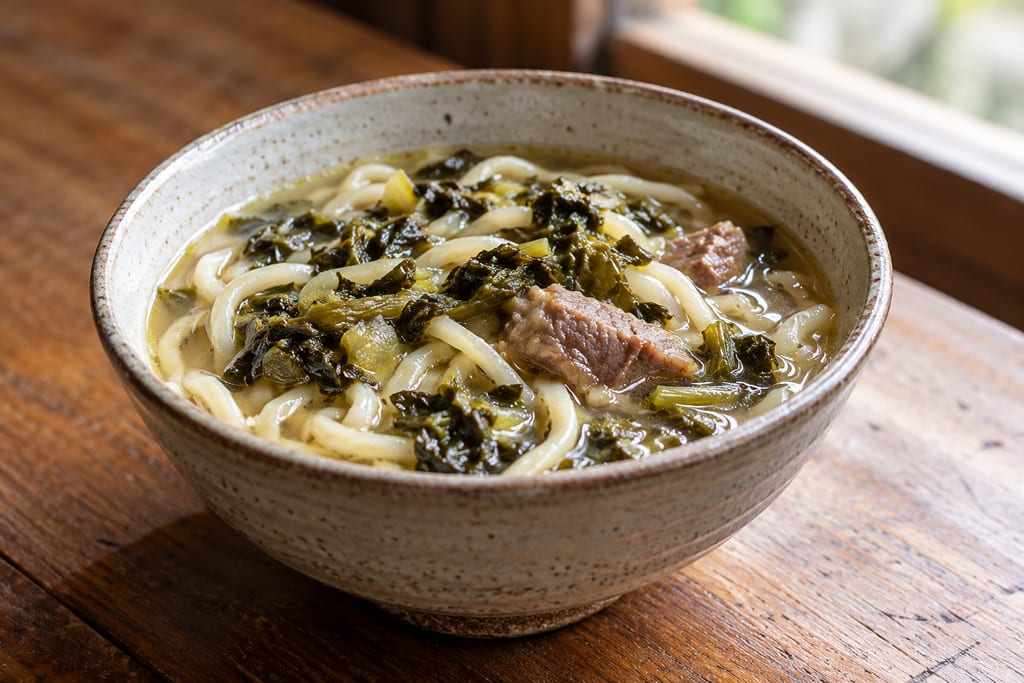
Goyang is a Sherpa fermented wild leafy food of the Darjeeling hills and Sikkim. Rainy-season magane-saag leaves are packed in a bamboo basket, held at room temperature for about a month, then eaten fresh or dried and used in soup.
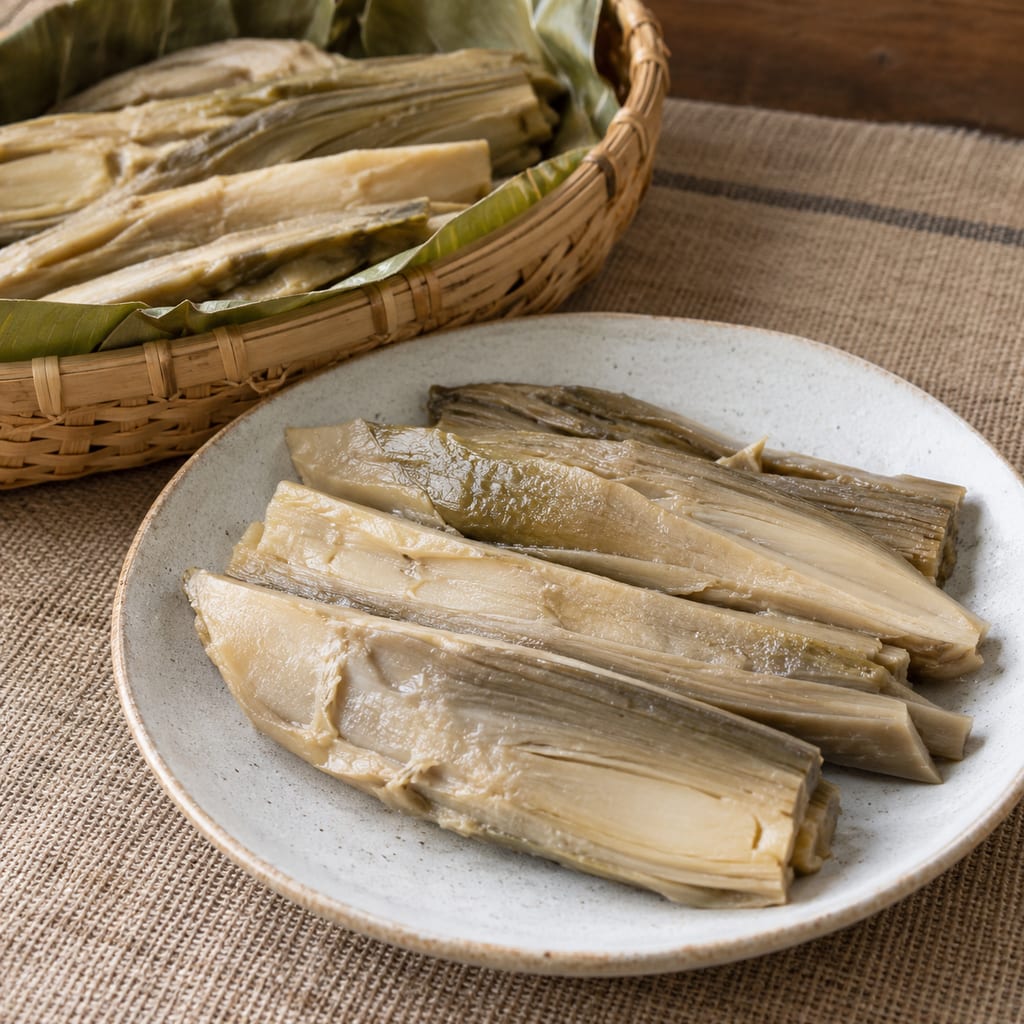
Upper tender bamboo-shoot tips, split or flattened, pit-fermented one to three months in Arunachal Pradesh and eaten in curries.
The original Polish barszcz: young hogweed leaves soured in warm water for a few days, then boiled into soup with egg, butter, cream or millet. Recorded from 1595, with warnings about the sap and lookalikes.
No community contributions have been published for this entry yet.
Sign in to contribute. Published comments and photos are free to read.
ElsevierScience · Method
Identification of predominant lactic acid bacteria isolated from traditionally fermented vegetable products of the Eastern HimalayasAn original comparative study of 2005 identifying the predominant lactic acid bacteria isolated from traditionally fermented vegetable products of the eastern Himalayas, including gundruk and sinki.
Species historically identified in gundruk studies include organisms classified as Lactobacillus plantarum, Lactobacillus fermentum, other lactobacilli and Pediococcus pentosaceus, with some taxonomic names since revised, for instance to Lactiplantabacillus plantarum.
Lactic acid bacteria identified in traditional sinki research include L. plantarum, L. brevis, L. casei and Leuconostoc fallax, which are not necessarily present in identical proportions in every household batch.
The comparative food-microbiology literature records wilting radish roots for 2 to 3 days before the sinki preparation proper.
Published studies identify mustard leaves, Brassica juncea, and leaves associated with other brassicas including cauliflower and traditional leafy mustard varieties, with radish leaves also used.
Cited in: Two vegetables, one preservation principle; Vegetable selection; The microbiology of gundruk; Making sinki: The distinctive pit technique; Why the pit works as a fermentation environment; Gundruk in everyday cooking; Sinki in cooking; Reported sensory changes and failure signs
PubMed CentralScience
Kinetics and modeling of growth and lactic acid production in GundrukAn original 2020 study of the kinetics and modelling of growth and lactic acid production in gundruk, which investigated the fermentation of Brassica juncea leaves over 16 days with the fermenting material at approximately 20 to 22°C.
It recorded a pH decrease from 6.59 to 3.71, with the lowest value measured on the ninth day, and titratable acidity expressed as lactic acid increasing from 0.095 per cent to 1.200 per cent by day twelve.
The lactic acid bacterial count increased over the first three days, by a factor whose multiplier and exponent did not survive the handover of this research, then declined and stabilised at a lower level.
The study's own caution: these measurements describe the particular leaves, vessel and conditions of that experiment and do not establish that every batch should be held for exactly sixteen days or will reach precisely pH 3.71, and an unsuccessful batch cannot be made safe by waiting until the same calendar day.
Cited in: What laboratory measurements reveal; Reported sensory changes and failure signs; Safety considerations
Journal of Applied MicrobiologyMethod · Science · History
Ethno-microbiology of ethnic Indian fermented foods and alcoholic beveragesA 2022 regional microbiological overview of ethnic Indian fermented foods and alcoholic beverages, used here for the documented gundruk production sequence: cleaning the harvested leafy vegetables, wilting for 1 to 2 days, crushing or bruising the leaves, pressing them firmly into an earthenware vessel to minimise air spaces, closing the vessel and holding it for approximately 15 to 22 days, then removing and sun drying for 2 to 4 days.
Other regional accounts describe shorter fermentation periods of approximately 7 to 15 days; the differences reflect source-specific practices and are not to be averaged into a single traditional standard.
Khalpi, a fermented cucumber preparation documented in Sikkim and nearby areas, and goyang and inziangsang are separate named regional foods involving leafy vegetable fermentation, not alternative spellings of gundruk.
The strong regional association is with Nepal, Darjeeling, Sikkim and neighbouring eastern Himalayan communities, in agricultural food systems where leafy greens and radishes are abundant in one season and less available later.
Cited in: Two vegetables, one preservation principle; Geographical setting and history; Making gundruk; Drying after fermentation; Gundruk in everyday cooking; Sinki in cooking; Related regional foods
PubMed CentralMethod · Science
Fermented Fruits and Vegetables of AsiaA comparative review of fermented fruits and vegetables of Asia covering sinki and other regional ferments, used here for the distinctive pit technique: radish roots wilted, crushed or otherwise broken down, dipped in lukewarm water, squeezed and packed tightly into a dry-ground pit approximately 2 to 3 feet in diameter that is cleaned, coated with mud and warmed by lighting a fire inside; after the ashes are removed the pit is lined with bamboo sheaths and paddy straw, the radish packed in, dry leaves laid over it, boards or stones used as weight and a mud covering closing the top, with a recorded fermentation period of 22 to 30 days followed by cutting and sun drying for 2 to 3 days.
The cited traditional studies do not provide one universal finished water-activity target for gundruk or sinki, and a dry surface does not guarantee that the centre of a thick piece has dried sufficiently.
Cited in: Vegetable selection; Making sinki: The distinctive pit technique; Why the pit works as a fermentation environment; Drying after fermentation; Related regional foods; Safety considerations