A bowl for poi, with more than one form
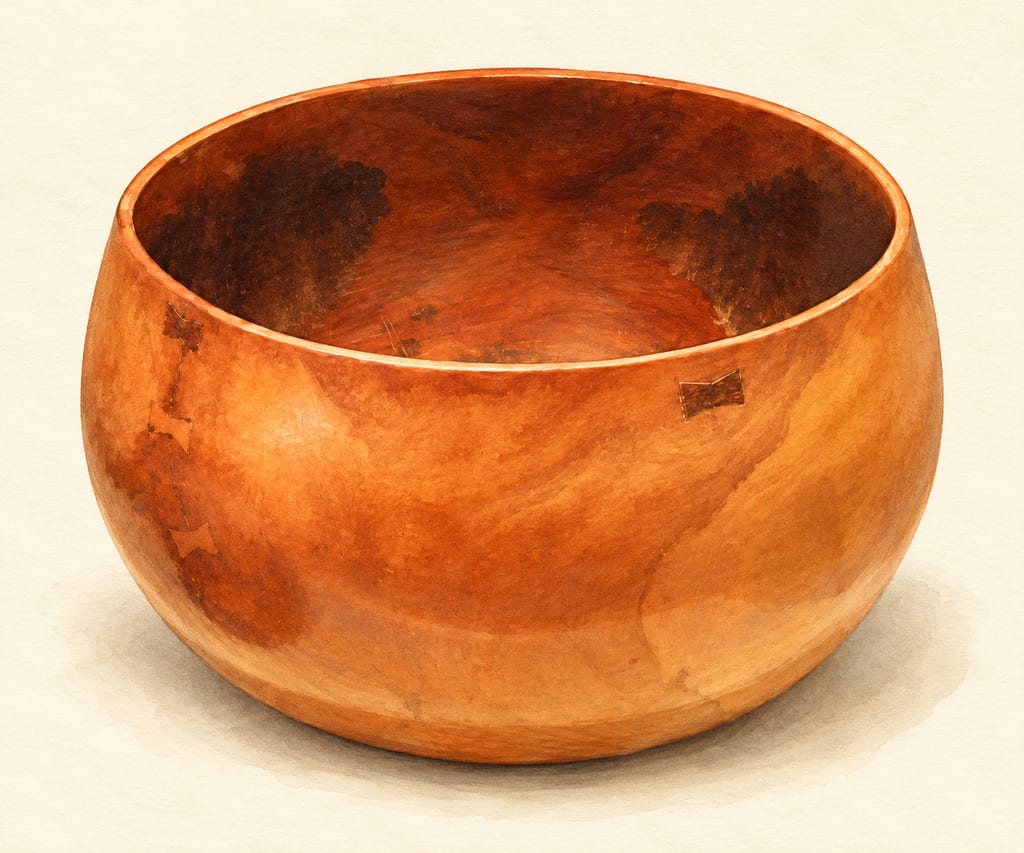
ʻUmeke is a Hawaiian word used for a bowl or calabash; ʻumeke poi names a bowl for poi. The Bishop Museum lists object 04006 simply as a wooden bowl and “Poi bowl,” from Hawaii, with no date or dimensions. A separate Honolulu Academy of Arts bowl photographed by Wikimedia Commons is described as carved kou and dated to the late 18th century. That is an object-specific date, not an origin date for the vessel form.
Wooden and gourd bowls both belong in this account. A carved wooden example may be called ʻumeke lāʻau, while cultural and museum sources describe gourd vessels used for poi. The sources also show that proportions and details vary: bowls may be more or less deep, and some have covers. A photograph of one polished bowl cannot stand in for every ʻumeke poi.
Sources for this section
Holding, storing, and serving
Poi is made from cooked or boiled taro corms pounded to a paste, then served at a fairly liquid consistency; it may be fresh or slightly fermented. Museum descriptions record wooden ʻumeke used to store and serve poi, alongside other foods. A bowl can therefore hold poi during a meal or between servings, but the vessel itself is not a fermentation method, and an object described only as a poi bowl should not be assigned a specific fermentation history.
A Pacific Worlds account from Heʻeia, Oʻahu, includes a community member’s recollection of a household poi bowl kept in the eating area and replenished with fresh poi. It offers one local description of ongoing practice, not a rule for all Hawaiian households. This bowl is also distinct from the tools that pound taro: it receives and holds poi after that work.
Sources for this section
Wood, gourd, and the work of making a bowl
Museum records describe wooden bowls with rounded bottoms; a Penn Museum example is likely kou, while the Bishop Museum record for object 04006 identifies wood without naming a species. A 2017 account of Hawaiian bowl-making discusses kou, milo, and other woods, as well as gourd and coconut-shell precedents. It describes the written record as sparse and draws on published sources and knowledge shared by Hawaiian bowl-makers, so its descriptions should not be turned into a claim that every bowl followed one recipe.
The same account explains that sizes and proportions correspond to different uses. Some wooden ʻumeke required substantial labor and were associated with chiefly households, while gourd bowls were widely used. Repairs, covers, and polished surfaces are visible or described for particular examples; they are not universal equipment features.
Sources for this section
Evidence, care, and limits
The surviving record combines museum catalogues, historic object photography, cultural scholarship, and a community account. The two linked photographs show the same late-18th-century carved kou bowl from different angles; they document one object rather than the full range of ʻumeke. The listed objects establish a Hawaiian association, but the inspected evidence does not establish when the form began, a standard capacity, or one island-wide design.
Historic descriptions of shaping, polishing, or repairing wood are not a present-day maintenance guide. The sources reviewed do not establish a safe modern cleaning regimen, the food-contact suitability of a particular finish, or where a reader can buy a newly made bowl. Treat dimensions, materials, and use as specific to each documented object.
Sources for this section
History
Bishop Museum entry 04006 records a wooden poi bowl from Hawaii but gives no date. The Honolulu Academy of Arts object photographed in Commons is captioned as a carved kou poi bowl from the late 18th century. These examples attest to bowls by that period, not to the origin date of the form.
Equipment details
SizeNo standard dimensions or capacity are established. The cited measurements and forms belong to individual museum objects.
How you get oneNot established The inspected sources document historical and museum objects, not a current source, price, or acquisition route.
CareThe sources document historic finishing and repairs but do not provide a modern cleaning or food-contact care schedule. Do not infer present-day use instructions from a museum object.
Made of
- Wood — Carved bowl body
Bishop Museum object 04006 is recorded as a wooden poi bowl; other museum examples describe kou and additional woods. These are object-specific records, not a universal species claim. - Gourd — Alternative bowl material
Cultural and museum sources document gourd bowls as well as carved wooden ʻumeke.
Places
Hawaiʻi
Traditional use · Region evidenceMuseum and cultural sources document poi bowls in Hawaiʻi; they do not establish one origin date or a single form.
Heʻeia, Oʻahu
Documented use · Locality evidenceA Pacific Worlds community account includes one household recollection about keeping and replenishing a poi bowl; it is not generalized to all households.