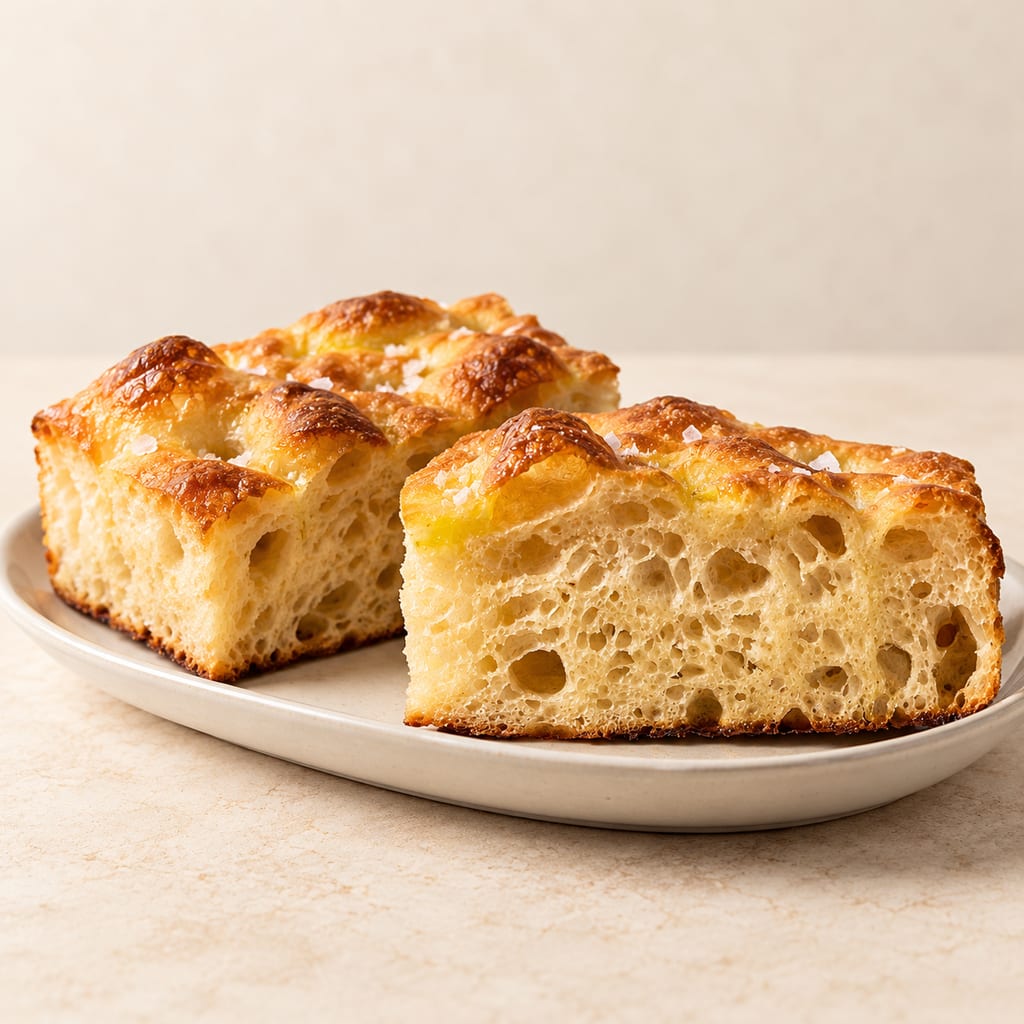
Sourdough focaccia
This sourdough focaccia uses ripe starter in place of commercial yeast. Olive oil enriches the folded dough and coats the pan before a long proof and a crisp, salted bake.
 FermenteaWhere food goes to change
Fat or oil
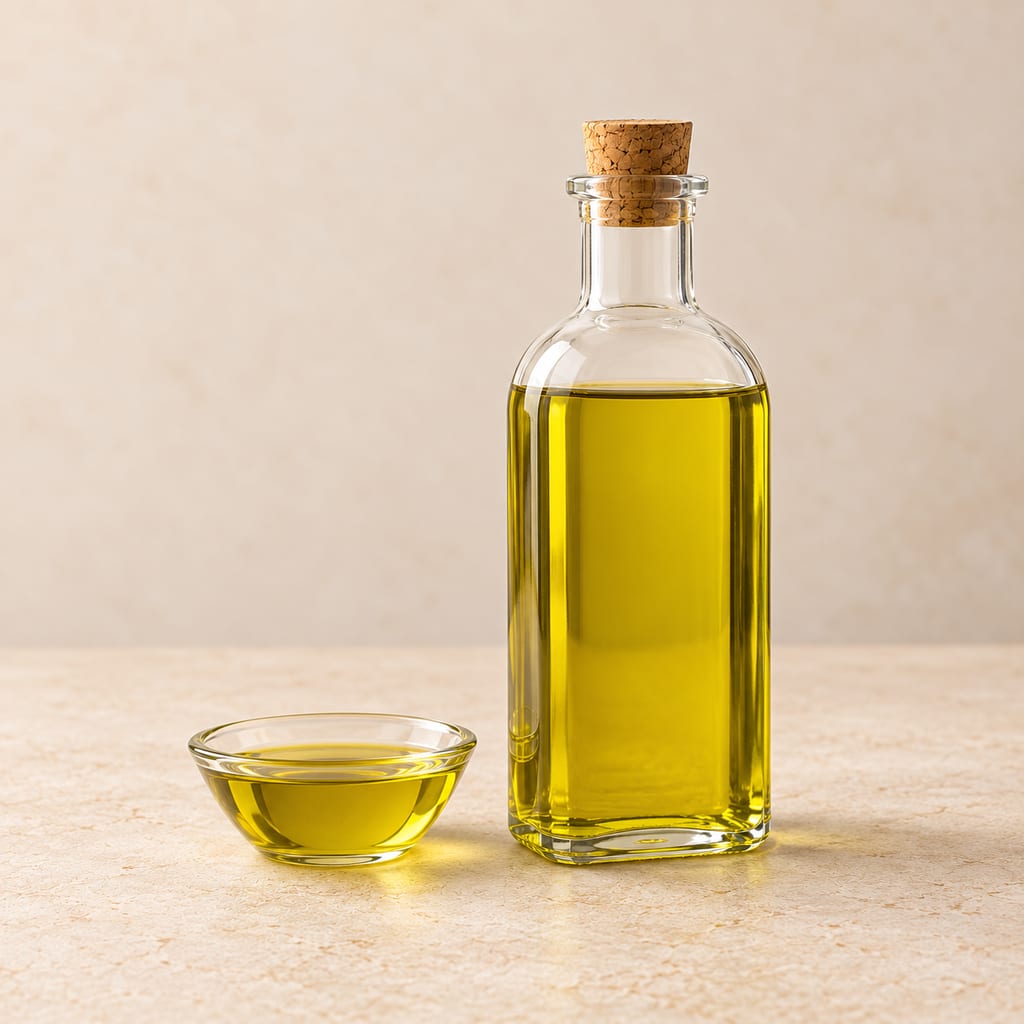
Extra-virgin olive oil is mechanically extracted olive-fruit oil meeting chemical and sensory standards. Its fruit aromas, bitterness and pungency vary by cultivar, harvest and handling.
Section sources: https://powo.science.kew.org/taxon/urn:lsid:ipni.org:names:610675-1; https://www.internationaloliveoil.org/olive-world/olive-oil/; https://cooc.com/how-to-taste/
Olive oil begins as the fat-rich flesh of a fruit. The olive tree (Olea europaea L.) is an evergreen species in the family Oleaceae. Its fruit is a drupe: a fleshy outer part surrounds a hard stone. The oil is concentrated in the fruit’s flesh, and its composition and sensory character vary with cultivar, orchard conditions and maturity at harvest. “Extra virgin” names a regulated category of oil, not a single olive variety, color or flavor style.
Fresh extra-virgin olive oil may be green-gold, golden or deeper yellow. Color alone cannot tell a taster whether it is fresh or sound; trained panels use tinted glasses so color does not bias sensory judgments. The smell can recall fresh olive fruit and, depending on the oil, green leaves, cut grass, artichoke, apple, almond or ripe fruit. On tasting, a clean bitterness and a peppery sensation in the throat may accompany fruitiness. These are recognized positive attributes, not signs that oil is spoiled. Their intensity varies; a soft, ripe-fruited oil and a robust, green-fruited oil can both belong to the category.
The International Olive Council (IOC) defines virgin olive oils as oils obtained from olive fruit solely by mechanical or other physical means, under conditions—especially thermal conditions—that do not alter the oil. Washing, decanting, centrifuging and filtering are permitted. Extra-virgin olive oil must be fit to eat as it is, have free acidity expressed as oleic acid no higher than 0.8 grams per 100 grams, and meet the category’s other physicochemical and sensory requirements. The acidity figure is not a measure of a sour taste, nor is it a complete quality test by itself; it is one of the category’s measured chemical criteria alongside sensory assessment. Virgin olive oil is a separate category with different limits. Refined olive oil and olive-pomace oil follow other production routes and are not synonyms for extra virgin.
Section sources: https://doi.org/10.1093/aob/mcx145; https://doi.org/10.3389/fpls.2023.1131557; https://doi.org/10.1086/737823; https://doi.org/10.1038/s41598-020-80772-6
The olive is deeply associated with the Mediterranean, but its domestication cannot be reduced to a single certain date or one simple journey from wild tree to crop. Wild and cultivated olives overlap in distribution and can be difficult to distinguish in pollen, wood and stone remains. Archaeobotanical and genetic studies have proposed cultivation and domestication histories that vary by region and period; researchers continue to revise them as new evidence appears. One regional review reports archaeological evidence for oil production in the southern Levant from the Pottery Neolithic to Chalcolithic transition, approximately 7,600–7,000 years before present, and distinguishes this from evidence for cultivation. The measure “BP” is retained as the paper uses it; it is not silently converted to a calendar year. The remains are interpreted through archaeological context rather than by a surviving bottle of oil. Broader syntheses likewise distinguish gathering wild olives, managing trees, cultivating groves, selecting domesticated types and producing oil. Those are related but not identical activities.
By antiquity, olive oil had become a major Mediterranean food and commodity. It supplied cooking fat and fuel and served in bodily care, ritual and other household uses. Roman-era production left presses, milling equipment, storage vessels and transport containers, but archaeological remains are incomplete and do not support a single model of production or state control across the empire. A recent reassessment of Roman and pre-Roman Italy stresses both the growing evidence for cultivation and production outside the regions long assumed to dominate, and the gaps that remain. Olive oil’s importance is certain; details about when a specific district began producing a surplus or how one trade route operated require local evidence.
Over centuries, groves and oil-making spread well beyond the Mediterranean’s eastern and southern origins into varied regional landscapes. Today olive-growing countries produce oils from many local cultivars and blends, and modern cultivation also exists outside the historic basin. The IOC’s category standard travels across these regions, but it does not make their oils taste alike. “Mediterranean” describes a broad cultural and agricultural sphere, not a guarantee of a particular origin, cultivar or sensory profile. A single bottle may combine oils from more than one country; origin claims should be read from the specific label rather than inferred from the category name.
Section sources: https://ucfoodquality.ucdavis.edu/olive-oil/olive-oil-processing; https://www.internationaloliveoil.org/olive-world/olive-oil/; https://eur-lex.europa.eu/legal-content/EN/TXT/?uri=CELEX:32022R2104; https://doi.org/10.1002/jsfa.11805
The grove sets the first conditions. Cultivars differ in fruit size, oil content, fatty-acid composition and aroma potential. Weather, water availability, orchard management and crop load also affect fruit and oil. Olives are harvested at different stages of maturity: greener fruit and later, darker fruit do not produce identical oils. Ripening can change the balance of aroma compounds and phenolic substances associated with bitterness and pungency. There is no universally best harvest stage: growers and millers weigh yield, flavor goals, local conditions and the cultivar’s behavior.
Once harvested, the fruit is cleaned and milled. Leaves, twigs, soil and damaged fruit can affect extraction and sensory quality, so processors sort and wash as appropriate. Crushing breaks the fruit cells and releases a paste of oil droplets, water and solids. Slow mixing of the paste, called malaxation, allows small oil droplets to coalesce into larger ones that can be separated more efficiently. Temperature, time, oxygen exposure and the fruit’s condition influence both extraction yield and aroma. A modern line commonly separates oil, vegetation water and pomace using centrifuges; some systems then separate remaining water from the oil. The exact equipment varies, but the defining point for virgin oil is mechanical or physical extraction without refining or solvent extraction.
The phrase “cold extracted” is useful only when understood as a process claim under the applicable rules; it does not mean that no heat was involved anywhere in production. For example, European Union rules reserve “first cold pressing” for virgin olive oils obtained below 27°C from a first mechanical pressing using a traditional hydraulic-press system; “cold extraction” applies below 27°C to percolation or centrifugation of olive paste. Modern mills often use crushers, malaxers and decanters rather than the old press. The producer’s exact process and label wording matter more than a picturesque image of stone wheels.
Crushing also starts chemical events that help form the oil’s aroma. When olive tissue is disrupted, plant enzymes act on fatty-acid precursors and generate volatile compounds. These can give fresh oils green, fruity or herbal notes. Cultivar and maturity affect which compounds form, and milling conditions alter their balance. This enzymatic aroma formation happens during fruit processing; it is not fermentation. Delayed handling or damaged fruit can instead allow unwanted microbial activity and produce sensory defects. “Fusty” notes, for example, are associated with olives that fermented or were stored poorly before milling. A defective oil is not transformed into extra virgin by filtering or by its region’s reputation.
Section sources: https://www.kingarthurbaking.com/recipes/big-and-bubbly-focaccia-sourdough-edition-recipe; https://ucfoodquality.ucdavis.edu/olive-oil/olive-oil-processing; https://doi.org/10.1002/jsfa.11805
Olive oil has a clear, specific role in the sourdough focaccia recipe that prompted this page. King Arthur Baking’s “Big and Bubbly Focaccia, Sourdough Edition” uses 19 grams of extra-virgin olive oil in a dough made with 300 grams of flour, then 26 grams more for the pan and topping. The source mixes the dough oil with starter and water before adding flour, table salt and sugar. Pan oil coats the baking surface and the dough as it is transferred; the rest is drizzled on top, where it gathers in fingertip dimples. The formula names extra-virgin oil, not a generic neutral cooking fat, so its fruit-derived flavor is part of the bread’s intended character.
In the dough, oil contributes fat and richness and changes how the crumb is perceived: it helps the bread eat tender rather than dry, while the dough’s structure still depends chiefly on hydrated wheat proteins, mixing and fermentation. Oil is not a leavening agent and does not feed the sourdough organisms. The culture’s yeasts and lactic-acid bacteria metabolize available sugars; the oil is a separate ingredient that coats and lubricates rather than fermenting into gas. When the dough is stretched into an oiled pan, oil reduces sticking and allows the dough to be handled without dry flouring. Surface oil browns and crisps in the oven, while oil in the dimples creates glossy, savory pockets.
The recipe’s distinction between the dough oil and the finishing oil is practical, not ceremonial. Oil mixed into the dough is dispersed through it; the later pour remains concentrated near the surface and dimples. The flaky finishing salt is a separate ingredient. A fragrant oil can add green or fruity notes before baking, although some volatile aromas fade with heat. The finished loaf may therefore combine a subtler oil presence in its crumb with a more direct impression from the top. A cook who changes the oil or removes either portion changes flavor, handling or pan release; the precise formula should be preserved when reproducing that named batch.
Section sources: https://www.internationaloliveoil.org/olive-world/olive-oil/; https://cooc.com/buying-tips/; https://ucfoodquality.ucdavis.edu/olive-oil/olive-oil-myths-and-facts; https://cooc.com/how-to-taste/; https://doi.org/10.5650/jos.ess19258; https://doi.org/10.1016/j.fpsl.2019.100433
Choose a bottle whose label identifies it as extra virgin and provides a credible origin and freshness information where available. Harvest date can help compare freshness, but a date is not a universal expiry guarantee. Oil from a single cultivar may show a recognizable house style, while a blend can be composed to balance aroma, bitterness and pungency. The words “robust” and “delicate” describe sensory intensity when used in a defined tasting context; they do not rank authenticity. A quality seal from a regional organization applies to oils meeting that organization’s own verification program, not to all products sold under the same national name.
Taste a small sample on its own if you want to understand its character. Fresh-fruit aroma, bitterness and throat pungency are qualities trained panels assess; a flat, stale or rancid smell is different from those positive sensations. Green color is not proof of quality. A dark bottle, tin or other light-protective container helps guard the oil, and the bottle should be closed between uses. Store it away from direct light and heat, including the warm area beside an oven. Oxygen, light, warmth and time contribute to deterioration. Cold temperatures can make olive oil cloudy or solid as naturally present waxes crystallize; that appearance alone does not establish that oil is spoiled. No single opened-bottle lifespan applies to every oil and storage condition, so follow the producer’s label and buy a size that suits how quickly you use it.
Extra-virgin olive oil is useful raw and cooked. In a vinaigrette it carries aroma and coats leaves; drizzled onto beans, soup, grilled vegetables or toast it supplies a final layer of fruit and texture. It can sauté, roast, bake and fry. Heating changes its flavor and gradually degrades minor compounds; the result depends on temperature, duration, oil composition and whether the oil is reused. A high-oleic fatty-acid profile and natural minor constituents contribute to oxidative stability, but they do not make the oil immune to heat or unlimited reuse. Avoid heating any oil until it smokes, and match the oil to the cooking task and the flavor desired. For focaccia, its value is both functional and expressive: it coats the pan, gathers in the dimples and makes the bread taste recognizably of olives.
Broad olive cultivation and oil use; no claim of a single origin or date for the modern grade.
This sourdough focaccia uses ripe starter in place of commercial yeast. Olive oil enriches the folded dough and coats the pan before a long proof and a crisp, salted bake.
No community contributions have been published for this entry yet.
Sign in to contribute. Published comments and photos are free to read.
Royal Botanic Gardens, Kew; Plants of the World OnlineEditorial
Olea europaea L.Accepted botanical name, family Oleaceae and classification.
Cited in: Fruit made liquid
International Olive CouncilEditorial
Olive oils: designations and definitions; olive oil and gastronomyVirgin oil physical extraction definition, extra-virgin category and free-acidity limit, plus IOC culinary and sensory overview.
Cited in: Fruit made liquid; From harvest basket to oil; Buying, tasting and using it
European Commission / EUR-LexEditorial
Commission Delegated Regulation (EU) 2022/2104, Article 10Reserved label meanings: first cold pressing and cold extraction below 27°C under the specified methods.
Cited in: From harvest basket to oil
Annals of BotanyEditorial
On the origins and domestication of the olive: a review and perspectivesWild/cultivated overlap and uncertainty in olive domestication history.
Cited in: A long Mediterranean history, with unsettled beginnings
Frontiers in Plant ScienceEditorial
The history of olive cultivation in the southern LevantRegional archaeological context; article reports early oil-production evidence in BP units and separates that from cultivation evidence.
Cited in: A long Mediterranean history, with unsettled beginnings
American Journal of ArchaeologyEditorial
The Archaeology of Olive Oil Production in Roman and Pre-Roman ItalyEvidence, regional patterns and gaps in the archaeology of Italian production.
Cited in: A long Mediterranean history, with unsettled beginnings
Scientific ReportsEditorial
Early production of table olives at a mid-7th millennium BP submerged site off the Carmel coast (Israel)Primary archaeological study distinguishes Kfar Samir oil extraction evidence from Hishuley Carmel table-olive preparation.
Cited in: A long Mediterranean history, with unsettled beginnings
University of California, Davis, UC Food Quality; adapted from Olive Production Manual for OilEditorial
Olive Oil ProcessingReceiving, cleaning, crushing, malaxation, separation; extraction-related quality and handling impacts.
Cited in: From harvest basket to oil; What it does in focaccia dough
Journal of the Science of Food and AgricultureEditorial
Identifying volatile and non-volatile organic compounds to discriminate cultivar, growth location, and stage of ripening in olive fruits and oilsCultivar, location and maturity affect measured oil composition and volatile profiles; olive-tissue disruption and enzyme-pathway background.
Cited in: From harvest basket to oil; What it does in focaccia dough
California Olive Oil CouncilEditorial
How to TastePanel-style sensory assessment; color bias, fruitiness, bitterness and pungency descriptors.
Cited in: Fruit made liquid; Buying, tasting and using it
King Arthur Baking Company, King Arthur Test KitchenEditorial
Big and Bubbly Focaccia, Sourdough EditionExact focaccia batch weights and placement of extra-virgin olive oil in dough, pan and topping.
Cited in: What it does in focaccia dough
California Olive Oil CouncilEditorial
Buying TipsLabel and harvest information, storage away from light, oxygen and heat; advice is council guidance and not universal shelf-life limit.
Cited in: Buying, tasting and using it
Journal of Oleo Science; authors Andrés Alvarruiz et al.Editorial
Evolution of Virgin Olive Oil during Long-term StorageStudy-specific changes during storage at three temperatures in oils from four varieties; not a universal shelf-life rule.
Cited in: Buying, tasting and using it
Food Packaging and Shelf Life; authors Basheer M. Iqdiam et al.Editorial
Influence of headspace oxygen on quality and shelf life of extra virgin olive oil during storageTested influence of headspace oxygen, packaging and storage temperature on EVOO quality.
Cited in: Buying, tasting and using it
University of California, Davis, UC Food QualityEditorial
Olive Oil Myths and FactsOil may cloud or solidify at low temperature because naturally present waxes crystallize; cloudiness or sediment is not by itself evidence of spoilage.
Cited in: Buying, tasting and using it
Wikimedia Commons; photographer Tony WebsterEditorial
Extra virgin olive oil and bread baguette (17303095818).jpgSubject photograph showing oil with bread; author, origin page and verified CC BY 2.0 license.
Wikimedia Commons; photographer Jules Clancy (jules / stone soup)Editorial
Aceite de oliva.jpgVisible olive oil in a glass cruet; author, Flickr origin and verified CC BY 2.0 license. Image does not prove grade or origin.