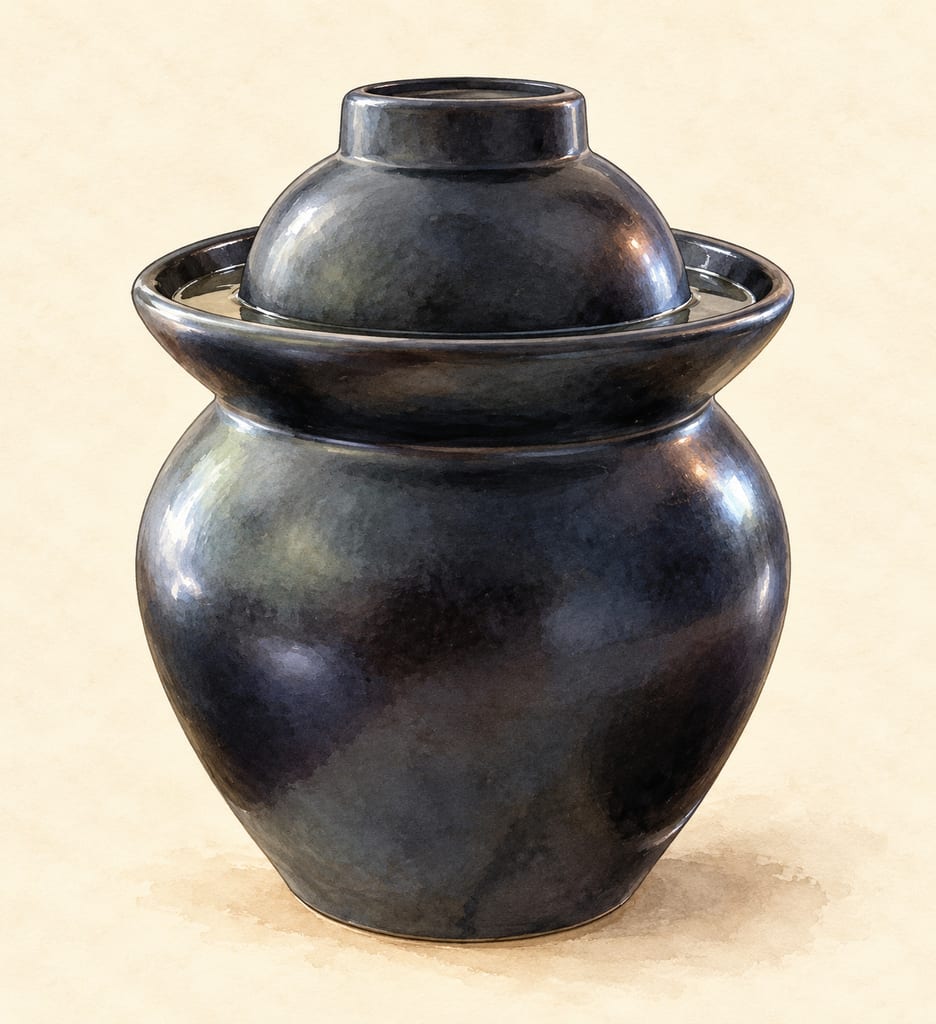
Paocai water-seal jar
The Sichuan paocai jar is a pottery or ceramic crock with a broad body, narrow neck, and annular water trough around its rim. An inverted lid rests in the trough; the seal is separate from the food brine.
 FermenteaWhere food goes to change
Dushan Xiasuan · Dushan shrimp sour paste
A fermented freshwater-shrimp condiment from Dushan, Guizhou, matured with salt and liquor and later seasoned with chilli, garlic and sweet rice wine.
Dushan shrimp sour is a fermented condiment made with freshwater shrimp in Guizhou, southwestern China. In the samples described by food researchers, the finished preparation was thick and semi-solid. It is a seasoning with a shrimp foundation, not simply a sour broth in which shrimp happen to be cooked. The sour, strong-smelling paste belongs to the food culture of Dushan County, although a county association does not by itself establish where or when it was first made.
A 2024 study examined preparations from nine workshops whose products were sold at local farmers’ markets. The researchers describe both household and commercial production and call the fermentation spontaneous. Their account offers a view into a set of existing practices; the nine sampled workshops are not a census of every maker, and the study cannot establish that every family uses the same ingredients or stages. The product can be recognised as a local preparation without pretending that a single measured formula represents all its makers.
The English name shrimp sour paste translates the idea of a shrimp-based sour condiment. A later paper uses the romanised name Dushan Xiasuan. The available evidence does not settle the precise local Chinese name or pronunciation for the workshop product shown in the video, so a phonetic caption should not be promoted into a definitive spelling. The video’s automatic captions also misrender the place name. Those limitations matter when searching for a food whose English and Chinese names may be shared by related preparations.
The workshop study describes a process in two broad periods. First, local freshwater river shrimp are mixed with salt and Chinese liquor, put into jars and left to ferment. In that workshop account, the initial additions are recorded as 8–10% salt and 4–6% liquor, followed by nine to twelve months of fermentation. It does not state the denominator clearly enough to turn those percentages into a reliable shopping list. Nor does it give a complete batch weight, species, measured storage temperature or a control plan for the individual workshops.
That first period is long compared with the few minutes needed to mix its ingredients, but duration alone is not a safety measure. In this spontaneous process, the raw materials and local environment contribute to the microbial community. It does not show which organism began each batch or prove that one identified organism was responsible for each change. Researchers sampled finished preparations, so their measurements describe the products they collected rather than a continuous observation of every jar from the start.
The paper also describes traditional jars with a water-filled neck intended to limit air entry. This vessel detail explains how the reported process is framed; it does not provide a complete specification of the equipment or prove that every workshop used the same jar. The description leaves important operational questions open, including how the shrimp were handled before mixing and the conditions maintained through changing seasons. A reader cannot safely fill those gaps by borrowing a method from another seafood ferment.
After the first period, white glutinous rice sweet wine, red chilli powder, further salt and garlic enter the mixture. It gives ranges of 8–13% for the sweet wine, 8–13% for chilli powder, 1–4% for the additional salt and 3–5% for garlic, again without making the basis of the percentages clear enough to reconstruct an exact batch. The seasoned mixture was held in a cool, shady place for more than three months. The paper does not give an upper duration or a numerical temperature for that stage.
The sequence matters. It is not evidence that all the ingredients went into the vessel together at the outset, nor that the second addition had identical proportions at each workshop. The researchers say the samples followed the same general process while their ingredient amounts varied. The first period and the subsequent seasoned period together help explain why the finished item is a matured condiment rather than a quick mixture of chilli and fresh shrimp.
A video visit gives a shorter, sensory account: the speaker names river shrimp, salt, chilli and rice wine, with tomato sometimes included. That list is evidence of what the presenter says about the visited preparation, not a measured recipe or proof that tomato belongs in every batch. It does not show how much tomato was used, when it entered the process or whether it was fermented with the shrimp. The video and workshop paper can sit alongside one another without forcing their ingredient lists into a single supposedly definitive formula.
The paste develops during spontaneous fermentation and maturation of a mixture containing shrimp, salt and alcohol-bearing ingredients. The 2024 researchers examined volatile compounds, which are substances that can enter the air above a food and contribute to its aroma. They identified 116 volatile compounds across the nine groups of samples, with esters a prominent class. A compound being detected does not mean it contributes equally to the smell of every sample; concentration and sensory threshold both matter.
The researchers also profiled bacterial communities and looked for associations between genera and measured flavour compounds. They identified Vagococcus, Lactococcus and Tepidimicrobium as genera associated with flavour formation in their analysis. Those associations are useful clues for further research, but a correlation in finished samples is not proof that adding any one organism will reproduce the condiment or make it safe. The study itself frames the work as a basis for later investigation of industrial starter cultures.
A separate Food Bioscience paper describes Dushan Xiasuan as a fermented shrimp sour paste and reports 119 volatile aroma compounds in its samples. Its abstract identifies different candidate microbial groups and discusses their potential contribution to flavour. Different samples, analytical choices and fermentation environments can produce different results; the two counts are not a fixed ingredient list or a target for a home batch. Neither paper establishes a simple visual or aromatic test for a safe finished preparation.
In the video, tasters compare the shrimp condiment to a combination of hot sauce, fish sauce and alcohol, and remark on a shrimp taste at the end. Those are personal impressions from the visited product, not a chemical definition. Together with the measured variety of aroma compounds, they convey why a small amount of the paste can bring several sensations to a dish: seafood savour, acidity, heat and an alcoholic note may all be present, with their balance depending on the actual batch.
The workshop study describes the paste as a condiment used in cooking meat, including beef, pork ribs and fatty intestines. These examples show how the shrimp preparation can season foods beyond seafood. They do not tell us the amount used, whether a particular dish is simmered or stir-fried, or the order in which a cook adds the condiment. Each finished dish needs its own documented recipe rather than a guessed quantity copied from a discussion of the paste.
The video’s presenters say they visited a Dushan restaurant serving both shrimp sour and a different, plant-based stinky sour after tasting condiments at a workshop. The account establishes a restaurant setting for the shrimp condiment in that visit. The detailed discussion immediately afterward, involving chilli, tomato and peanuts or toasted soybeans, concerns the stinky sour; it cannot be reassigned to the shrimp paste. The restaurant’s name, menu, portion and exact serving method are not established by the inspected transcript.
This distinction is useful because Guizhou has many preparations described in English with the word sour. A condiment may be placed beside food, mixed into a dipping sauce or cooked with other ingredients, but those are different actions. The sources here establish meat-dish use and one restaurant serving the shrimp sour; they do not establish every possible table use, a customary serving size or a seasonal menu. Local cooks and a directly documented dish would be needed to fill those details.
Dushan shrimp sour should not be treated as interchangeable with every shrimp paste. The 2024 paper contrasts its local freshwater shrimp and sour, pungent character with the marine shrimp and salty, savoury profile described for other shrimp pastes. That comparison concerns the product groups discussed by the authors, not an absolute rule for every coastal paste. Species, processing and seasoning all affect the result, and the paper does not identify the exact river-shrimp species used by its nine workshops.
Sour-soup fish is another distinct expression. A study of tomato sour soup describes a fermented vegetable sauce used in fish, beef and hot pot dishes. The presence of fish in such a finished soup does not make the tomato sauce a fermented fish paste. Its laboratory tomato process and starter culture cannot be transferred to raw shrimp or used to supply missing parameters for Dushan shrimp sour.
The supplied video transcript contains a garbled reference to fish paste and fish shrimp fermentation near its closing recap. It does not establish whether a separate preparation called fish sour is being named, what it contains or how it is made. Until a clearer account identifies that food, neither a fish recipe nor a claim that fish and shrimp are the same preparation follows from the caption. Keeping those uncertainties visible makes the shrimp record more precise.
Dushan shrimp sour is described as part of the county’s group of three sours, alongside pickled vegetables and stinky sour paste. The 2024 article repeats a claim, attributed to earlier literature, that the group has a history reaching the Ming dynasty. That is a reported historical claim about the group; the available text does not provide a dated primary attestation establishing the shrimp paste itself at a particular point in the dynasty. The date should remain open until the underlying evidence is traced.
The modern study gives concrete evidence of workshops and market products in Dushan, while the video records a visit to a workshop and a restaurant. These are different kinds of evidence from a historical household account. They show that the condiment is made and encountered in the present, but do not determine its inventor, its first village, the age of every ingredient combination or a continuous unchanged recipe over centuries. The paper also discusses wider commercial interest; that should not be mistaken for proof of any specific current distribution.
The sources inspected here do not establish a particular season for catching the shrimp or starting a batch. A fermentation lasting many months passes through seasons, but its duration alone does not prove a customary starting month. Likewise, the sources do not identify the exact species or give a precise yield. Those are productive questions for local makers and Chinese-language records, rather than gaps to be filled with assumptions about climate or comparable foods.
Raw shrimp is a perishable aquatic ingredient. A long sealed fermentation with variable salt, alcohol and temperature raises food-safety questions that a flavour study does not resolve. The workshop paper reports ingredient ranges and sensory and laboratory measurements, but it does not specify the percentage basis or publish a validated household process with critical controls. A pleasant sour smell, a certain number of months or a water-sealed jar cannot by itself demonstrate safety.
The US Food and Drug Administration’s fish and fishery products guidance addresses hazards and controls in seafood processing; the appropriate controls depend on the product and process. Its existence does not validate the Dushan workshop formula. In particular, one should not attach a generic acidity, salt percentage or temperature to this preparation and call the resulting method proven. The hazards and controls for a specific production method need qualified assessment.
This account therefore describes the preparation without offering quantities and steps for making it at home. A useful future recipe would need a fully specified source batch, the basis for every proportion, the shrimp handling and vessel conditions, measured temperatures and durations, and a product-specific safety assessment. Those details would allow a cook to understand what was actually done and what remains uncertain, rather than turning a partial description into an instruction.
A 2024 study attributes a Ming-era history to Dushan’s three sours as a group through earlier literature; it does not establish a primary dated attestation for this shrimp preparation.
No reproducible ingredient list is recorded.
Raw shrimp and a long fermentation require controls specific to the product and process.
Hazard sourceThe sources do not give enough detail for preparation directions.
The study sampled products from workshops in Dushan County; this does not establish a precise birthplace.
The Sichuan paocai jar is a pottery or ceramic crock with a broad body, narrow neck, and annular water trough around its rim. An inverted lid rests in the trough; the seal is separate from the food brine.
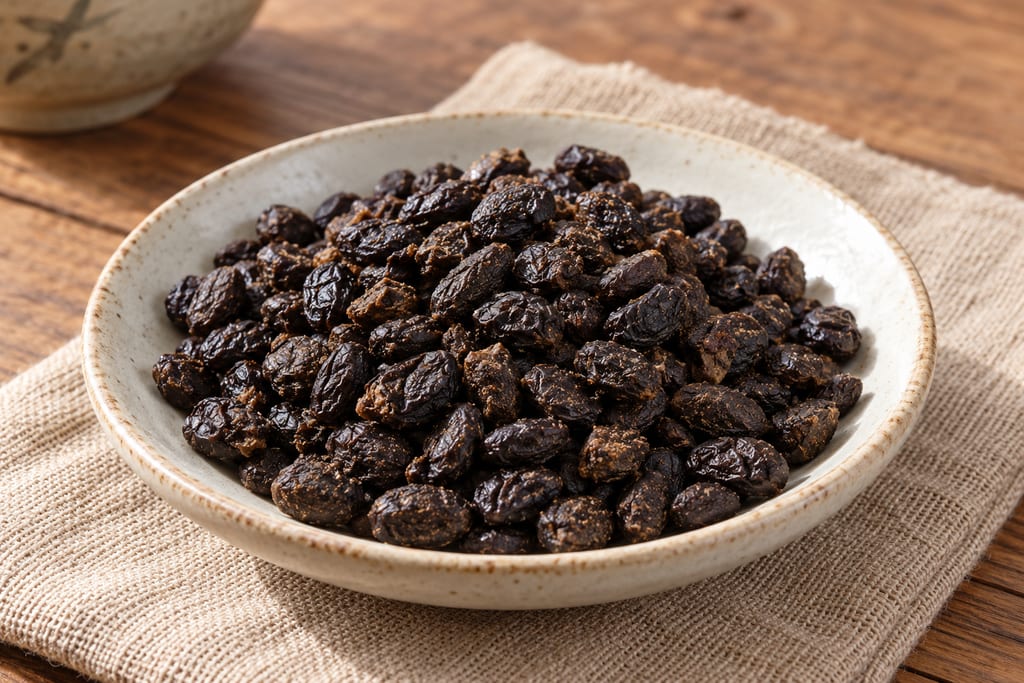
A Chinese fermented soybean condiment in which Bacillus-led bacteria, not moulds, drive the fermentation. Documented in Zunyi, Guizhou, and kept separate from mould-led douchi.
A pungent fermented vegetable condiment from Dushan, Guizhou, made in a documented traditional pattern with impatiens and other plants.
A Dushan restaurant dish of pork large intestine cooked with the fermented condiment chousuan.
A fermented tomato and chilli sour from Guizhou, used as a cooking base for fish, beef, hot pots and other dishes.
Beef and fresh mustard greens in a sour broth made with an already fermented chilli base.
A Guizhou fermented sour liquid made in distinct traditions from rice-washing water, rice soup or flour soup.
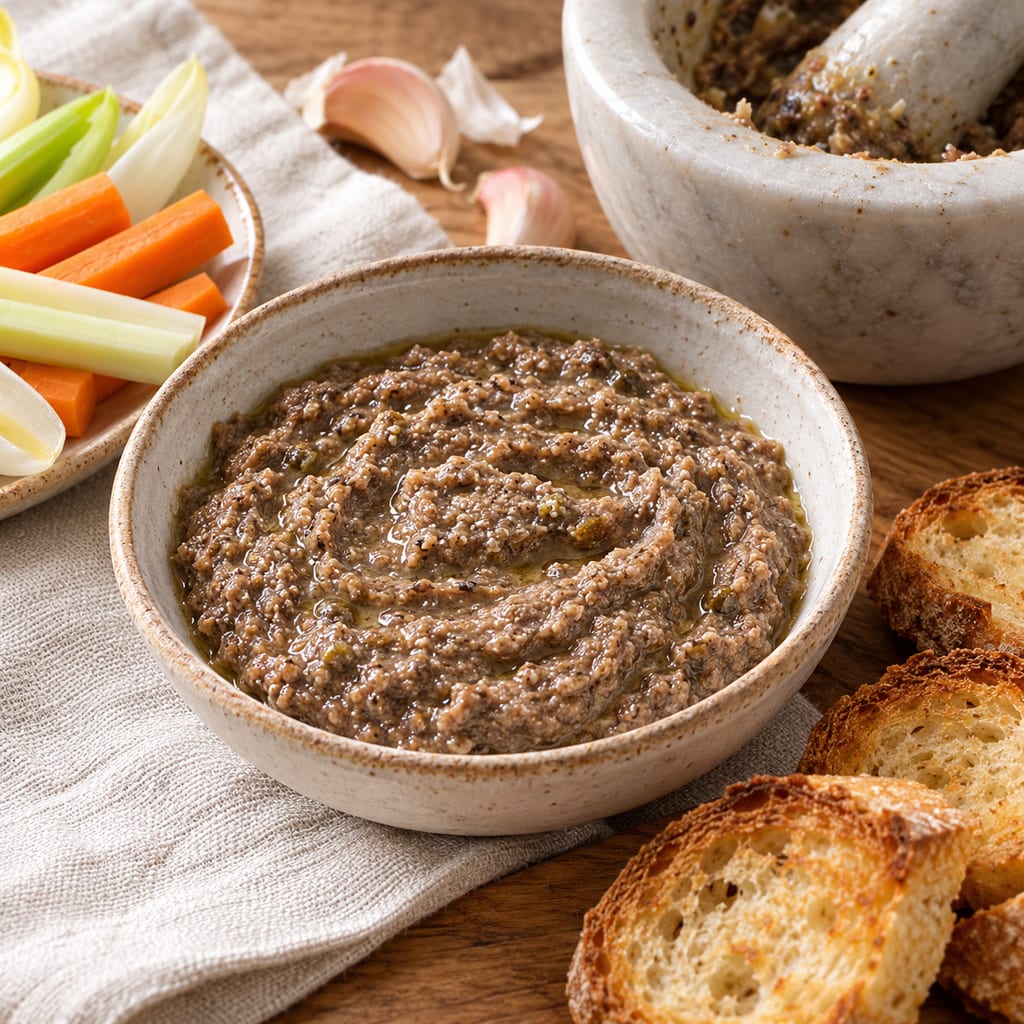
A Provencal dip of anchovies, garlic, capers and olive oil, pounded or blended to a creamy paste and served with raw vegetables, bread and eggs.
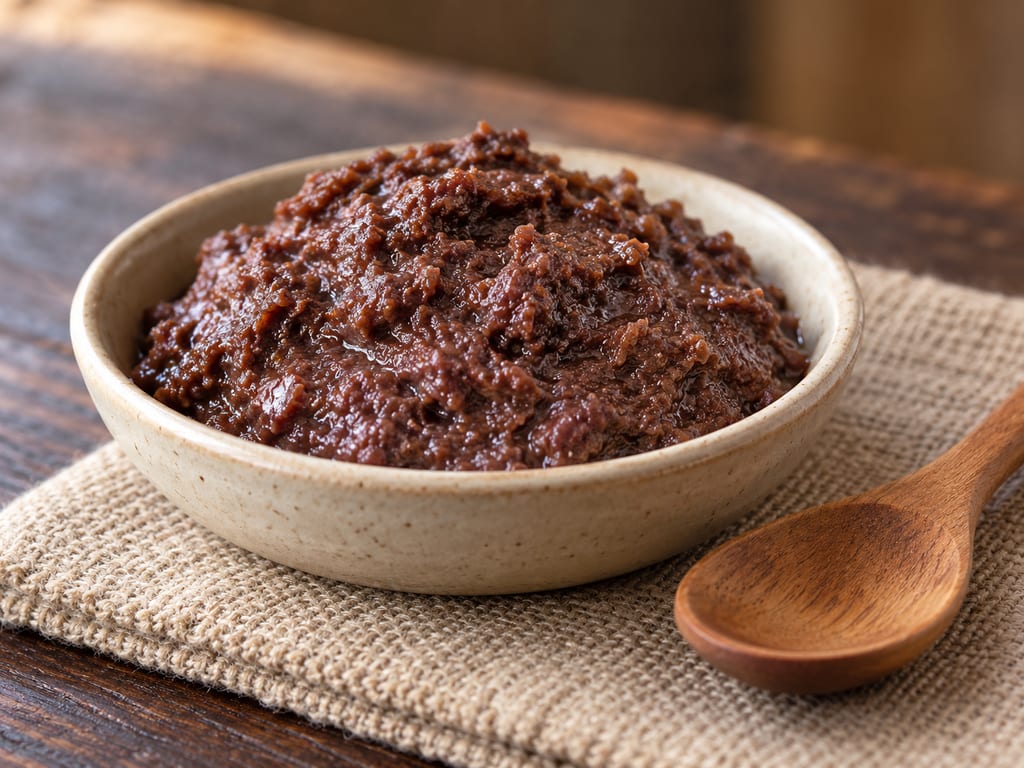
Bagoong isda is a Philippine fish paste: whole small fish salted and left to ferment for a month or more in earthen jars. It is the fish counterpart of bagoong alamang.
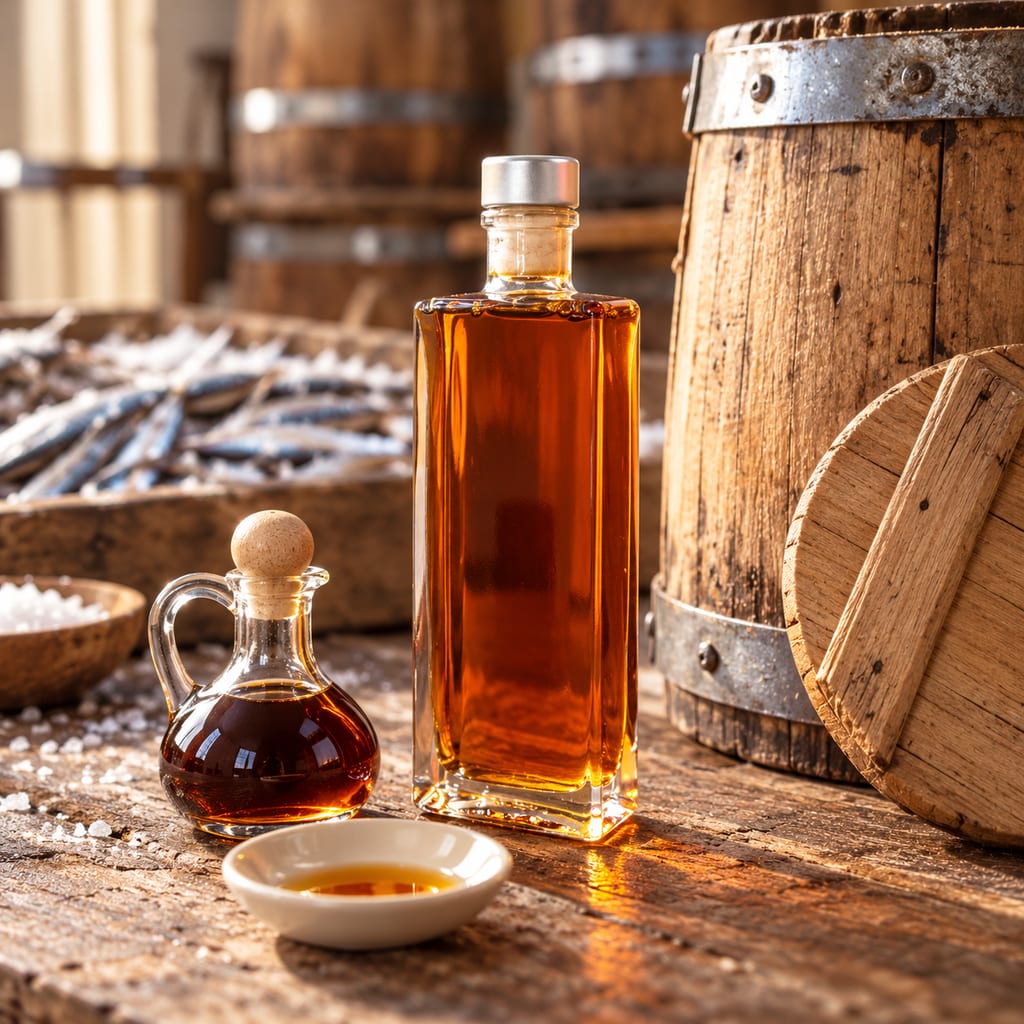
Colatura di alici is the amber liquid drained from salted anchovies matured in wooden containers in Cetara, on the Amalfi coast of Campania, and sold under a protected designation of origin.
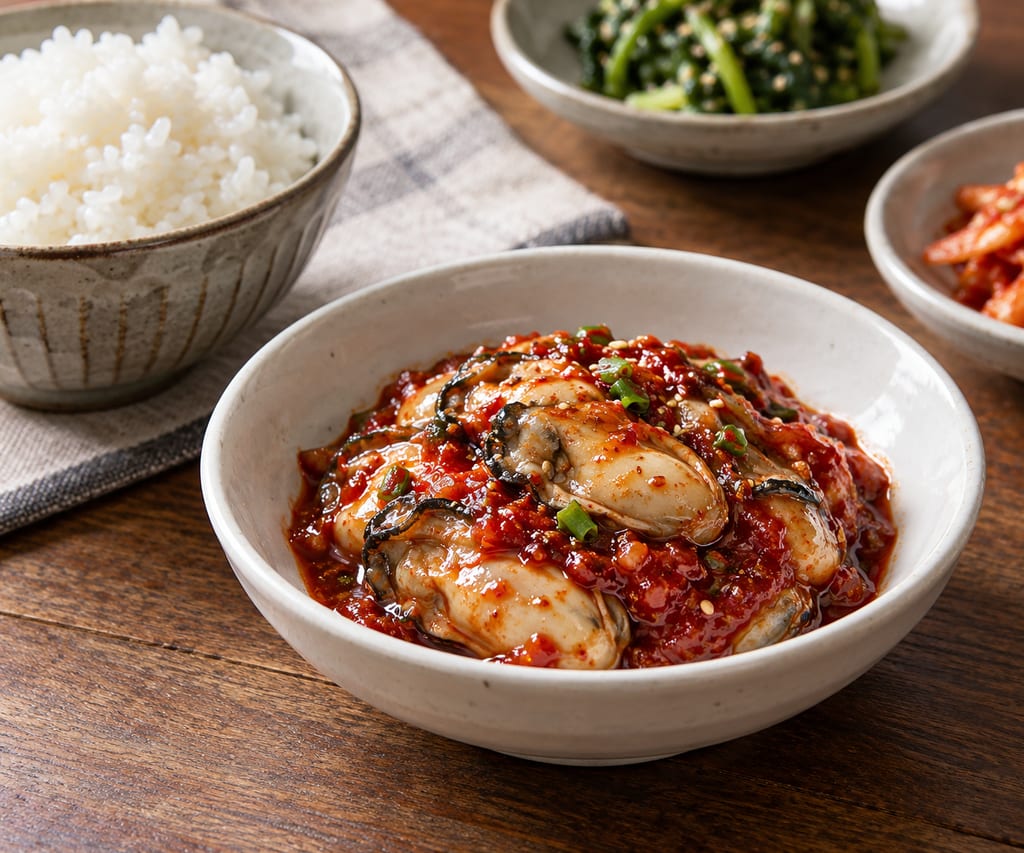
A Korean salted-oyster jeotgal seasoned with chili, associated especially with Seosan and Ganwoldo. This page records its food culture, not a household preparation method.
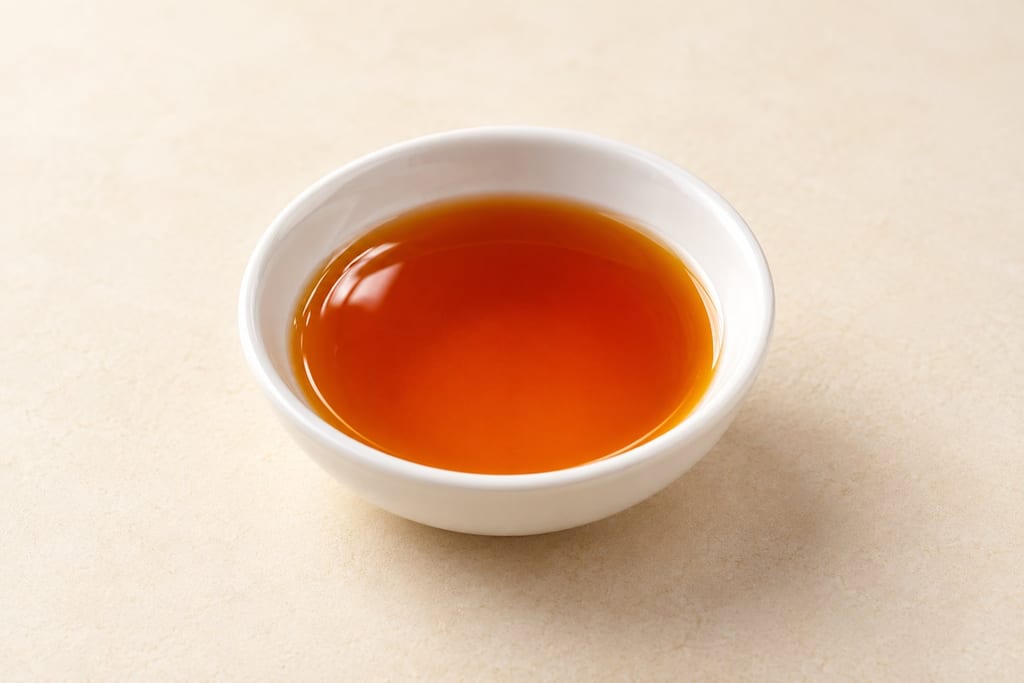
Fish sauce is a clear, salty seasoning made by maturing fish with salt and drawing off the liquid. The broad family includes distinct regional sauces rather than one interchangeable method.
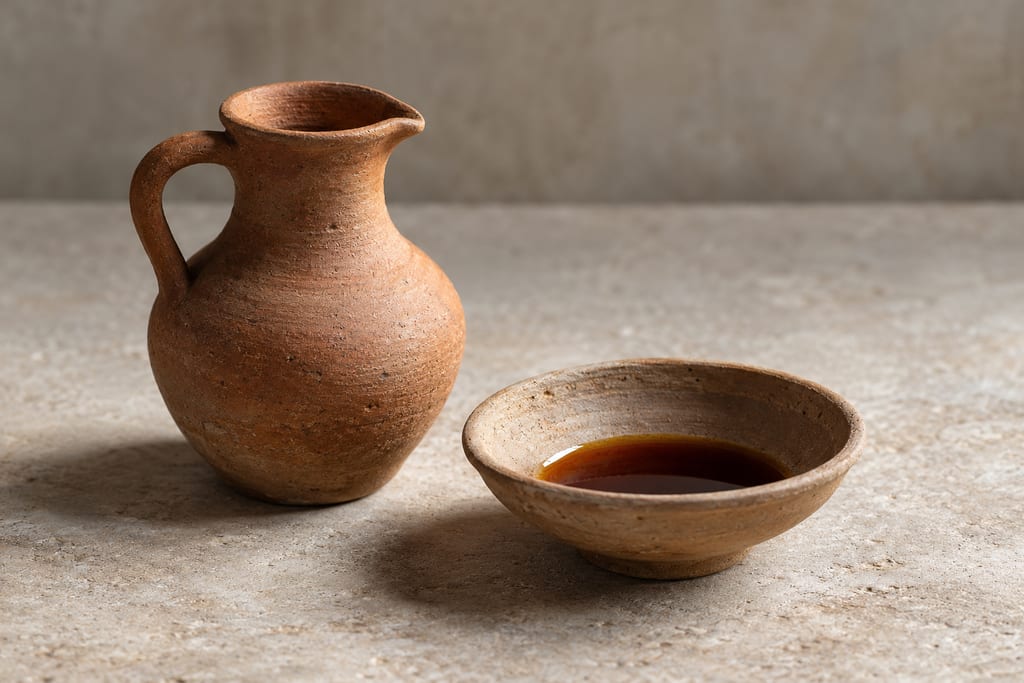
Garum, Greek garos and Latin liquamen, was the fish sauce of the ancient Mediterranean: fish and viscera salted and left in the sun, then drained off as a savoury liquid.
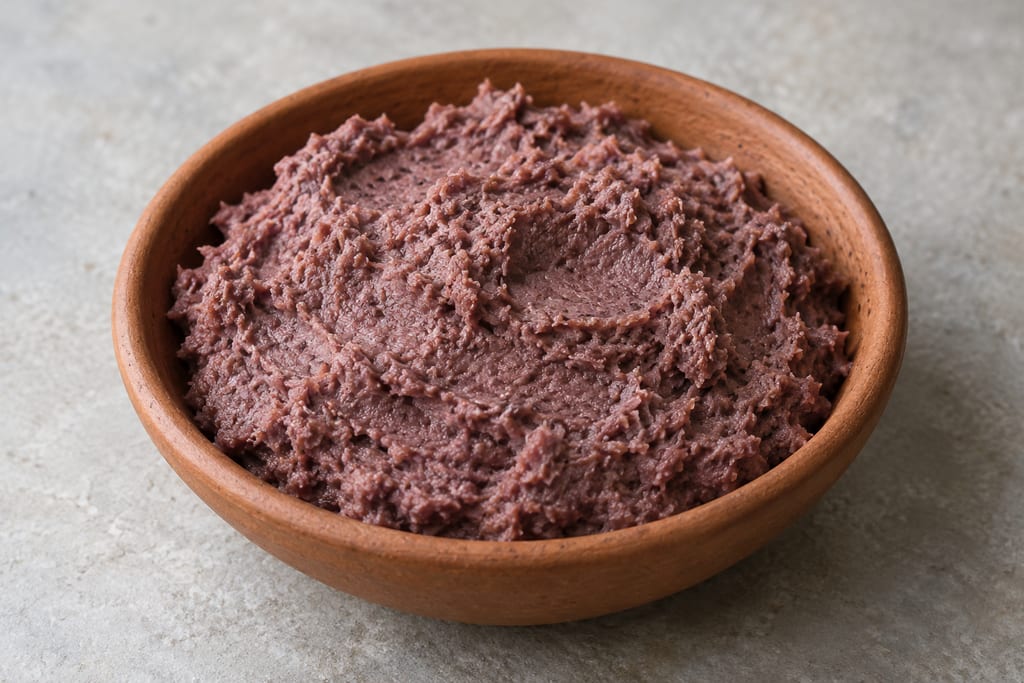
Guinamos is a shrimp paste made on Guimaras in the Philippines: small shrimp salted by hand, sun-dried and trodden by foot until it turns smooth.
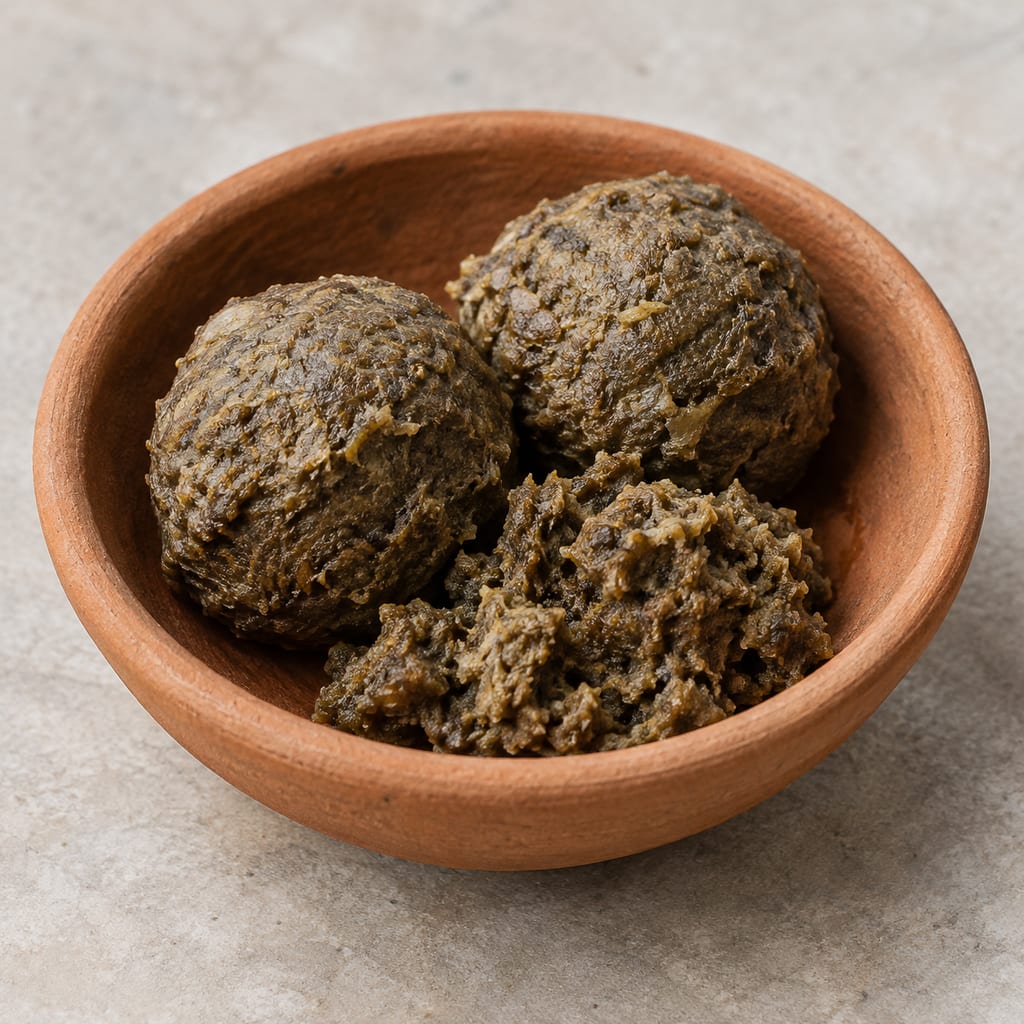
Manipuri fermented fish-and-aroid paste, formed into balls or kept in an earthen pot, used to season Manipuri dishes. Its method is documented in outline only.
No community contributions have been published for this entry yet.
Sign in to contribute. Published comments and photos are free to read.
Food Chemistry: XMethod · History · Use
Correlation between physicochemical properties, flavor characteristics and microbial community structure in Dushan shrimp sour pasteNine workshops, two-stage process, flavour analysis and culinary uses.
Cited in: A freshwater shrimp condiment; Shrimp, salt and the first long fermentation; A second seasoning and maturation; What creates the flavour; A seasoning at the table and in the kitchen; Freshwater shrimp and other sour foods; History and the limits of the record; Reading the process safely
Food BioscienceResearch
Microbial communities and volatile compounds in Dushan Xiasuan: a traditional Chinese fermented shrimp sour pasteAbstract: identity and measured volatile compounds.
Cited in: A freshwater shrimp condiment; What creates the flavour
saintcavishInspiration · Use
The Fermented World of GuizhouAutomatic English transcript of workshop and restaurant visit; names and timing need verification.
Cited in: A freshwater shrimp condiment; A second seasoning and maturation; What creates the flavour; A seasoning at the table and in the kitchen; Freshwater shrimp and other sour foods; History and the limits of the record
Microorganisms, 2022Context
Comparison of Fermentation Behaviors and Characteristics of Tomato Sour Soup between Natural Fermentation and Dominant Bacteria-Enhanced FermentationTomato sour soup used in fish dishes is a distinct vegetable preparation.
Cited in: Freshwater shrimp and other sour foods
US Food and Drug AdministrationSafety
Fish and Fishery Products Hazards and Controls GuidanceSeafood hazards and controls depend on product and process.
Cited in: Reading the process safely