← Equipment

Equipment · Tanks and vats

Carved natural-stone wine vessel

Loading ratings…

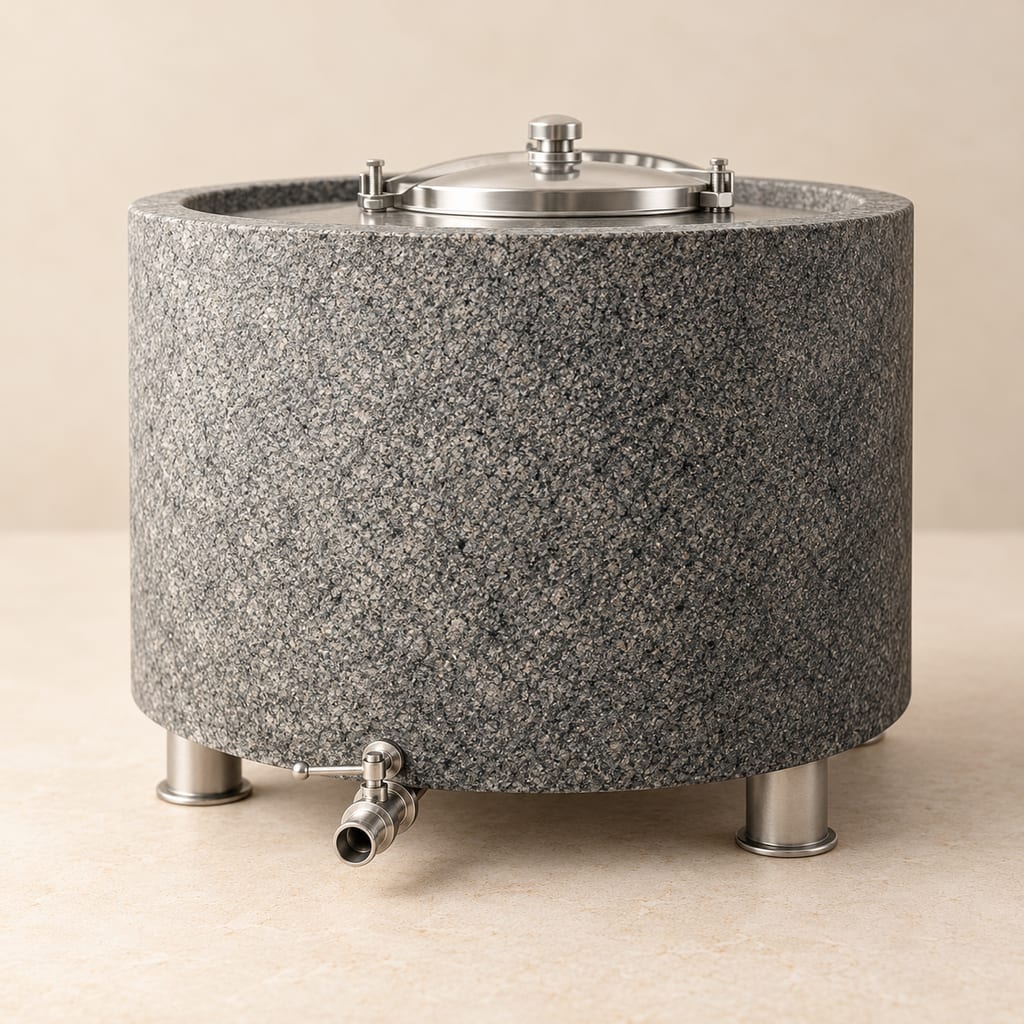
A wine fermentation and maturation tank carved from a single granite block, with a thick mineral shell and fitted metal closures and taps.

A squat carved-granite wine tank with a thick mineral shell, metal top closure and low tap.

A tank carved from one block

A carved natural-stone wine vessel is a freestanding tank hollowed from a solid block rather than a clay jar, a bedrock press or a structure built into the ground. Giesen describes its bespoke tanks as single slabs of volcanic rock, weighing more than three tonnes and holding around 750 litres. The maker's photograph shows two broad, squat vessels with thick, visibly crystalline granite walls, top fittings and taps near the base. Their mass is part of the object: this is winery-scale equipment installed with specialist stoneworking and lifting, not a small household fermenter.

Sources for this section

German manufacture, New Zealand use

Giesen says the tanks were sourced from a stonemason in Germany and brought into use at its winery for fermentation and maturation. That distinction matters: Germany is the documented place of manufacture, while Marlborough, New Zealand is the documented wine-growing and use region named for Giesen's Gemstone Riesling. This does not claim that granite winemaking originated in either place. Giesen also says French winemakers have used granite vessels for centuries; the page supplies no historical dates or chain of evidence for this particular tank form, so that statement is best read as the winery's context for its modern experiment rather than a dated origin story.

Sources for this section

What the stone may contribute

The winery reports that the granite keeps wine at a consistently low temperature and permits slow air exchange; it compares the gradual evaporation it observes to a barrel's effect on concentration. These are maker observations about its own tanks, not a quantified performance specification. The page gives no measured heat-transfer profile, oxygen-transmission rate, evaporation percentage, or operating limits. Granite is a natural material, so results cannot be assumed identical across blocks, finishes, dimensions or closures. In practice, the fitted lid and the way the vessel is run are part of the system: stone alone does not tell a winemaker how much air reaches a batch or what temperature it will hold.

Sources for this section

Fermentation, maturation and care

Giesen documents use of its tanks for white-wine fermentation, maturation and storage, naming Riesling, Chardonnay and Sauvignon Blanc. The current Gemstone Riesling page says the wine's fruit comes from Marlborough and that fermentation occurred in granite and stainless-steel fermenters. A stone vessel can hold a wine parcel without adding oak flavour, but this does not make it interchangeable with stainless steel, a wooden barrel or clay: each material and closure presents a different surface and exposure to air. The source does not publish cleaning instructions, a sealing method, pressure rating, food-contact certification, transport procedure or a maintenance schedule. Those details must come from the maker for the individual tank. Its reported capacity and weight also describe Giesen's bespoke example, not a universal specification for every carved-stone tank.

Sources for this section

History

The documented example is contemporary: Giesen says it sourced bespoke tanks from a German stonemason for use at its winery. The company also describes granite wine vessels as a practice used by French winemakers for centuries; that producer statement does not date this particular tank or prove that modern carved tanks share one uninterrupted design history.

Equipment details

Capacity750 L Giesen reports a capacity of around 750 L for each of its bespoke tanks; the source gives no tolerance, so this is an approximate reference model, not a universal size.
SizeThe inspected source gives no external dimensions.
PowerNo power The stone vessel itself has no powered mechanism; any winery pumps or temperature-control equipment are separate.
How you get oneBought from a maker Giesen's bespoke tanks were sourced from a stonemason in Germany. The source does not provide a general supplier, price or ordering route.

Made of

  • Granite (plutonic rock) — Monolithic vessel body
    Giesen describes the tank as carved from a single solid slab; its interior surface is also granite.
  • Metal — Fittings
    The photographed example has fitted metal taps and top hardware; the source does not identify the alloys or closure specification.

Places

Germany

Manufacture · Country evidence

Giesen says it sourced its bespoke granite tanks from a stonemason in Germany; this records manufacture sourcing, not an origin claim for all stone wine vessels.

Marlborough

Documented use · Region evidence

Giesen documents its winery use of granite tanks and identifies Gemstone Riesling as Marlborough wine; this records one documented use, not a tradition of origin.

Related

Community

No community contributions have been published for this entry yet.

Share what you made

Sign in to contribute. Published comments and photos are free to read.

Sources