What it is
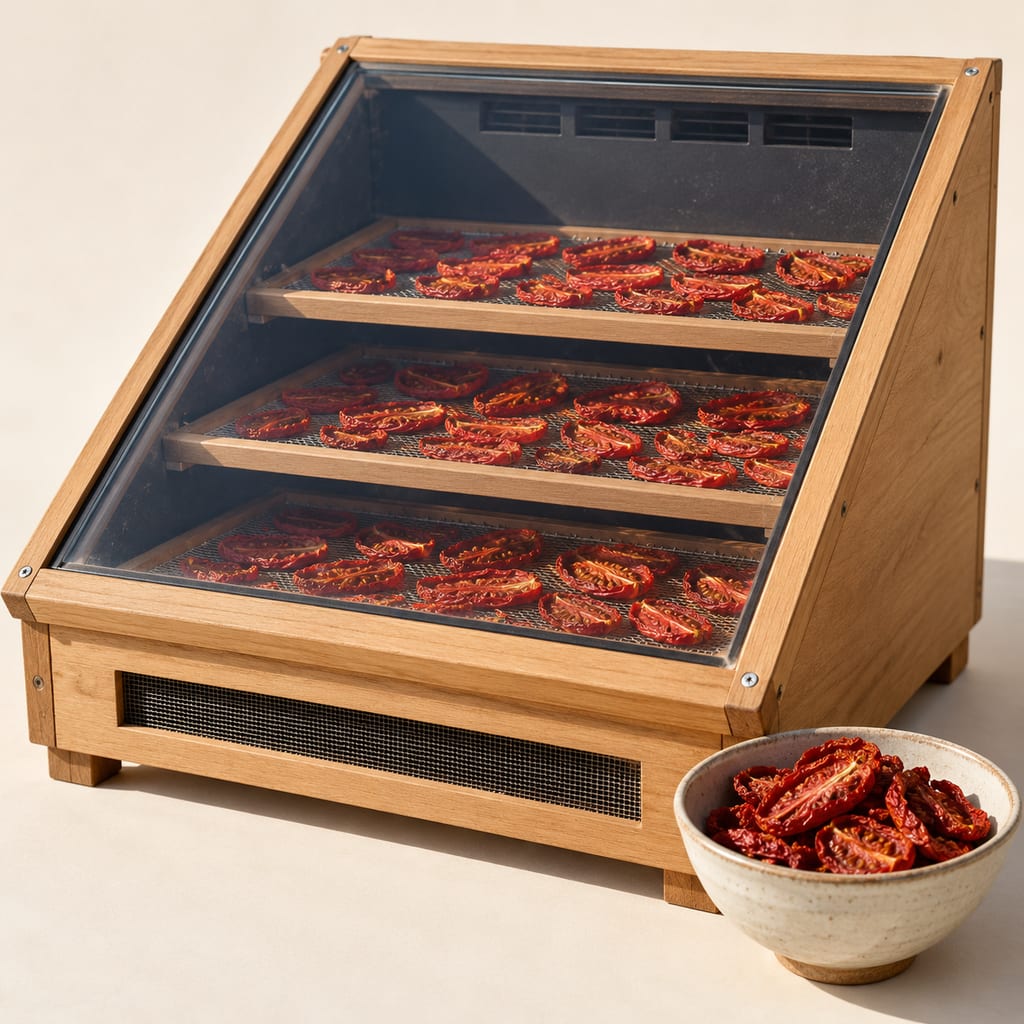
A direct solar cabinet dryer is a box with a transparent cover on the sun side and a dark interior. Sunlight passes through the cover and heats the interior and the product. Air enters through screened openings low in the base, passes over the trays and leaves through vents high in the back, carrying moisture with it. An indirect dryer differs because it heats its air in a separate collector, so its product is not exposed to sunlight.
The FAO manual describes a hinged transparent lid and a mesh tray raised above the floor, with an aperture screen against insects. The top cover has to fit weather-tight. The screen is noted specifically for insect exclusion.
Sources for this section
Origin and the 1978 drawing
The most detailed record is a schedule and drawing in the UNIDO publication Technology for Solar Energy Utilization, published in 1978 as part of its Development and Transfer of Technology Series. The drawing is labelled as a solar cabinet drier and states that the dimensions were used for a dryer in a Kanpur case study. The design draws on Brace Research Institute work, which the publication credits without a date for the cabinet itself.
The schedule gives a cabinet of 198 cm length and 66 cm width, with 2 cm wood panels and plywood base panels, three 62 cm trays, three glass panes of 61 by 62 cm and 5 cm of wood-wool insulation. The same schedule lists 27 polyethylene liners of 127 mm diameter for the air holes. Leg lengths, runner positions, hole coordinates and the cover frame are not given in the text read, so the drawing needs to be read before any cut list is made.
Sources for this section
Building and testing one
A builder would assemble the body and legs, insulate the base and sides, drill the base air openings and fit liners, screen the apertures, mount the tray runners and trays, and then fit the glass cover with a seal or retaining moulding. The order is an interpretation of the source, not a tested sequence, and the drawing should confirm it.
Testing comes before use. Measure the temperature and humidity at the inlet, over the trays and at the outlet, with the cabinet empty and loaded. Check the air distribution across the trays, look for condensation under the cover, and check that the cover opens for cleaning. None of these tests establishes food safety.
Sources for this section
History
The UNIDO publication records a solar cabinet drier with drawings and specifications, used in a Kanpur case study. Its design lineage draws on Brace Research Institute work. The FAO manual describes the same cabinet class with typical proportions, but it is not the same dimensioned unit.
Equipment details
SizeThe 1978 drawing schedule gives a cabinet 198 cm long and 66 cm wide. The height and door details are not in the text read, so no height is recorded.
PowerSolar The cabinet dries by sunlight and by air moving through it, with no fan or heater in the basic design.
How you get oneBuilt yourself The 1978 drawing can be used to build the cabinet. No source gives a complete cut list, and a prototype has to be measured before it is relied on.
CareClean the glass covers, trays and mesh between batches. Check that the cover seal and the air apertures stay free of insects and debris.
Made of
- Plywood base, 20 mm — Floor of the cabinet
Two base panels of 1980 by 660 mm are listed. Stock standard and tolerance are not given. - Wood side, rear and front panels, 20 mm — Walls of the cabinet
Board width and length are not given in the source text. - Polyethylene pipe liners, 127 mm diameter by 60 mm — Lined air holes through the insulated base
Twenty-seven liners are listed. Hole placement needs the original drawing. - Wood and wire-mesh trays, 620 by 620 mm — Hold the product in the airflow
Three trays are listed. Mesh gauge and opening are not given. - Glass cover panes, 610 by 620 mm — Transparent top that admits sunlight
Three panes are listed. Pane thickness and sealing detail are not given. - Wood-wool insulation, 50 mm — Insulates the base and sides
The source says at least 5 cm and gives no retention method. - Aluminium foil lining — Reflective inner side walls
Two sheets are listed without dimensions. - Fine insect netting — Covers the air apertures
Fibreglass is preferred in the source. Mesh opening is not given.
Risks and precautions
Overheating of product in sunlightFood under a glass cover receives direct radiation as well as warmed air, so the product can exceed its safe temperature range when the sun is strong.
Hazard source
Rain and insects entering the cabinetThe cover needs a weather-tight fit, and the apertures need screening against insects.
Hazard source
Fine insect netting on all air apertures
Control source
Log temperature and relative humidity inside the cabinet and at the air inlet during each batch
Control source
A cabinet used for fruit is not validated for raw fish or meat by that use alone.
Night-time rewetting of partly dried product is an open question for this cabinet. Measure the product's moisture across a night before relying on the cabinet overnight.
Limits
The cover admits direct sunlight onto the product as well as heating the air. Product in direct radiation can overheat, so the design is not the same as a shaded cabinet.
Source →The dimensions in the 1978 drawing are the case-study figures. They do not show the current construction standard and carry no stated tolerance.
Source →The FAO manual's food-drying guidance concerns fruit and vegetables. The cabinet is not validated for meat or fish on the basis of that guidance.
Source →Places
Kanpur
Documented use · Locality evidenceThe publication says the dimensions shown were used in the Kanpur case-study dryer. It gives no coordinates.