A stone made for a thin sheet of piki
The piki stone is a prepared sandstone slab whose working face is smoothed so a very thin corn batter can cook and lift away as a sheet. A Hopi-authored account by Victoria Spencer and Marlene Sekaquaptewa reports finished stones about 12–16 inches long, 16–24 inches wide and 2–4 inches thick, weighing roughly 35–45 pounds. The ranges describe examples in that account; they are not one standard pattern.
The account describes quarrying, drying and hand-smoothing the sandstone before use. It also records careful family care and the passing of stones across generations. The equipment is therefore both a cooking surface and a valued possession within a living food tradition.
Sources for this section
Set above a fire
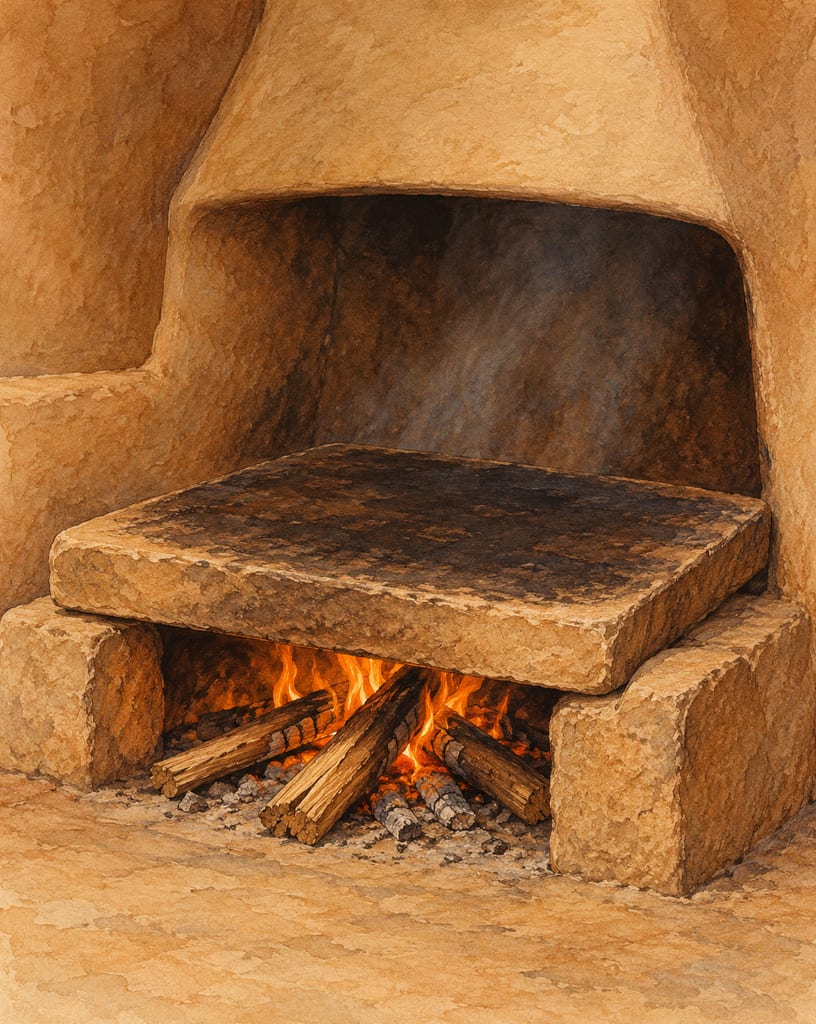
In the published description, the slab rests on supports in a dedicated piki-making space, with a wood fire below and a hood that carries smoke away. The 2025 Heard Museum resource likewise describes a smooth sandstone stone heated by cedar wood. A Smithsonian American Art Museum painting from about 1937–1943 offers a historical visual depiction of a woman making piki on a flat stone above a fire; it is an artwork, not a plan for the hearth.
The slab's prepared face is central to its use: piki makers spread the batter thinly, then lift the cooked sheet from the hot surface. This specialized setting and practiced work do not establish a safe substitute in a domestic oven, on a gas burner or on a generic griddle.
Sources for this section
A Hopi tradition and a separate archaeological find
The Hopi Tribe places its villages on three mesas in northeastern Arizona. The Penn Museum account describes piki making in Hopi villages, while a Heard Museum resource published in 2025 says piki remains commonly made at Hopi. The practice is also described as significant in everyday and ceremonial life; this record treats the stone as equipment within that context rather than as a generic baking surface.
The University of New Mexico's Maxwell Museum exhibit records a distinct piki stone from Pottery Mound, near Los Lunas, New Mexico, dated A.D. 1350–1490. That specimen is evidence for an archaeological Pueblo-region stone identified for piki. It does not establish that the Hopi practice began then or that the same family or object has been used continuously since that time.
Sources for this section
History
The University of New Mexico records a piki stone from Pottery Mound dated A.D. 1350–1490. Hopi-authored and Hopi-community museum sources describe the stone's continued place in piki making, including a 2025 public resource. The archaeological object does not date the beginning of Hopi practice or prove uninterrupted continuity.
Equipment details
CapacityCapacity does not apply to this stone cooking surface.
SizeSpencer and Sekaquaptewa report finished stones about 12–16 inches long, 16–24 inches wide and 2–4 inches thick, with weight around 35–45 pounds. These are reported ranges, not a single standard size.
PowerFire or solid fuel The Hopi sources describe a wood fire below the slab; the 2025 Heard Museum resource names cedar for piki making.
How you get oneNot established Sources describe quarrying and shaping stones but do not establish whether a contemporary reader can acquire one or how individual stones are obtained today.
CareThe 1995 Hopi-authored account describes careful drying, smoothing and continued family care of the stone. It does not give a universal cleaning or maintenance schedule.
Made of
- sandstone — cooking surface
The Hopi-authored account describes a carefully selected slab smoothed for piki; it does not specify a single geological formation for all stones.
Limits
The source documents the stone in Hopi piki making; it does not establish interchangeability with modern griddles, ovens or unrelated cooking methods.
Source →Reported size and weight ranges describe finished stones in one account; they are not an engineering specification for a hearth or support.
Source →Places
Hopi villages on three mesas
Traditional use · Region evidenceThe Hopi-authored account describes use in Hopi villages; the Hopi Tribe locates its villages on three mesas in northeastern Arizona. Not an exclusive origin claim.
Pottery Mound, near Los Lunas
Historical attestation · Locality evidenceA UNM exhibit records a specimen identified as a piki stone from this Pueblo site; this is not an origin claim for the living Hopi tradition.