A fruit built as a box of jewels
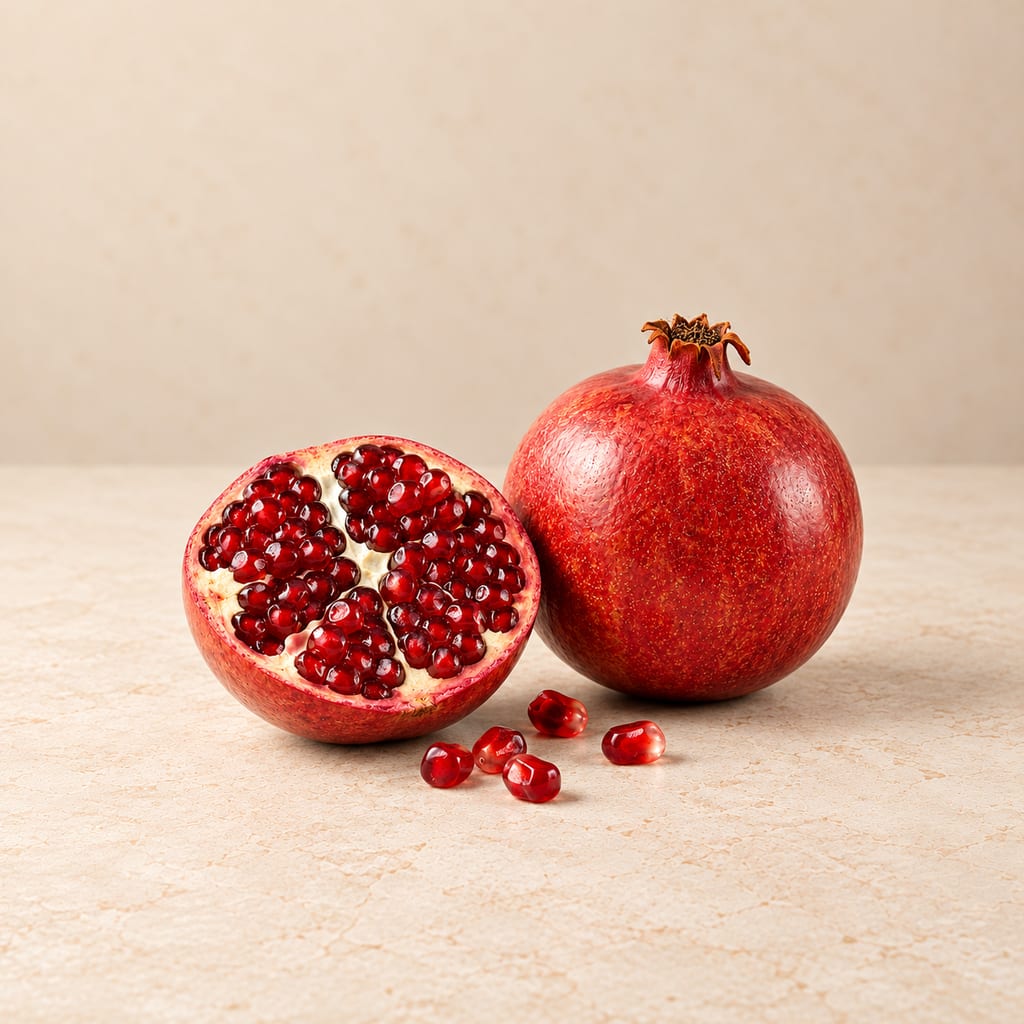
The pomegranate, Punica granatum, is a fleshy berry with a nearly round body crowned by a prominent calyx. Its peel is thick, with a coloured outer skin, and inside lie several chambers divided by membranous walls and packed with arils. An aril is a seed wrapped in a layer of juicy cells that grow out from the seed coat, and it is the edible part: a fruit holds roughly 200 to 1,400 of them. Outer colour runs from yellow and green through pink to deep red or purple, and the juicy layer from white to deep red. Wild fruit is 2 to 8 centimetres across and some cultivars reach 12.
The fruit has no close edible relatives. The genus Punica has just two species, and the other one, Punica protopunica, is a small, uncoloured, inedible fruit endemic to the island of Socotra. All the variety in the market belongs to one species, with more than 500 named cultivars that differ in size, colour, ripening date and, above all, in taste, which runs from sour to sweet.
That range of taste is why the pomegranate matters in the fermented kitchen. A sweet pomegranate is a dessert fruit and a juice for drinking. A sour pomegranate is an acid, and the acid is what is wanted in pomegranate molasses and in the dried sour arils sold as anardana. The same species supplies both, and the cook chooses by the fruit’s acidity.
Sources for this section
From the Caucasus to Carthage and Bukhara
The wild range of the pomegranate lies across the Caucasus and the Iranian plateau, in what is now Iran, Turkmenistan, Afghanistan and Pakistan. It is among the early domesticated fruits; accounts place its domestication in the Transcaucasia and south Caspian region, about 5,000 years ago and possibly as early as the fifth millennium BCE. Chemical evidence of pomegranate consumption, and possibly of wine making, has been reported from the Areni-1 cave complex in southeastern Armenia, dated to around 4000 BCE.
From there it spread through the ancient Near East. Neolithic remains were found at Gezer in Israel, and carbonised peel comes from early Bronze Age levels at Jericho and at Arad. Mesopotamian cuneiform texts mention pomegranates from the middle of the third millennium BCE, and waterlogged fruit was recovered from the Uluburun shipwreck off Turkey, which dates to about the fourteenth century BCE. Egypt used the fruit in texts, in art and in tombs as dried fruit. The crop was naturalised around the Mediterranean from about 2000 BCE, brought by the Phoenicians. Pliny the Elder wrote that Carthage supplied Rome with large seedless pomegranates, which the Romans called malum punicum, the Punic apple, or granatum.
The fruit was a mass food as well as a luxury. In the city of Bukhara, in Central Asia, refuse-filled wells and cesspits of the tenth and eleventh centuries CE held 27,324 pomegranate seeds, alongside 241,366 grape pips, 52,795 fig seeds and 14,178 mulberry seeds. Spanish settlers took the pomegranate to the Americas in the late sixteenth century and to California in 1769; John Tradescant the Elder brought it to England in the seventeenth century, and Thomas Jefferson planted pomegranates at Monticello in 1771. Today India and China lead production, followed by Iran, Turkey, Afghanistan, the United States, Iraq, Pakistan, Syria and Spain.
Sources for this section
How the tree grows and where it makes sour fruit
The pomegranate is a deciduous shrub or small tree, 1.5 to 5 metres tall, with flowers 3 centimetres or more across that carry three to seven petals. It tolerates frost down to about minus 12 degrees Celsius, and cuttings root best at 18 to 29 degrees. The Northern Hemisphere harvest runs from about September to February, and the Southern Hemisphere’s from March to May. Some old specimens in France have lived for 200 years.
Climate steers the taste. In studies of the same cultivars grown in a Mediterranean climate and in a hot desert, the Mediterranean fruit had more glucose and fructose and also higher acidity, with more citric and malic acid. Sour cultivars are mostly grown in the cool north and sweet ones in hot dry country: southern Spain and North Africa grow mostly sweet fruit, while in northern Turkey and Russia sour cultivars are marketed. Reported total acidity runs from 0.5 to 2.3 percent in Russian fruit, 0.6 to 2.2 percent in Macedonian, 0.4 to 2.8 percent in Georgian and 1.7 to 4.6 percent in Turkish. Within one climate, maturity also counts: as the fruit ripens on the tree, total acidity falls while sugars, the sugar-to-acid ratio and the pH rise.
Sources for this section
What is in the juice
The sugars in pomegranate juice are mostly fructose and glucose in similar amounts, with sucrose and maltose in lesser amounts and, in some cultivars, absent. They run 4.2 to 8.5 grams per 100 grams of juice, and the juice’s total soluble solids track them closely. Collections measured around the world give soluble solids of about 11 to 19 percent, a narrow range compared with acidity. Raw fruit is 78 percent water. Per 100 grams it gives 83 kilocalories, 18.7 grams of carbohydrate of which 13.7 grams are sugars, 4 grams of fibre, 10.2 milligrams of vitamin C and 236 milligrams of potassium. The juice has a pH near 4.4.
Acidity is where cultivars differ. Citric acid is usually the main acid, reaching 3.76 grams per 100 grams of juice in some fruit, with much smaller amounts of malic, oxalic, succinic, tartaric and ascorbic acids; in the peel, citric acid is also the main acid, at roughly a third to a fifth of the arils’ level. Citric acid content varied 78-fold among twelve Tunisian cultivars, from 0.4 to 31.4 grams per litre, and 22-fold among 29 Israeli ones. Because sugars change little from one cultivar to the next, acidity is the main factor deciding how a pomegranate tastes. The ratio of soluble solids to titratable acidity ranged from 6.1 to 64.6 among 29 Israeli cultivars; low numbers mean sour fruit and high numbers sweet.
The red comes from anthocyanins, and the astringency from tannins. The peel is rich in hydrolysable tannins, mainly punicalagin, which are among the compounds that make a whole-fruit extract bitter and puckering. The arils’ seeds, about 10 percent of the fruit’s weight, hold 6 to 20 percent oil whose main fatty acid is punicic acid, over 60 percent of the fatty acids. In a study of 17 varieties, conjugated fatty acids made up 65 to 80 percent of the oil, and punicic acid was 74 to 85 percent of those. Juice carries little protein, about 1 percent, compared with the seeds.
Among the polyphenols, anthocyanins are the largest group of flavonoids in the arils and give juice its red. The main phenolic acids are gallic and ellagic acids and the hydroxycinnamic acids caffeic, chlorogenic and p-coumaric, while the peel carries the ellagitannins punicalagin and pedunculagin. How much of each a fruit holds depends on cultivar, growing region, climate, maturity, cultivation practice and storage, so two pomegranates of the same name can differ in colour, astringency and acidity. The juice also holds amino acids, which feed yeast: in six Chinese cultivars glutamine, serine, aspartate and alanine were the most abundant, and fruit from a maritime region held more total amino acids than fruit from a continental one.
Sources for this section
What pomegranate does in fermentation and in preserves
Pomegranate juice ferments because it holds fermentable sugars and amino acids. It is made into wine in some eastern countries, and a recent study made four wines from two cultivars, Jolly Red and Smith, using two yeasts, Saccharomyces cerevisiae Clos and a Saccharomyces cerevisiae ex-bayanus strain, EC1118. The juice contained sucrose, glucose and fructose, citrate as the main organic acid, malate and lactate, amino acids such as alanine, arginine and valine, and anthocyanins. After fermentation the sucrose and glucose had gone, ethanol, glycerol, succinate and traces of acetate and 2,3-butanediol had appeared, and anthocyanins had disappeared from the NMR spectra. Citrate stayed almost constant through fermentation, so the acid that made the juice tart still shaped the wine.
Pomegranates are sold as fruit, juice, jam and, in some eastern countries, as an alcoholic ferment. The cultivar affected the wine far more than the yeast. The Smith cultivar gave wines with more citrate and gallate, which tasters linked with acidity, astringency and a darker tonality; the Jolly Red wines had more fructose, malate, glycerol and aromatic amino acids and scored higher for fruitiness, softness, balance and structure. The yeast changed fewer descriptors: the EC1118 wines were more fruity and acidic, and the Clos wines higher in tonality, alcohol, sweetness and structure. A winemaker choosing a pomegranate is mostly choosing a profile of acid, sugar and polyphenol.
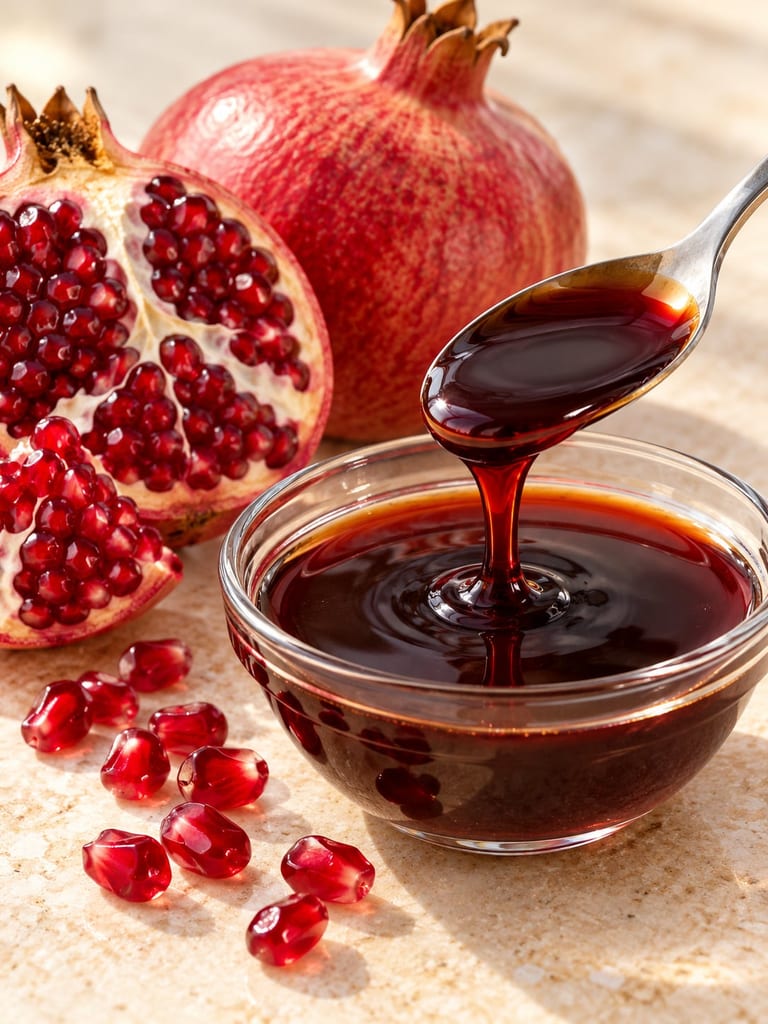
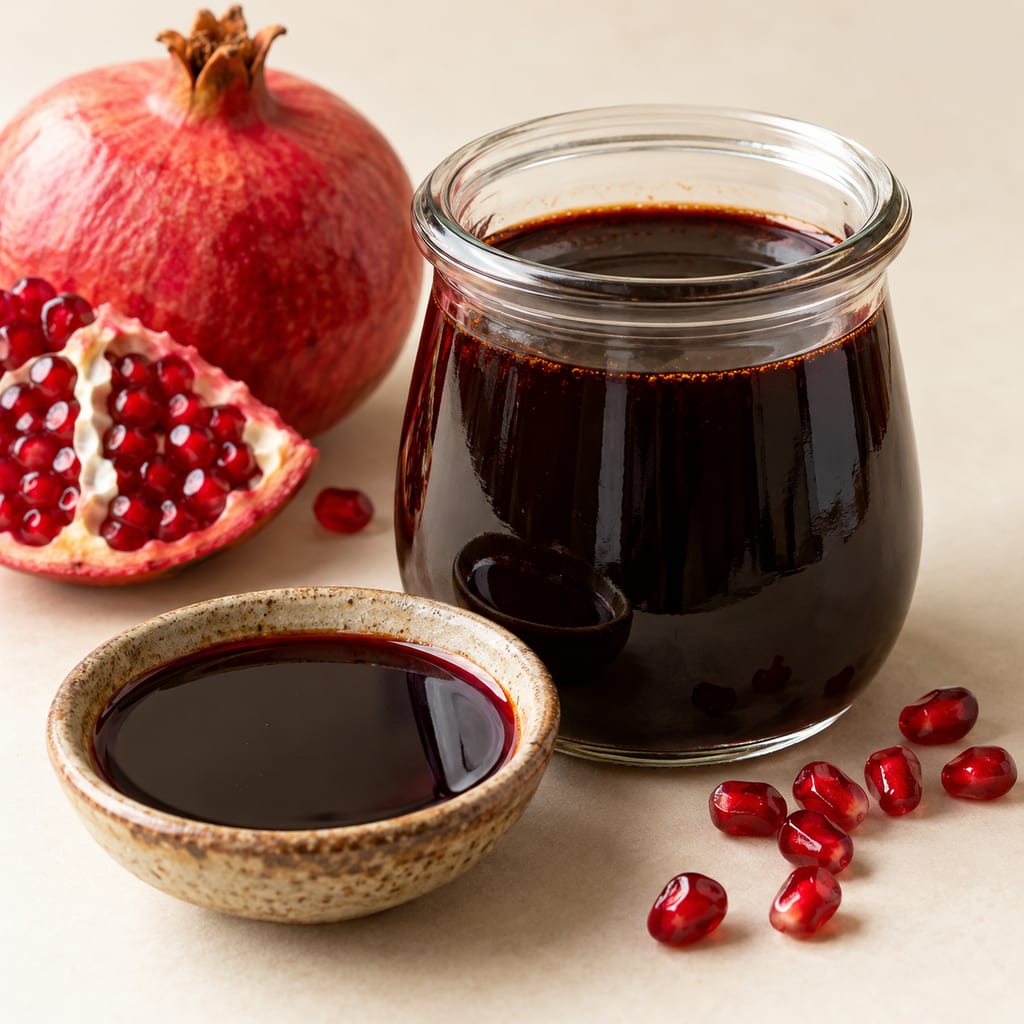
Two other products rest on acid and concentration. Pomegranate molasses is concentrated juice: commonly unpeeled pomegranates are squeezed and the juice is heated until it reduces to about half its volume, and once thickened sugar, coriander, basil and cinnamon, sometimes with black or red pepper, are added. It goes by several names: dibs ar-rumman in Arabic, robb-e anâr in Persian, nar ekşisi in Turkish and narsharab in Azerbaijani, a word that literally means pomegranate wine although the product contains no alcohol. Anardana is the dried arils of sour pomegranate, which serve as a natural acidulant and flavouring in Indian and Middle Eastern cooking. In wild fruit from the Pir Panjal range of Jammu and Kashmir, the source of much anardana, titratable acidity runs from 0.87 to 2.46 percent, pH from 2.79 to 4.11 and soluble solids from 10.7 to 17.6 degrees Brix; the acidity is described as an advantage in the dried aril because it suppresses microbes and improves shelf stability.
Sources for this section
Choosing and handling
Taste cannot be assumed from the fruit’s appearance, because outer colour runs from yellow and green to deep red and the juicy layer from white to deep red within the one species, while acidity differs many times over between cultivars. The practical rule is to buy for the job: a cook who wants acid should look for a named sour cultivar or fruit from a cool-climate region, and a cook who wants sweetness should look for the opposite, or taste an aril before buying a quantity.
Maturity changes the result. Because acidity falls and sugar rises during ripening on the tree, fruit picked earlier is sharper than fruit left to hang. The peel is rich in hydrolysable tannins, mainly punicalagin, which are astringent.
Sources for this section
Varieties
A handful of cultivars recur in the research. Wonderful is an American cultivar grown in Israel and South Africa. Rosh Hapered is a sweet Israeli cultivar whose citric acid content is low compared with its malic, succinic and oxalic acids. Ganesh is an Indian cultivar and Taifi a Saudi Arabian one. Jolly Red and Smith are the cultivars of the pomegranate wine study. Sweet and sour have no fixed boundary. Spanish fruit judged sour measured 32 to 96 on the ratio of soluble solids to acidity and sour-sweet fruit 17 to 28, while Italian sweet and sour varieties together spanned 6.6 to 35.2, so the numbers depend on the method and the collection.
Sources for this section
How it is used
Pomegranate molasses is a key ingredient of Persian cooking, used in fesenjān, a sauce of walnuts and pomegranate, and in the soup ash-e anar. Across West Asia, the South Caucasus, Anatolia, the Balkans and the Levant it is used mostly in fish and meat dishes and as a dressing in salads, where it gives a light sour taste. Grenadine syrup was originally thickened, sweetened pomegranate juice, although the molasses is a different product. In Turkey a pomegranate sauce is used as a salad dressing or a marinade, and the seeds are scattered over desserts such as güllaç.
The dried arils called anardana serve as an acidulant in Indian cooking. Pomegranate juice is fermented to wine in some eastern countries, and a peel extract has been used to stain wool and silk. The arils get their red from anthocyanins, the peel carries punicalagin, and the seeds hold an oil rich in punicic acid.
Sources for this section
Notes
Acid and sugar figures differ greatly by cultivar and climate. The wine findings are from two cultivars and two yeasts.
Sources for this section
Places
Caucasus and Iranian plateau
Historical attestation · Region evidenceNative range and the region where domestication is placed; not a single recorded birthplace.
Areni-1 cave complex, Armenia
Historical attestation · Locality evidenceChemical evidence of pomegranate consumption and possibly wine making.
Jericho and Arad
Historical attestation · Region evidenceCarbonised pips and peel fragments.
Carthage
Historical attestation · Locality evidencePliny reports Carthage supplying Rome with large seedless pomegranates.
Bukhara, Uzbekistan
Historical attestation · Locality evidencePomegranate seeds in refuse wells and cesspits of the medieval city.
Iran
Traditional preparation · Country evidencePomegranate molasses is a key ingredient of Persian cooking; a country-level association.
Turkey
Traditional preparation · Country evidencePomegranate sauce as dressing and marinade; sour cultivars marketed in the north.
India
Modern adaptation · Country evidenceLeading producing country.