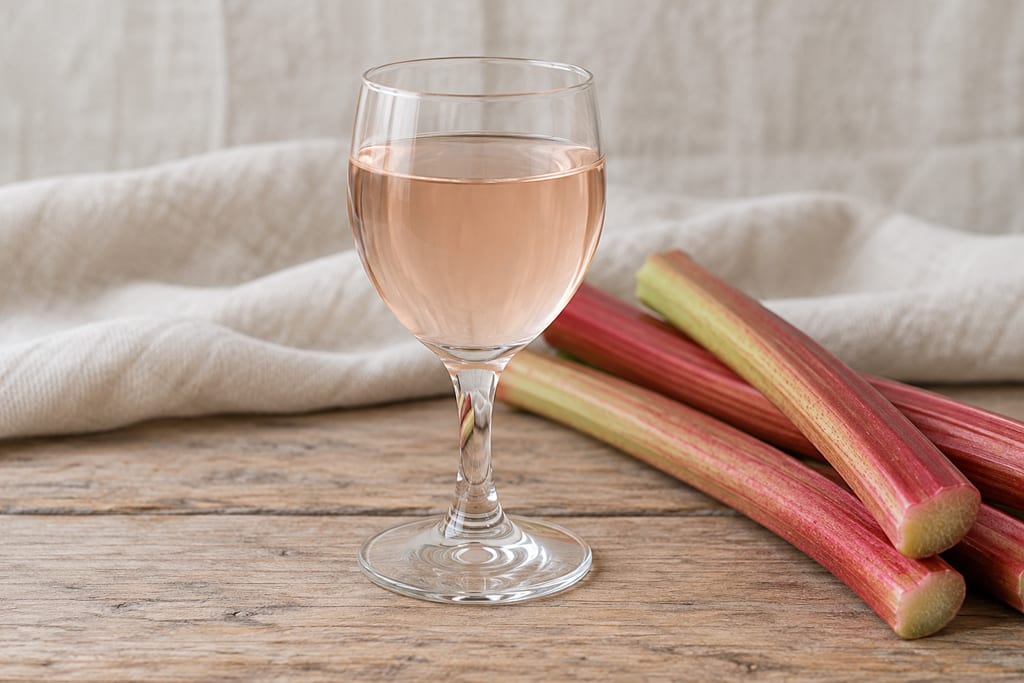
Rhubarb wine
S. O. Beeton’s 1861 household book records rhubarb wine made with rhubarb pulp, water, loaf sugar, lemon rind and isinglass; its historical directions do not establish a safe modern fermentation endpoint.
 FermenteaWhere food goes to change
Substrates
Rhubarb stalks are the tart leaf petioles of garden rhubarb, eaten as a vegetable and used in sweet dishes and wines; they lend a must sharpness and aroma but little sugar.
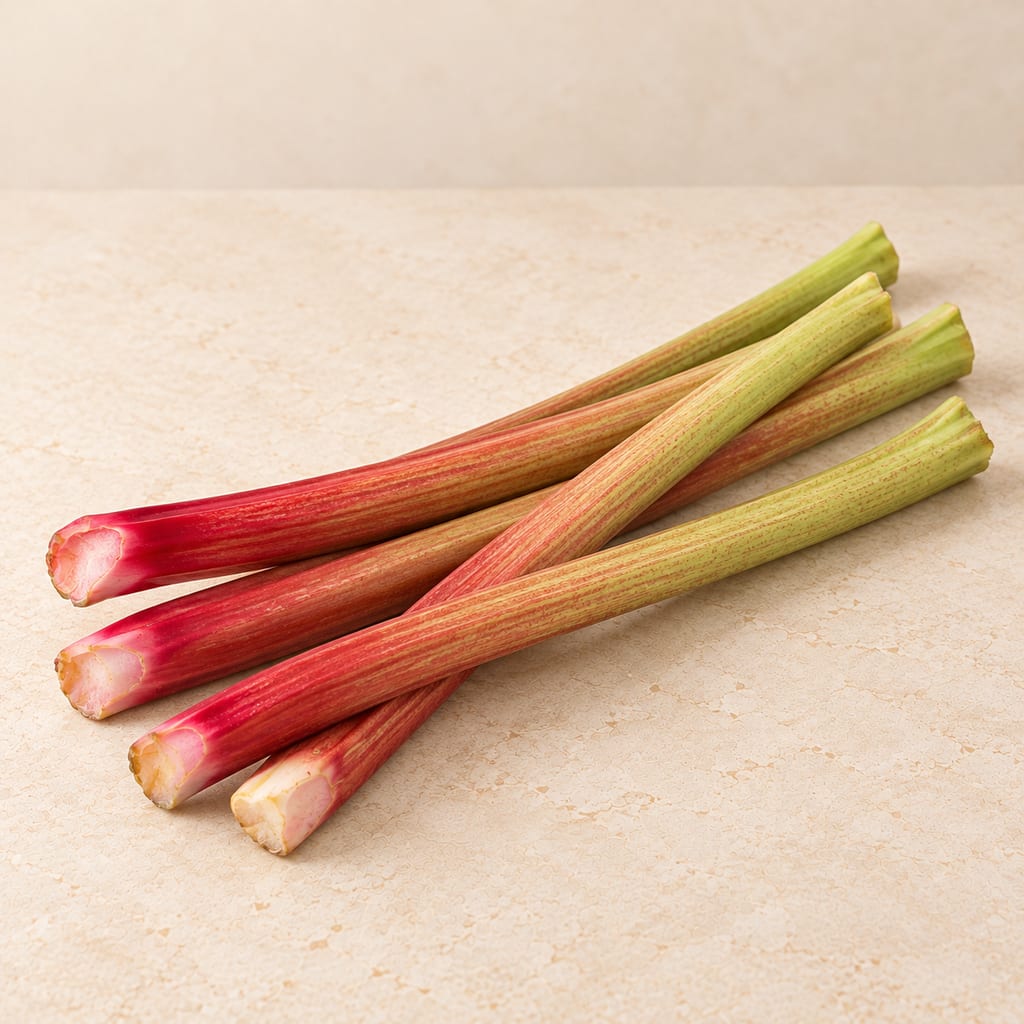
The long, fleshy part sold as a rhubarb stalk is a leaf petiole: the stalk that connects a leaf blade to the plant crown. It is not a botanical stem, despite the everyday names “stalk,” “stick,” and “stem.” The leaf blade is a different plant part and must not be treated as food. Garden rhubarb is a perennial in the buckwheat family, Polygonaceae. Horticultural references commonly use Rheum × hybridum for cultivated garden rhubarb, while botanical databases also recognize species such as Rheum rhabarbarum. The names are not interchangeable with every wild or medicinal Rheum.
A stalk is typically firm and fleshy, with a channelled or ribbed surface and a crisp, juicy interior. Its skin may be green, pink or red, sometimes with several colours along one petiole. Colour alone does not establish a variety or its sweetness. University of Minnesota Extension notes that varieties differ in sourness and fibrousness; greener types there are described as more vigorous and longer-stalked than red types. Cultivated garden rhubarbs have a complicated history of hybridization and selection, so the exact parentage of a supermarket bunch is seldom something its colour can tell you.
The word rhubarb has covered plants with distinct uses. In Europe, dried roots of several Rheum species were traded as medicine long before the garden petiole became a familiar food. Those roots are not the ingredient described here. Auguste Chevalier’s historical review reports that European botanical gardens held more than one rhubarb species by the middle of the seventeenth century and that one spread in English cultivation during the eighteenth. He identifies the French 1765 edition of Philip Miller’s gardening dictionary as an early printed record of eating the leaf petioles in spring tarts. He also warns that the names and ancestry of cultivated forms were uncertain. This is an eighteenth-century European attestation, not proof of a global first use.
Nineteenth-century household writing shows stalks entering domestic food and drink. Isabella Beeton’s 1861 Book of Household Management includes “Rhubarb Wine” as recipe 1829. In the scanned 1968 facsimile, the recipe names rhubarb pulp, spring water, loaf sugar, isinglass and lemon rind, and tells readers to gather rhubarb around mid-May. Its method describes steeping, straining, fermentation and later casking and bottling. A separate general rhubarb entry in the independent transcription names the leaf footstalk as the culinary part, but the wine recipe itself says only “rhubarb pulp.” It gives neither a species nor a named yeast, measured endpoint, alcohol strength, validated storage control or evidence that its historical bottling instructions are safe today.
Rhubarb later became a conspicuous market crop in parts of northern England. A 1945 review in Nature describes the West Riding of Yorkshire as the principal production area at that time and discusses both natural and forced cultivation. In the Rhubarb Triangle around Leeds, Wakefield and Morley, forcing sheds produced stalks out of the ordinary field season and supplied distant markets. Wakefield Museums records an 1886 bottle of homemade rhubarb wine in its collection, evidence that the drink appeared in local material culture as well as in printed cookery. That bottle does not establish a recipe, household prevalence or continuous local tradition. Yorkshire Forced Rhubarb now has a protected regional product specification; its name applies to a defined growing area and method, not to all rhubarb.
Older histories sometimes treat 'rhubarb' as a single plant moving unchanged from an Asian medicinal trade into European kitchens. Chevalier's account makes that simple story unreliable: it separates medicinal root use from culinary petioles and describes cultivated forms as hybrid complexes whose identities were already disputed. Kew's accepted range for Rheum rhabarbarum is useful botanical evidence, but it cannot by itself date or locate modern garden rhubarb's domestication. A European culinary attestation and a Yorkshire growing tradition are documented, while the worldwide first use and the ancestry of the garden crop are unknown.
Rhubarb makes its mark in a ferment through sourness, colour and plant aroma. A 2013 study of Rheum rhabarbarum juice found low soluble solids and sugar alongside high total acidity; malic acid was the main measured acid, followed by oxalic and citric acids. Those results describe the samples and processing in that study, not every cultivar, season or juice. They help explain why a rhubarb must can taste sharply tart before fermentation and why rhubarb wine formulas often supply fermentable sugar separately.
Beeton’s recipe makes that distinction visible: it includes three pounds of loaf sugar for each gallon of liquor, in addition to the rhubarb pulp. The historical text therefore does not describe a wine fermented from rhubarb’s native sugars alone. NDSU Extension’s modern comparison likewise includes sugar and a packet of wine yeast, but it is a separate formulation with its own additions and monitoring instructions. It does not confirm Beeton’s process or resolve the internal disagreement between the modern guide’s finishing gravity figures.
Alcoholic fermentation occurs when yeast metabolizes fermentable sugars, producing ethanol, carbon dioxide and other compounds that shape aroma and flavour. That general mechanism does not identify what organisms acted in Beeton’s vessel: his text names no inoculum and gives no measurements that would let a reader infer a controlled endpoint. Rhubarb brings acidic juice and characteristic aroma, while added sugar can supply substantial fermentable material. No exact sugar content, final acidity, alcohol level or fermentation time can be calculated for an unspecified batch from the historical account.
The processing study also matters when stalks are prepared for a ferment. It describes washing, comminuting the stalks and dejuicing the mash promptly, and reports that its juice process did not require enzyme treatment or heating to obtain high juice yields. That result is a specific food-processing experiment, not a home safety procedure and not an instruction for Beeton’s wine. Pressing whole or cut stalks, heating them, or steeping them in water will extract different proportions of juice, acids and plant aroma. A recipe needs to state its own extraction method if those differences are important.
Rhubarb’s fresh acidity can also affect balance: it may make a young must taste sharper than a sweeter fruit juice, while fermentation and any later sweetening can change the finished impression. That sensory description is not a measure of pH, titratable acidity or stability. The cited juice analysis reports chemical values from its own sample; it does not show how much acid remains after a particular household wine ferments. Without a recipe’s cultivar, extraction, dilution and measurements, those values cannot be transferred to predict a finished drink.
Garden rhubarb is grown as a long-lived crown in temperate gardens. The Royal Horticultural Society describes a fertile, well-drained site and a productive clump that can remain in place for years. The stalk is harvested by easing it from the crown and removing its leaf blade. Minnesota Extension advises leaving a newly planted crown alone during its first growing season and waiting longer for plants raised from seed; its guidance is regional and is not a universal calendar for every climate or cultivar. Both extension accounts emphasize that the plant needs its leaves after harvest to rebuild reserves.
The main fresh harvest is in spring in temperate northern gardens, though timing shifts with climate, cultivar and whether the crop is forced. RHS lists April or May for most varieties and recommends easing back harvesting after late June or early July so established clumps can recover. Beeton’s mid-May instruction belongs to his nineteenth-century British recipe and should not be copied as a universal season. Yorkshire forcing is a separate cultivation practice: growers lift mature crowns after outdoor growth and bring them into dark, warmed sheds, producing tender shoots earlier in the year. It changes season and growing conditions; it does not turn the petiole into a different plant part.
Fresh stalks are commonly stewed or baked with sweeteners in pies, crumbles and cakes, made into sauces and preserves, or cooked and strained into drinks. Minnesota Extension also describes sweetened rhubarb juice. The stalk’s tartness pairs naturally with sugar in these culinary uses, but the sugar level in a dessert or juice is not evidence of how much is appropriate in a ferment. Named varieties can differ in stalk length, colour, acidity and fibre; follow a source that identifies the variety rather than assuming red stalks are sweeter or suitable for a particular wine.
Forced production is a growing technique, not a fermentation step. The Yorkshire product specification describes a bounded district and a winter forcing practice: crowns first grow outside, then are lifted and brought into dark sheds where the shoots develop without ordinary daylight. Wakefield’s museum account notes that harvesters worked by candlelight and that the region’s trade once moved boxes to London and European markets. The protected name matters because local soils, climate, cultivar selection and the handling method together define that product; a stalk grown elsewhere does not become Yorkshire Forced Rhubarb merely by looking similar.
Choose stalks that are firm and unspoiled, and handle the petiole as the edible part. Cut or twist the stalk from the plant using the relevant local growing guidance, then remove the entire leaf blade and discard it before the stalk enters a kitchen or fermenting vessel. Do not use the leaves for garnish, flavouring or a substitute for another green. Wash the stalks and remove soil; the exact trimming or cutting size depends on the cited preparation. If a recipe calls for chopped stalks or pulp, that is a form of preparation, not a claim that all parts of the plant are usable.
RHS says rhubarb is best used fresh, though it can be kept in a refrigerator for a couple of weeks or frozen. Storage life depends on condition and storage practice; this source does not establish a wine-making shelf life for cut stalks or pulp. A producer selecting stalks for juice or wine should use a process-specific source for washing, extraction and timing rather than transferring a fruit-wine rule to rhubarb without evidence.
The large leaf blade is not edible. MedlinePlus identifies oxalic acid and possible anthraquinone glycosides in rhubarb leaves; Minnesota Extension also warns that the leaves are toxic and says only the thick petioles are edible. Remove leaf blades at harvest and keep them out of preparations. This warning concerns the plant part and does not give a numerical dose or describe a way to make leaves safe.
The stalk itself also contains oxalic acid, as Minnesota Extension notes. Its presence is not a reason to invent a universal limit: the sources here provide no rhubarb-wine threshold, batch calculation or medical rule. The Extension page says people with gout, kidney disorders or rheumatoid arthritis may wish to discuss high-oxalate foods with a clinician. No specific stalk quantity, ferment acidity, smell, taste, bubbling or home measurement is presented here as proof of safety. Beeton’s historical directions are evidence of a published recipe, not a validated preservation process.
Beeton’s 1861 British household cookbook documents rhubarb pulp in a wine recipe and its separate entry identifies the culinary leaf footstalk; it does not establish a birthplace or precise household location.
Historical cultivation and a protected regional forcing tradition are documented here; this is not the origin of all garden rhubarb or of rhubarb wine.
S. O. Beeton’s 1861 household book records rhubarb wine made with rhubarb pulp, water, loaf sugar, lemon rind and isinglass; its historical directions do not establish a safe modern fermentation endpoint.
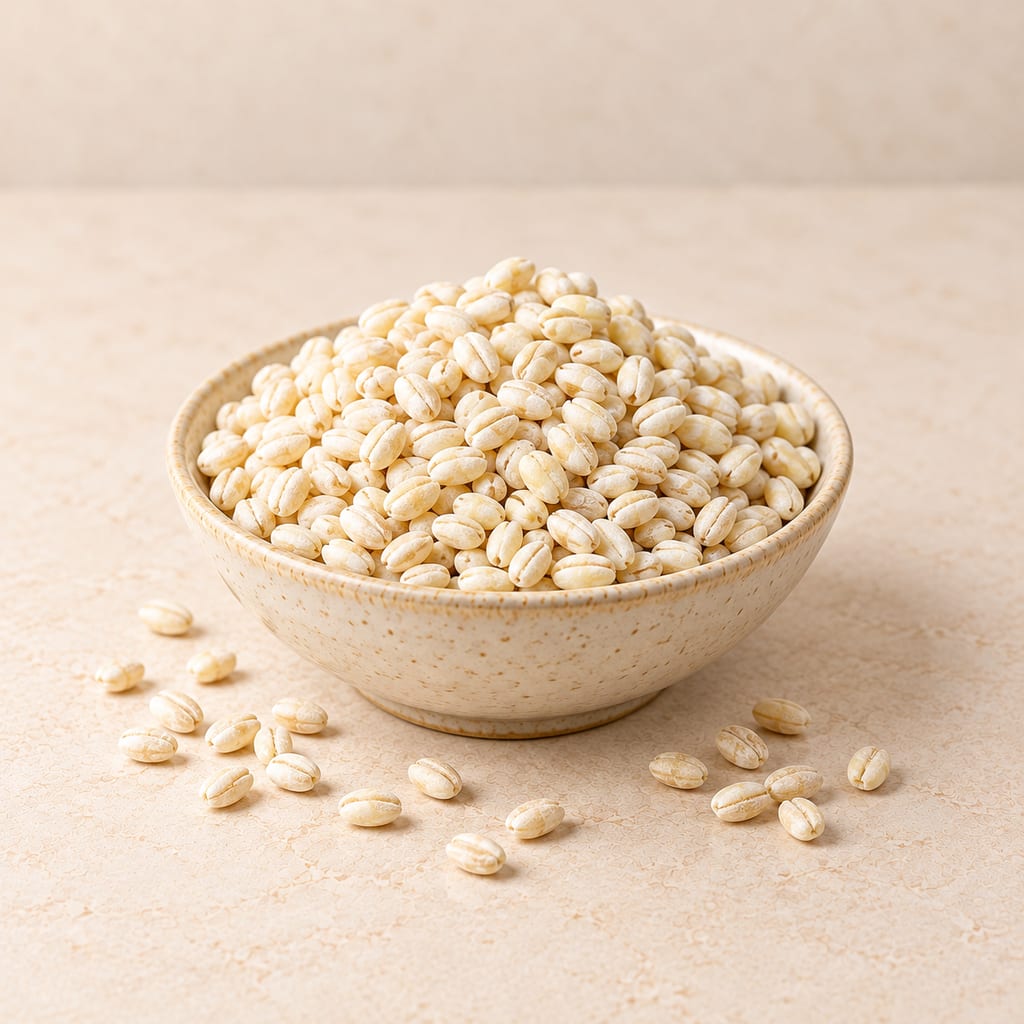
Barley is a hardy cereal, domesticated in the Middle East over 10,000 years ago, eaten whole, pearled or milled, malted for brewing, and grown with koji mold for barley miso.
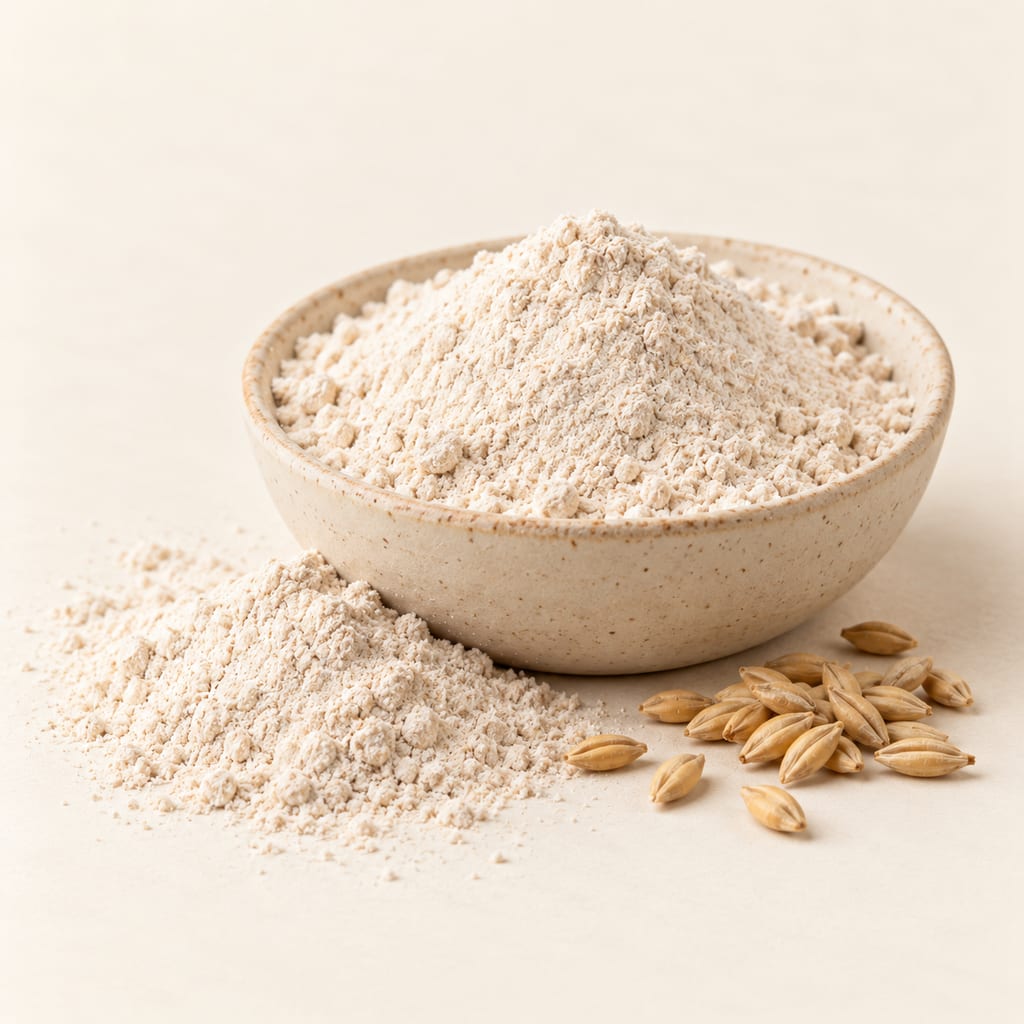
Barley flour is ground barley grain; whether it comes from pearled or hulless kernels, its milling and limited wheat-like gluten-forming ability shape the doughs and foods it can make.
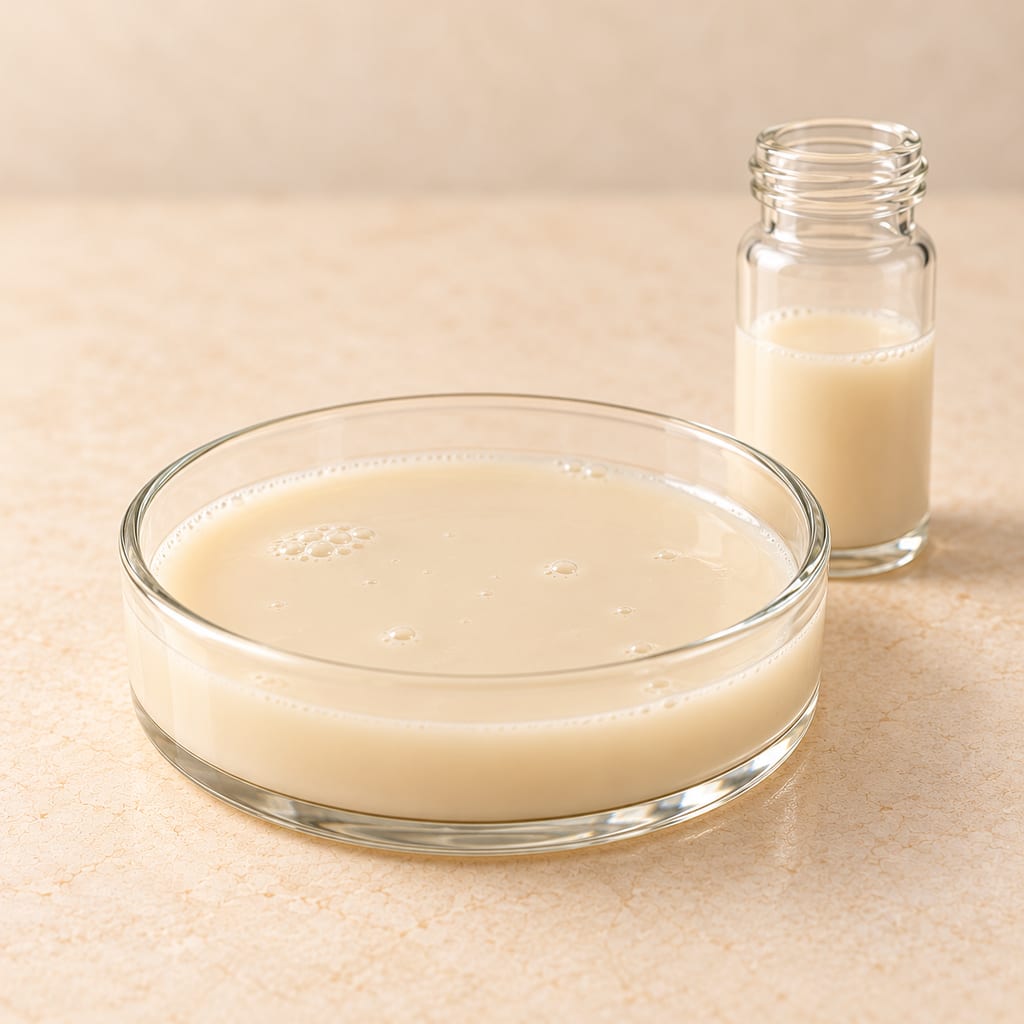
Brewer’s yeast is a working name for living cultures selected for brewing, not one strain or always one species. Ale and lager cultures differ, and older household books may use the term for foam or sediment from brewery beer.
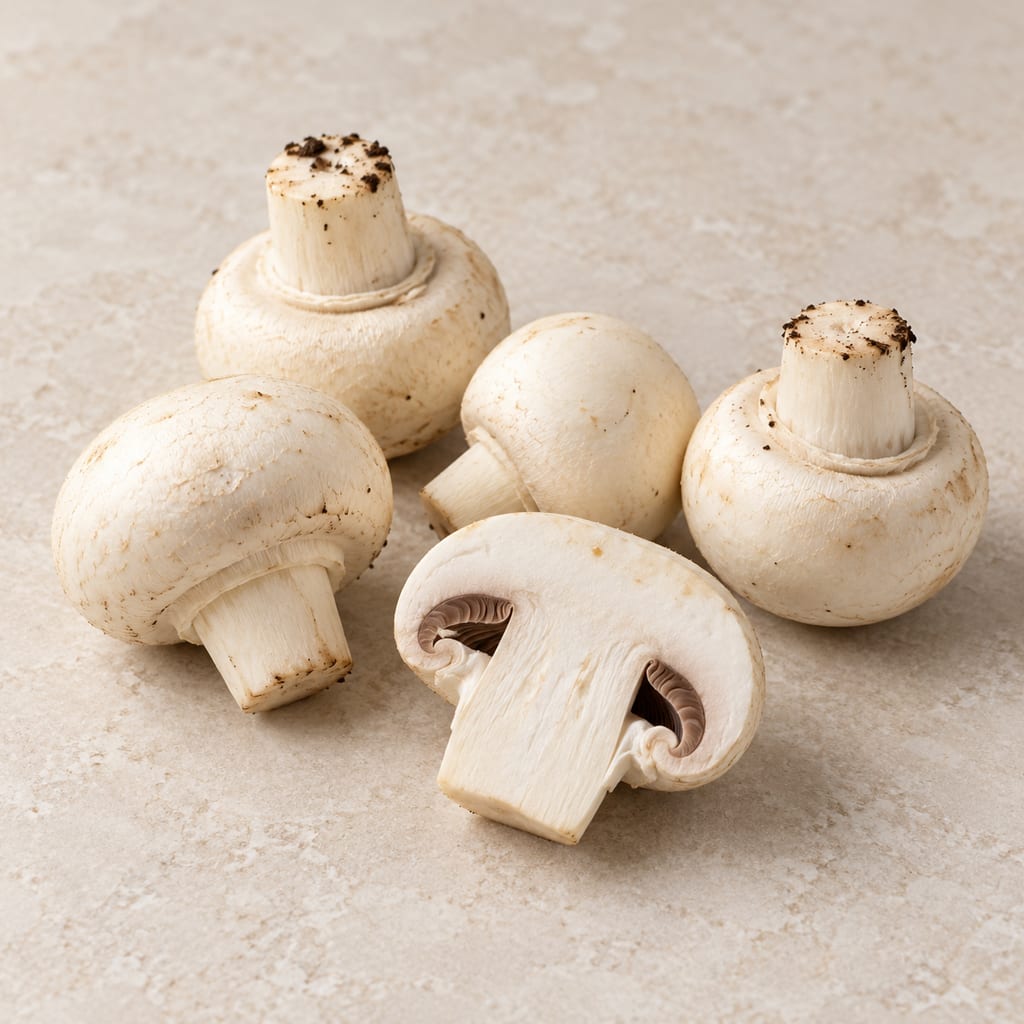
A cultivated form of Agaricus bisporus sold young as a button and at more mature stages as cremini or portobello, used fresh or preserved in everyday cooking.
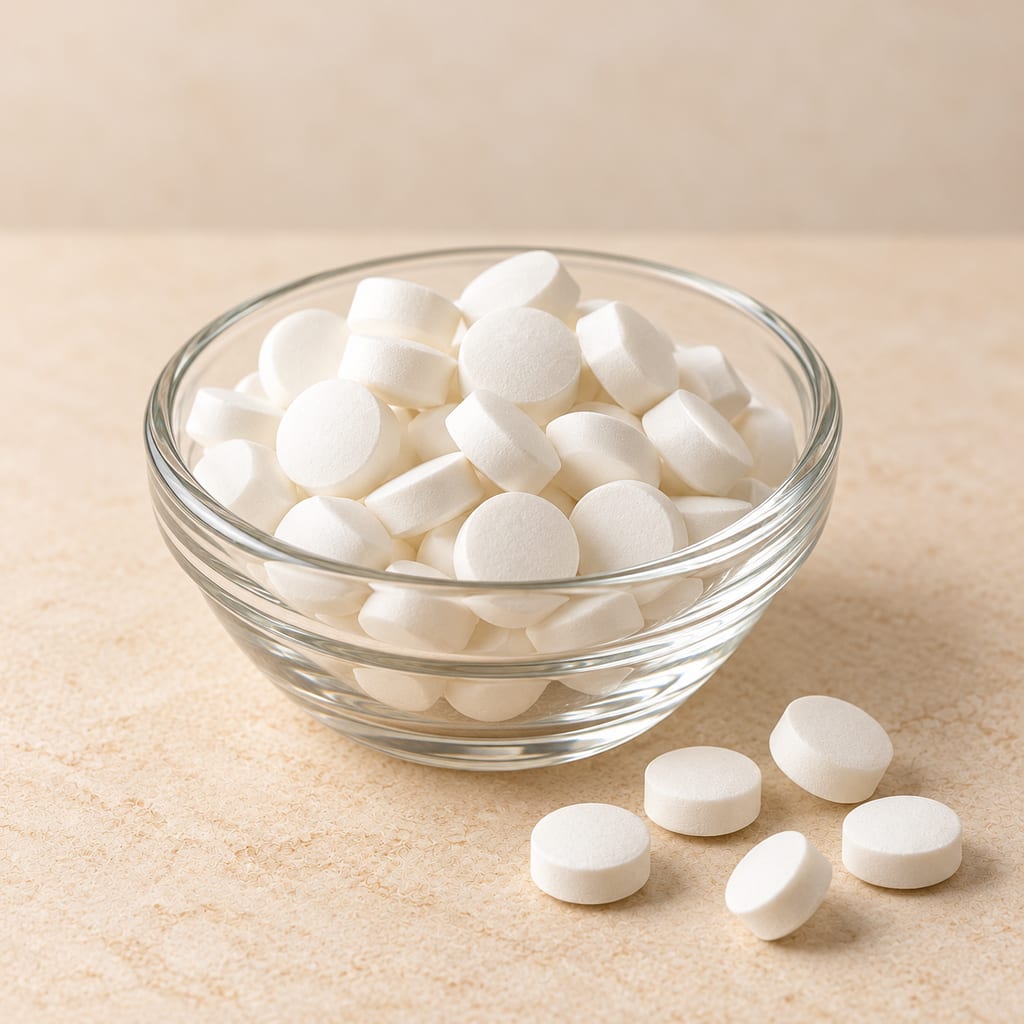
Campden tablets portion a metabisulfite salt for particular wine, cider or other fermentation uses. Tablet strength and the resulting free sulfur dioxide depend on the product and liquid.
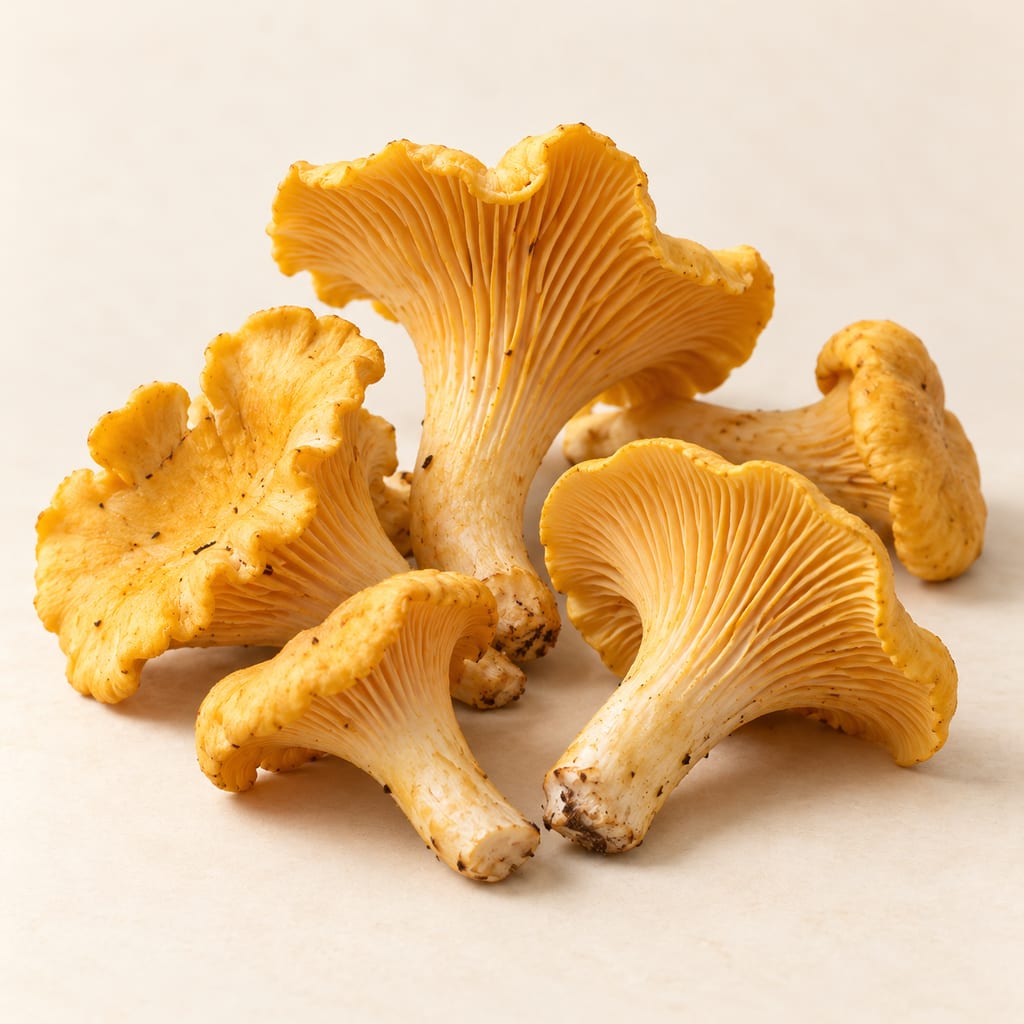
Chanterelles are wild, tree-associated edible mushrooms, particularly the European golden chanterelle Cantharellus cibarius, prized for their firm flesh, fruity aroma and use fresh, frozen, dried or pickled.
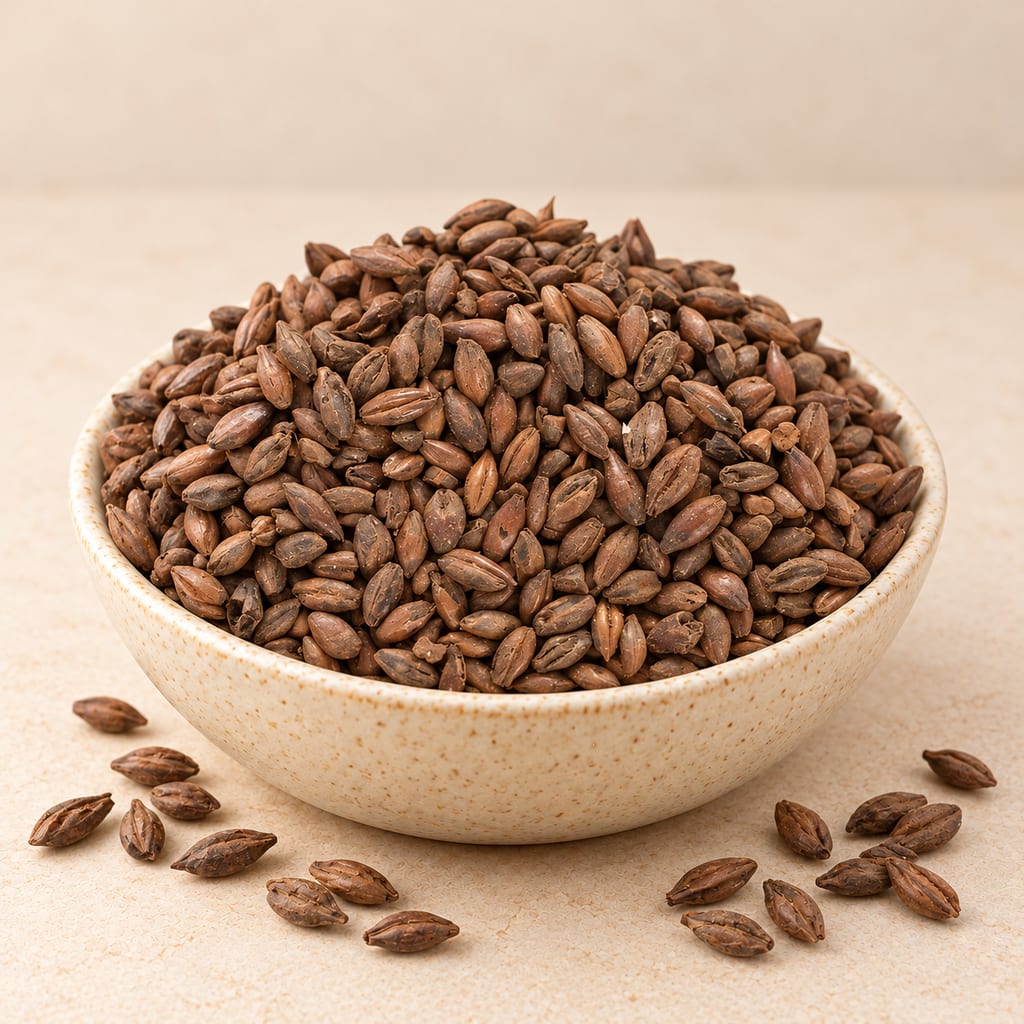
Chocolate malt is barley that has been malted and then roasted to a dark brown, used in porters, stouts and brown ales for colour and a bitter-cocoa, roasted-coffee flavour. It contains no cocoa.
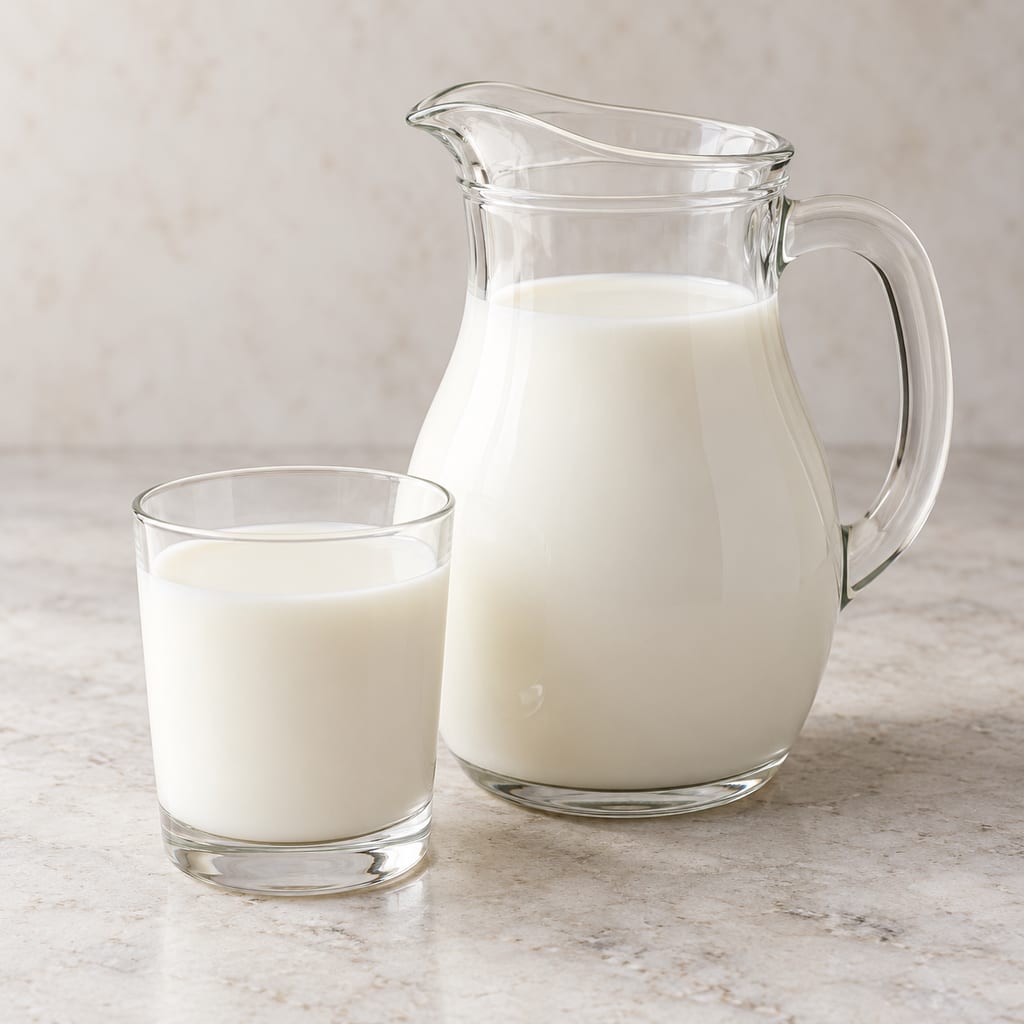
Cow milk and water-buffalo milk are distinct dairy substrates whose fat, protein and mineral balance affects cheese; this ingredient name preserves a choice rather than defining a blend.

A gelling polysaccharide extracted from red seaweeds, sold as kanten strips or powder; it sets firm at a low concentration and stays solid until about 85 °C.

A Dominican table and seasoning condiment of sour orange juice, mixed with lime and salt and bottled raw; garlic, oregano or a hot pepper may be added for meat or a spicier bottle.

Cicerbita alpina is an alpine perennial whose tender shoots and leaves have been eaten raw or cooked. Sámi milk preparations and modern Carnian dishes are distinct uses, with serious identification and preservation limits.

Japanese skipjack tuna cooked, then repeatedly smoked and dried over a wood fire by the hand-fired tebiyama method into a hard block for shaving into dashi: the first stage of katsuobushi.

A Swedish-style spirit vinegar made by fermenting neutral alcohol with live vinegar bacteria, with a separate guide to commercial ättika strengths.

A yeast-raised wheat ring shaped from a firm dough, briefly boiled and baked. This source-batch formula gives a gently malted crust and a chewy crumb.

A warm dip of garlic, anchovy and olive oil, often enriched with butter, that Piedmont serves over a flame with raw and cooked vegetables and bread.

Bechamel is a white sauce of milk thickened with a butter and flour roux, one of the French mother sauces, and the base from which Mornay and other cheese and cream sauces are made.
No community contributions have been published for this entry yet.
Sign in to contribute. Published comments and photos are free to read.
Plants of the World Online, Royal Botanic Gardens, KewIdentity · Distribution
Rheum rhabarbarum L.Kew accepts Rheum rhabarbarum L. as a species and gives its native range as southern Siberia to northern and central China; this distribution belongs to the taxon, not to every hybrid garden cultivar.
Cited in: The stalk is a leaf petiole
Royal Horticultural SocietyIdentity · Cultivation · Handling
Rhubarb: grow your ownRhubarb leafstalks are petioles, often called sticks or stems; garden rhubarb is grown as a vegetable and used mainly for dessert. The page lists Rheum × hybridum, cultivation, harvest and storage information.
Cited in: The stalk is a leaf petiole; Growing, harvest and kitchen forms; Choosing, trimming and storing
University of Minnesota ExtensionIdentity · Cultivation · Use · Safety
Growing rhubarb in home gardensOnly the long thick leaf petioles are edible; leaves are toxic. Stalk varieties differ in sourness and fibrousness. The extension describes harvest, common uses and the acid content of stalks.
Cited in: The stalk is a leaf petiole; Growing, harvest and kitchen forms; Choosing, trimming and storing; The important plant-part boundary
Revue de botanique appliquée et d'agriculture coloniale / PerséeHistory · Identity
Les Rhubarbes cultivées en Europe et leurs originesChevalier's 1942 account reports that the 1765 French edition of Miller's gardening dictionary records rhubarb leaf petioles used in spring tarts; he distinguishes culinary petioles from roots grown for medicine and stresses uncertainty in cultivated-rhubarb hybrid ancestry.
Cited in: From medicinal roots to spring cooking
Project GutenbergHistory · Fermentation · Use
The Book of Household ManagementRecipe 1829, Rhubarb Wine, calls for rhubarb pulp, water, sugar, isinglass and lemon rind. The directions give mid-May, steeping, straining, fermentation, casking and bottling; the recipe does not specify a yeast, species, endpoint or safety validation. A separate general Rhubarb entry identifies the culinary part as leaf footstalk.
Cited in: From medicinal roots to spring cooking
Internet Archive (1968 facsimile of the 1861 London edition)History · Fermentation
The Book of Household ManagementInspected recipe 1829 on scanned pages 0299–0300 / printed pages 887–888 in the 1968 facsimile. It describes 5 lb rhubarb pulp to 1 gallon spring water and 3 lb loaf sugar per gallon liquor; these figures document the historical text and are not a validated modern formula.
Cited in: Acid, aroma and a small sugar contribution
LWT - Food Science and TechnologyFermentation · Composition
Processing and chemical composition of rhubarb (Rheum rhabarbarum) juiceThe 2013 study describes rhubarb juice as low in sugar (about 12 g/L; 4–4.8 °Brix) and high in total acidity (about 17 g/L), with malic acid the major acid followed by oxalic and citric acids. These are study-specific juice measurements, not universal values or safety limits.
Cited in: Acid, aroma and a small sugar contribution
North Dakota State University Extension, FN 1638Fermentation · Modern use
Making Rhubarb WineA distinct modern home-wine comparison uses additional sugar and wine yeast with rhubarb; its formulation and contradictory finishing-gravity figures remain specific to that guide and are not used as controls or as validation for the historical Beeton method.
Cited in: Acid, aroma and a small sugar contribution
MedlinePlus Medical Encyclopedia, U.S. National Library of MedicineSafety
Rhubarb leaves poisoningThe leaf blades contain oxalic acid and possible anthraquinone glycosides; the source distinguishes the edible stalk from the toxic leaves. No quantitative threshold is supplied or adopted.
Cited in: The important plant-part boundary
Nature, volume 155, page 359History · Cultivation
Cultivation of RhubarbA 1945 review of Ministry of Agriculture Bulletin 113 identifies the West Riding of Yorkshire as the leading production area at that time and discusses natural and forced cultivation; the geographic statement is historical, not current production data.
Cited in: From medicinal roots to spring cooking
Wakefield Museums and CastlesHistory · Cultivation · Regional use
RhubarbMuseum account describes the Wakefield–Leeds–Morley Rhubarb Triangle, the 1880s growth of forcing sheds, London and European markets, wartime decline and a surviving 1886 rhubarb-wine bottle in the collection.
Cited in: Growing, harvest and kitchen forms
Department for Environment, Food & Rural Affairs / UK GovernmentRegional use · Cultivation
Yorkshire Forced Rhubarb: product specificationOfficial protected-name specification identifies a defined Yorkshire area and describes the production practice for Yorkshire Forced Rhubarb; this is a regional protected product, not the origin or identity of rhubarb generally.