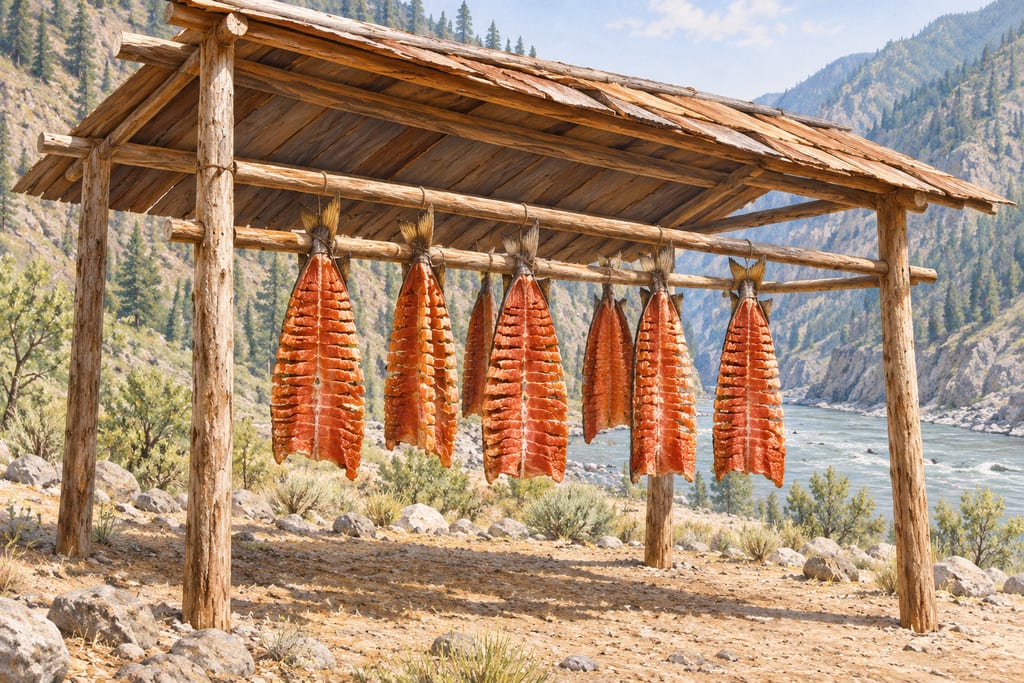
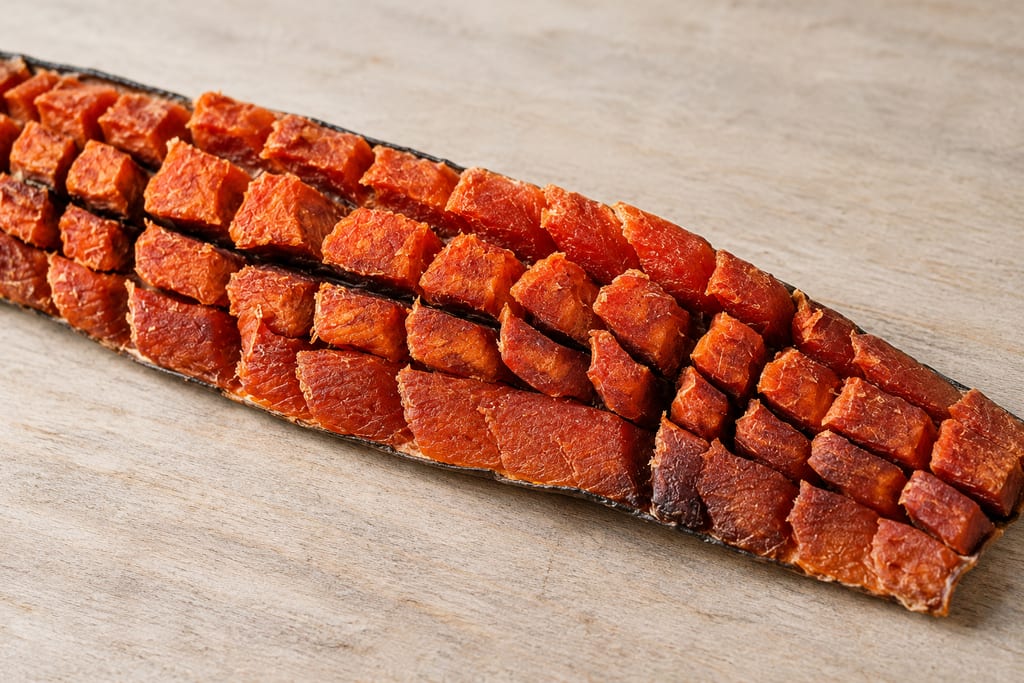
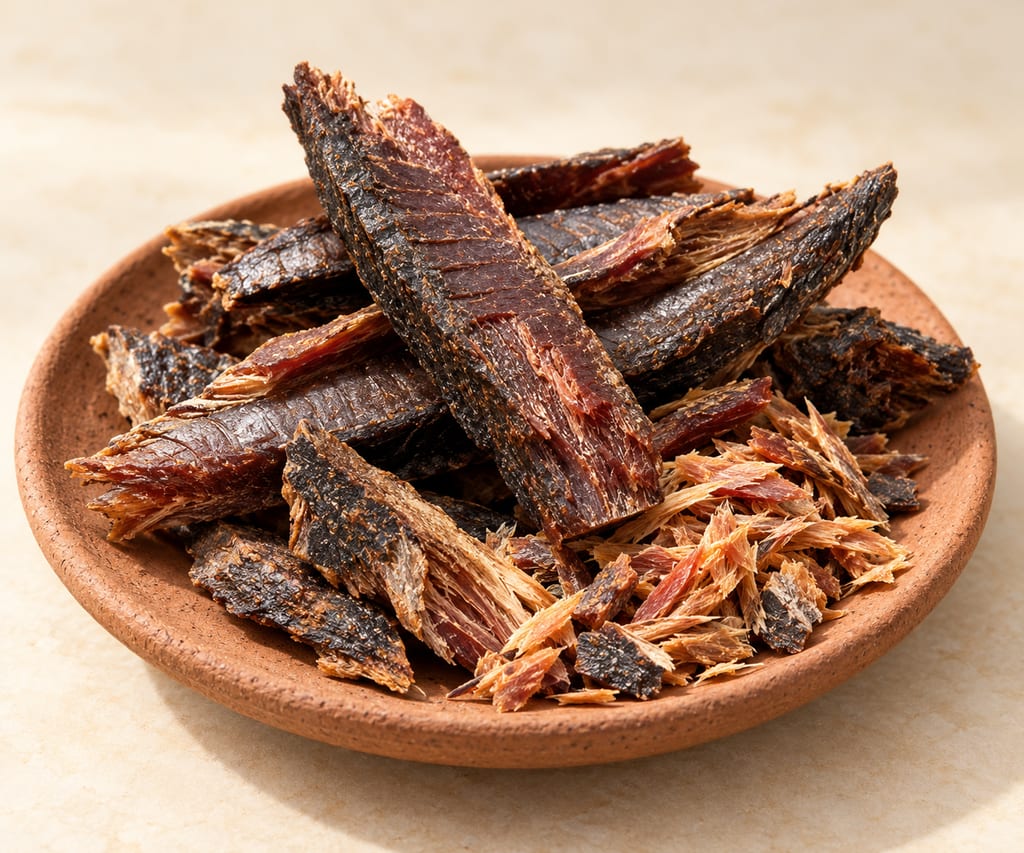
Salmon opened, scored and hung on roofed racks in the dry canyon winds of the Fraser River: slhíts'es in Stó:lō documentation, sts'wan in St'át'imc records.
In the Fraser Canyon, the river's geography creates conditions that have long been used for preserving salmon. Strong air currents move through narrow valleys and across exposed rocky slopes. During suitable weather, opened salmon can lose moisture without spending long periods in direct sunshine.
For Indigenous communities of the Fraser watershed, these winds are not incidental background conditions. They are part of the preserving technology.
Wind-dried salmon is commonly discussed alongside smoked salmon, but the two processes are different. Properly prepared wind-dried fish relies principally on airflow and evaporation rather than sustained exposure to smoke.
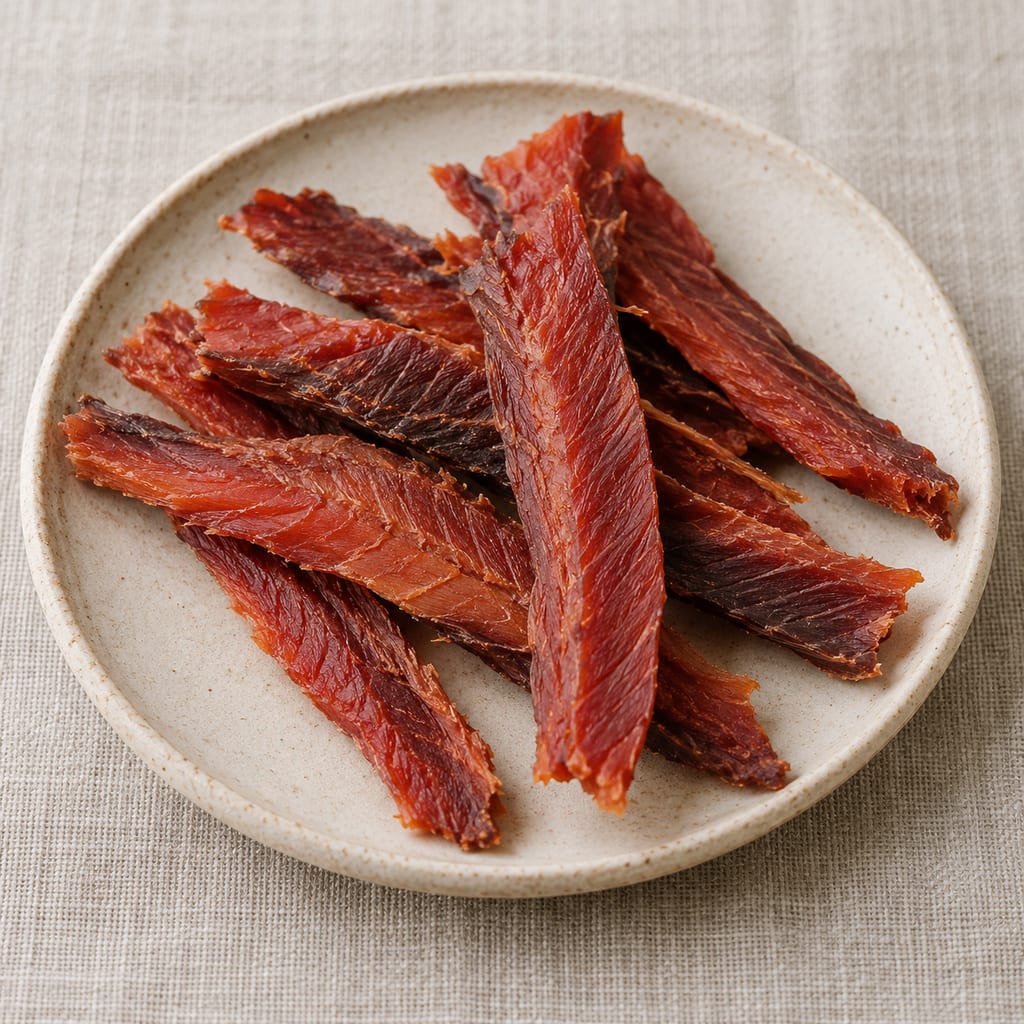
The finished food may be firm and darkened, with a concentrated flavour and a distinctly chewy texture. Its appearance depends on the salmon species, flesh thickness, seasonal fat content, cut and drying conditions.
Two traditions especially relevant to the historical sources are those of Stó:lō and St’át’imc peoples.
Stó:lō preservation teaching materials record slhíts’es, wind-dried salmon. St’át’imc records use sts’wan for their wind-dried salmon.
These should not be treated as interchangeable spellings of a single word. They belong to different Indigenous language and cultural contexts, although related practical concerns occur in both traditions.
Chinook salmon — English — Oncorhynchus tshawytscha
Chum salmon — English — Oncorhynchus keta
Coho salmon — English — Oncorhynchus kisutch
The traditional languages concerned are generally written using Latin-based orthographies with specialized characters and punctuation, rather than a separate non-Latin script.
A scientific name can identify a salmon species, but there is no single scientific name for wind-dried salmon as a food. The name describes a preparation that may use different fish according to place, season and community practice.
An Indigenous preservation tradition, not an imported stockfish
Pacific salmon have been central to the food economies, trade and cultural lives of Indigenous communities throughout the Fraser watershed for many generations.
The historical importance of salmon cannot be reduced to calories. Fishing locations, access rights, harvest seasons, processing knowledge, kinship relationships and ceremonial obligations all shaped the way fish was obtained and shared.
Fish preservation allowed communities to use seasonal salmon runs over a much longer period.
A successful harvest might provide many fish in a relatively short time. Preserving the catch transformed this unpredictable seasonal abundance into food for winter, travel and exchange.
The exact date when wind drying first developed in the Fraser Canyon is not known.
Archaeological evidence of long-standing salmon use does not, by itself, tell us the cutting geometry, rack design or drying practice used at every historical period.
The documentation becomes more specific in ethnographic accounts, photographs and recorded community knowledge from the nineteenth and twentieth centuries.
These sources describe a technically sophisticated process rather than the casual hanging of whole fish.
Communities with favourable wind-drying conditions could produce substantial amounts of dried salmon.
Other areas were better suited to smoking, or had different combinations of fish species, weather and equipment.
Stó:lō accounts describe wind-dried salmon being exchanged for smoked salmon from other areas.
St’át’imc historical testimony identifies wind-dried salmon as an important trade product, including exchanges involving the Hudson's Bay Company before British Columbia entered Canadian Confederation in 1871.
These transactions demonstrate the food's economic value, but they should not be taken to mean that all salmon was processed primarily for sale.
Household consumption, community sharing, ceremony and trade existed alongside one another.
Wind drying depends on a series of physical conditions.
Air moving over the surface of fish removes water vapour. When the surrounding air has capacity to absorb additional moisture, more water can evaporate from the surface.
Inside the flesh, moisture must move toward that surface before it can leave.
Drying therefore happens through two linked processes: internal movement of water and external removal by the air.
A thick slab of fish can develop a relatively dry exterior while remaining moist inside. That difference matters because microbial growth can continue in inadequately dried interior regions.
Sunshine may provide some warmth, which can increase evaporation, but direct sun is not automatically beneficial.
Excessive surface heating can damage the fish, accelerate fat oxidation and create uneven drying. Meanwhile, persistent rain can replenish moisture that has already been removed.
Traditional Fraser Canyon racks were therefore often placed where wind was strong while a roof or covering limited exposure to rain and intense direct sunlight.
The resulting equipment uses the local climate selectively.
A rack on a windswept rocky slope is not functionally equivalent to a rack in a humid, sheltered garden.
Pacific salmon species vary considerably in fat content.
Even within one species, the condition of the fish changes with its migration, maturity and stage in the spawning cycle.
Oils contribute flavour and energy but can also undergo oxidation, producing unpleasant rancid tastes.
A lower-fat fish may dry differently from one with a very rich belly.
Experienced fish processors therefore make decisions about the suitability of particular salmon and cuts rather than assuming that every fish from a run behaves identically.
Fatty salmon is not inherently impossible to dry. It simply presents different storage and quality challenges.
Heads, viscera and other parts may be removed or preserved separately, depending on the community and intended use.
The anatomical distinctions matter.
Internal organs contain microorganisms and enzymes that can accelerate deterioration. Removing them changes the microbial conditions within the remaining flesh.
Traditional processors also made use of parts that an unfamiliar observer might overlook. Backbones, heads and roe could be cooked or preserved separately.
The goal was not necessarily to produce a modern boneless retail fillet.
Documented St’át’imc methods describe removing heads and fins, leaving two fillets connected at the tail, and making additional cuts to expose the muscle.
Other Fraser traditions include opening the salmon along the back and removing sections of backbone and ribs while retaining much of the skin.
These are related solutions to the same problem, but they should not be described as one identical procedure used everywhere.
The opened body presents a larger surface area to drying air.
Correctly placed cuts allow sections of flesh to separate slightly, producing more surfaces from which water can evaporate.
Cuts also influence how the final fish can be broken into pieces and eaten.
A deep cut that exposes muscle without severing the entire fillet can transform the drying behaviour of a large fish.
There is no reason to invent a universal spacing or depth for this operation. The documented geometry differs among communities and individual processors.
The racks themselves deserve attention as a material technology.
They could be positioned over exposed rocks, with wooden bars supporting salmon opened into broad sheets.
Roofs helped protect against sudden showers. Their shape and height allowed the fish to remain accessible while encouraging air circulation.
This is why local knowledge of landscape is as important as the cutting technique.
Moving the same equipment to a different climate changes its performance.
A source photograph of a Fraser Canyon rack from 1961 demonstrates that these structures were part of a working landscape, not merely illustrations in ethnographic books.
Other images show salmon cut into intricate slitted patterns that permit wind to circulate through the flesh.
Traditional equipment cannot be reduced to a single standardized construction drawing. Materials, available locations and household practice differed.
The Nlaka’pamux and other peoples of the interior Plateau also possess extensive salmon-preservation knowledge.
Images from their communities can be valuable for comparative interpretation, but their food names and practices should not automatically be labelled Stó:lō or St’át’imc.
The shared use of salmon and wind does not make the cultures interchangeable.
The principal purpose of this preservation was to create food that could be kept and transported beyond the immediate fishing season.
Dried salmon could be eaten in pieces, shared during travel, traded or incorporated into meals with other foods.
The degree of dryness would influence preparation.
Some dried fish is eaten directly in small portions; other preparations benefit from cooking or rehydration.
Historical sources do not provide a single standardized modern recipe for serving every type of slhíts’es or sts’wan.
It would be inappropriate to invent one and label it a traditional community recipe.
A useful culinary distinction is between strongly dried fish and softer, partly dried products. Their textures, storage needs and suitability for direct consumption are different.
Serving customs also exist within broader cultural relationships involving fishing rights, family practices and community gatherings.
This is not simply an ingredient detached from its producers.
What successful and unsuccessful drying can look like
Firm flesh and progressive moisture loss are expected during drying, but texture alone cannot establish safety.
Potential problems include insects settling on exposed flesh, moisture collecting beneath coverings, persistent damp weather and internal portions failing to dry adequately.
Heavy surface drying combined with a soft, wet interior is especially problematic.
Salmon oils may become rancid during unsuitable storage, producing stale or unpleasant flavours.
Mould growth, slime, putrid odours or suspicious discoloration are reasons to discard a product rather than attempt to rescue it through extra drying.
The observation that a fish has survived several days outdoors does not prove that it is safe.
Traditional producers relied on knowledge of exact locations, seasonal conditions and fish characteristics that cannot be recreated by copying the number of days alone.
Unsalted dried fish deserves particular care because it lacks the additional microbial barrier supplied by a substantial salt cure.
The US FDA's guidance for shelf-stable dried seafood identifies water activity of 0.85 or below as a significant control, but this should not be treated as a complete preservation recipe.
Achieving an appropriate water activity throughout the thickest parts of a product, preventing contamination during processing and ensuring suitable storage all matter.
The CDC also identifies some dried unsalted fish among foods associated with botulism in Alaska.
That does not establish that all traditionally wind-dried Fraser salmon is dangerous. It does mean that an unfamiliar producer cannot safely assume that local knowledge, equipment and weather are interchangeable with those of another region.
For a contemporary cook, purchasing fish from a competent producer with appropriate food safety controls is more responsible than attempting unrefrigerated salmon drying from an ethnographic description.
Traditional drying systems depend on seasonal relationships between salmon runs, temperature, precipitation and wind.
A change in any of these affects the others.
Warmer, more humid periods can make drying more difficult. Changes in river temperature and flow can affect salmon migration and fish condition. Wildfire smoke and changing access to customary fishing locations can create additional pressures.
These are not simply obstacles to reproducing an old recipe.
They threaten a system of food knowledge that relies on the living landscape.
The St’át’imc continue to raise concerns about the future of Fraser salmon, access to fish and the environmental pressures facing the watershed.
Wind-dried salmon remains a particularly clear demonstration that preservation technology can be inseparable from a river, a community and a specific climate.
Pacific salmon have been central to the food economies, trade and cultural lives of Indigenous communities throughout the Fraser watershed for many generations, and fishing locations, access rights, harvest seasons, processing knowledge, kinship relationships and ceremonial obligations all shaped how fish was obtained and shared. Preservation turned an unpredictable seasonal abundance into food for winter, travel and exchange.
The exact date when wind drying first developed in the Fraser Canyon is not known. Archaeological evidence of long-standing salmon use does not by itself establish the cutting geometry, rack design or drying practice of any particular period; the documentation becomes specific in ethnographic accounts, photographs and recorded community knowledge from the nineteenth and twentieth centuries. St'át'imc testimony identifies wind-dried salmon as an important trade product, including exchanges involving the Hudson's Bay Company before British Columbia entered Canadian Confederation in 1871.
Ingredients
Scaling: source batch only
Sockeye salmonHead, remove the fins and viscera, leave two fillets connected at the tail and score the flesh to expose the muscle.
Amount not stated
The sources describe community practice rather than a measured batch.
Method
Risks and precautions · High risk
Clostridium botulinum in unsalted dried fish
Unsalted dried fish lacks the microbial barrier supplied by a substantial salt cure, and the CDC identifies some dried unsalted fish among foods associated with botulism in Alaska.
Hazard source
An inadequately dried interior
A thick slab can develop a relatively dry exterior while remaining moist inside, and microbial growth can continue in inadequately dried interior regions.
Hazard source
Fat oxidation and insect or rain damage during drying
Salmon oils may become rancid during unsuitable storage, and insects settling on exposed flesh or moisture collecting beneath coverings can spoil the fish before it dries.
Hazard source
Water activity for shelf-stable dried seafood, achieved throughout the thickest parts
Control source
The cited sources establish no laboratory-validated water-activity endpoint for any traditional Fraser Canyon product, so the recorded practice is not a home preservation method.
Copying a number of drying days without the exact location, seasonal conditions and fish knowledge of traditional producers is not a safety plan.
Mould growth, slime, putrid odours or suspicious discoloration are reasons to discard a product rather than attempt to rescue it through extra drying.
Selecting and landing the fish. Fishing method and location influence the condition in which salmon reaches the processor.
Removing unwanted tissues. Heads, viscera and other parts may be removed or preserved separately, depending on the community and intended use.
Opening the body. Documented St’át’imc methods describe removing heads and fins, leaving two fillets connected at the tail, and making additional cuts to expose the muscle.
Scoring the flesh. Lengthwise or angled cuts expose interior muscle.
Hanging on sheltered racks. The opened fish is suspended so that air can circulate around it.
Watching and managing the fish. Fish were not simply forgotten after hanging.
Removing and storing. Finished fish was taken down when it reached the condition recognized by the processors.
Places
Fraser River watershed
Traditional preparation · Region evidence
The watershed within which the practice is documented; not a claim about a single point of origin.
Stó:lō teaching materials describe roofed racks in the exposed Fraser Canyon for wind-drying salmon. Xwísten describes a separate living St’át’imc practice at Bridge River; these sources do not establish one shared rack design.
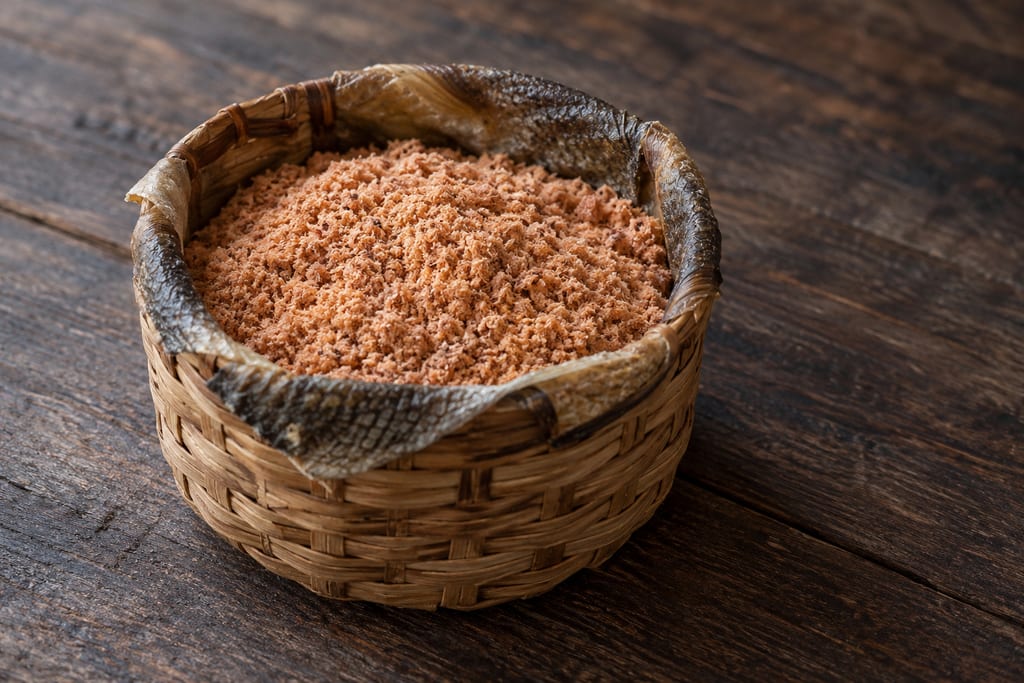
Dried salmon broken down, pounded to a meal and pressed into grass baskets lined with fish skin: the compact trade food of Celilo Falls and The Dalles.
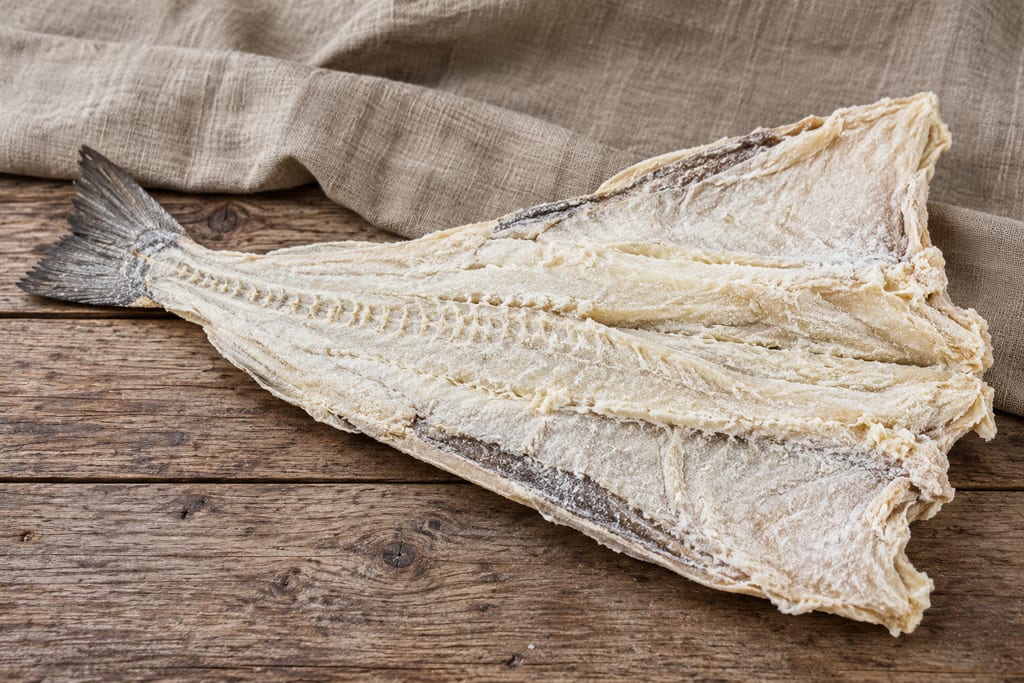
Cod split, salted and dried on flakes until hard, a long-keeping fish that must be desalted and rehydrated before use; the salting and the extensive drying together make it portable where light salting or partial drying does not.
Montréal smoked meat is a brisket-centred Jewish deli specialty shaped by migration and Montréal's restaurant culture. This entry documents reported commercial traditions and one deli's account; it is not a home-curing method.
Pemmican is dried meat mixed with rendered animal fat, sometimes with berries. Sources link it to Indigenous North American food traditions and later fur-trade provisioning. This documentary entry gives no home preparation or storage method.
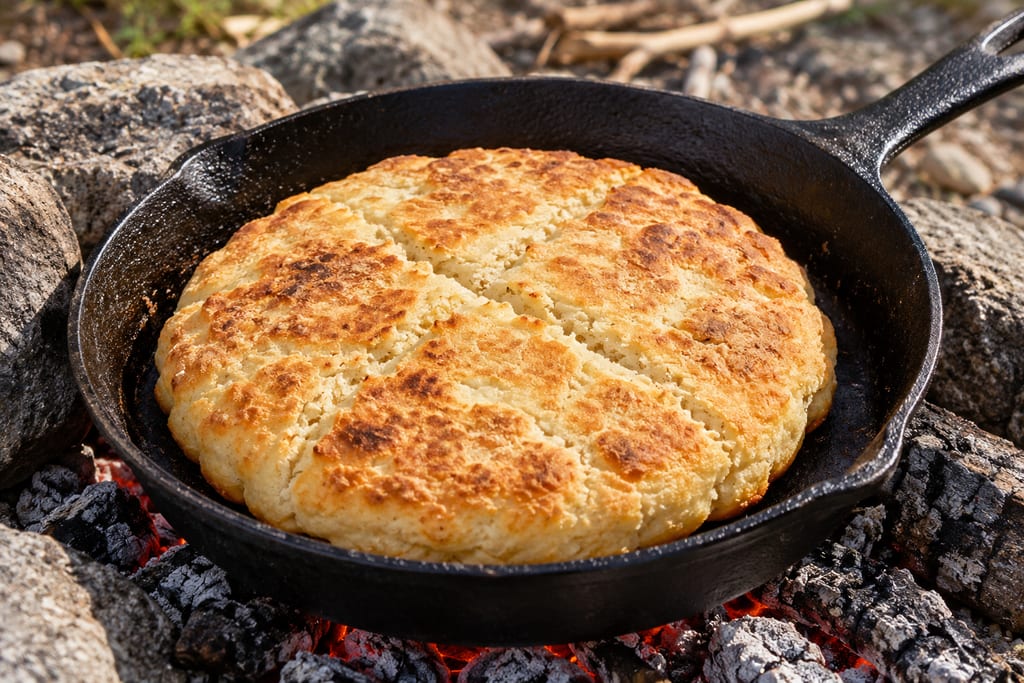
This flour, baking-powder and oil dough is Parks Canada’s contemporary Métis-interpreter version prepared at Rocky Mountain House; its specific recipe origin is unknown.
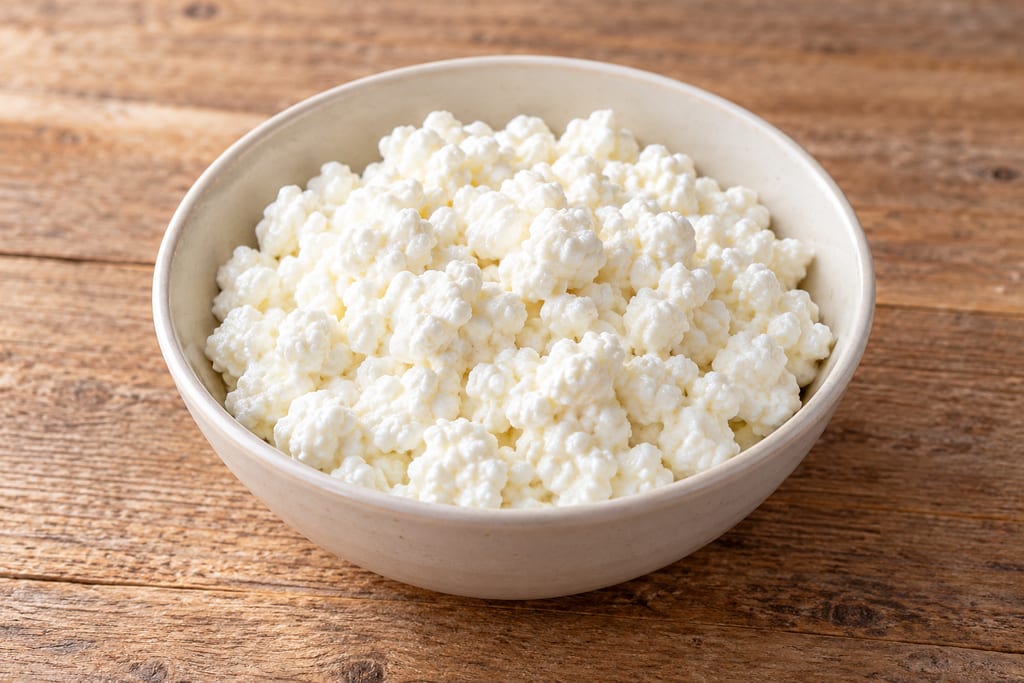
Skim milk is cultured slowly, cut into curds, warmed and drained to make fresh cottage cheese. Cold-water washing softens its flavour before cream and salt are added.
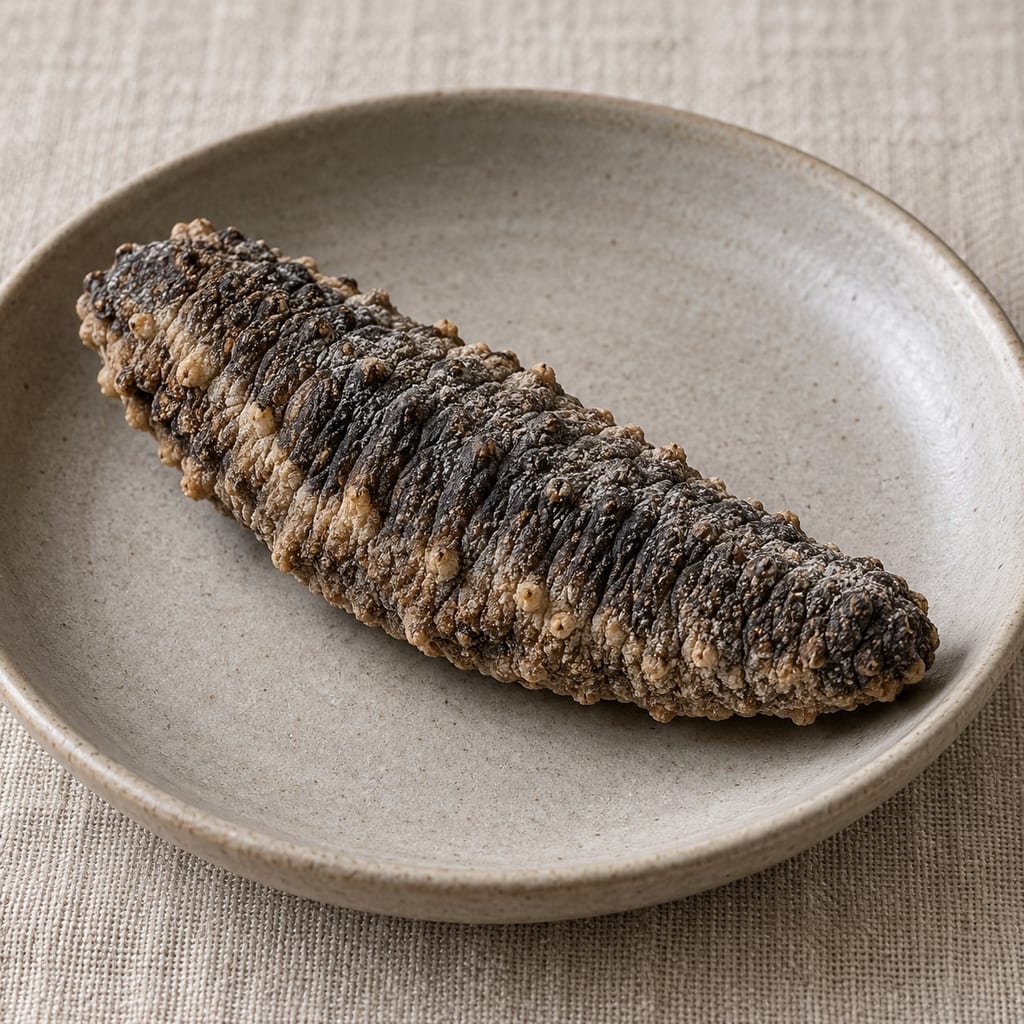
Sea cucumber cleaned, boiled and dried, sometimes with smoke, into a long-keeping trade product; Makassan processing in Arnhem Land is documented from at least the eighteenth century.
Anchoveta salted, drained of sanguaza and sun-dried on sand or stones at Caleta de Carquín, a technique declared part of Peru's cultural heritage in 2016.
Greenlandic capelin dried whole on rocks, among crowberry vegetation or on buildings, and the microbial research that has made this small fish unusually well studied.
Small central-Mexican lake silversides, Chirostoma spp., dried whole and sometimes salted, then fried, roasted or simmered into Lenten tortitas and snacks.
Koobi is Ghanaian salted and dried tilapia. Sources differ on the brief ripening stage and drying period, and do not establish a single validated household process. This entry records documented variants and their limits.
Izu Islands fish cured by repeated immersion in a maintained microbial brine, then dried. The reused brine, not drying alone, is what defines the product.
Maldive fish is a hard, smoke-dried tuna product made in the Maldives and traded especially to Sri Lanka, where it is known as umbalakada. Cooks shave or pound it into a concentrated savory seasoning for sambols, curries and other dishes.
Community
No community contributions have been published for this entry yet.
Share what you made
Sign in to contribute. Published comments and photos are free to read.
Stó:lō preservation teaching materials record slhíts'es, wind-dried salmon, distinguished from fish preserved using smoke
Windswept Fraser Canyon locations and roofed racks
Wind-dried salmon exchanged for smoked salmon from other areas
Cited in: Salmon preserved by the landscape; An Indigenous preservation tradition, not an imported stockfish; Salmon and regional trade; Why the Fraser Canyon works; Why moving air matters more than direct sunlight; 1. Selecting and landing the fish; 2. Removing unwanted tissues; 3. Opening the body; 4. Scoring the flesh; 5. Hanging on sheltered racks; 6. Watching and managing the fish; 7. Removing and storing; The drying rack as specialized equipment; Stó:lō and St’át’imc variations; Stó:lō slhíts’es; St’át’imc sts’wan; Eating wind-dried salmon
Accessed 2026-10-27
University of Victoria Ethnographic Mapping LabHistory
St'át'imc testimony identifying wind-dried salmon as an important trade product, including exchanges involving the Hudson's Bay Company before British Columbia entered Canadian Confederation in 1871
St'át'imc methods removing heads and fins, leaving two fillets connected at the tail, with additional cuts to expose the muscle
Drying over approximately a week in suitable warm, dry and windy weather
Cited in: Salmon preserved by the landscape; Salmon and regional trade; Preparing salmon for wind drying
Opening the salmon along the back and removing sections of backbone and ribs while retaining much of the skin
Lengthwise or angled cuts that let sections of flesh separate slightly
Cited in: Why the Fraser Canyon works; Salmon fat content; Preparing salmon for wind drying; Other neighbouring traditions; What successful and unsuccessful drying can look like
Accessed 2026-10-27
UBC Laboratory of Archaeology ArchivesEquipment · History