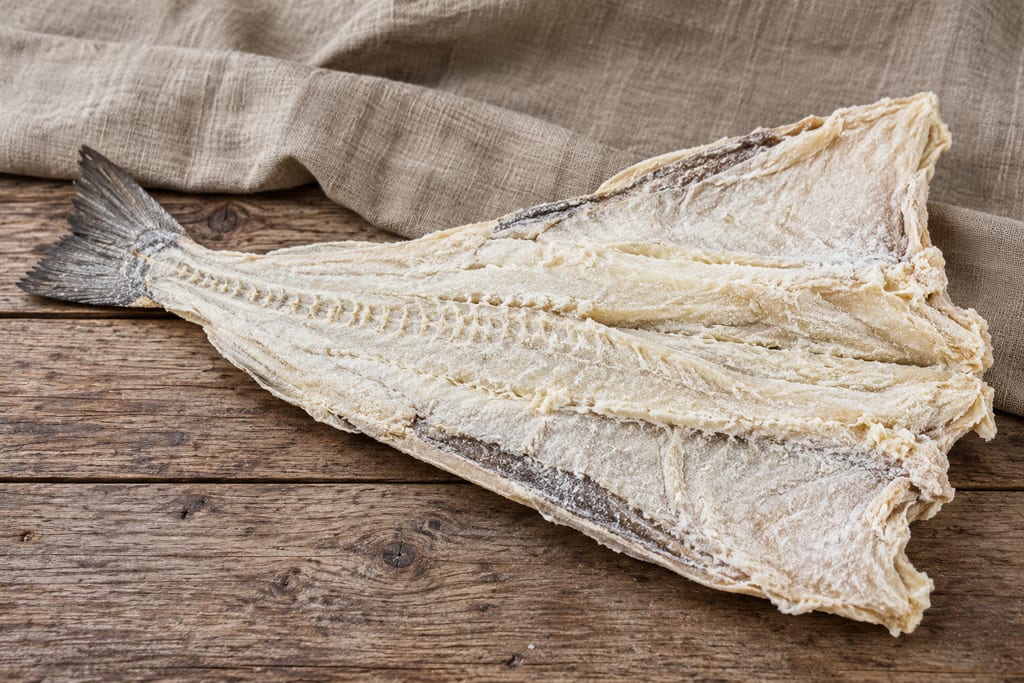
Dried salted cod
Cod split, salted and dried on flakes until hard, a long-keeping fish that must be desalted and rehydrated before use; the salting and the extensive drying together make it portable where light salting or partial drying does not.
 FermenteaWhere food goes to change
Traditional method
Salt cod · Saltfish · Dry saltfish · Morue salée · Morue séchée · Bacalhau · Bacalao · Baccalà
Atlantic cod split, salted and dried on raised flakes along the Newfoundland and Labrador shore, manufactured ashore for markets across the Atlantic.
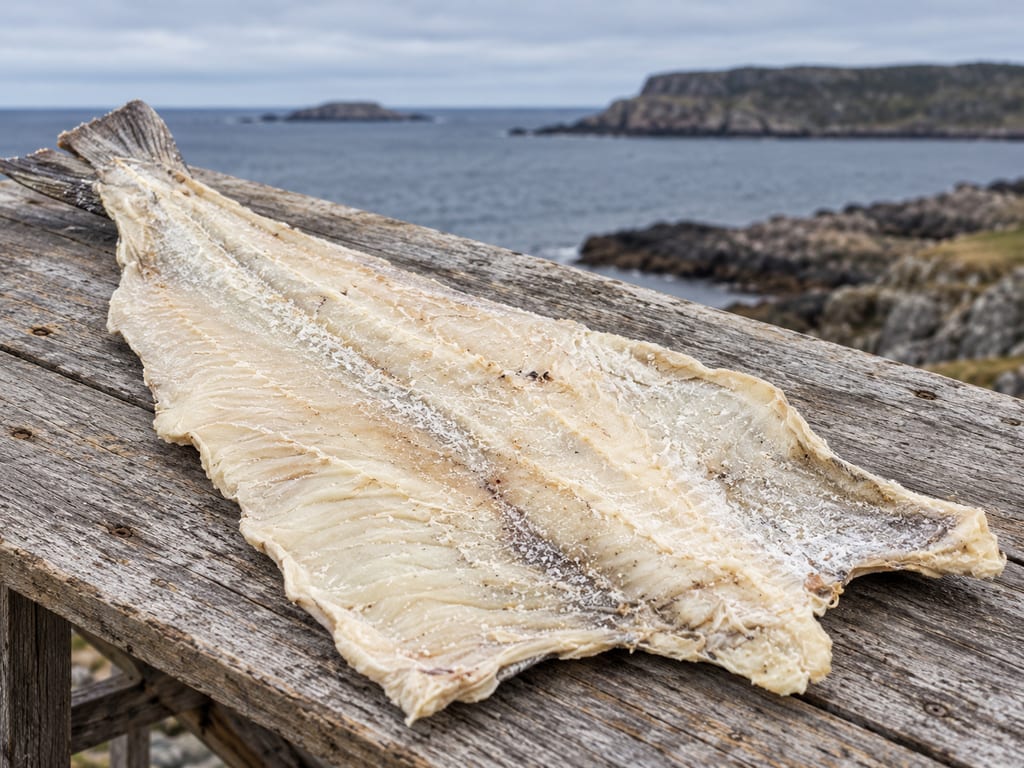
Newfoundland salt cod is Atlantic cod preserved by removing its internal organs, splitting the body, applying salt and, in many traditional methods, drying the cured fish in the open air. The result is a firm, concentrated ingredient capable of travelling far beyond the fishing grounds where it was caught.
The fish is Atlantic cod, Gadus morhua, a cold-water marine species belonging to the family Gadidae. Its relatively lean white muscle makes it especially suitable for producing a firm salted-and-dried product.
The finished fish can look quite different depending on the curing method. Some forms remain moist and heavily salted; others are dried into broad, rigid sheets. A fully dried salt cod is not simply fresh cod with water removed. Its muscle proteins, texture, salt distribution and flavour have all changed during processing.
Several names appear throughout the Atlantic trade:
Salt cod, saltfish — English, Newfoundland and Caribbean — Salt-preserved cod
Dry saltfish — Newfoundland English — Cod preserved by salting and substantial drying
Morue salée — French — Salted cod
Morue séchée — French — Dried cod
Bacalhau — Portuguese — Cod, especially familiar in salted preparations
Bacalao — Spanish — Cod, often sold salted
Baccalà — Italian — Salt cod
These names overlap, but they are not perfectly interchangeable. The Portuguese word bacalhau, for instance, is strongly associated with salt cod as a culinary ingredient, whereas some European traditions distinguish salted cod from unsalted stockfish.
The most important distinction is that Newfoundland salt cod is not the same thing as traditional Norwegian stockfish. Stockfish, in its strict North Atlantic sense, is air-dried without preliminary salting. Newfoundland's historically important export was primarily salt-preserved cod.
Long before the development of European commercial cod fisheries, Indigenous peoples in the North Atlantic and elsewhere in North America caught, processed and preserved fish.
The Alutiiq Museum documents archaeological evidence for cod processing in the Kodiak region approximately 3,800–3,000 years ago. That evidence does not establish the origin of Newfoundland salt cod, but it demonstrates that North American fish-preservation traditions cannot simply be treated as inventions introduced by Europeans.
European fisheries expanded around Newfoundland during the late fifteenth and sixteenth centuries. Basque, Portuguese, French and English fishing enterprises became involved in the North Atlantic cod trade.
Claims that Basque fishermen secretly discovered North America centuries before Columbus are not securely established. The better documented history concerns expanding Basque cod-fishing activities in the Gulf of St Lawrence during the 1520s and 1530s.
Newfoundland's geography was exceptionally favourable for a large cod fishery. The waters of the Grand Banks supported abundant cod populations, while sheltered coves provided landing places and space for processing fish ashore.
The difference between catching cod and manufacturing salt cod was fundamental.
Fresh cod spoils quickly. A successful export fishery therefore needed somewhere to remove heads and viscera, split fish, apply preserving salt, dry the product where appropriate, and store it before ships returned across the Atlantic.
The shoreline became an extension of the fishing vessel.
By the seventeenth century, fishing stations and more permanent settlements formed an extensive coastal processing network. Fishing stages, salting buildings, drying flakes and storage lofts were essential parts of that economy.
During the nineteenth century, Newfoundland salt cod reached Spain, Portugal, Italy, Brazil and the Caribbean.
This was not one uniform market purchasing an identical product.
Different buyers wanted different sizes, moisture levels, curing styles and grades of fish. Some customers preferred a comparatively light cure and attractive large fish; others purchased small, very dry products or lower commercial grades.
War, tariffs and trading relationships could transform the fishery.
During the Napoleonic period, disruption to competing European suppliers increased demand for Newfoundland fish. Approximately 400,000 quintals were exported to Spain in 1814. A Newfoundland quintal represented 112 pounds of fish.
Spanish demand subsequently declined as tariffs changed, while other markets expanded.
Brazil became particularly important after the opening of shipments in 1808. Its buyers developed a preference for small, very dry Newfoundland salt cod.
The British Caribbean was another major destination. Plantation owners purchased relatively inexpensive preserved fish to provision enslaved labourers, and the trade continued in altered circumstances following emancipation.
Preserved fish thus moved through an Atlantic economy built partly on coercion, colonial commerce and unequal access to food. Its history includes skilled processing and remarkable commercial reach, but also the systems of slavery that helped sustain demand.
Salt itself moved through related trading networks. Solar-evaporated salt from the Turks Islands travelled north, while cured fish travelled south.
The nineteenth-century cod trade was therefore also a trade in the materials required to preserve cod.
Fresh fish contains enough water to support rapid microbial growth. Its muscle also contains enzymes that continue to act after death.
Preservation must change the conditions under which microorganisms grow and those enzymes operate.
Salt contributes through several mechanisms.
When salt is placed against moist cod muscle, water dissolves the salt and forms a concentrated brine at the surface.
Salt then diffuses into the flesh while water moves out. These movements continue over time, depending on the thickness of the fish, temperature, salt concentration and structure of the muscle.
The fish loses moisture, becomes firmer and develops a different texture.
Large, thick sections do not cure at the same rate as thin portions. That is one reason traditional processors split cod and remove much of its backbone: opening the body exposes more flesh to salt and subsequent drying.
Water activity, written as \(a_w\), measures the availability of water for microbial processes. It is not the same as total moisture content.
A piece of salted fish can contain substantial moisture while still having less biologically available water than an equivalent piece of fresh fish.
For commercial shelf-stable dried seafood, the US Food and Drug Administration identifies water activity of 0.85 or below as an important safety control against growth and toxin production by pathogenic bacteria.
This is a general technical criterion, not proof that a particular historical Newfoundland fish reached that value.
Salt content, moisture content and water activity must not be treated as interchangeable measurements.
Salting changes the interaction between fish muscle proteins and water.
The muscle contracts and firms. With continued curing and drying, the fish becomes denser and less like fresh cod.
When properly desalinated and cooked, salt cod can separate into substantial flakes while retaining a distinctive resilient texture.
Its characteristic flavour develops through concentration, changes in muscle constituents and processes occurring during storage. It is not necessary to assume deliberate bacterial fermentation to explain the result.
Salt reduces the opportunities for many microorganisms, but some salt-tolerant bacteria and moulds can survive or grow under favourable conditions.
Drying too slowly, uneven salting, moisture accumulation or unsuitable storage can produce spoiled fish despite the presence of salt.
A further distinction concerns Clostridium botulinum. The organism can produce dangerous toxin under particular conditions, and toxin cannot be reliably detected by smell or appearance.
For that reason, describing salt as a preservative is not equivalent to validating a home recipe.
Historical Newfoundland processing is often described as making fish.
That expression recognizes that an edible export product had to be manufactured from the catch through considerable shore-based labour.
Cod were brought ashore and transferred to a fishing stage.
The head and internal organs were removed. Early removal of the viscera reduced the opportunities for intestinal contents and associated microorganisms to contaminate the edible flesh.
Speed mattered. Delays before processing could compromise the quality of the entire batch.
The fish was opened and much of the backbone removed.
This produced the familiar broad, flattened shape of traditional salt cod.
An evenly split fish exposed the flesh more effectively to salt and air, reduced the thickness of sections that needed curing, and made later handling easier.
Skilled splitters worked rapidly, and their knife work influenced both appearance and commercial quality.
The opened fish were placed in curing arrangements with salt distributed over the flesh.
The precise equipment and method depended on the fishery.
One historically important distinction was between heavily salted wet cures, commonly associated with French operations, and the lighter-salted, extensively dried cures associated with English shore fisheries.
Wet-curing processes permitted fish to remain packed in brine. Dry-fish production depended more heavily on suitable shore facilities and outdoor drying weather.
These distinctions were not absolute national rules.
No universal historical salt-to-fish ratio is established by the principal Newfoundland sources. Assigning a single percentage to every historical cure would be misleading.
Fish destined for further drying were washed after curing to remove loose surface salt and curing residues.
This did not reverse the cure. Salt had already entered the muscle.
Washing also helped produce a cleaner-looking fish for subsequent drying and grading.
The best-known Newfoundland drying equipment was the flake: a raised outdoor platform allowing fish to be spread in the air.
Flakes were often associated with wooden frames and surfaces that supported the opened fish while exposing them to drying conditions.
The weather was critical.
Suitable sunshine and moving air encouraged moisture loss. Persistent rain, damp air and poorly managed piles worked against it.
The whole process demanded attention rather than simply leaving fish outdoors.
Fish were periodically turned, gathered or stacked and subsequently spread again.
Gathering could protect fish during unsuitable weather and formed part of managing the drying process.
Workers learned to judge the condition of the fish by experience, but traditional sensory assessment is not equivalent to laboratory verification of its microbiological safety.
The finished fish was sorted for quality and market.
Appearance, size, cleanliness, curing condition and visible defects could affect the grade.
Storage lofts and other enclosed areas protected the fish after drying. A successful drying period could still be wasted if a finished product absorbed excessive moisture during storage.
The exact drying duration cannot be reconstructed as one universally applicable number. Fish size, initial moisture, cure and weather varied.
A traditional Newfoundland fishing premises might contain several structures with entirely different purposes.
The waterfront stage was associated with landing and initial processing. Salting sheds sheltered curing operations. Flakes provided outdoor drying space. Storage lofts protected the finished product.
The Burgess fishing property at Whiteway preserves evidence of this integrated arrangement.
These buildings also show why a historical fish-processing complex cannot be reproduced simply by building a drying rack.
The complete production system needed controlled handling before drying, protection while salting, constant attention during drying, and dry storage afterward.
Women and children played indispensable roles in the shore fishery.
Washing, spreading, turning, gathering and watching the weather could involve long periods of repetitive physical work.
Women frequently managed fish on the flakes while other family members were occupied catching, landing or splitting cod.
The Maritime History Archive records these responsibilities and the practice of gathering fish into rounded piles known locally as faggots.
The word belongs to Newfoundland fish-curing terminology in this context.
The export economy depended as much on this processing labour as it did on boats and navigation.
Newfoundland's saltfish traditions were shaped by where fish were landed, how they were processed and who bought them.
A French-associated wet cure could involve more extensive salt and brine contact, producing a product different from a heavily dried shore cure.
A particularly dry fish suitable for Brazilian markets differed from softer products destined for other buyers.
Labrador-cured fish developed its own reputation in Mediterranean trade. Individual markets could prefer its characteristics even when they purchased cod from several other origins.
The variation was technological as well as commercial: a processor selected methods according to salt supply, drying weather, available labour, storage, transportation and expected sale price.
No single technique represents every Newfoundland household or historical fishing station.
Salt cod must normally be prepared before cooking.
The familiar process involves soaking the fish in potable water to remove excess salt and rehydrate the flesh. Water is changed as necessary.
There is no universal soaking time that works for every piece. Thickness, salt level and dryness all matter.
Use refrigeration during prolonged desalting rather than leaving the fish in a warm kitchen.
The best-known Newfoundland preparation is fish and brewis.
Fish and brewis combines prepared salt cod with hard bread, a durable ship's biscuit traditionally associated with Newfoundland provisioning.
The hard bread is soaked and cooked, then combined with the prepared fish. Salt pork or its rendered fat may be included.
A documented description from 1766 refers to fish, biscuit and a small quantity of salt pork boiled together for approximately one hour.
Later versions developed different methods and accompaniments.
Some households serve the fish and bread separately with rendered pork fat and crisp pieces of salt pork. Other versions incorporate potatoes.
The dish expresses the practical value of preserved ingredients: fish, hard bread and salt pork could be stored when fresh supplies were limited.
Salt cod also appears in fish cakes, stews, chowders and other home cooking.
Across the Atlantic, descendants of the same preserving technology enter Portuguese bacalhau dishes, Spanish salt-cod preparations, Italian baccalà recipes and Caribbean saltfish meals.
The curing process made these connections possible, but each destination developed its own cuisine.
A well-produced dry salt cod should have the appearance and texture appropriate to its particular cure, without evidence of spoilage.
The very firm texture of heavily dried cod is not itself a defect. Nor does the presence of visible salt automatically indicate deterioration.
However, warning signs include:
- Slimy or unusually wet surfaces where a dry cure is expected. - Unexpected mould growth or discoloration. - Strong rancid odours. - Evidence of insect contamination. - Damp packaging or water accumulation. - Soft, deteriorating areas inconsistent with the product's normal texture.
Not every surface crystal or natural colour variation is mould. Conversely, a fish that looks normal is not guaranteed safe.
Spoilage indicators help identify failures; they cannot prove that pathogens or toxins are absent.
Traditional processors used experience to manage these problems. Modern commercial processors additionally use hygiene systems, product specifications, water-activity testing and validated controls.
Consumers should follow the storage instructions for their particular purchased product. Some salted cod is sold as refrigerated wet-cured fish, while other products are marketed as shelf-stable dry saltfish. They should not be stored interchangeably.
Newfoundland salt cod demonstrates that preservation is simultaneously a biochemical process, a craft, an infrastructure system and a commercial decision.
Removing the backbone changed how quickly salt entered the flesh. Flakes changed how weather could be used to remove water. Storage buildings protected the result. Different curing choices produced fish for different markets.
The product helped build communities along Newfoundland's coastline and connected them to consumers thousands of miles away.
It also reveals the less comfortable history of Atlantic provisioning and colonial trade.
Above all, Newfoundland salt cod was never merely fish left to dry. It was the product of organized knowledge, specialized labour and an entire coastal economy.
Indigenous peoples of the North Atlantic and elsewhere in North America caught and preserved fish long before European commercial cod fisheries; the Alutiiq Museum documents cod processing in the Kodiak region approximately 3,800 to 3,000 years ago, which does not establish the origin of Newfoundland salt cod but shows that North American fish preservation was not a European introduction. European fisheries expanded around Newfoundland during the late fifteenth and sixteenth centuries, with Basque, Portuguese, French and English enterprises involved. Claims that Basque fishermen secretly discovered North America before Columbus are not securely established; the better documented history concerns expanding Basque cod fishing in the Gulf of St Lawrence during the 1520s and 1530s.
Scaling: source batch only
The organism can produce dangerous toxin under particular conditions, and toxin cannot be reliably detected by smell or appearance.
Hazard sourceSome salt-tolerant organisms survive or grow when drying is too slow, salting uneven, or storage unsuitable.
Hazard sourceWater activity for shelf-stable dried seafood
Control sourceNo universal historical salt-to-fish ratio or drying duration is established for the Newfoundland cure, so this account is not a validated home-preservation procedure.
Refrigerate salt cod during prolonged desalting rather than leaving it in a warm kitchen.
Wet-cured refrigerated salted cod and shelf-stable dry saltfish are different products and must not be stored interchangeably.
The shore fishery that manufactured the cure; not a claim about a single locality of origin.
A recorded export market, not a place of preparation.
A recorded export market, not a place of preparation.
A recorded export market, not a place of preparation.
A recorded export market whose buyers preferred a small, very dry cure.
A recorded export market where plantation owners bought inexpensive preserved fish; not a place of preparation.
Cod split, salted and dried on flakes until hard, a long-keeping fish that must be desalted and rehydrated before use; the salting and the extensive drying together make it portable where light salting or partial drying does not.
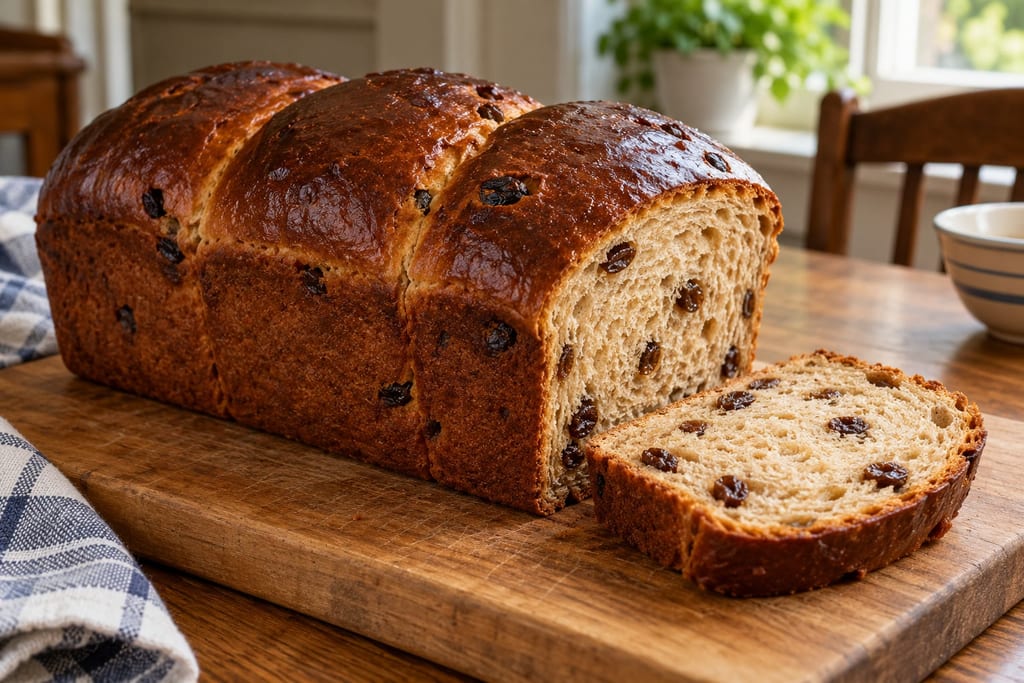
A Newfoundland family-style sweet yeast loaf with molasses, raisins, cinnamon and cloves. This version follows a half-batch adaptation of Nanny Hemeon's family formula; it is not a standard recipe for all Newfoundland households.
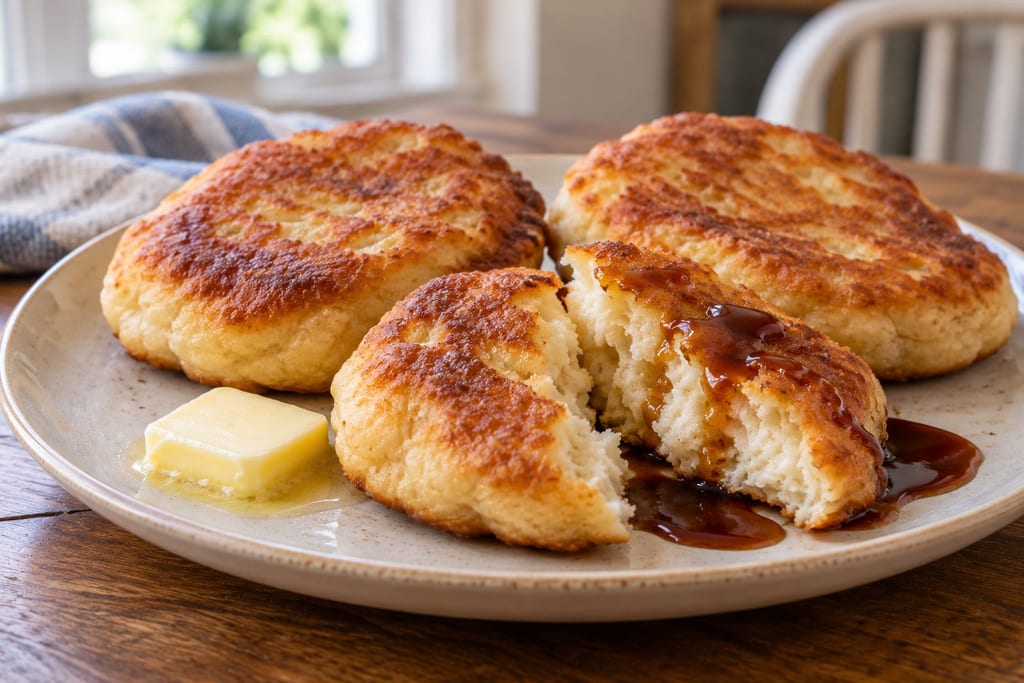
Rounds of leftover yeasted white bread dough, rested and shallow-fried slowly in canola oil; served warm with butter and molasses.

Salmon roe is separated from skeins and treated in two salt-water stages using a University of Alaska Extension formula.

Kodiak salmon, halibut and cod cut as seg'aq and hung on an initaq rack to become tamuuq, with kac'amaasaq and kupcuunaq named as different results.
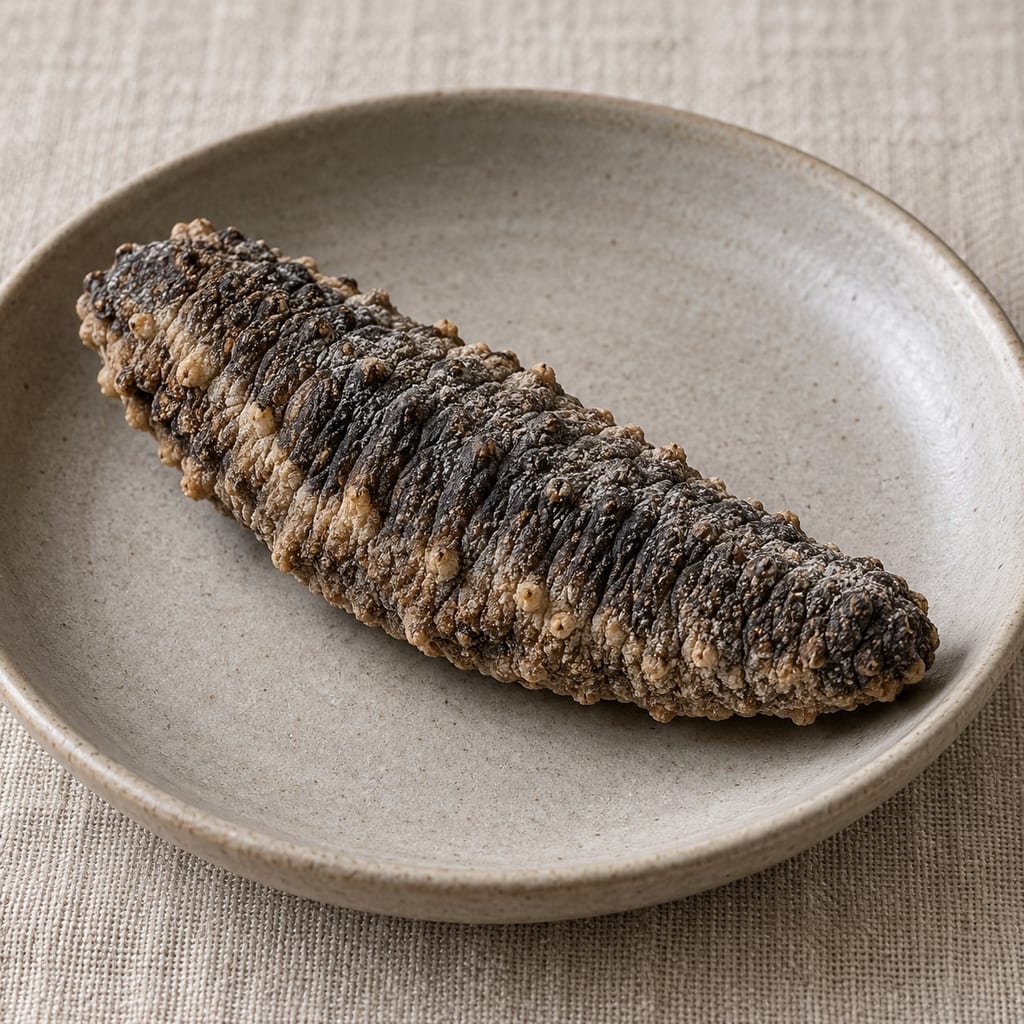
Sea cucumber cleaned, boiled and dried, sometimes with smoke, into a long-keeping trade product; Makassan processing in Arnhem Land is documented from at least the eighteenth century.
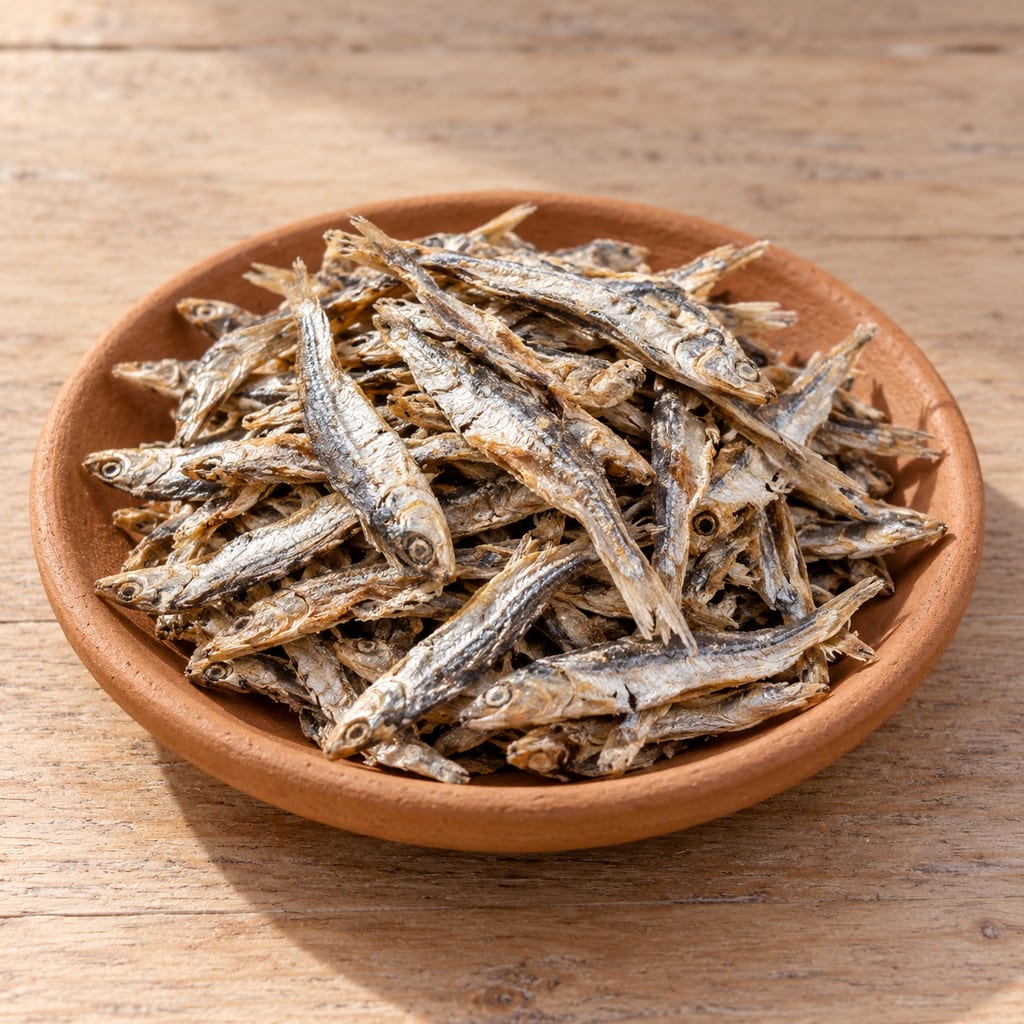
Anchoveta salted, drained of sanguaza and sun-dried on sand or stones at Caleta de Carquín, a technique declared part of Peru's cultural heritage in 2016.
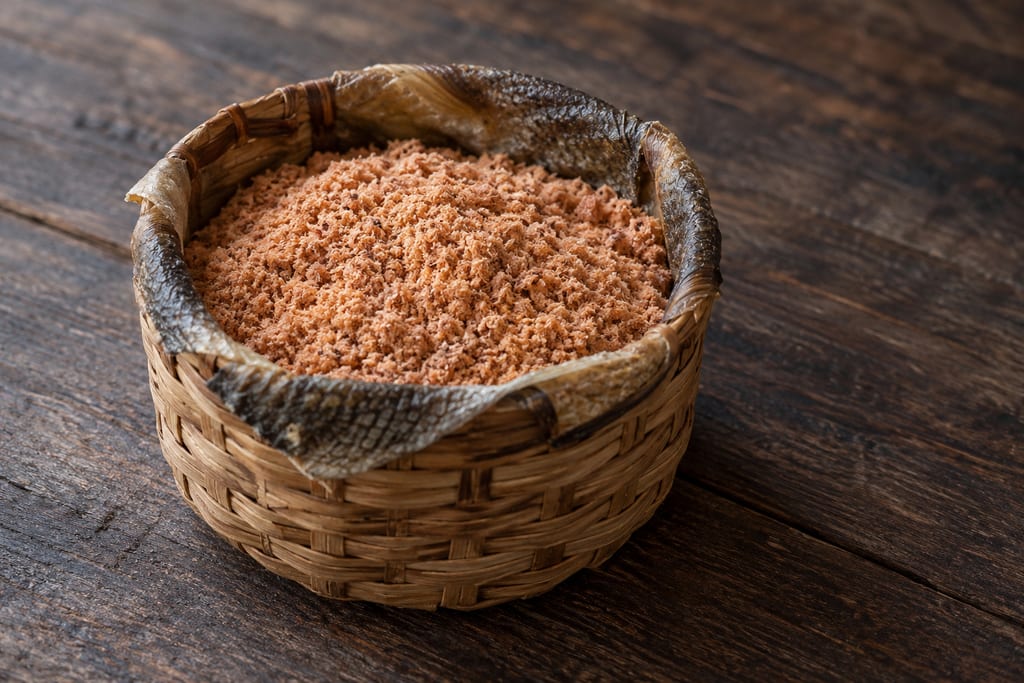
Dried salmon broken down, pounded to a meal and pressed into grass baskets lined with fish skin: the compact trade food of Celilo Falls and The Dalles.
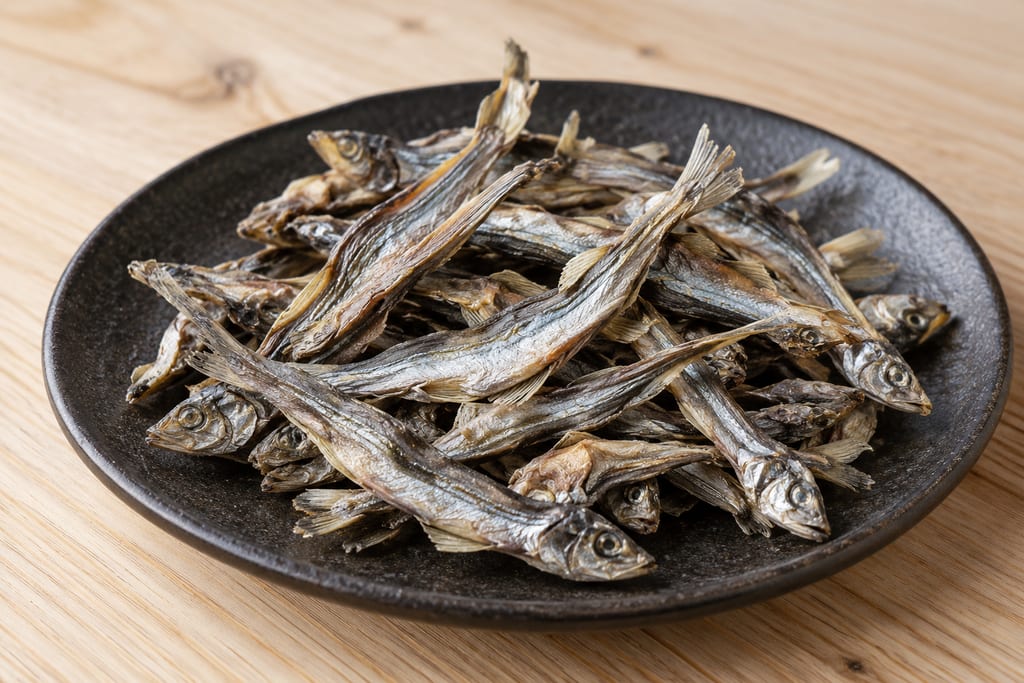
Greenlandic capelin dried whole on rocks, among crowberry vegetation or on buildings, and the microbial research that has made this small fish unusually well studied.
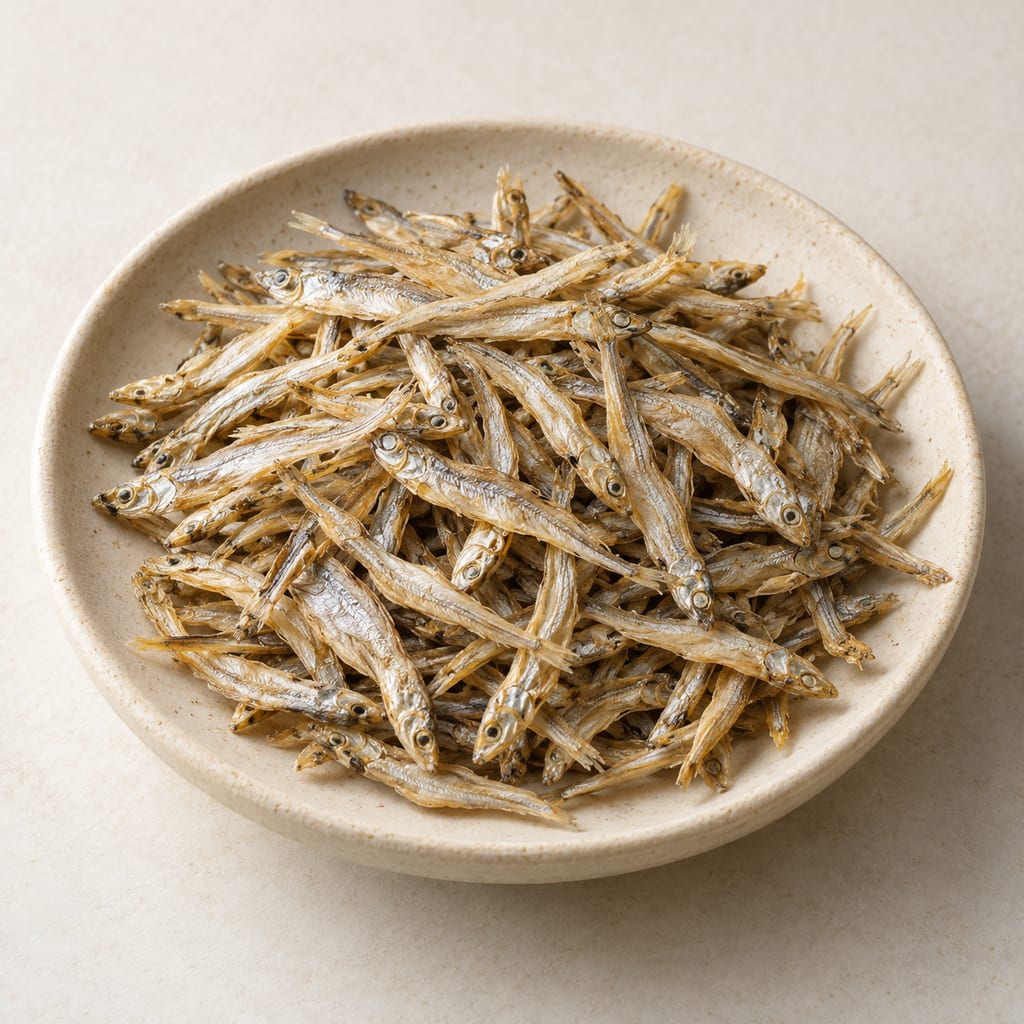
Small central-Mexican lake silversides, Chirostoma spp., dried whole and sometimes salted, then fried, roasted or simmered into Lenten tortitas and snacks.
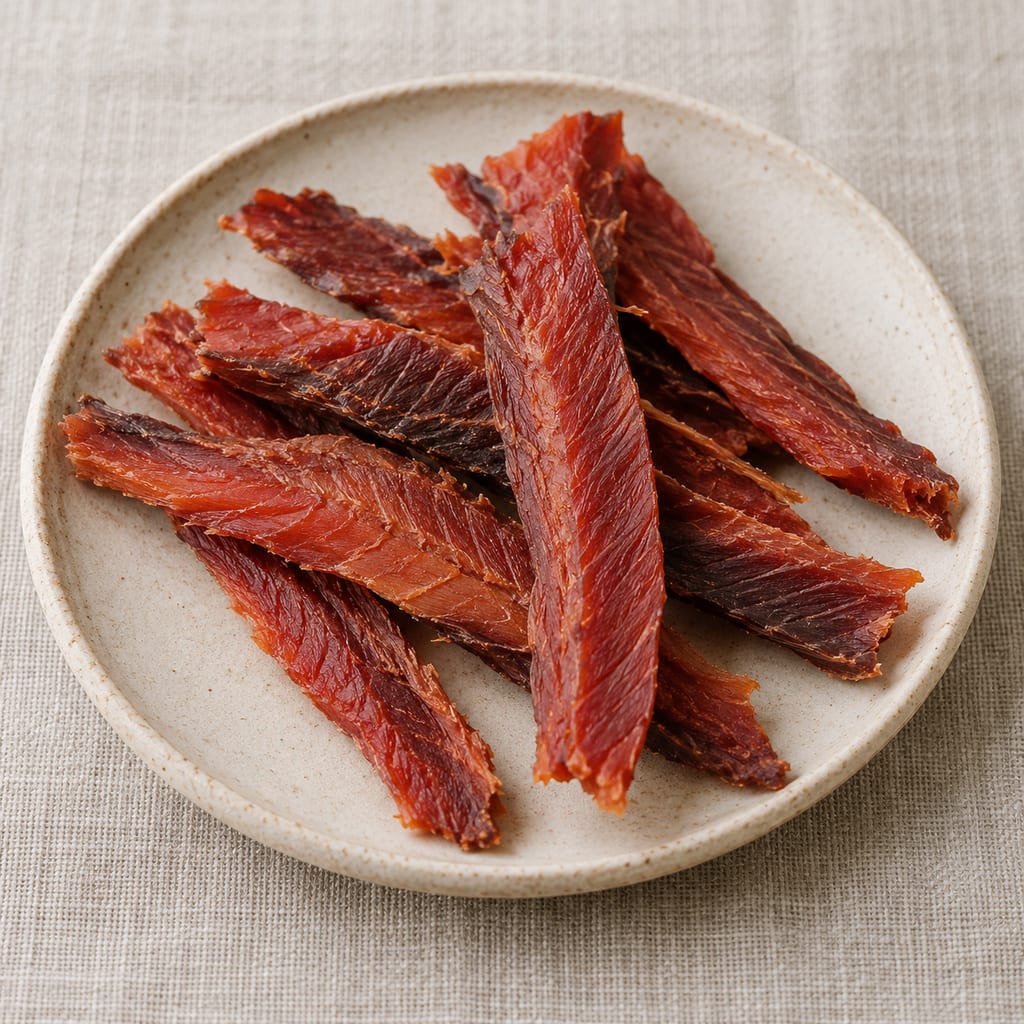
Salmon opened, scored and hung on roofed racks in the dry canyon winds of the Fraser River: slhíts'es in Stó:lō documentation, sts'wan in St'át'imc records.

A gelling polysaccharide extracted from red seaweeds, sold as kanten strips or powder; it sets firm at a low concentration and stays solid until about 85 °C.

A Dominican table and seasoning condiment of sour orange juice, mixed with lime and salt and bottled raw; garlic, oregano or a hot pepper may be added for meat or a spicier bottle.

Cicerbita alpina is an alpine perennial whose tender shoots and leaves have been eaten raw or cooked. Sámi milk preparations and modern Carnian dishes are distinct uses, with serious identification and preservation limits.

Japanese skipjack tuna cooked, then repeatedly smoked and dried over a wood fire by the hand-fired tebiyama method into a hard block for shaving into dashi: the first stage of katsuobushi.

A Swedish-style spirit vinegar made by fermenting neutral alcohol with live vinegar bacteria, with a separate guide to commercial ättika strengths.

A yeast-raised wheat ring shaped from a firm dough, briefly boiled and baked. This source-batch formula gives a gently malted crust and a chewy crumb.

A warm dip of garlic, anchovy and olive oil, often enriched with butter, that Piedmont serves over a flame with raw and cooked vegetables and bread.

Bechamel is a white sauce of milk thickened with a butter and flour roux, one of the French mother sauces, and the base from which Mornay and other cheese and cream sauces are made.
No community contributions have been published for this entry yet.
Sign in to contribute. Published comments and photos are free to read.
Newfoundland and Labrador Heritage Web SiteHistory · Trade
Newfoundland and Labrador Heritage — 19th-century saltfish marketsNineteenth-century export markets in Spain, Portugal, Italy, Brazil and the Caribbean
Approximately 400,000 quintals exported to Spain in 1814; a Newfoundland quintal was 112 pounds
Brazilian shipments opened in 1808 and Brazilian buyers preferred a small, very dry cure
Market-specific grades, sizes and cures
Turks Islands solar salt moving north while cured fish moved south
Cited in: What is Newfoundland salt cod?; History: from seasonal fisheries to international trade; The rise of Newfoundland's export markets; The traditional production process; 1. Landing and heading; 2. Splitting; 3. Salting; 4. Washing; 5. Drying on flakes; 6. Turning and gathering; 7. Grading and storage; Regional and commercial variations; Why Newfoundland salt cod matters
Newfoundland and Labrador Heritage Web SiteHistory · Trade
Newfoundland and Labrador Heritage — Nineteenth-century tradeNineteenth-century trade relationships, tariffs and war disrupting the fishery
Labrador-cured fish and its Mediterranean reputation
Cited in: What is Newfoundland salt cod?; The rise of Newfoundland's export markets; Regional and commercial variations
Heritage NLUse · History
Heritage NL — Fish and BrewisFish and brewis as a Newfoundland preparation
A 1766 description of fish, biscuit and a small quantity of salt pork boiled together for approximately one hour
Cited in: How Newfoundland salt cod is eaten; Fish and brewis
Memorial University Maritime History ArchiveHistory · Labour
Memorial University Maritime History Archive — Women in the fisheryWomen and children spreading, washing, turning, gathering and watching fish on the flakes
Gathering fish into rounded piles known locally as faggots
Cited in: The labour of making fish; Why Newfoundland salt cod matters
Heritage NLEquipment · History
Heritage NL — Burgess Fishing PropertyThe Burgess fishing property at Whiteway preserving stage, salting shed, flake and storage loft together
Cited in: The traditional production process; The buildings and equipment; Why Newfoundland salt cod matters
Canadian Museum of HistoryHistory
Canadian Museum of History — Basque maritime activitiesExpanding Basque cod-fishing activity in the Gulf of St Lawrence during the 1520s and 1530s
Cited in: History: from seasonal fisheries to international trade
US Food and Drug AdministrationSafety
US FDA — Fish and Fishery Products Hazards and Controls GuidanceWater activity of 0.85 or below as a control against growth and toxin production by pathogenic bacteria in shelf-stable dried seafood
Clostridium botulinum toxin cannot be reliably detected by smell or appearance
Cited in: How salt curing works; Osmosis and salt diffusion; Water activity; Protein changes; Why salt is not an absolute safeguard; Recognizing quality and defects