Lunu miris (DailyLife.lk source batch)
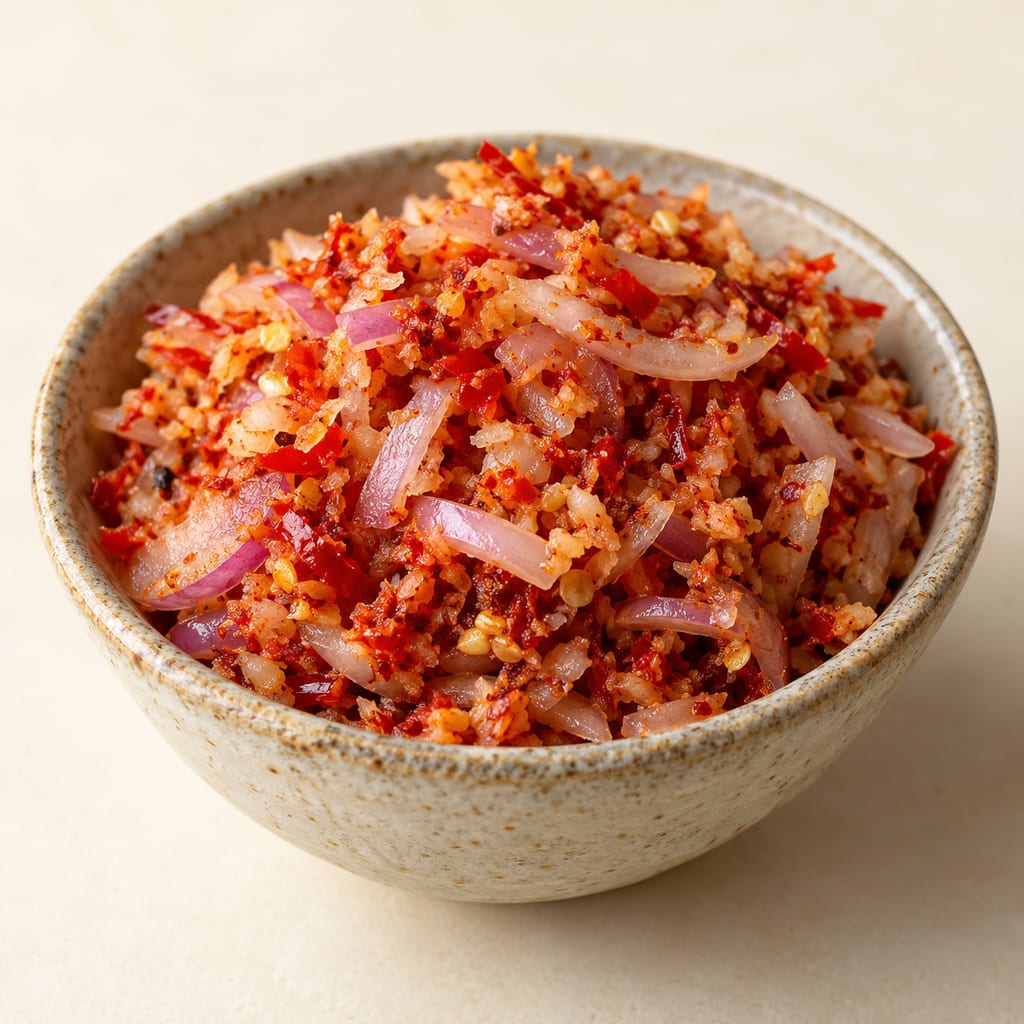
A Sri Lankan lunu miris made by pounding onion and chilli flakes with lime; Maldive fish is optional.
 FermenteaWhere food goes to change
Traditional method
Maldive fish is a hard, smoke-dried tuna product made in the Maldives and traded especially to Sri Lanka, where it is known as umbalakada. Cooks shave or pound it into a concentrated savory seasoning for sambols, curries and other dishes.
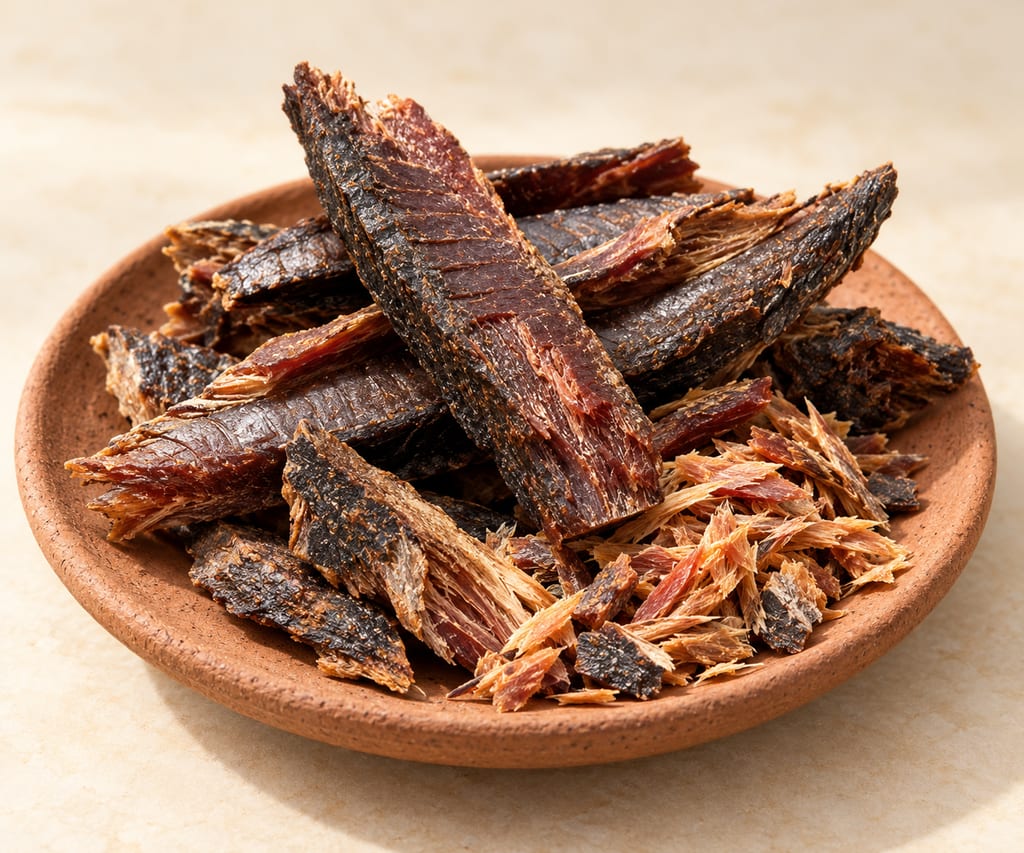
Maldive fish names a preserved tuna product, not one universal cut or fermented paste. The familiar form is solid, hard-dried and smoke-marked, made from tuna flesh cooked in salted water, drained and cleaned, then smoked and dried. In Sri Lanka the product is called umbalakada and used in small quantities to give food a deep, meaty savor. The term can be confusing: Sri Lankan market usage includes several fish species and processing traditions, while the Maldivian export product is historically associated with skipjack tuna. The name alone does not prove which species or process was used in a particular package.
The product's firmness is practical as well as sensory. A hard piece can be stored and transported as a dense commodity, then shaved, pounded or grated by the cook. Unlike a soft smoked fish eaten as a fillet, Maldive fish is often a seasoning: a little can spread through a dish and bring concentrated marine, smoky taste. The Sri Lankan name should not erase its Maldivian production history, and the Maldivian origin should not suggest that all Sri Lankan preparations use one standardized block.
The Maldives' tuna fishery grew within a much older Indian Ocean trading world. A historical ecology study traces written accounts of processed tuna from the fourteenth century, when Ibn Battuta described fish being cut, partly cooked, smoked and dried for export. Sixteenth-century accounts describe further processing and wider trade. These records were written by visitors and traders, not a continuous local archive, so they help establish that a trade existed without fixing one invention date for Maldive fish.
Later accounts describe tuna cut into different pieces, cooked and dried, with the product carried to markets across the region. Sri Lanka became its most important destination and developed a culinary identity of its own around umbalakada. This was not simply a modern export novelty: the sources place dried tuna in regional exchange over centuries, although scale, fishing fleet and processing economy changed over time.
The export market shifted in the twentieth century. Maldivian marine research and fisheries accounts describe smoke-dried tuna exports to Sri Lanka and a major disruption to that market in the early 1970s, followed by diversification into frozen and canned tuna. Mechanized vessels and new processing industries changed production economics; they did not make every traditional process identical to factory processing. The record supports a long trade relationship and a marked market transition, not a claim that one recipe stayed unchanged for a thousand years.
The Maldivian national competency standard sequences sorting cut fish by size, boiling in salted water, draining and cleaning, smoking, and sun-drying. It is a process outline rather than a recipe with one household ratio or a complete validated schedule. Sorting gives workers comparable pieces to handle. Cooking changes raw muscle to a firm cooked structure; draining and cleaning remove loose material before smoke exposure and drying. Smoking deposits flavor compounds and contributes heat, while later drying removes moisture and creates the hard product described in trade and regulatory accounts.
These operations are not all fermentation. No source consulted establishes that a desired microbial fermentation is necessary to make hard export-style Maldive fish. The main transformations are cooking, smoke exposure and moisture removal. A separate, softer Maldivian smoked-fish term, valhomas, is used for a less fully dried product and deserves its own treatment; combining its texture and process with the hardest export style would create a misleading hybrid.
The standard's order matters, but a sequence does not by itself tell a home cook how to safely process tuna. The document does not supply a universal cut dimension, salt concentration, heating duration, smoke temperature, drying endpoint or shelf-life validation. Those values depend on the process and product. This account therefore records the documented sequence without inventing numbers or promising room-temperature safety.
Skipjack tuna is the fish most closely linked to the Maldivian product in historical and fisheries literature. Its use reflects the island fishery and trade, rather than a rule that all Maldive fish must be one species: a Sri Lankan draft food regulation defines it using several tuna species. That document is explicitly a draft, not evidence of an enacted legal standard. It describes Maldive fish as hard, dried and smoked, and offers a useful record of how regulators proposed to distinguish it from generic dried fish.
Salt is part of the documented cooking stage. It seasons the flesh and contributes to processing, but the sources do not authorize substituting an improvised brine ratio for a validated preservation process. Smoke adds characteristic aroma and flavor through compounds produced when wood or other fuel burns and decomposes. It can also carry contaminants. A University of Peradeniya study examined twelve Maldive-fish samples and reported polycyclic aromatic hydrocarbons (PAHs) in the smoke-cured product, with much of the measured burden concentrated in the outer crust. That small sample from Kandy markets is evidence of a hazard worth controlling, not a measurement that predicts every product.
Drying changes texture and handling by taking water out of cooked fish. The hard result can be cut into thin flakes or crushed to a fine seasoning. Dryness alone, however, cannot establish that a piece was processed or stored safely. Tuna is susceptible to histamine formation if raw fish handling and temperature control fail; histamine is not reliably removed by ordinary cooking. Smoke-related contaminants and handling hazards also cannot be judged by the finished food's aroma. Commercial controls and a validated process matter more than a home inspection.
The phrase Maldive fish travels across languages and markets. In the Maldives it evokes a cooked, smoked and thoroughly dried tuna product tied to the country's fishery. In Sri Lanka, umbalakada is a familiar ingredient in everyday cooking, and sources note that more than one scombroid fish may appear in products sold under the broader name. Species, cut, smoke exposure and degree of drying can vary. That makes careful labeling and source-specific descriptions more useful than treating every smoked fish block as interchangeable.
Valhomas is a related but distinct Maldivian product described as softer and less fully dried than export-style hard fish. A cook may use it differently because its moisture and texture differ. Katsuobushi, the Japanese product made through a more elaborate smoke-drying process with mould-ripened forms, is another distinct preparation, not a synonym. These comparisons show why regional preservation traditions should be named separately instead of blended into a generic recipe.
In Sri Lankan cooking, Maldive fish is prized as a seasoning that contributes savory depth to sambols, curries and salads. A 2020 review of indigenous and traditional foods describes it as an umami-rich addition. A cook shaves, grates, pounds or crumbles the hard flesh so small pieces disperse through a mixture. In pol sambol, it can accompany grated coconut, chilli and other seasonings; in a curry it contributes a concentrated fish note without replacing fresh fish or the sauce's other ingredients.
The form determines the technique. A very hard piece is easier to shave or pound than to slice into a tender fillet-like portion. Small flakes distribute evenly; coarser fragments remain distinct and provide intermittent salty, smoky bites. The right amount depends on the saltiness and intensity of the product and the dish. Sources establish the ingredient's role, but not one fixed quantity suitable for every brand, species or recipe, so it should be treated as an adjustable seasoning in dish recipes rather than assigned a universal measure here.
Its use also carries trade history into the kitchen. A dried export commodity became a defining taste in Sri Lankan home food, while the Maldivian side connects it to tuna fishing, processing labor and changing export markets. Eating a little in coconut sambol is an example of how a preserved food moved through Indian Ocean commerce and became locally characteristic in more than one place.
Choose a product whose species, origin and producer are identified where possible, and follow its label for storage and preparation. A Sri Lankan draft regulation describes good Maldive fish as hard-dried and firm rather than rubbery, with a characteristic reddish-brown sheen when cut. It also lists objectionable conditions such as putrid, rancid or mouldy odor, visible mould, insect damage, scorching and stale or putrid flavor. Those are rejection signs, not a safety test: an apparently normal piece can still carry hazards that require control earlier in the chain.
Keep opened and unopened products according to their packaging directions and producer's advice. This account does not assign a shelf life or claim a hard piece is safe indefinitely at room temperature. If a package lacks clear origin or storage information, ask the seller or choose a traceable product. Handle it as a fish product, avoid cross-contamination with ready-to-eat foods, and do not use smell or taste to decide whether a product that was mishandled is safe.
Traditional accounts emphasize that Maldive fish is not made by a single dramatic smoking step. The fish must first be divided into portions that can be handled consistently and then passed through cooking, cleaning, smoking and drying. The Maldives competency standard's size sorting reflects the practical challenge of processing fish cuts that differ in thickness: uneven pieces can heat and dry at different rates. The standard specifies the work sequence, but does not imply that household operators should guess at a final moisture target or smoke exposure.
Processing also joins several kinds of labor and equipment. A kettle handles the cooking stage; workers then need a clean place to drain and trim the cooked fish; racks or a chamber allow smoke to reach the pieces; and an outdoor drying surface supports the last documented stage. The archive's smokehouse atlas notes this broader system: the chamber is one component, alongside boiling equipment and open drying space. That description is useful because a building alone does not explain the product. Smokehouse designs differ with fuel, scale and local practice, while the food's process spans more than the enclosure.
Fuel and smoke exposure shape flavor and quality. The evidence reviewed here does not establish one wood species or fuel prescription for every island or period, so this recipe does not name one. Sri Lankan research documents PAHs in samples of Maldive fish and shows why smoke management is a quality concern as well as a flavor choice. It would be misleading to present darker color, a stronger smoke aroma or longer exposure as automatic signs of better preservation.
The finished product is used in a different way from fresh tuna. A piece of hard Maldive fish may be shaved into thin fragments with a knife or pounded, then mixed through a dish. This takes advantage of its durability and intensity: the cook can add a modest amount and distribute its flavor without serving a full fish portion. In coconut-based preparations, the dried fish's savory taste sits alongside coconut richness, chilli heat and other seasonings. It can be toasted or cooked as part of a dish when that dish's own recipe calls for it, but heating it does not change the underlying identity of the preserved product.
Because the product's salt and smoke levels vary, recipes that use it need to distinguish a measured ingredient from an optional seasoning. A recipe for Maldive fish itself cannot responsibly prescribe an exact salt quantity from sources that provide only a process outline. Likewise, a sambol writer should specify the form used—fine powder, small flakes or a larger fragment—when it materially changes texture. This keeps a preparation page's method distinct from the dish pages that use the finished product.
Cooked or ground remains may also make the product seem similar to fish powder or dried-fish condiments from elsewhere. Those similarities are functional: all can concentrate fish flavor in a small dose. They do not prove shared history, identical raw material, or equivalent processing. Maldive fish's connection to Maldivian skipjack and the Sri Lankan trade should remain visible in comparisons.
The evidence has different strengths. The national competency standard is useful for the current training sequence; historical travel accounts as assembled in the ICES Journal review establish earlier processing and trade, but they were recorded by outsiders and translated across time; and the Peradeniya study is a small market sample rather than a survey of all current production. The Sri Lankan regulation file is a draft. Keeping these limits visible avoids turning a narrow observation into a timeless rule.
Several questions remain open in the sources consulted: the exact range of present-day island methods, which fuels different producers use, how commercial producers validate moisture and shelf stability, and how formulations vary by tuna species. None of those gaps requires inventing an answer. A product label, producer's process documentation and local food-safety authority are the right sources for current handling instructions; historical descriptions are not substitutes for them.
Written accounts describe processed and traded Maldivian tuna by the fourteenth century; later records describe dried-fish trade and its importance in Sri Lanka. The exact age of the present product name and every modern method is not established.
Scaling: source batch only
Tuna can form histamine when raw fish handling and temperature control fail.
Hazard sourceA Sri Lankan study detected PAHs in sampled Maldive fish.
Hazard sourceUse wholesome, temperature-controlled fish and a validated product-specific process.
Control sourceThis is not a validated home-preservation recipe.
Do not infer safety from dryness, smell, appearance or taste.
Country-level association for the traditional preparation; sources do not establish one exclusive island of origin.
Documented culinary use and trade destination; not claimed as the preparation's birthplace.
A Sri Lankan lunu miris made by pounding onion and chilli flakes with lime; Maldive fish is optional.
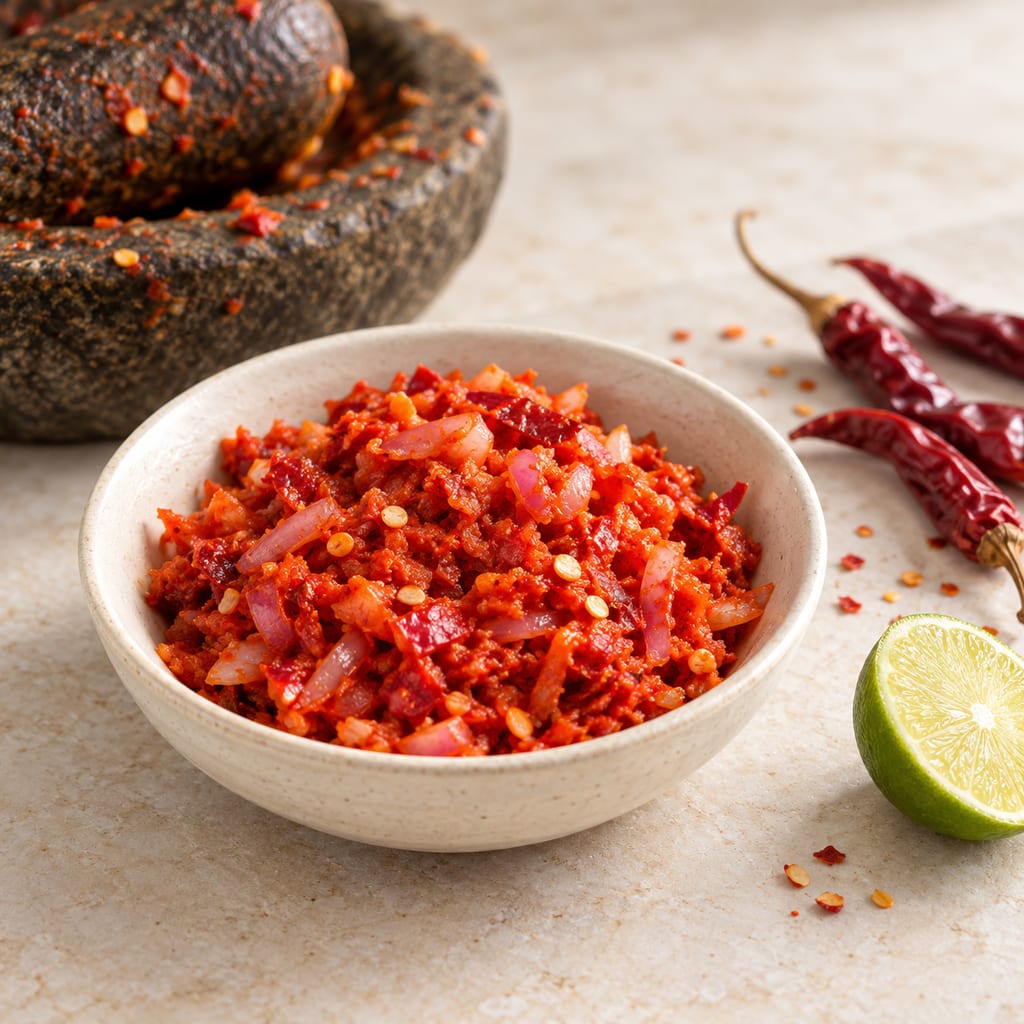
Lunu miris is Sri Lanka's pounded onion and chilli sambol: chilli flakes and red onion crushed with salt and lime, often with Maldive fish, eaten in small amounts with hoppers, pol roti and kiribath.
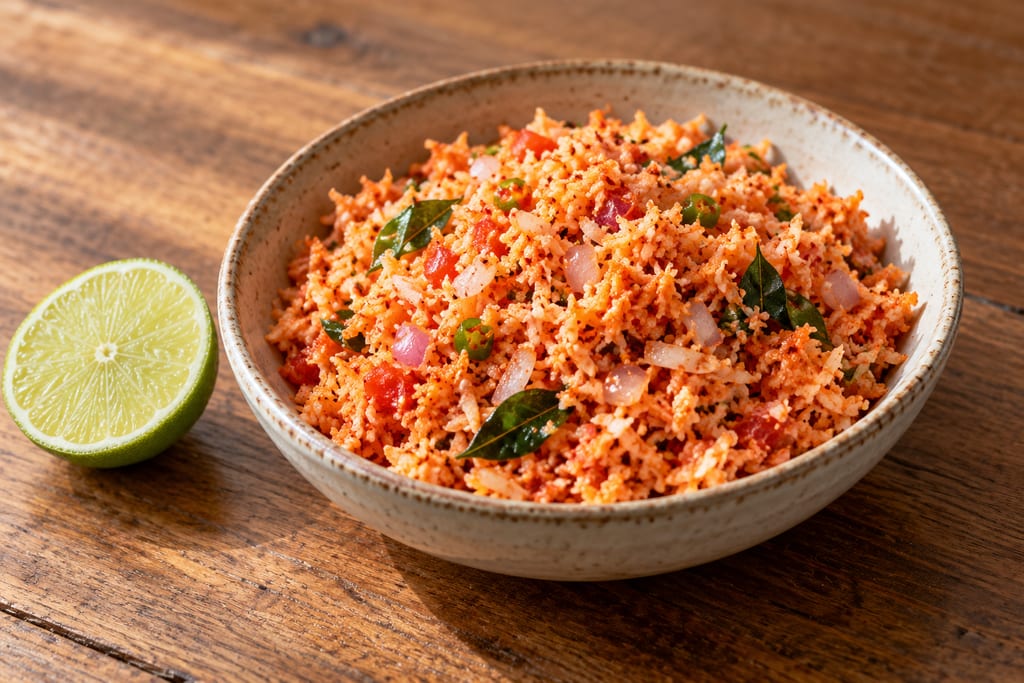
A Sri Lankan coconut relish made from grated coconut, aromatics, chilli, lime and optional Maldive fish; a seasoned paste is folded through the coconut by hand.
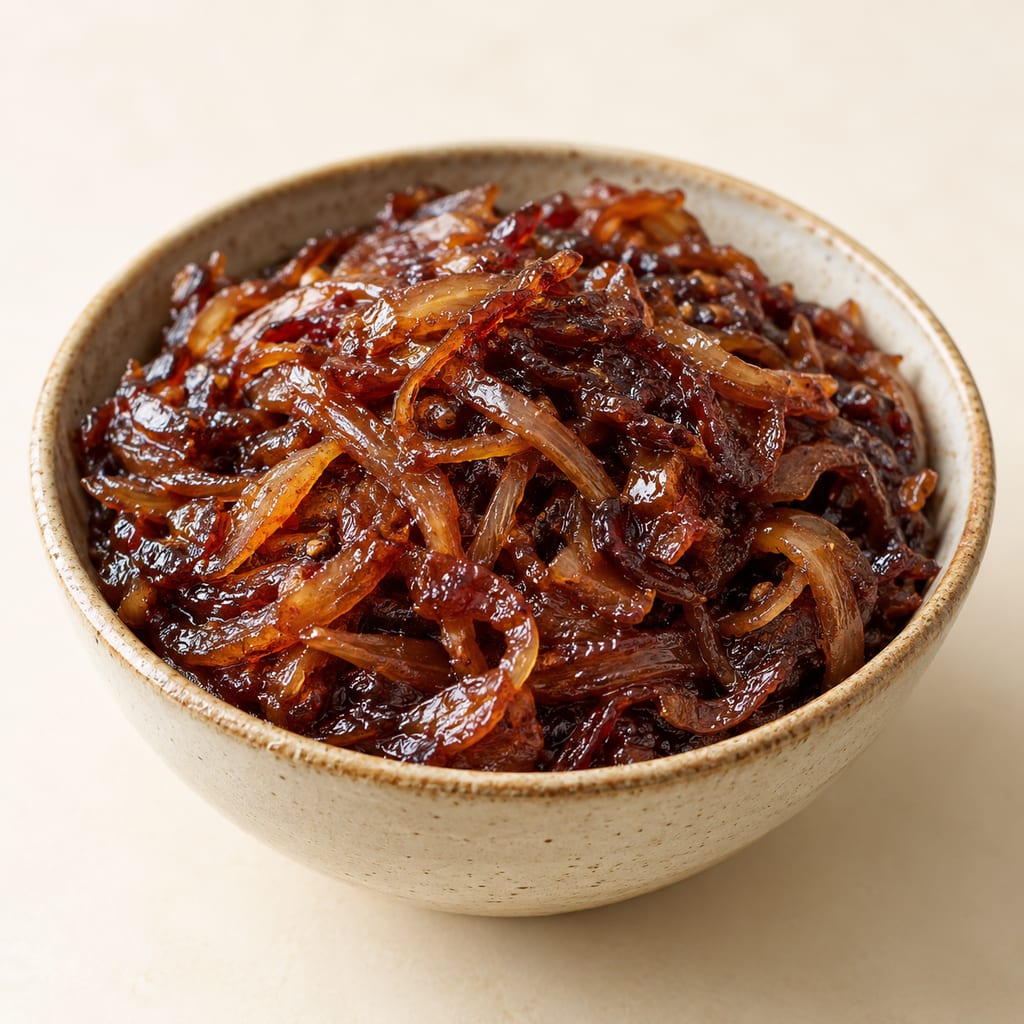
Sri Lankan cooked onion relish: onions fried in oil until dark and jammy, then sharpened with tamarind and sweetened with sugar. Not a fermented condiment.
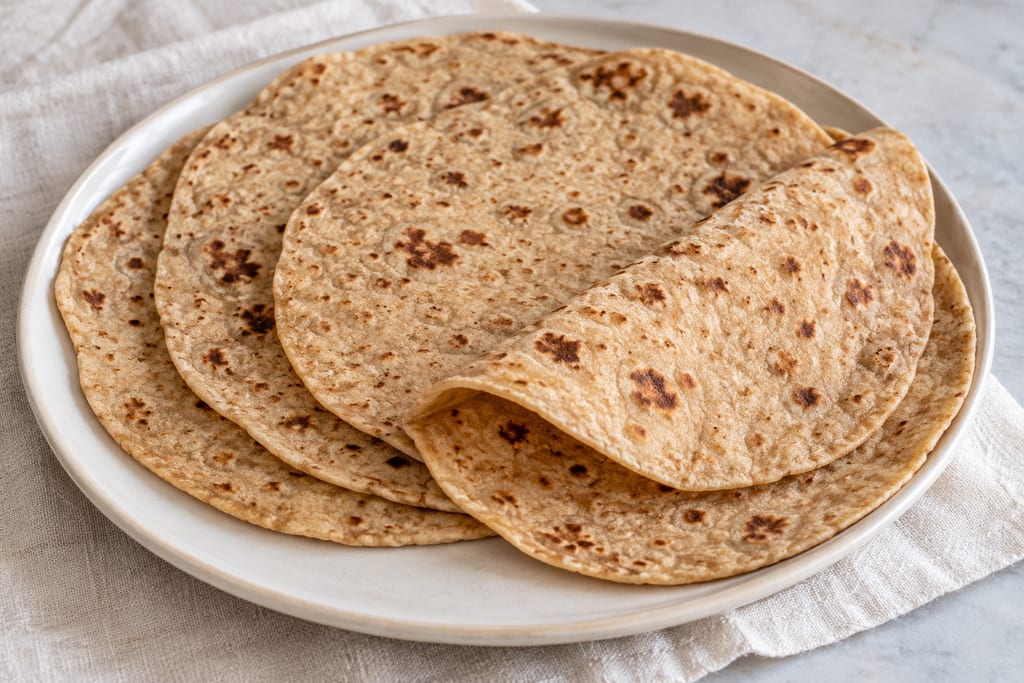
A Maldivian flatbread made with whole-wheat atta, rolled thin and cooked on a hot pan. This batch makes four.
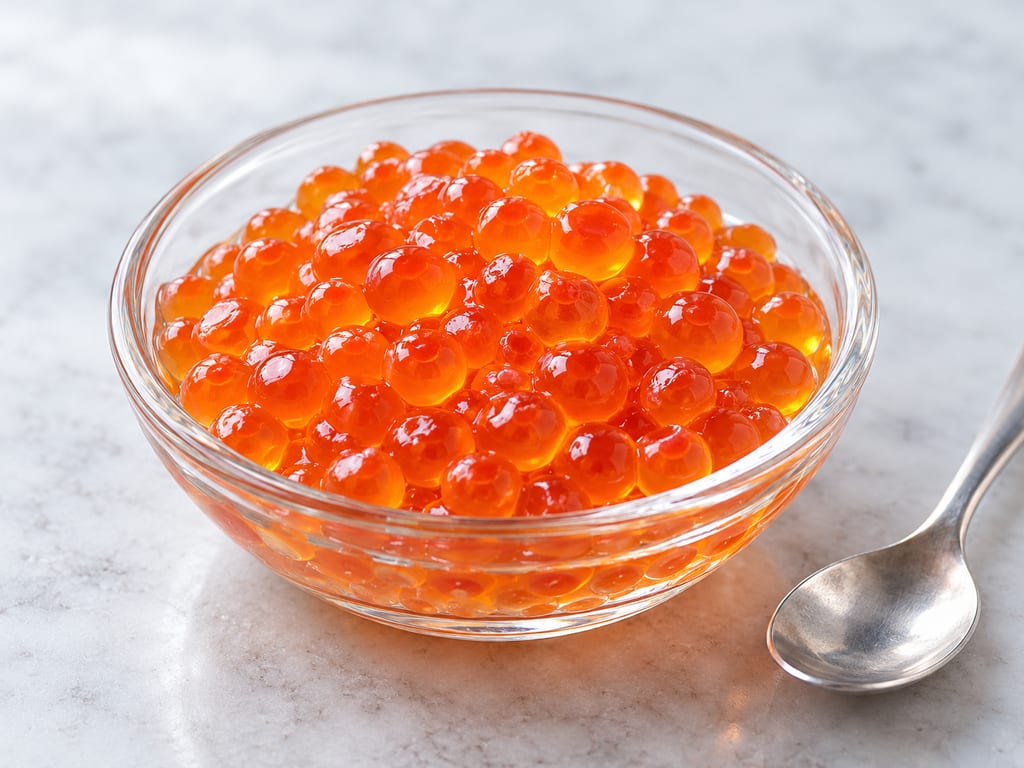
Salmon roe is separated from skeins and treated in two salt-water stages using a University of Alaska Extension formula.

Kodiak salmon, halibut and cod cut as seg'aq and hung on an initaq rack to become tamuuq, with kac'amaasaq and kupcuunaq named as different results.
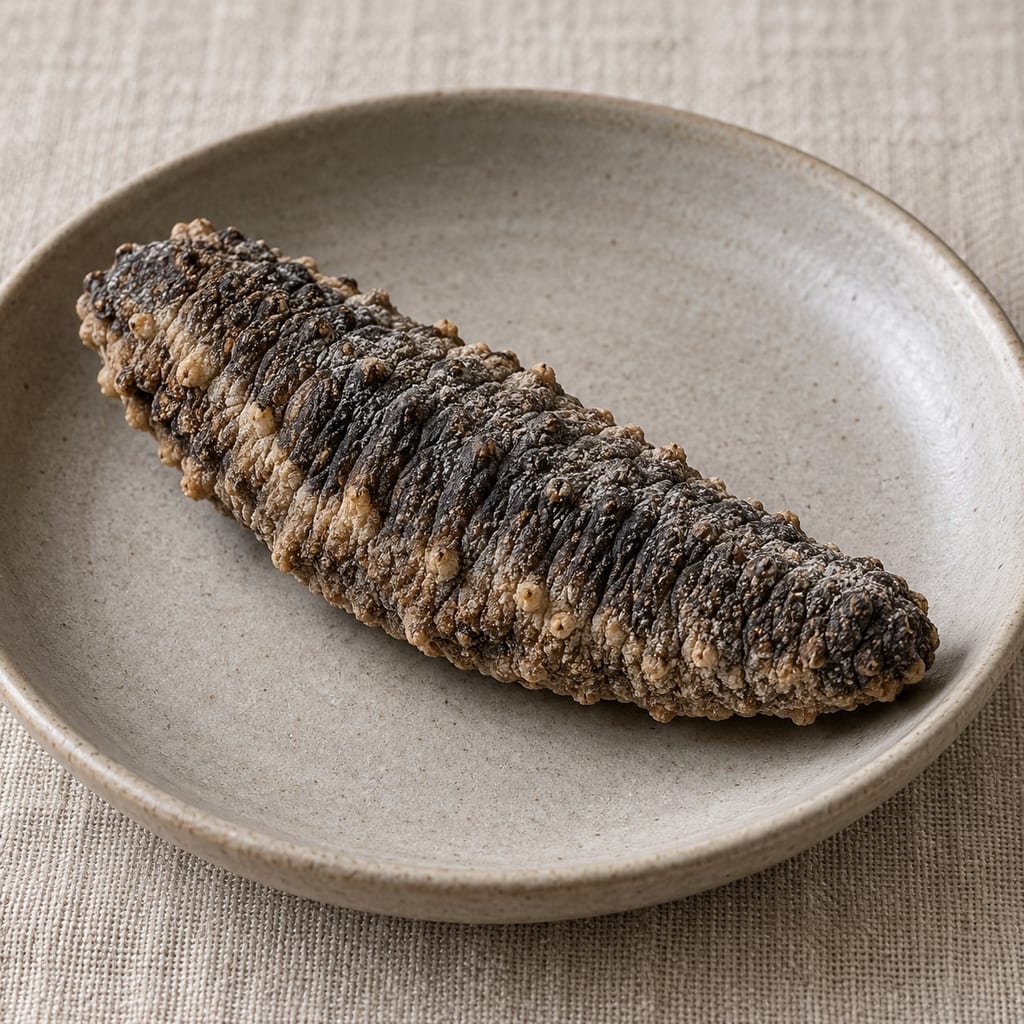
Sea cucumber cleaned, boiled and dried, sometimes with smoke, into a long-keeping trade product; Makassan processing in Arnhem Land is documented from at least the eighteenth century.
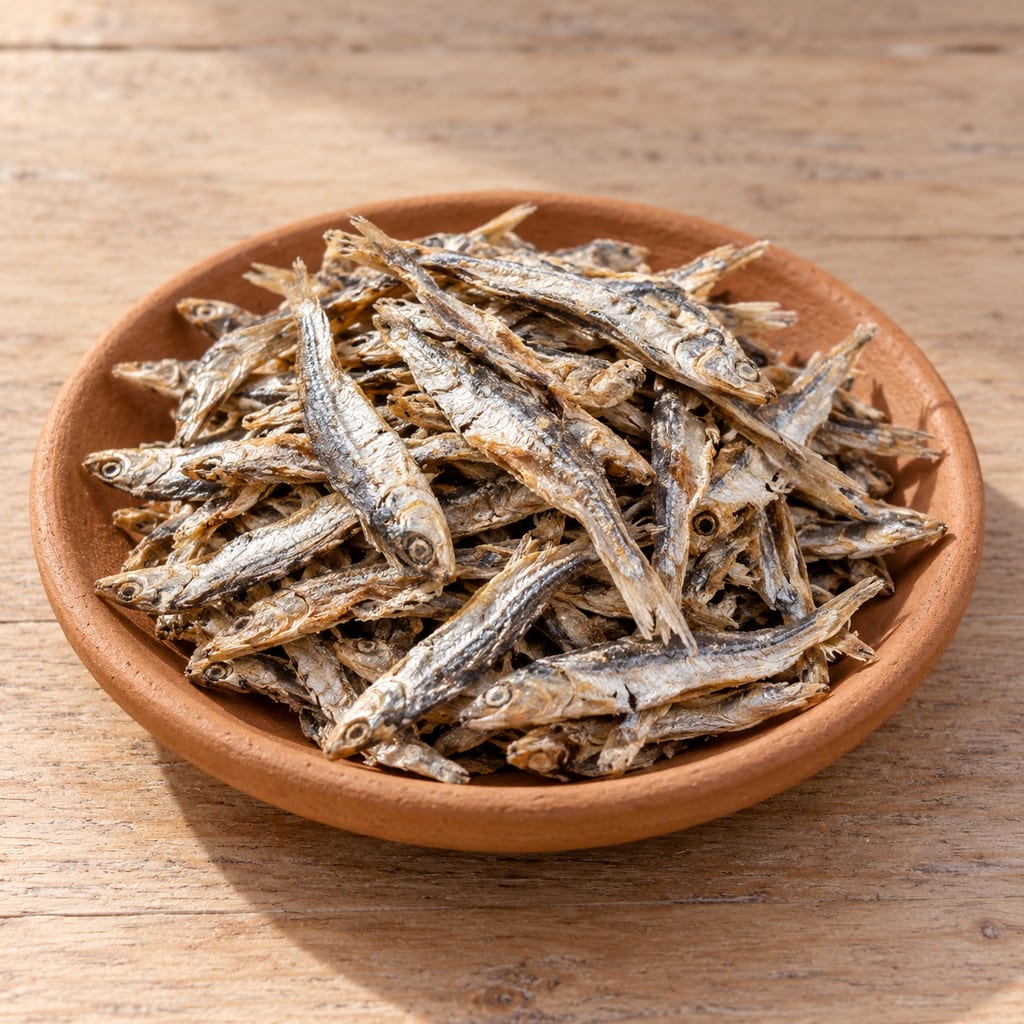
Anchoveta salted, drained of sanguaza and sun-dried on sand or stones at Caleta de Carquín, a technique declared part of Peru's cultural heritage in 2016.
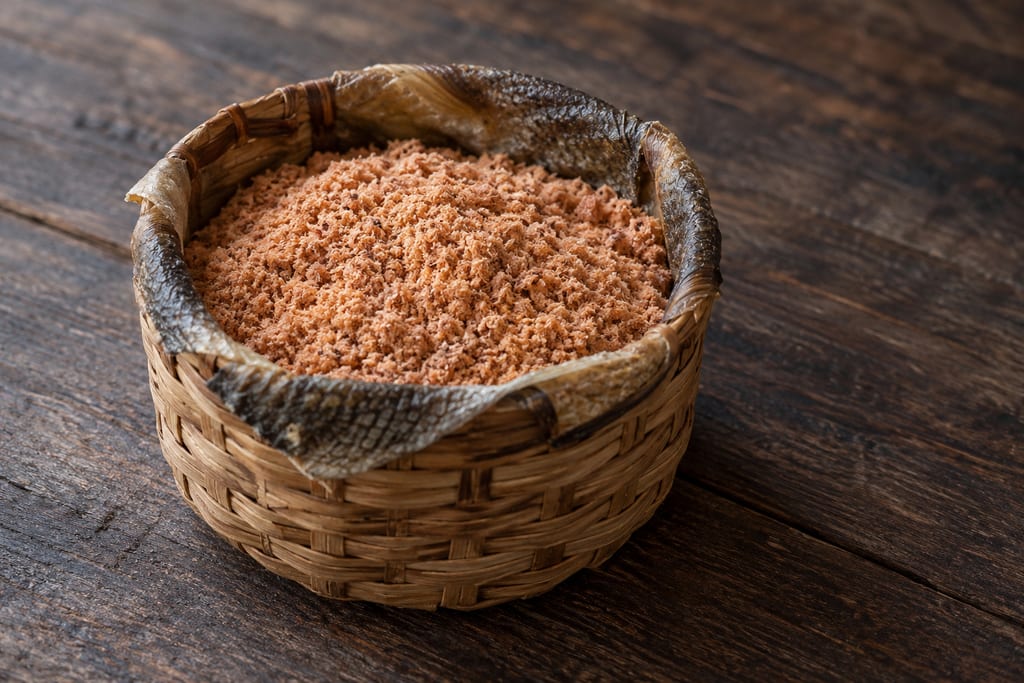
Dried salmon broken down, pounded to a meal and pressed into grass baskets lined with fish skin: the compact trade food of Celilo Falls and The Dalles.
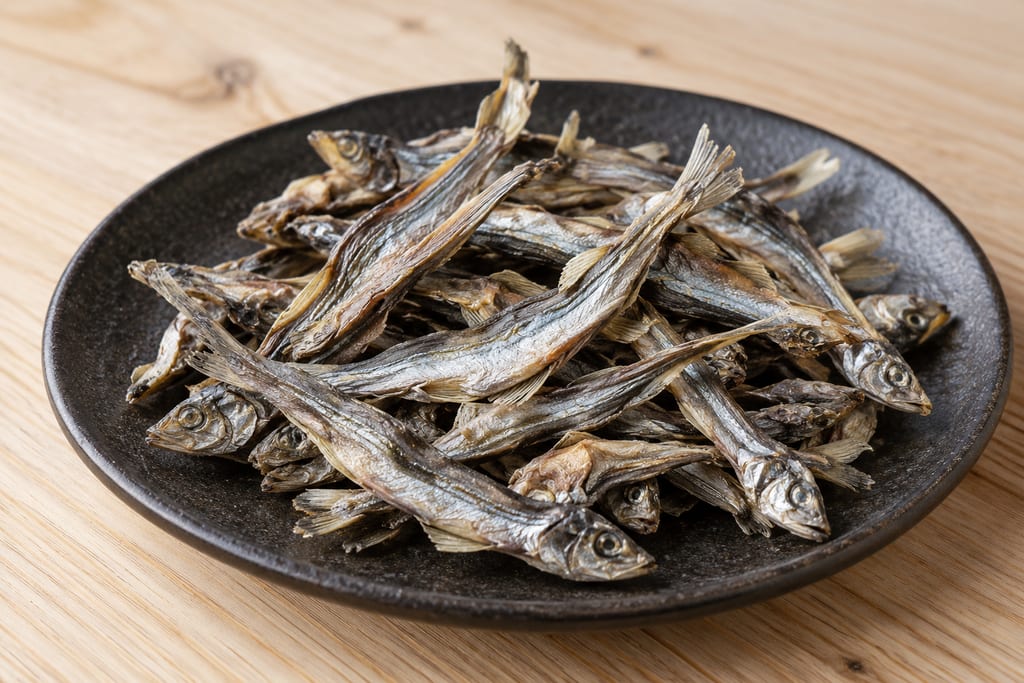
Greenlandic capelin dried whole on rocks, among crowberry vegetation or on buildings, and the microbial research that has made this small fish unusually well studied.
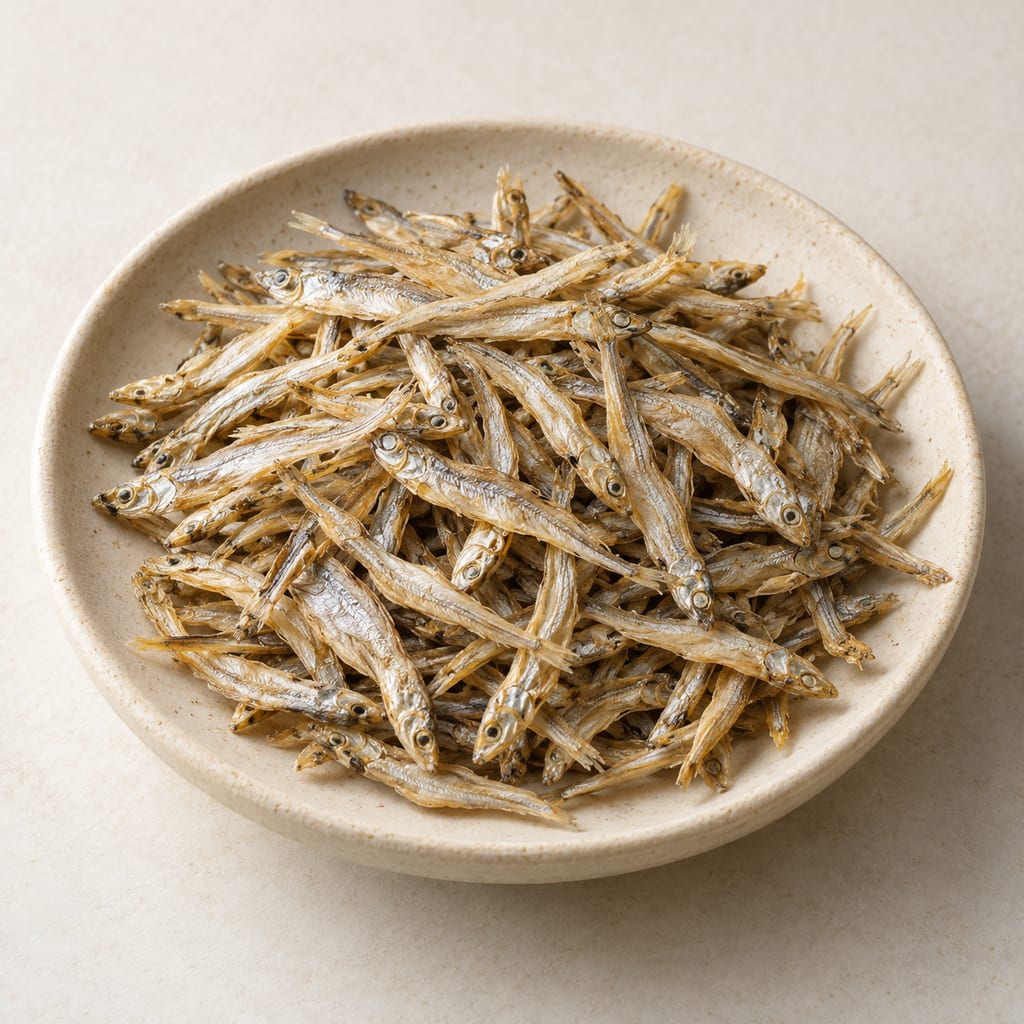
Small central-Mexican lake silversides, Chirostoma spp., dried whole and sometimes salted, then fried, roasted or simmered into Lenten tortitas and snacks.
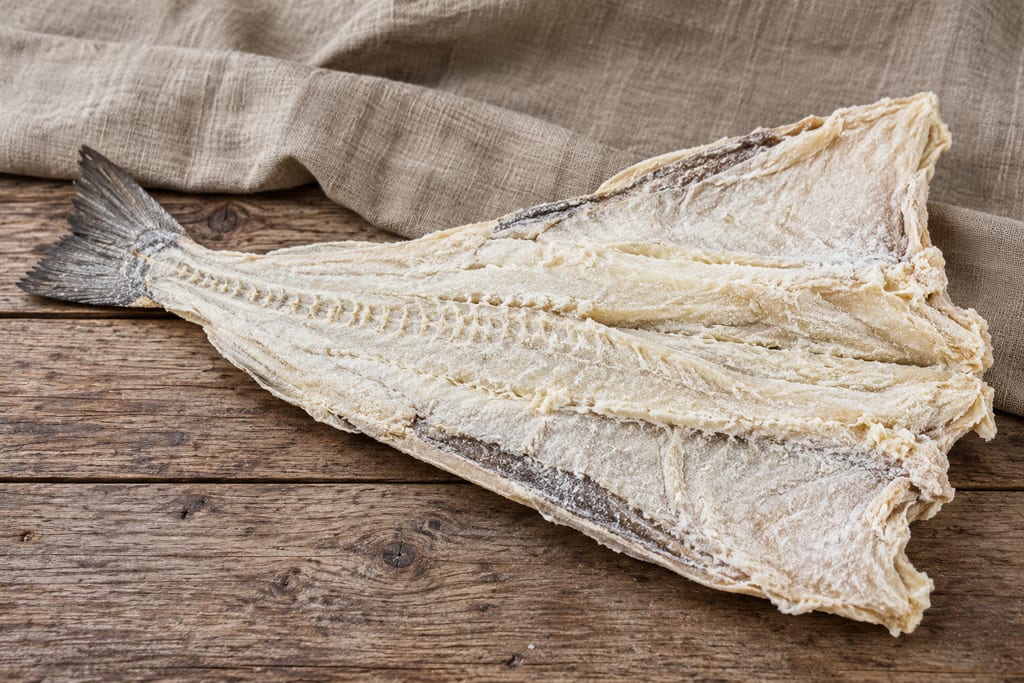
Cod split, salted and dried on flakes until hard, a long-keeping fish that must be desalted and rehydrated before use; the salting and the extensive drying together make it portable where light salting or partial drying does not.

Protected Italian vinegar made only from cooked grape must, fermented and aged in a battery of wooden barrels for at least 12 years: sweet, sharp and syrupy.

Airag is Mongolia’s fermented mare’s-milk drink, traditionally churned with saved starter in a reusable cowhide khokhuur.

Appam, or hoppers, are South Indian and Sri Lankan rice pancakes made from a fermented coconut-and-rice batter and cooked in a curved pan to a crisp lacy rim and a soft, spongy centre.

Auricularia tremellosa is a wood ear fungus of the genus that supplies most dried wood ear sold in China; its own food record is thin, and the culinary practice described here comes from the closely related wood ear species.

Ayran is Turkey’s cold, savoury yogurt drink: plain yogurt is loosened with water and lightly salted, then whisked smooth or aerated into a soft cap of foam.
A thin stone griddle used over an open hearth. Norwegian archaeology documents the established tradition from the early Middle Ages; a Viking-period origin is only a cautious suggestion linked to Shetland.

Crushed or milled barley cooked in water until the starch softens and the mixture thickens, the plainest way a northern household turned stored grain into a meal, here with apple and hazelnut.

Black carrot is the anthocyanin-pigmented Eastern carrot (Daucus carota var. atrorubens), the purple root that preceded orange types and still colours kanji and şalgam.
No community contributions have been published for this entry yet.
Sign in to contribute. Published comments and photos are free to read.
Maldives TVET AuthorityMethod · Safety
National Competency Standard for Fish Processing and Quality ControllerSequence: sort by size, boil in salted water, drain and clean, smoke, sun-dry.
Cited in: What the processing stages do; Fish, salt, smoke and drying; Cutting, labor and the work of preservation; Limits of the surviving record
ICES Journal of Marine Science / Oxford AcademicHistory · Geography · Culture
King tuna: Indian Ocean trade, offshore fishing, and coral reef resilience in the Maldives archipelagoHistorical review of tuna processing and trade across Indian Ocean, including dried tuna exports and Sri Lanka market.
Cited in: From island fishery to Indian Ocean commodity; Regional forms and the line between them; How cooks use it; Reading a piece in the kitchen; Limits of the surviving record
Marine Research Centre, MaldivesHistory · Geography · Trade
Maldives Marine Research Bulletin No. 2Public fisheries bulletin used for Maldives fishery and trade context.
Cited in: From island fishery to Indian Ocean commodity
University of PeradeniyaTechnique · Safety
Effect of Smoke Curing on some Foods in Sri LankaStudy of smoke constituents and PAHs in twelve Maldive-fish samples; most measured PAH concentrated in outer crust.
Cited in: Fish, salt, smoke and drying; Choosing and keeping the product; Cutting, labor and the work of preservation; Limits of the surviving record
Journal of Ethnic Foods, Springer NatureUses · Geography · Variations
Indigenous and traditional foods of Sri LankaReview describes cooked, dried, smoked product and its use in Sri Lankan curries and salads.
Cited in: A hard tuna product built for trade; Regional forms and the line between them; How cooks use it; Reading a piece in the kitchen
Sri Lanka Ministry of HealthIdentity · Quality · Safety
Food (Fish & Fish Products) Regulations – 2020 (draft)Explicitly draft; describes Maldive fish as hard dried tuna product processed by salting, drying and smoking, with quality descriptors.
Cited in: A hard tuna product built for trade; What the processing stages do; Fish, salt, smoke and drying; Choosing and keeping the product
FAO / Bay of Bengal ProgrammeGeography · History · Fisheries
Studies of the Tuna Resource in the EEZs of Sri Lanka and MaldivesJoint fisheries research in Sri Lanka and Maldives EEZs.
Cited in: From island fishery to Indian Ocean commodity