A cauldron that crossed uses
A try-pot is a large iron cauldron associated with the whaling trade. On a whaleship, it held cut pieces of blubber while heat rendered the fat into oil. The Kona Historical Society describes the heating, skimming and pouring-off of oil from a pot used for this work. At the Two Brothers wreck, NOAA archaeologists found cast-iron trypots and hundreds of bricks, physical remains that identify the vessel's whaling equipment and its 1823 loss.
The same kind of iron vessel appears in a Hawaiian account from 1825. Botanist James Macrae recorded that chiefs distilled spirits from fermented ti-root liquor using large iron try-pots obtained from whale ships in exchange for provisions. This makes the pot important to the history of ʻokolehao, but it does not mean that the try-pot itself was a complete still. Macrae's brief description does not specify a lid, outlet, condenser, supports or exact heating arrangement, so those parts should not be reconstructed as fact.
Sources for this section
Form and limits of the evidence
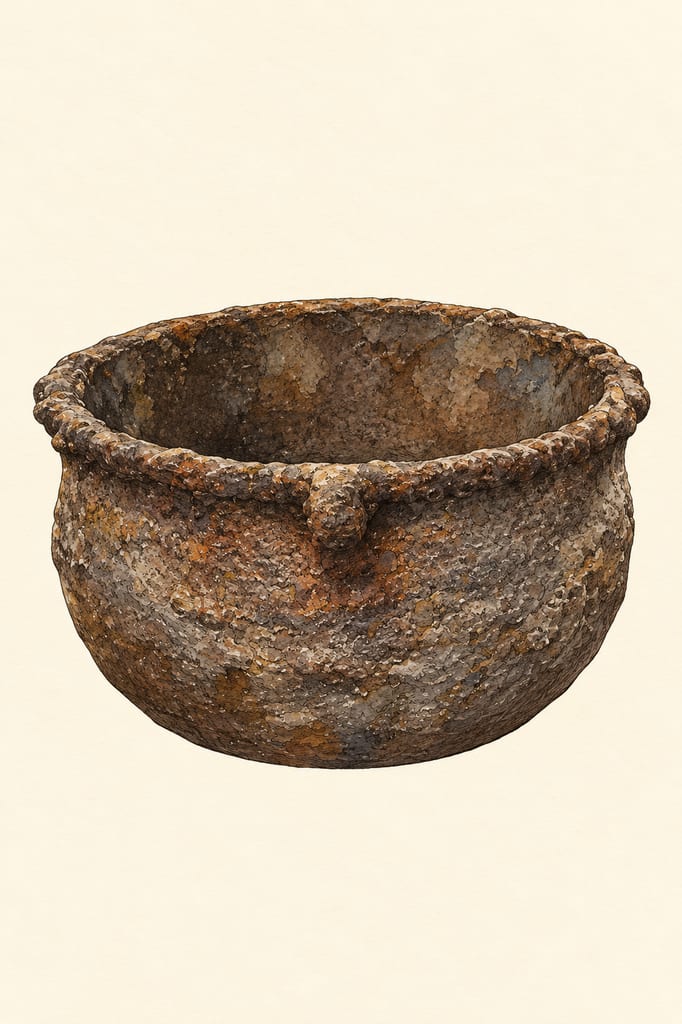
The surviving examples support a sturdy, open-mouthed cast-iron vessel. The Kona Historical Society gives dimensions for its own Greenwell pot—28 inches high and 36 inches across the flared rim—and describes it as assembled from cast pieces with feet and side handles. Those measurements and construction details belong to that specific object, not to every try-pot. The NOAA photograph of a pot at the Two Brothers wreck shows the broad, rounded cauldron form in its archaeological setting; the surrounding reef and marine growth are not part of the vessel.
The Greenwell pot's use for whale-oil rendering is described by the historical society, while its later use in Kona is as a water-lily basin. The page also recounts Macrae's separate evidence for distilling ti-root liquor in Hawaiʻi. It speculates about the Greenwell pot's own earlier use ashore, so this entry does not identify that artifact as one of Macrae's stills.
Sources for this section
Use in context
Aboard whalers, try-pots belonged to a larger tryworks arrangement: the pot was heated so blubber could be boiled down and the oil collected. The pot is the movable vessel; the brickwork and fire installation are part of the shipboard plant, not included in this equipment record. In Macrae's account, the pot's role shifts from rendering animal fat to distilling a fermented plant liquor, but the surviving text gives no operational instructions. It therefore supports a historical use, not a reproducible design or a modern distillation guide.
The Kona Historical Society’s account connects try-pots with the history of ʻokolehao through Macrae’s 1825 report of Hawaiian chiefs distilling fermented ti-root liquor in iron pots. The evidence is geographically specific: the Hawaiian account describes the liquor and exchange with whale ships, while the archaeological wreck records a separate whaling vessel at French Frigate Shoals. Together, these records show how maritime iron equipment could circulate into local practice without proving a precise route, maker, or universal form.
Sources for this section
History
James Macrae's 1825 account describes Hawaiian chiefs distilling spirits from fermented ti-root liquor in large iron try-pots obtained from whaling ships in exchange for provisions. Independently, NOAA documents cast-iron try-pots aboard the whaleship Two Brothers, lost at French Frigate Shoals in 1823. These attestations show the vessel in two related but distinct settings; they do not identify the Greenwell pot in Kona as one of Macrae's stills.
Equipment details
PowerFire or solid fuel A try-pot rendered whale blubber over a fire; the precise heat source and arrangement in Macrae's Hawaiian distillation account are not described.
How you get oneNot obtainable today The documented examples are historical whaling equipment; this record does not identify a contemporary maker or supply.
Made of
- Cast iron — Vessel body
NOAA identifies the Two Brothers wreck pots as cast iron; the Kona Historical Society describes its example as a black cast-iron cauldron.
Limits
The source does not establish that every whaling try-pot was used for distilling ʻokolehao; Macrae's account describes a particular Hawaiian practice.
Source →Places
Hawaiʻi
Historical attestation · Country evidenceJames Macrae's account places iron try-pots obtained from whale ships in a ti-root distillation practice in Hawaiʻi; it does not locate the sheds more precisely.
French Frigate Shoals, Northwestern Hawaiian Islands
Historical attestation · Region evidenceNOAA documents try-pots at the Two Brothers wreck site, a whaling vessel lost in 1823; the pots are not the Hawaiian stills described by Macrae.