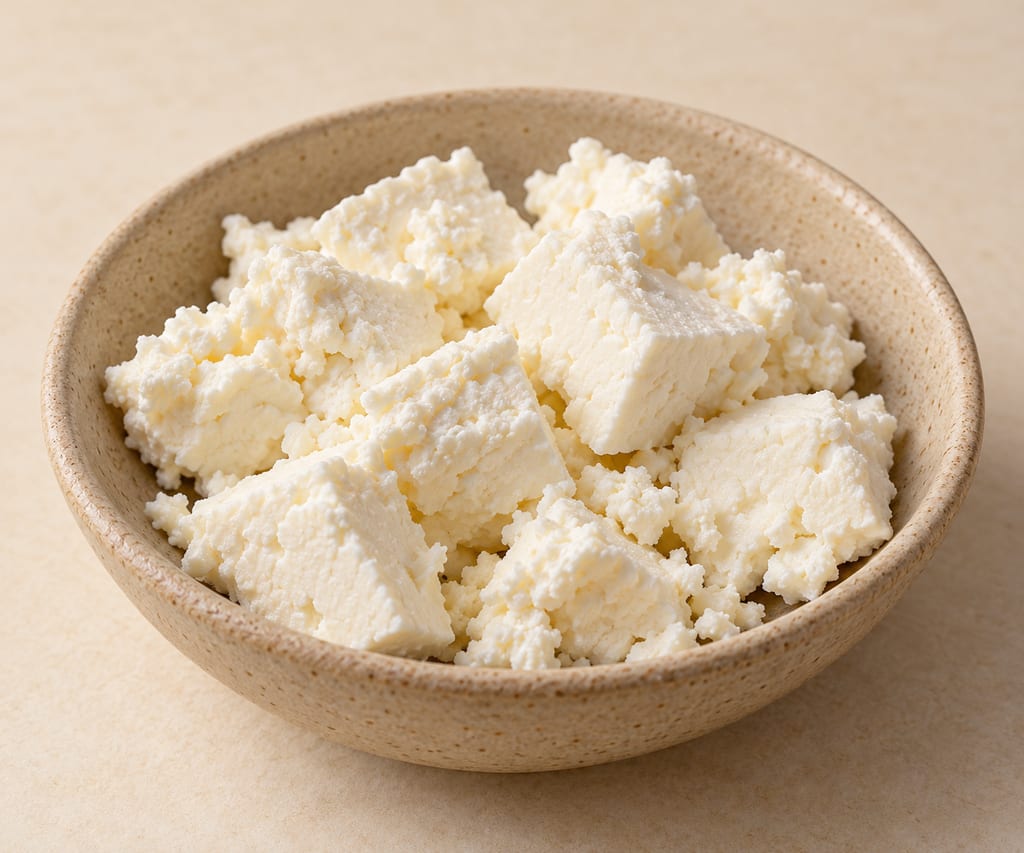
Feta-style cheese, hot whey-brined
Whole milk set with a mesophilic starter and rennet makes a fresh, crumbly feta-style cheese. Its curds pass through hot salted whey before molding.
 FermenteaWhere food goes to change
Cultures
MT1 is a named dairy starter in a home Feta-style method. The brief recipe name does not establish its manufacturer or exact strains; a documented commercial MT1 product is one distinct example.
In cheesemaking, a starter is a deliberately added community of living lactic-acid bacteria. Its first job is to ferment milk sugar, lactose, into acid while the curd is forming. That acidification works alongside the milk’s coagulating enzyme, rennet: the culture changes the milk’s chemistry over time, while rennet helps casein proteins assemble into the gel that traps fat and water. The two are partners in a make, not interchangeable ingredients. New Mexico State University’s home Feta-style recipe lists “MT1 starter culture (mesophilic)” at one-quarter teaspoon for two to three gallons of pasteurized, non-homogenized whole milk. Its directions warm the milk to 90°F (32.2°C), add and stir in the culture, and let it ripen for two hours before adding rennet. That is the clearest evidence for the role of MT1 in this particular adaptation: it is the named starter inoculum for the milk-ripening stage.
The name appears in more than one commercial context. A study of Feta made at Dodoni’s Thebes plant in spring 2020 reports CHOOZIT MT1 LYO 10 DC attributed to Chr. Hansen. It lists *Lactococcus lactis* subsp. *lactis*, *L. lactis* subsp. *cremoris*, *Streptococcus thermophilus*, and *Lactobacillus delbrueckii* subsp. *bulgaricus*. A current Dairy Connection listing places MT1 CHOOZIT 10 DCU under Danisco and prints the same four names. Those sources identify what each author or seller described; the shared name and species list do not prove identical strains, package lineage, or the maker of the quarter-teaspoon MT1 in NMSU’s home recipe.
Before commercial starter manufacture, cheesemakers often relied on fermentation already taking place in milk. A cheesemaker might allow selected raw milk to sour, then use some of that fermented milk to inoculate the next batch. Repeated transfer—often called back-slopping—could select for acid-producing bacteria that were well adapted to that dairy and routine. It could also carry forward unwanted microbes or drift in composition. Mark Johnson’s review describes traditional practices based on naturally fermented milk, whey, or transfers into fresh milk, and explains that the microbiology was variable. It cautions that those earlier conditions are not equivalent to current carefully cooled milk supplies.
A change came in the late nineteenth century. Danish buttermakers began selecting individual lactic-acid bacterial strains, and purified cultures entered commercial use in the 1890s. The modern culture maker grows selected organisms, concentrates them, and preserves them for dairies. Freeze-drying removes water so the living bacteria can travel as a dry preparation. Some cultures are propagated into a larger bulk starter before entering the vat; others are designed to go directly into the milk. The sachet belongs to this later world of repeatable inoculation, even though it still serves the old purpose of turning milk sugar into acid.
The direct-vat-set format makes the starter a measured ingredient at the vat, much as rennet is, though the two do different work. Frozen and freeze-dried DVS products both concentrate living cultures for direct addition. That convenience helps a cheesemaker begin from a known inoculum without maintaining a house culture through repeated transfers. It does not erase the importance of milk quality, temperature, packet condition, or the time allowed for acidification.
“Mesophilic” is a temperature classification, not the name of a bacterium or a guarantee that every member of a blend behaves identically. A scholarly review of cheesemaking cultures places the usual optimum growth range of mesophilic dairy starters around 20–32°C and thermophilic starters around 37–45°C. It also emphasizes that strains can keep fermenting outside their optimum range, with natural variability between species and strains. The NMSU milk temperature of 32.2°C sits at the upper edge of that review’s mesophilic optimum; the recipe’s two-hour ripening period is its instruction for that make, not a universal MT1 performance specification.
The commercial MT1 formulation reported in the Feta study is a mixed culture: two mesophilic Lactococcus subspecies together with thermophilic S. thermophilus and L. delbrueckii subsp. bulgaricus. That combination explains why sellers describe the product as a mesophilic/thermophilic blend, while NMSU calls its recipe ingredient “mesophilic.” The words need not contradict each other: a cheese culture can include organisms with different preferred temperature ranges, and the name applied in a home recipe may be a shorthand. But the NMSU text does not supply a formulation sheet, so the paper’s four species should not be presented as an official declaration of what NMSU used.
Even when the species names are known, the exact strain identities and proportions matter. Culture companies select strains for properties such as acidification, salt tolerance, growth at the process temperature, and contribution to the cheese’s eventual profile. A species list cannot tell a home cheesemaker the expected rate of acidification, whether a particular packet is still viable, or how it will behave in a different milk or recipe. Those are product- and process-specific characteristics. This is why the named culture should be used according to its own current label and the recipe that calls for it, rather than treating every mesophilic blend as a drop-in equivalent.
Milk contains lactose, a sugar made from glucose and galactose. Starter bacteria take up and metabolize lactose, producing lactic acid. As acid accumulates, milk pH falls. NMSU explains that the acid contributes to preservation, removes water from the curd, and helps develop texture; it also says native microflora initially produce flavor compounds that change during aging. In a cheese vat, the cheesemaker’s timing matters because the acidification trajectory affects curd development and later texture. The desired point is not simply “as sour as possible”: a recipe balances culture activity with temperature, rennet coagulation, cutting, draining, salting, and storage.
Rennet performs a different operation. NMSU describes its enzyme action as allowing casein to form chains and a mesh-like gel that holds water and fat. Starter acidification and enzymatic coagulation overlap in time, but have different causes. Rennet is not a bacterial culture; culture is not a substitute for rennet in this recipe. NMSU gives the starter a two-hour ripening step before rennet is added, then separately instructs the maker to stir in dissolved rennet and wait for the curd to form. That sequence lets the milk acidify before coagulation begins, as the recipe writer intended.
Acid also continues to matter after the cut. When a curd is cut, whey can escape from the newly exposed surfaces; as the curd firms and loses moisture, its final texture changes. NMSU's broader guide says temperature and handling affect texture, and that salt may be applied in brine, on the surface, or dry, depending on the cheese. In its Feta-style method the curds pass through hot whey brine, a process step distinct from culture fermentation. The culture's action begins in the warm milk. The later brining is a separate step, and the culture is not shown to be responsible for heating or salting the curd.
Cheese starters can influence more than acid. Johnson notes that starter choice affects acid development and the physical attributes of cheese, while other microorganisms often have larger roles in flavor development during ripening. The 2020 commercial Feta process that used CHOOZIT MT1 also measured the cheese during its maturation, but that industrial protocol cannot be used as a home prediction for this adaptation: the milk, culture dose, equipment, curd operations, containers, and ripening controls differ. A starter name does not promise an exact flavor. In this recipe, its firmly supported contribution is acidification during the milk-ripening stage, with likely downstream effects on the curd that depend on the full process.
In the NMSU Feta-style make, one-quarter teaspoon of MT1 goes into two to three gallons of pasteurized, non-homogenized whole milk warmed to 90°F (32.2°C). The maker stirs in the starter and gives the milk two hours to ripen before adding rennet. During that interval, the bacteria begin acidifying the milk; rennet comes later to set its casein into curd. The source does not name a packet maker, so this kitchen measure belongs to the home recipe rather than to every product sold as MT1.
The commercial Feta study reports 0.75 grams per kilogram of milk for its own CHOOZIT MT1 LYO 10 DC process. That mass-based plant dose cannot be converted from NMSU’s quarter teaspoon without a product-specific density and activity specification. The two makers also use different milks, equipment and curd handling. The shared MT1 name helps locate a type of culture, but it does not turn the industrial dose into an instruction for the home batch.
NMSU also describes live cultured yogurt or buttermilk as possible starters in other cheese makes. They are living cultures, but their bacteria and activity differ from a named MT1 preparation. In this Feta-style make, changing the inoculum would change the early acidification path and could alter the curd. The yogurt and buttermilk examples illuminate what a starter does; they are not measured substitutes for this recipe.
A current Dairy Connection listing presents MT1 CHOOZIT 10 DCU as a freeze-dried mesophilic/thermophilic blend for Feta and other white cheeses, under the Danisco brand. It names the same four species printed in the Feta study, whose methods instead attribute CHOOZIT MT1 LYO 10 DC to Chr. Hansen. A buyer should use the current packet’s complete product name, manufacturer, batch and directions. The two published attributions are not enough to reconstruct a common formulation history, and NMSU does not identify which packet it used.
Dry starter cultures contain living bacteria whose activity depends on the packet and how it was kept. A generic catalogue explains how freeze-dried direct-vat-set cultures are made, but it is not the storage label for the current MT1 listing. Follow the temperature and date on the actual sachet, and keep moisture and dirty utensils away when measuring. NMSU emphasizes clean culture handling; a viable starter is needed for the milk-ripening interval to develop as intended.
The seller marks its MT1 listing “Kosher Dairy,” a dietary designation for that listed product. It does not publish a full carrier or allergen declaration on the opened page. The NMSU recipe says only “MT1 starter culture,” and the Feta study names species without a sachet ingredient list. Neither source establishes that every MT1 packet is milk-free, lactose-free or suitable for a particular allergy. A person who needs that answer should read the current manufacturer’s label or obtain its technical declaration for the exact SKU.
The culture’s documented culinary setting is white-brined cheese. The commercial study added CHOOZIT MT1 during Feta production; the seller markets its Danisco-listed MT1 for Feta and other white cheeses, including high-protein sheep milk. NMSU’s home adaptation also names MT1 but uses a different milk and process. In all three, the culture begins acid development; each cheese then gains its own character through milk choice, coagulation, draining, salt and ripening. The shared designation alone does not make the cheeses or packets interchangeable.
Mesophilic starters are a broader family used in cheeses made at moderate temperatures. Different blends can contain different organisms and behave differently at the same vat temperature. The four species reported for the industrial culture and the current seller’s listing provide more detail than NMSU’s brief name, but species names still leave strain identity and activity open. That is why a cheesemaker selects a culture for the milk and method, rather than swapping any packet labelled mesophilic into the same recipe.
A packet can carry several useful descriptions at once. “Mesophilic” and “thermophilic” describe preferred growth temperatures, “mixed” describes more than one organism, and “direct-set” describes a concentrated culture added to the vat. MT1 is a product designation within that vocabulary. In the linked make, its practical role is clear: it is stirred into warm milk before rennet so the milk can begin fermenting.
A commercial Feta study used CHOOZIT MT1 LYO 10 DC here; it does not identify the NMSU recipe packet.
Whole milk set with a mesophilic starter and rennet makes a fresh, crumbly feta-style cheese. Its curds pass through hot salted whey before molding.
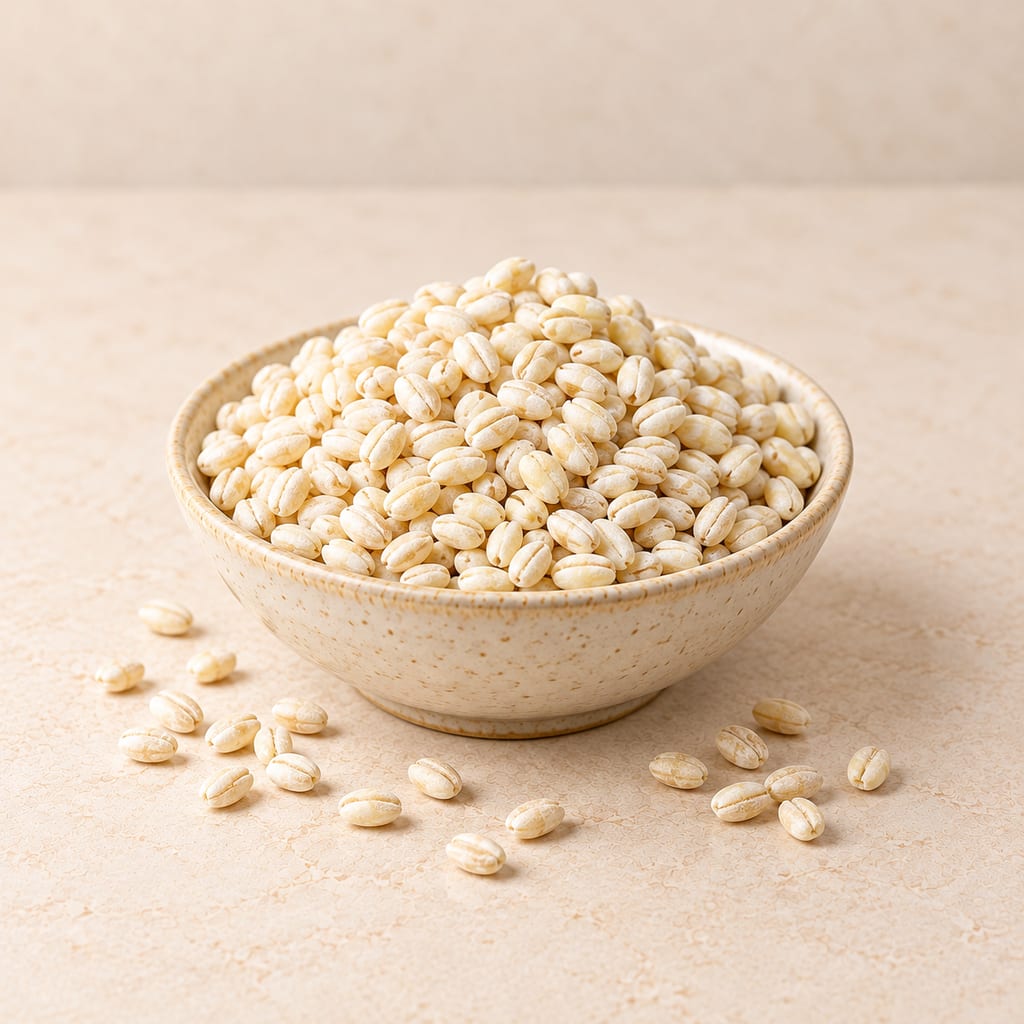
Barley is a hardy cereal, domesticated in the Middle East over 10,000 years ago, eaten whole, pearled or milled, malted for brewing, and grown with koji mold for barley miso.

Caesar’s mushroom, Amanita caesarea, is a prized wild, tree-associated fungus of Mediterranean Europe, gathered seasonally for regional dishes. Its celebrated name and food traditions sit beside serious identification risks.
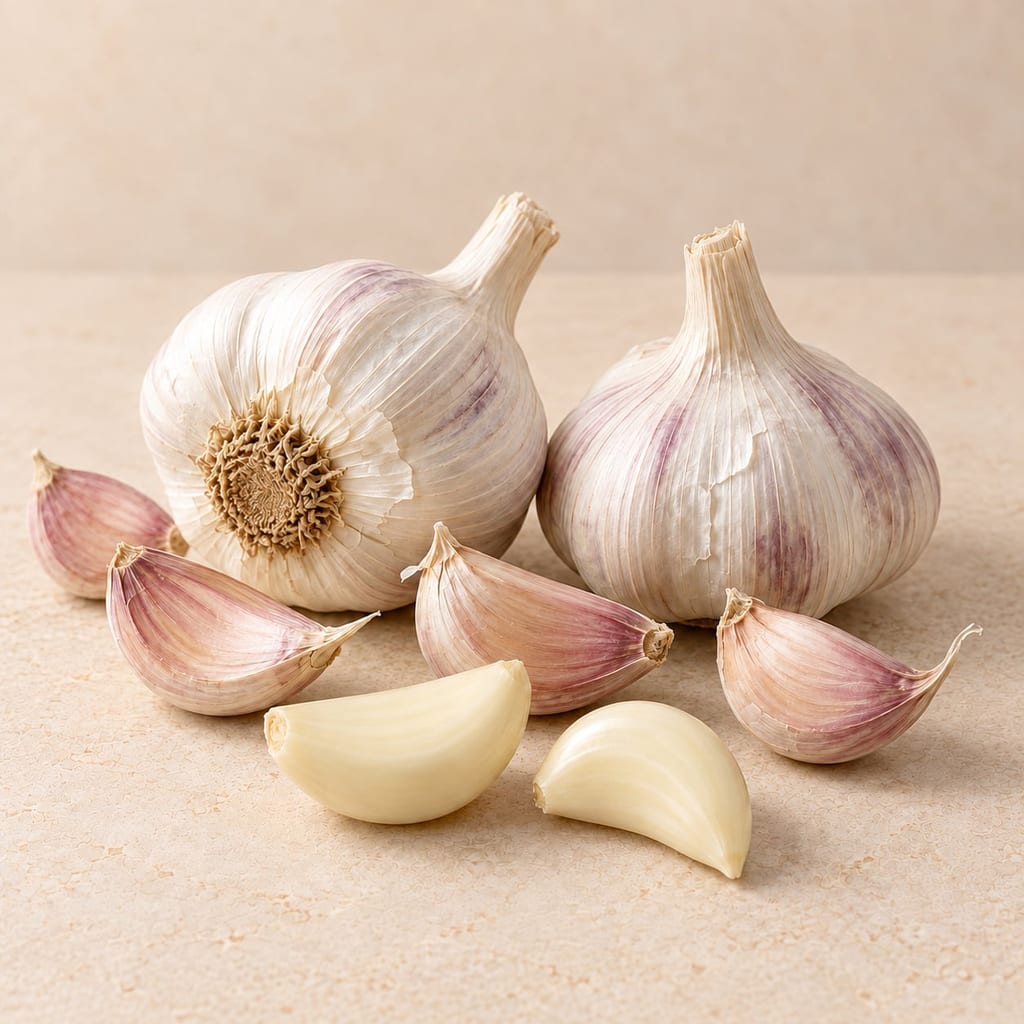
Garlic cloves are the separate bulblets of Allium sativum, pungent only once cut. They flavour herb salts, ferments such as Thai som-fak, and countless cooked dishes.

Milk supplies protein, fat and lactose for cultured drinks and cheese. Animal species, composition and processing each affect how it behaves.
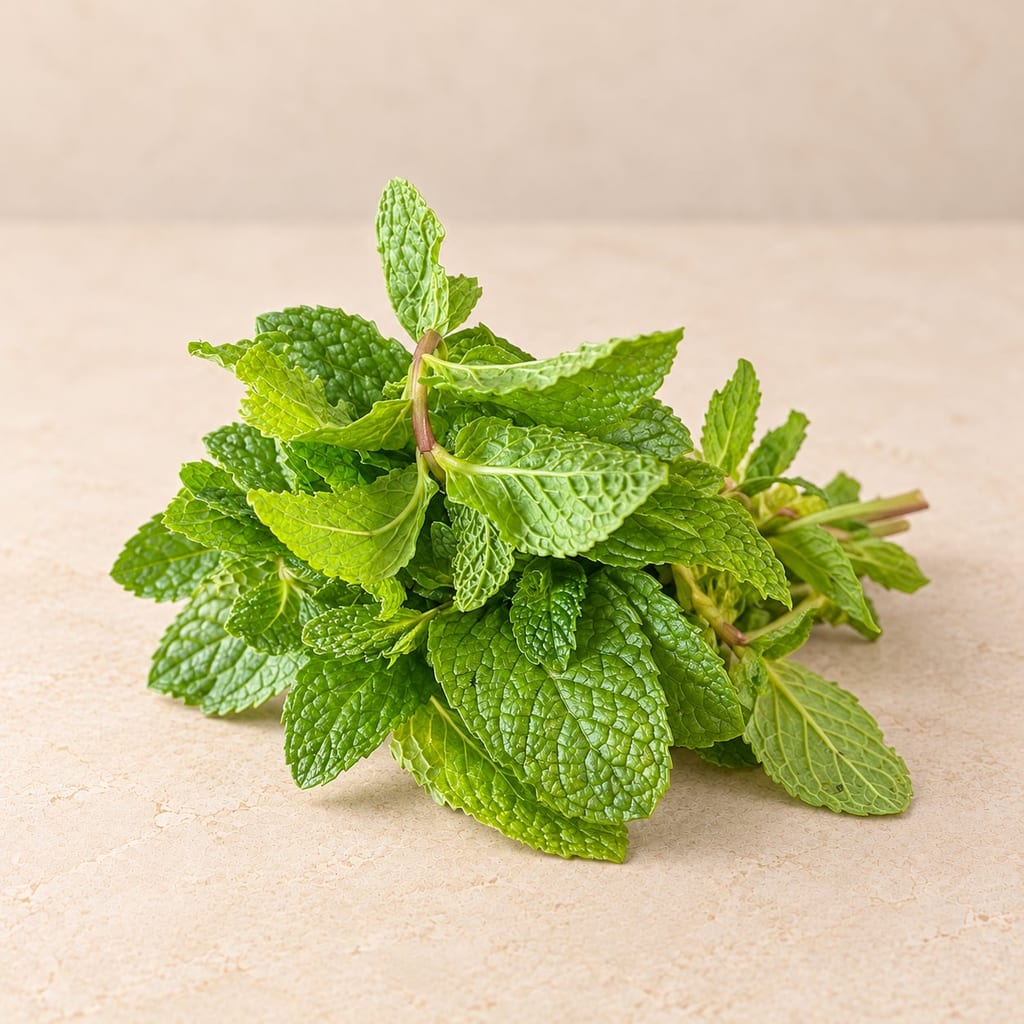
Mint is the fresh leaf of aromatic Mentha plants, chiefly spearmint and peppermint. It gives chutneys, yoghurt sauces and fermented drinks a cool, sweet, green note.

Oil extracted from olive fruit serves as cooking fat, flavouring and, in some cheese methods, an exterior treatment. Grade, cultivar, processing and storage shape its character.
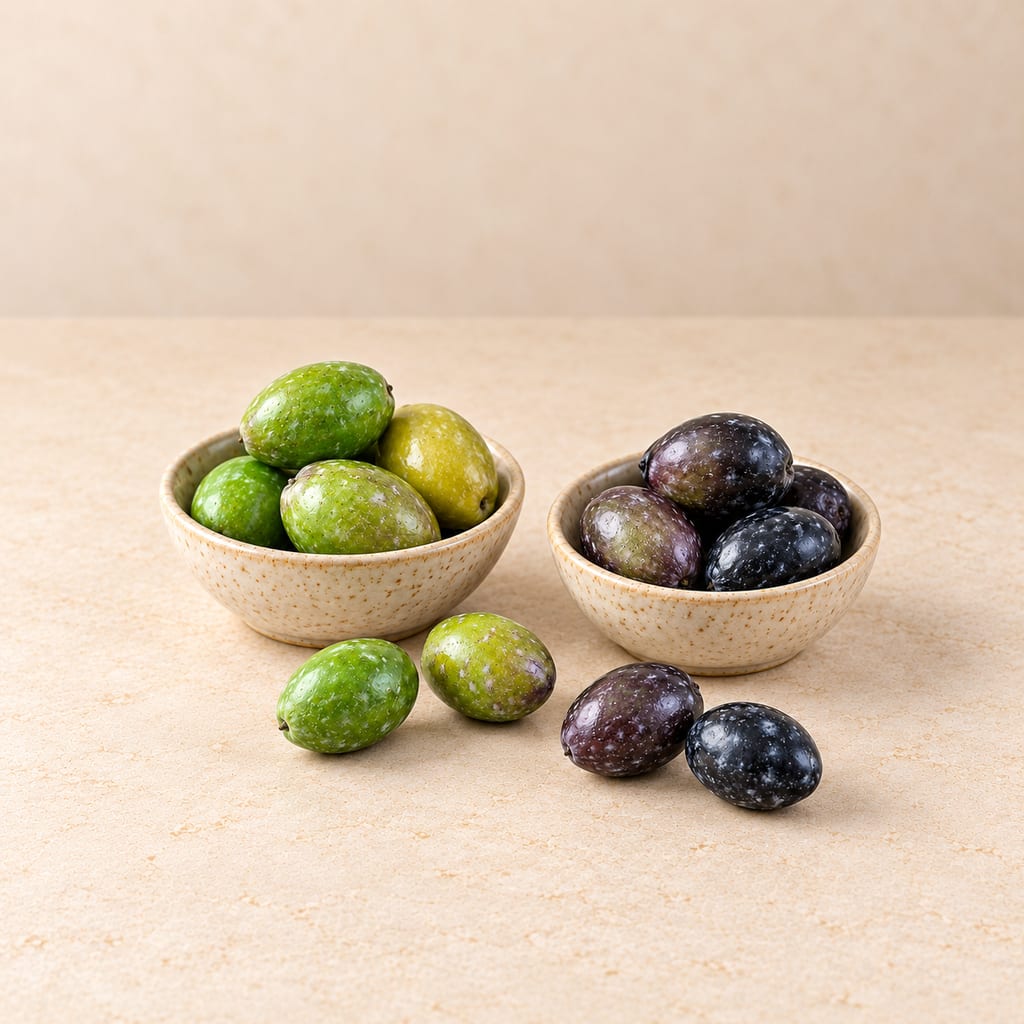
Olives are the bitter fruit of Olea europaea, made edible by lye, brine or salt, and the raw material of the table olives that are cured and fermented around the Mediterranean.
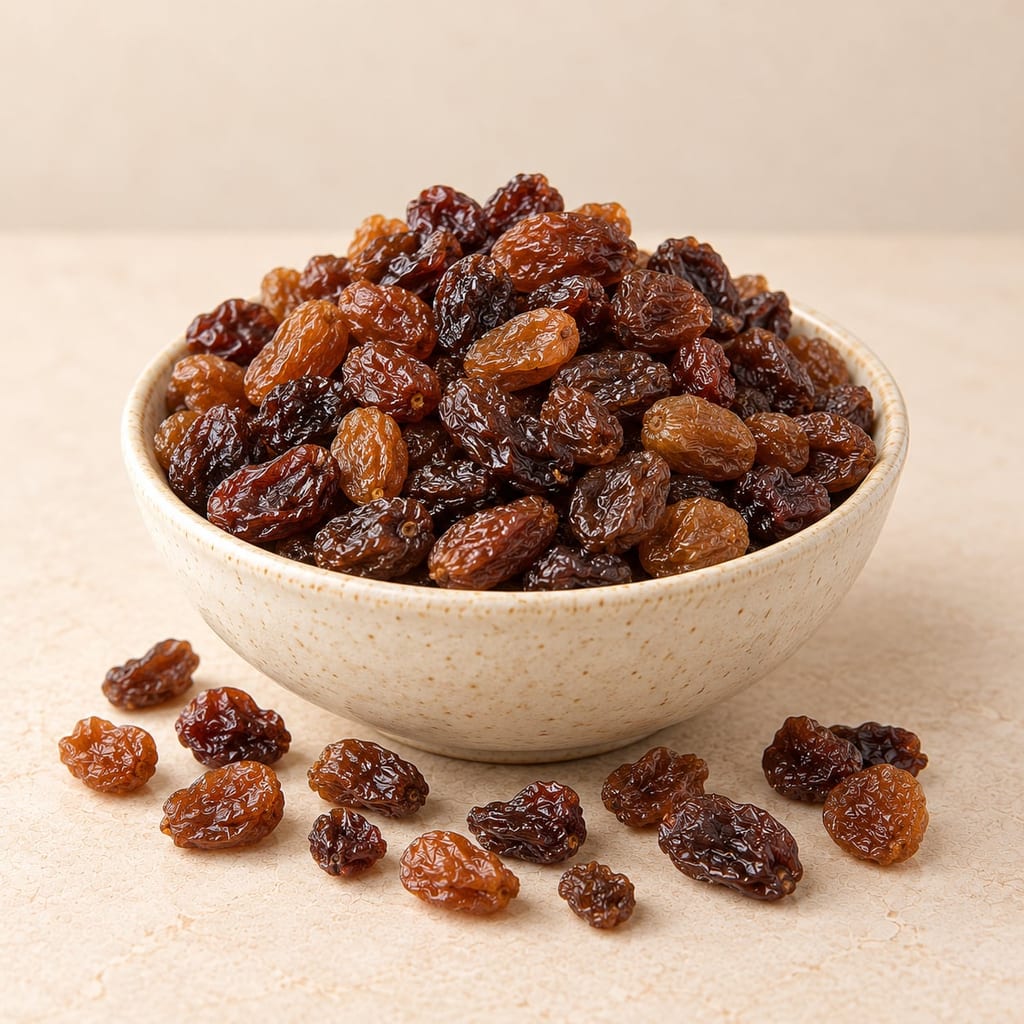
Raisins are dried grapes whose variety and drying method shape their size, colour and flavour. In a documented 1861 ginger wine they are stoned, chopped and added to the cask after yeast.

Soft, spreadable Calabrian pork sausage made with a great deal of red chilli and fatty pork, stuffed into natural casings, sometimes smoked and matured while staying soft.

A way to add independent temperature logging to an existing food dehydrator without changing its built-in controls or protections. It is a monitoring method, not a rewiring plan.

Pleurotus cystidiosus is the abalone mushroom, a cultivated oyster-type fungus with dark brown caps that grows more slowly and is more demanding than other Pleurotus species.

A dark, balanced vinegar from Emilia-Romagna made by combining cooked or concentrated grape must with wine vinegar, then acetifying and refining it in wood under a protected specification.

A living dairy inoculum that starts controlled cream fermentation, developing acidity and aroma before sour cream or cultured butter is finished.

A small electric incubator holds jars at a selected temperature for yogurt and other documented warm food preparations. Controls, capacity and vessel arrangement vary by model.

Adygean salt is a seasoned table salt associated with Adygea and the wider North Caucasian culinary tradition. Salt is blended with garlic and a variable selection of herbs and spices; the exact mix depends on the named style and maker.

The African Caesar-group mushroom, Amanita masasiensis, is a wild ectomycorrhizal species of central and southern African woodlands, eaten locally. The genus contains deadly poisonous species, so identification needs care.
No community contributions have been published for this entry yet.
Sign in to contribute. Published comments and photos are free to read.
New Mexico State University ExtensionIngredient context · Process · Safety
Making Homemade Cheese, NMSU Guide E-216NMSU home cheese methods, including distinct Queso Fresco, Neufchâtel and MT1 Feta-style processes.
Cited in: A small sachet with a specific job; What the bacteria do in milk and curd; MT1 in the NMSU Feta-style make; Buying, storing, and handling a culture; Uses, alternatives, and what “Feta-style” means here
Foods (full text at PubMed Central)Ingredient context · Process
“Evaluation of a New Bulk Packaging Container for the Ripening of Feta Cheese,” Foods 12(11), 2176 (2023), article methods text2020 Dodoni Feta production at Thebes using CHOOZIT MT1 LYO 10 DC, its listed species and commercial dose.
Cited in: A small sachet with a specific job; Why mesophilic describes a working range, not a single organism; What the bacteria do in milk and curd; MT1 in the NMSU Feta-style make; Buying, storing, and handling a culture; Uses, alternatives, and what “Feta-style” means here
European UnionIngredient context
European Commission, Feta PDO page, full text (PDO territory and production identity)Greek Feta protected-origin identity, distinct from a home Feta-style adaptation.
Cited in: A small sachet with a specific job
American Society for MicrobiologyHistory · Process · Safety · Ingredient context
Johnson, Microbiology Spectrum, full textMesophilic and thermophilic culture ranges, starter history and culture roles in cheese.
Cited in: From saved sour milk to controlled starter packets; Why mesophilic describes a working range, not a single organism; What the bacteria do in milk and curd; Buying, storing, and handling a culture; Uses, alternatives, and what “Feta-style” means here
Chr. Hansen (PDF hosted by Hjemmeriet)History · Safety
Chr. Hansen, Global Cheese Culture Catalogue (2014), full PDF textManufacturer’s historical description of direct-vat-set frozen and freeze-dried culture formats; not current MT1 directions.
Cited in: From saved sour milk to controlled starter packets; Buying, storing, and handling a culture
Chr. HansenHistory
Chr. Hansen, “Four new Chr. Hansen cultures for soft cheese,” press releaseManufacturer’s description of concentrated direct-vat-set dairy cultures.
Cited in: From saved sour milk to controlled starter packets
Dairy ConnectionIngredient context · Process · Safety
Dairy Connection product listing (retailer, not manufacturer; product description and product image)Current product listing places MT1 CHOOZIT 10 DCU under Danisco; lists freeze-dried format, four species and Kosher Dairy; no full carrier or allergen declaration is printed on the opened page.
Cited in: A small sachet with a specific job; Buying, storing, and handling a culture; Uses, alternatives, and what “Feta-style” means here