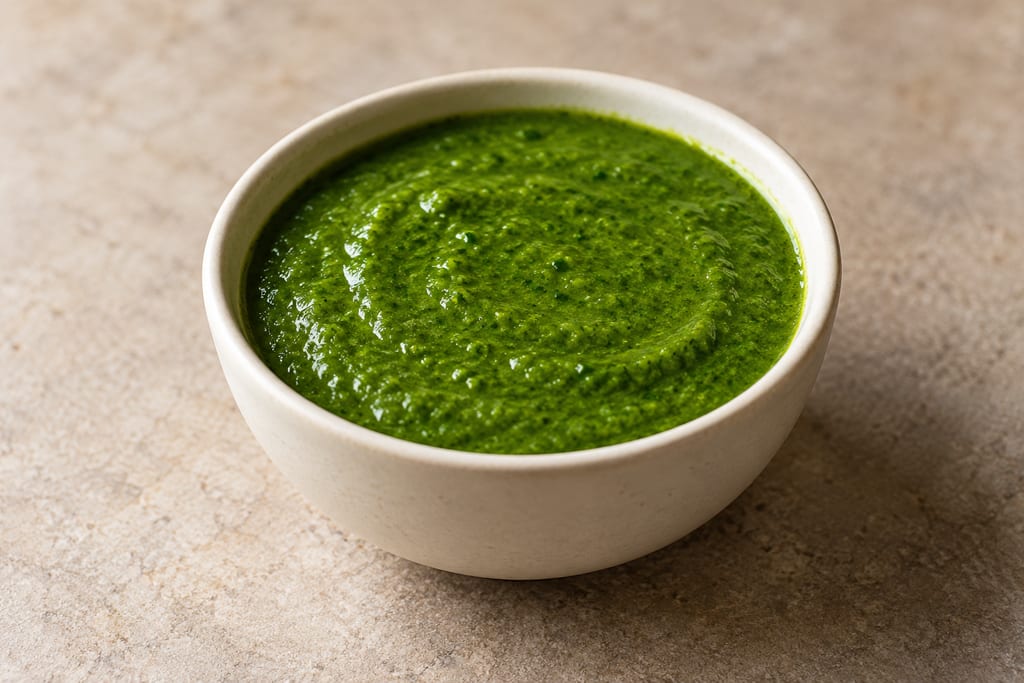
Coriander-mint chutney
A cold-blended coriander and mint chutney with ginger, green chilli and optional cumin and lemon; the author serves it with snacks, chaat and sandwiches.
 FermenteaWhere food goes to change
Spices and aromatics
Mint is the fresh leaf of aromatic Mentha plants, chiefly spearmint and peppermint. It gives chutneys, yoghurt sauces and fermented drinks a cool, sweet, green note.
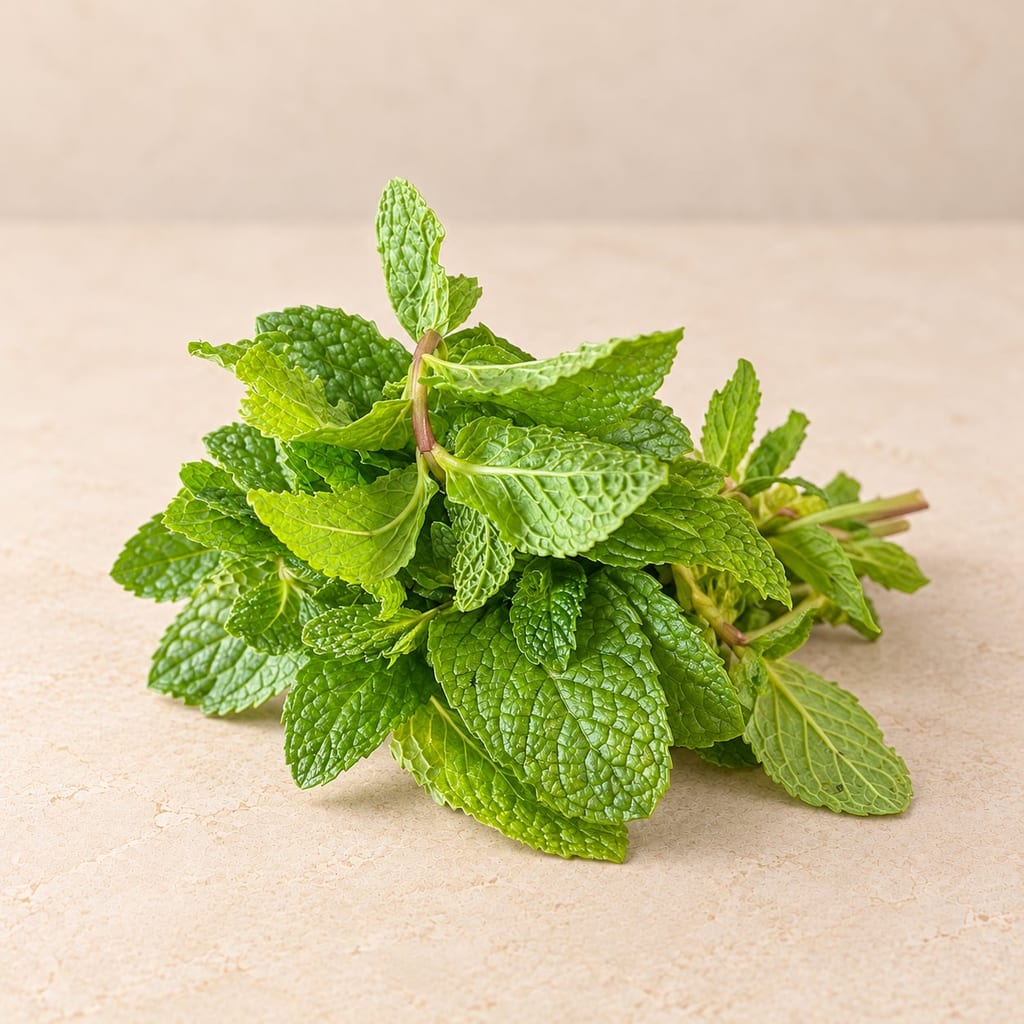
Mint is the fresh leaf of plants in the genus Mentha, a group of strongly scented perennial herbs in the mint family, Lamiaceae. The plants stand 10 to 120 centimetres tall and have square stems, leaves in opposite pairs with serrated edges, and small white, pink or purple flowers packed in rings along the stem. Leaf colour runs from dark green to purple-tinged or pale yellow-green. Mint spreads by runners, which is why it is the herb that takes over a garden bed.
How many mints there are depends on who is counting. A conservative revision recognises 18 species and 11 hybrid species, Kew's Plants of the World Online lists 24 species and 15 hybrids, and more than 3,000 names have been published for the genus. Mints cross freely wherever two of them grow together, so much of what is sold as a species is a hybrid or a clone kept going by cuttings.
For a cook the genus divides into two smells. Peppermint and the corn mints carry menthol and menthone, which give the sharp, cooling, almost medicinal note of mint sweets and toothpaste. Spearmint carries carvone and smells sweeter, greener and warmer. Spearmint is the mint most kitchens mean when a recipe says only "mint": it is the one in mint sauce, in Moroccan tea, in chutney and in a bowl of yoghurt with cucumber. Peppermint is the mint of sweets, liqueurs and tea bags.
The word mint comes from Latin mentha, which comes from Greek míntha and, before that, a Linear B word written mi-ta. In Greek myth Minthe was a nymph loved by Hades; in the version in Ovid, Persephone or Demeter turned her into the plant, or Hades caused the fragrant plant to grow from her dust. The myth fixes the plant in the Greek world, and a mountain called Mount Minthe near Pylos is named in this tradition. The Persian word pudna, for pennyroyal, gave rise to the Indo-Aryan pudīna, the name by which mint is known in India.
Greek and Roman herbals name several mints, including works by Hippocrates, Dioscorides, Galen, Cato, Ovid and Pliny the Elder. The oldest surviving illustrations of mint species are in the Vienna Dioscorides, a manuscript prepared in Constantinople in 512 CE for the princess Juliana Anicia. The Roman cookbook attributed to Apicius includes a mint sauce for roast lamb or kid. Spearmint is traditionally said to have reached England with the Romans by the fifth century, but that account does not date the beginning of its cultivation there.
Arabic- and Persian-language medical writing carried Greek herb traditions forward and added new uses. Majusi, writing in 994 CE, prescribed raw mint mixed with vinegar for fainting and vomiting; Ibn Sina, who died in 1037, recommended its sherbet. Sekanjabin is a honey-and-vinegar drink flavoured with mint. John Gerard's 1597 Herbal recommends spearmint for watering eyes and for wasp and bee stings. English household books later record mint sauce made with chopped mint, sugar and vinegar; by the mid-eighteenth century it was established with lamb. In 1816, French cook Louis Eustache Ude noted that England served mint sauce with sugar and vinegar in a sauceboat, while France used maître d'hôtel sauce.
Peppermint is a very young plant by comparison. It is a hybrid of watermint, Mentha aquatica, and spearmint, Mentha spicata, and it is sterile, so every plant is a clone. John Ray published it in 1696 from a find in Hertfordshire credited to a Dr Eales, and it entered the London Pharmacopoeia in 1721. Linnaeus gave it the name Mentha × piperita in 1753.
Growing mint for oil became an industry in England in the 1750s. By 1796 about 40 hectares of peppermint were grown near Mitcham, south of London, then harvested and carried to London for distillation. Over the next twenty years the district spread to ten townships. Mitcham peppermint travelled with settlers to North America; commercial peppermint was being raised in Massachusetts by 1812, and nine distilleries worked in New York by 1830. In 1853 Albert M. Todd brought roots of Black Mitcham to Michigan. By 1915 Todd was growing several hundred acres of Scotch spearmint, a cross of corn mint and spearmint, which out-yielded native spearmint. Mitcham cultivation ended by 1940. A review of Japanese mint history reports that corn mint (Mentha arvensis) was distilled for menthol in Japan, where a menthol eye medicine appears in the oldest surviving Japanese medical text of 984 CE; Japan began exporting menthol in 1873.
Today most mint oil comes from China, India and Japan, where corn mint is distilled for menthol, and the United States mint oil trade, at its peak in 2011 near 3,175 tonnes of peppermint oil and about 1,000 tonnes of spearmint oil, has declined as Asian menthol grew. Counted as plant production rather than oil, the leading peppermint producers reporting to the Food and Agriculture Organization in 2018 were Morocco, Argentina, Mexico, Bulgaria and Spain, and a later table gives Morocco 27,784 tonnes in 2022 out of a world total of 35,547. The living genetic stock is kept in a collection at Corvallis, Oregon, which holds about 450 clones of 34 mint types.
Mint's scent is essential oil held in small glands on the leaf surface. The oils are mixtures of terpenes and the reported composition varies enormously with species, chemotype, growing site, soil, the stage the plant has reached when cut, and even whether the leaf was analysed fresh or dried. A review of the published analyses found one species of watermint, Mentha aquatica, with 26 distinct chemical types, and spearmint oils in which a single compound, piperitone oxide, made up 36 to 95 per cent of the oil.
Two families of compound define the cook's mints. In peppermint the oil is dominated by menthol, a cooling alcohol, with menthone beside it; one analysis gave menthol 41 per cent and menthone 23 per cent, and the dried leaf yields 0.3 to 0.4 per cent volatile oil. The proportions swing widely: a commercial peppermint oil bought in New Delhi measured 19 per cent menthol, while corn mint oils analysed in China and Brazil ran from 29 to 81 per cent, which is why the same word covers a mild leaf and a harsh one. In spearmint the signature compound is (−)-carvone, at 40 to nearly 68 per cent of the oil in different studies, accompanied by limonene, which adds a citrus note, and 1,8-cineole. Spearmint carries almost no menthol, which is why it tastes warm and sweet instead of icy. Pennyroyal and Corsican mint are different again, with pulegone as their main compound.
Warmth and light matter. Peppermint wants long days with warm to hot conditions and cool nights to strike the right balance of oil compounds, and its menthol content is higher at flowering than at budding. Spearmint leaves lose their aromatic appeal once the plant has flowered.
Mint seasons foods that may themselves be fermented, including yoghurt sauces and chutneys. It does not act as a starter in the preparations described here. Its fresh, cool aroma can complement sourness and salt, but the herb is present for flavour.
Laboratory studies find antimicrobial activity for some mint oils, but effects in food depend on the food matrix. Fat, protein, salt and water activity can limit the activity of essential oils, and their results in culture cannot be carried directly over to a recipe. Menthol, a major compound in peppermint, is a weaker antibacterial than phenolic compounds such as thymol and carvacrol.
A study tested peppermint oil in tzatziki, a cucumber-and-yoghurt dip: concentrations from 0.5 to 2.0 per cent eliminated added Salmonella enteritidis there, while the effect was not seen in pâté. These are oil concentrations tested in a study, not ordinary amounts of fresh leaf. The results do not show that mint leaves make a yoghurt sauce safe or preserved.
Dried mint is the dehydrated leaf form. It is sold separately from fresh mint and has a different texture and aroma.
Spearmint, Mentha spicata, native from Ireland to southern China, is the common kitchen mint. It comes as plain garden mint, as a crinkle-leaved form sold as Crispa or Moroccan mint, as Tashkent and Spanish selections, and as the tea mint grown in the mountains of Morocco. Peppermint, M. × piperita, is the cooling hybrid, with forms such as Black Mitcham and Chocolate mint. Scotch spearmint, M. × gracilis, a cross with corn mint, is called ginger mint, and Cuban or mojito mint is M. × villosa, a cross of spearmint with round-leaved mint.
Apple mint, Mentha suaveolens, and its hybrid false apple mint are grown for culinary and ornamental use. Corn mint, M. arvensis, is also called field mint and is cultivated for menthol in parts of Asia. Recipe and market names such as mint, pudina, spearmint and peppermint can refer to different Mentha plants or products. Identify the species or form from the label or source when it matters; taste alone does not establish a plant's identity.
Choose bunches with green, unwilted leaves and sound stems. The University of Illinois Extension describes keeping cut stems in water for three to seven days and refrigerating leaves in a plastic bag for about a week. Colorado State University Extension advises against refrigerating or freezing mint and recommends hanging it to dry. These sources give different storage advice. Neither establishes a universal storage duration for every bunch or cultivar, so use fresh mint promptly and follow the conditions that suit the product and purpose.
For drying, cut the mint just as the flowers begin to open; for fresh use, pick as needed, because frequent cutting produces new growth and the new growth has the most flavour. Dried leaves are used in cooking and tea.
Mint can cause allergic reactions in some people, from oral tingling and heartburn to contact dermatitis, and, rarely, anaphylaxis. The strong peppermint oil should be kept away from the faces of small children.
Mint is used in British mint sauce for roast lamb, in mint jelly in the United States, in Syrian limonana, and in Indian curries and green chutneys. Mint is also a necessary leaf in Tuareg tea, and it is used with lamb in Middle Eastern cooking. Cocktails such as the mint julep and mojito use it as well. These examples span different species, preparations and serving contexts; a recipe that says only “mint” may not identify the cultivar.
Mint often appears with sour ingredients: English mint sauce combines the leaf with vinegar, while chutneys and raita may pair it with citrus, yoghurt or tamarind. Sekanjabin combines mint with honey and vinegar. The form and proportions vary by recipe, and those fresh preparations should not be treated as preserved solely because they contain an acidic ingredient.
Mint grows best in cool, moist soil rich in organic matter, with a pH from 6 to 7.5, in full sun to partial shade, and it grows almost anywhere in a temperate climate. It spreads by runners above and below ground, so gardeners plant it in a pot or a bottomless container, though the roots can escape the latter. Peppermint is sterile and propagated only from cuttings of runners; spearmint and corn mint do set viable seed but are normally grown from cuttings too, and one hectare of well-grown stock can supply seven to ten hectares of new planting. Divide plants every three to four years and cut the flower spikes as they appear to keep the leaf flavour. Frequent cutting makes new growth, which is the best-tasting. The leaf is best picked in the morning after the dew dries, when the oil content is highest.
The great disease of the mint industry is verticillium wilt, caused by the soil fungus Verticillium dahliae. The old peppermint cultivar Black Mitcham is very susceptible and also sterile, which has made it hard to improve by breeding; resistant cultivars such as Todd's Mitcham and Roberts Mitcham were developed by radiation and mutation breeding.
The origin of Black Mitcham peppermint has not been established. A proposed parentage for spearmint involves Mentha longifolia and M. suaveolens, and peppermint is a hybrid with watermint, but the reviewed sources do not establish when or where these plants first arose. A review mentions peppermint in connection with the Ebers Papyrus, a claim that is uncertain because peppermint was formally described much later. Mount Minthe near Pylos has been proposed as a possible location associated with triploid spearmint, but this does not establish a birthplace.
The native range given for spearmint; other mints have their own ranges across Europe, Asia and Africa.
Named in the myth of Minthe; suggested in one study as a possible origin of triploid spearmint, which is not established.
The English centre of peppermint growing and distillation, about 40 hectares by 1796.
Corn mint was distilled for menthol; the oldest Japanese medical text mentions it.
Black Mitcham roots were planted in St Joseph County; Scotch spearmint was added in 1915.
The largest reported peppermint producer, and the home of Maghrebi mint tea.
Pudina is a staple herb of curries and chutneys; corn mint oil is distilled there.
A cold-blended coriander and mint chutney with ginger, green chilli and optional cumin and lemon; the author serves it with snacks, chaat and sandwiches.
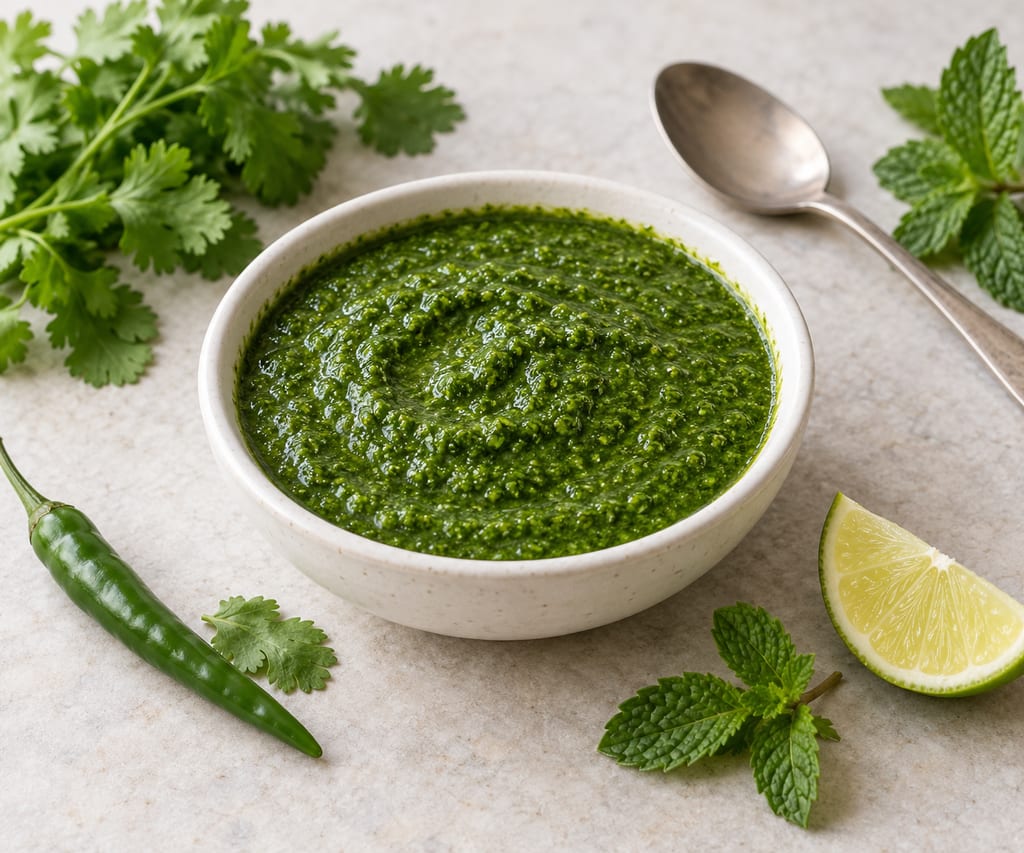
A fresh, uncooked green chutney blended from coriander, mint, chilli and citrus. This measured development batch is untested and intended for prompt serving.
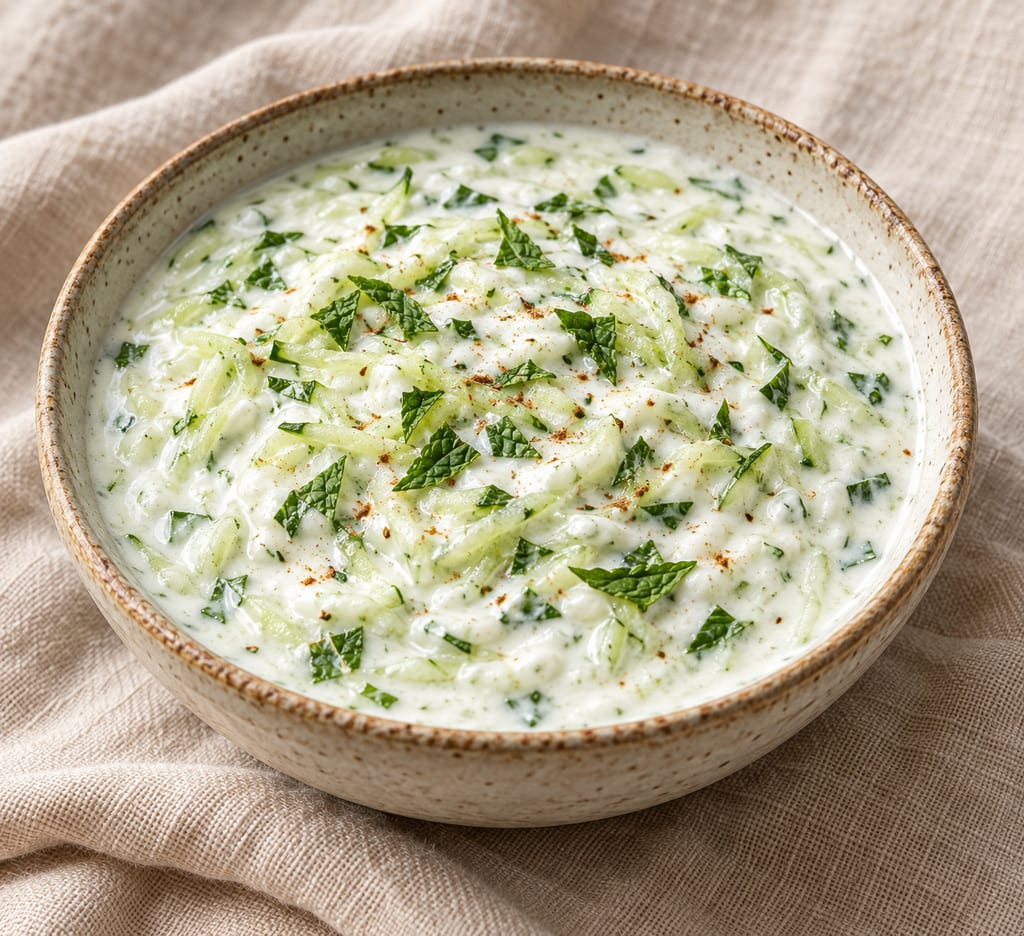
Cucumber and chopped herbs are folded into plain yoghurt with salt and roasted cumin for a cool South Asian accompaniment to spiced food.
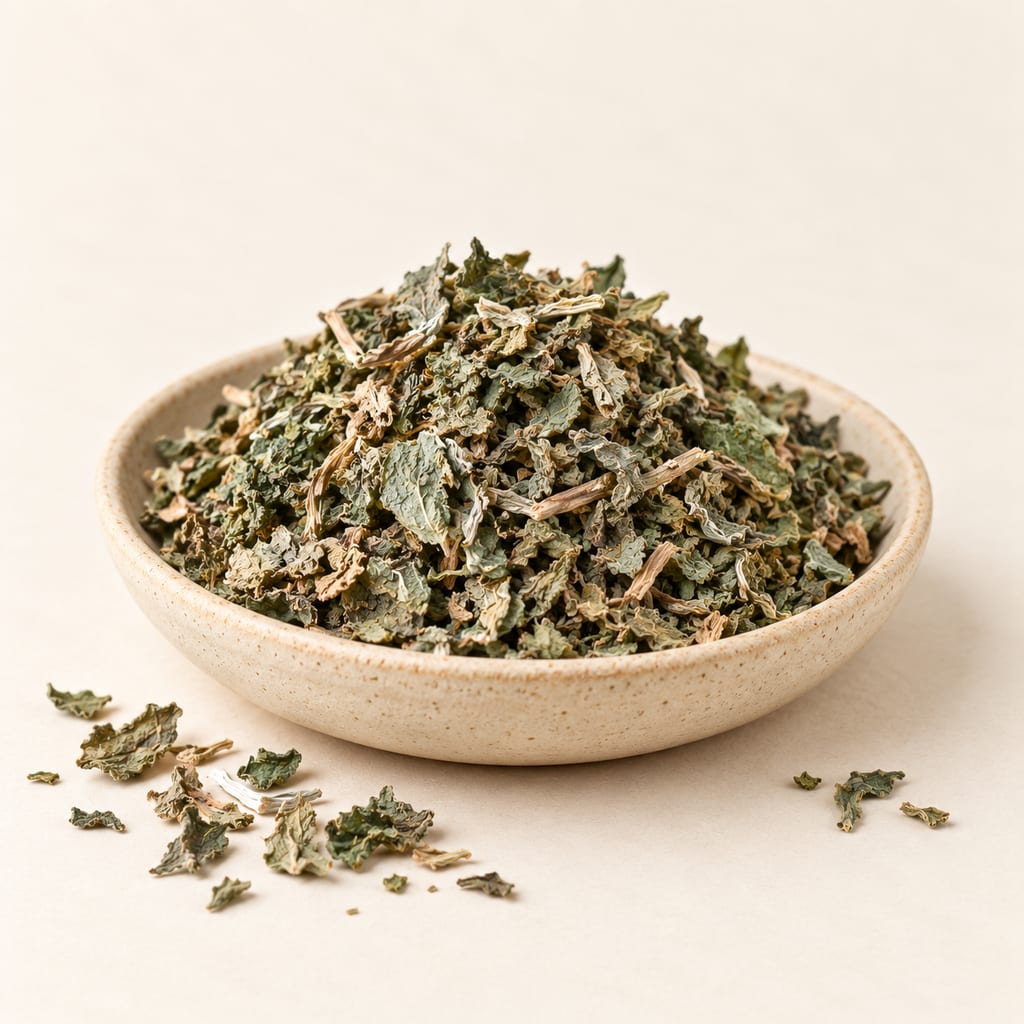
Dried mint is the leaf of a Mentha plant after moisture has been removed. The exact species varies by product; the linked Halloumi recipe specifies only optional dried mint, while separate standards distinguish spearmint from peppermint.
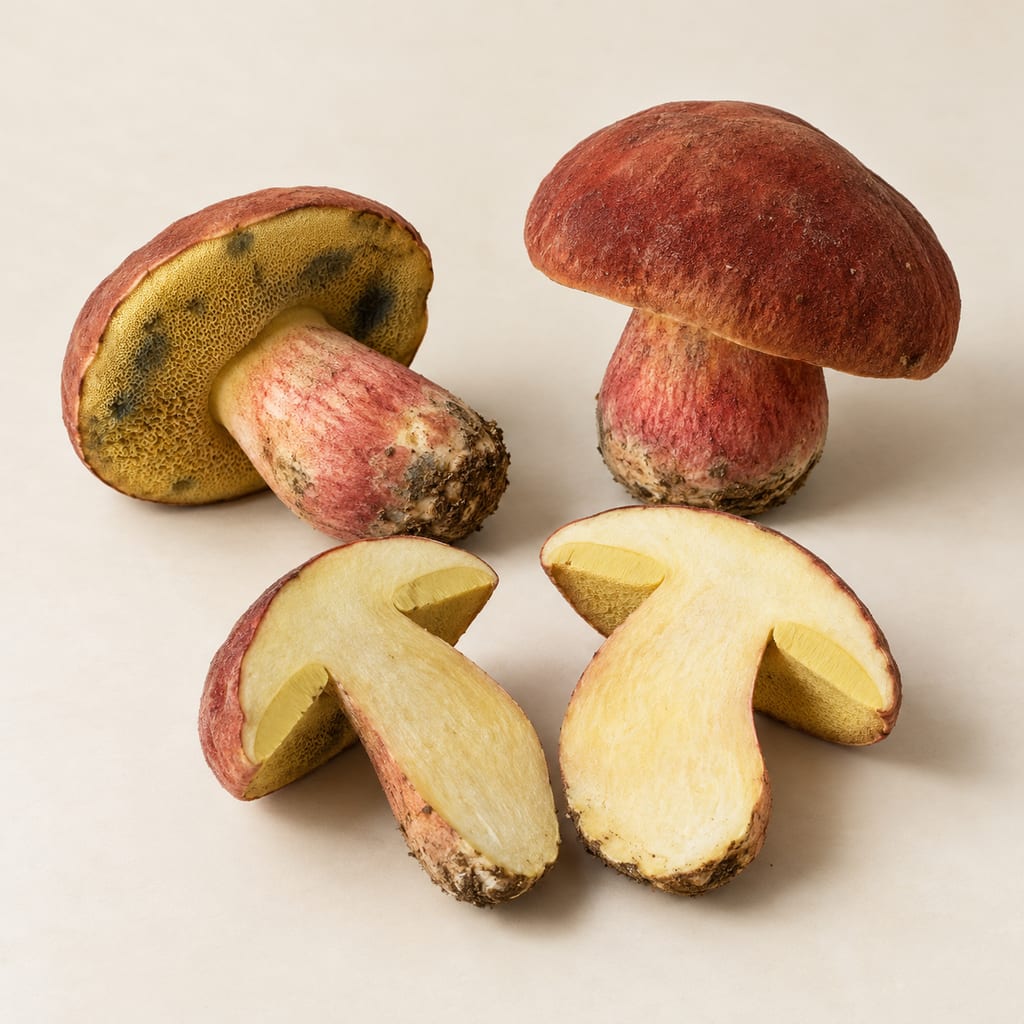
A red-and-yellow bolete described from Michigan and also listed in Mexican fungal records. Historical sources classify it as food, but its species limits, Mexican range and safe food use need careful qualification.
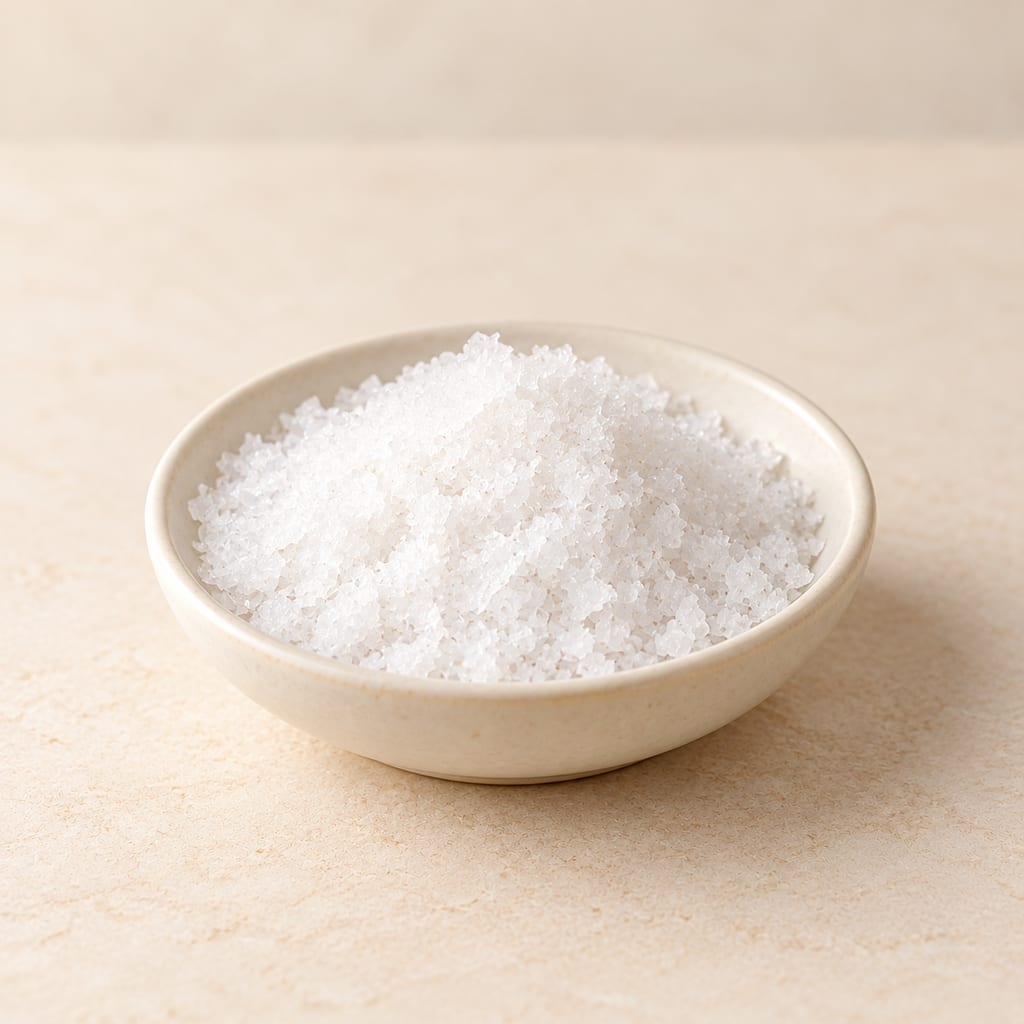
Coarse cooking salt named for its use in koshering meat. Its flakes vary by maker, so crystal shape, additives and the recipe’s unit all matter.

At North Abydos in Egypt, a fixed early Dynastic brewery comprised parallel semi-subterranean installations with rows of ceramic mash vats; excavation reports revise their number, scale and estimated batch capacity.

Ají amarillo is the orange-yellow Peruvian chilli cultivar group of Capsicum baccatum, used to colour and season huancaína sauce and ají de gallina. Published heat estimates do not establish one range for the named cultivar.

Toasted almonds are whole sweet almond kernels dry-roasted until golden to brown. Heat replaces their marzipan note with a roasted, nutty one; they thicken and flavour romesco.

Kodiak salmon, halibut and cod cut as seg'aq and hung on an initaq rack to become tamuuq, with kac'amaasaq and kupcuunaq named as different results.

Aniseed is the dried ripe fruit of Pimpinella anisum, an aromatic Apiaceae spice commonly called a seed. It adds a sweet, warm aroma to breads such as Moroccan krachel and South African mosbolletjies, and is distinct from star anise.

A fixed Late Chalcolithic installation in Areni-1 cave combined a shallow clay pressing basin with a large jar set into the cave floor and storage vessels nearby.

Ripe avocado flesh is the soft, buttery, fat-rich pulp of Persea americana, eaten raw. It is low in acid, so it is a fresh ingredient that needs care in chilled dishes.

A portable dome and pan used over a hearth, with embers on the lid and heat from below. Regional peka and saç forms share this principle while differing in materials, pan shape and how the food is cooked.
No community contributions have been published for this entry yet.
Sign in to contribute. Published comments and photos are free to read.
Frontiers in Plant Science, 2020 (Vining, Hummer, Bassil, Lange, Khoury and Carver)History · Taxonomy · Chemistry
Crop Wild Relatives as Germplasm Resource for Cultivar Improvement in Mint (Mentha L.)Number of Mentha species and hybrids by authority; more than 3,000 names.
Name from Greek myth; Mount Minthe and triploid spearmint.
Greek, Roman and Islamic herbal references; Vienna Dioscorides of 512 CE; Majusi, Ibn Sina.
Mitcham growing from the 1750s; Todd and Michigan; Japanese menthol; production figures; Corvallis collection.
Carvone in spearmint and menthol and menthone in peppermint; Black Mitcham wilt susceptibility and sterility.
Cited in: A cool leaf with two different smells; The name and the first records; How peppermint was made and how mint became a crop; What makes the smell; Open points
Plants (Basel), 2018 (Salehi and colleagues)Chemistry · Antimicrobial · Cultivation
Plants of Genus Mentha: From Farm to Food FactoryComposition varies with species, chemotype, growing site, stage and material; carvone range in spearmint; M. aquatica chemotypes.
Growing conditions, soil pH 6 to 7.5, propagation and the hectare ratio.
Food matrix effects on mint oils: fat, protein, pH; menthol a weak antibacterial.
Peppermint oil eliminated Salmonella enteritidis in tzatziki and did not help in pâté.
Cited in: A cool leaf with two different smells; What makes the smell; What mint does in fermented foods; Growing mint
Frontiers in Microbiology, 2012 (Hyldgaard, Mygind and Meyer)Antimicrobial · Science
Essential Oils in Food Preservation: Mode of Action, Synergies, and Interactions with Food Matrix ComponentsTerpenes without functional groups have low inherent antimicrobial activity; phenolic terpenoids are far more potent.
Essential oil composition varies with plant, season and conditions.
Cited in: What mint does in fermented foods
WikipediaTaxonomy · Culinary · Secondary
MenthaFamily, plant description, hybrid parentage, menthol and carvone, etymology and myth, regional uses, harvest and storage, allergic reactions.
Cited in: A cool leaf with two different smells; The name and the first records; What makes the smell; The mints you will meet; Using, choosing and keeping fresh mint; Where mint goes on the plate; Growing mint
WikipediaHistory · Chemistry · Secondary
PeppermintParentage; Ray 1696, 1721 Pharmacopoeia, Linnaeus 1753; oil composition; verticillium wilt and resistant cultivars; FAOSTAT figures.
Cited in: How peppermint was made and how mint became a crop; The mints you will meet; Open points
WikipediaCulinary · History · Secondary
SpearmintNative range; carvone; uses; cultivars; introduction to England.
Cited in: The name and the first records; The mints you will meet
WikipediaHistory · Culinary · Secondary
Mint sauceMint sauce recipes of 1914; Pliny and Apicius; established by the mid-eighteenth century; Ude 1816.
Cited in: Where mint goes on the plate
University of Illinois ExtensionCultivation · Storage
MintRhizomes spread; containers; divide every 3 to 4 years; cut flower spikes; fresh storage 3 to 7 days; dry at first flowers.
Cited in: Using, choosing and keeping fresh mint; Where mint goes on the plate; Growing mint
Colorado State University Extension, PlantTalkCultivation · Storage
Mint (Mentha)Moist soil rich in organic matter; harvest in the morning when dew has dried; do not refrigerate or freeze; hang to dry.
Cited in: Using, choosing and keeping fresh mint; Growing mint