A name that changed with the forest
The winter chanterelle is generally treated today as Craterellus tubaeformis. Its former combination, Cantharellus tubaeformis, remains common in field guides and food writing; it is the basionym, the original name behind the later combination. “Chanterelle” is a familiar food name, not a promise that every mushroom bearing it belongs to Cantharellus.
The Swedish name trattkantarell is documented in 1896 and Norwegian traktkantarell in 1936. These name records do not establish when people first ate the mushroom. Across Scandinavia, public encouragement of mushroom gathering dates back much further, while everyday household use became more established after the 1880s. The particular rise in popularity in Sweden came later, especially in the late 1970s and early 1980s.
Sources for this section
A small trumpet in moss
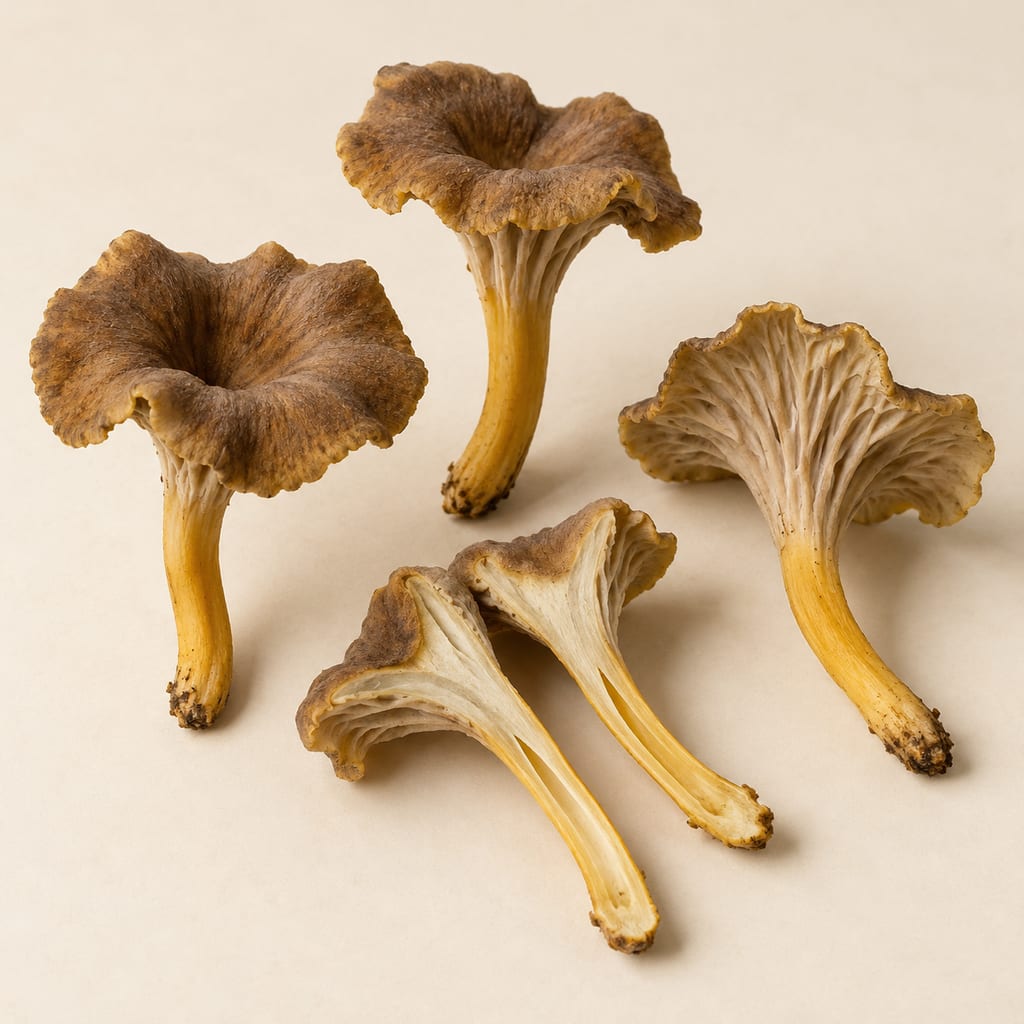
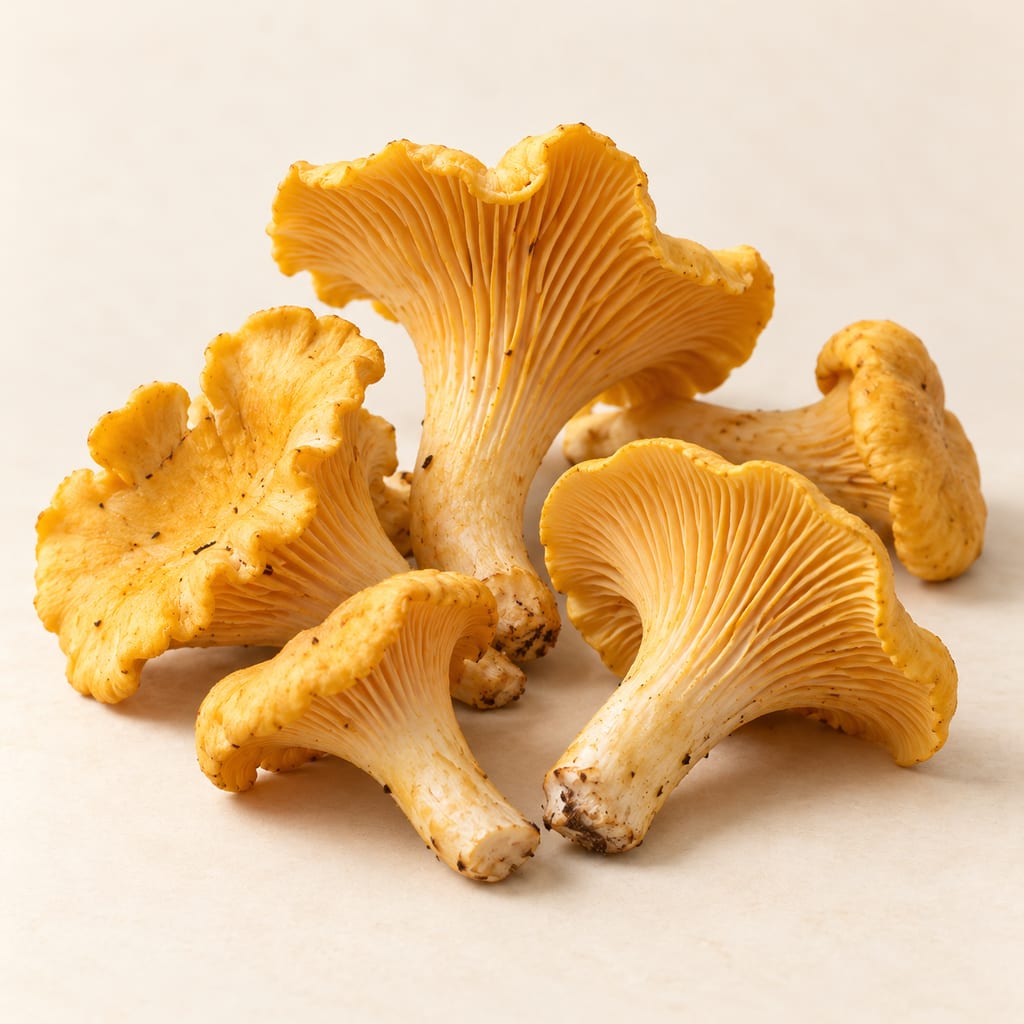
The cap is usually gray-brown, though its shade varies. It begins as a shallow funnel with a central depression that can deepen into a narrow tube. Underneath are thick, blunt folds rather than thin blade-like gills, and these folds run down the stem. The slender stem is yellow to yellow-brown and hollow; the cap flesh is thin and pale. It is small and can be partly hidden in moss, so a patch may be easier to see than an individual mushroom.
In Finland it is described as common in southern and central regions, particularly in moist mossy conifer forest. Finnish guidance places the usual season around September or October onward, with fruiting sometimes continuing after frost until snow covers the ground. That calendar belongs to Finland; latitude, weather and forest conditions shift the season elsewhere. The tissue is delicate and the stem can be somewhat tough; the taste is described as mild and slightly sweet, with a weak smell.
Sources for this section
Forest ecology and uncertain borders
Craterellus tubaeformis is mycorrhizal: its underground mycelium associates with living tree roots. The visible mushroom is only the short-lived fruit body of a larger organism. A molecular study in northwestern Oregon found occurrence significantly related to stand age and well-decayed coarse woody debris. These are findings from that regional study, not universal habitat rules.
Documented food use is in Europe, and species concepts can differ outside Europe. Older North American guides applied the same name to Pacific Northwest mushrooms, but some of those historical records may refer instead to a distinct, provisionally named species, Craterellus neotubaeformis. A shared historical label does not establish a continuous range across continents, so older North American applications remain unresolved.
Sources for this section
From the autumn basket to the kitchen
Winter chanterelles are eaten fresh, frozen or dried. Their thin flesh lends itself to drying, which lets a seasonal harvest be used later. Finnish sources describe frying and adding them to soups; contemporary Scandinavian cooking also uses them with potatoes, game, veal and fish, and in sauces. Their flavour is gentle and earthy rather than assertive.
A reported Nordic practice is to soak dried funnel chanterelles before cooking, using water, wine or milk. It is a documented practice, not a standardized method with a universal soaking time. The supplied catalogue also records pickled use, but the evidence here does not establish a tested preservation formula, acidity target or storage life. No fermentation process is established for this ingredient page. Use a tested preservation recipe rather than inferring safety from appearance or taste.
The mushroom entered formal trade. A Nordic Council report covers commercial wild-mushroom markets, and Spain’s 2009 marketing decree lists the species for fresh marketing under specified sanitary conditions. A market listing is not a guarantee that any wild specimen is correctly identified or safe.
Sources for this section
Identification and caution
Wild mushroom safety depends on correct identification, not on the fact that a species is eaten somewhere. Norway’s poison-information guidance warns that deadly webcaps can grow in the same places and resemble trumpet chanterelles in colour. It advises examining mushrooms individually, keeping species separate and eating only those identified with complete certainty.
The Finnish authority notes other lookalikes. Cantharellus lutescens may resemble a funnel chanterelle from above but differs in its underside, stem and habitat. Omphalina chrysophylla can also be confused in appearance, though it is associated with decaying conifer stumps or exposed surface roots and is not edible. These comparisons are not a field key. A photograph or online description cannot confirm a wild specimen.
Sources for this section
Places
Finland
Documented use · Country evidenceFinnish authority documents the mushroom as a common edible species and describes its habitat, season and uses; this does not imply all Finland has the same fruiting calendar.
Sweden
Documented use · Country evidenceScandinavian ethnobiological study describes the species’ rise in Swedish foraging culture; not an origin claim.
Norway
Documented use · Country evidenceIncluded in the study’s Scandinavian food-culture context; the cited Norwegian poison guidance is used only for safety, not as evidence of range.