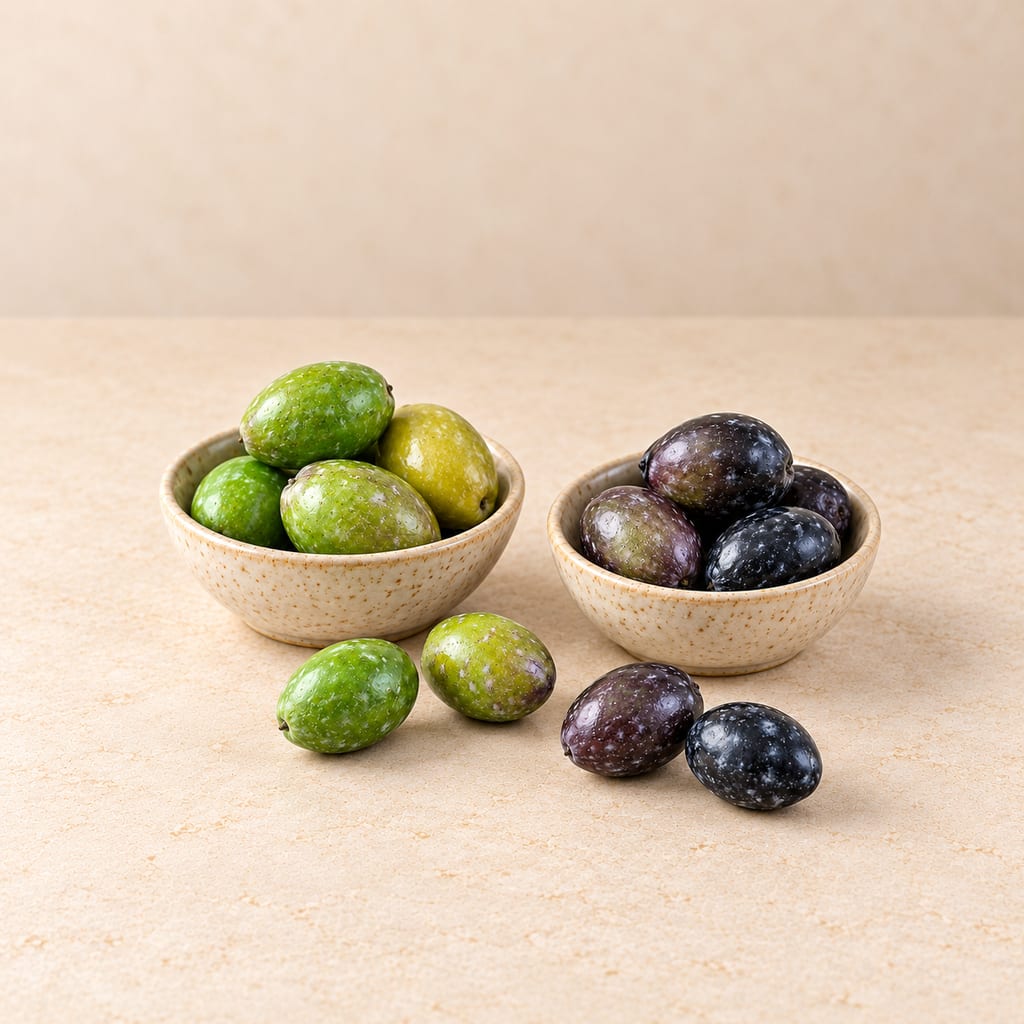
Olives
Olives are the bitter fruit of Olea europaea, made edible by lye, brine or salt, and the raw material of the table olives that are cured and fermented around the Mediterranean.
 FermenteaWhere food goes to change
Traditional method
Natural black olives · Conservolea natural black olives
Ripe olives go straight into brine with no lye and cure for months, mostly by yeasts. The home method here is the University of California two-stage brine.
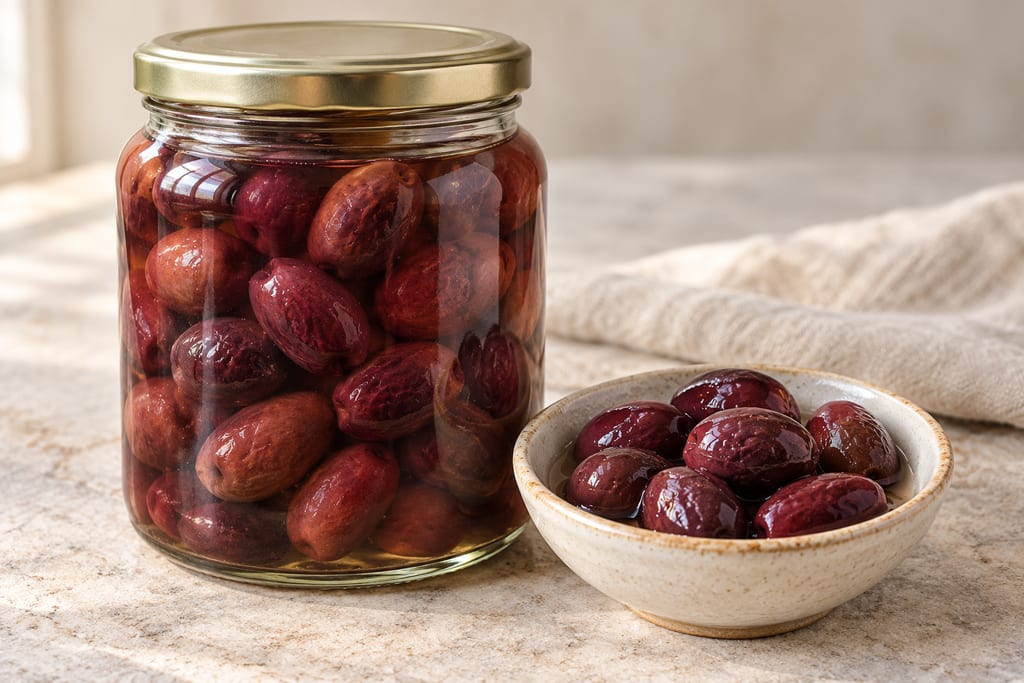
Greek-style black olives in brine are mature olives preserved in a salt solution over several months.
The process gradually reduces the fruit's natural bitterness while changing its flavour, texture and microbiological environment.
The resulting olives may remain slightly bitter, fruity, salty and firm, with varying degrees of wrinkling.
The Greek description is μαύρες ελιές σε άλμη, meaning black olives in brine. Another relevant term is φυσικές μαύρες ελιές, natural black olives.
The olive tree is Olea europaea L., and the edible fruit is a drupe containing a single hard stone.
Black olives are not a separate botanical species. Their dark colour principally reflects fruit maturity and cultivar, although some industrially processed products become black through oxidation.
This recipe is the Greek-style black-olive brining method published by the University of California Agriculture and Natural Resources.
The term describes the style of preservation. The publication does not claim that this specific recipe was collected in a particular Greek village.
Two black olives can look alike and be made in opposite ways. One is darkened by oxidation in an alkaline medium, sealed in containers and heat-sterilised, and comes out uniformly black. The other goes from the tree into salted water and sits there for months while yeasts and bacteria work on it. The International Olive Council treats them as different products.
The council's trade standard defines black olives as fruit harvested fully ripe, or slightly before. Natural olives are green, turning-colour or black olives placed directly in brine, where they undergo complete or partial fermentation. So natural does not describe a colour: a natural black olive is a ripeness class joined to a process, and the process is the one that skips the lye. A third group, treated olives, gets an alkaline treatment first and is packed in brine afterwards. Colour alone does not establish fermentation.
Greek-style is the usual name for the direct-brine version. It labels a process and gives Greece no exclusive ownership of the method.
Olive cultivation developed across the Mediterranean over thousands of years.
Olive trees and olive oil were already important in ancient Mediterranean economies.
However, the existence of ancient olive cultivation does not establish the first date when people used the exact two-stage brining method described here.
Olives naturally contain intensely bitter phenolic compounds, particularly oleuropein.
Before they can be eaten comfortably, these compounds must be removed or transformed.
Mediterranean communities developed several ways to accomplish this, including direct brining, dry salting and alkaline treatment.
Natural brine curing became one of the major traditions.
Modern commercial classification distinguishes Greek-style natural black olives from Spanish-style green olives and California-style oxidized black olives.
These are manufacturing categories, not simply differences in fruit colour.
The Greek table-olive association says the Konservolia cultivar was traded in the nineteenth century and that an export effort began in the early twentieth. That is the processors' own account of a commercial type. It says when Konservolia entered trade, not when anyone first put a ripe olive straight into brine, and no source used here dates that.
Two cultivars carry most of the Greek story. Natural black Kalamata olives are made in the Peloponnese and Central Greece, with Aitoloakarnania, Lakonia and Fthiotida among the producing prefectures, and the Greek table-olive association says they are picked by hand from late October into early winter. Natural black Konservolia, also spelled Conservolea, comes from Central Greece: Fthiotida, Fokida, Magnisia, Aitoloakarnania, Arta and Evia. The association calls it the country's oldest variety.
Conservolea accounts for around 25 percent of annual Greek table olive production, about 40,000 tonnes, and producers hand-pick it from September to December. That window covers every colour and style of the olive, so it is not a black-olive calendar.
Neither name is a synonym for natural black olives in general. They are cultivars that are often cured this way.
Ingredient: Firm, fully coloured olives — Quantity: As many as the vessel accommodates
Ingredient: Pickling salt for initial brine — Quantity: 8 oz (¾ cup) per US gallon water
Ingredient: Pickling salt for strong brine — Quantity: 1 lb (1½ cups) per US gallon water
Ingredient: Cool water — Quantity: As required for brines
The original recipe uses US measures.
One US gallon is approximately 3.785 litres, but the original source formula should be preserved rather than replaced with rounded metric percentages.
For measuring salt, mass is generally more reproducible than cups because crystal sizes differ.
Do not alter the documented brine concentrations without a properly evaluated alternative process.
Choose mature, firm fruit that is dark red to purplish black.
The original method specifies fruit harvested before the first frost.
Olives should be free from bruising, rot and obvious defects.
Sorting by size helps them cure at similar rates.
The publication identifies Manzanillo, Mission and Kalamata among the cultivars commonly used for this style.
These are different olive cultivars; the method is not restricted to one.
The degree of ripeness affects bitterness, pigment and texture.
The California guide says to process fruit within a few days of harvest if possible and to hold it meanwhile at 41–50°F (5–10°C), preferably in shallow, ventilated crates. At 32–36°F (0–2°C) for two weeks or more, olives suffer chill injury.
Use food-grade plastic or glass containers that can be made airtight.
The publication recommends one-quart glass jars as the smallest container size.
A separate vessel is needed to mix the brine.
Cleanliness is important because the olives undergo a long period of storage and microbial activity.
The method also requires routine inspection for pressure, leakage and surface growth.
Remove bruised, defective or damaged fruit.
If practical, separate olives into batches of similar size.
This helps make curing more even.
Place the olives in clean food-grade vessels.
Do not crush or crack them.
This is a whole-fruit brining method.
For each US gallon of cool water, dissolve:
\- 8 oz pickling salt, equivalent to the publication's ¾ cup measure.
Cover the olives with this brine.
Close the lids loosely.
Store at 60–80°F, approximately 16–27°C.
The loose initial closure allows gas produced during early fermentation to escape.
After seven days, discard the initial brine.
Prepare strong brine using:
\- 1 lb pickling salt per US gallon water, equivalent to the publication's 1½ cups.
Cover the olives with fresh strong brine.
Close the lids firmly.
Store the olives for at least two months.
They may still retain some bitterness at this point.
The exact amount depends on cultivar, maturity and processing conditions.
For a less bitter product, replace the strong brine with newly prepared strong brine at monthly intervals for two or three months.
Each new brine removes additional bitter compounds.
Use the same published strong-brine concentration.
Check regularly for bulging lids, leakage and surface growth.
If gas causes a lid to bulge, carefully release the pressure as directed in the original method, then close it again.
Replace any lost liquid with the prescribed strong brine.
The publication permits fairly bitter olives to be eaten after two months.
For less bitter olives, store them for at least three months.
Some fruit may require six months or longer.
The original tested home-pickling guide allows these olives to remain in strong brine in a cool, dark place for at least one year, provided containers remain airtight and the lids do not corrode.
This is a source-specific storage recommendation, not a claim applicable to arbitrary olive ferments.
After opening, refrigerate any remaining olives.
By weight of water, the California medium brine works out at roughly 6 percent salt and the strong brine at roughly 12 percent. That puts the strong brine above the 8–10 percent range a review of the olive literature gives for Greek-style brines, which it describes as driven mainly by yeasts, with lactic acid bacteria and gram-negative bacteria also involved.
The California calendar is about taste: it says nothing on when an olive becomes safe, and it asks for no pH meter, airlock, fermentation weight or temperature control. Its one stated rule is that olives that become mouldy, soft or bad-smelling must not be eaten or tasted. The rule does not work in reverse. A jar that looks and smells normal has not shown itself safe, and neither have bubbles, a familiar taste or a good colour. The method has no home pH or salt endpoint, and the figures from the Greek experiments are not substitutes for one.
The major compound is oleuropein, a phenolic secoiridoid.
It has a pronounced bitter taste.
During curing, some oleuropein and related phenolic compounds diffuse out of the olive flesh into the brine.
Other portions are transformed through enzymatic reactions.
Beta-glucosidase and esterase enzymes can participate in converting oleuropein into simpler compounds, including hydroxytyrosol-related products.
These reactions gradually reduce bitterness.
Brine changes maintain a concentration difference between the olive and the surrounding liquid, encouraging additional bitter compounds to move out.
This is why repeated fresh brine produces a different result from leaving olives undisturbed in the same liquid.
Lye removes oleuropein with a chemical step before the olives go into brine. Greek producers of natural black olives ferment without chemical debittering and pay for that with time. A health review puts total phenol loss at about 32–58 percent across spontaneous and controlled fermentations, so the olive that results is milder, not bitter-free. The same review notes that there are no clinical studies on the health effects of eating table olives; the phenol figures describe what the fruit loses in the brine, not what eating it does.
Natural black-olive fermentation can involve both yeasts and lactic-acid bacteria.
Its microbial ecology differs from that of an ordinary lightly salted cabbage ferment.
The relatively high salt concentration restricts many microorganisms.
Yeasts are often especially important in natural black-olive preparations.
Some lactic-acid bacteria may produce organic acids, helping change the brine pH.
Other microorganisms can contribute desirable or undesirable compounds.
The exact succession depends on olive cultivar, salt concentration, temperature and natural microbial populations.
It should not be assumed that every natural black-olive batch becomes dominated by Lactobacillus plantarum.
Research on natural black olives has documented batches in which yeast activity was prominent and lactic-acid bacteria were much less abundant.
This is a major reason that commercial control of natural olives requires more than simply waiting for bubbles to appear.
A 2002 study fermented Conservolea black olives for up to 190 days at 25°C, at 18°C and at ambient temperature, in brines of 4, 6 and 8 percent salt. At 4 and 6 percent, at 25 and 18°C, lactic acid bacteria grew well, and the brine became more acidic and its pH fell. At 8 percent, yeasts were favoured instead, with lower acidity and higher pH. Four lactic acid species were identified, among them Lactobacillus plantarum and L. pentosus. The best result came at 25°C and 6 percent salt, which reached the authors' target of 142 millimoles of lactic acid per litre (1.28 percent weight by volume) and a pH of 3.8. Olives at 25°C were judged ready to eat after 5 months.
A later paper followed Kalamata olives bought from a processor in Katerini, in northern Greece, harvested in December 2015. Twelve vessels each held 8 kg of olives and 4 litres of brine, at room temperature, for 187 days. The brine was 7 percent salt, either plain or acidified with 0.5 percent vinegar or 0.1 percent lactic acid. Lactic acid bacteria started at 4.7 log10 colony-forming units per gram, about 50,000 per gram, peaked within a week and had disappeared from the counts by day 20. Yeasts sat near 5.2 log10, roughly 160,000 per gram, from start to finish, and dominated once the bacteria faded. The three brines began at pH 6.65 (plain), 4.44 (vinegar) and 3.04 (lactic acid) and all ended near pH 4.2. Ethanol, a yeast product, peaked at 4.9–5.1 grams per litre around day 60 and fell to 3.5–3.8 by the end.
A study of Conservolea and Kalamata by Italian and Greek researchers found something different: yeasts present throughout, and lactic acid bacteria appearing only in the final stage. The papers disagree on when the bacteria matter. They used different fruit, brines and starting acidity, which may explain part of the gap, but the question is open. The same study proposed compounds measured at 30, 90 and 180 days as markers of how a fermentation is going.
For the trade, the International Olive Council's standard sets limits on the brine for natural olives: at least 6 percent salt, a pH no higher than 4.3 and at least 0.3 percent lactic acid. The best Conservolea brine in the 2002 study, at pH 3.8 with 1.28 percent lactic acid, and the Kalamata vessels in the later study, which ended near pH 4.2, both sit inside the pH limit.
The standard also leaves a door open: a product that does not meet these values may be marketed only if it is made by a traditional method whose food safety an official body guarantees. These are rules for commercial packs. They are not a home test, because a jar in a kitchen has no equivalent check.
Salt draws moisture from the fruit and changes the osmotic environment.
Olives may become slightly shrivelled.
The University of California method specifically notes this as an expected consequence of strong brine.
Some colour may fade during curing and darken again when exposed to air.
These appearance changes do not necessarily indicate spoilage.
However, excessive softening and tissue breakdown can be defects.
Enzymes and undesirable microorganisms may damage cell-wall components, producing an unacceptable texture.
Mature fruit is cured directly in brine, without a preliminary sodium-hydroxide treatment.
This is the category represented by the recipe.
Fruit is packed in salt without being submerged in a conventional brine.
Water leaves the fruit, producing a more wrinkled, concentrated product.
This is a separate method.
On the island of Thassos, in northern Greece, olives of the Thassos cultivar are traditionally layered with coarse salt in concrete tanks and left to cure dry. A 2023 survey measured nine retail samples of these olives from Athens: pH 4.0 to 5.0, water activity 0.58 to 0.91, and 5.26 to 9.15 grams of sodium chloride per 100 grams of pulp. No lactic acid bacteria were detected, and yeasts dominated. Nine shop samples of one style differed widely in how salty and how dry they were.
Kalamata olives may be cured using different processes and finished with vinegar or oil-containing dressings.
The name of the cultivar does not, by itself, specify one manufacturing method.
Green olives may undergo controlled lye treatment before brining.
The alkalinity chemically reduces bitterness.
This is different from direct natural black-olive curing.
Many commercially canned black olives have been darkened through oxidation and heat processed.
Their black colour does not mean they are naturally black-ripe fermented olives.
Greek-style black olives can be served directly after appropriate curing.
They are familiar as table olives with bread, cheese and other Mediterranean foods.
Some are served with olive oil and herbs.
They can be included in salads, baked dishes, stews or olive spreads.
The published method permits soaking finished olives in water overnight to reduce their saltiness.
After soaking, they may be served with a little olive oil.
The soaking changes their preserving conditions, so the prepared portion should not be returned casually to the main stored batch.
Refrigerate prepared leftovers.
A sound finished olive should retain an appropriate texture for its cultivar and treatment.
Some slight wrinkling is normal.
The flavour may retain moderate bitterness.
It should have a recognisable olive aroma without putrid or otherwise objectionable notes.
The brine should remain in contact with the fruit.
However, normal aroma and colour do not guarantee microbial safety.
Mould: Surface mould is a warning sign. Do not taste suspect olives.
Soft, slimy fruit: This may indicate spoilage.
Putrid odour: Reject the product.
Leaking brine: Replace with fresh strong brine as instructed.
Gas pressure: Monitor lids and release pressure carefully if needed.
Corroded lids: Corrosion compromises the container.
Unexpected floating fruit: Gas can collect within the olive tissue, causing floaters and texture defects.
Persistent bitterness: The fruit may require more curing, particularly with larger or less mature olives.
This is one of the stronger recipe records in the collection because the source is a dedicated home-preservation guide prepared by food-safety specialists.
The published salt concentrations, storage temperatures and brine-change instructions should be followed exactly.
The method does not authorize replacing the brine with plain water during long storage or adding arbitrary quantities of herbs, garlic or oil to the main curing vessel.
Do not taste olives that are mouldy, soft or bad-smelling.
For storage, use the tested guidance applicable to this exact method.
Refrigerate the product after opening.
On a shop shelf, natural black olive tells you about a process: ripe fruit, straight into brine, no lye, months of slow work. Black alone does not signal that method, since lye-treated olives can be just as black, and the label says nothing about the exact ferment inside the tank or jar, which depends on salt, temperature and the fruit.
Nobody has dated the start of direct-brine curing, and the nineteenth-century trade history is the industry's own account. The studies of how lactic acid bacteria and yeasts share the brine disagree on timing. The effect of eating these olives on health has not been tested in clinical trials. The home method with published steps is Californian, not Greek, and gives no olive weight, yield or pH endpoint.
Greek-style black-olive curing illustrates a preservation process in which salt, gradual diffusion and microbial activity operate over months.
Its principal culinary challenge is reducing the natural bitterness of a fruit that is otherwise difficult to eat.
The finished product depends on patience and correctly maintained brine rather than aggressive preliminary chemical treatment.
It is a good example of how a traditional method has been translated into detailed, source-specific home-preservation instructions.
UC ANR documents a Greek-style black olive brine process but does not claim to have collected this particular recipe in Greece. The Greek table-olive association says Konservolia was traded in the nineteenth century and that an export effort began in the early twentieth century; that is the processors' own account of a commercial type, and no source dates the start of direct-brine curing.
Scaling: source batch only
Salt is a preservative in this long olive fermentation; source instructs exact brine concentrations and monitoring for pressure, leaks and surface growth.
Hazard sourceFollow the source-specific brine concentrations and inspect containers regularly; release bulging-lid gas carefully, replace lost brine, and refrigerate olives after opening.
Control sourceDo not vary the source brine concentrations. Refrigerate any uneaten olives after opening.
Do not taste olives that are moldy, soft or bad smelling.
The trade limits for commercial natural olives and the Greek experimental figures are not a home endpoint; the home method has no pH or salt endpoint.
Greek-style black olive method; geographic origin not established by this source. UC ANR labels this Greek-style black olives but does not state that this particular method was documented in Greece; no mapped country or coordinates are asserted.
The Greek table-olive association names these areas, with Aitoloakarnania, Lakonia and Fthiotida among the producing prefectures, for natural black Kalamata olives. It says nothing about where direct-brine curing began.
The association names Fthiotida, Fokida, Magnisia, Aitoloakarnania, Arta and Evia as the home of natural black Konservolia (Conservolea). It does not date the method.
Olives are the bitter fruit of Olea europaea, made edible by lye, brine or salt, and the raw material of the table olives that are cured and fermented around the Mediterranean.
Salt seasons a meal, shapes fermentation and preserves food. Its history follows the people who mine, harvest, trade and transform it, and the choices hidden inside an ordinary packet.
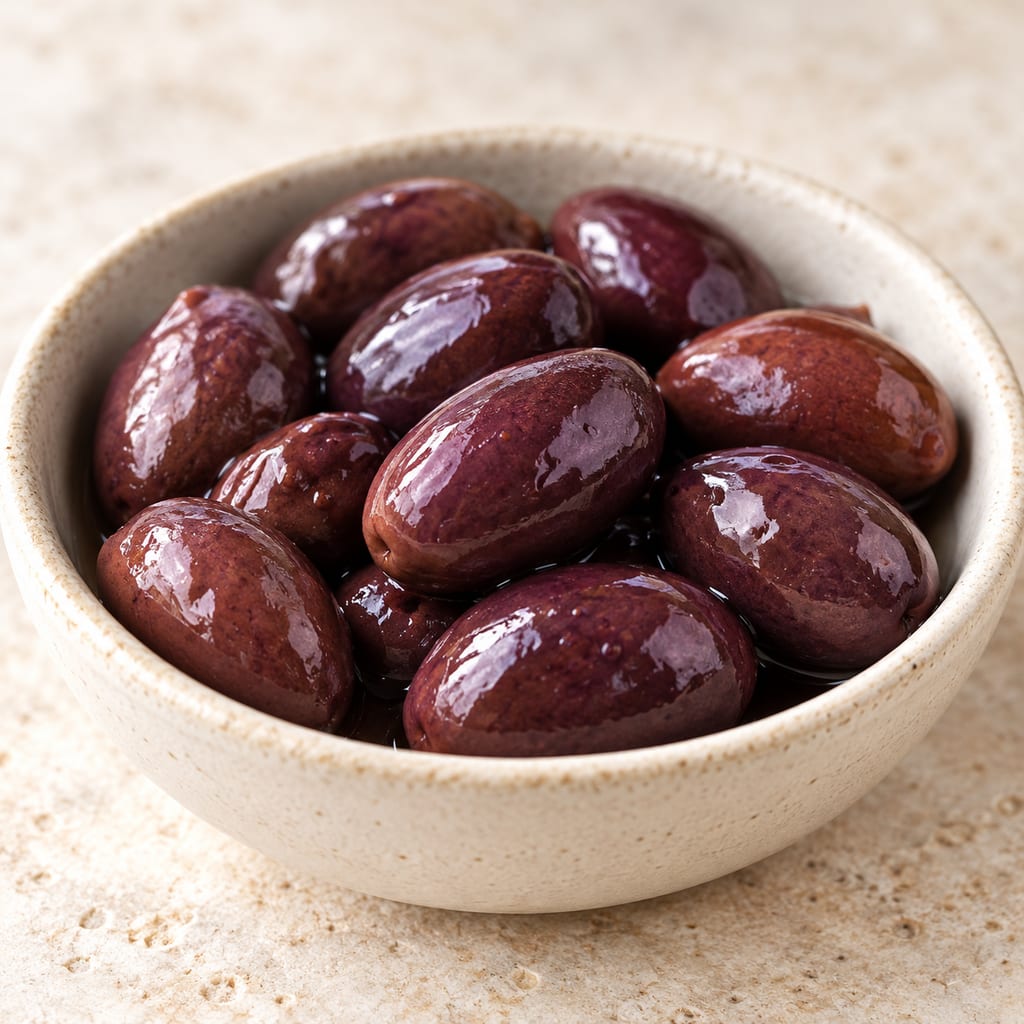
Elia Kalamatas is a Messinia table olive of the Kalamon variety, picked before full ripeness and fermented in brine for six to nine months; it is a PDO product, not a generic black olive.
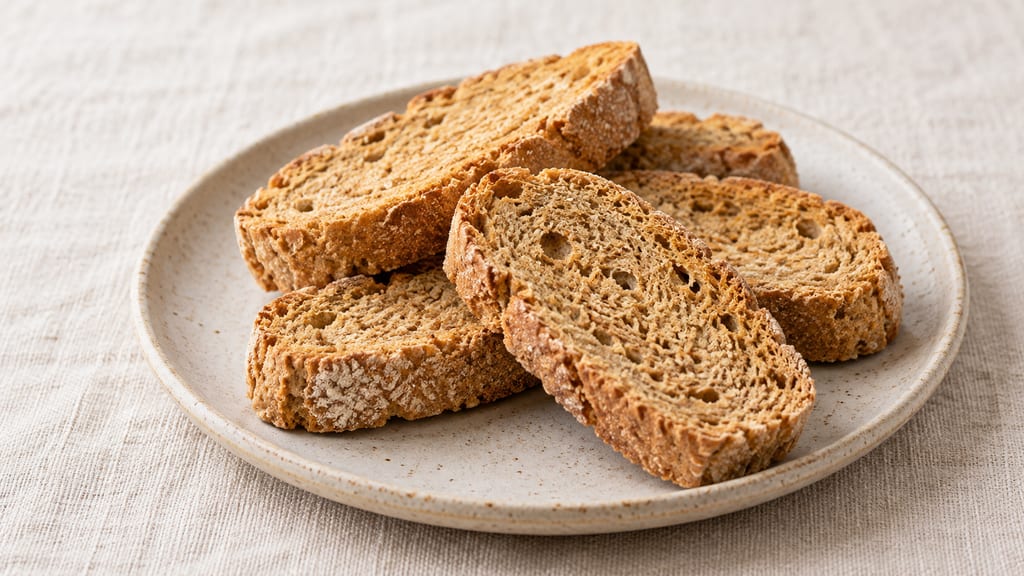
Cretan paximadi is a twice-baked rusk. This barley-wheat version is raised with yeast, baked as a loaf, sliced, and dried slowly until it keeps.
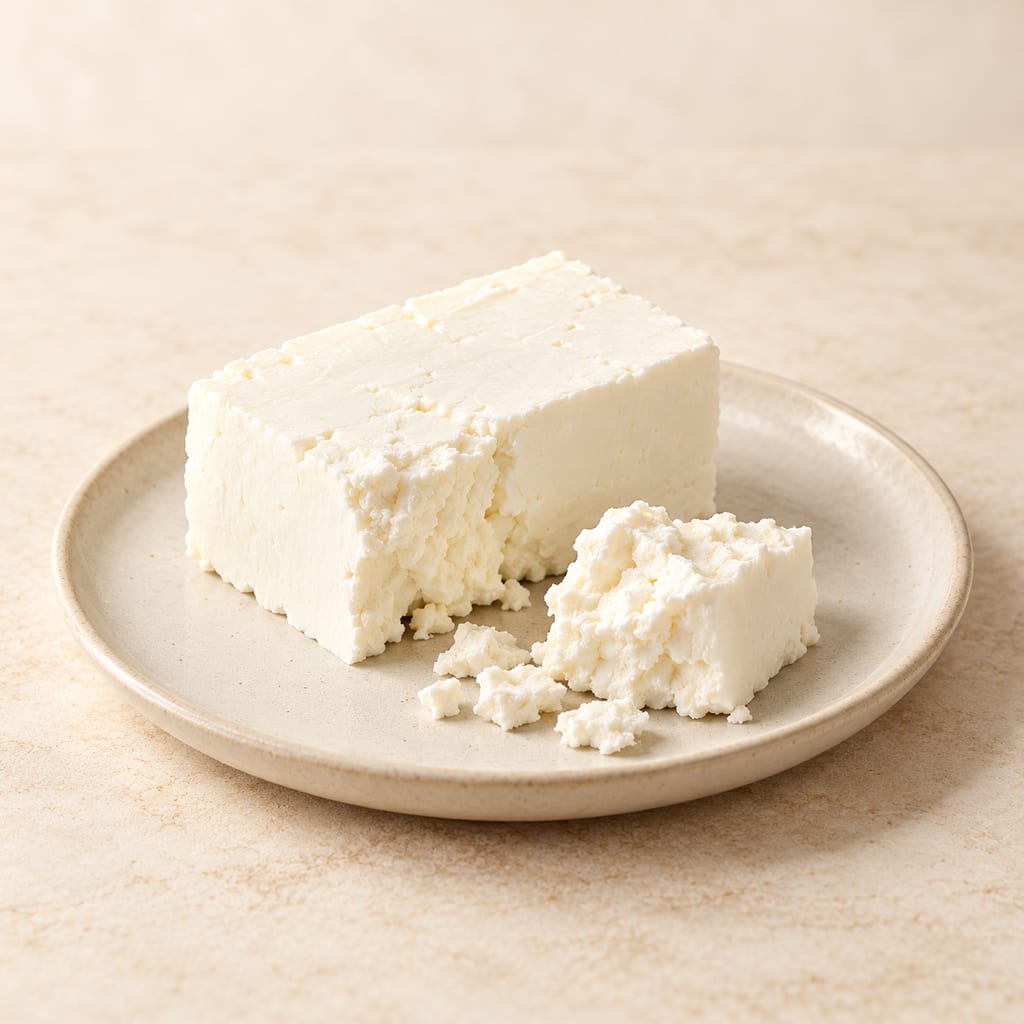
White cheese made with a lactic starter and rennet, drained without pressing, dry-salted and covered in brine. This home adaptation allows whole milk from different dairy animals.
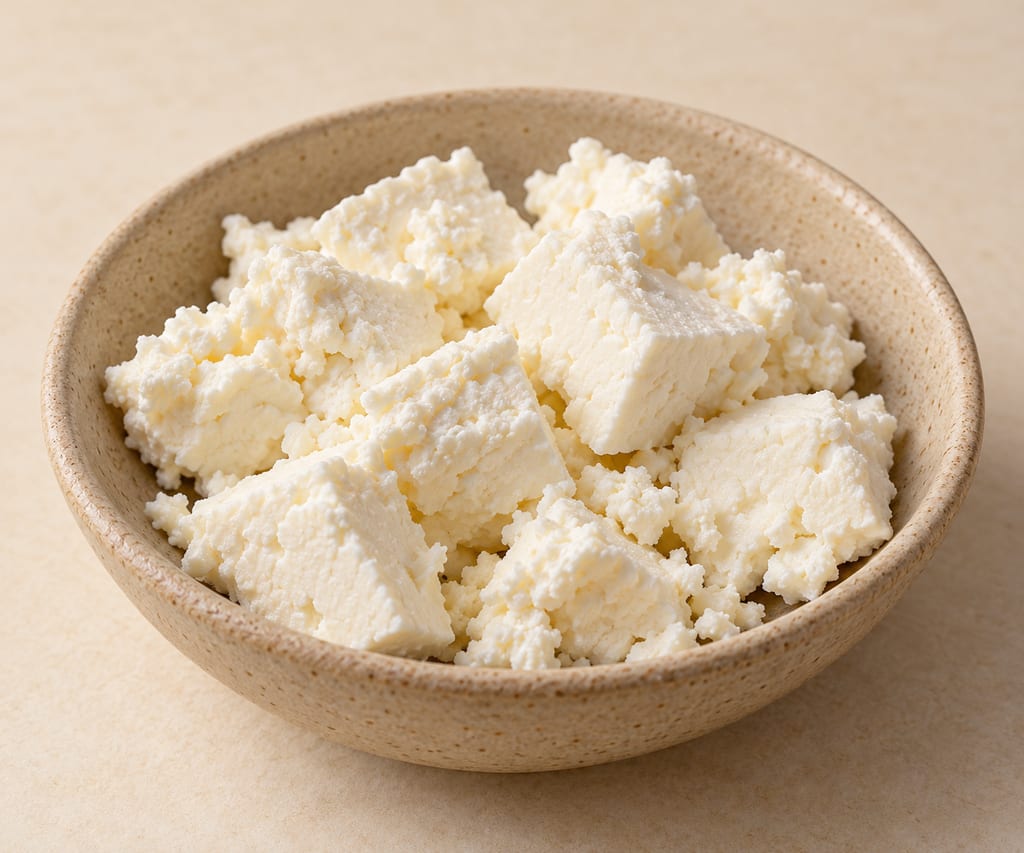
Whole milk set with a mesophilic starter and rennet makes a fresh, crumbly feta-style cheese. Its curds pass through hot salted whey before molding.
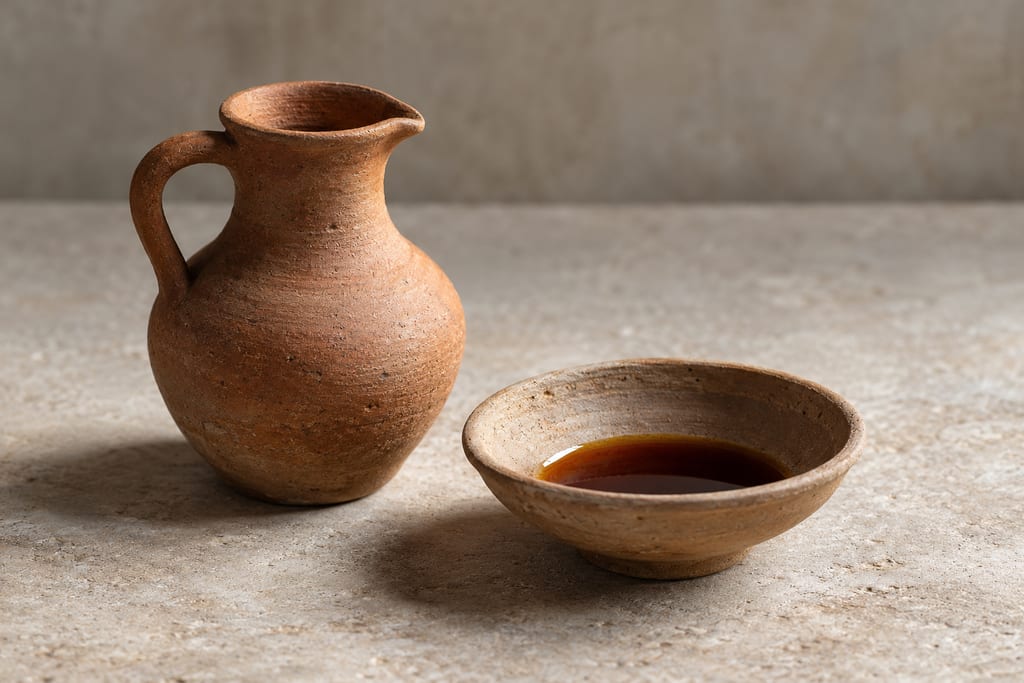
Garum, Greek garos and Latin liquamen, was the fish sauce of the ancient Mediterranean: fish and viscera salted and left in the sun, then drained off as a savoury liquid.
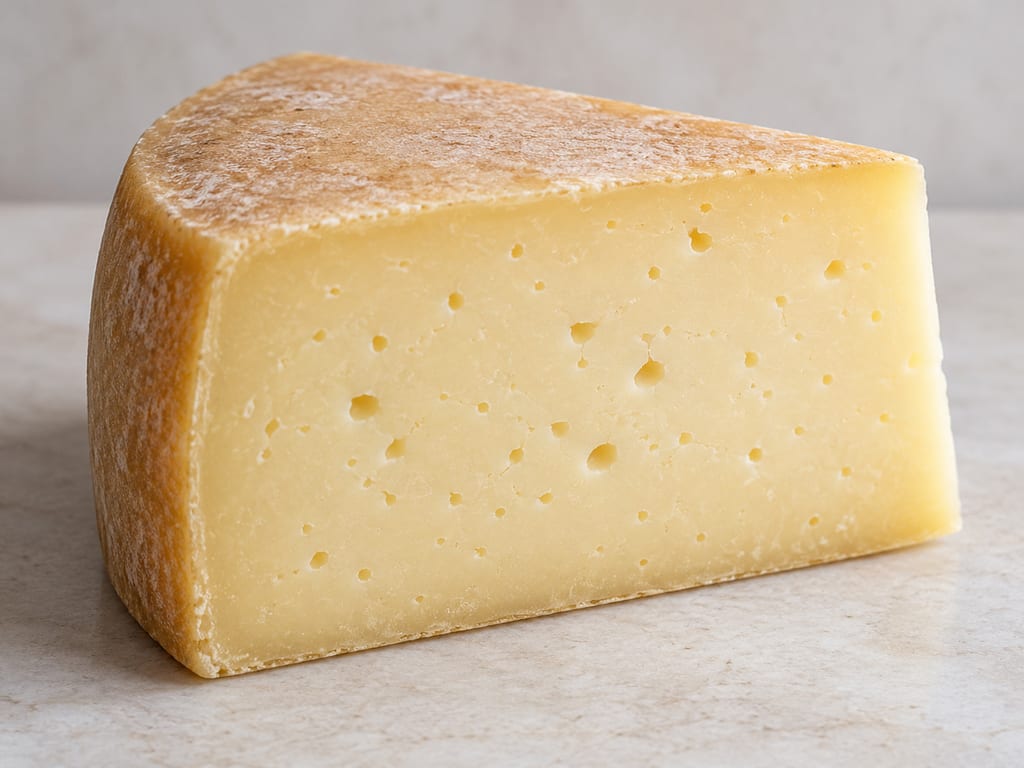
This Cypriot graviera is a hard sheep-milk cheese with a dry rind and round eyes. Its curd is heated, pressed and dry-salted before a long cool ripening.
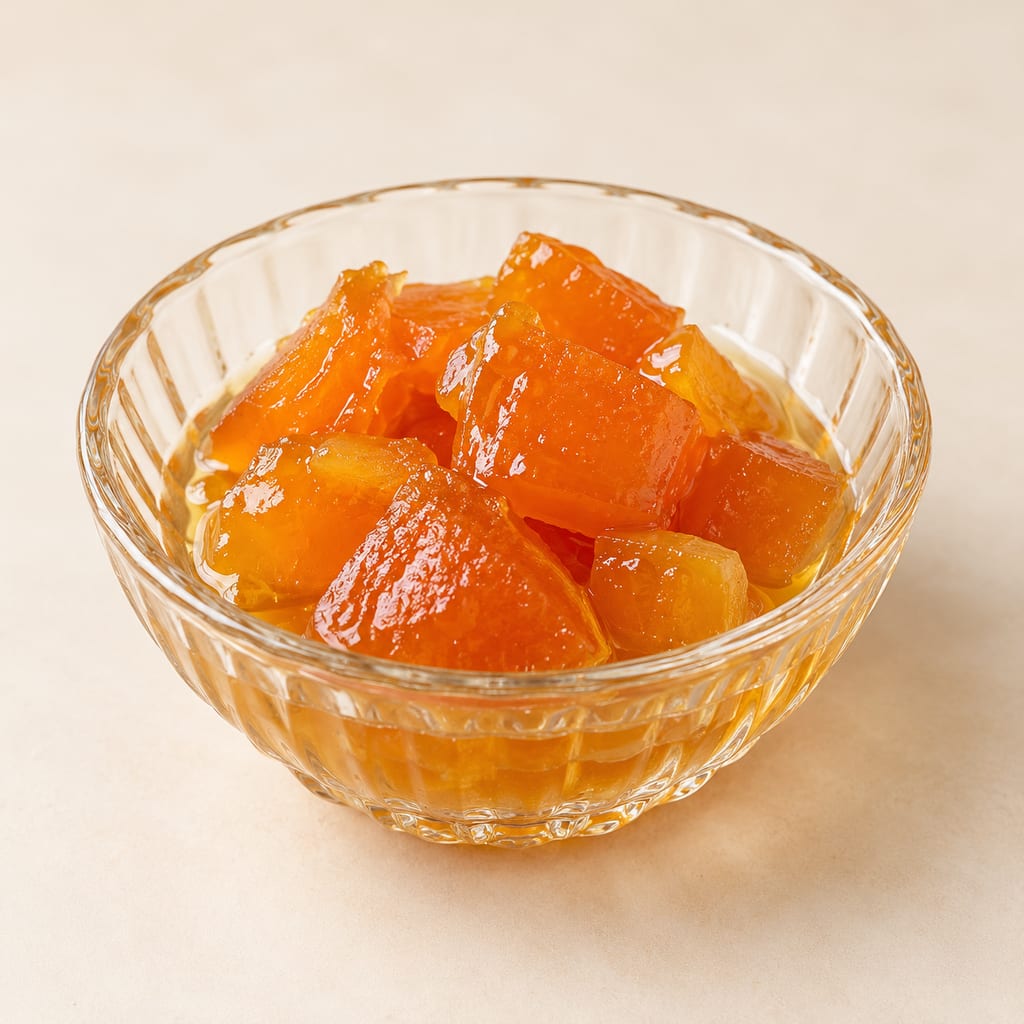
Greek pumpkin spoon sweet, with Cypriot context: Freeze for winter; small fresh portion refrigerated up to 48 hours.
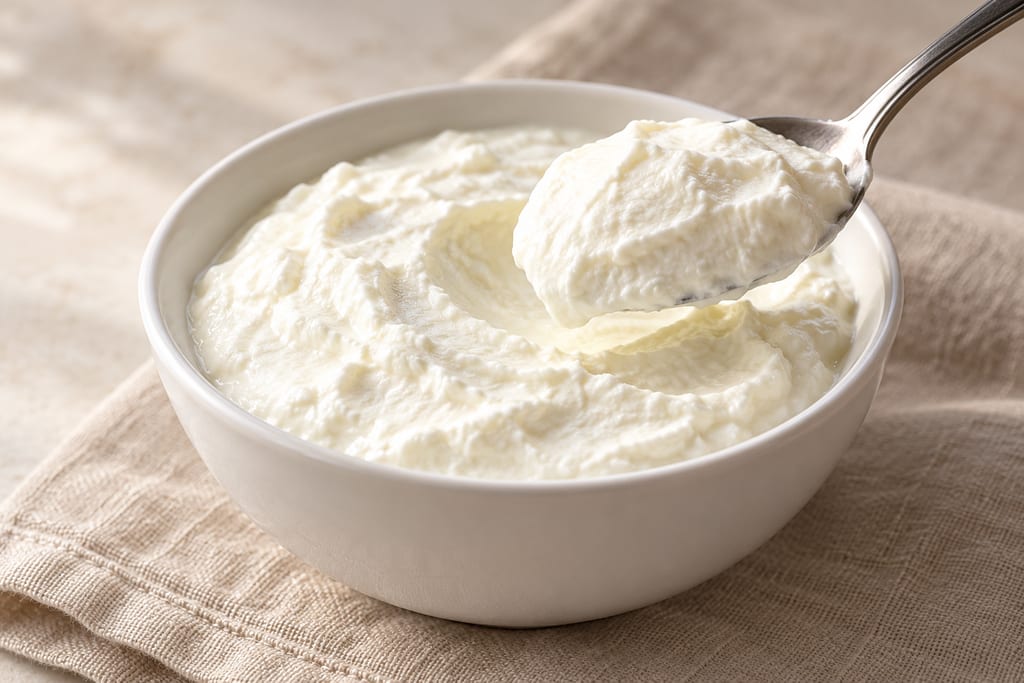
Greek-style strained yogurt is cultured whole milk drained through cloth to remove whey. This modern Utah home method makes a thick yogurt from a gallon batch.
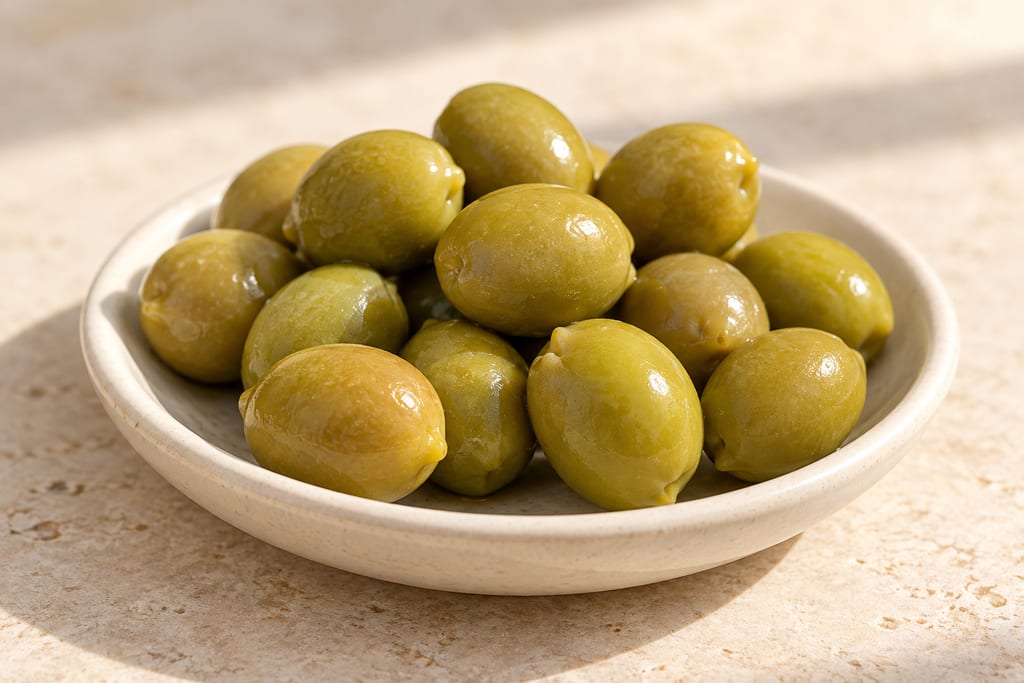
A Portuguese table-olive product from the Negrinha cultivar in northeastern Portugal, sold in three commercial styles, two of them brined fermentations and one oxidised to black.
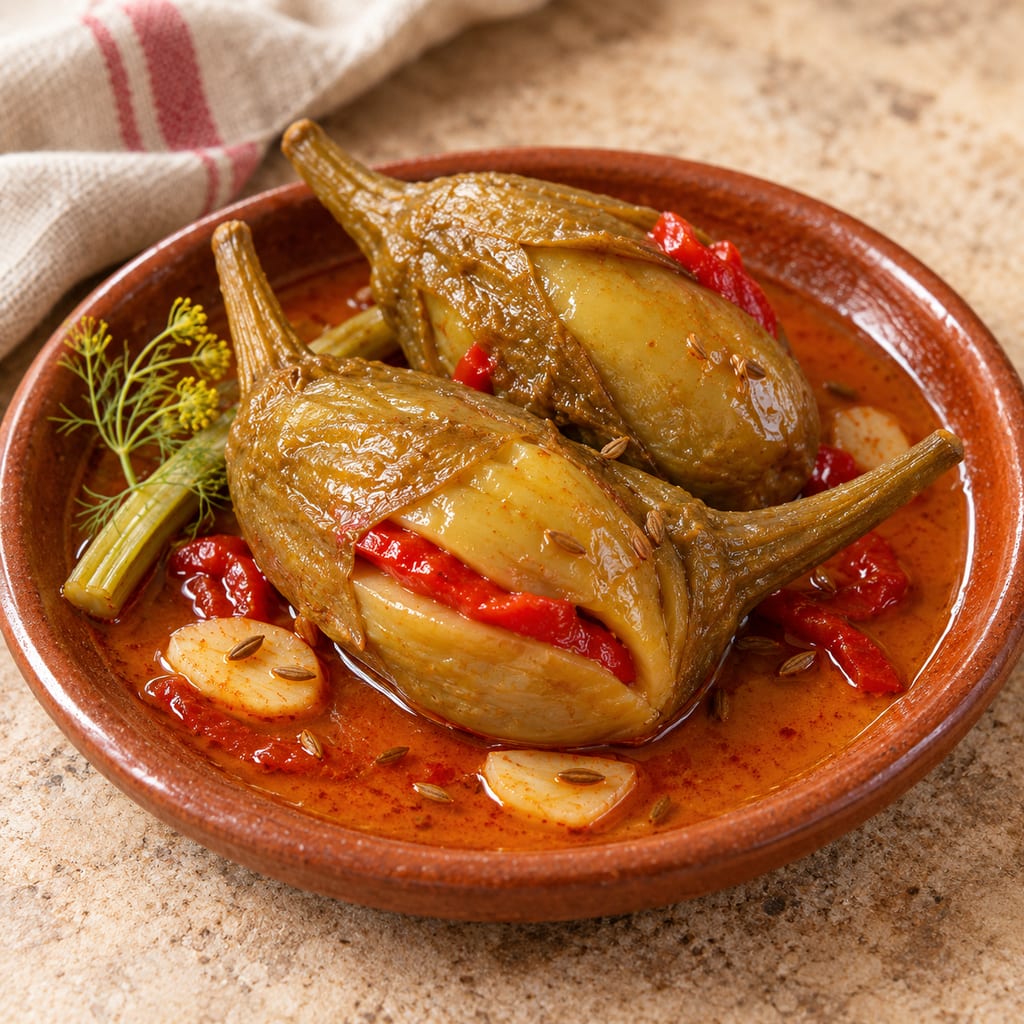
A protected aubergine preserve from Ciudad Real in Spain: tender fruit of the local Dealmagro variety, cooked briefly and then fermented in a vinegared, paprika-seasoned dressing.
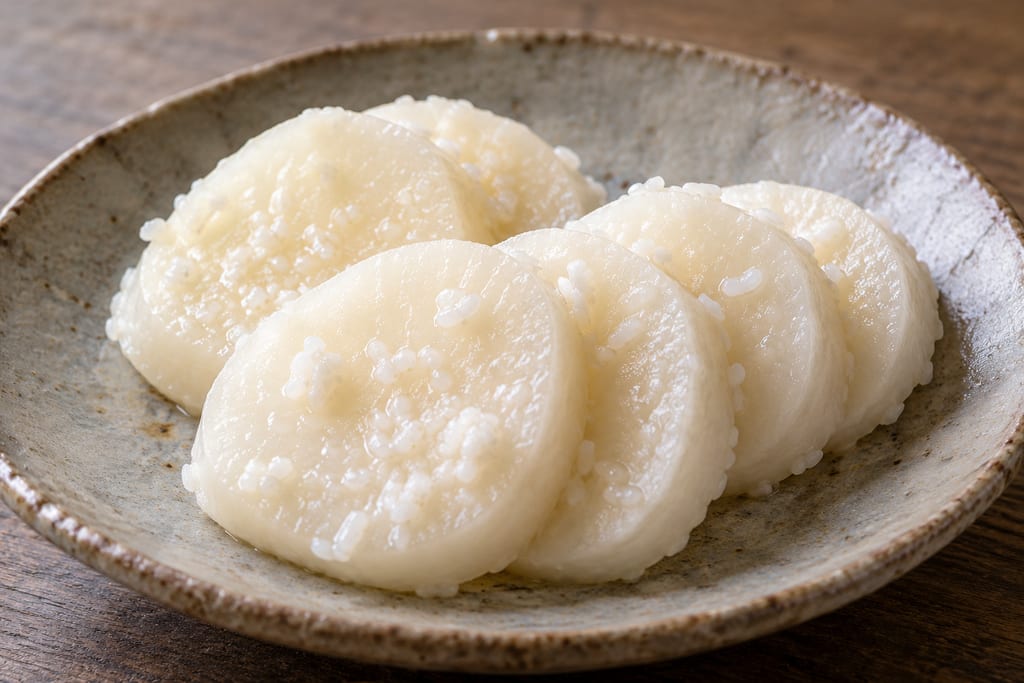
A sweet, crisp Japanese daikon pickle from Tokyo's Nihonbashi district, made by salting fresh radish and dressing it in rice koji, sugar or koji amazake without the heavy drying used for takuan.
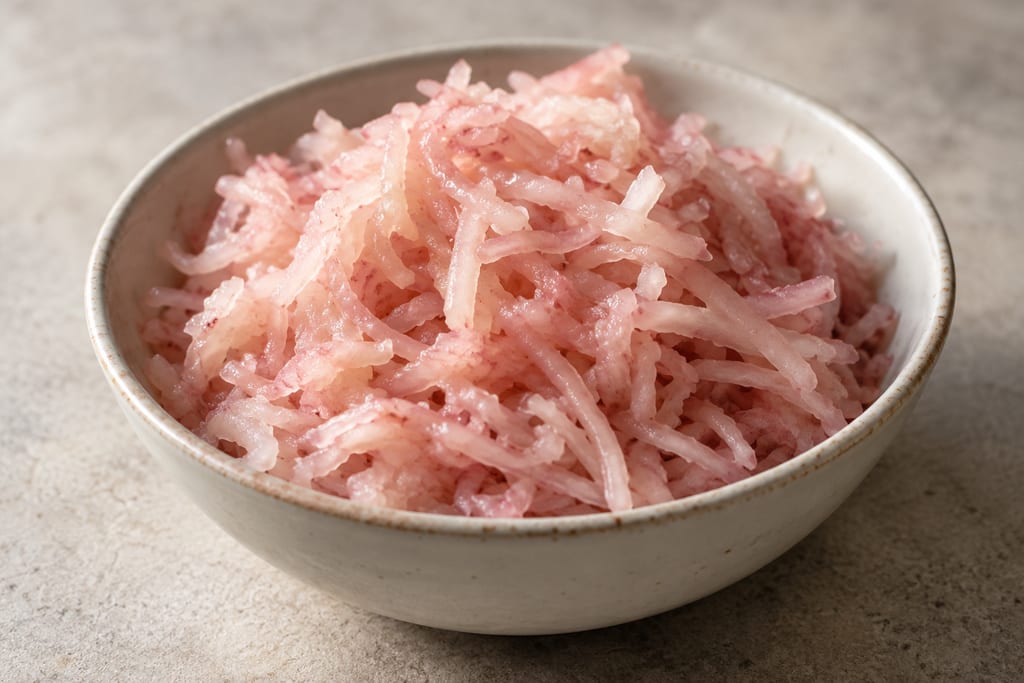
Source-specific Brovada DOP producer method for Friuli Venezia Giulia turnips and red-grape marc. This records a regulated producer process; it is not a validated home-scale recipe.
An industrial fermentation patio places factory-made fiberglass-reinforced polyester olive tanks below floor level, with drainage and transfer infrastructure arranged around the buried vessels.
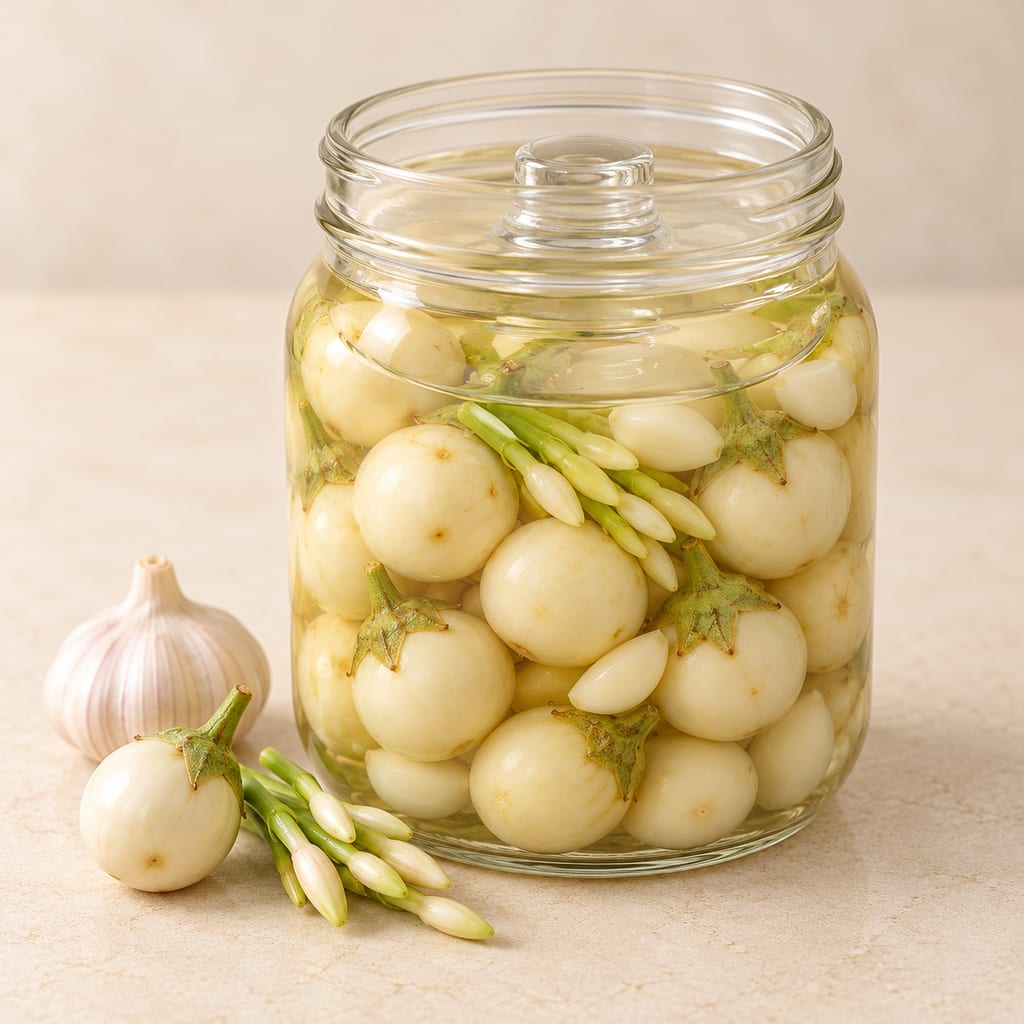
Vietnamese salted and fermented small eggplant, dried on the day of purchase, then held submerged in warm salty water with garlic and galingale flower for a week or longer.
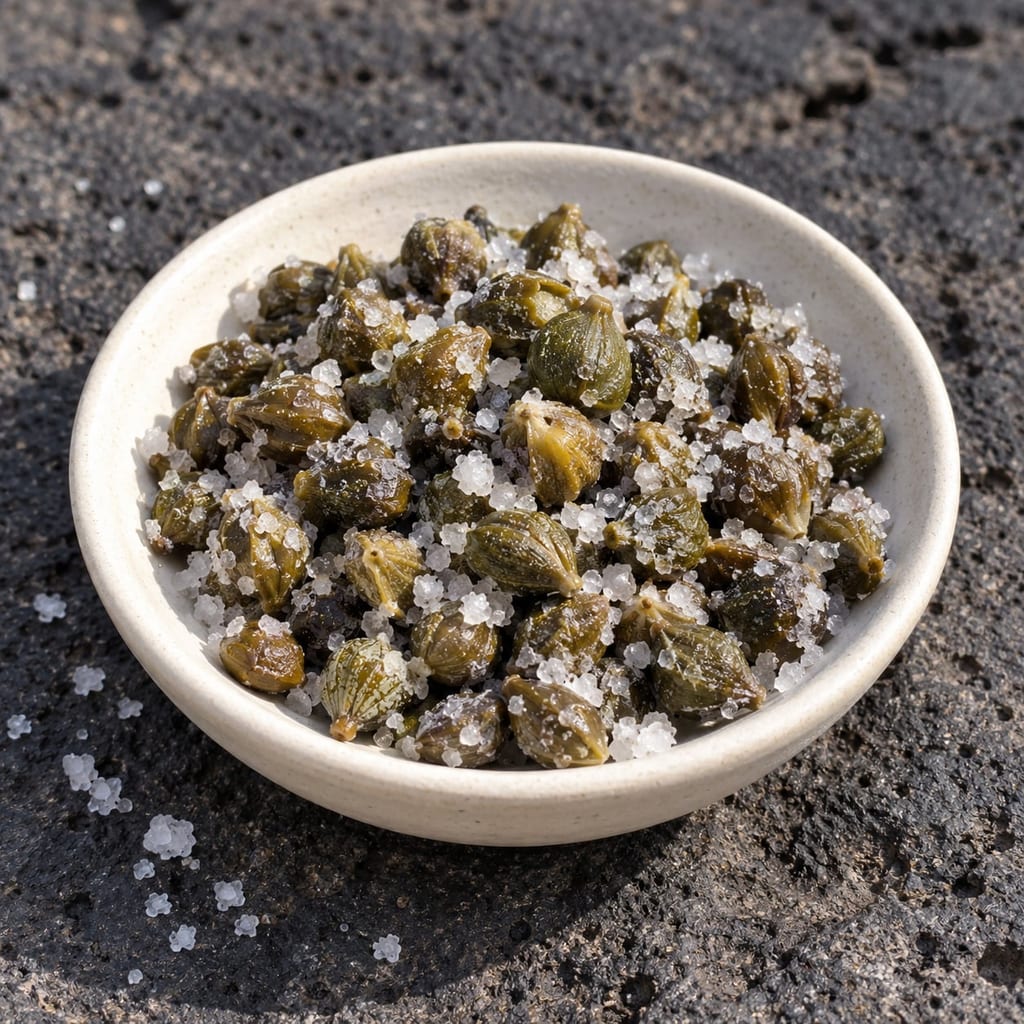
A protected Sicilian product: unopened caper buds from the island of Pantelleria, dry-salted with sea salt in a two-stage process that encourages lactic fermentation.
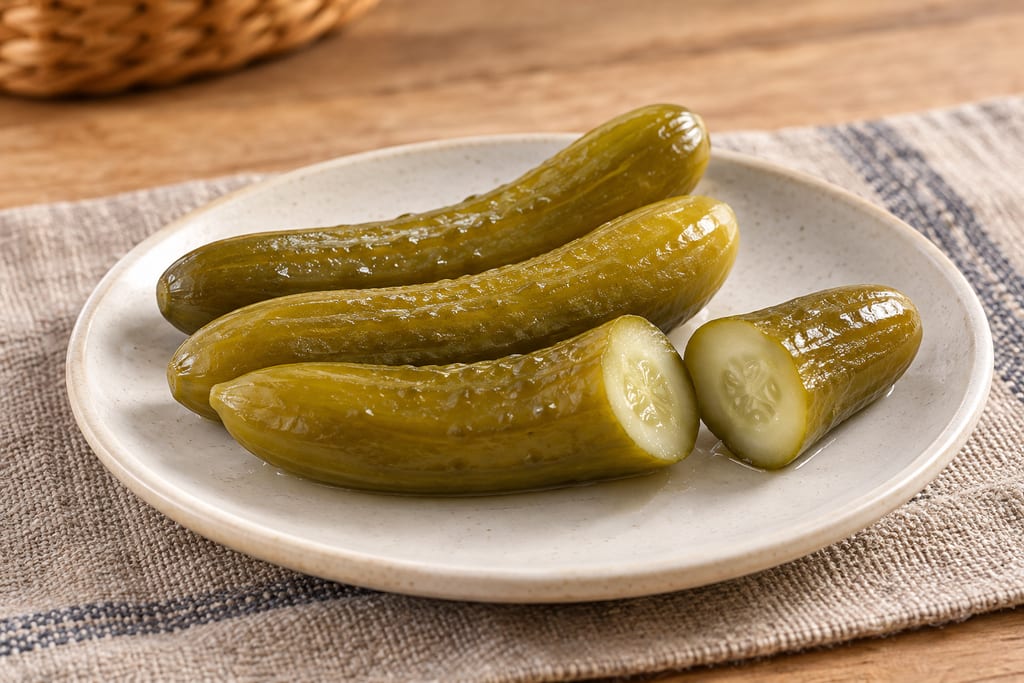
Çubuk turşusu is a registered pickle from Çubuk district in Ankara. Its cucumber variant is sold as Salatalık Turşusu, and a commercial specification sets its brine and room-temperature period.
No community contributions have been published for this entry yet.
Sign in to contribute. Published comments and photos are free to read.
University of California Agriculture and Natural Resources; revised by UC Davis food-safety scientistsInspiration · Geography · Safety
Olives: Safe Methods for Home Pickling, Greek-style black olives in brineExact initial and strong brine recipes, temperature, time, pressure monitoring, storage and style designation.
Cited in: What are Greek-style black olives in brine?; History; Ingredients; Selecting olives; Equipment; 1. Sort the olives; 2. Pack into containers; 3. Prepare medium brine; 4. Begin curing; 5. Replace the brine after seven days; 6. Continue curing; 7. Optional monthly brine changes; 8. Inspect containers; 9. Allow longer curing where desired; 10. Storage and serving; How the home brines compare with Greek-style brines; Greek-style natural black olives; Dry-salt cured black olives; Kalamata-style olives; Spanish-style green olives; California-style black olives; How to eat them; Reducing saltiness; Recognising a good result; Problems; Safety; What is still unknown; Why this preparation matters
Cited in: What are Greek-style black olives in brine?; Equipment; Why olives are bitter; Fermentation microbiology; What happens to the texture?; Recognising a good result; Why this preparation matters
Cited in: What are Greek-style black olives in brine?; History; Equipment; Why olives are bitter; Fermentation microbiology; What happens to the texture?; Greek-style natural black olives; Dry-salt cured black olives; Kalamata-style olives; Spanish-style green olives; California-style black olives; Recognising a good result; Why this preparation matters
Cited in: Why olives are bitter; Fermentation microbiology; What happens to the texture?; Problems; Safety
Cited in: How to eat them; Reducing saltiness; Why this preparation matters
International Olive CouncilDefinition · Safety
Trade Standard Applying to Table Olives, COI/OT/NC no. 1Defines natural olives as green, turning-colour or black olives placed directly in brine and undergoing complete or partial fermentation; sets brine limits of at least 6 percent salt, pH no higher than 4.3 and at least 0.3 percent lactic acid, with an exception for traditional methods guaranteed by an official body.
Cited in: Natural black olives: a ripeness class joined to a process; What the trade standard asks of the brine; What a label can and cannot tell you
ΔΟΕΠΕΛ (Greek National Interprofessional Organization of Table Olives)Geography · History
Olive varieties (Ποικιλίες ελιάς)Producing areas and hand-picking season for natural black Kalamata and Konservolia; Konservolia traded in the nineteenth century and exported from the early twentieth.
Cited in: History; Kalamata and Conservolea; What is still unknown
Konstantopoulos S.A. OlympGeography
Conservolea VarietyConservolea is about 25 percent of annual Greek table olive production, around 40,000 tonnes, hand-picked from September to December.
Cited in: Kalamata and Conservolea
Food Microbiology 19(6):605-615Method
Microbiological and physicochemical changes of naturally black olives fermented at different temperatures and NaCl levels in the brinesConservolea black olives fermented up to 190 days at three temperatures in 4, 6 and 8 percent brines; lactic acid bacteria favoured at 4 and 6 percent, yeasts at 8 percent.
Cited in: What the Greek studies measured; What the trade standard asks of the brine
Food Microbiology 46:368-382Method
Physico-chemical characterization of natural fermentation process of Conservolea and Kalamata table olives and development of a protocol for the pre-selection of fermentation startersYeasts present throughout and lactic acid bacteria appearing only in the final stage; markers measured at 30, 90 and 180 days.
Cited in: What the Greek studies measured
Frontiers in Microbiology 8:2673Method
Evolution of Yeast Consortia during the Fermentation of Kalamata Natural Black Olives upon Two Initial Acidification TreatmentsKalamata olives in 7 percent brine for 187 days; lactic acid bacteria gone from counts by day 20; yeasts dominant; all brines ended near pH 4.2.
Cited in: What the Greek studies measured; What the trade standard asks of the brine
Journal of Nutritional Science 9:e57Method · Health
Table olives and health: a reviewGreek-style brines of 8–10 percent salt, yeast-driven; total phenol loss of about 32–58 percent; no clinical studies on eating table olives.
Cited in: How the home brines compare with Greek-style brines; Why olives are bitter; What is still unknown
International Journal of Food Microbiology 398:110226Method
Exploring yeast diversity of dry-salted naturally black olives from Greek retail outlets with culture dependent and independent molecular methodsNine retail dry-salted olives from Athens: pH 4.0–5.0, water activity 0.58–0.91, salt 5.26–9.15 g NaCl per 100 g pulp, yeast-dominated, no lactic acid bacteria detected.
Cited in: Dry-salt cured black olives