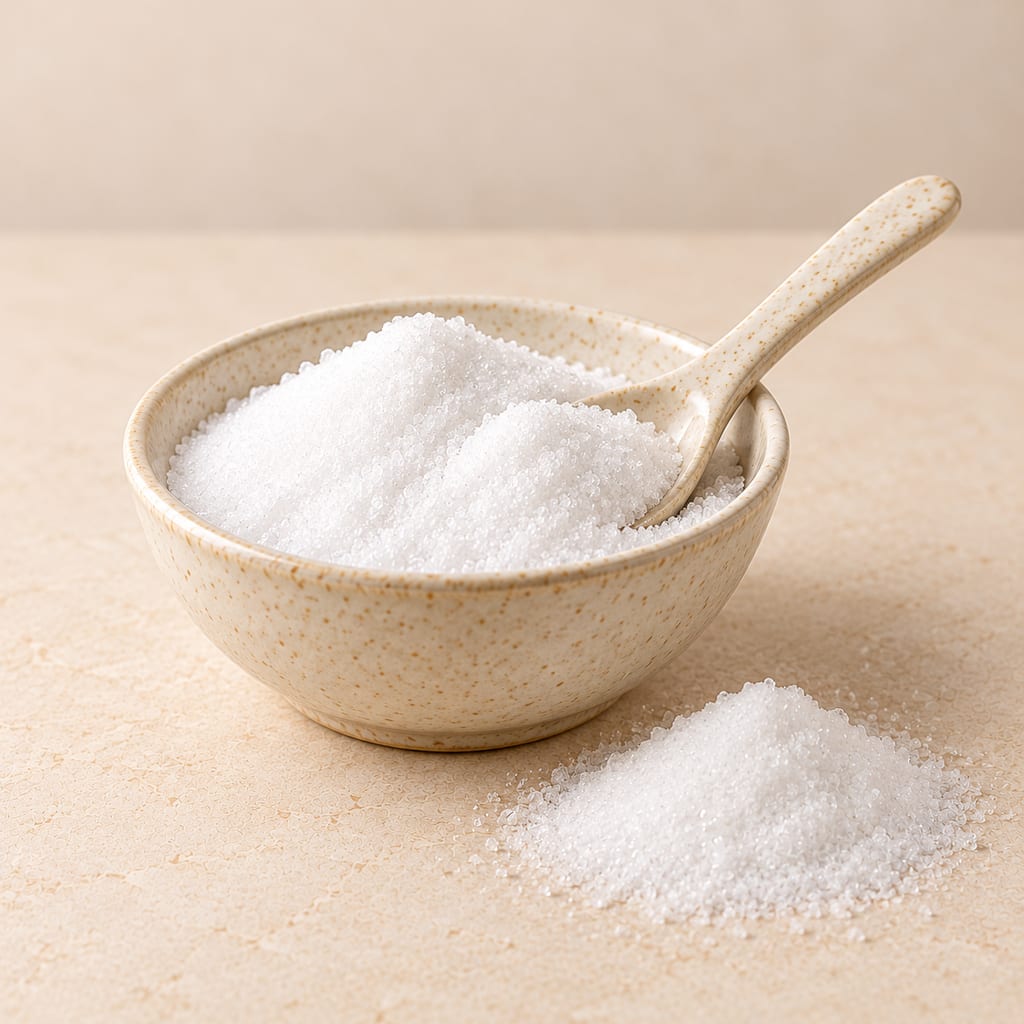
Bicarbonate of soda
Sodium bicarbonate is a mildly alkaline kitchen powder used for leavening and, in two published South African green-fig konfyt methods, in the preliminary boil.
 FermenteaWhere food goes to change
Modern method
Groenvy-konfyt · Green fig preserve
Whole unripe figs are softened and cooked in cinnamon and ginger syrup as a refrigerator-only South African konfyt; this method does not provide a shelf-stable canning process.
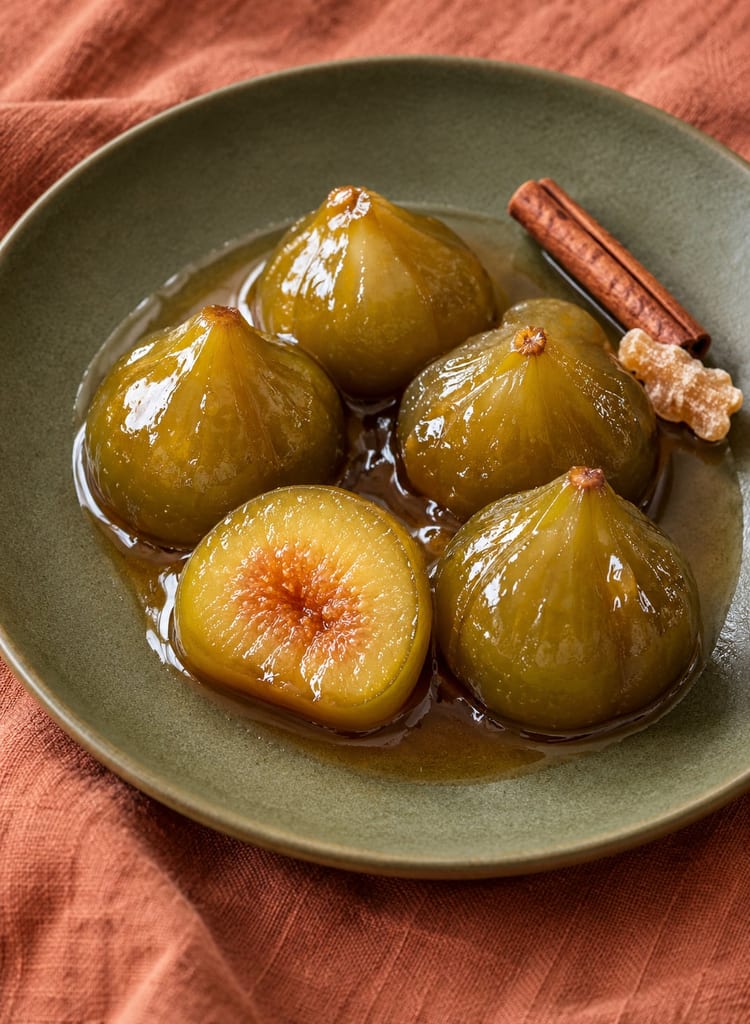
Green-fig konfyt keeps the fruit whole in a sweet, scented syrup. The figs are picked before they ripen, prepared so syrup can reach the interior, softened in a separate water bath, then cooked slowly in syrup until the liquid thickens and the fruit looks glossy. Cinnamon and dried ginger perfume this version. Its point is not to make a smooth jam: a spoonful should contain intact fruit and syrup, so the cook pays attention to tenderness without letting the figs collapse.
The name helps distinguish the form. The Dictionary of South African English defines konfyt as fruit preserved in its own syrup, whole or in large pieces, and traces the word through Afrikaans to Dutch konfijt. South African cookery also uses the word for fruit such as naartjie, melon and apricot. This recipe is one Cape cookbook account of green figs; it does not stand for every konfyt or claim to be the sole traditional method.
The documentary trail supports a long history of fruit cooked in syrup in South Africa, but it does not establish when green-fig konfyt began. The dictionary records the word in Cape writing by 1861 and later quotations describe preserved fruit served with tea, family supplies of konfyt, and fruit sold at communal gatherings. A 1913 household guide gives a general sugar-and-water rule for konfyt. Those records describe a family of practices, not this recipe's precise lime soak, spice mix or quantity.
The word is Afrikaans, from Dutch, but food histories do not travel as neatly as words. A South African writer's account of green-fig preserve describes Cape Malay cookbooks and household cookery alongside Dutch-colonial trade and the forced migration of Southeast Asian people who cooked in the Cape. It names Hilda Gerber's *Traditional Cookery of the Cape Malays*, published around 1945 from a manuscript found after her death, and other cookbooks from 1923, 1952, 1975 and 1985. This is evidence of the layered record and of who preserved recipes in print; it is not proof that one community invented the dish or that all cooks used one method.
Wines of South Africa presents the version here as a recipe by Cass Abrahams from *Cass Abrahams Cooks Cape Malay: Food from Africa*. The Cape placement and cookbook credit are publication context. They locate this documented version without turning the Cape into an exclusive birthplace or assigning it an unsupported starting date. Historical claims about the exact recipe therefore remain narrower than the wider history of konfyt.
This preparation uses figs that have not ripened, rather than ripe figs that happen to have green skin. The distinction matters because the fruit is meant to hold together during soaking, boiling and a long syrup cook. A South African grower quoted in the Gardenista account describes using the early breba crop, called voorvye in the Cape, for konfyt, while a later main crop, eetvye, is left to ripen for eating fresh. The account reports that practice for some trees and households; it does not make it a rule for every region or cultivar.
Green fruit is worked whole. WOSA's recipe asks the cook to grate away the peel and cut a small cross at the blossom end. That opening is a practical path for the soak and later syrup. It also means the appearance of the finished preserve depends on careful handling: a deep cut or rough stirring may damage the shape, while an uncut fruit may take up syrup differently. The source does not specify fig variety, size, or a maturity test beyond calling them green figs, so those details cannot be supplied as universal selection rules.
This is a cooked preserve, not a fermentation. No starter, culture or microbial acidification appears in the method. The transformation comes from preparation, heat and contact with syrup. Cutting the blossom end exposes the interior; soaking overnight in water with slaked lime is a distinct treatment, followed by a thorough wash. USDA's technical review describes calcium hydroxide as a firming agent because calcium can bind with soluble pectin in fruit cell walls. That general food-science explanation makes firmness a plausible purpose for this stage, but it is not a study of this particular fig recipe and does not establish its lime concentration.
The following boil is in fresh water with bicarbonate of soda, after which the figs are drained. The recipe's endpoint is tenderness, and it gives no duration or cooking-water volume. Heat softens the fruit so it can be eaten and helps the syrup enter, but the page does not claim that the bicarbonate has a measured chemical effect or that tenderness signals preservation safety. Those details are not reported in the source.
The syrup begins with sugar, water and lemon juice. Stirring over low heat dissolves the sugar before the fruit is added; keeping it from boiling at that stage is the instruction in the recipe. During the slower cook, water evaporates from the pan and the syrup thickens while the figs exchange moisture and take on sweetness and spice. Utah State University Extension explains that syrup around whole fruit changes its flavor and texture, while the syrup itself is not the canning safety process. It also notes that changes to syrup strength can change the texture, color and shape of whole fruit. For that reason the listed balance is best read as a particular source formula, not a free-form ratio to alter for a shelf-stable jar.
The finished figs are not meant to form a pectin gel. They remain whole in a pourable or spoonable syrup, rather than setting like jelly. The visual cue 'shiny' and the source's description of a thick syrup help the cook judge this version's texture, but there is no measured concentration, temperature or endpoint. The recipe's own source leaves cooking time open.
The green figs provide the whole fruit and its shape. Their firmness before ripening suits a preserve where intact pieces matter. Slaked lime appears in the overnight soak, and bicarbonate in the preliminary boil; they are separate alkaline ingredients used at separate points. The lime's food-use grade and dilution are not specified by WOSA, so readers should not infer that any building, garden or industrial lime is suitable. The method calls for thoroughly washing the fruit, but gives no measured rinsing procedure. The uncertainty is part of the recipe as documented.
Sugar forms the sweet syrup and contributes the finished preserve's distinctive sweetness and texture. Water dissolves the sugar and provides the liquid in which the figs cook. Lemon juice supplies a sharp citrus note, but the recipe provides no acidity measurement and does not use it as a validated canning control. Cinnamon sticks and pieces of dried ginger scent the liquid. The exact sizes of the ginger pieces and their strength are not standardized in the source, so the listed pieces should not be mistaken for a weight-based formulation.
Nothing in this ingredient list is a starter culture. The term 'fermentation' can be tempting because Fermentea includes many fermented foods, but this product is a syrup preserve made by heat. That distinction matters for both explanation and safety: it should not be treated as a fermented food with a microbial acidification step.
The first stage removes the peel and opens the blossom end. The second leaves the fruit overnight in the lime mixture. The word 'overnight' is the only duration the source gives; it does not mean a fixed number of hours. After soaking, WOSA calls for thorough washing. Keep the wash separate from the next cooking stage: the figs are then boiled in water with bicarbonate until tender and drained before they meet the syrup.
Next, dissolve the stated sugar in the water and lemon juice over low heat, stirring and not allowing this first syrup to boil. Add cinnamon and dried ginger, then the figs. The recipe asks for slow cooking until the syrup thickens and the figs look shiny, but gives no duration, thermometer reading or syrup concentration. The amount of water used to cover the figs in the lime soak and the separate boiling water is also unstated. The 500 g fruit and the basic syrup quantities are not enough to calculate those other liquids or a finished yield.
The source ends by directing cooks to fill the hot preserve into sterilised jars, but it gives no jar size, headspace, validated post-fill process, storage condition or shelf life. This public adaptation does not follow that hot-fill bottling direction. Instead, transfer the finished preserve into clean, shallow, refrigerator-safe containers and refrigerate promptly within two hours at 4 °C or below, following general FoodSafety.gov cooling guidance. This keeps the recipe explicitly refrigerator-only and does not assign a storage duration.
A separate University of Georgia-tested fig-preserves formula illustrates what shelf-stable canning requires: it specifies a jar size, headspace and boiling-water canner schedule. It uses its own quantities and sequence; it is not a processing schedule for this Cape recipe and those directions should not be transplanted here. Keep this preserve refrigerated; do not seal it for room-temperature storage.
South African recipes do not reduce to one formula. A Western Cape Department of Agriculture book records a separate preserve for hard green figs without the lime soak. It trims and cross-cuts fruit, parboils it in salted water, then cooks it in syrup. Its batch uses 1.5 kg figs, 2.5–3 kg sugar and 6 litres of syrup water; it allows lemon juice or measured acid alternatives and leaves the salt and parboiling-water quantities open. That method has its own ingredient balance and texture cues. It is already recorded as a linked variant and should be read on its own terms rather than folded into the Cass Abrahams version.
The Gardenista account also describes other ways cooks approach green figs and names Cyprus, Greece, parts of Eastern Europe, Ecuador and Brazil as places where unripe figs are cooked in syrup. Similar ingredients do not prove identical histories. The source explicitly notes that methods differ, so the comparison is useful as a reminder that preserving the unripe fruit is a wider practice, not evidence of one shared recipe.
Konfyt itself includes whole pieces and larger fruit, not only figs. Historical dictionary entries record naartjie, watermelon, apricot and other forms. These are related in the way they preserve fruit in syrup, but fruit, preparation and flavouring vary. A green fig's firm body makes it suited to a whole-fruit preserve; soft fruit or peel can make a different texture and needs its own method.
Green-fig konfyt belongs both at a sweet table and beside savory food. Historical South African quotations place konfyt with afternoon tea, while a later Cape Malay cookbook is cited for serving it on its own at weddings and feasts. The personal Cape account gives toast as a simple breakfast pairing and also uses the fruit with Gruyère and in a salad of shaved fennel, lemon and Aleppo pepper. Those are examples rather than rules.
A South African preserve producer describes whole figs in syrup with cheese, roast pork or mosbolletjies, a sweet enriched bread. The contrast is easy to understand: syrupy sweetness and tender fruit work against salty cheese or the savory richness of roast meat, while the intact figs can be sliced, spooned or served whole. A little syrup can also season a plate, but the source recipe gives no serving quantity and the taste will depend on how concentrated the cook lets it become.
Because the fruit remains whole, the preserve can be served from a jar as a spoon sweet, put beside bread and butter, or used as a small accompaniment rather than spread like jam. Its characteristic is the pairing of intact fig and syrup: a clear visual and textural contrast that disappears in a purée.
The recipe records ingredients, sequence and sensory cues, but not enough to reproduce every detail exactly. Fig variety and size, water volumes for two separate stages, lime grade and concentration, measured rinse steps, cooking duration, final yield and jar size remain unknown. Thickening and gloss are visual descriptions, not a refractometer reading or a safety test. Neither taste, smell, appearance nor an intact lid can show that a jar has received a safe preservation process.
The simplest way to read the page is to keep its two kinds of information apart. The recipe preserves Cass Abrahams's documented cooking method and quantities without filling gaps by guesswork. Preservation guidance explains why the hot-fill instruction does not establish shelf stability. The comparison recipe from the National Center for Home Food Preservation shows a separately tested fig method; it cannot validate this one by resemblance. That distinction respects the Cape recipe while giving a reader a clear account of what it can and cannot promise.
Konfyt is the South African name for whole fruit or large pieces preserved in syrup, a word inherited through Afrikaans from Dutch. The term appears in nineteenth-century South African writing, and green-fig konfyt is named in a 1968 quotation. Cass Abrahams's Cape Malay cookbook presents this lime-soaked, spice-scented version; the publication does not establish where or when the particular method began.
Scaling: source batch only
The source says to bottle the preserve hot but gives no tested post-fill process. Open-kettle filling does not prevent all spoilage risks, so this version is explicitly refrigerated only.
Hazard sourceTreat this as a refrigerator-only preserve. Transfer the hot preserve into clean, shallow, refrigerator-safe containers and refrigerate promptly within 2 hours; keep the refrigerator at 4 °C or below. This general chilled-leftover guidance does not establish shelf stability or a recipe-specific storage duration.
Control sourceDo not seal for room-temperature storage. For shelf-stable canning, use a tested recipe with its specified jar preparation and heat process rather than the source's hot-fill direction.
Control sourceRefrigerator-only preparation: refrigerate promptly within 2 hours and keep at 4 °C or below.
Do not treat hot filling sterilised jars as a shelf-stable canning process. This page provides no validated storage duration.
For shelf-stable canning, use a tested recipe and its specified post-fill process.
WOSA groups the page with Cape recipes and credits Cass Abrahams's Cape Malay cookbook. This is publication context, not a claim of origin or exclusive regional practice.
Sodium bicarbonate is a mildly alkaline kitchen powder used for leavening and, in two published South African green-fig konfyt methods, in the preliminary boil.
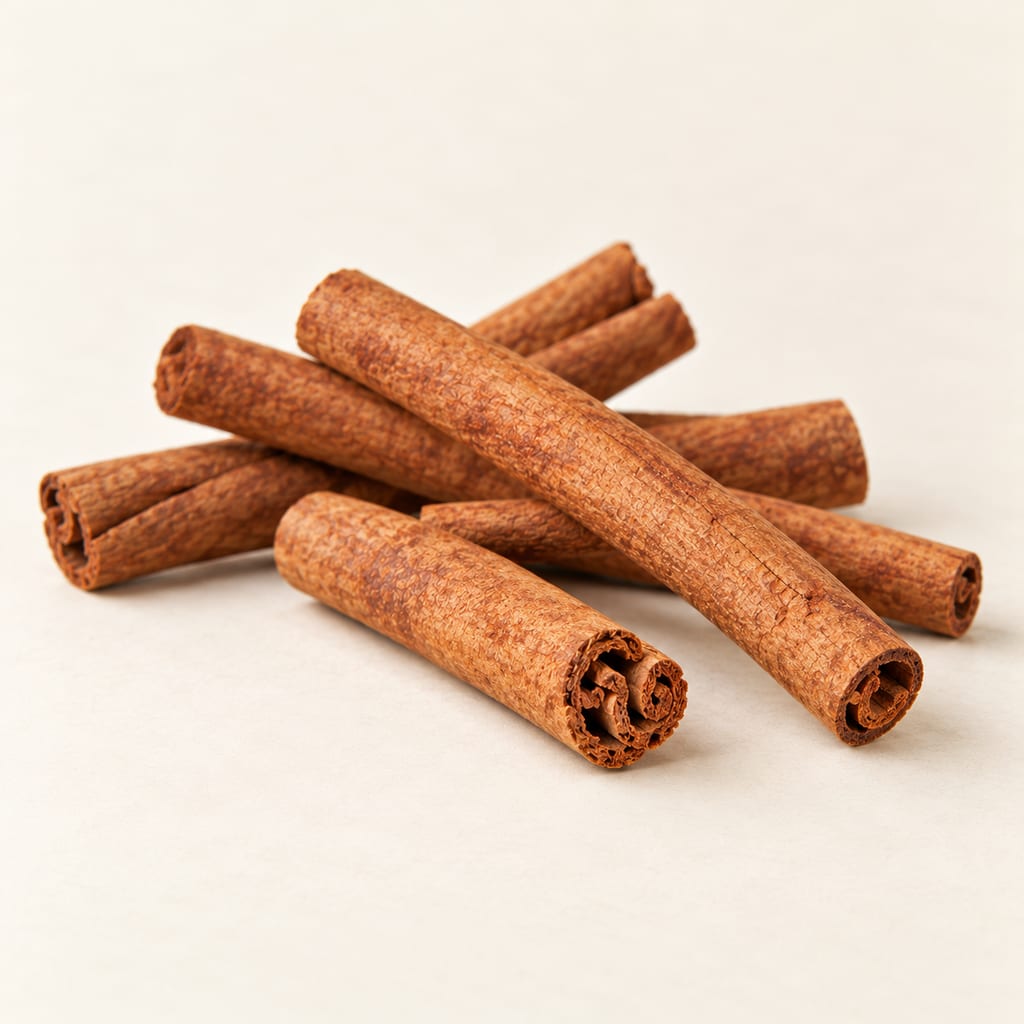
Cinnamon sticks are dried inner bark curled or layered into quills. The common name covers several Cinnamomum species; whole bark perfumes food and drink.
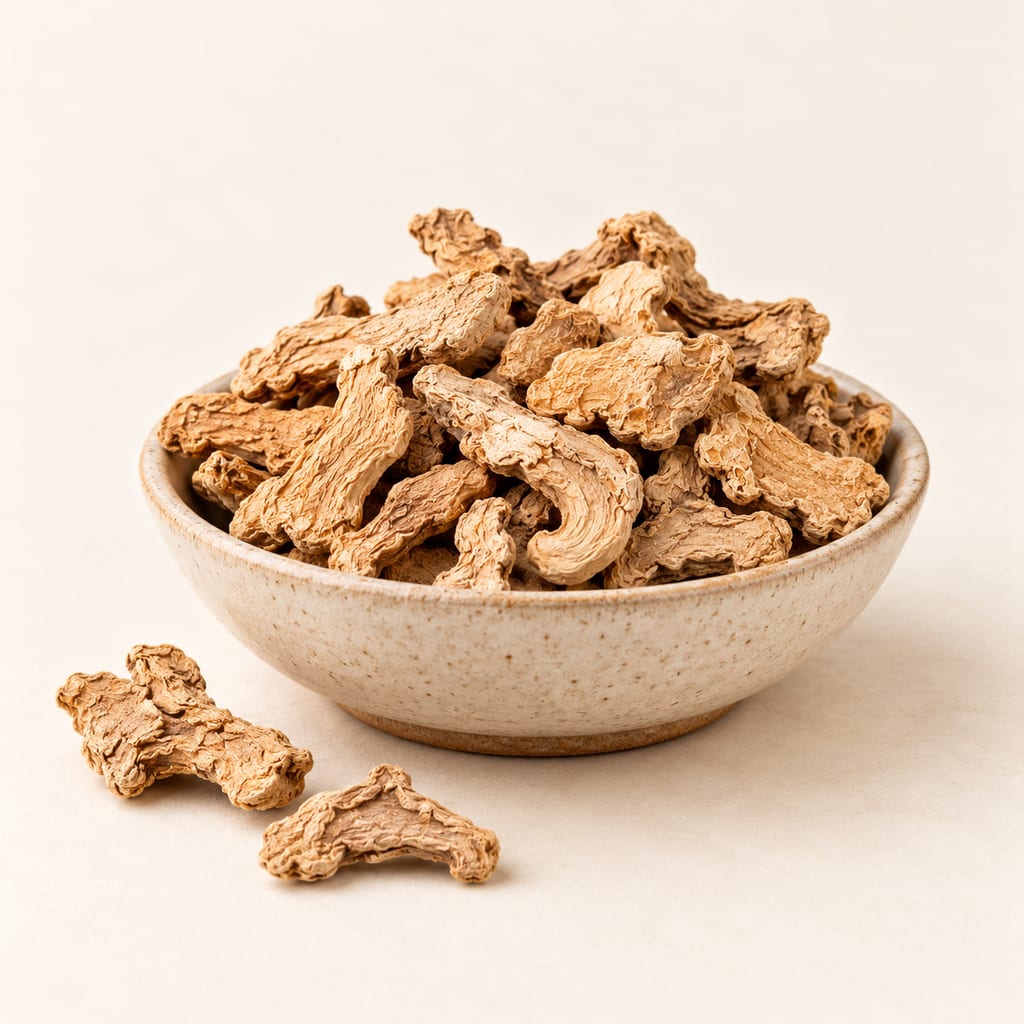
Dried ginger is the mature, dried rhizome of Zingiber officinale; its warm flavor and whole, sliced or ground forms serve different kinds of cooking.
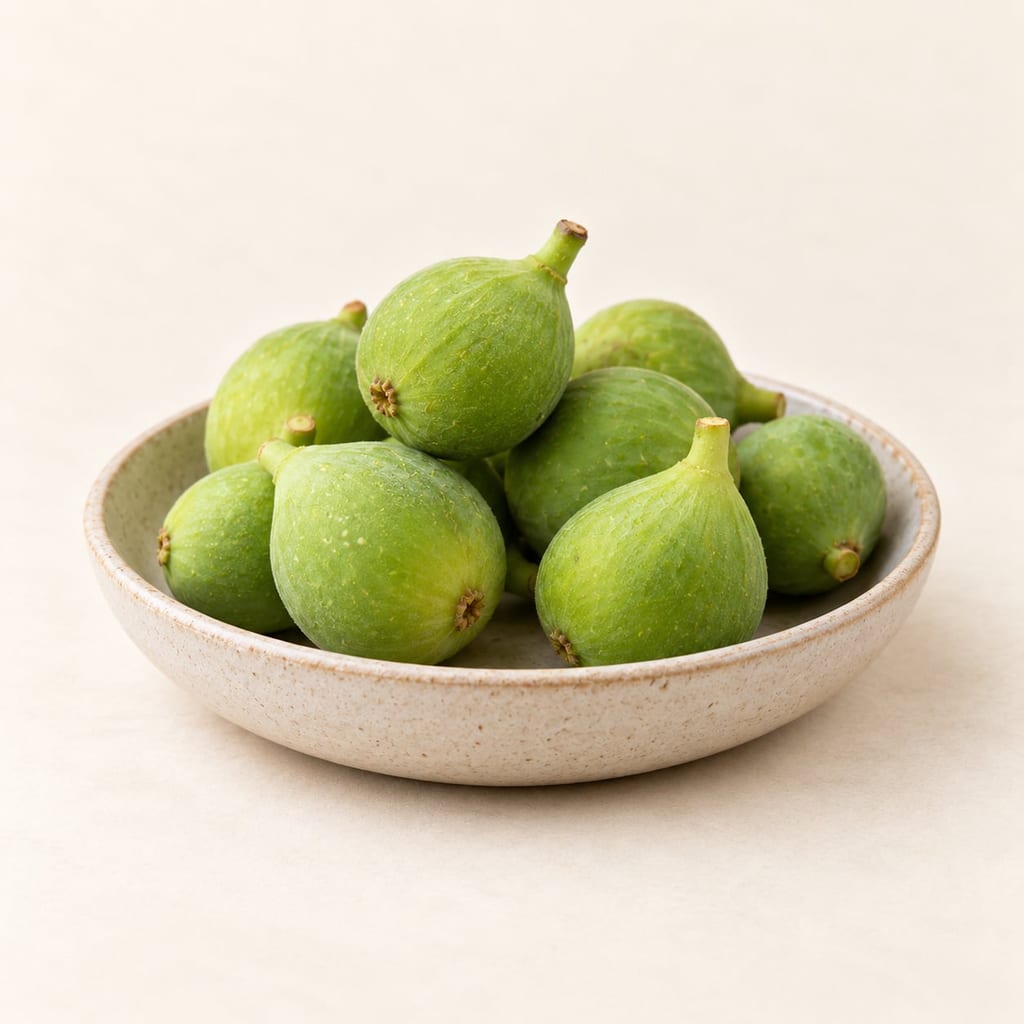
Firm green figs are the unripe fruit of the fig tree selected for preserves that keep the fruit whole and let it absorb syrup.
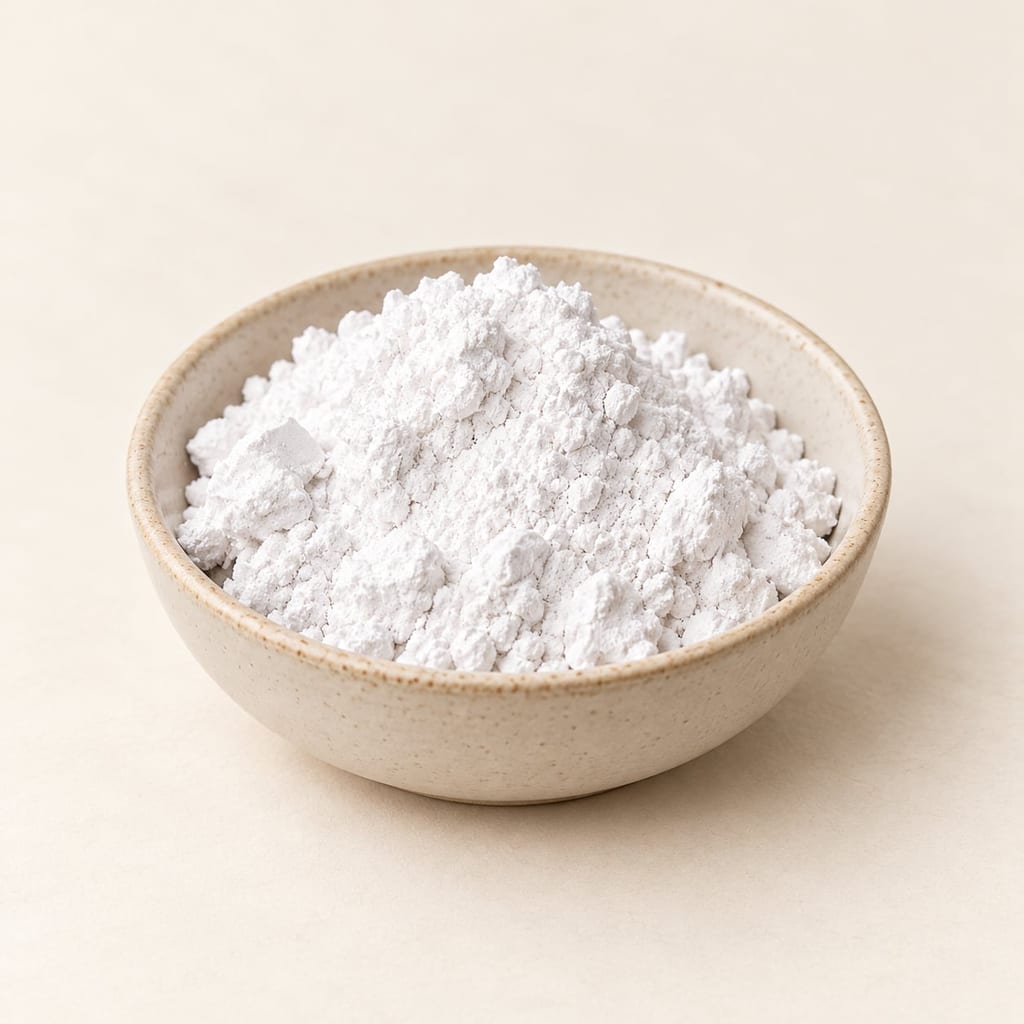
Food-grade slaked lime is calcium hydroxide, an alkaline processing aid used in distinct food treatments including green-fig soaking and maize nixtamalization.
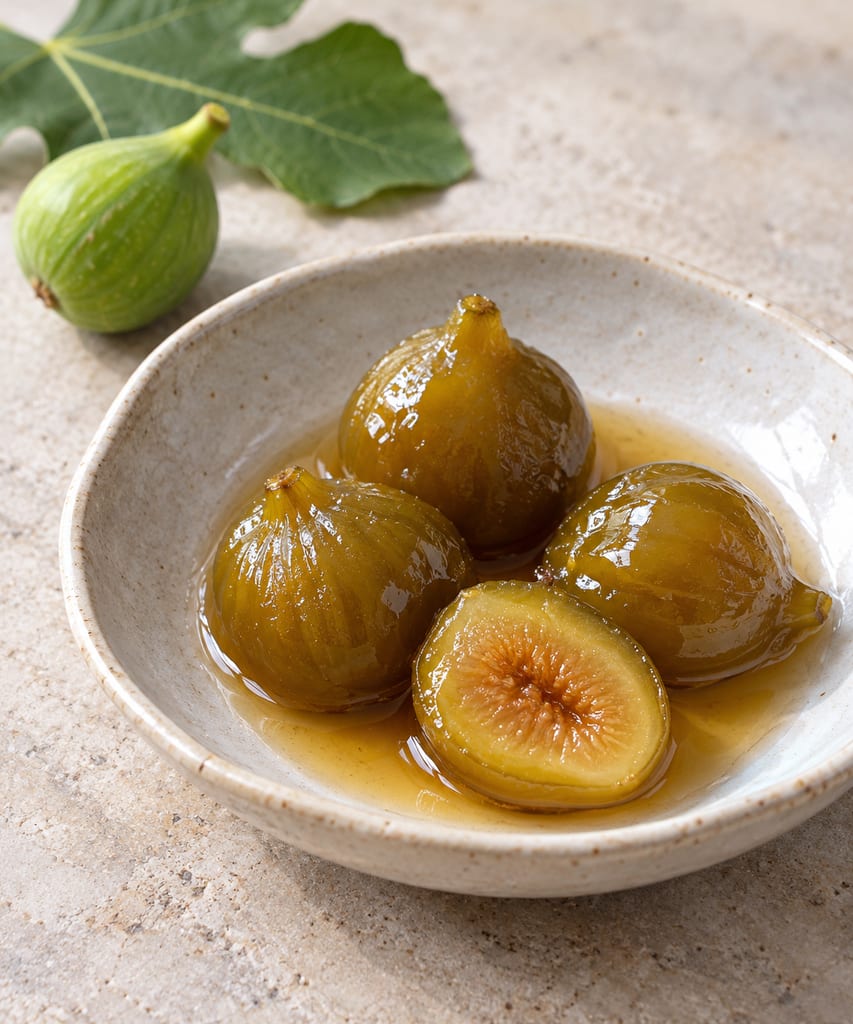
Hard green figs are parboiled and cooked whole in a lemon-sharpened sugar syrup as a refrigerator-only South African konfyt; the method does not establish shelf-stable canning.
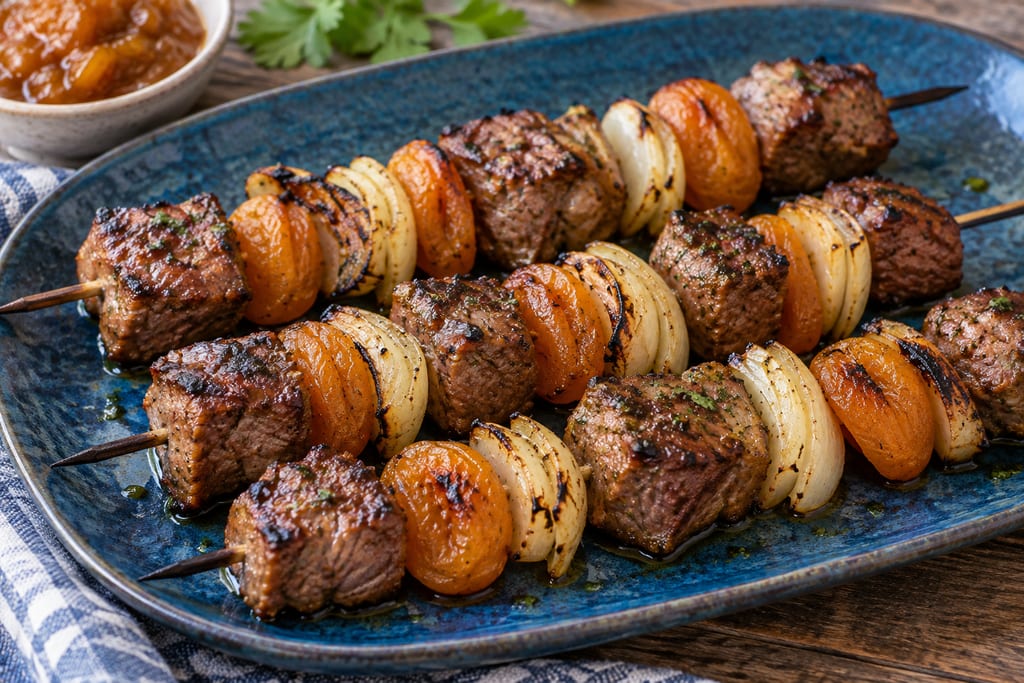
Cape skewers of marinated lamb or mutton threaded with onion, fat or dried fruit and grilled, their marinade balancing curry spice against vinegar or tamarind and something sweet.

Adrak murabba preserves young ginger in sugar syrup, a sweet South Asian preparation recorded in Indian cookery and food-processing sources.
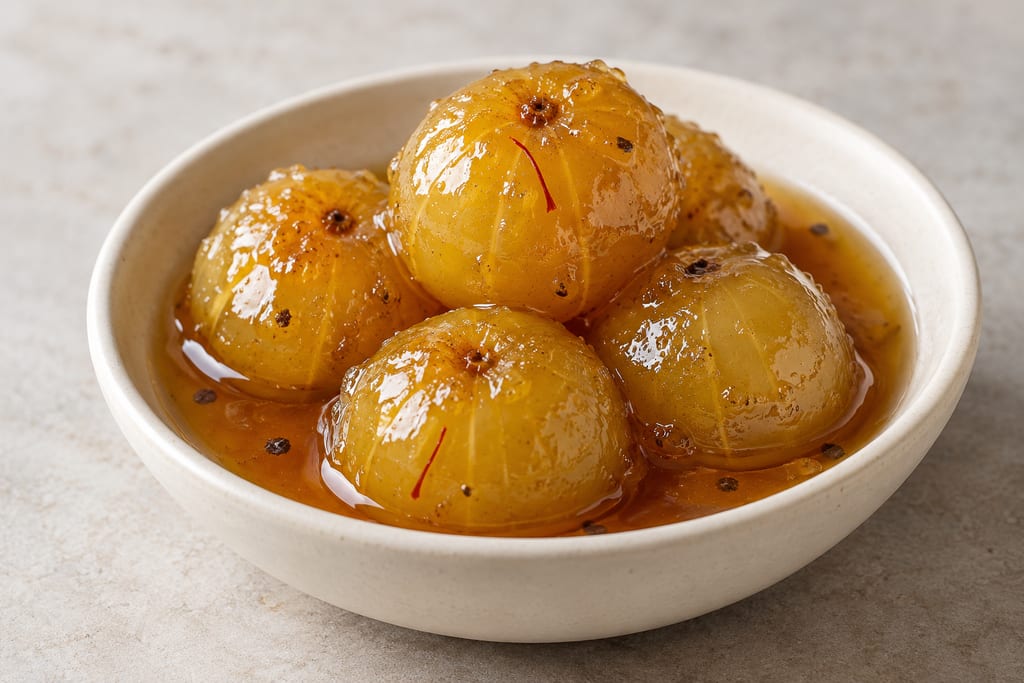
Amla murabba preserves whole Indian gooseberries in a heavy sugar syrup scented with cardamom and sharpened with pepper and black salt. This household method soaks the fruit before cooking.
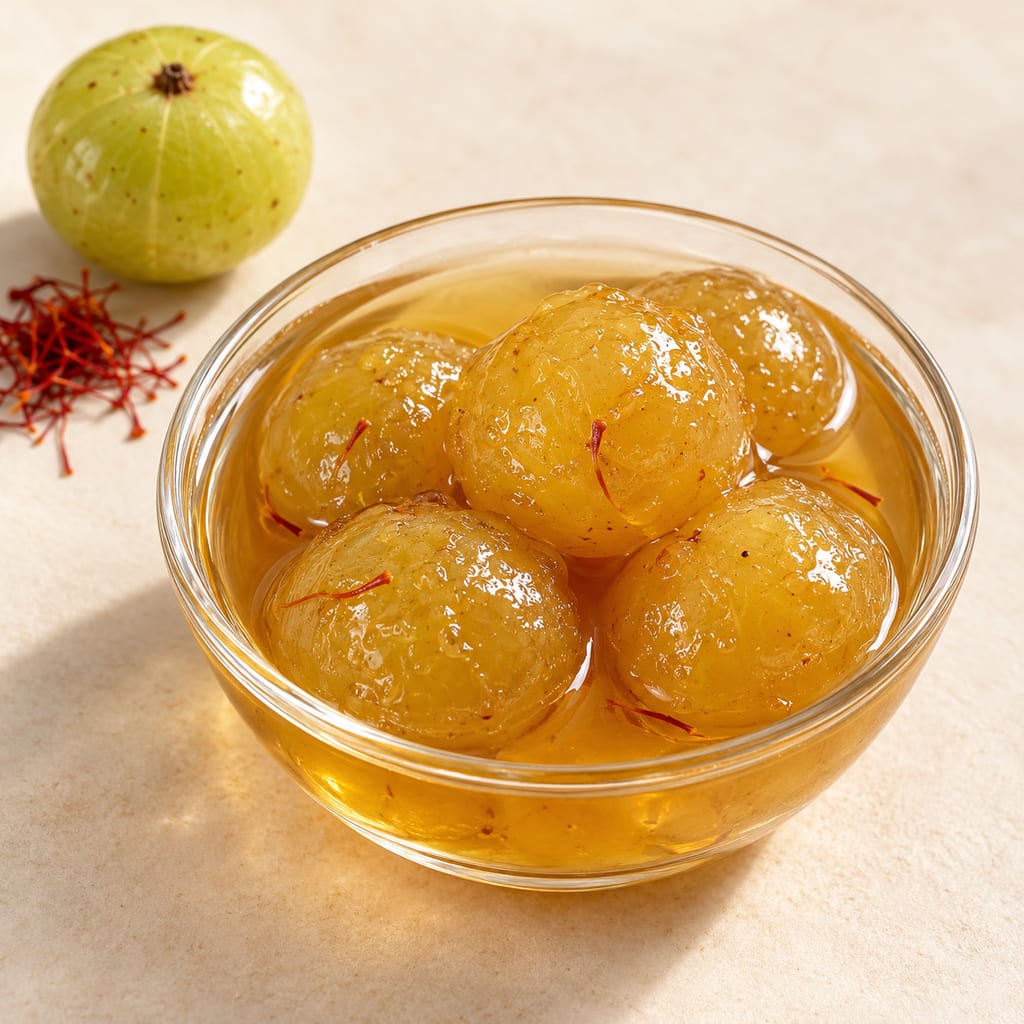
Whole amla simmer in sugar syrup with saffron, black cardamom and pepper in this chef's version of the Indian fruit preserve. The fruit is soaked overnight before cooking.
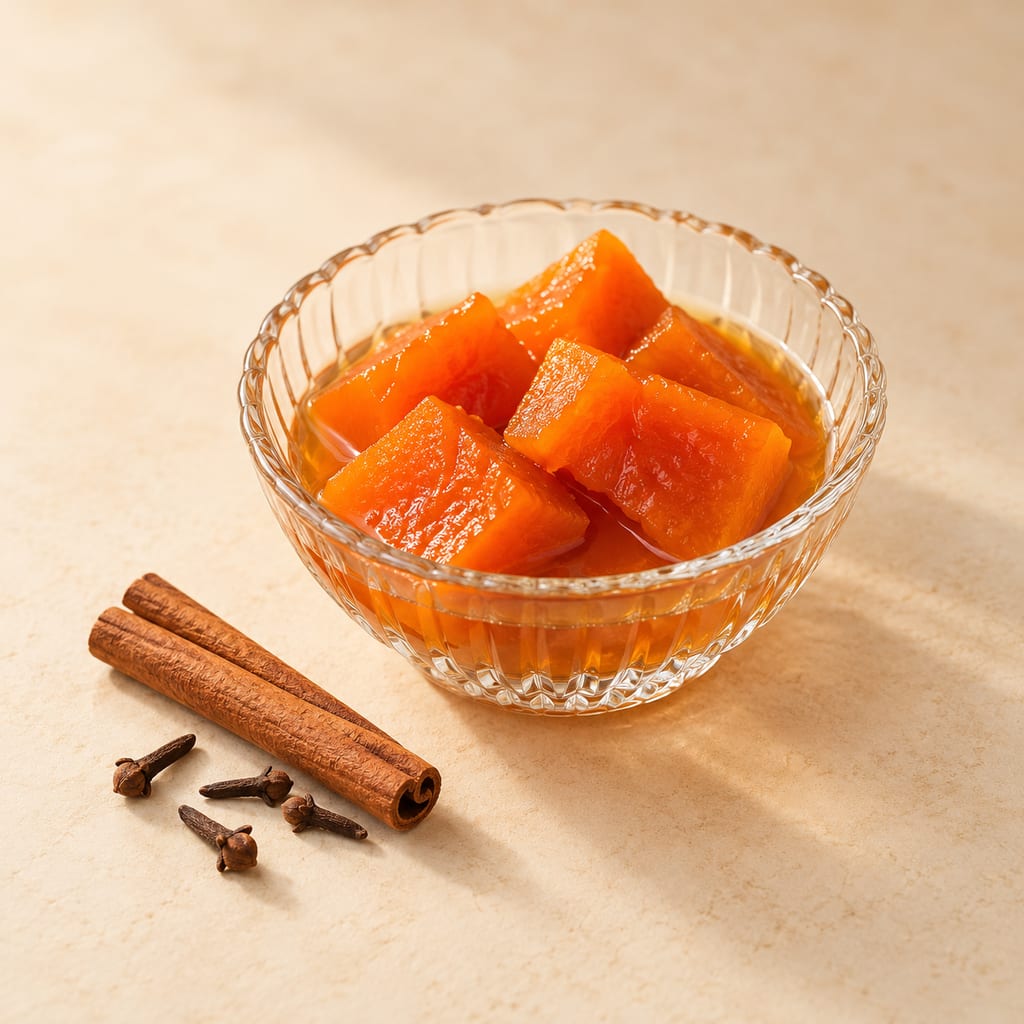
Brazilian doce de abóbora: Freeze for winter; small fresh portion refrigerated up to 48 hours.
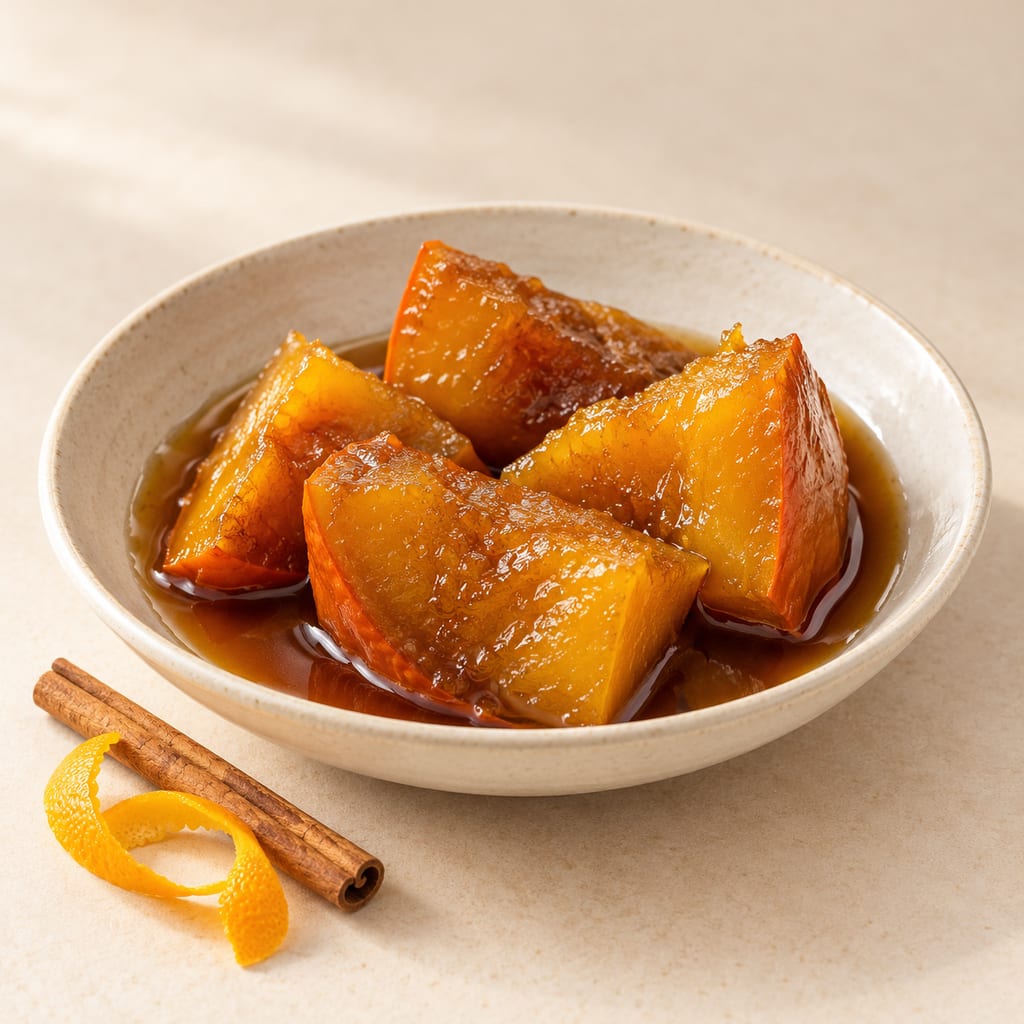
Rind-on pumpkin simmered with piloncillo, orange and cinnamon until glazed. This Mexican sweet keeps refrigerated for up to one week.
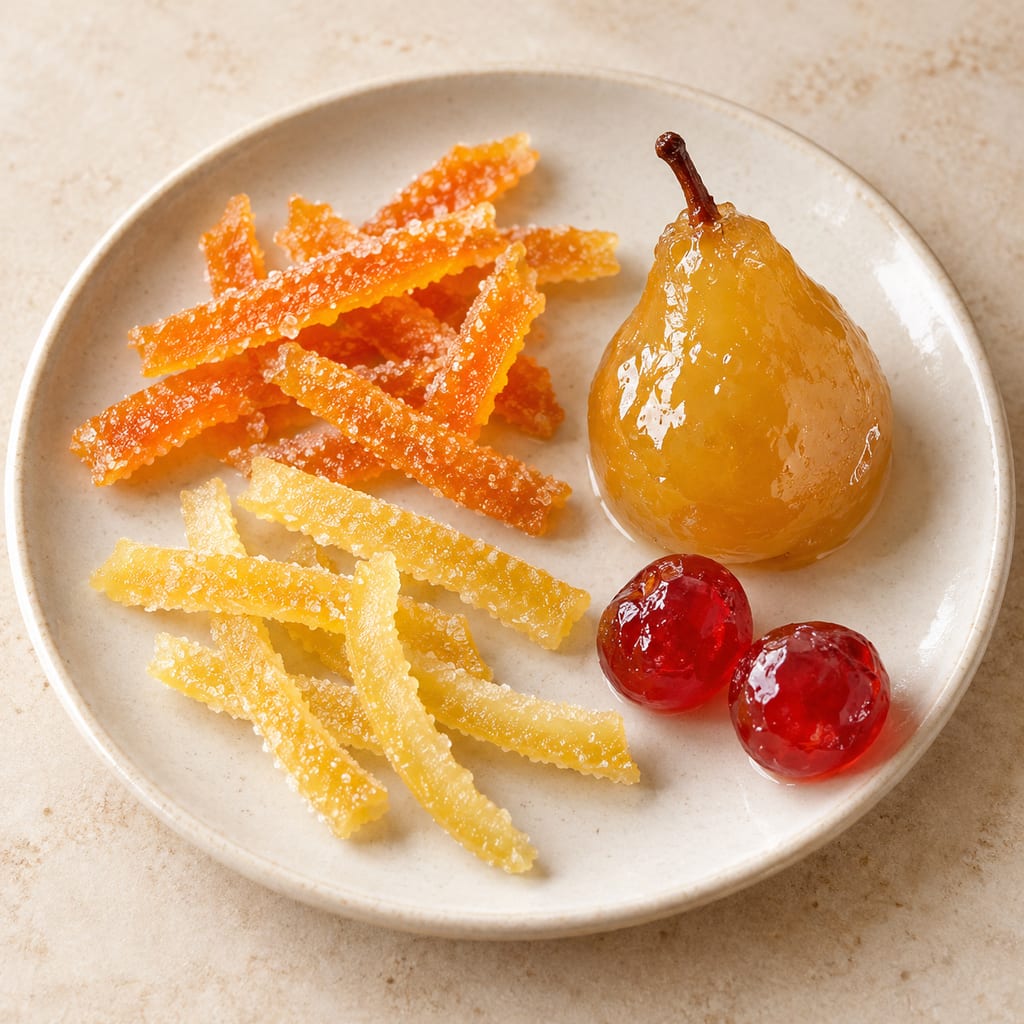
Candied fruit is fruit that has been repeatedly steeped in concentrated sugar syrup, which replaces part of its water with sugar, often followed by drying. It differs from fruit served in a thin syrup.
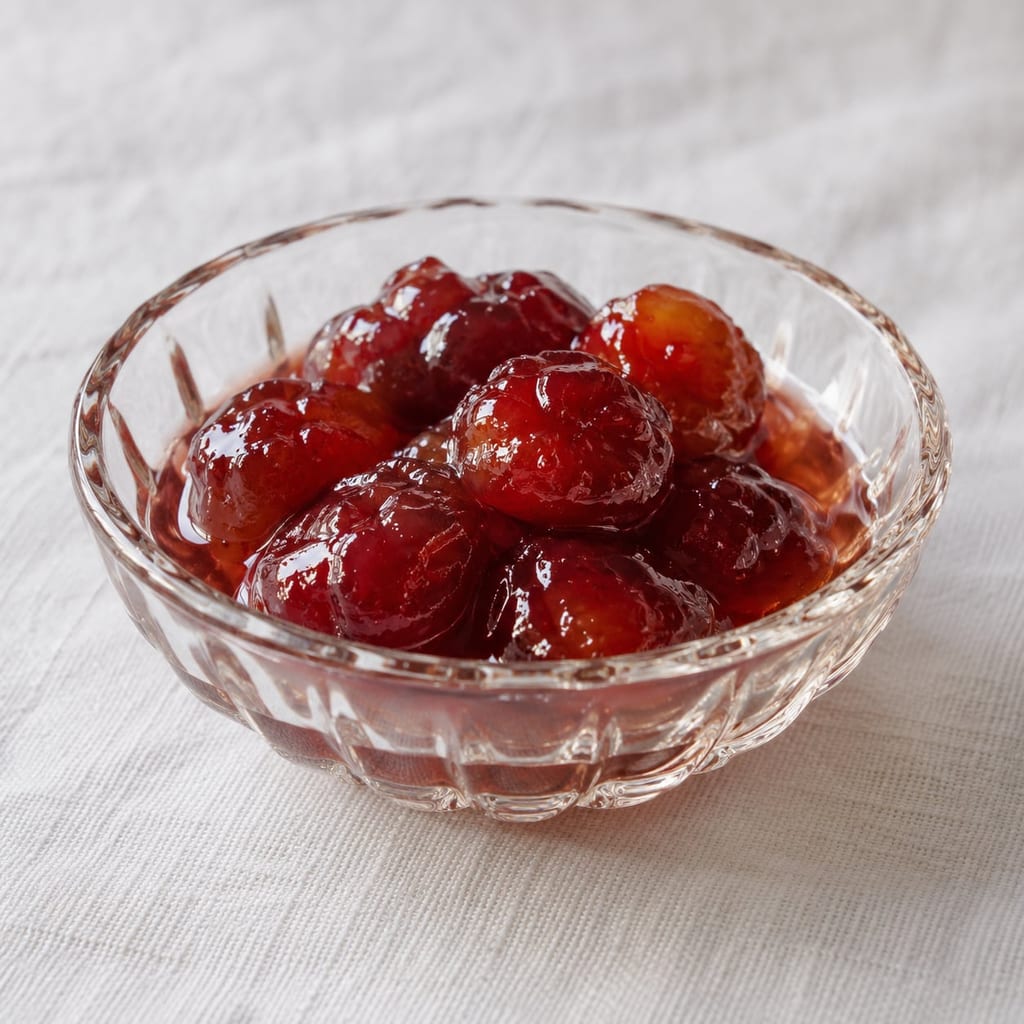
Cypriot cherry glyka made by layering firm pitted cherries with sugar, briefly boiling them, chilling overnight, and boiling again to concentrate the syrup. This version is refrigerated and has no shelf-stable canning process.
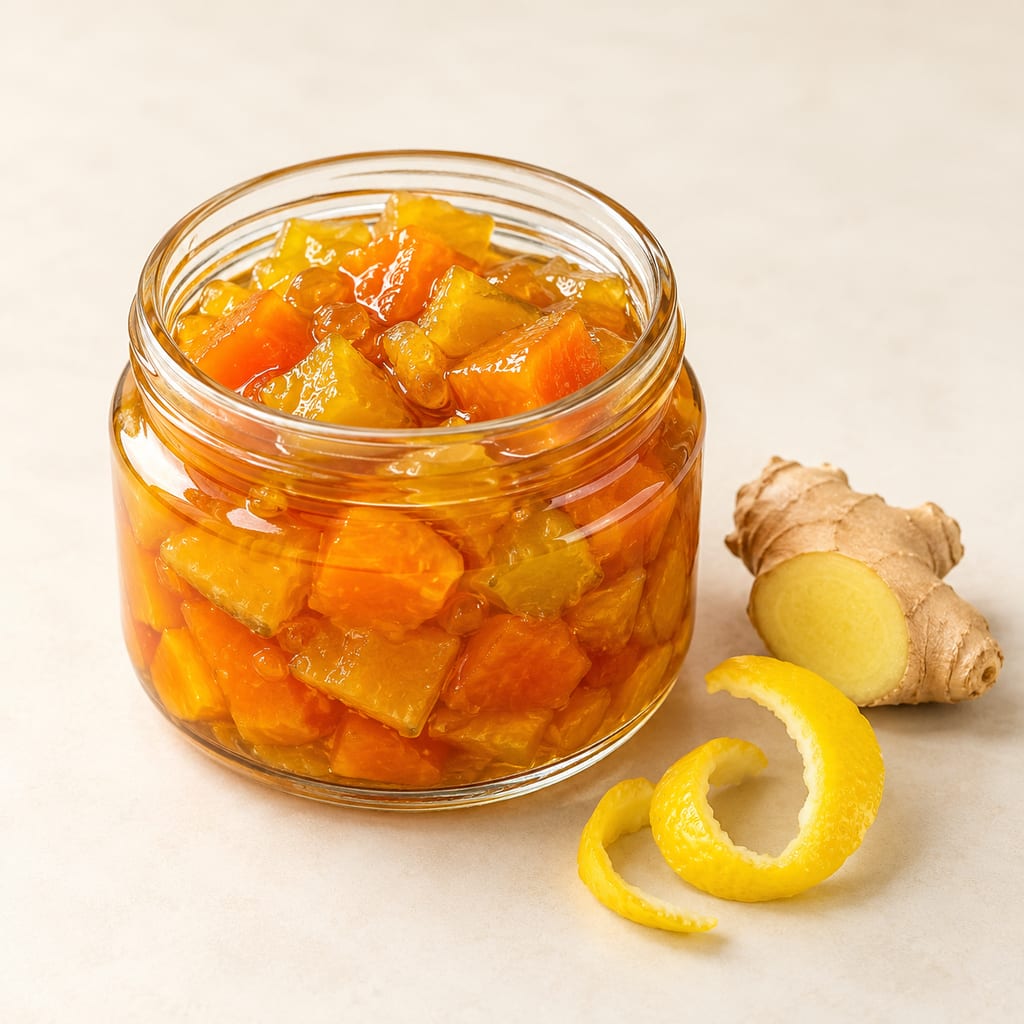
English lemon-and-ginger preserved pumpkin, after an 1861 recipe: Freeze for winter; small fresh portion refrigerated up to 48 hours.
No community contributions have been published for this entry yet.
Sign in to contribute. Published comments and photos are free to read.
Wines of South Africa (WOSA), Cape RecipesInspiration · Process
Green Fig KonfytIngredients, syrup basis, stages, quality cues and hot bottling (lines 78–108).
Cited in: A whole-fruit preserve called konfyt; A history recorded in words and cookbooks; Why the fruit is picked green; What the soak, heat and syrup change; Why each ingredient is here; Following the stages without blending methods; What the source leaves open
Dictionary of South African EnglishHistory · Terminology
konfytKonfyt means whole or large fruit pieces in syrup; word derives from Afrikaans and Dutch; historical quotations include green-fig konfyt in 1968.
Cited in: A whole-fruit preserve called konfyt; A history recorded in words and cookbooks; Why the fruit is picked green; A related method, and other green-fig sweets; Serving the preserve
National Center for Home Food PreservationSafety
Equipment and Methods Not RecommendedOpen-kettle filling and sealing without a tested post-fill process is not recommended for home canning because it cannot prevent all spoilage risks.
Cited in: What the source leaves open
Gardenista; Marie ViljoenHistory · Regional use · Variations · Serving
Green Fig Preserve Recipe: A Taste of South AfricaThe account describes green-fig preserve as a South African konfyt made with fully unripe figs and sold at roadside farm stalls and small-town shops.
The author traces her Cape family and cookbook research, naming Hilda Gerber (circa 1945), The Cape Times' Old Times Recipes (1952), Mary Higham (1923), Dine van Zyl (1985), and Lesley Faull and Vida Heard (1975).
The author reports the Cape distinction between first-crop voorvye (breba figs) used for konfyt and the later eetvye crop eaten ripe, based on a Cape Town grower's account.
The history narrative identifies colonial movement and enslaved Southeast Asian cooks as part of the complex context; it does not establish a single origin for the preserve.
Serving examples include toast, tea or coffee as a spoon sweet, cheese and a fennel salad.
Cited in: A whole-fruit preserve called konfyt; A history recorded in words and cookbooks; Why the fruit is picked green; Why each ingredient is here; Following the stages without blending methods; A related method, and other green-fig sweets; Serving the preserve
Utah State University ExtensionMethod context · Safety
Reduced Sugar and Sugar-free Food PreservationThe source distinguishes whole or halved fruit packed in syrup from jams and jellies: syrup changes flavor and texture but does not provide the canning safety process.
It notes that reducing syrup sugar can alter whole-fruit texture, color and shape; sugar level in syrup is a quality choice when using an otherwise safe tested process.
It warns that canning safety still depends on an appropriate preservation process, not syrup alone.
Cited in: What the soak, heat and syrup change; What the source leaves open
National Center for Home Food Preservation; University of Georgia Cooperative ExtensionMethod comparison · Safety
Fig PreservesThis is a separately tested U.S. fig-preserves recipe, not the Cape recipe on this page.
The tested method specifies jar headspace and a boiling-water canner process, unlike WOSA's hot-bottling instruction, which supplies no post-fill process.
Cited in: What the source leaves open
U.S. Department of Agriculture, Agricultural Marketing ServiceIngredient function · Method context
Technical Evaluation Report: Calcium Hydroxide, HandlingUSDA's technical review describes calcium hydroxide as a firming agent: calcium ions can bind with soluble pectin in fruit cell walls and help retain fruit particle integrity.
This general food-science explanation makes a plausible context for the lime soak, but does not independently test Cass Abrahams's specific fig method or validate its lime concentration.
Cited in: What the soak, heat and syrup change; Why each ingredient is here
Western Cape Department of Agriculture; H. Lotter, 2014Variant method · Regional context
The Fig in South AfricaThe book gives a separate hard-green-fig preserve method without a lime soak: similar-sized fruit is trimmed and cross-cut, parboiled in salted water, then cooked in syrup.
The recipe specifies 1.5 kg fruit, 2.5–3 kg sugar, 6 L syrup water, and a choice of lemon juice or measured acids, while leaving the parboiling-water volume and salt amount unspecified.
It is a separate South African method; it is not an instruction to substitute ingredients or quantities in Cass Abrahams's recipe.
Cited in: Following the stages without blending methods; A related method, and other green-fig sweets
Wildebraam Berry EstateModern use
Green Fig PreserveA current South African producer describes whole green figs in syrup as a sweet, earthy preserve and suggests cheese platters, roast pork and mosbolletjies as pairings.
Cited in: Serving the preserve
FoodSafety.gov (U.S. Department of Health and Human Services)Safety
4 Steps to Food SafetyGeneral leftover guidance says to refrigerate perishable food within two hours, keep the refrigerator at 40 °F (4 °C) or below, and use shallow containers for rapid cooling. This supports refrigerator-only handling here; it does not validate a canning process or recipe-specific storage duration.