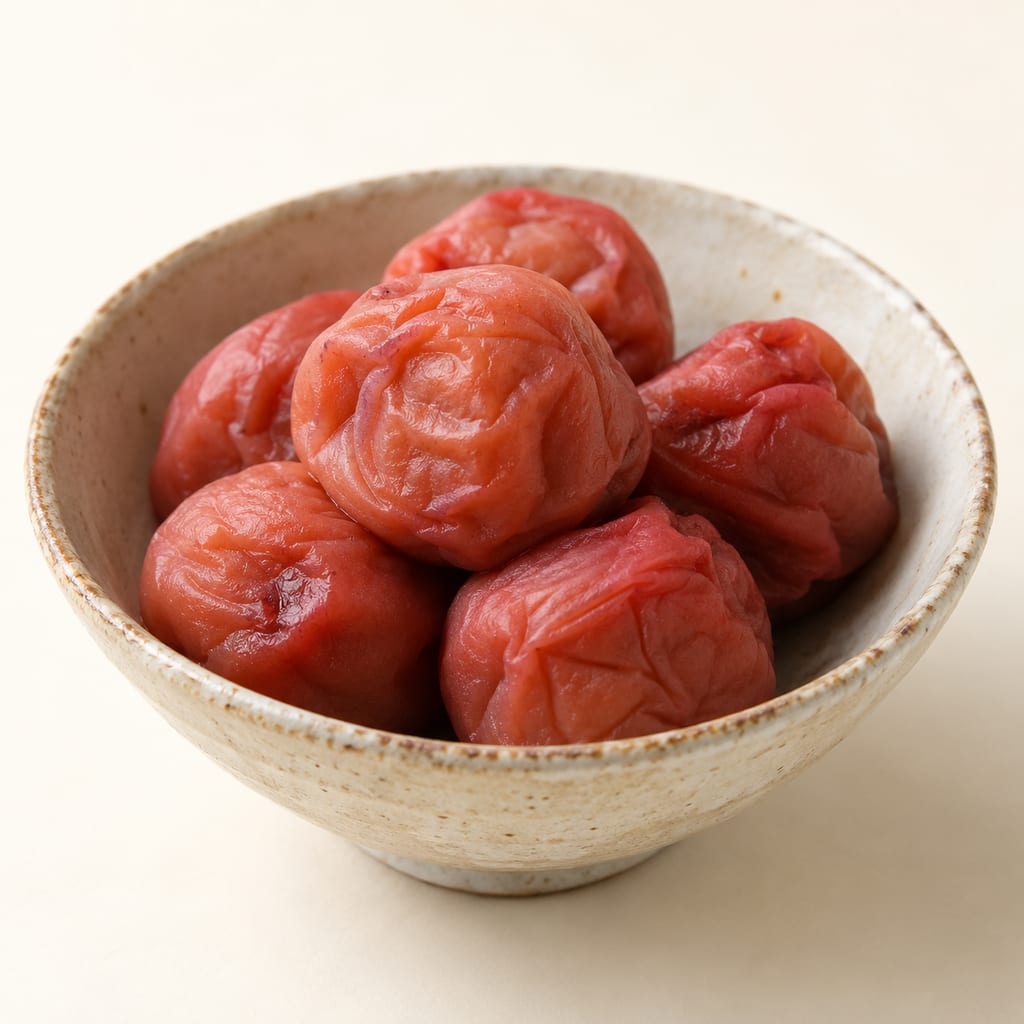
Umeboshi
Naturally acidic ume fruit salted and sometimes dried in Japan; the salt, the fruit’s own acidity and the loss of moisture supply the preservation, and the preparation is not always fermented.
 FermenteaWhere food goes to change
Traditional method
梅酢 · うめず · Ume-su · Ume pickling liquid · Umeboshi pickling liquid · Japanese ume vinegar · Japanese plum vinegar · 白梅酢 · 赤梅酢 · Shiro-umezu · Aka-umezu
The very salty, sour liquid drawn out of Japanese ume fruit by salt during umeboshi making: acidity from the fruit's citric and malic acid, not from acetic fermentation; white, or red with shiso.
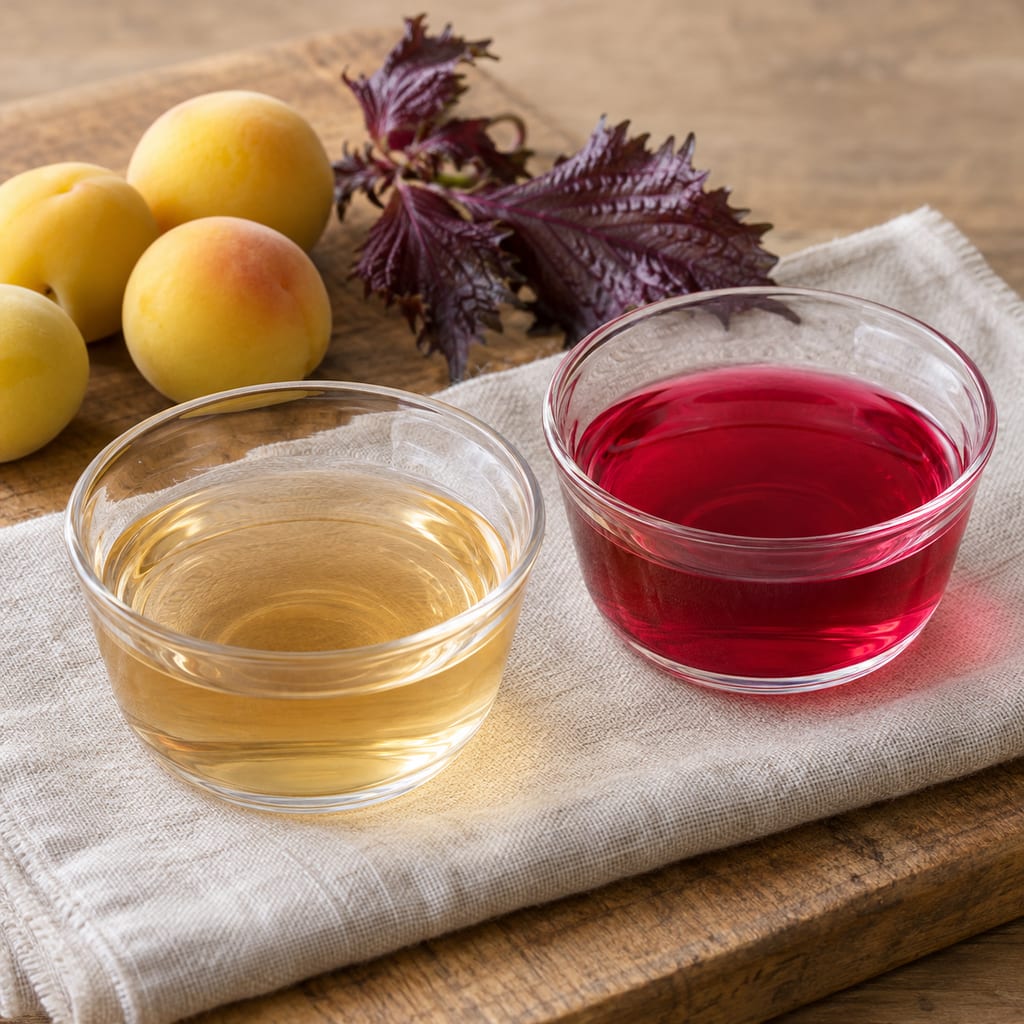
Umezu, 梅酢 (うめず), is the very salty, sour liquid that comes out of Japanese ume fruit when it is packed in salt to make umeboshi. It is often translated as Japanese plum vinegar, which is misleading. Traditional umezu needs no wine, alcohol or vinegar mother and no acetic acid bacteria. Its sourness comes from acids already in the fruit, mainly citric and malic acid, and its saltiness from the curing. It is better thought of as an acid-rich fruit brine than a fermented vinegar.
The fruit is ume, Prunus mume, called Japanese apricot or Japanese plum, which is not the European plum Prunus domestica. Salted ume becomes umeboshi, the sharp preserved fruit eaten with rice. Umezu forms while the fruit is being salted, and it may stay in the umeboshi batch or be drawn off and used as a condiment.
There are two main kinds. 白梅酢 (shiro-umezu), white umezu, is the liquid from salting ume alone, usually pale yellow, straw or faintly amber rather than white. 赤梅酢 (aka-umezu), red umezu, is coloured with red shiso, whose leaves give anthocyanin pigment and a herbal aroma. Both stay salty, ume-acidic liquids and not acetic ferments.
Making umeboshi gives a preserved fruit and a liquid that can be reused in vegetable pickles, seasoning and later batches. Japanese agricultural guidance recommends keeping the umezu and not throwing it away, to flavour vegetables, to make red pickled ginger, or to coat fresh ume with salt for the next batch.
Traditional high-salt umezu is very concentrated. The Japanese Ume Research Association describes typical examples as about 18 to 20 percent salt and about 5 percent citric acid, while Kanagawa Prefecture works out about 15 percent salt in the liquid from one of its 18-percent-salt umeboshi methods. The numbers describe different preparations. Some products sold as umezu are ume soaked in ordinary vinegar or sugar-extracted ume juice, which are not the same. Umezu here means the liquid that salting produces.
The history of umezu follows the salting of ume and not the first mention of ume trees in Japan. Ume appear in early poetry and were grown for flowers and fruit, which does not show the fruit was salted or its liquid collected. The preparation becomes visible through references to salty-sour ume products and how they were used.
The earliest significant text is from the Heian period. The Heibonsha World Encyclopedia entry on umezu reports that the Wamyō Ruijushō, a dictionary compiled around 934 by Minamoto no Shitagō, glosses 塩梅 (enbai) as 梅酢也. That links salted ume acid to the language of seasoning, since enbai came to mean adjusting flavour and then balance in general. It is evidence for terminology and not for a recipe.
The medical compilation Ishinpō of 984 is often cited in histories of umeboshi, and the Ume Research Association takes it as evidence for the medicinal use of salted ume. It gives no household umezu recipe, and old claims of curing illness are separate from the chemistry.
The Nippo Jisho, the Japanese-Portuguese dictionary made by Jesuits in Nagasaki in 1603 to 1604, is cited by the Nihon Kokugo Daijiten under 梅酢, which shows the word was known in the early seventeenth century.
The red shiso version has a firmer date. The Ume Research Association names Honchō Shokkan by Hirano Hitsudai and Nōgyō Zensho by Miyazaki Yasusada, both of 1697, as early written accounts of colouring umeboshi with red shiso. They show a seventeenth-century shiso method and not that bottled red umezu was sold separately. The association also keeps an old umeboshi specimen dated 1576, which does not say whether its liquid was ever collected.
Regional production grew around Odawara in Kanagawa, which the agriculture ministry says travellers on the Tōkaidō knew in the Edo period, and in the ume districts of Wakayama. Modern agricultural guides give measured salt proportions for extracting umezu that can be checked independently of the old stories.
Umezu forms by salt extraction and not by a required fermentation. Salt placed against ume makes a strong solution at the fruit surface, and water moves out of the tissue towards it. The water dissolves more salt and carries soluble substances from the fruit: organic acids, sugars, mineral ions and phenolic compounds. The liquid that collects is umezu.
Salt also diffuses into the fruit. A weight pressing the ume keeps them in contact with salt and releases liquid, and once enough juice has gathered, keeping the fruit under it limits oxygen and surface spoilage. The liquid is not just salted water, since it holds a large share of the ume's own soluble material.
The main acids are citric acid (C6H8O7, three carboxylic groups) and malic acid (C4H6O5, two), both already in ume before salting. In water they give the strongly acid conditions and tart taste. No yeast is needed to make ethanol and no acetic acid bacteria to oxidise it, so the usual vinegar route from sugar through alcohol to acetic acid does not describe traditional umezu.
A 2017 chemical study analysed five commercial umezu samples from Fujian and Guangdong in China. Citric acid made up about 67.5 to 74.3 percent of the identified organic acids and malic acid about 12.9 to 18.9 percent, with small amounts of lactic and acetic acid. Those trace acids do not mean the products were fermented as vinegars. The samples held 20.36 to 22.01 percent salt, total titratable acidity of 4.55 to 5.44 percent and a pH of about 1.81 to 1.90. They are measurements of those factory products and not specifications for Japanese homemade umezu.
Japanese sources describe similar strength: roughly 18 to 20 percent salt and about 5 percent citric acid from the Ume Research Association, and about 15 percent salt from Kanagawa's 18-percent-salt method. These depend on how much water is released and how the liquid is handled. Salt content, titratable acidity and pH are different measurements.
Red umezu adds pigment extraction. Red shiso, Perilla frutescens var. crispa, contains anthocyanins including shisonin and malonylshisonin. Salting and rubbing breaks up the leaves, and in acid umezu the pigments go into the liquid and show a bright red that low pH favours. Research on red shiso umeboshi confirms that acidity, salt and other compounds affect anthocyanin stability.
Polyphenols also enter the brine. The 2017 analysis identified neochlorogenic, chlorogenic and cryptochlorogenic acids, and laboratory antioxidant assays showed activity, which does not show benefit from eating umezu.
The basic ingredients are ume and salt. A measured Kanagawa Prefecture recipe uses one kilogram of ume and 180 grams of salt. The ume provide the water and natural acids, and the salt draws out the liquid and holds back many microbes. No water, alcohol, vinegar mother or yeast is needed, and the liquid the recipe produces can be kept on its own as white umezu.
The fruit matters. Kanagawa recommends suitably ripe ume and names Jūrō and Sugita as good for umeboshi, and warns against narrow green immature fruit. Fruit that is still slightly green can be held at about 20 degrees C for one to two days until it turns yellow. The ume are washed and drained, and the surface should stay slightly moist so salt clings, with no large amount of added water.
The washed ume are layered with the measured salt in a non-reactive vessel, a little salt on the bottom, then ume, then more salt, shaking so the fruit is coated evenly, with the rest of the salt on top. A pressing plate and weight hold the fruit down, and Kanagawa suggests a weight of about half the fruit weight. As juice appears it forms the white umezu.
The liquid should rise over the fruit quickly, preferably within the first day, so that no fruit is left exposed. After one to two days the vessel is tilted or the fruit moved, and after two to three days settled salt is redistributed so it dissolves evenly.
A Wakayama recipe published by the agriculture ministry uses one kilogram of ripe yellow ume, 200 grams of coarse salt and a one-kilogram weight, with liquid in about two to three days and a pickling period of about a month. It is a separate regional formula and not a correction of Kanagawa's, and different salt ratios change extraction speed, salt concentration and character.
Kanagawa's technical method continues the first salting for about three weeks. The ume can then be taken out and dried for umeboshi, leaving the liquid, which is collected into a clean container. Removing too much liquid too early can leave the remaining fruit uncovered, so umezu and the ume have to be managed together.
Red umezu needs red shiso. The leaves are washed, salted and rubbed, and the first dark, harsh liquid is squeezed out. They are then rubbed or mixed with umezu to give a bright red acid liquid. Kanagawa uses salt at about 20 percent of the leaf weight for the shiso. The treated leaves can go into the umeboshi and the red liquid is kept as red umezu.
Older umezu can be reused. Kanagawa suggests using umezu equal to 10 to 20 percent of the fresh fruit weight to wet the ume before coating with salt, which helps the salt stick and speeds the first liquid. It is a salty, acid processing aid and not a vinegar mother, and it must be counted when working out a batch's salt concentration. The yield of umezu is not fixed and depends on the fruit, maturity, salt, pressure, time and how much liquid stays with the umeboshi.
Umezu is made wherever ume are salted for umeboshi, with differences by region, maker and household: the variety and ripeness of the ume, the amount of salt, red shiso, old umezu and how the finished liquid is treated. No nationwide recipe or standard salt concentration exists.
Wakayama is a major source because of its ume orchards and umeboshi industry. The agriculture ministry records a preparation of one kilogram of ripe yellow ume and 200 grams of salt, with the umezu formed in the first pickling before the fruit is sun-dried. Commercial Wakayama also makes reduced-salt and seasoned umeboshi whose liquid differs a lot from traditional high-salt umezu.
Odawara in Kanagawa has its own preserved-ume tradition, linked by the ministry with Edo-period Tōkaidō travellers. Kanagawa's guidance gives 180 grams of salt per kilogram of ume with pressing, salt distribution and liquid management, and names Jūrō and Sugita.
The main variation is red shiso. White umezu comes from salted fruit alone and red umezu forms when treated red shiso leaves meet the acid liquid. Written references to red shiso umeboshi date from 1697. Modern makers add the shiso at different stages, and the colour, aroma and dissolved shiso content differ.
Reuse is another. Kanagawa wets fresh ume with old umezu and also describes using umezu as the pickling liquid for small ume. Umezu that begins at about 15 percent salt can fall to about 7 to 8 percent after it has been used with fresh small fruit, so even authentic umezu changes with reuse and the lower-salt liquid needs more storage care.
Red umezu is the origin of beni shoga, ginger pickled in it, which the agriculture ministry names as the source of the red ginger in Osaka's 紅しょうが天 (beni shoga ten). Some products sold as umezu are really sugar-extracted ume juice or ume steeped in bought vinegar, or they are seasoned, filtered or adjusted, and they differ from traditional salt-extracted white and red umezu.
Umezu is a strongly sour and salty seasoning that does the work of vinegar and salt together. It goes in small amounts or mixed with other things, and the amount depends on its salt, the dish and whether it is white or red. It is not interchangeable with brewed vinegar in equal volume.
One of the simplest uses is a quick vegetable side. Kanagawa suggests adding a little umezu to finely cut vegetables, rubbing or mixing, letting liquid come out and squeezing. The result keeps some ume fragrance and a salty-sour taste. This is a quick seasoning and not a second fermentation or a tested shelf-stable pickle.
Red umezu colours pickles. Japanese references name ginger, myoga, daikon and turnip, with the acid and salt seasoning and the shiso anthocyanin giving the red. Beni shoga, red pickled ginger, is the best known.
The ministry describes Osaka's 紅しょうが天 (beni shoga ten) as slices of red pickled ginger battered and fried, with the umezu acidity set against the coating, and names beni shoga as ginger originally pickled in liquid left over from making umeboshi.
A little umezu seasons rice or mixed rice, and red umezu colours it. Kanagawa mentions ume-based salty-sour seasonings for somen and udon broths. These are seasoning uses and do not show that umezu makes cooked rice safe at ordinary quantities.
Red umezu can season or colour root vegetables, and white umezu gives acid without the red. Because umezu is far saltier than table vinegar, dressings and sauces made with it have to allow for both salt and acid, and a recipe for rice vinegar should not get the same volume of umezu.
Older Japanese dictionaries and regional accounts record umezu as a household remedy for heat and digestive complaints. That does not show it treats illness, and its very high sodium is a practical consideration. It is a seasoning and pickling liquid and not a medicinal vinegar.
The sign that a batch is working is liquid rising to cover the salted fruit. It starts cloudy or pale yellow and ends up over the ume. Kanagawa recommends bringing the liquid over the fruit promptly and keeping it submerged, since exposed fruit can deteriorate, above all where the salt is uneven, and the weight and pressing plate keep fruit and liquid in contact.
The salt quantity is the main control. Kanagawa specifies 180 grams per kilogram of ume and notes that cutting the salt delays the rise of the umezu, letting fruit near the surface ripen or spoil before it is covered. Too much salt leaves undissolved material at the bottom and can lead to salt crystals in the finished fruit. Do not lower the salt and expect the same preservation.
Salt distribution matters. Kanagawa redistributes liquid and settled salt after two to three days, because uneven concentration gives uneven preservation between top and bottom. Old umezu used to wet fresh ume changes the starting balance of water and salt, and a brine of unknown composition is not a measured ingredient.
Acidity has to be read correctly. Umezu holds a lot of organic acid with little acetic acid. A wine vinegar with 5 percent acetic acid and a traditional umezu with about 5 percent citric acid are not the same, and total titratable acidity, pH, salt and the individual acids are separate measurements. Sourness cannot be turned into an acetic acid percentage.
The 2017 analysis of five Chinese commercial umezu products found real differences between samples, with salt from about 20.36 to 22.01 percent and acids and phenolics varying with the fruit. They are not guaranteed values for a Japanese batch made at 180 grams of salt per kilogram.
Colour must be read in context. White umezu may be yellow or amber and red umezu gets its red from shiso. A fading or darkening red does not alone show spoilage, since Kanagawa notes red umeboshi darken in long storage and acidity affects shiso pigment stability. Unidentified surface mould, decomposition or off smells need separate food-safety assessment and cannot be judged by colour.
Lower-salt versions need more care. The Ume Research Association explains that traditional high-salt umeboshi resists spoilage but reduced-salt seasoned products generally need refrigeration, and Kanagawa documents small ume kept in reused umezu at about 7 to 8 percent salt, warning of mould in longer or warm storage and recommending refrigeration and prompt eating. Storage advice for strong umezu does not apply to diluted or repeatedly reused liquid.
The vessel should suit salty acid: Kanagawa recommends glass or suitable plastic and warns that iron and other reactive metals corrode and add rust. Covers and seals should limit contamination and evaporation, since water loss raises the salt concentration and changes the texture.
Umezu is not a substitute for vinegar in shelf-stable canning. Its acidity comes from other acids, and its salt and acid vary. A tested recipe that specifies commercial 5 percent acetic acid vinegar must not be changed by adding umezu without validation, and the old belief in the antibacterial power of ume and salt does not make every diluted dish safe at room temperature.
For a record, note the ume variety, ripeness, fruit weight, salt weight, container, any old umezu, pressing, the appearance of the liquid, the salting time and any shiso. With laboratory analysis record salt, pH, titratable acidity and the organic acids separately.
The Wamyō Ruijushō, a dictionary compiled around 934, glosses 塩梅 (enbai) as 梅酢也, and the medical compilation Ishinpō of 984 is cited for salted ume. The Nippo Jisho of 1603 to 1604 lists 梅酢, and Honchō Shokkan and Nōgyō Zensho, both of 1697, describe colouring umeboshi with red shiso.
An old umeboshi specimen dated 1576 survives. In the Edo period Odawara umeboshi were known to travellers on the Tōkaidō, and Wakayama grew into the largest ume-producing region.
Cutting the salt delays the liquid and lets fruit near the surface ripen or spoil before it is covered.
Hazard sourceExposed fruit can deteriorate, above all where salt is uneven.
Hazard sourceSettled salt gives uneven preservation between top and bottom unless it is redistributed after two to three days.
Hazard sourceIron and other reactive metals corrode in salty acid and add rust.
Hazard sourceReused liquid falls from about 15% to 7 to 8% salt, and lower-salt ume need refrigeration and prompt eating because of mould.
Hazard sourceUmezu is very salty and is used in small amounts.
Hazard sourceUmezu is not equivalent to 5% acetic acid vinegar in tested recipes.
Hazard sourceUse the documented ume-to-salt ratio.
Control sourceKeep the fruit covered by the extracted umezu.
Control sourceRedistribute settled salt.
Control sourceSalt for red shiso.
Control sourceCount old umezu in the batch salt.
Control sourceUse glass or suitable plastic and no reactive metal.
Control sourceFor preserving use commercial vinegar of the acidity a tested recipe specifies.
Control sourceDo not cut the salt: 180 g per kg of ume is what makes the liquid rise and keeps the fruit from spoiling. Keep every ume under the liquid.
Umezu is very salty (roughly 15 to 20 percent salt). Use it in small amounts, and allow for its salt in any dish.
Reused or diluted umezu, at 7 to 8 percent salt, needs refrigeration and prompt eating, because mould grows in longer or warm storage.
Do not use iron or other reactive metal containers; they corrode in the acid brine.
Do not use umezu in place of the specified vinegar in canning or pickling recipes.
Discard a batch with unidentified surface mould, decomposition or off smells.
A major ume-growing and umeboshi region.
A preserved-ume tradition and the source of the Kanagawa method.
A country-level association.
Naturally acidic ume fruit salted and sometimes dried in Japan; the salt, the fruit’s own acidity and the loss of moisture supply the preservation, and the preparation is not always fermented.
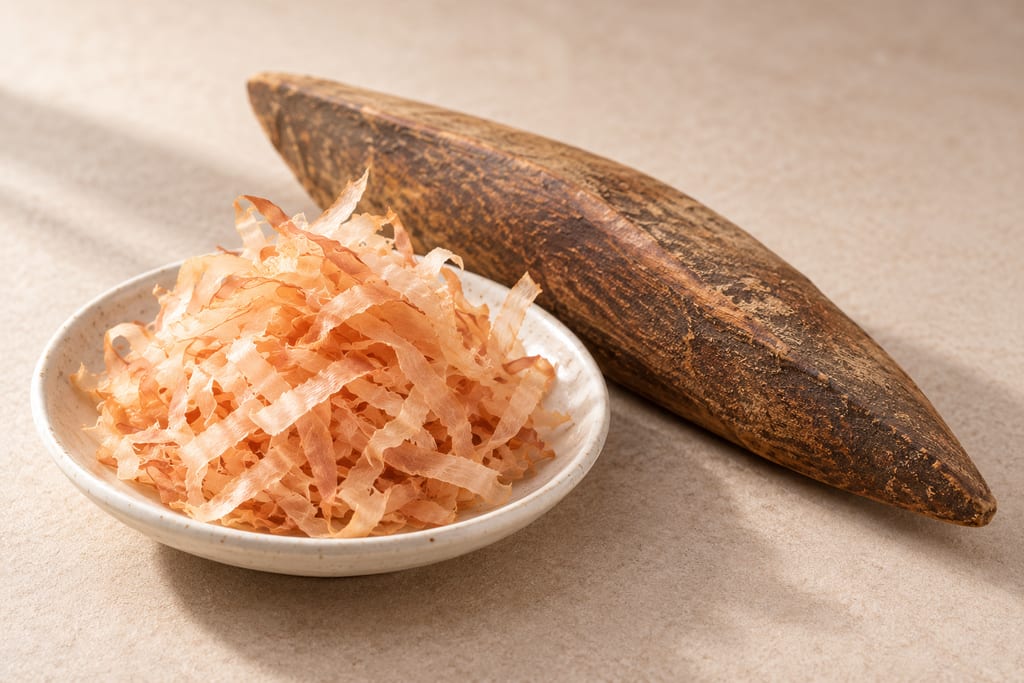
Katsuobushi is skipjack tuna cooked, smoked and dried into a hard block that is shaved into flakes for dashi and toppings. Some styles stop at the smoke-dried stage; others receive carefully managed mold maturation.
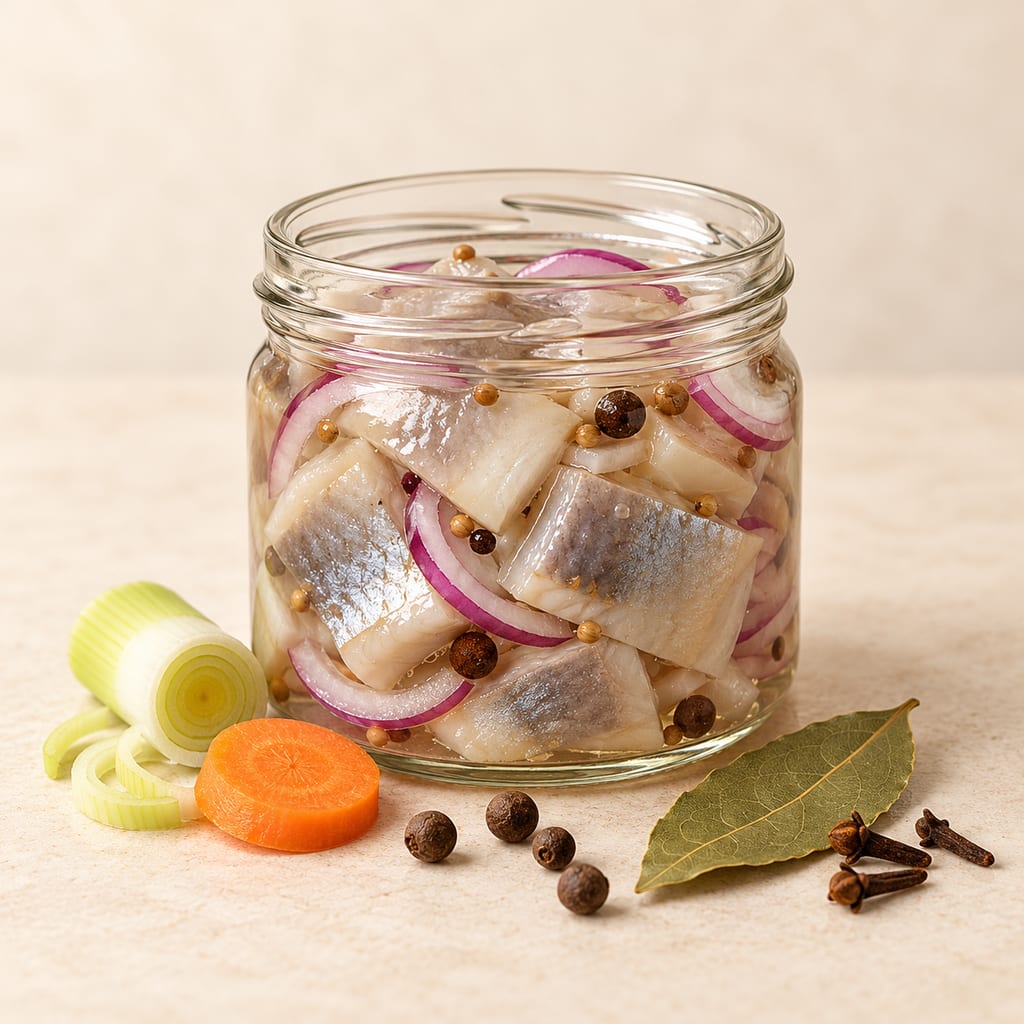
A Swedish ready-to-dress herring preparation: add the classic sliced aromatics and spices to already prepared herring, then serve or chill for fuller flavour.

Achcharu is a family of Sri Lankan vinegar pickles made with mixed vegetables or seasonal fruit and a piquant spice dressing. This version is a quick, refrigerated, non-fermented mixed-vegetable pickle.
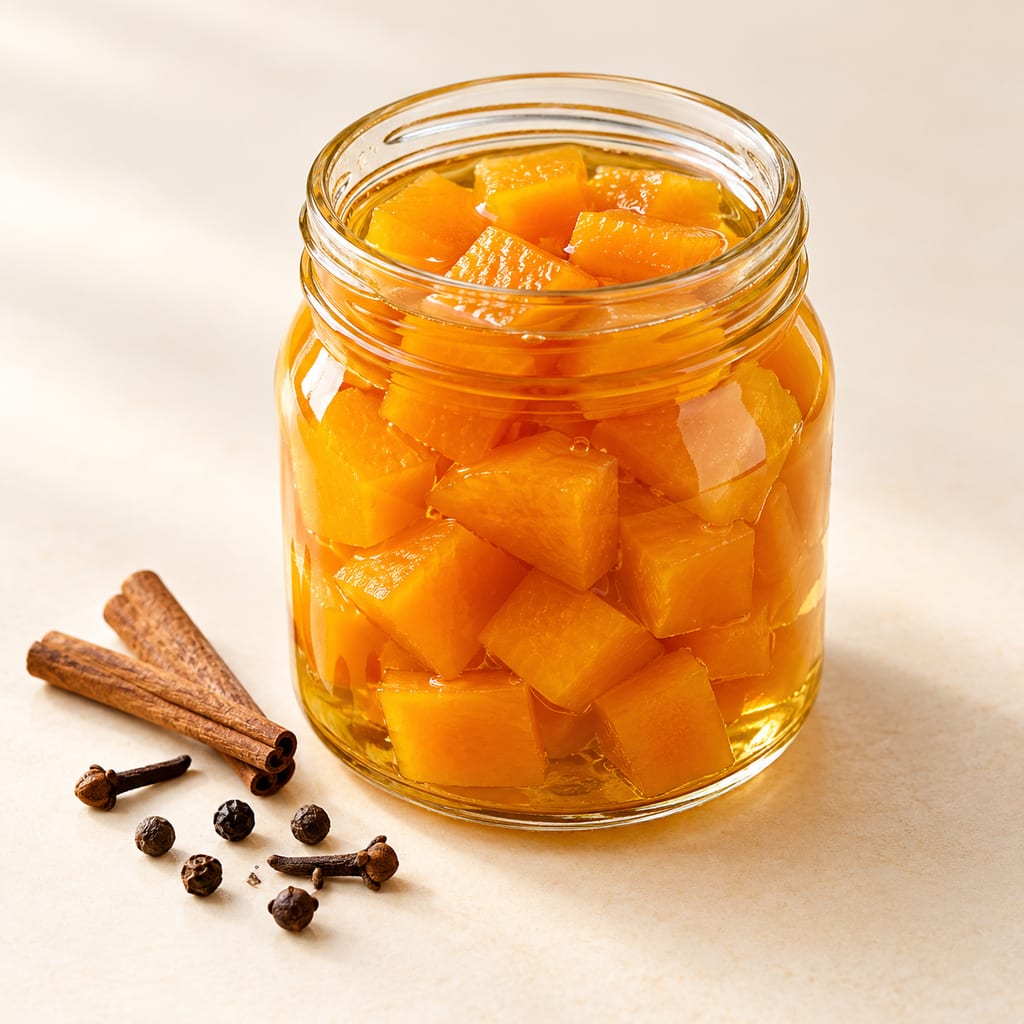
Ball sweet pumpkin pickles: Cupboard: exact published Ball formulation and water-bath process.
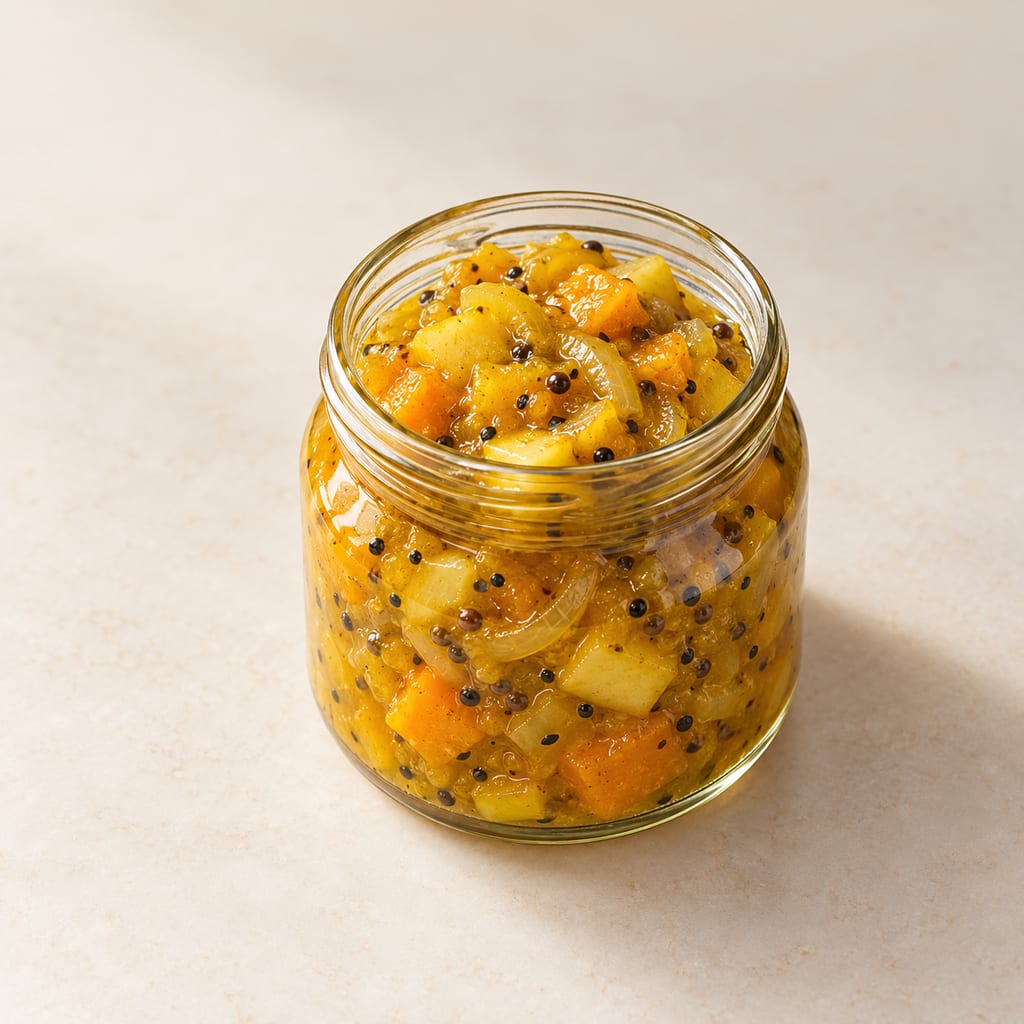
British pumpkin, apple and mustard pickle: Freeze for winter; small fresh portion refrigerated up to 48 hours.
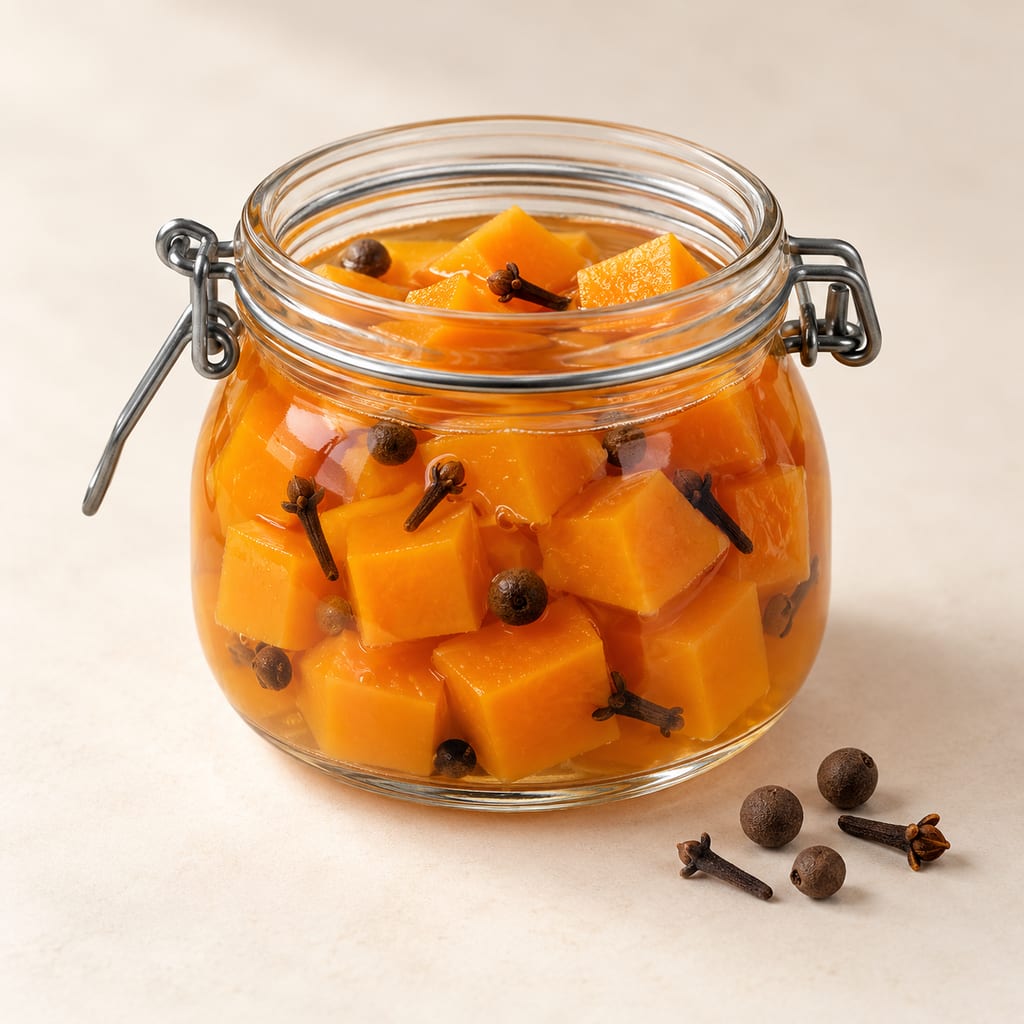
Dynia marynowana: Freeze for winter; small fresh portion refrigerated up to 48 hours.
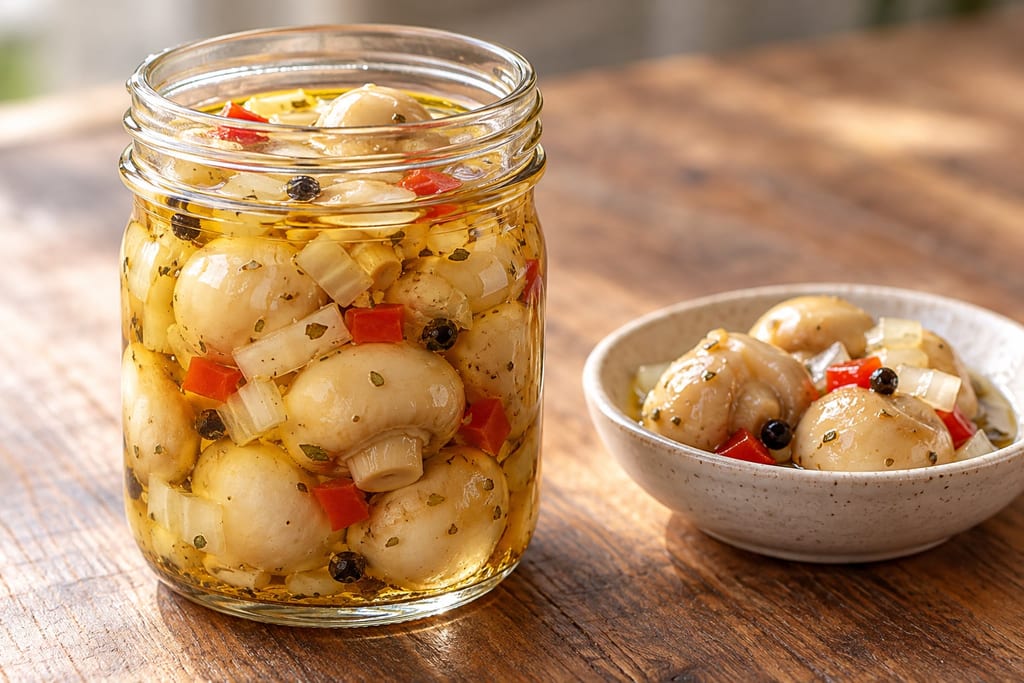
Small edible mushrooms are briefly cooked and packed in a seasoned vinegar marinade, a sweet-sour preserve served cold in Poland and neighbouring cuisines.

Fried or cooked food covered in a vinegar-based preparation, the heat and the externally supplied acid working together; a family of methods whose early form is a Roman instruction for treating fried fish with hot vinegar.
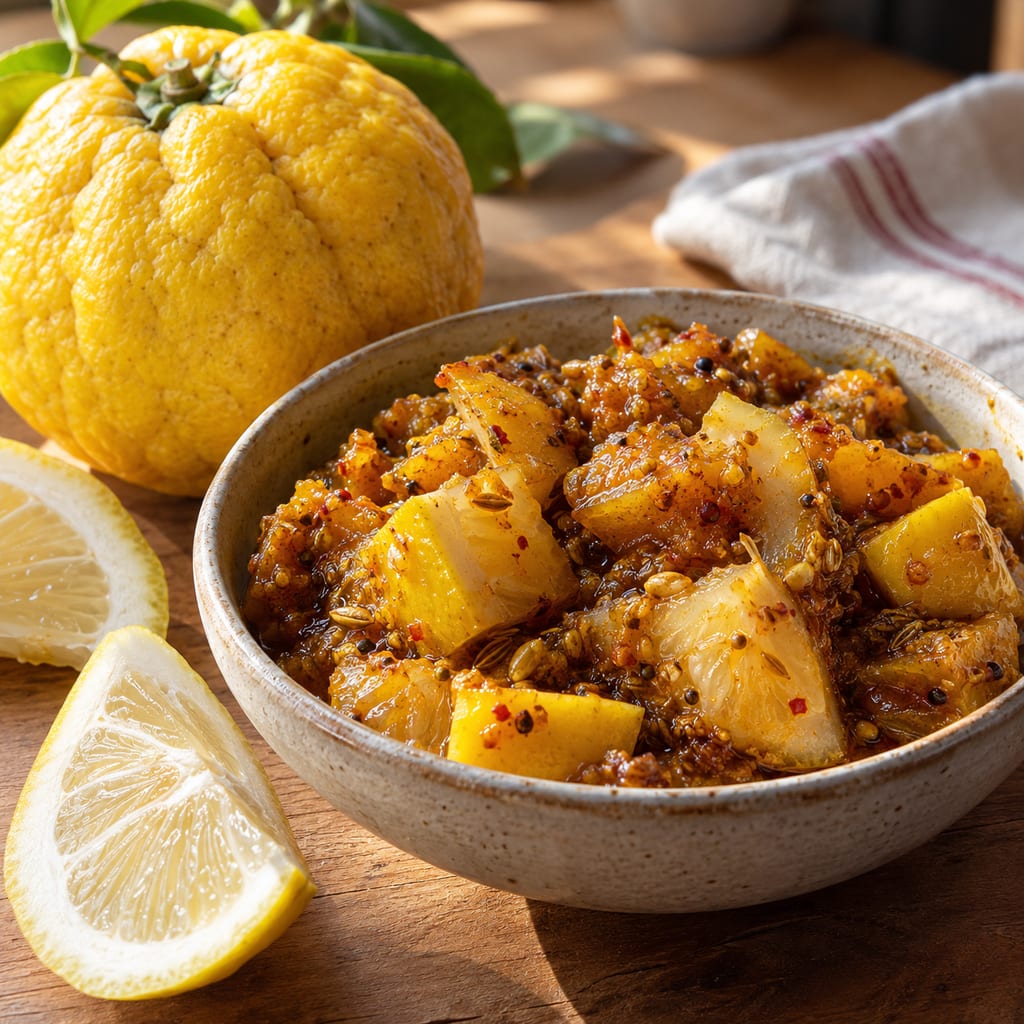
Ripe Himalayan galgal is boiled, sun-dried and cooked with mustard oil, spices and jaggery before a further rest in a ceramic jar.

Protected Italian vinegar made only from cooked grape must, fermented and aged in a battery of wooden barrels for at least 12 years: sweet, sharp and syrupy.

Airag is Mongolia’s fermented mare’s-milk drink, traditionally churned with saved starter in a reusable cowhide khokhuur.

Appam, or hoppers, are South Indian and Sri Lankan rice pancakes made from a fermented coconut-and-rice batter and cooked in a curved pan to a crisp lacy rim and a soft, spongy centre.
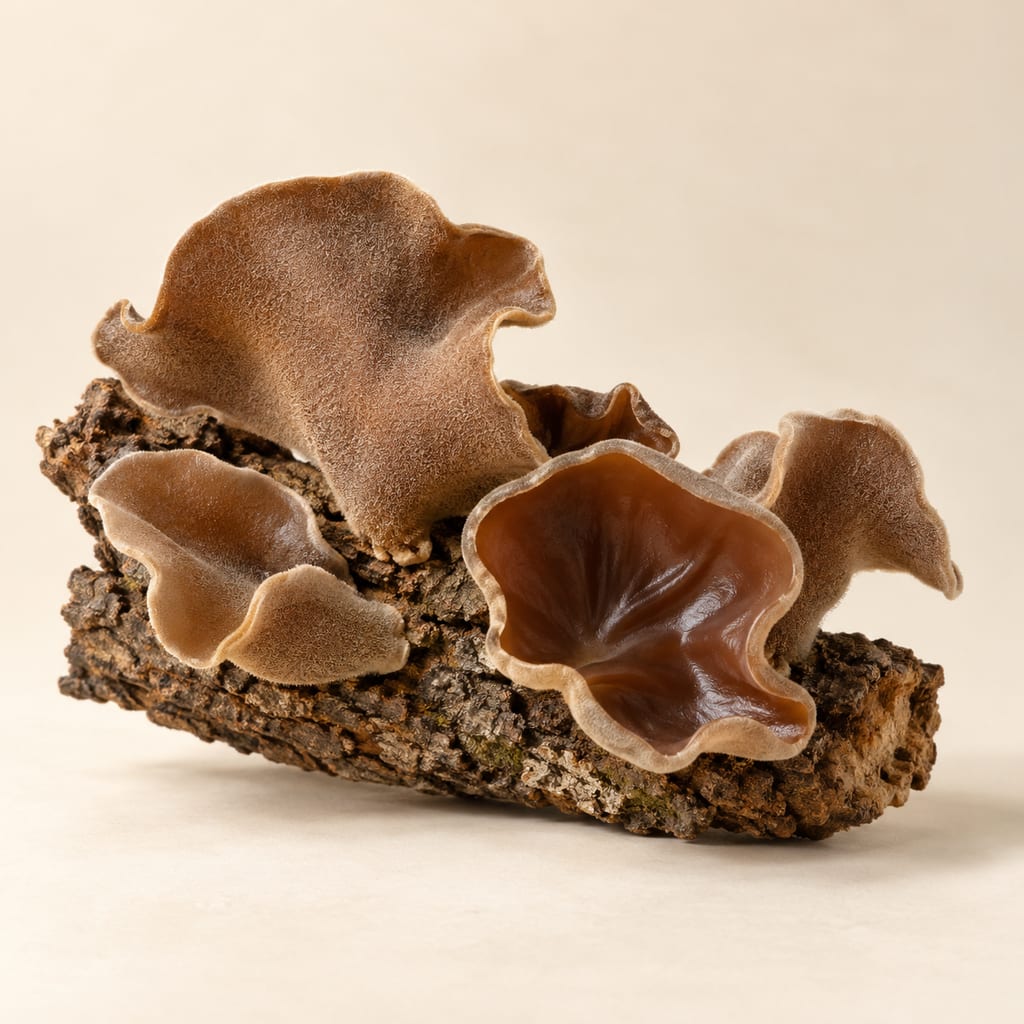
Auricularia tremellosa is a wood ear fungus of the genus that supplies most dried wood ear sold in China; its own food record is thin, and the culinary practice described here comes from the closely related wood ear species.

Ayran is Turkey’s cold, savoury yogurt drink: plain yogurt is loosened with water and lightly salted, then whisked smooth or aerated into a soft cap of foam.
A thin stone griddle used over an open hearth. Norwegian archaeology documents the established tradition from the early Middle Ages; a Viking-period origin is only a cautious suggestion linked to Shetland.

Crushed or milled barley cooked in water until the starch softens and the mixture thickens, the plainest way a northern household turned stored grain into a meal, here with apple and hazelnut.
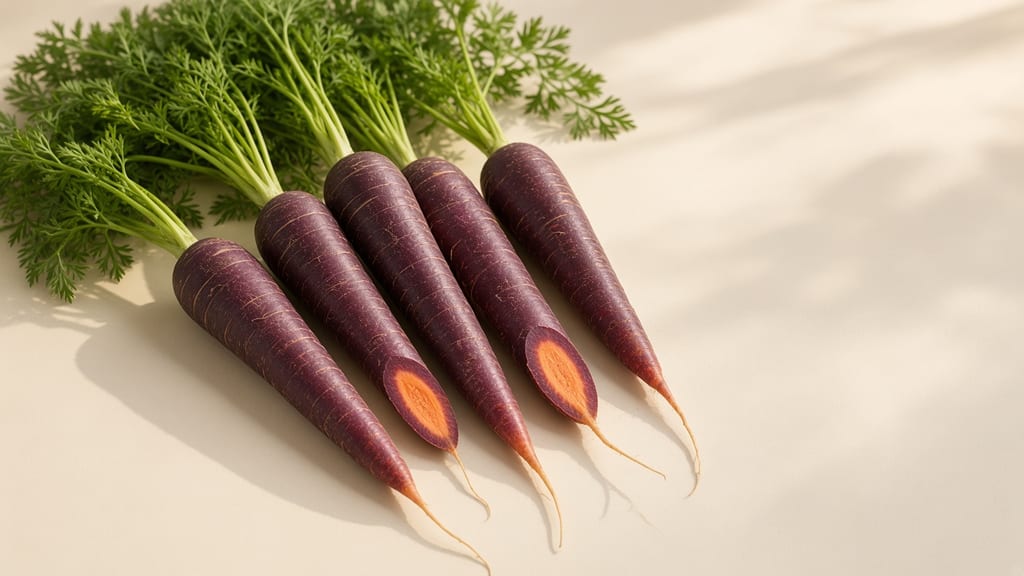
Black carrot is the anthocyanin-pigmented Eastern carrot (Daucus carota var. atrorubens), the purple root that preceded orange types and still colours kanji and şalgam.
No community contributions have been published for this entry yet.
Sign in to contribute. Published comments and photos are free to read.
Kanagawa Prefecture Agriculture DivisionMethod
Umeboshi: ingredients and raw materials1 kg ume, 180 g salt; Juro and Sugita
Cited in: What it is; How it is made
Kanagawa Prefecture Agriculture DivisionMethod
Umeboshi: preparation methodLayering, weight, three weeks of salting, collecting white umezu
Cited in: What it is; History; How it works: salt draws out the acid; How it is made; Variations; How it is eaten and used; Reading results and problems
Kanagawa Prefecture Agriculture DivisionMethod · Use
Umeboshi: practical preparation adviceLiquid coverage, salt distribution, old umezu 10 to 20%
Cited in: What it is; How it is made; How it is eaten and used; Reading results and problems
Kanagawa Prefecture Agriculture DivisionMethod
Red umeboshi: preparation methodRed shiso salted at about 20% of leaf weight
Cited in: How it works: salt draws out the acid; How it is made
Kanagawa Prefecture Agriculture DivisionMethod
Red umeboshi: practical adviceRed umeboshi darken in storage
Kanagawa Prefecture Agriculture DivisionSafety · Method
Small ume and umezu: practical adviceReused umezu at 7 to 8% salt needs refrigeration
Cited in: Variations; Reading results and problems
Ministry of Agriculture, Forestry and Fisheries, JapanMethod
Umeboshi: Wakayama1 kg yellow ume, 200 g coarse salt, 1 kg weight
Cited in: History; How it is made; Variations
Ministry of Agriculture, Forestry and Fisheries, JapanHistory
Odawara umeboshiTokaido travellers in the Edo period
Cited in: History; Variations
Ministry of Agriculture, Forestry and Fisheries, JapanUse
Beni shoga ten, OsakaBeni shoga from umeboshi liquid; battered red ginger
Cited in: Variations; How it is eaten and used
Japan Ume Research AssociationHistory · Chemistry
Ume products and their historyWamyo Ruijusho 934, Ishinpo 984, 1697 shiso texts; 18 to 20% salt and about 5% citric acid
Cited in: What it is; History; How it works: salt draws out the acid; Variations; How it is eaten and used; Reading results and problems
Journal of Food Quality, 2017Chemistry
Chemical composition and antioxidant activities of five commercial umezuCitric 67.5 to 74.3%; salt 20.36 to 22.01%; pH about 1.81 to 1.90
Cited in: How it works: salt draws out the acid; Reading results and problems
National Center for Home Food Preservation, University of GeorgiaSafety
General Information on PicklingUnknown-acidity liquids in preserving
Cited in: Reading results and problems