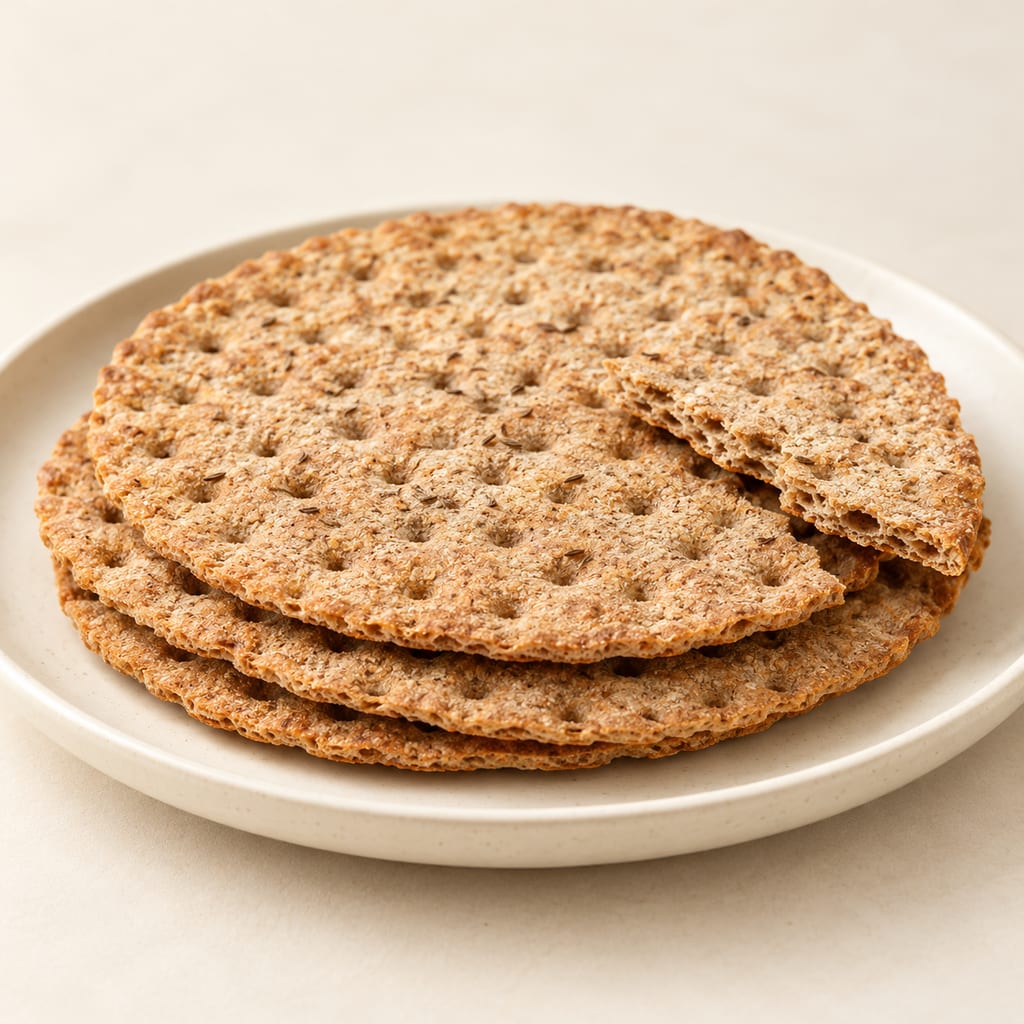
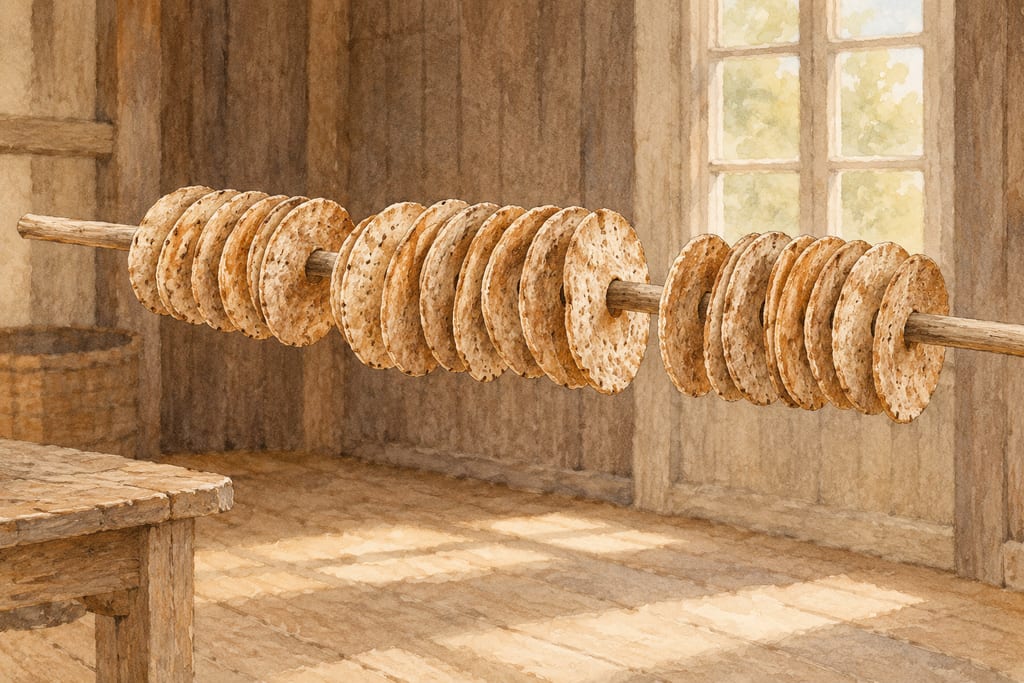
Knäckebröd is a Swedish crispbread with a long storage history. The Swedish heritage inventory connects its rye form with medieval Sweden and notes the traditional round cake with a hole that could be hung on a pole. It describes crispbread as a nationwide food, with stronger historical and current production in several south-central provinces.
The measured method below is a Swedish home recipe for eight rounds. It uses rye and wheat flour, yeast, honey and caraway, so it is one modern household formula rather than a universal or medieval recipe.
Measure 20 g fresh yeast, 4 dl lukewarm water, 1 tablespoon honey, 1½ teaspoons sea salt, ½ tablespoon crushed caraway, 3 dl coarse rye flour and 3 dl wheat flour. Reserve some wheat flour for rolling.
Dissolve the yeast in the water, then add the honey, salt and caraway. Work in the rye flour and most of the wheat flour. Cover and let rise for 1 hour. Divide the dough into eight pieces and roll each into a large, very thin round. Roll with a patterned kruskavel if available, or prick all over with a fork.
Bake on a lightly floured sheet at 200°C for about 10 minutes, until hard but not too brown. Cool on a wire rack. The source gives no round diameter or storage period.
Flour is raw and may carry harmful bacteria. Do not taste the dough before baking; cook the rounds fully and wash hands and work surfaces after handling raw flour. Let the crispbread cool fully before storing it dry; no storage duration is established here.
Swedish national heritage and bread sources describe rye crispbread as a long-standing Swedish food, with medieval origins and a traditional storage role. The present eight-round recipe is a modern home formula using both rye and wheat flour, honey and caraway; it is not presented as a historical formula.
Ingredients
Yield 8 rounds · Scaling: source batch only
Fresh yeastDissolve in the water.
20 g
WaterLukewarm.
4 dl
HoneyStir into the yeast water.
15 mL1 tbsp as recorded
Sea salt
7.4 mL1½ tsp as recorded
Caraway seedsCrush lightly; the source permits other bread spices instead.
7.4 mL½ tbsp as recorded
Optional spice variation is source-stated.
Coarse rye flourUse most of the wheat flour for kneading and rolling.
3 dl
Wheat flourAdd most to the dough; reserve some for rolling.
3 dl
The source gives an approximate volume, not a weight.
Method
Risks and precautions · Standard risk
Raw flour in dough
Flour is a raw food and may carry harmful bacteria; it must be baked before eating.
Hazard source
Do not taste raw flour or dough; bake the rounds fully and wash hands, utensils and surfaces after handling raw dough.
Control source
Cool completely before storing so moisture does not soften the crispbread. The recipe sources give no storage duration.
Dissolve the yeast in the lukewarm water. Stir in the honey, salt and crushed caraway.
Work in the rye flour and most of the wheat flour until a workable dough forms. Reserve some wheat flour for rolling.
Cover the dough with a cloth and let it rise for 1 hour.
Divide the dough into eight pieces. Roll each piece into a large, very thin round, dusting with the reserved flour as needed.
Roll a patterned crispbread pin over each round if you have one, or prick the surface all over with a fork.
Place the rounds on a lightly floured baking sheet. Bake at 200°C for about 10 minutes, until hard but not deeply browned.
Cool on a wire rack before serving. Keep the crispbread dry; the source gives no storage duration.
Conditions
Yield8 rounds
Temperature200°C
Places
Sweden
Traditional preparation · Country evidence
Swedish heritage and bread sources describe rye crispbread as a nationwide food tradition.
The Swedish national heritage inventory identifies this south-central province among the areas of historically and currently concentrated crispbread production.
The Swedish national heritage inventory identifies this south-central province among the areas of historically and currently concentrated crispbread production.
The Swedish national heritage inventory identifies this south-central province among the areas of historically and currently concentrated crispbread production.
The Swedish national heritage inventory identifies this south-central province among the areas of historically and currently concentrated crispbread production.
The Swedish national heritage inventory identifies this south-central province among the areas of historically and currently concentrated crispbread production.
A wooden pole threaded through the central holes of dry Swedish storage loaves lets them hang for drying and storage. Swedish sources document the practice as an old way to keep bread dry; the surviving accounts do not give a standard pole size or one universal arrangement.
Långfil and tettemelk are traditional Swedish and Norwegian cultured milks with a mild sour taste and a stretchy texture produced by ropy lactic acid bacteria.
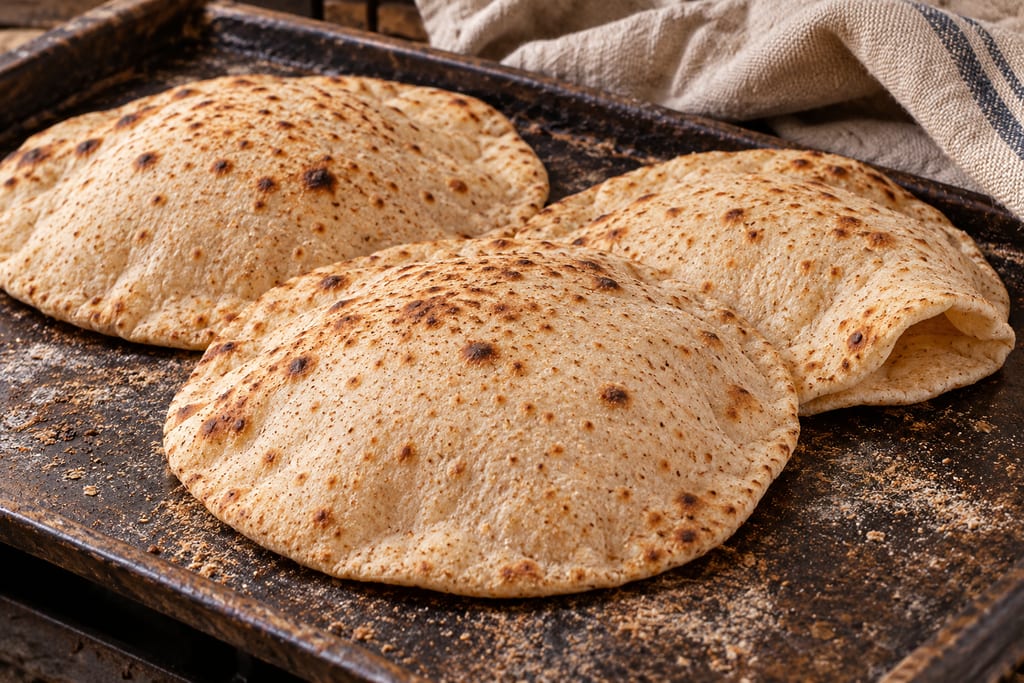
This home adaptation of Egyptian aish baladi uses a refrigerated yeast biga, whole-wheat dough, bran dusting and a very hot baking surface to make 16 pocketed rounds.
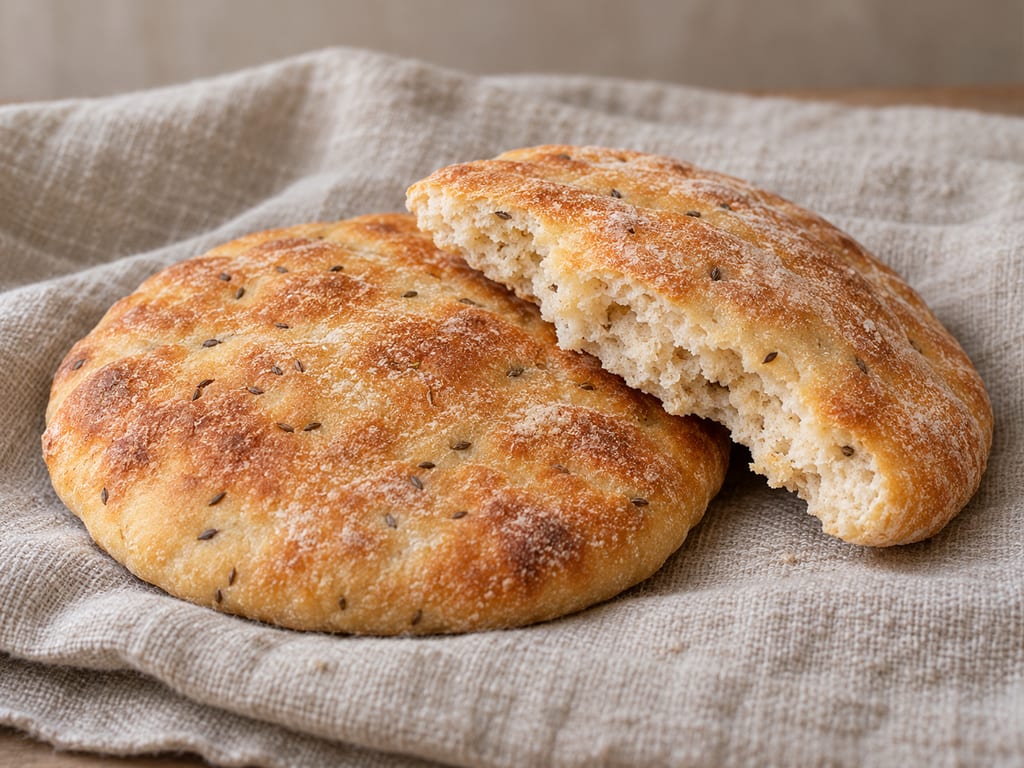
A measured, yeast-raised Ayacucho chapla home method shared by Thermomix Peru presenter Roxanna Salaverry. It makes thin, anise-scented rounds baked at 240°C; the historic qunchu-leavened form is documented separately.
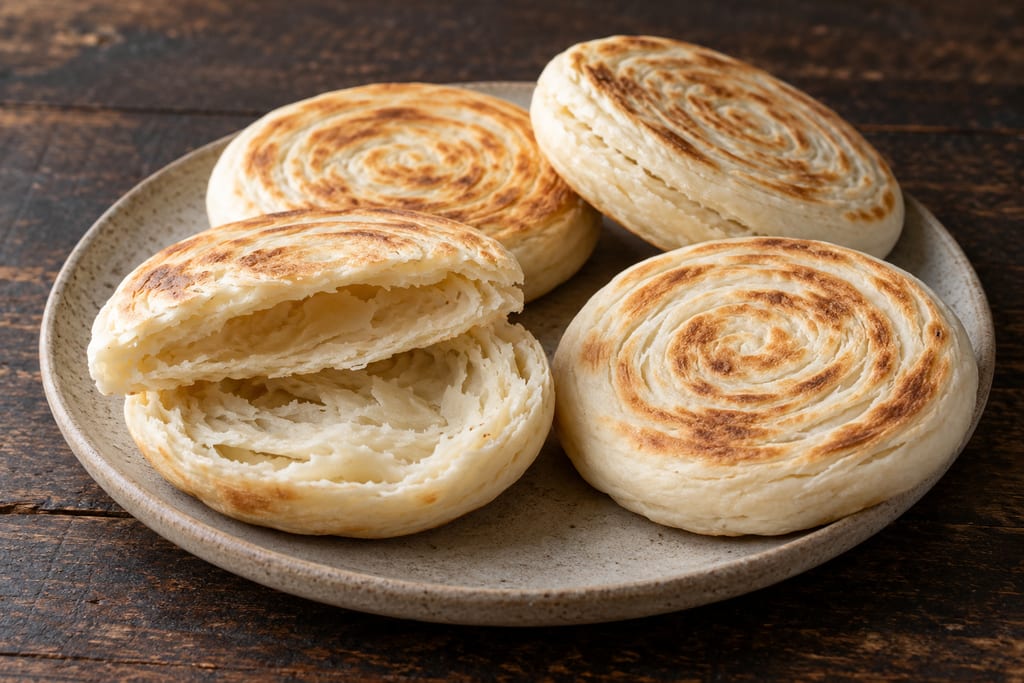
This Shaanxi-associated yeast flatbread uses a simple water dough, coiled shaping and a skillet bake. It is the bread used in roujiamo, not the filled meat dish.
This Turkish bazlama uses yeast, plain yogurt and olive oil for a soft dough cooked in a skillet. Shape it into twelve small or six larger rounds, flip as bubbles appear, and wrap the breads to keep them soft.
Protected Italian vinegar made only from cooked grape must, fermented and aged in a battery of wooden barrels for at least 12 years: sweet, sharp and syrupy.
Appam, or hoppers, are South Indian and Sri Lankan rice pancakes made from a fermented coconut-and-rice batter and cooked in a curved pan to a crisp lacy rim and a soft, spongy centre.
Auricularia tremellosa is a wood ear fungus of the genus that supplies most dried wood ear sold in China; its own food record is thin, and the culinary practice described here comes from the closely related wood ear species.
Ayran is Turkey’s cold, savoury yogurt drink: plain yogurt is loosened with water and lightly salted, then whisked smooth or aerated into a soft cap of foam.
A thin stone griddle used over an open hearth. Norwegian archaeology documents the established tradition from the early Middle Ages; a Viking-period origin is only a cautious suggestion linked to Shetland.
Crushed or milled barley cooked in water until the starch softens and the mixture thickens, the plainest way a northern household turned stored grain into a meal, here with apple and hazelnut.
Black carrot is the anthocyanin-pigmented Eastern carrot (Daucus carota var. atrorubens), the purple root that preceded orange types and still colours kanji and şalgam.
Community
No community contributions have been published for this entry yet.
Share what you made
Sign in to contribute. Published comments and photos are free to read.
A Swedish home recipe published 4 December 2009 gives 20 g yeast, 4 dl water, honey, salt, caraway, 3 dl coarse rye flour and 3 dl wheat flour for eight rounds.
The dough rises one hour, is divided and rolled very thin, patterned with a kruskavel or pricked, then baked at 200°C about 10 minutes until hard but not too brown.
Cited in: Swedish rye crispbread; Eight thin rounds
Accessed 2026-10-29
Levande kulturarv (Living Heritage), Swedish Institute for Language and Folklore and partner agenciesHistory · Geographic context · Food use
Swedish rye crispbread is associated nationwide with everyday meals and celebrations; traditional formula centers on rye flour, yeast, water and salt.
Inventory connects rye crispbread with medieval origins and hole-shaped storage breads; it names south-central provinces where production is concentrated.