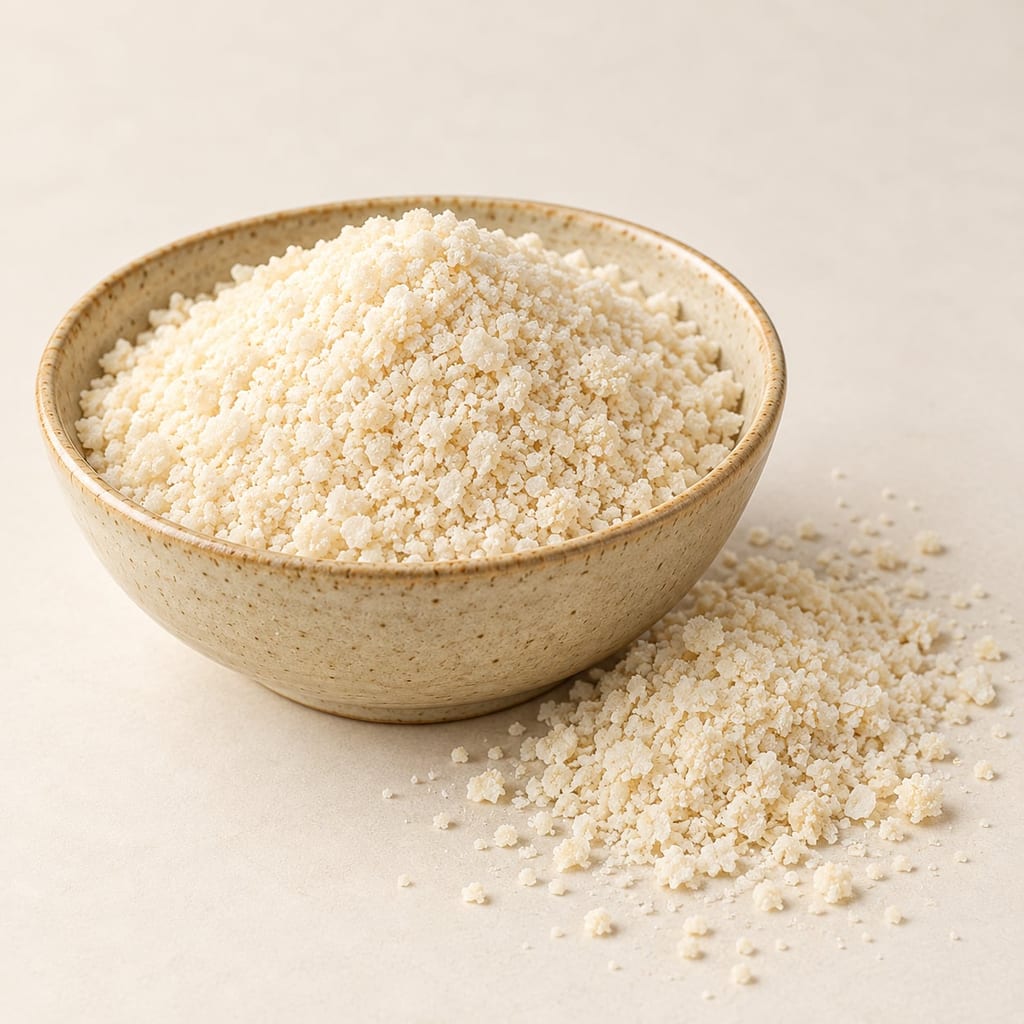
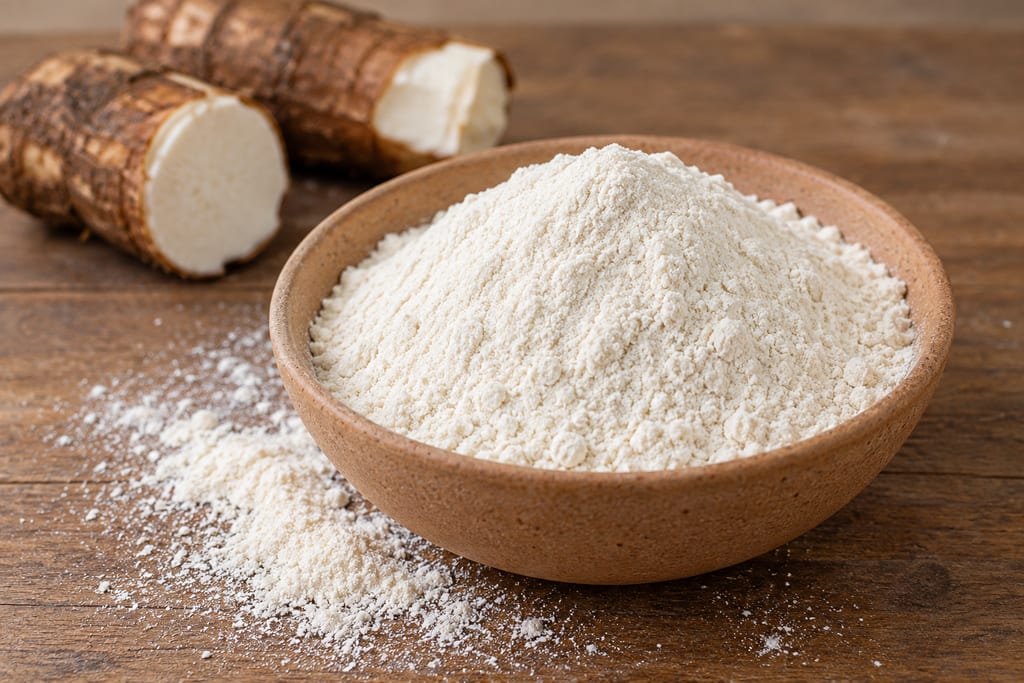
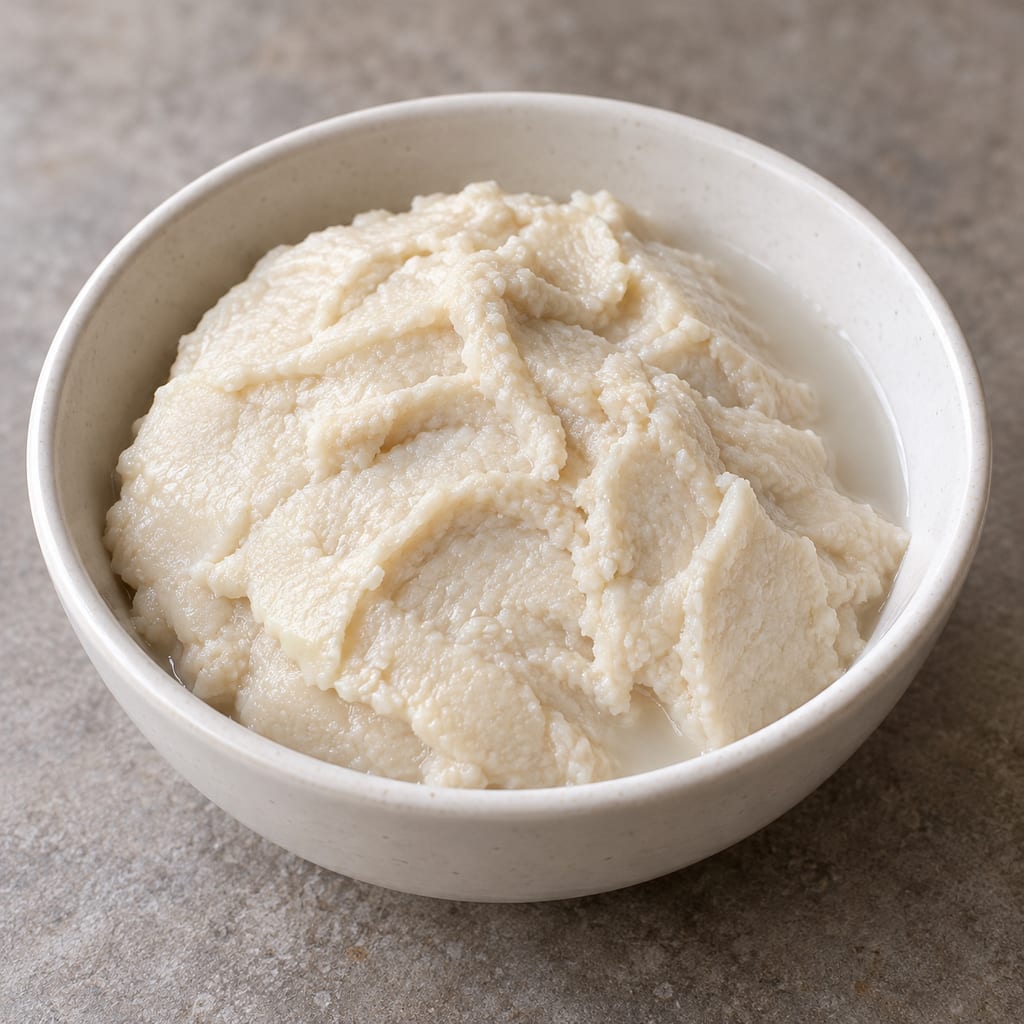
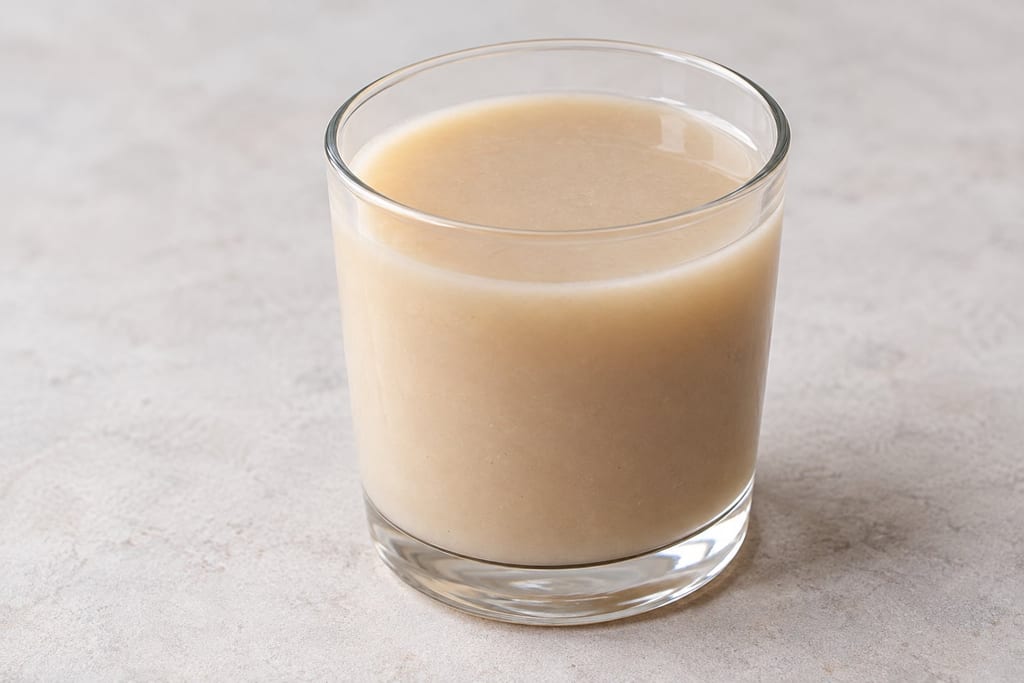
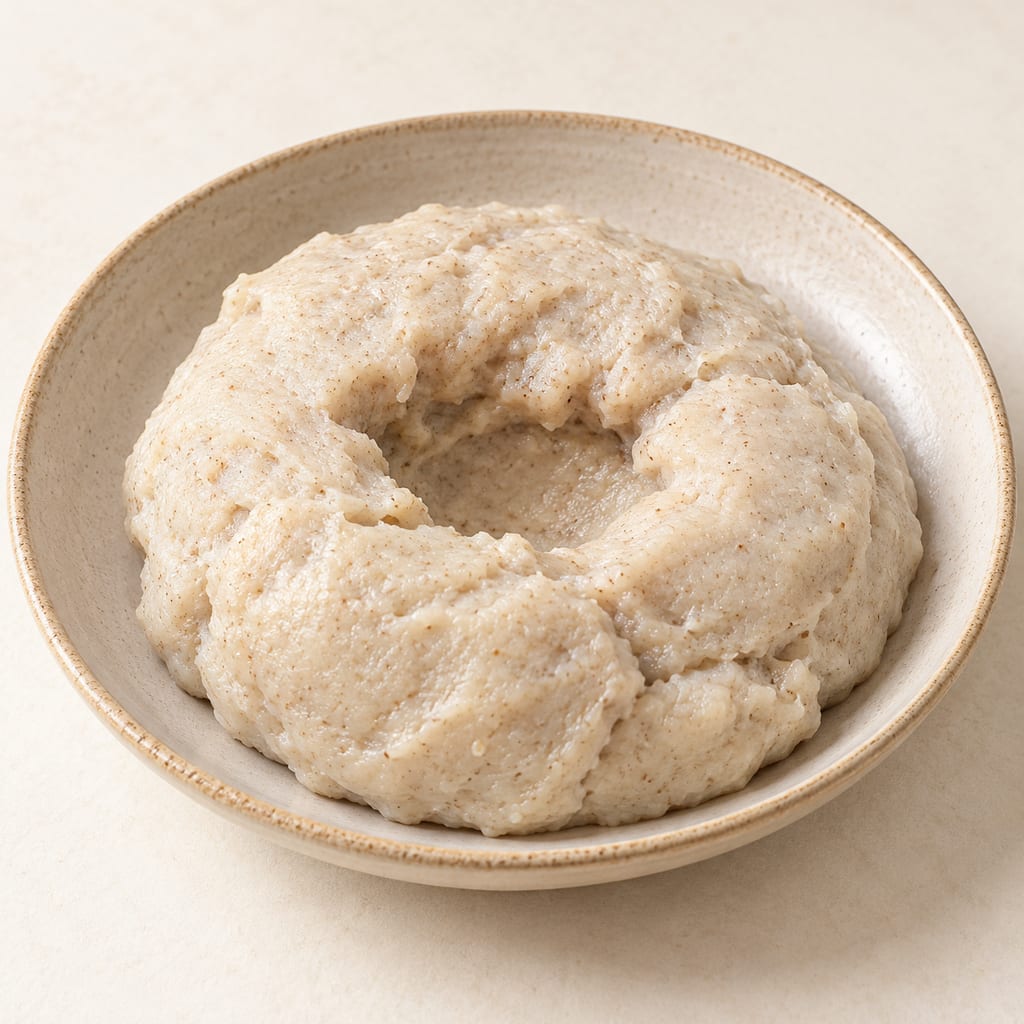
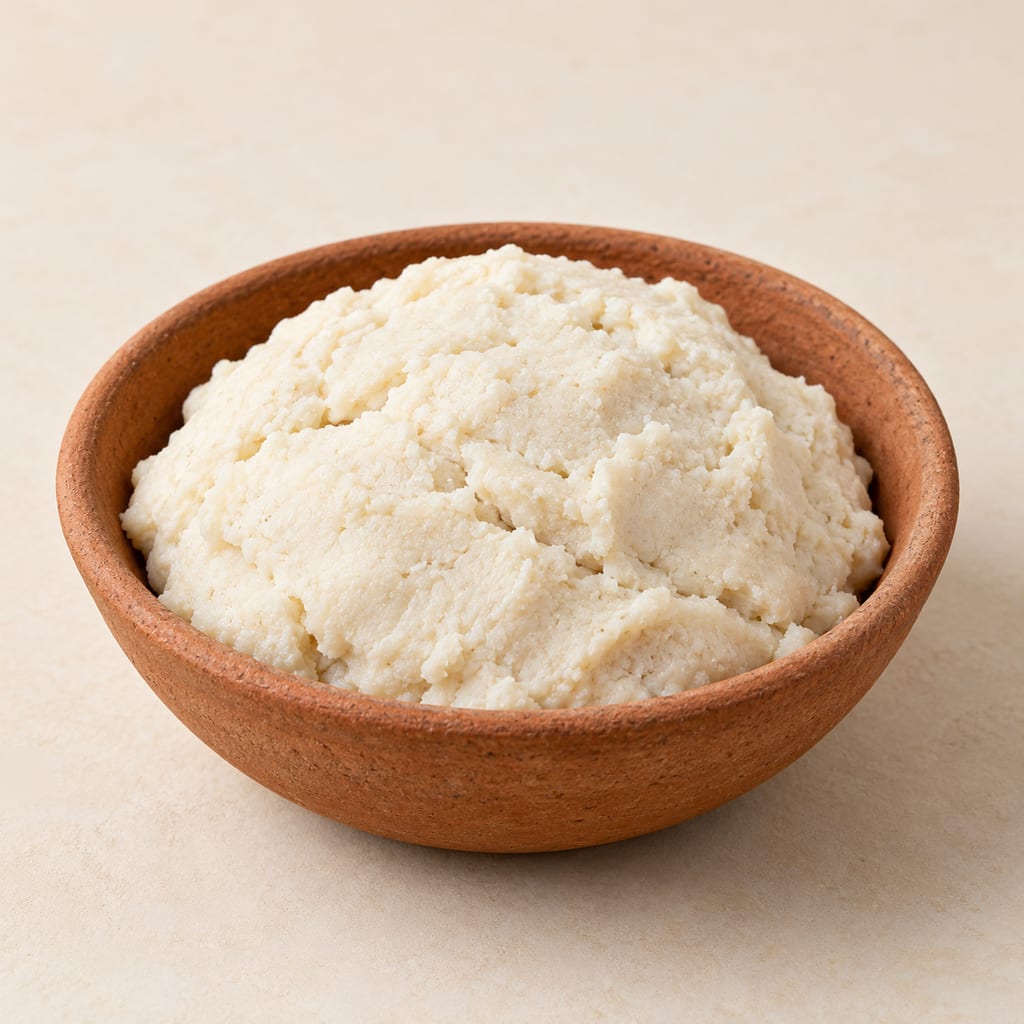
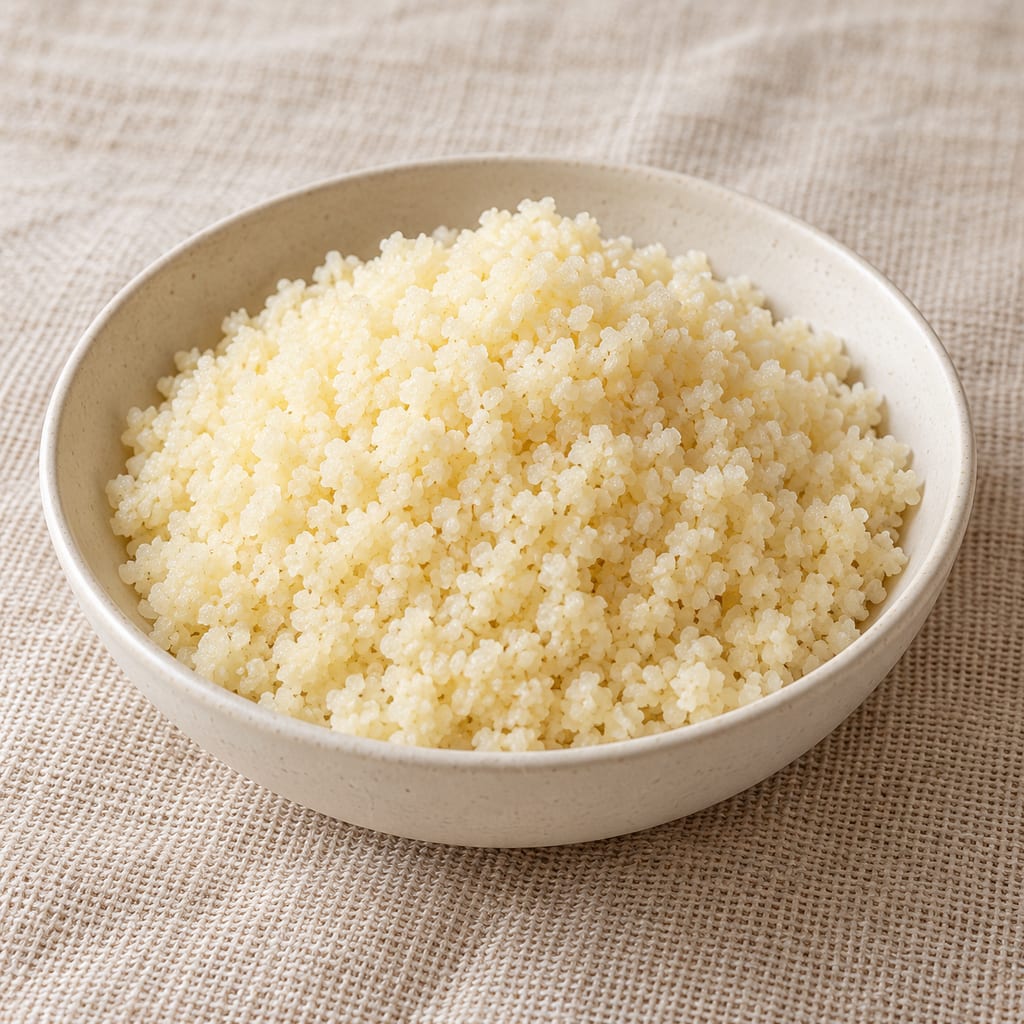
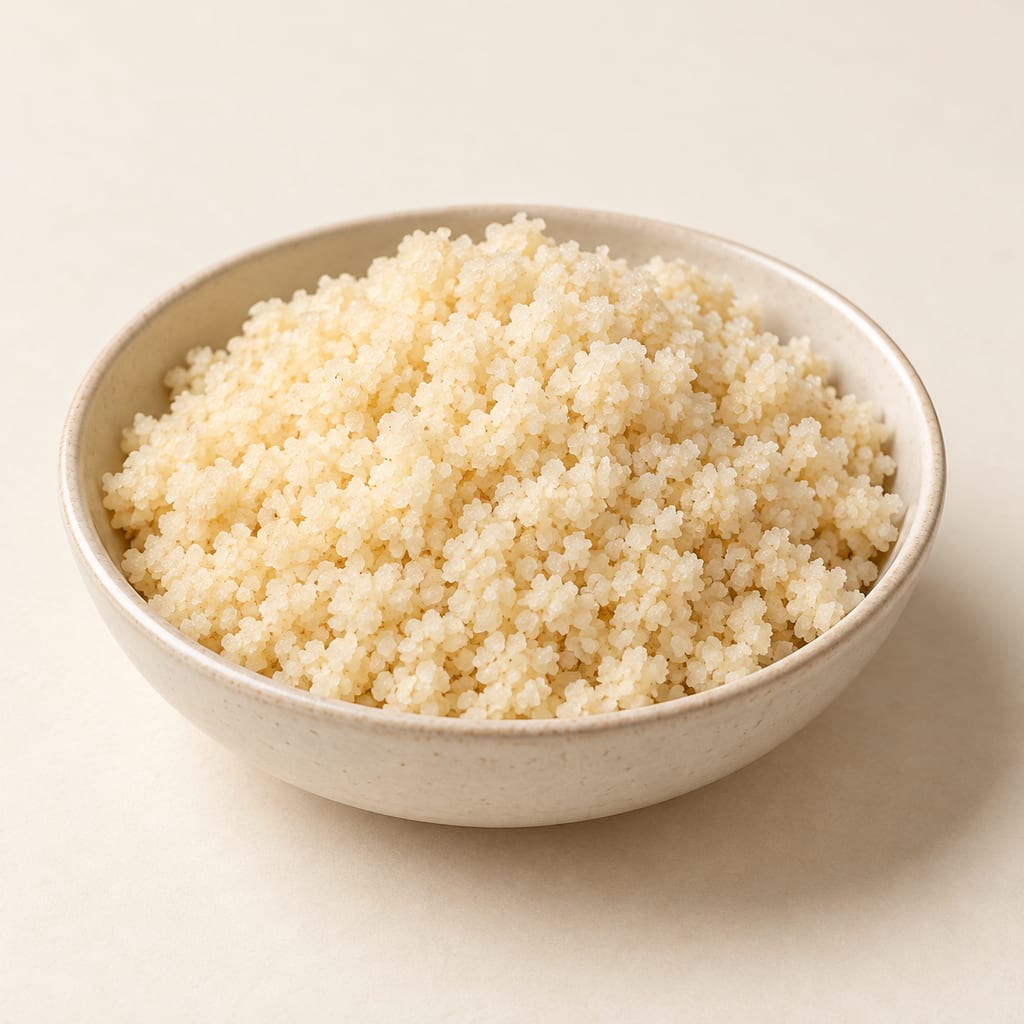
White gari is grated cassava fermented for three days, then pressed, sieved and toasted dry into a coarse West African meal eaten soaked or as a stiff porridge.
White gari, also spelled garri, is a dry, granular food made from cassava roots that have been peeled, washed, grated, fermented, pressed, sieved and roasted.
It is one of West Africa's most important cassava foods and is especially familiar in Nigeria and Ghana, with closely related traditions in Benin, Togo and other countries.
The raw material is cassava, Manihot esculenta Crantz, a tropical plant belonging to the family Euphorbiaceae.
Finished white gari consists of small cream-coloured or pale granules. It has a lightly toasted flavour and may be mild or distinctly sour, depending on the fermentation.
Unlike attiéké, which is generally moist and steamed, gari is roasted to a relatively low moisture content so that it can be stored and transported more readily.
The name white gari distinguishes it from yellow gari, which may be coloured by palm oil or produced from yellow-fleshed cassava varieties.
Gari / Garri — West African English and regional usage — Fermented and roasted cassava granules
Gàrí — Yoruba usage — Cassava gari
Gari blanc — French-language West Africa — White gari
Gari jaune — French-language West Africa — Yellow gari
Gari soakings — Ghanaian English — Gari soaked in water, often served with sugar, milk or nuts
Added starter — None specified in the standard spontaneous process
Fermentation — 1–5 days, depending on method and desired sourness
Fermentation temperature — Not specified numerically
Pressing — Combined with or following fermentation
Roasting — Until appropriately dry and cooked; no universal time or temperature supplied
Maximum product moisture — 12% m/m under the Codex gari standard
Codex maximum free hydrocyanic acid — 2 mg/kg
Finished yield — Not specified
Safety status — Requires validated cyanide reduction, hygiene and product-quality controls
The moisture and cyanide figures are finished-product standards, not instructions that can be verified by tasting the gari or counting fermentation days.
History: a South American crop becomes a West African staple
Cassava was domesticated in South America and reached Africa through post-Columbian exchanges.
Its introduction is commonly associated with Atlantic trade and Portuguese involvement in moving crops between continents from the sixteenth century onward.
But the arrival of cassava is not the same event as the invention of gari.
African communities developed their own processing systems, culinary uses and regional preferences for the crop.
Cassava became attractive partly because it could produce substantial quantities of edible starch in environments where other crops might be less dependable.
However, its cyanogenic compounds required careful processing.
The transformation of cassava into fermented, dry, roasted granules was an important solution.
It provided a food that could be traded and stored more easily than fresh roots.
There is no securely established single date or inventor for gari.
The roots contain large amounts of starch along with moisture, fibre and smaller quantities of other compounds.
Cassava can be classified broadly into cultivars with differing concentrations of cyanogenic compounds, but the popular terms sweet and bitter do not provide a sufficiently reliable food-safety test.
Even cassava considered sweet must be prepared appropriately.
The root variety, age, cultivation conditions and handling can influence the initial cyanogenic content.
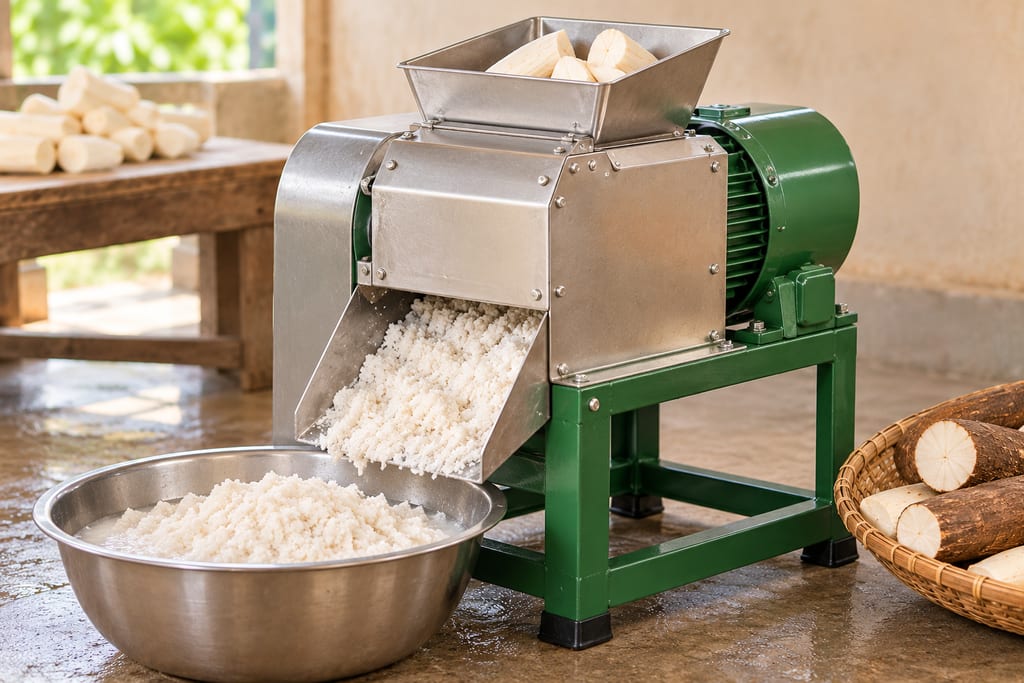
Traditional gari processing involves peeling knives, washing containers, hand or mechanical graters, sacks or baskets, presses, sieves and roasting pans.
The roasting pan is particularly important.
A wide, shallow pan permits the granules to be stirred and exposed to heat.
Traditional processors may use clay, metal or other suitable equipment according to local practice.
Industrial systems can mechanize grating, pressing and roasting.
However, the same broad physical transformations must still occur.
The equipment should be suitable for food contact and protected from contamination.
This is a technical description of gari manufacture. It is not a validated home method for detoxifying cassava without measurement or qualified process control.
After pressing, the cassava mash becomes more compact.
Break up the material and pass it through an appropriate sieve.
This creates granules of more consistent size and removes large fibres or lumps.
Granule size matters because small and large particles heat differently during roasting.
Some commercial grades use specific sieve sizes, but those must be recorded with their applicable standards rather than invented for a traditional household batch.
Modern product standards provide useful quantitative reference points.
Moisture content — Maximum 12.0% m/m
Free hydrocyanic acid — Maximum 2 mg/kg
Appearance — Free of objectionable contamination and foreign matter
Food suitability — Safe and suitable for human consumption
The IITA manual also reproduces a quality table specifying total acidity as lactic acid in a 0.6–1.0% range.
These are different types of measurements.
Moisture content indicates how much water remains.
Free hydrocyanic acid concerns a specific toxic substance.
Total acidity concerns acid concentration.
One measurement cannot replace another.
In particular, the 2 mg/kg limit for free hydrocyanic acid in gari is not interchangeable with a 10 mg/kg figure expressed as total hydrocyanic acid for cassava flour.
White gari is one of the most important examples of a fermented food whose final character depends as much on mechanical and thermal processing as on microorganisms.
Fermentation creates acidity and contributes to the transformation of cassava.
Grating, pressing and roasting are essential to the resulting product.
The finished granules can then be stored, moved and used in numerous dishes.
Gari also demonstrates how African food-processing technologies transformed a crop introduced from South America into an ingredient with its own regional identities.
Its significance is not limited to being inexpensive or shelf-stable.
It is central to everyday meals, commercial food production, family practices and regional tastes across much of West Africa.
Gari is a West African fermented cassava staple. This record follows a modern research batch based on a documented Nigerian preparation.
Ingredients
Yield 10 kg fermented portion before dewatering; finished yield not reported · Scaling: source batch only
Peeled cassava pulppeel, wash, grate through a 10 mm grater and ferment for 72 hours
10 kg after fermentation; source lot split into two 10 kg portions
Palm oilthe source uses no palm oil for this portion
0 none in white gari variant
Method
Risks and precautions · Elevated risk
Cassava cyanogenic glycosides
Cassava cyanogenic glycosides can release hydrogen cyanide; inadequate processing can leave a toxic product.
Hazard source
Follow the complete source-described cassava preparation stages. FSANZ says cassava should be peeled and fully cooked before eating; the source process does not provide a finished-product cyanogen test or establish that every batch is adequately detoxified.
Control source
Cassava can contain cyanogenic glycosides. Fermentation and drying may reduce cyanogens, but this source does not establish a finished-product result for each batch.
Do not judge cyanogen removal by sourness, smell, color, texture, or appearance. This research process is not a validated detoxification control plan.
Peel and wash the cassava, then grate it through a 10 mm grater.
Ferment the grated pulp for 72 hours. The experiment divided the fermented material into two 10 kg portions; use the portion with no palm oil for white gari.
Press the pulp continuously to remove liquid, until little or no water is observed; neither the pressure nor the duration is specified.
Sieve the dewatered pulp through a 0.1 mm sieve.
Toast the sifted pulp in a pan with continuous stirring, following the FAO technical account of gari preparation. The sources do not give a time or temperature.
Conditions
Yield10 kg fermented portion before dewatering; finished yield not reported
Fermentation3 days
Places
Benue State, Nigeria
Documented preparation · Region evidence
The laboratory study collected cassava in Benue State, Nigeria. FAO documents gari as a staple across Nigeria, Ghana, Benin and Togo; the recipe is a study protocol, not a claim of origin.
Graters, motorized rasping drums and processor grating discs reduce cassava or coconut to shreds or mash. They perform the grating stage only; later processing determines texture, extraction and cassava safety.
Eba is a West African dish of cooked gari, stirred into hot water until it forms a thick paste. It is a cooking stage with no new fermentation, served with soup.
Lafun is a Nigerian fermented cassava flour described in historical accounts. This record documents reported processing stages, not a validated household method or a batch-specific cyanogen and moisture safety endpoint.
Ogi or akamu is a wet fermented cereal preparation documented in Nigeria and Benin. Grain or maize starch is steeped, milled or sieved, then fermented by process-specific routes; evidence supports no universal method or safety limit.
Ata dindin is the Yoruba fried pepper sauce: chillies, red bell pepper and onion blended and cooked down in oil until the oil separates. The same name is also given to a finished stew built on it.
Kilishi is a Hausa-land dried meat from northern Nigeria and southern Niger: thin slices of beef or other meat, dried, coated in a spiced groundnut paste and dried again.
A thick, spiced northern Nigerian drink of pearl millet in which only part of the fermented slurry is cooked, so raw starch and gelatinised starch are recombined.
Aceda is Sudan’s firm cereal porridge, commonly made from sorghum and shaped into a smooth mound. Some versions use fermented dough; fermentation is not universal.
Ghanaian sour cassava dough fermented with traditional inoculum and drained during fermentation. It is used as a base for cooked foods such as banku and akple; process variants and safety outcomes differ.
Appam, or hoppers, are South Indian and Sri Lankan rice pancakes made from a fermented coconut-and-rice batter and cooked in a curved pan to a crisp lacy rim and a soft, spongy centre.
A hot, sour maize drink from Tabasco made from maize that is not lime-cooked. The ground grain sours for half a day, then makers strain it and boil it until thick.
Ivorian cassava semolina: grated cassava is fermented overnight with a traditional inoculum, pressed, sieved into granules, dried and steamed. Documented in a 2006 field study; no sole original process is established.
Attiéké is an Ivorian staple of grated cassava fermented with a traditional inoculum, then pressed, sieved, granulated, dried and steamed into fine couscous-like grains.
Crushed or milled barley cooked in water until the starch softens and the mixture thickens, the plainest way a northern household turned stored grain into a meal, here with apple and hazelnut.
A fermented pearl-millet gruel documented in Ouagadougou, Burkina Faso. Whole grain is soaked, wet-milled and sieved; the settled paste ferments again before it is cooked with its liquid.
Community
No community contributions have been published for this entry yet.
Share what you made
Sign in to contribute. Published comments and photos are free to read.
Benue State cassava source; 72-hour fermentation, 10 kg fermented portions, white gari without palm oil, continuous pressing and 0.1 mm sieving.
Cited in: What is white gari?; Recipe at a glance; Nigeria; Ghana; Benin and Togo; Cassava roots; Potable water; Fermentation starter; Salt; Palm oil; Equipment; The documented production method; Stage 1 — Select suitable roots; Stage 2 — Peel; Stage 3 — Wash; Stage 4 — Grate; Stage 5 — Ferment; Stage 6 — Press and dewater; Stage 7 — Break up and sieve; Stage 8 — Roast; Stage 9 — Cool; Stage 10 — Final sieving and packing; How fermentation actually works; The cyanogenic chemistry; Fermentation and acid production; Pressing and diffusion; Roasting and starch; Why fermentation alone is insufficient; The Codex quality requirements; White gari and yellow gari; Ijebu gari; Mild Nigerian gari; Ghanaian gari; Beninese and Togolese gari; How to eat white gari; Eba; Gari soakings; Gari foto; Dry garnish; The gari forms lumps during roasting; The granules are burnt; The product contains sand; The gari becomes damp; Unexpected visible mould develops; The gari tastes strongly sour; The product looks normal but has excessive cyanide; Safety and storage; Cyanide poisoning; Contamination during manufacture; Moisture after roasting; Packaging; Preparing food for children; Why white gari matters
Accessed 2026-10-25
Food and Agriculture Organization of the United NationsProcess · Geography
Gari is a staple in Nigeria, Ghana, Benin and Togo; after pressing and sieving, the pulp is roasted in a wide pan with continuous stirring.
Cited in: Recipe at a glance; History: a South American crop becomes a West African staple; Equipment; The documented production method; Stage 1 — Select suitable roots; Stage 2 — Peel; Stage 3 — Wash; Stage 4 — Grate; Stage 5 — Ferment; Stage 6 — Press and dewater; Stage 7 — Break up and sieve; Stage 8 — Roast; Stage 9 — Cool; Stage 10 — Final sieving and packing; Safety and storage
Cited in: Recipe at a glance; History: a South American crop becomes a West African staple; Equipment; The documented production method; Stage 1 — Select suitable roots; Stage 2 — Peel; Stage 3 — Wash; Stage 4 — Grate; Stage 5 — Ferment; Stage 6 — Press and dewater; Stage 7 — Break up and sieve; Stage 8 — Roast; Stage 9 — Cool; Stage 10 — Final sieving and packing; Safety and storage
Cited in: Recipe at a glance; History: a South American crop becomes a West African staple; Equipment; The documented production method; Stage 1 — Select suitable roots; Stage 2 — Peel; Stage 3 — Wash; Stage 4 — Grate; Stage 5 — Ferment; Stage 6 — Press and dewater; Stage 7 — Break up and sieve; Stage 8 — Roast; Stage 9 — Cool; Stage 10 — Final sieving and packing; How fermentation actually works; The cyanogenic chemistry; Why fermentation alone is insufficient; Safety and storage; Why white gari matters
All ten recipe entries are now included in the chat, with their requested identifiers, method details, source lists and image references. Editorial qualification: The first six entries were expanded from readable source records. For plant-0015 through plant-0018, the corresponding original records were unavailable, so those four pages were reconstructed from published sources rather than from the missing database fields. They should retain a reconstructed-draft status until compared with the original records
Cited in: Recipe at a glance; History: a South American crop becomes a West African staple; Equipment; The documented production method; Stage 1 — Select suitable roots; Stage 2 — Peel; Stage 3 — Wash; Stage 4 — Grate; Stage 5 — Ferment; Stage 6 — Press and dewater; Stage 7 — Break up and sieve; Stage 8 — Roast; Stage 9 — Cool; Stage 10 — Final sieving and packing; Safety and storage