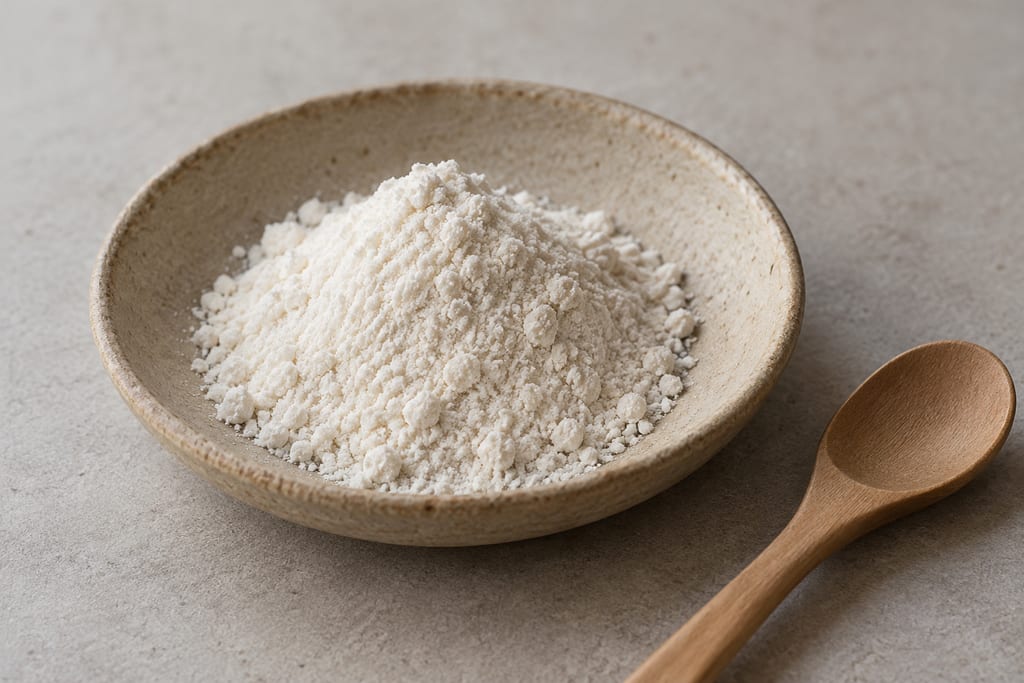
Turep starch (Ainu lily-bulb starch)
Starch released from giant woodland lily bulbs by pounding, washed out in water, settled and dried: the refined fraction of an Ainu process that also yields fermented cakes from the residue.
 FermenteaWhere food goes to change
Traditional method
Yukola · Ma · Iukola · Dried salmon
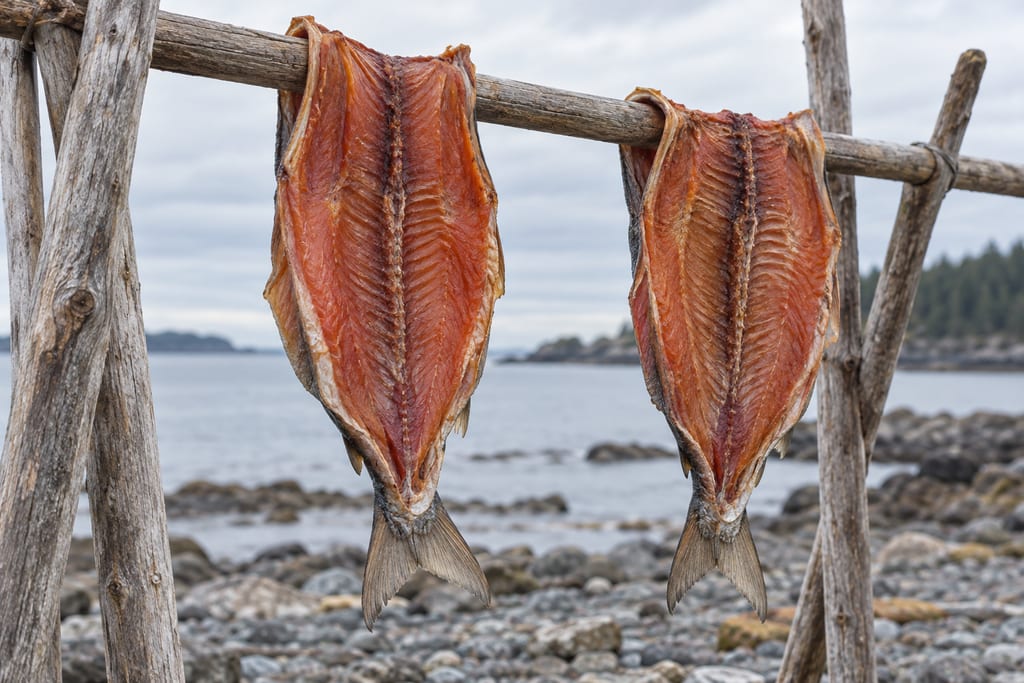
Pacific salmon opened along the backbone and hung on elevated wooden frameworks to air-dry, the winter provision at the centre of Nivkh household fishing on Sakhalin and the Lower Amur.
Yukola is a form of dried fish found across several peoples and regions of Siberia and the Russian Far East. Among Nivkh communities of Sakhalin and the Lower Amur, dried salmon was historically a fundamental winter provision.
The term should not be mistaken for the name of one precisely defined product shared by every community. Russian descriptions use yukola broadly, while Nivkh-language terminology also includes locally recorded names for dried fish and the structures used in its production.
One documented Nivkh term for dried fish is ma, although local dialects and transcription systems differ. Drying frameworks are recorded as ha's. These local terms help distinguish the technology from the generalized Russian label.
The most important fish traditionally included Pacific salmon, particularly chum salmon (Oncorhynchus keta) and pink salmon (Oncorhynchus gorbuscha). Other locally available fish could also be preserved.
The process transforms large seasonal catches into portable provisions. The fish are cleaned, cut to expose their flesh, hung where air can circulate, and dried sufficiently for subsequent storage.
A second food, mos, demonstrates what can be done with preserved fish and its skin. Mos combines prepared fish-skin material, fat, berries and other gathered ingredients to produce a jelly-like dish. It is not simply dried fish and should not be confused with fermented fish.
These two foods belong together in the wider story of Nivkh preservation because drying, storage, fat extraction, rehydration and cooking formed connected stages of seasonal household provisioning.
The Nivkh are an Indigenous people whose historical territories include northern Sakhalin Island and the estuary and lower reaches of the Amur River.
Fishing has long been central to their livelihoods. Salmon runs supplied food in quantities that could be difficult to obtain at other times of year.
The seasonal pattern encouraged intensive processing. Catching fish was only the beginning; the catch had to be divided between immediate consumption, drying, other preparations and animal feed.
Nivkh households historically maintained sled dogs, making large quantities of preserved fish important for transport as well as human nutrition.
The 19th-century record is particularly valuable.
Anton Chekhov, visiting Sakhalin in 1890, described fish spread open and suspended on drying structures near dwellings. The quantity was so great that the hanging fish gave the landscape a distinctive appearance.
Photographs made by Bronislaw Pilsudski in the early 20th century show Nivkh settlements and their drying facilities. Later photographs, including images from the 1930s, document the continuing practice.
These images demonstrate large-scale household processing, rather than a small batch made occasionally as a delicacy.
Ethnographic records from the 20th and 21st centuries document continuity alongside major changes caused by commercial fishing, Soviet collectivization, settlement policies and changing household economies.
The community did not simply abandon dried fish when modern food supplies became available. Yukola continued to carry cultural, practical and culinary significance.
At the same time, methods that had operated within a highly localized fishing economy could be disrupted when access to fishing grounds, seasonal movements or traditional storage buildings changed.
The first stage depends on the seasonal availability of fish.
Chum and pink salmon have different run patterns, and catches vary according to location, river conditions and year. The timing of food preparation is therefore tied to actual fish migrations rather than a uniform calendar date.
Historically, fishing technology included nets, hooks, spears, weirs and other locally adapted equipment.
After capture, fish intended for drying must be handled before decomposition progresses. This is particularly important when large catches arrive over a short period.
The drying site traditionally stands where airflow is available. Wooden frameworks provide elevated horizontal supports from which the fish can hang.
Elevation helps expose the product to moving air and separates it from ground moisture, dirt and some animals.
The structures may stand beside summer dwellings or near fishing camps. Their arrangement reflects the need to process large numbers of fish simultaneously.
The construction is simple in appearance but technically significant. A drying rack must support wet fish, keep individual pieces separated and withstand local weather.
A substantial supply of appropriately sized poles is necessary. The supporting structure also has to make hanging and removal practical.
Historic Nivkh storage architecture included raised buildings used for keeping food away from snow and animals. Such structures were part of a preservation chain extending beyond drying itself.
The traditional fish-cutting operation is designed to expose flesh to air.
Whole fish retain moisture within the body cavity and thick muscle sections. Cutting and opening them changes the relationship between surface area and volume.
The fish are washed and gutted. In a documented Nivkh method, an incision runs along the backbone while the two sides remain connected near the tail.
The backbone and large bones can be removed, and the head may either be removed or remain attached to part of the fish.
The resulting opened fish presents a much greater drying surface than an intact fish.
Cut quality is important. Uneven cuts and deep pockets can hold moisture, delaying drying and allowing spoilage to begin locally.
A smooth cut helps liquid drain and exposes the flesh more consistently.
The fish are suspended over the supports, often with enough space between pieces to allow air to pass freely.
Different finished preparations may retain the skin or have it removed. Fattier portions and leaner strips also behave differently during storage.
The exact distinctions between cuts depend on local practice and the type of fish.
No universal Nivkh salting percentage, cut thickness or drying duration can be established from the cited descriptions. The surviving accounts are descriptions of skilled community practice, not complete modern technical specifications.
Fish flesh contains water, proteins, fat, minerals and smaller amounts of other compounds.
Drying removes water by evaporation. Water first leaves exposed surfaces; internal water then migrates toward those surfaces.
The rate is controlled by the temperature and humidity of the air, its movement across the fish, the thickness of the flesh and the condition of its surface.
A thick section can remain moist inside even when its surface looks dry.
As water is removed, the concentration of soluble compounds in the remaining tissue increases. The flesh becomes firmer and the flavor more concentrated.
Fish proteins undergo structural changes during storage, including some oxidation and aggregation. Fats can also oxidize, creating desirable or undesirable flavor changes depending on conditions and duration.
These changes help explain the distinctive flavor of dried salmon but are not, by themselves, proof of microbial fermentation.
Traditional yukola is primarily a dried food. Some uncontrolled microbial activity might occur during processing, but that possibility does not justify classifying the entire product as fermented.
The distinction is especially important because uncontrolled spoilage organisms can also metabolize fish tissue.
Drying must happen quickly enough, relative to the conditions, to prevent unacceptable microbial growth.
Properly dried fish is lighter and more compact than fresh fish, although its storage quality depends on the extent of drying and protection against renewed moisture.
Traditional raised storehouses helped protect supplies during winter. Snow and cold could contribute to preservation, but a storehouse was also designed to discourage animals and keep provisions accessible.
Preserved fish could be removed as required rather than cooked immediately after capture.
This allowed a summer or autumn catch to support meals during seasons when fishing was more difficult.
Yukola could also function as food for sled dogs. This had direct implications for transport: animals performing winter journeys needed concentrated provisions that could accompany their handlers.
Food preservation was therefore connected to mobility, fishing organization and household labor.
Yukola could be eaten without elaborate preparation where traditional practice and product condition allowed, or cooked in soups and other dishes.
Cooked preparations sometimes combined dried fish with fresh fish, meat, herbs and roots. The preserved ingredient brought concentrated fish flavor to a meal that could otherwise change substantially with season and household supplies.
Mos is a particularly distinctive example of the Nivkh use of fish components.
It is described in community food documentation as a sweet, jelly-like preparation combining processed fish, fish skin, fat, nuts, berries and sometimes cooked lily-family tubers.
The important transformation begins with preserved fish or skin that has been soaked in water.
One documented household sequence starts with dried fish soaked overnight. The skin is separated and soaked further, then cleaned carefully to remove scales.
The cleaned skin is placed briefly in boiling water. The published account gives one to two minutes for this stage.
The material is then pounded and worked with liquid and fat until a uniform mass develops.
Seal fat is specifically recorded, together with broth from cooking the skin.
This is followed by additions such as boiled saranga tubers, dwarf-pine nuts, cranberry, bilberry, lingonberry, cloudberry or other locally available berries.
The mixture is traditionally worked in a wooden container called an orn, with a wooden implement recorded as mamas.
It is then frozen and served as a distinctive food associated with hospitality and special occasions.
The named berries and their proportions can vary considerably. The published source does not give a complete weighed recipe, and none should be fabricated.
The account describes traditional production taking up to seven hours, while some modern makers report approximately three hours using contemporary equipment.
Those figures are descriptions of labor and preparation, not verified safety limits.
Fish skin contains substantial amounts of collagen, a structural protein that gives connective tissues strength and flexibility.
When collagen is heated in water, some of its structure can be disrupted and soluble gelatin-like material extracted.
On cooling, this material can form a network that traps water and produces a soft gel.
The texture of mos depends on this protein chemistry and the physical mixing of fat, water and other ingredients.
Pounding helps distribute material and can contribute to a smoother mixture. Fat changes mouthfeel, while berries introduce acidity, aroma, color and sweetness.
The result is unusual only from the perspective of cuisines that strongly separate savory fish from sweet fruit preparations.
In a food system where salmon, marine fat, berries and stored roots are central resources, their combination is entirely intelligible.
Fish-skin dishes described in different ethnographic works should not automatically be treated as identical. Regional names and preparations vary, and published accounts sometimes use mos for preparations that differ substantially in their ingredients.
The most secure approach is to retain the documented household form rather than invent a canonical recipe.
Mos is more than a technique for using preserved ingredients.
It has been recorded at gatherings and as a food prepared for visitors and relatives.
Descriptions also connect it with offerings and the historical Bear Festival.
In some accounts, preparation took place at night and was associated with beliefs concerning spirits and the appropriate circumstances for making the dish.
These practices belong to specific communities and historical settings. They should not be presented as mandatory rules followed by all Nivkh households today.
The food is also associated with threatened knowledge transmission. Its preparation requires familiarity with ingredients, tools, textures and handling procedures that are difficult to preserve through brief written recipes alone.
The continued existence of mos illustrates how a stored staple such as yukola can support ceremonial dishes and everyday meals alike.
Dried fish must be protected from inappropriate moisture, insects, animals and contamination.
Uneven drying can leave moist sections vulnerable to bacterial growth. Fatty fish can also develop rancid flavors through oxidation.
A visibly slimy surface, abnormal decomposition odor, insect infestation or unexpected mold growth indicates a problem.
However, dangerous microorganisms and toxins may be present without obvious spoilage.
Fish preservation presents particular hazards, including Clostridium botulinum under certain oxygen-poor storage conditions. Marine fish can also carry other pathogens or parasites.
A traditional air-drying description cannot be converted into a safe modern household procedure merely by copying the cutting method.
The sources do not provide validated water-activity limits, salt concentrations, drying temperatures or shelf-life figures for Nivkh yukola.
Likewise, the fact that mos is frozen does not establish that all possible hazards have been eliminated. Freezing does not sterilize fish products.
Where mos is prepared today, fish and other animal ingredients should come from safely handled sources and be processed under appropriate controls.
The cultural practice is documented here without endorsing unvalidated raw-fish preservation.
Yukola and mos illustrate a food economy that made intensive use of fish.
Flesh became dried provisions. Skin could provide food or material for clothing. Fat was extracted for cooking. Some remaining material could be used for animals or other household purposes.
The exact uses varied, and it would be incorrect to imagine that every fish was necessarily divided in one prescribed fashion.
The central point is that a seasonal fish harvest generated more than a single meal.
Drying created durable provisions, storage extended their usefulness, and later cooking transformed those provisions into different foods.
Mos provides one particularly striking example: a preserved fish ingredient becomes part of a berry-rich, gelatinous preparation associated with celebration and hospitality.
Fishing has long been central to Nivkh livelihoods, and the salmon runs supplied food in quantities difficult to obtain at other times of year. That seasonal pattern encouraged intensive processing: catching the fish was only the beginning, and the catch had to be divided between immediate consumption, drying, other preparations and animal feed. Households maintained sled dogs, which made large quantities of preserved fish important for winter transport as well as for human nutrition, so preservation was tied to mobility, fishing organisation and household labour at once. Ethnographic records of the twentieth and twenty-first centuries document continuity alongside major changes caused by commercial fishing, Soviet collectivisation, settlement policies and changing household economies; the community did not simply abandon dried fish when other food supplies became available, and yukola continued to carry cultural, practical and culinary significance, while methods that had worked inside a highly localised fishing economy could be disrupted when access to fishing grounds, seasonal movements or traditional storage buildings changed. The stored fish also supported dishes of its own, among them mos, a frozen jelly-like preparation of prepared fish-skin material, fat, berries and other gathered ingredients that is recorded at gatherings, as a food for visitors and relatives, with offerings and with the historical Bear Festival.
Scaling: source batch only
Fish preservation presents particular hazards, including Clostridium botulinum under certain oxygen-poor storage conditions, and marine fish can also carry other pathogens or parasites.
Hazard sourceUneven cuts and deep pockets hold moisture, and a thick section can remain moist inside even when its surface looks dry, leaving sections vulnerable to bacterial growth within a batch that appears finished.
Hazard sourceFats in dried salmon can oxidise during storage, producing rancid flavours; the change continues independently of microbial activity and is not prevented by the drying itself.
Hazard sourceThe fact that mos is frozen does not establish that all possible hazards have been eliminated, because freezing does not sterilise fish products, and the preparation uses soaked preserved fish, skin and animal fat handled by hand over several hours.
Hazard sourceCut smoothly along the backbone so liquid drains and no deep pocket holds moisture, and open the fish fully to increase the drying surface
Control sourceHang pieces separated on an elevated framework where air moves, clear of ground moisture, dirt and animals
Control sourceDry quickly enough for the prevailing conditions to prevent unacceptable microbial growth, and protect the dried fish from renewed moisture, insects, animals and contamination
Control sourceWhere mos is prepared today, take fish and other animal ingredients from safely handled sources and process them under appropriate controls
Control sourceThe cited sources establish no validated water-activity limit, salt concentration, drying temperature or shelf life for Nivkh yukola; these are descriptions of skilled community practice, not modern technical specifications.
A traditional air-drying description cannot be turned into a safe modern household procedure merely by copying the cutting method.
Dangerous microorganisms and toxins may be present in dried fish without any obvious spoilage, so a clean appearance and smell establish nothing.
Freezing mos does not sterilise it: the preparation is made from soaked preserved fish, skin and animal fat worked by hand, and the time figures recorded for it describe labour, not a safety limit.
A slimy surface, an abnormal decomposition odour, insect infestation or unexpected mould growth means the fish should be rejected rather than dried further.
Northern Sakhalin Island is part of the historical territories of the Nivkh, an Indigenous people whose household fishing this account documents. The row is at island-region level: it records where the practice is documented and claims no settlement, no single household method and no uniform product shared by every community. The account is explicit that Russian descriptions use the word yukola broadly and that it is not the name of one precisely defined product, while Nivkh-language terminology includes its own locally recorded names, among them ma for dried fish.
The estuary and lower reaches of the Amur River are the second part of the historical Nivkh territories named in the account. A region-level row covering the river section as a whole, because the fishing camps and summer dwellings beside which the racks stood moved with the runs. No locality is claimed, and the row does not assert that drying was practised identically along the whole river or that it is practised everywhere today: the records also document disruption when access to fishing grounds, seasonal movements or traditional storage buildings changed.
Dried fish of this kind is found across several peoples and regions of Siberia and the Russian Far East, which is why the Russian word yukola is used broadly. This row records that wider distribution only. It is not a claim that the Nivkh method documented on this page is the method used by any other people, and the Nivkh technology should be distinguished from the generalised Russian label.
Starch released from giant woodland lily bulbs by pounding, washed out in water, settled and dried: the refined fraction of an Ainu process that also yields fermented cakes from the residue.

Salmon roe is separated from skeins and treated in two salt-water stages using a University of Alaska Extension formula.

Kodiak salmon, halibut and cod cut as seg'aq and hung on an initaq rack to become tamuuq, with kac'amaasaq and kupcuunaq named as different results.
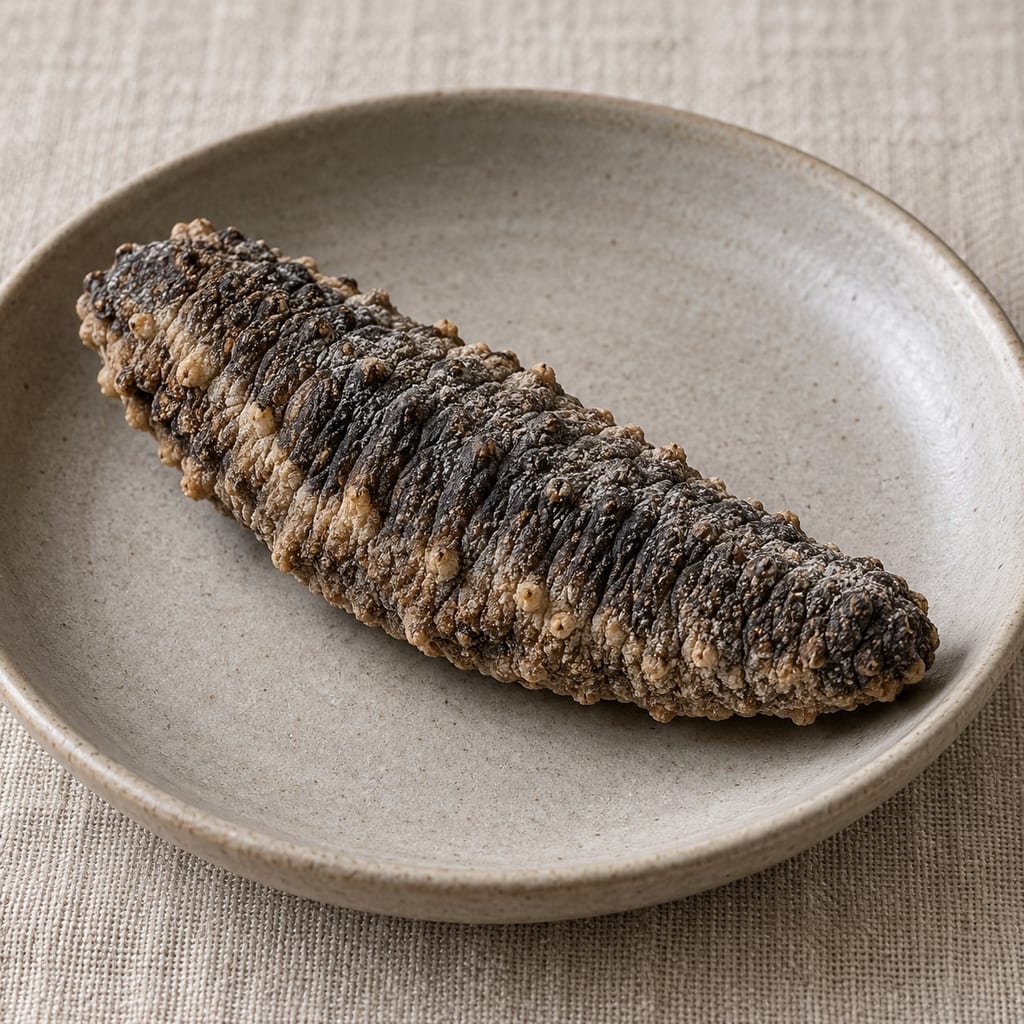
Sea cucumber cleaned, boiled and dried, sometimes with smoke, into a long-keeping trade product; Makassan processing in Arnhem Land is documented from at least the eighteenth century.
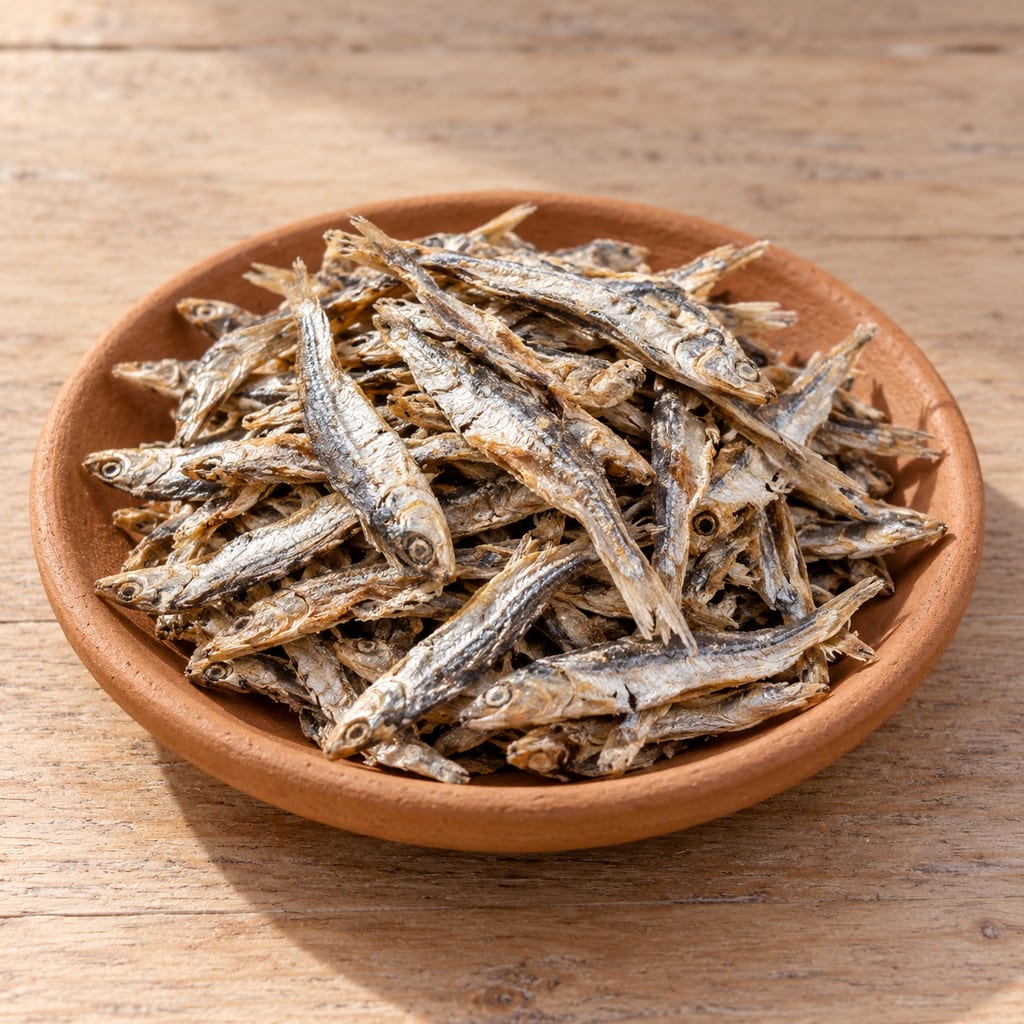
Anchoveta salted, drained of sanguaza and sun-dried on sand or stones at Caleta de Carquín, a technique declared part of Peru's cultural heritage in 2016.
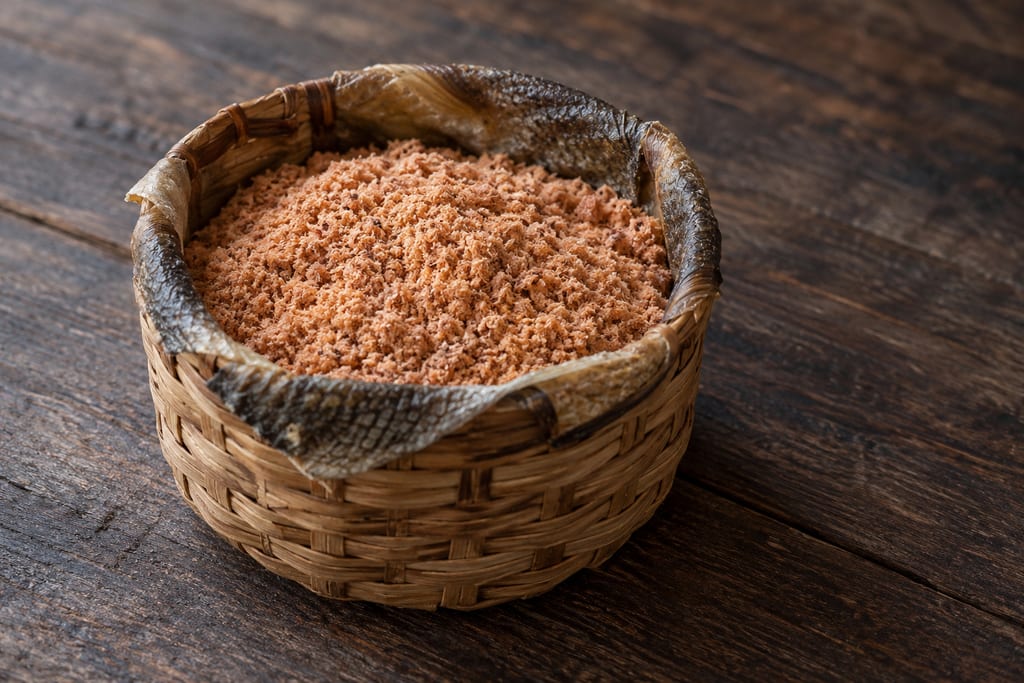
Dried salmon broken down, pounded to a meal and pressed into grass baskets lined with fish skin: the compact trade food of Celilo Falls and The Dalles.
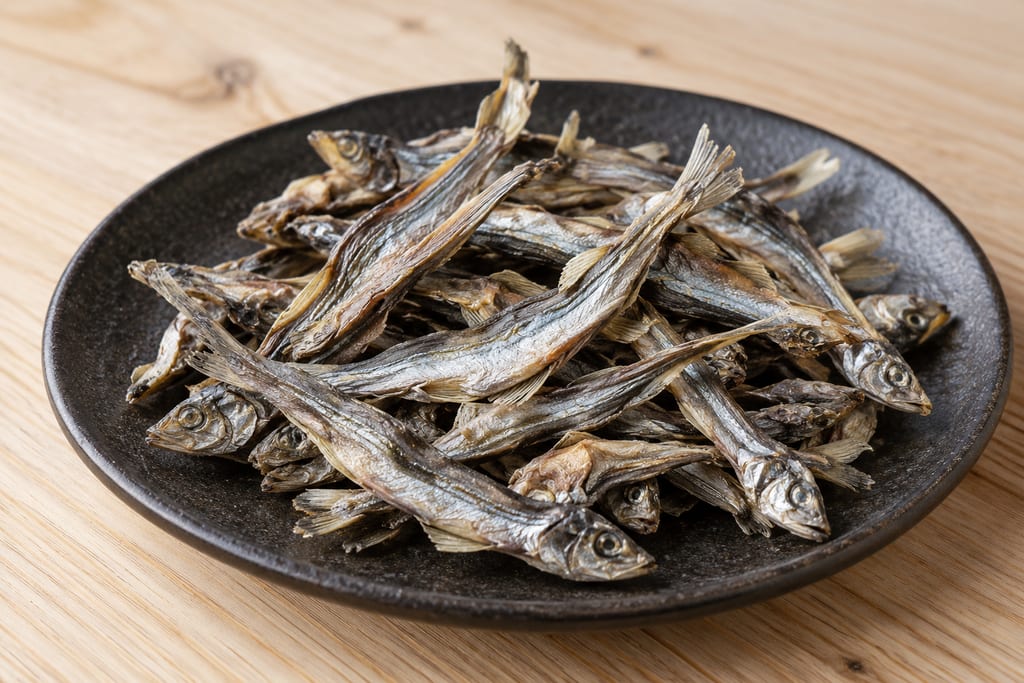
Greenlandic capelin dried whole on rocks, among crowberry vegetation or on buildings, and the microbial research that has made this small fish unusually well studied.
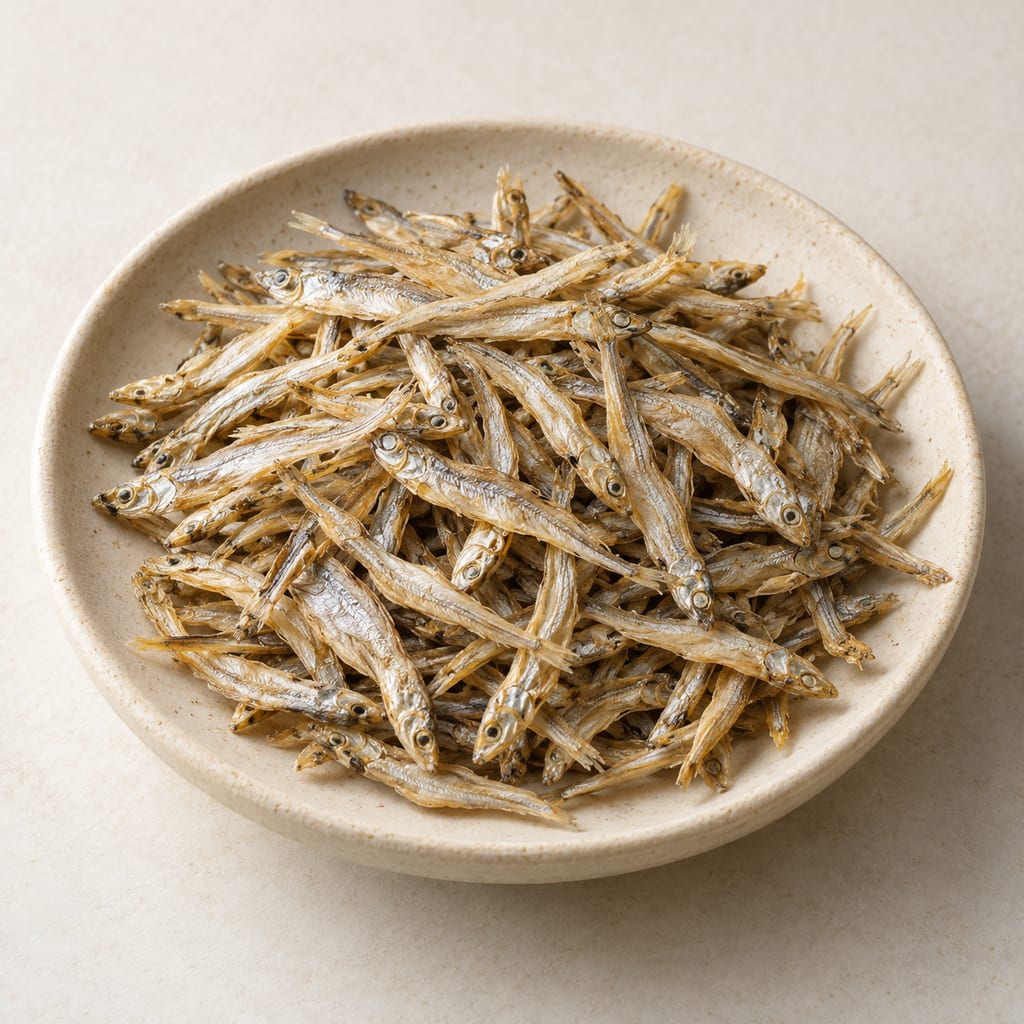
Small central-Mexican lake silversides, Chirostoma spp., dried whole and sometimes salted, then fried, roasted or simmered into Lenten tortitas and snacks.
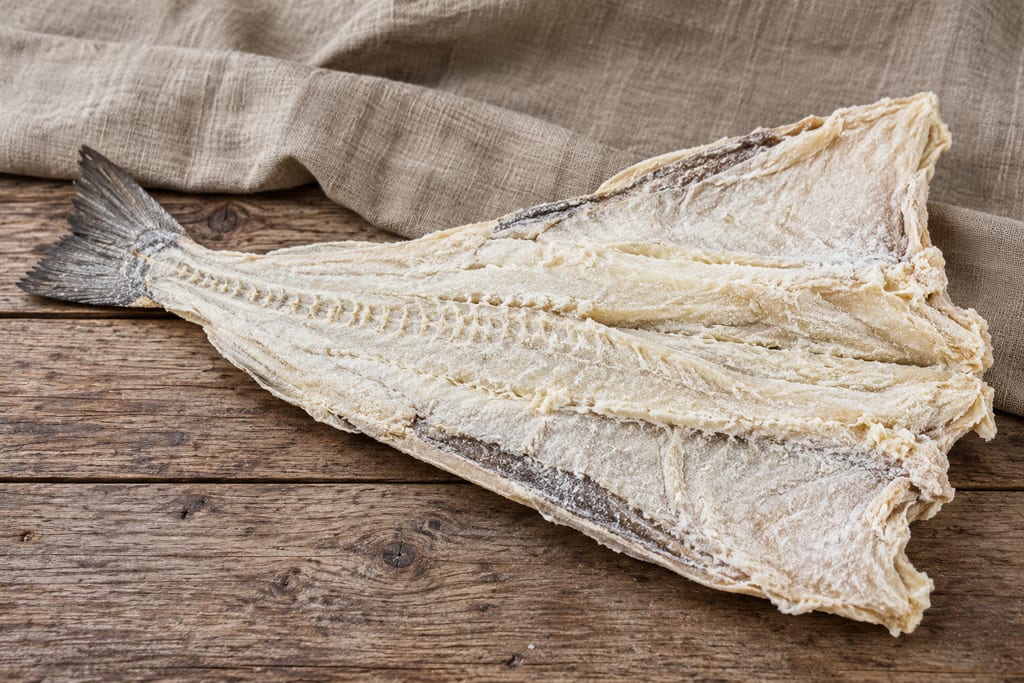
Cod split, salted and dried on flakes until hard, a long-keeping fish that must be desalted and rehydrated before use; the salting and the extensive drying together make it portable where light salting or partial drying does not.

A Cap-Pelé boucanière is an Acadian herring-smoking building. The documented Willie Niles example is a one-storey wood-frame structure with a ridge smoke vent and interior bays for hanging fish-bearing cannes.

Achcharu is a family of Sri Lankan vinegar pickles made with mixed vegetables or seasonal fruit and a piquant spice dressing. This version is a quick, refrigerated, non-fermented mixed-vegetable pickle.

The acocote is a long, hollowed and dried gourd used to draw aguamiel from a mature maguey. It is a harvesting tool: the sap is transferred to a separate vessel before it ferments into pulque.

Adrak murabba preserves young ginger in sugar syrup, a sweet South Asian preparation recorded in Indian cookery and food-processing sources.

Parkia biglobosa seeds are fermented into regional West African seasonings, including nététou, iru, dawadawa and soumbala. The yellow fruit pulp is a separate food, and names and methods vary by place.

Japanese reddish-brown vinegar from sake lees matured about three years, turned to vinegar by acetic bacteria; the vinegar of Handa and Edomae sushi rice.

A refined common-wheat flour blended for a broad range of baking; its protein and behavior vary with wheat, milling and market.

The almond mushroom, Agaricus subrufescens, was cultivated in eastern North America in the 1800s, lost its market, and returned as a cultivated mushroom from Brazil, where it is grown under several names.
No community contributions have been published for this entry yet.
Sign in to contribute. Published comments and photos are free to read.
Russian Museum of EthnographyHistory · Method
Russian Museum of Ethnography: Nivkhi and UiltaMuseum collection material on the Nivkhi and Uilta documenting fishing settlements and the drying racks beside them: elevated wooden frameworks standing where airflow is available, which keep the fish separated, raise it clear of ground moisture, dirt and some animals, and must support the weight of wet fish and withstand local weather.
Historic Nivkh storage architecture included raised buildings used for keeping food away from snow and animals, forming part of a preservation chain extending beyond drying itself.
Photographs by Bronislaw Pilsudski in the early twentieth century show Nivkh settlements and their drying facilities, and later images, including some from the 1930s, document the continuing practice at household rather than occasional-delicacy scale.
Cited in: A preserved fish that supported an entire food system; The geographical and historical setting; Catching fish and preparing the drying site; What actually happens during drying; Storage and the winter food supply
Culture.ruHistory · Method
Culture.ru: Samobytnaya Rossiya — NivkhiA regional historical and culinary overview of the Nivkh, used here for the documented cutting method: the fish are washed and gutted, an incision runs along the backbone while the two sides remain connected near the tail, the backbone and large bones can be removed, and the head may either be removed or remain attached to part of the fish.
The most important fish were Pacific salmon, particularly chum salmon, Oncorhynchus keta, and pink salmon, Oncorhynchus gorbuscha, with other locally available fish also preserved.
Anton Chekhov, visiting Sakhalin in 1890, described fish spread open and suspended on drying structures near dwellings in such quantity that the hanging fish gave the landscape a distinctive appearance.
Dried fish could be eaten without elaborate preparation where traditional practice and product condition allowed, or cooked in soups and other dishes, sometimes combined with fresh fish, meat, herbs and roots.
Cited in: A preserved fish that supported an entire food system; The geographical and historical setting; Catching fish and preparing the drying site; Cutting the fish; What actually happens during drying; Recognizing problems and understanding safety
Slow Food Foundation for BiodiversityMethod · History
Slow Food Foundation: Mos Sweet JellyA community-product description of mos as a sweet, jelly-like preparation combining processed fish, fish skin, fat, nuts, berries and sometimes cooked lily-family tubers.
One documented household sequence: dried fish soaked overnight, the skin separated and soaked further, then cleaned carefully to remove scales; the cleaned skin placed briefly in boiling water for one to two minutes; the material then pounded and worked with liquid and fat until a uniform mass develops, with seal fat specifically recorded together with broth from cooking the skin.
Additions such as boiled saranga tubers, dwarf-pine nuts, cranberry, bilberry, lingonberry, cloudberry or other locally available berries, the mixture worked in a wooden container called an orn with a wooden implement recorded as mamas, then frozen.
Traditional production is described as taking up to seven hours, while some modern makers report approximately three hours using contemporary equipment. The named berries and their proportions vary considerably and the source gives no complete weighed recipe.
Mos has been recorded at gatherings and as a food prepared for visitors and relatives, and descriptions connect it with offerings and the historical Bear Festival.
Cited in: Mos: Turning preserved fish into a special dish; Why fish skin can form a jelly; Ritual and social significance; Recognizing problems and understanding safety
Business History ReviewHistory
Cambridge University Press: The Nivkh People's Sustainable Bear Hunting EnterpriseHistorical economic and subsistence context for Nivkh territories from the seventeenth to the twentieth centuries, used here for the structure of the seasonal food economy: salmon runs supplied food in quantities difficult to obtain at other times of year, the catch had to be divided between immediate consumption, drying, other preparations and animal feed, and households maintained sled dogs, which made large quantities of preserved fish important for winter transport as well as human nutrition.
Ethnographic records of the twentieth and twenty-first centuries document continuity alongside major changes caused by commercial fishing, Soviet collectivisation, settlement policies and changing household economies, including disruption when access to fishing grounds, seasonal movements or traditional storage buildings changed.
Cited in: The geographical and historical setting; Storage and the winter food supply; Ritual and social significance; A tradition of complete utilization
Sapporo Gakuin UniversityInspiration
Traditional Nivkh KitchenA local photographic research record of the traditional Nivkh kitchen. Its original page could not be fully retrieved during verification, so it is carried as a located record of the subject rather than as support for any specific figure or procedure.
Cited in: A tradition of complete utilization