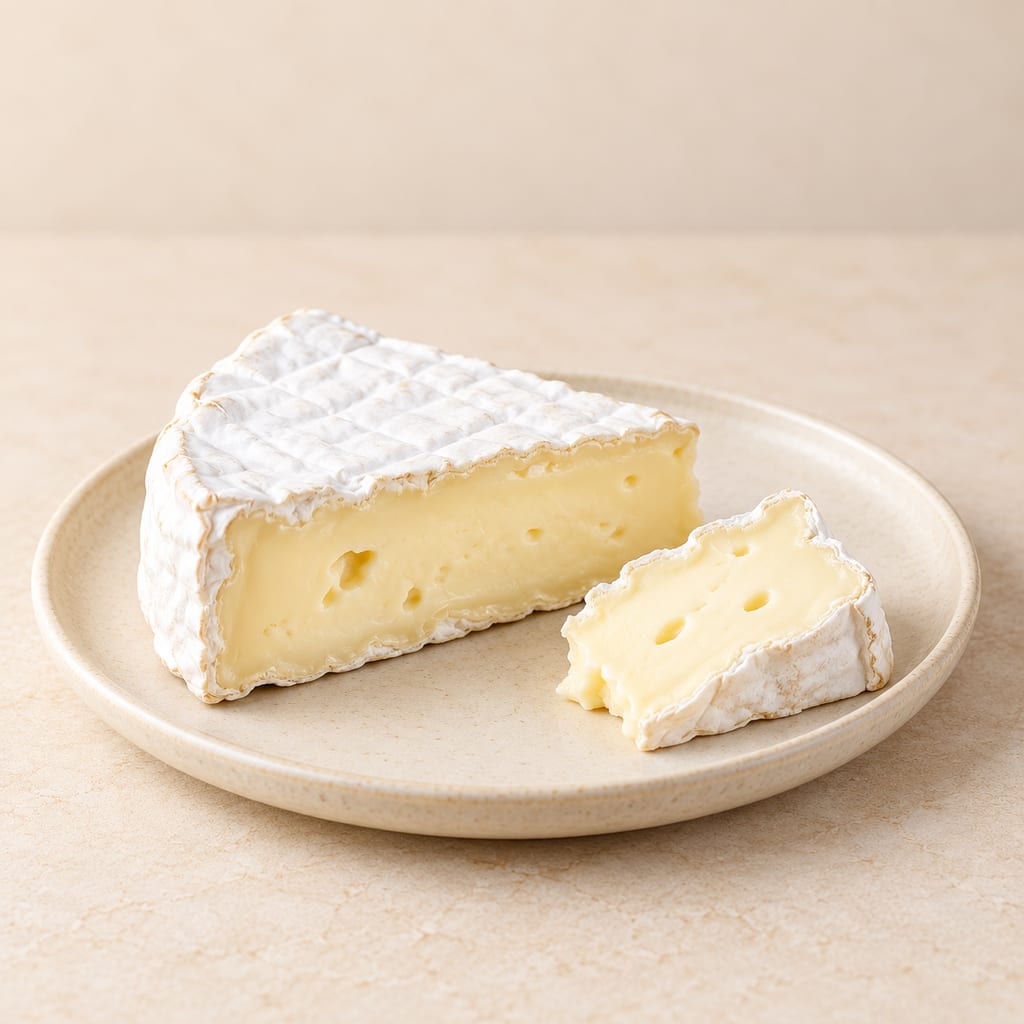
Brie, cream-enriched
A cream-enriched Brie with a white bloomy rind and a softening center, made from pasteurized milk with lactic and surface cultures.
 FermenteaWhere food goes to change
Cultures
A selected fungal culture for white, bloomy cheese rinds. Its growth and enzymes help change the acidity, texture and aroma of soft-ripened cheese.
Penicillium candidum culture is an ingredient for making a living cheese rind. It supplies selected ripening fungi, commonly as a dried powder, rather than a flavoring intended to remain unchanged in the food. After inoculation and the appropriate cheese-making stages, the fungus grows across the surface. Its pale mycelium gives a bloomy-rind cheese a recognizable coat, while its biological activity helps transform the material beneath that coat. The ingredient and the rind it produces are therefore different stages of the same working relationship.
The familiar white surface of Brie and Camembert belongs to a history of choosing fungi for food. A cheese rind is a habitat with abundant nutrients and a particular combination of salt, moisture, acidity and oxygen. Organisms that grow there can change the cheese, and cheese-makers have learned to favor growth that produces the character they want. Selected food cultures bring that choice into the make as an identified input. They differ from an unidentified mold that happens to appear on a piece of cheese.
Charles Thom's 1906 USDA bulletin, Fungi in Cheese Ripening: Camembert and Roquefort, captures an early scientific examination of that craft. Thom studied fungi as organisms that could be isolated and compared. His experiments separated questions that a single word such as ripening can hide: changing acidity, digesting casein, producing texture and creating a characteristic flavor. A fungus able to break down curd was not necessarily enough to reproduce the eating qualities of Camembert. The bulletin placed observable dairy work beside laboratory cultures and chemical analysis.
That distinction remains useful. A white coat is one visible result, while protein breakdown, acid consumption and aroma development are processes within a changing food. Modern culture selection concerns the combination of those properties. Commercial products can be selected for different growth or enzyme characteristics, so the general name Penicillium candidum does not describe every packet equally. The linked cream-enriched Brie names the culture but leaves its commercial strain unspecified; that precision should be preserved when choosing a product for the make.
Purchasing begins with food-use identity, product name and application. A commercial culture should be matched to the cheese method and its dose basis. Dried direct-vat preparations and products intended for spraying have their own handling instructions. A teaspoon in a home recipe cannot be converted into a manufacturer's culture units without knowing the formulation. The useful question is which prepared culture the make requires, not simply whether a powder can grow something white.
The names on dairy labels and the names in taxonomy can differ. Penicillium candidum is the historical name commonly retained in cheese recipes and commercial listings. Index Fungorum treats that name as a synonym of Penicillium camemberti. Its nomenclatural record dates the candidum name to Link in 1809 and the camemberti name to Thom in 1906. These dates concern the naming of organisms. They do not establish when a particular cheese began, when the fungus was first used in food or when a modern sachet was developed.
The organism is a fungus, rather than a lactic acid bacterium. Its growing filaments form mycelium, the visible network associated with the white bloom. A selected culture supplies a starting organism or population, and the cheese-making environment then provides conditions for growth. The lactic starter has already helped create an acidic curd. The rind organism encounters that curd as a substrate on which it can use nutrients and carry out further transformations.
Commercial names add another layer of identity. A supplier may offer several Penicillium candidum products with different codes and qualitative descriptions. Those product codes are meaningful choices within a catalogue, even when all bear the same broad taxonomic name. The linked Brie recipe's generic culture line does not identify it as LyoPro PC, SAM3 or another named product. A matching spoon measure is insufficient to establish that equivalence, because concentration and activity belong to the product formulation as well as the species.
The LyoPro PC technical sheet provides a concrete example of a prepared culture. It lists Penicillium candidum with maltodextrin and lactose carriers and describes a freeze-dried dairy ripening culture. It also gives product-specific growth and enzyme characterizations. These details show what a commercial preparation can contain beyond the organism's name. They are useful for reading a label, while remaining specific to that formulation rather than describing every culture sold under the candidum name.
Experimental work also reveals why selected identity matters. In 2019, Bodinaku and colleagues studied wild Penicillium isolates adapting to cheese-curd media. Changes in pigmentation, reproduction and volatile compounds accompanied the experimental adaptation. The work makes domestication an observable biological process, rather than merely a historical label. It involved defined laboratory isolates and conditions; it offers insight into selection on cheese, not a method for turning unknown household mold into an edible starter.
The rind begins with a chemical environment prepared by other organisms and by physical cheese-making. Lactic bacteria use milk sugar and produce acid. Rennet helps set the protein network; drainage and salting alter its moisture and composition. Penicillium and companion ripening organisms then grow at the surface of that formed cheese. Their work belongs to maturation, even when the culture powder was originally introduced into the milk before coagulation.
Lactate produced during lactic fermentation is an important carbon source in Camembert-type rind systems. Surface fungi can transport and metabolize it, supporting growth while reducing acidity at the surface. This is a different direction of change from the acidifying starter's initial work. The cheese consequently develops a gradient: the exterior and interior need not have the same acidity or the same microbial activity at the same moment. Ripening proceeds through a spatially organized food rather than a perfectly uniform block.
Ammonia is another part of that developing environment. Microbial amino-acid metabolism can release it, and controlled cheese studies have linked rind acidity changes with fungal growth and ammonia concentration. Diffusion toward the interior has been proposed as a contributor to changes beneath the rind. The important practical idea is that a surface community can influence material beyond the visible filaments. The fungus does not have to fill the entire cheese with mycelium for its activity to affect the paste.
Protein breakdown provides a second route from rind to texture. Casein forms much of the cheese's structural network. Proteases cut proteins into smaller fragments; peptidases can continue the work on peptides, releasing amino acids. As the original framework is altered, the curd's mechanical behavior changes. A firm young paste can become softer beneath the rind while the center remains less mature. Cutting through a ripening cheese can therefore reveal a progression of textures rather than a single state throughout.
Experiments on Camembert have followed these changes by sampling from the surface toward the center and examining protein fragments and soluble nitrogen. They distinguish early action associated with the milk-clotting enzyme from later products associated with increasing mold protease activity. This helps explain why maturation is not simply waiting for a finished cheese to become older. Different enzyme systems act across the sequence, and the material they receive has already been changed by earlier stages.
Milk fat supplies additional material for ripening. Lipases release fatty acids from fat molecules, and further metabolism can produce compounds that contribute to aroma. Protein-derived amino acids likewise become substrates for subsequent reactions. Flavor development therefore combines the release of smaller molecules with their further transformation. It cannot be reduced to the presence of a white coat, or to a single molecule made by one named fungus. The cheese is a community and a nutrient system as well as a shape.
A metatranscriptomic study of a Canadian Camembert-type cheese examined fungal activity through expressed genes. It found activity associated with carbohydrate, organic-acid, lipid and protein metabolism, along with growth and responses to stress. The approach connected ripening organisms with the work they were carrying out in the cheese matrix. This was a particular mixed-culture cheese, but it provides a useful picture of maturation as coordinated biological activity rather than an inert coating on the outside.
The linked Brie make brings that ecology into a practical sequence. MM100 serves as the milk-phase starter, Geotrichum candidum accompanies rind development, and Penicillium supplies the later white bloom described in the method. Turning and handling the cheese expose and support its surfaces as the coat develops. The exact timing and texture belong to that recipe and its environment. The general ingredient page explains the roles, while the complete make retains the actual instructions.
A culture preparation can contain carriers as well as fungal material. Those carriers and the manufacturing process matter to dietary labeling. LyoPro PC, for example, lists lactose among its carriers and declares milk as an allergen. That is a product-specific declaration, not a taxonomic property shared by every fungus carrying the same species name. The actual packet and its current supplier documentation should govern the ingredient used in a particular kitchen or dairy.
The finished food has its own allergen context. A Brie made with milk and cream remains a milk-containing cheese regardless of the culture's declaration. Selecting a different culture does not remove the milk proteins already present in the recipe. Culture ingredients, the dairy substrate and the finished cheese are connected stages, but each carries information that should be read at its own level. A shopper's dietary decision therefore needs more than the name of the ripening organism.
Cold storage and dry handling preserve the prepared culture's intended condition. Commercial sheets specify storage and expiry for their own formats, and repackaged portions should follow their supplied instructions. A manufacturer's stated shelf life for a sealed sachet is different from the keeping period of an opened portion or a rehydrated spray. Those forms have different conditions, so a number printed for one should not be extended to the others.
The distinction is especially important when preparing a spray. The LyoPro manufacturer sheet gives a short refrigerated holding instruction for its rehydrated preparation, while a retailer's page gives a much longer period. Those directions conflict. The exact product's manufacturer or current package instructions should be clarified before preparing and holding such a solution. The linked Brie instead uses its named powder in the milk, so there is no need to introduce a separate spray method into that recipe.
French bloomy-rind cheese provides an important cultural setting for this organism, while modern culture production and distribution reach well beyond the place of a named cheese. Camembert and Brie have helped make the white fungal rind familiar at the table. Their characteristic textures and aromas result from selected organisms working in a cheese-making process, with milk, shape, salting and maturation contributing alongside the culture.
A culture's factory location is a different geographical fact from that cheese tradition. A product may be manufactured in one country, sold in another and used in milk from a third. LyoPro PC identifies an Italian country of origin for that preparation; it does not locate the origin of every Penicillium candidum culture. The generic ingredient in the linked Brie remains broader than one manufacturer's product and narrower than unidentified white molds growing in any dairy environment.
Its immediate documented use on this site is the cream-enriched Brie. There the culture helps build the ripening surface that changes the paste beneath it. At the table, that work is experienced as the relationship between rind, softened outer paste and the less mature center of a younger cheese. The powder itself is not the culinary destination. Its value lies in the transformation it participates in, from a carefully prepared inoculum to a living rind and a cheese with its own developing texture and aroma.
Milk may be present in commercial formulations; LyoPro PC declares milk and lactose carrier. Check the actual culture package.
Association with selected fungi of French bloomy-rind cheeses, not a documented birthplace of every commercial culture.
Country of origin declared for the illustrative LyoPro PC product; the linked Brie does not identify its PC as that SKU.
A cream-enriched Brie with a white bloomy rind and a softening center, made from pasteurized milk with lactic and surface cultures.
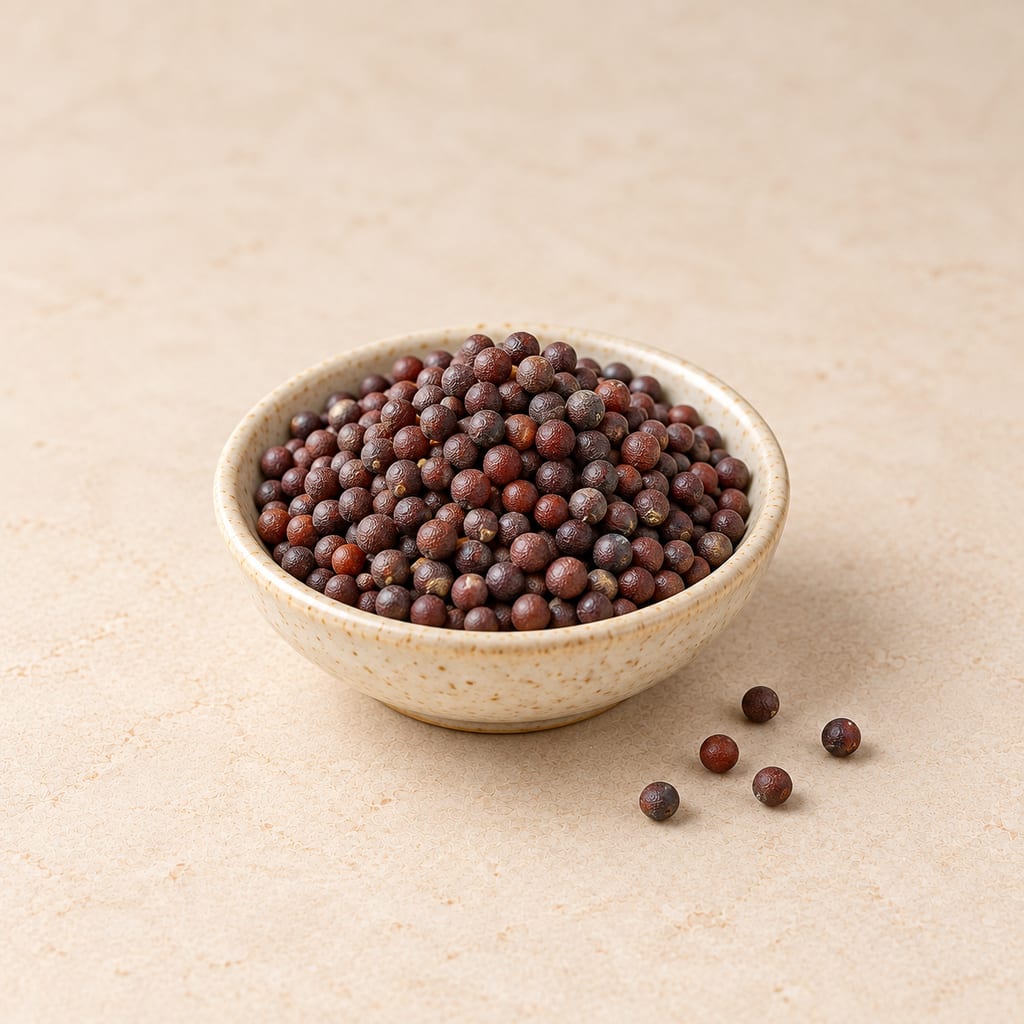
Black mustard seed is the small, dark, very pungent seed of Brassica nigra, the hottest of the three mustards. It gives its bite through sinigrin, which turns into allyl isothiocyanate when the crushed seed meets water.
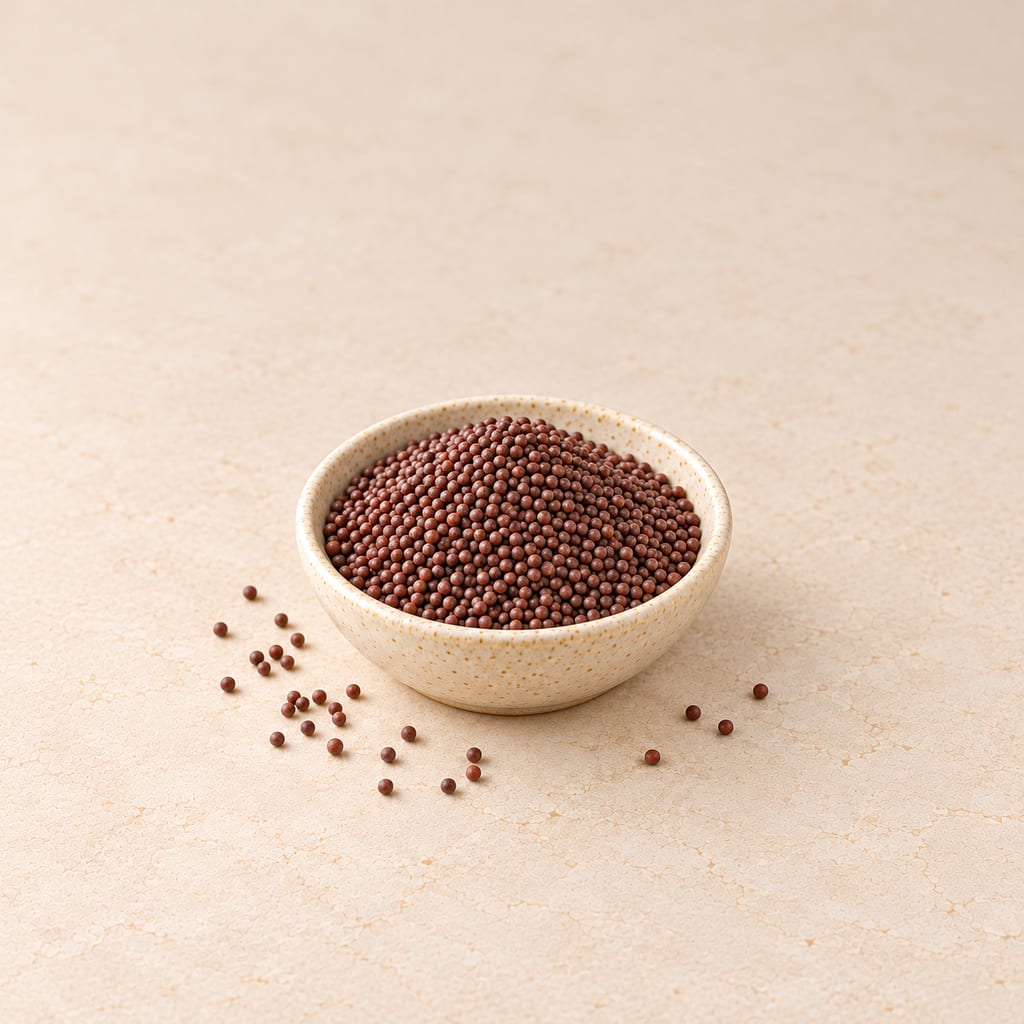
Brown or oriental mustard seed comes from Brassica juncea, a hybrid of black mustard and turnip rape. It is the hot, easily harvested seed behind Dijon, spicy brown mustards and much of the mustard oil of the Indian subcontinent.
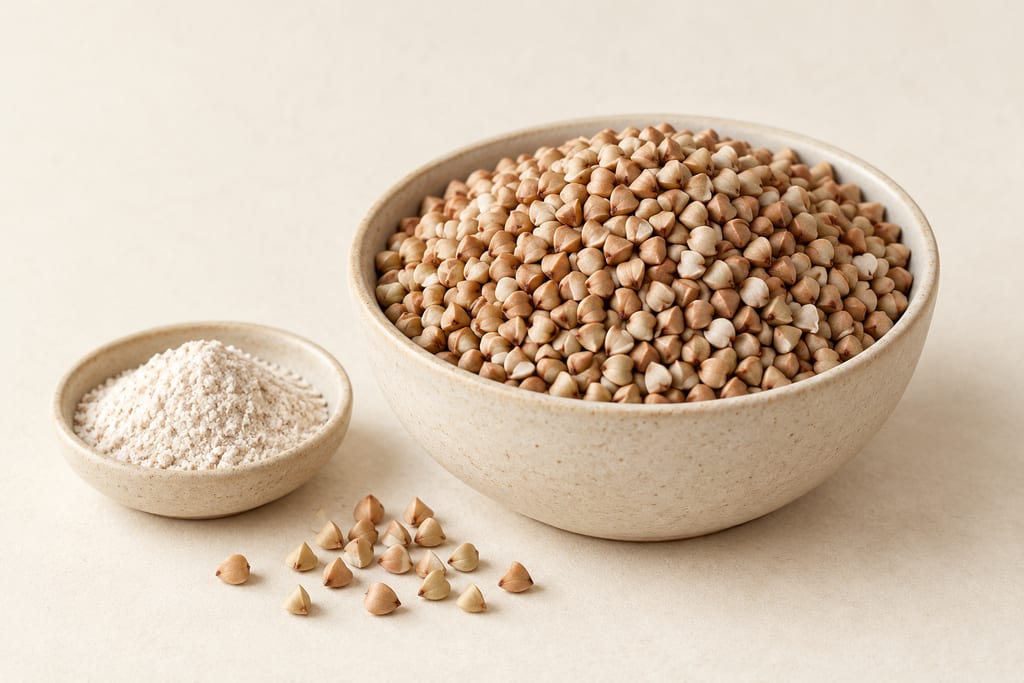
Buckwheat is a triangular-seeded flowering plant whose whole groats and flour cross regional food traditions, from porridge and pancakes to modern sourdough and gluten-free bread.
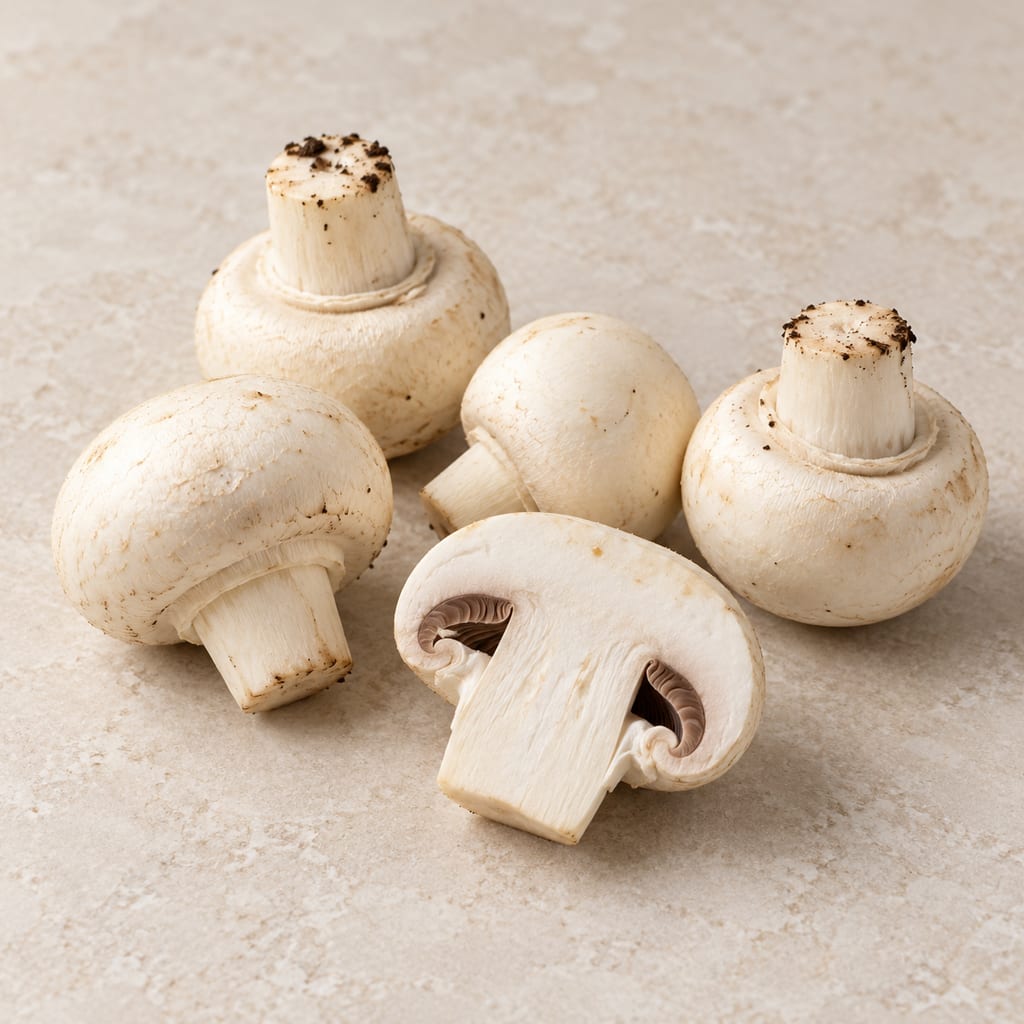
A cultivated form of Agaricus bisporus sold young as a button and at more mature stages as cremini or portobello, used fresh or preserved in everyday cooking.
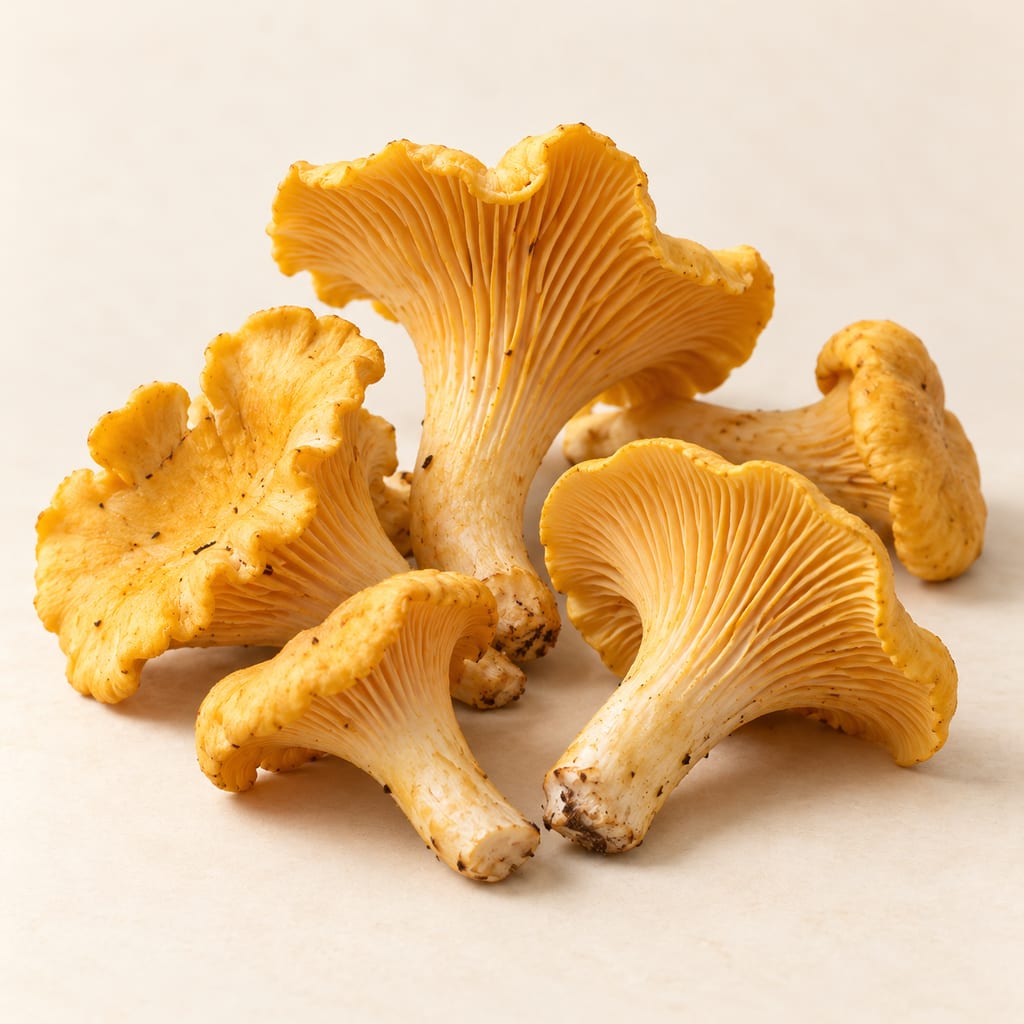
Chanterelles are wild, tree-associated edible mushrooms, particularly the European golden chanterelle Cantharellus cibarius, prized for their firm flesh, fruity aroma and use fresh, frozen, dried or pickled.

Chicken eggs supply proteins and yolk fats that set and emulsify. Atlas breads use them in enriched doughs, surface washes and a sourdough pancake batter mixed after fermentation.
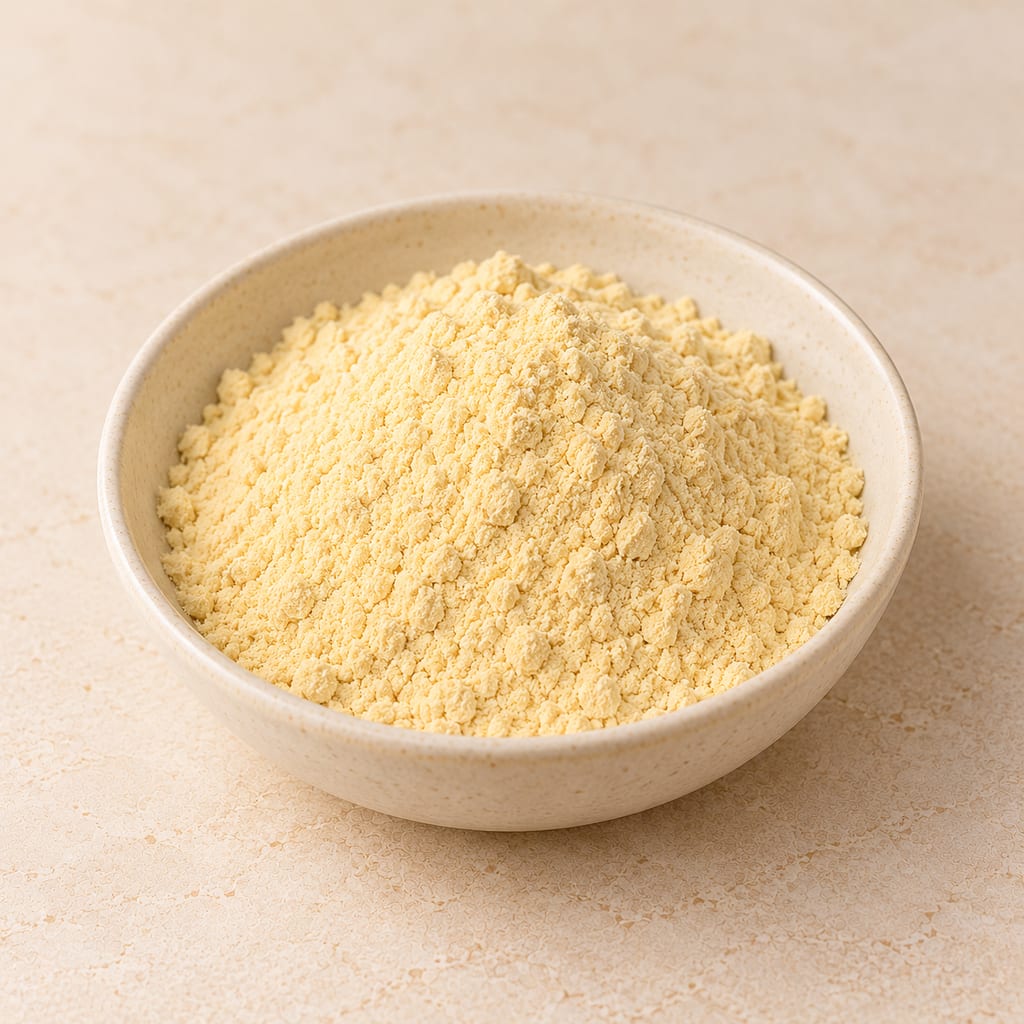
Chickpea flour is milled Cicer arietinum, used as besan in many Indian dishes and as the base of breads such as socca and farinata.
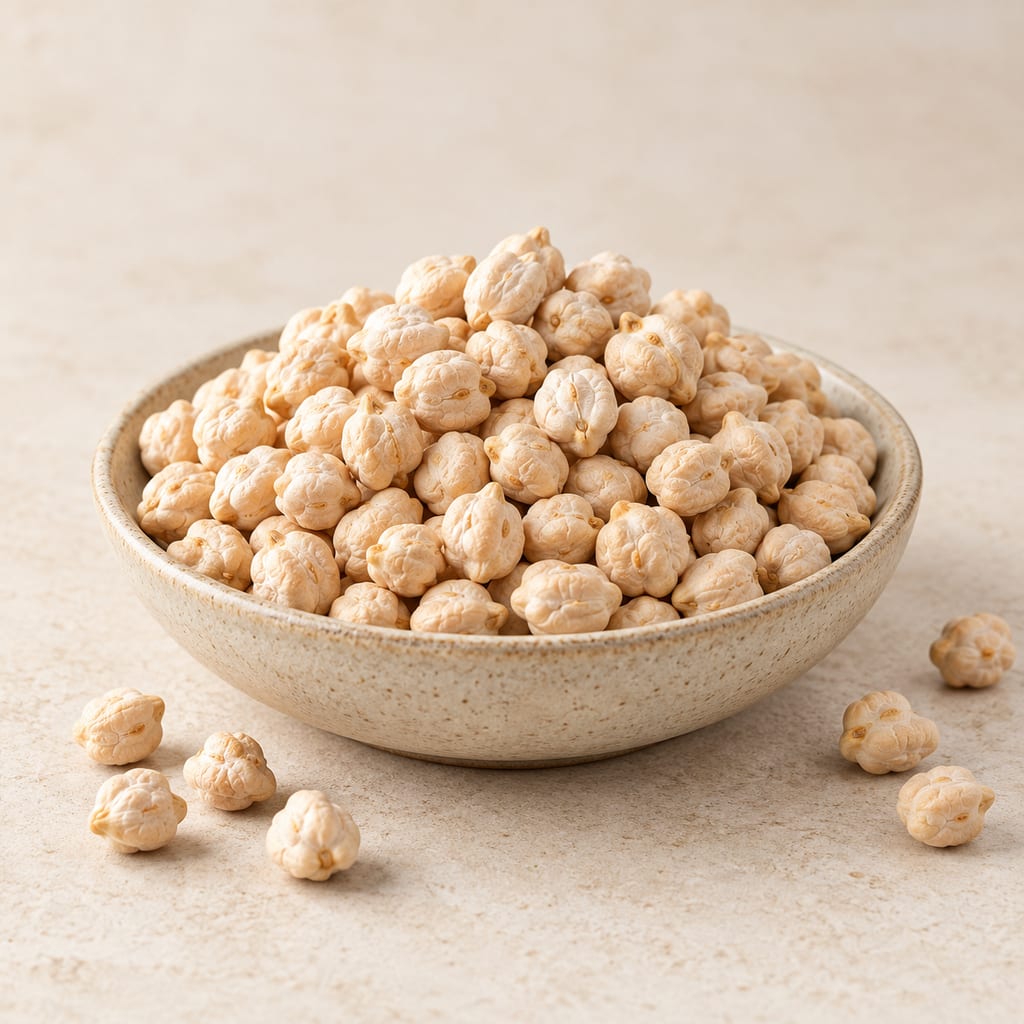
Chickpeas (Cicer arietinum) are dry pulses eaten whole or milled into flour, which gives socca, farinata and other breads a dense, nutty batter or dough.

A Cap-Pelé boucanière is an Acadian herring-smoking building. The documented Willie Niles example is a one-storey wood-frame structure with a ridge smoke vent and interior bays for hanging fish-bearing cannes.

Achcharu is a family of Sri Lankan vinegar pickles made with mixed vegetables or seasonal fruit and a piquant spice dressing. This version is a quick, refrigerated, non-fermented mixed-vegetable pickle.

The acocote is a long, hollowed and dried gourd used to draw aguamiel from a mature maguey. It is a harvesting tool: the sap is transferred to a separate vessel before it ferments into pulque.

Adrak murabba preserves young ginger in sugar syrup, a sweet South Asian preparation recorded in Indian cookery and food-processing sources.

Parkia biglobosa seeds are fermented into regional West African seasonings, including nététou, iru, dawadawa and soumbala. The yellow fruit pulp is a separate food, and names and methods vary by place.

Japanese reddish-brown vinegar from sake lees matured about three years, turned to vinegar by acetic bacteria; the vinegar of Handa and Edomae sushi rice.

A refined common-wheat flour blended for a broad range of baking; its protein and behavior vary with wheat, milling and market.

The almond mushroom, Agaricus subrufescens, was cultivated in eastern North America in the 1800s, lost its market, and returned as a cultivated mushroom from Brazil, where it is grown under several names.
No community contributions have been published for this entry yet.
Sign in to contribute. Published comments and photos are free to read.
Index Fungorum, Royal Botanic Gardens KewIdentity · Names
Penicillium candidum Link — Names Record174737Taxonomic synonymy connects Penicillium candidum with Penicillium camemberti;1809 and 1906 are nomenclatural dates.
Cited in: Penicillium names and prepared cultures
USDA Bureau of Animal IndustryHistory · Science
Fungi in Cheese Ripening: Camembert and Roquefort, Bulletin82Thom's 1906 historical bulletin compares fungal isolation, acidity, casein digestion, flavor and texture during cheese ripening.
Cited in: Selecting the white rind
mBioIdentity · Science · History
Rapid Phenotypic and Metabolomic Domestication of Wild Penicillium Molds on CheeseThe cheese-curd-medium experiment compares selected and wild fungi through changes in pigmentation, reproduction and volatile production.
Cited in: Selecting the white rind; Penicillium names and prepared cultures; Brie, Camembert and a travelling culture
Journal of Dairy ResearchScience
Controlled production of Camembert-type cheeses. PartI: Microbiological and physicochemical evolutionsThe study abstract concerns rind/core acidity, lactate, ammonia, proteolysis and proposed inward ammonia diffusion in a mixed-culture model.
Cited in: How the bloom changes the cheese
Nippon Shokuhin Kagaku Kogaku KaishiScience
Proteolysis in Camembert Cheese during RipeningThe study abstract describes surface-to-center proteolysis involving early chymosin activity and later mold enzymes.
Cited in: How the bloom changes the cheese
BMC GenomicsScience
Metatranscriptome analysis of fungal strains Penicillium camemberti and Geotrichum candidum reveal cheese matrix breakdown and potential development of sensory properties of ripened Camembert-type cheeseThe industrial Canadian mixed-culture experiment examines fungal expression associated with carbohydrate, organic-acid, lipid and protein metabolism and stress.
Cited in: How the bloom changes the cheese
Codex-ing Biotech IngredientsProduct example · Selection · Handling · Allergens
LyoPro PC Technical Data SheetThe named freeze-dried product contains maltodextrin and lactose, declares milk and Italian origin, and specifies a short rehydrated-spray holding period.
Cited in: Selecting the white rind; Penicillium names and prepared cultures; Carriers, cold storage and a spray conflict; Brie, Camembert and a travelling culture
New England Cheesemaking Supply CompanyProduct example · Handling · Allergens
Penicillium Candidium (LyoPro PC)The retailer declares milk and freezer storage and gives a spray holding period that conflicts with the manufacturer sheet.
Cited in: Selecting the white rind; Penicillium names and prepared cultures; Carriers, cold storage and a spray conflict
New England Cheesemaking Supply CompanyUse
Brie Cheese Making RecipeThe Brie method uses separate MM100, C70 and Penicillium candidum preparations; its commercial PC strain is unspecified.
Cited in: Selecting the white rind; How the bloom changes the cheese; Carriers, cold storage and a spray conflict; Brie, Camembert and a travelling culture