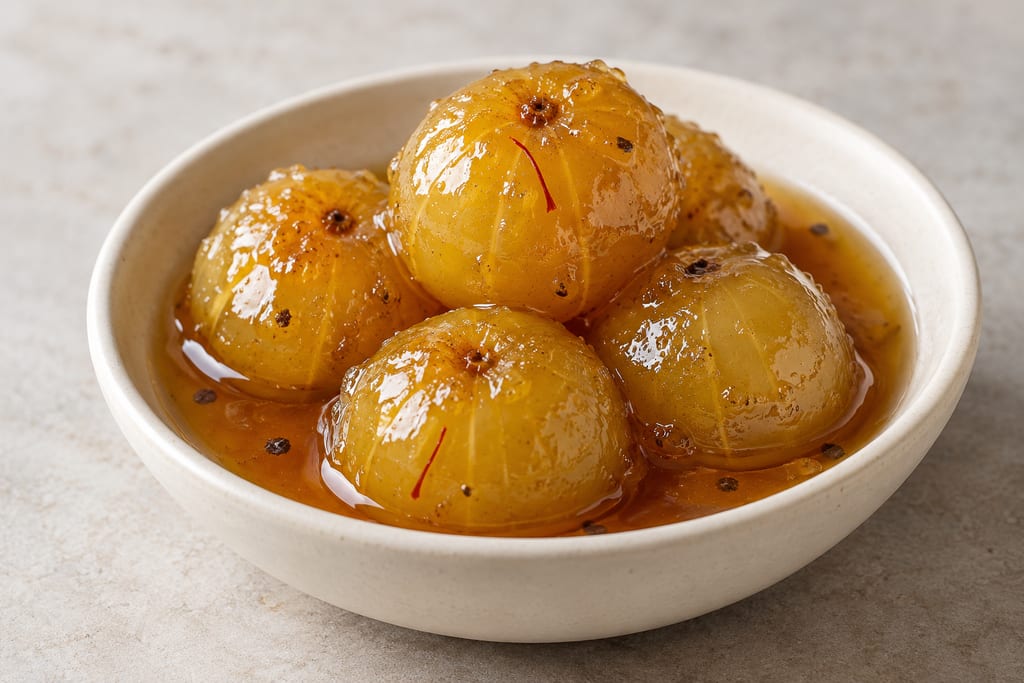
Amla murabba
Amla murabba preserves whole Indian gooseberries in a heavy sugar syrup scented with cardamom and sharpened with pepper and black salt. This household method soaks the fruit before cooking.
 FermenteaWhere food goes to change
Spices and aromatics
Saffron is the dried stigma of Crocus sativus, valued for its golden colour, floral aroma and gentle bitterness; two linked amla preserves use it at distinct stages and measures.
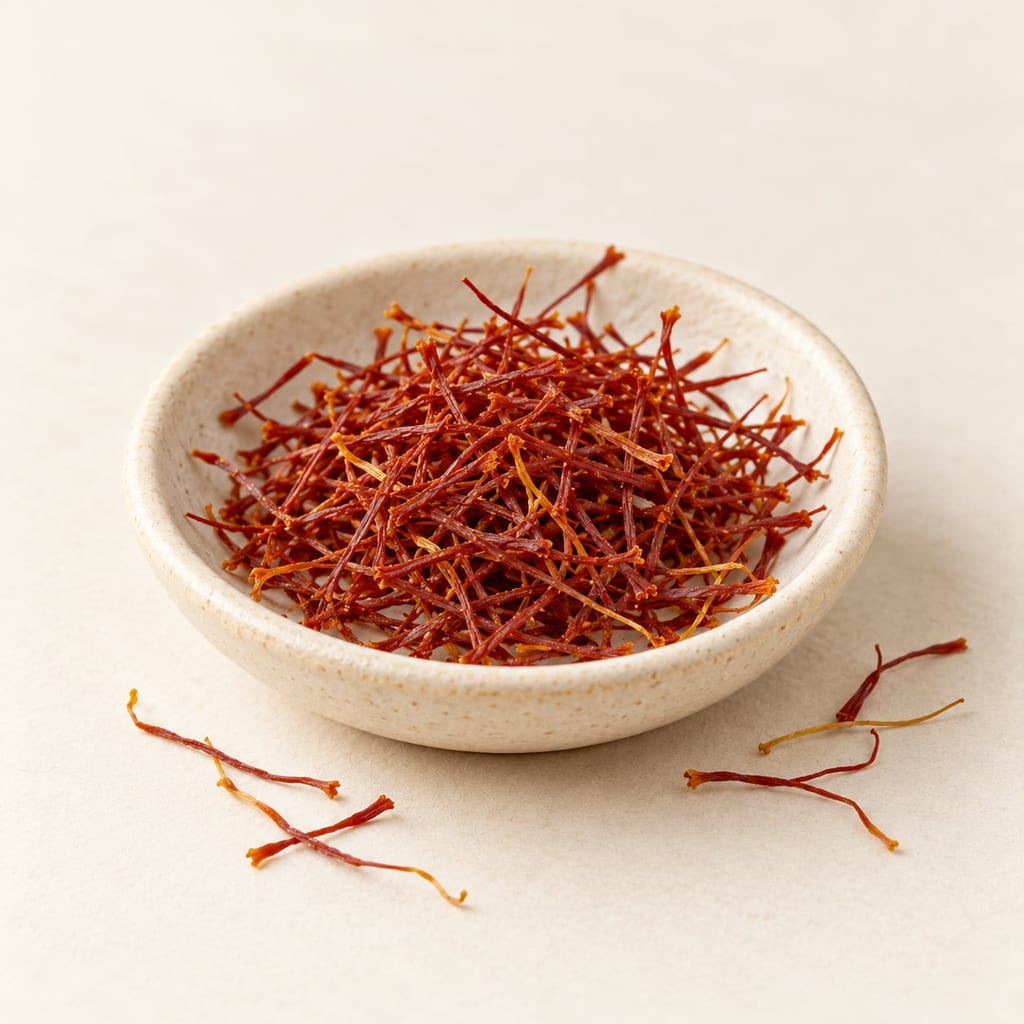
Saffron is the dried stigma of the autumn-flowering crocus Crocus sativus L. Each flower has three slender, deep orange-red stigma branches, usually still joined at their paler base when sold as threads. They are not petals, stamens or the whole flower. The dry threads feel light and brittle; when steeped, they release a warm golden colour, a distinct floral, hay-like aroma and a gentle bitterness. The spice is both a colourant and a seasoning, but its colour, bitterness and smell come from different compounds and do not necessarily rise or fade together.
The plant belongs to the iris family, Iridaceae. Kew’s Plants of the World Online accepts Crocus sativus as the species name and describes it as a cultivated plant, or cultigen, with a native range listed as Greece. In everyday writing, “saffron” can mean the plant or the spice; precisely, the spice is its dried stigmas. Standards also allow a small piece of the style, the slender stalk supporting the stigma, to remain attached. Whole threads show the form of the plant part; ground saffron may be convenient to disperse, but it removes that visible cue and makes adulteration harder to spot.
Cultivated saffron has an old Greek history, though its first grower and precise place of origin are unknown. Ancient images of crocuses do not always identify the species, and researchers have debated which wild plant gave rise to the sterile crop. Botanical and genetic evidence now supports early cultivation in Greece, possibly Attica; Kew lists the plant as a cultigen from Greece. That is a carefully bounded account of origin, not a date of invention. The threads that entered ancient fragrant preparations came from plants tended through a growing cycle, but their surviving traces do not reveal the first person who gathered or dried a stigma.
The written record gives a firmer, though still limited, foothold. Theophrastus’s Enquiry into Plants, written in the fourth century BCE, names saffron crocus among the plants that flower in autumn. A related work, On Odours, calls crocus the source of saffron perfume and praises the material from Aegina and Cilicia. These passages show that people in the ancient Greek world recognized the plant and valued its fragrant product, and that they associated quality with particular places. They do not establish the first cultivation site or prove that every ancient use involved C. sativus rather than a related crocus.
Over later centuries saffron became a crop and traded spice across parts of the Mediterranean and Asia. The routes and dates of spread are not a single settled story: cultivated plants and their corms moved with growers, merchants and changing political networks. Today, names such as Kashmir saffron and La Mancha saffron can refer to regulated geographical products, not different species. Kashmir Saffron is a registered Indian geographical indication; Spain’s La Mancha product has a protected designation with place-specific production and processing requirements. The labels connect the spice to a verified production area and practice. They should not be confused with a botanical cultivar name, nor do they make every unlabelled saffron from a wider country identical.
Saffron crocus is sterile and triploid: its cells carry three chromosome sets rather than the usual paired sets. It does not reliably make fertile seed. Growers propagate it vegetatively from corms and their daughter corms. A corm is a compact underground stem base, not a true bulb. This unusual reproduction helps explain why the crop remains labor-intensive and why growers depend on planting material rather than ordinary seed selection. Cultivation needs a seasonal cycle suited to the corm and a brief autumn flowering period; local schedules vary with climate and place, so a calendar for one growing region is not universal.
The crop is planted as corms. Leaves and flowers emerge seasonally, and when a flower opens the three stigmas must be separated from the rest of the plant. The flowers are delicate and short-lived, so harvest and separation are concentrated into a narrow seasonal window. In many producing regions, people pick flowers and remove the stigmas by hand. This is skilled repetitive work: the spice weighs little, and an enormous number of flowers contributes to a small quantity of dried threads. Mechanized harvesting or separation may be possible in some settings, but handling choices affect both intact appearance and the quality of the harvested material.
Fresh stigmas are not yet the familiar spice. Drying removes water and changes their chemistry. It stabilizes the material for storage while developing the characteristic aroma and concentrating colour and taste per unit weight. Drying is not a neutral final step: temperature, time, airflow and method alter the balance of saffron’s key compounds. Spanish producers traditionally toast the separated stigmas over a heat source on a sieve; other regions use sun, shade or controlled dryers. These are documented production traditions, not recipes to combine into one universal method. A study comparing microwave treatments likewise found that the treatments changed crocin-related pigments, picrocrocin and safranal in different ways; its optimized laboratory treatment is evidence of process sensitivity, not a household drying instruction.
Crocins are water-soluble carotenoid pigments that give saffron its strong yellow-orange colouring power. Picrocrocin is associated chiefly with its bitter taste. Safranal is a volatile aroma compound: it contributes to the spice’s characteristic warm, hay-like and sometimes floral smell. The threads’ visible red-orange colour is not the same as the golden colour they impart to water or syrup. Crocins dissolve into the liquid; the colour spreads outward from the thread as it infuses.
The compounds change during drying and storage. Research describes safranal formation as part of post-harvest development, while the picrocrocin concentration may decrease as aroma develops. The pathways and final balance depend on the drying and subsequent handling; a higher level of one marker does not automatically mean a better spice in every dish. Standards and regional specifications assess several dimensions, including purity, moisture, colouring strength, aroma and taste. Those measures are useful for trade and quality control, but they do not replace the cook’s task of using a small ingredient thoughtfully in a particular preparation.
Saffron is used in rice dishes, broths, milk sweets, baked goods, syrups and drinks. In Spanish cooking it is strongly associated with rice dishes; across Iranian and South Asian cooking it appears in rice preparations, stews, desserts and celebratory foods. The same thread can lend colour to a liquid and aroma to a rich dish, but it is not a generic yellow dye: turmeric, safflower and food colouring have different flavour and chemical profiles. Replacing saffron changes more than colour.
A common kitchen approach is to let threads infuse in a little liquid before adding them to a larger preparation. Water, milk and syrup all carry the water-soluble colour, and crushing the threads can disperse them more quickly. The best timing depends on the recipe: a preparation may ask for an infusion, or may put the threads directly into a cooking liquid. Heat and duration can change saffron’s volatile profile, and the effect depends on the preparation. Follow the recipe’s stage rather than treating a separate soak as mandatory.
Across the cuisines surveyed in food literature, saffron appears in very different roles: Iranian sholeh zard is a rice pudding, Indian kheer and payasam are milk-and-rice sweets, while biryani and pulao use the spice in seasoned rice. Spanish rice dishes use it as a colouring and flavouring; the La Mancha designation identifies a particular production tradition, not a requirement for every Spanish rice preparation. These examples show why saffron is sold as a tiny, potent seasoning rather than used like a bulk spice. It can tint a whole pot of liquid, yet its aroma is delicate enough that a recipe’s timing matters. In desserts, saffron’s bitterness can balance sugar and dairy; in savoury rice, its floral warmth can bridge the grain, broth and other spices. Those are culinary roles, not fixed pairings or a guarantee that every regional dish uses saffron.
The two amla murabba recipes linked to this ingredient illustrate the differences. Nisha Madhulika’s Hindi recipe lists optional saffron as “half a small spoon,” without defining the spoon’s volume, and adds it with the other seasonings after the cooked murabba has cooled. NDTV Food’s recipe, credited to Chef Reetu Uday Kugaji, specifies 0.5 g and adds saffron with crushed cardamom and pepper while the fruit and syrup continue cooking. The first is an optional, unstandardized household measure and a late addition; the second is a gram measure and a hot-syrup addition. Their methods do not establish a conversion between measures or prove that either amount is universal. The saffron’s role in both is to perfume and tint a sweet fruit preserve alongside other seasonings.
Saffron is sold as whole threads, cut threads and powder. Thread length, the amount of yellow style attached, moisture, foreign matter, colour strength and aroma can all affect a product’s appearance and quality grade. A bright red thread is not by itself proof of authenticity or high quality; saffron varies naturally, and low-grade or adulterated products can be difficult to identify by sight alone. Ground spice is particularly hard to assess visually. Buy from a traceable seller and look for a named origin, harvest or packing details, and a clear product identity. A protected designation such as Kashmir or La Mancha has a defined scope; a country-of-origin label has a broader meaning.
La Mancha’s product specification describes saffron sold under that protected designation as threads, not powder, and lays out appearance, purity, chemical and sensory requirements. The specification describes its own protected product; it is not a rule for every saffron on the market. Kashmir’s geographical indication establishes a protected product name and registration, not a universal sensory ranking among regions. Neither an origin name nor a grade label alone tells a cook the exact flavor of an individual jar.
The current La Mancha PDO specification requires the dried spice to be stored in conditions that limit contact with moisture, light and foreign material. This is a product-specific direction, not a universal shelf-life promise for every crop and package. For a household jar, keep the threads closed against damp and light and follow the producer’s label. Avoid leaving them open beside a steaming pan or in direct sunlight. The care embodied in saffron is worth protecting; storage preserves its qualities rather than making the spice stronger.
Use only identified Crocus sativus saffron for food. Some plants sold or nicknamed as autumn crocus are unrelated and are not edible saffron; plant identification is not a safe do-it-yourself substitution exercise. This page treats saffron as a culinary spice and does not turn traditional or experimental medicinal claims into food advice. In a kitchen, the soundest use is modest and specific: let the threads contribute their own aroma and golden colour, then let the dish’s other ingredients remain legible around them.
Kew describes the cultivated plant as a cultigen from Greece; exact domestication site debated.
Current PDO specification documents regional production and toasting; not the sole global saffron method.
Indian government GI registration for Kashmir Saffron, certificate dated 2020-05-01.
Amla murabba preserves whole Indian gooseberries in a heavy sugar syrup scented with cardamom and sharpened with pepper and black salt. This household method soaks the fruit before cooking.
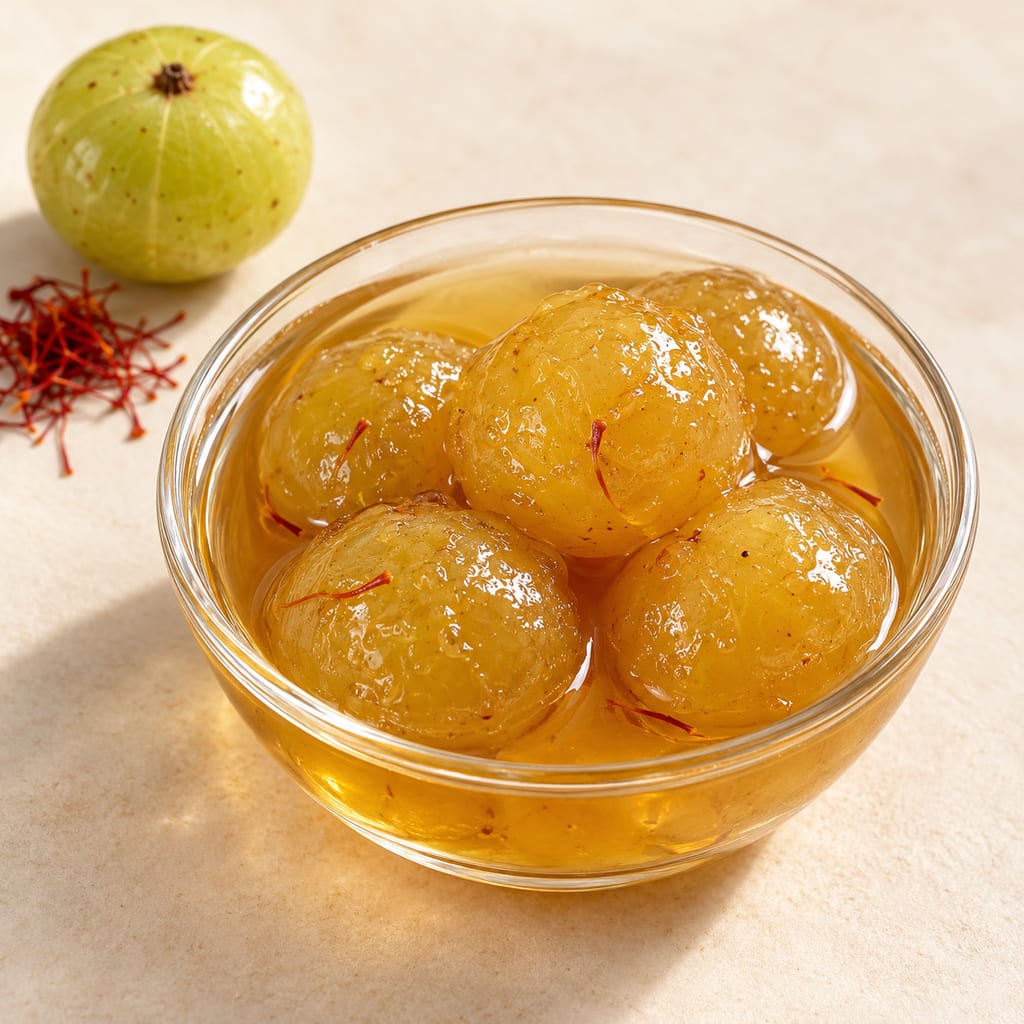
Whole amla simmer in sugar syrup with saffron, black cardamom and pepper in this chef's version of the Indian fruit preserve. The fruit is soaked overnight before cooking.
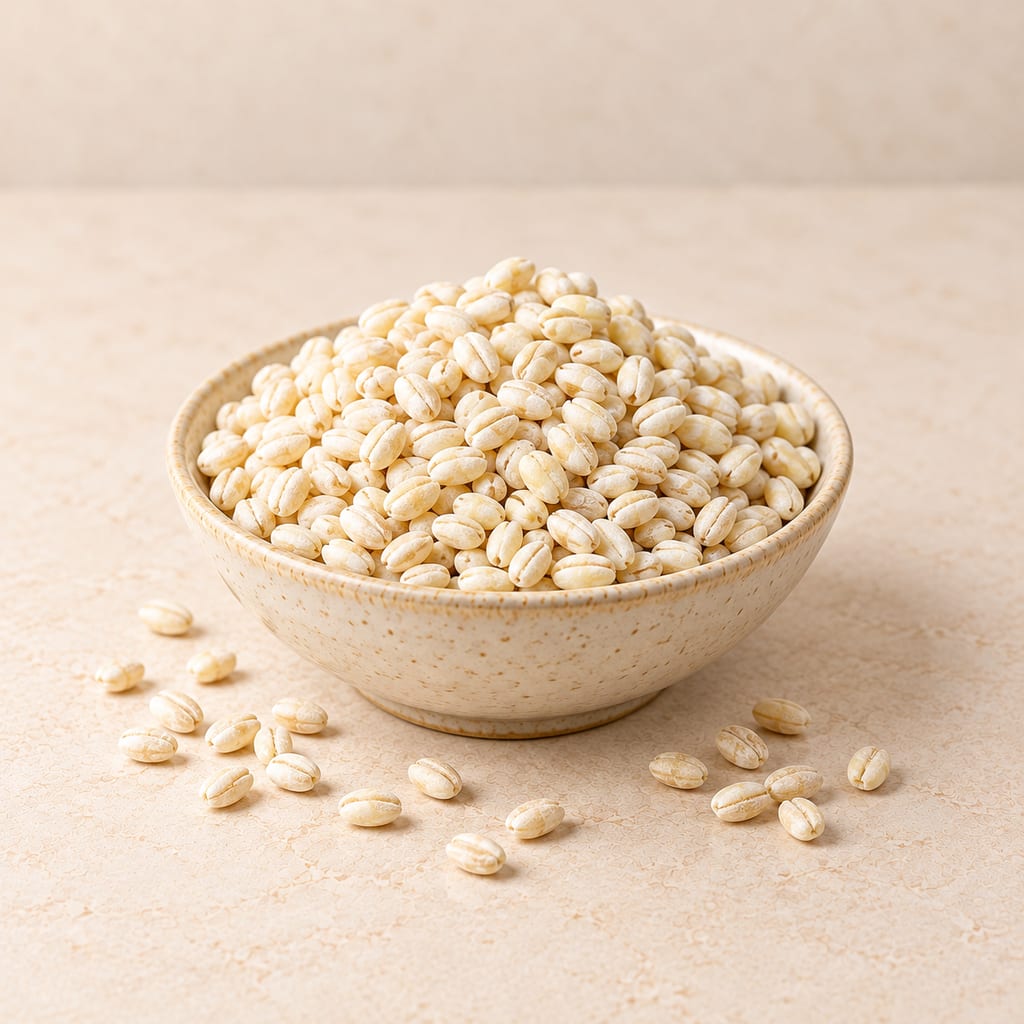
Barley is a hardy cereal, domesticated in the Middle East over 10,000 years ago, eaten whole, pearled or milled, malted for brewing, and grown with koji mold for barley miso.
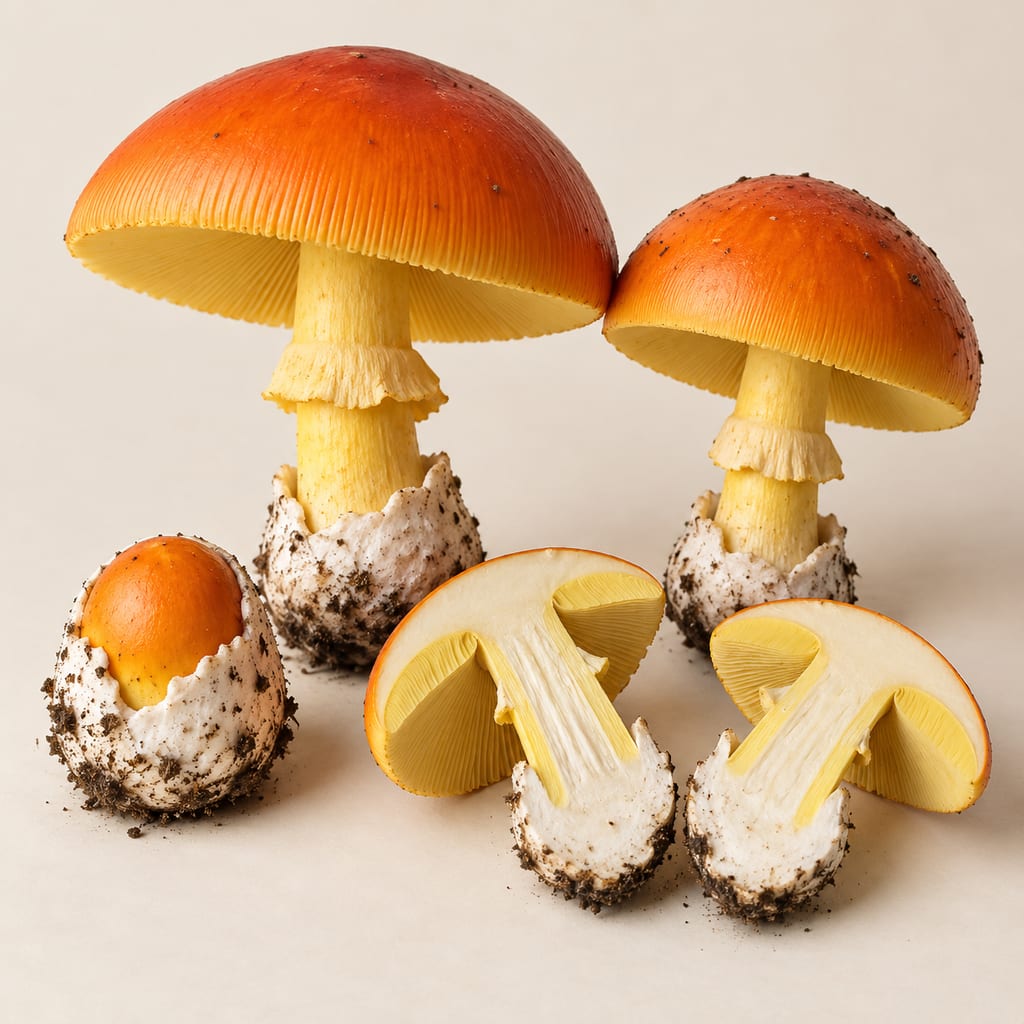
Caesar’s mushroom, Amanita caesarea, is a prized wild, tree-associated fungus of Mediterranean Europe, gathered seasonally for regional dishes. Its celebrated name and food traditions sit beside serious identification risks.
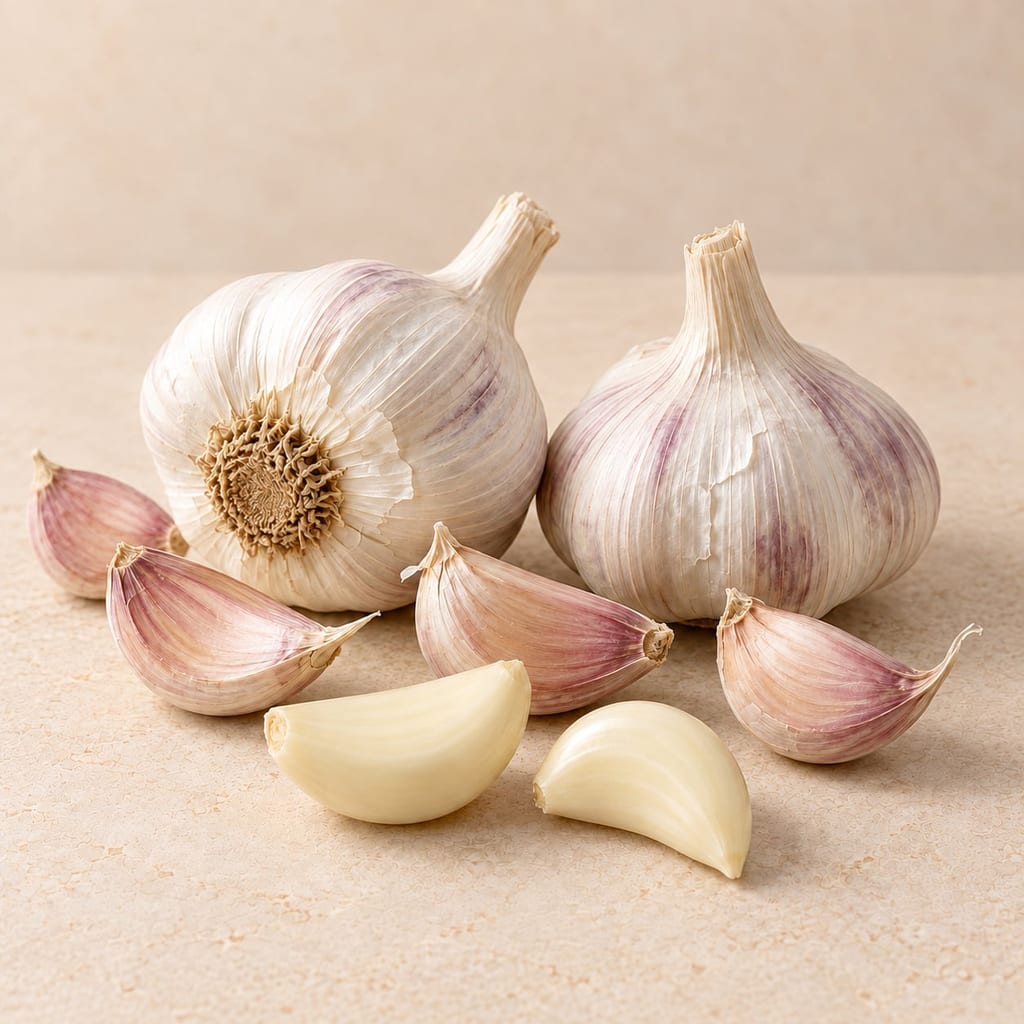
Garlic cloves are the separate bulblets of Allium sativum, pungent only once cut. They flavour herb salts, ferments such as Thai som-fak, and countless cooked dishes.
Milk supplies protein, fat and lactose for cultured drinks and cheese. Animal species, composition and processing each affect how it behaves.
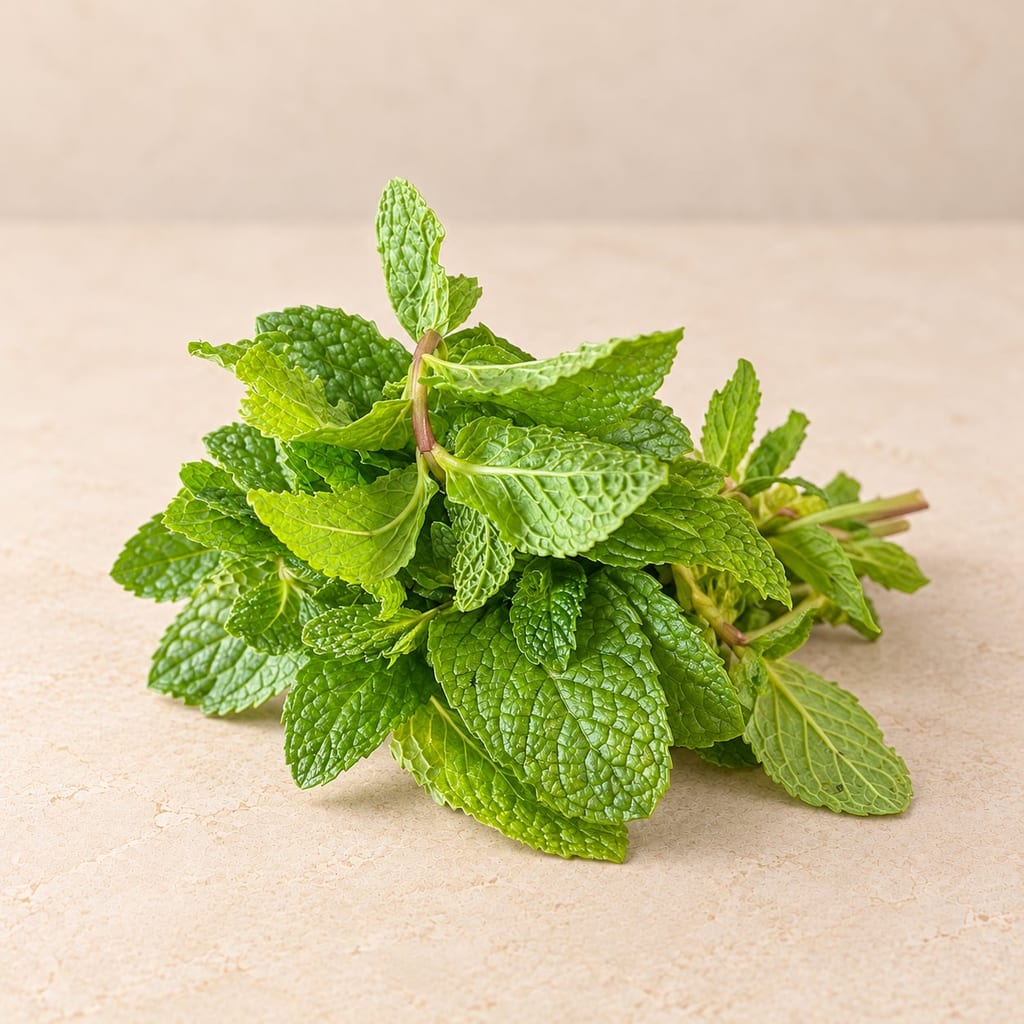
Mint is the fresh leaf of aromatic Mentha plants, chiefly spearmint and peppermint. It gives chutneys, yoghurt sauces and fermented drinks a cool, sweet, green note.
MT1 is a named dairy starter in a home Feta-style method. The brief recipe name does not establish its manufacturer or exact strains; a documented commercial MT1 product is one distinct example.
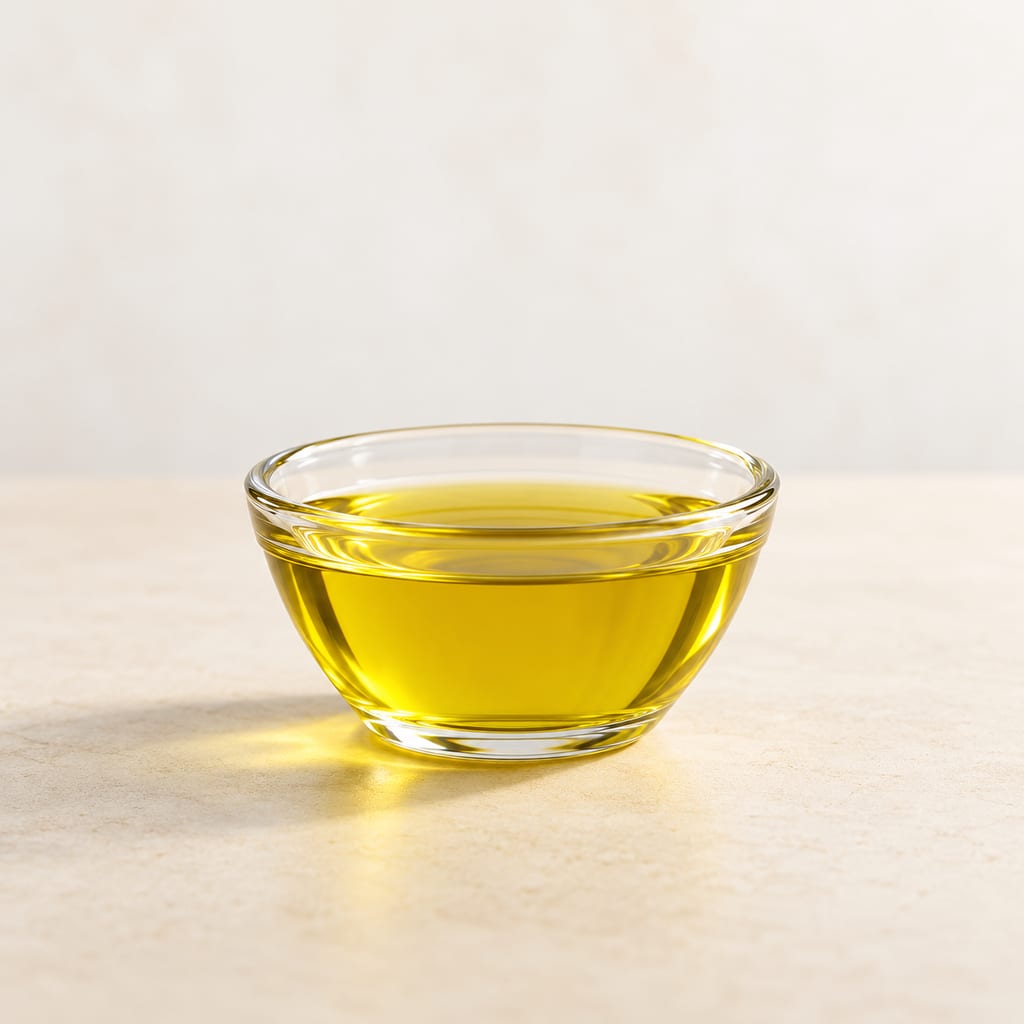
Oil extracted from olive fruit serves as cooking fat, flavouring and, in some cheese methods, an exterior treatment. Grade, cultivar, processing and storage shape its character.
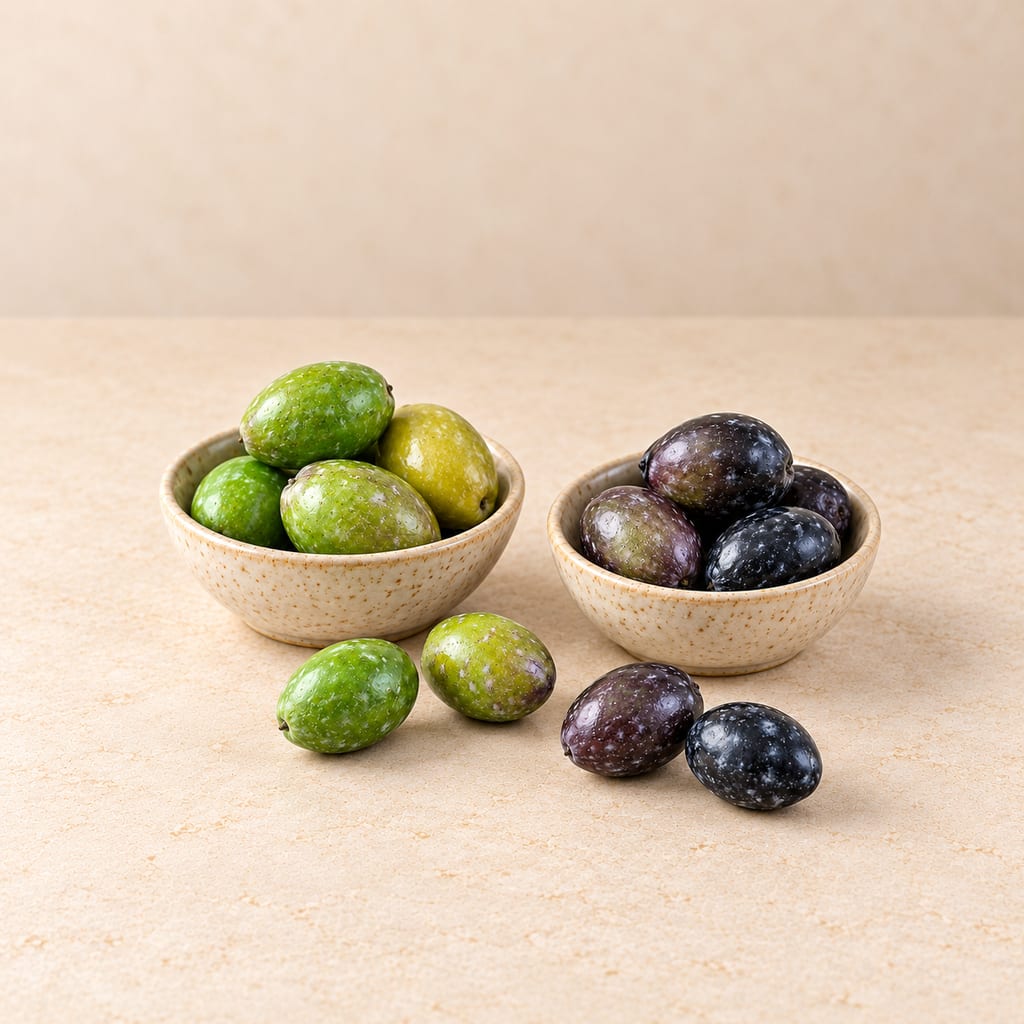
Olives are the bitter fruit of Olea europaea, made edible by lye, brine or salt, and the raw material of the table olives that are cured and fermented around the Mediterranean.

At North Abydos in Egypt, a fixed early Dynastic brewery comprised parallel semi-subterranean installations with rows of ceramic mash vats; excavation reports revise their number, scale and estimated batch capacity.

Ají amarillo is the orange-yellow Peruvian chilli cultivar group of Capsicum baccatum, used to colour and season huancaína sauce and ají de gallina. Published heat estimates do not establish one range for the named cultivar.

Toasted almonds are whole sweet almond kernels dry-roasted until golden to brown. Heat replaces their marzipan note with a roasted, nutty one; they thicken and flavour romesco.

Kodiak salmon, halibut and cod cut as seg'aq and hung on an initaq rack to become tamuuq, with kac'amaasaq and kupcuunaq named as different results.

Aniseed is the dried ripe fruit of Pimpinella anisum, an aromatic Apiaceae spice commonly called a seed. It adds a sweet, warm aroma to breads such as Moroccan krachel and South African mosbolletjies, and is distinct from star anise.

A fixed Late Chalcolithic installation in Areni-1 cave combined a shallow clay pressing basin with a large jar set into the cave floor and storage vessels nearby.

Ripe avocado flesh is the soft, buttery, fat-rich pulp of Persea americana, eaten raw. It is low in acid, so it is a fresh ingredient that needs care in chilled dishes.

A portable dome and pan used over a hearth, with embers on the lid and heat from below. Regional peka and saç forms share this principle while differing in materials, pan shape and how the food is cooked.
No community contributions have been published for this entry yet.
Sign in to contribute. Published comments and photos are free to read.
Kew Science, Plants of the World OnlineUndated; accessed 2026 10 26
Crocus sativus L. | Plants of the World OnlineAccepted name, family, cultigen status and Kew’s current native-range description.
Cited in: The dried stigmas; The flower and the spice; An old crop with an unsettled beginning; From bloom to thread; Culinary identity and plant caution
Frontiers in Plant Science2022 02 25; 13:834416
Ancient Artworks and Crocus Genetics Both Support Saffron’s Origin in Early GreecePeer-reviewed review of ancient art and genetic evidence; states an origin debate, argues for early Greece/Attica, and describes triploid sterility and vegetative daughter-corm propagation. Used as a current hypothesis, not a definitive origin date.
Cited in: An old crop with an unsettled beginning; From bloom to thread
W. Heinemann, London; G. P. Putnam’s Sons, New York; Loeb Classical Library1916 translation of fourth century BCE text
Enquiry into Plants and Minor Works on Odours and Weather Signs, Volume II, Book VI §§6.5–8.3The English text of Book VI describes saffron crocus and its autumn flowering with early rains; it distinguishes cultivated saffron crocus from a scentless mountain form. The passage is not used to claim a modern harvest calendar.
Cited in: An old crop with an unsettled beginning
Loeb Classical Library, Volume II; mirrored by University of Chicago / Bill Thayer1926 English edition; accessed 2026 10 26
Concerning Odours, §27Primary passage says saffron perfume is made from crocus and that the best was from Aegina and Cilicia. Supports ancient geographic reputation in perfume, not food trade or botanical origin.
Cited in: An old crop with an unsettled beginning; A measured accent in many cuisines
Foods2021 02 12; 10(2):404
Effect of Crocus sativus L. Stigmas Microwave Dehydration on Picrocrocin, Safranal and Crocetin EstersOpen-access research using saffron stigmas; supports dried-stigma identity, crocin/picrocrocin/safranal sensory associations, water solubility of crocins, and the fact that dehydration treatment changes metabolite balance. Experimental microwave results are not generalized into a home method.
Cited in: The dried stigmas; The flower and the spice; From bloom to thread; Three compounds, three sensory jobs; Protecting aroma after opening
Food Science & Nutrition2022 03 14; 10(6):2082–2090
Effect of low-pressure cold plasma processing on decontamination and quality attributes of Saffron (Crocus sativus L.)Open-access study and introduction identify crocin, picrocrocin and safranal as color, taste and aroma contributors. The page does not use its experimental plasma decontamination results as home advice.
Cited in: Three compounds, three sensory jobs
Longhua Chinese Medicine2022 06 30
Saffron (Crocus sativus L.) as a valuable spice and food product: a narrative reviewReview on crop and spice identity, historical uncertainty, culinary uses across regions, production and low-yield economics, and confusion with Colchicum autumnale. Used for overview and culinary applications, not as a primary historical record or medicinal evidence.
Cited in: An old crop with an unsettled beginning; From bloom to thread; A measured accent in many cuisines; Place names, grades and buying threads; Culinary identity and plant caution
Office of the Controller General of Patents, Designs & Trade Marks, Department for Promotion of Industry and Internal TradeCertificate dated 2020 05 01; accessed 2026 10 26
Geographical Indication Details: Kashmir Saffron, Application 635Official registry lists Kashmir Saffron as registered and Jammu & Kashmir as the geographical area. Supports named designation, not sensory superiority or a specific cultivar.
Cited in: Place names, grades and buying threads
Government of SpainGovernment registry checked 2026 10 26; current specification listed from 2025 06 23
DOP/IGP: Azafrán de La ManchaGovernment page lists competent authority, product specification and current protected designation context for La Mancha saffron.
Cited in: Place names, grades and buying threads
Ministerio de Agricultura, Pesca y Alimentación, Government of SpainCurrent specification effective 2025 06 23; checked 2026 10 26
Pliego de condiciones: DOP Azafrán de La ManchaCurrent government product specification defines protected saffron threads, the specified area, toasting method and storage away from moisture and light. No temperature ceiling is claimed in the narrative.
Cited in: From bloom to thread; Three compounds, three sensory jobs; Place names, grades and buying threads; Protecting aroma after opening
Nishamadhulika.comUndated; accessed 2026 10 26
आंवले का मुरब्बा (Amla Murabba Recipe)Hindi recipe ingredient line says optional half-small-spoon saffron; the selected method adds saffron with seasonings after the fruit/syrup cools. Spoon volume is not defined. Recipe method is not presented as preservation validation.
Cited in: A measured accent in many cuisines
NDTV FoodUpdated 2018 07 30; accessed 2026 10 26
How To Make Amle Ka Murabba At HomeIngredient line specifies 0.5 g saffron; method adds it while the fruit and syrup are cooking. Preserves separate formula and stage from the Hindi Nisha recipe.
Cited in: A measured accent in many cuisines