
Akazu (red sake-lees vinegar)
Japanese reddish-brown vinegar from sake lees matured about three years, turned to vinegar by acetic bacteria; the vinegar of Handa and Edomae sushi rice.
 FermenteaWhere food goes to change
Traditional method
バタバタ茶(ばたばたちゃ) · Batabatacha · Batabata cha · Batabata tea · ばたばた茶 · 朝日町のバタバタ茶 · Asahi batabata-cha · Asahi batabata tea · Toyama batabata-cha · 富山県産バタバタ茶 · 蛭谷の黒茶 · Birudan kurocha · Japanese aerobic post-fermented tea · Whisked batabata tea
A Japanese post-fermented tea from Asahi in Toyama: mature tea leaves are steamed and fermented aerobically in turned, self-heating heaps, then dried; traditionally boiled and whisked into a foam.
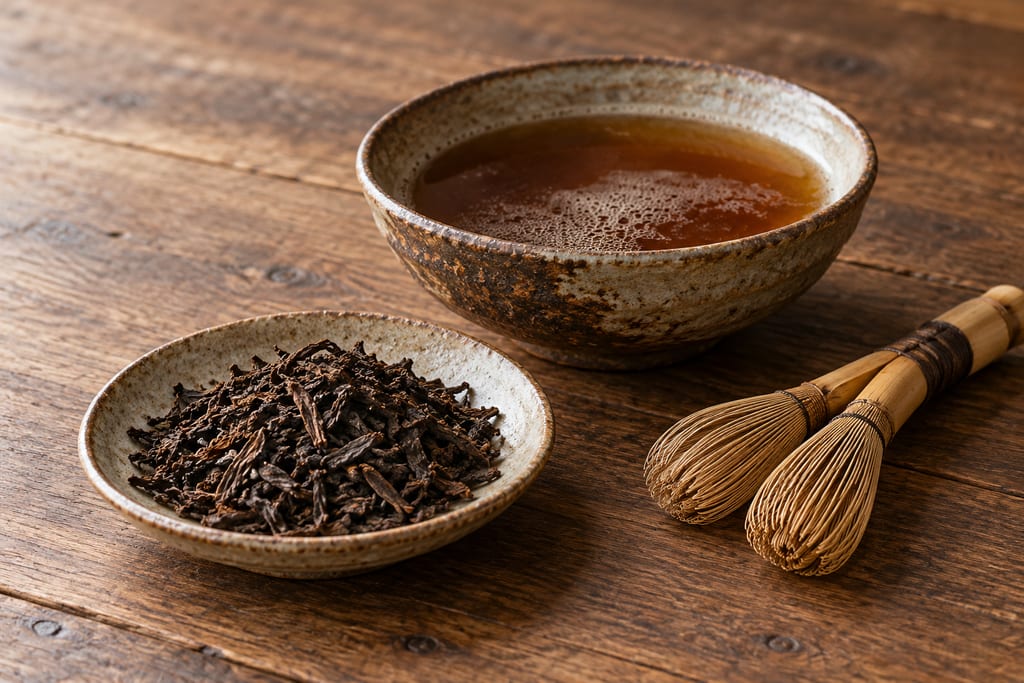
Batabata-cha is a traditional Japanese post-fermented tea made from mature leaves of Camellia sinensis, particularly associated with the mountain community of Birudan in Asahi, Toyama Prefecture. The leaves are steamed, fermented in a large aerated mass, repeatedly turned to manage the heat produced by microorganisms, and dried. The finished material consists of dark, loose leaf fragments. It is normally boiled to extract the tea, then sometimes whisked into a fine foam using a special paired bamboo whisk.
The name batabata-cha has two related meanings. It can refer to the fermented black tea used in Asahi, or to the regional custom of rapidly whisking brewed tea. Batabata is associated with the quick back-and-forth movement of the whisk, and some accounts also connect it with the sound made against the bowl. In neighbouring Itoigawa, the same serving tradition may use ordinary bancha or locally gathered plants rather than Toyama's fermented black tea. The fermented tea is a narrower subject than the whisked-tea custom.
The tea belongs to the Japanese category of post-fermented tea, 後発酵茶, or kō-hakkōcha. The distinction is biochemical. Green tea is heated to prevent substantial native leaf-enzyme oxidation, while conventional black tea develops through oxidation of leaf polyphenols before the final heat treatment. Batabata-cha is first steamed and then transformed through microbial growth on the heated leaves. It does not involve fermenting a sweetened tea infusion, and no ordinary kombucha mother or SCOBY is added.
Unlike goishicha and Ishizuchi-kurocha, which undergo distinct aerobic and oxygen-limited fermentation stages, batabata-cha is manufactured principally through one prolonged aerobic process. The heated leaf mass supports fungi and heat-tolerant bacteria, which produce metabolic heat. Traditional workers periodically remove, loosen and cool the material before returning it to a fermentation enclosure called a muro. The process lasts approximately one month, although published accounts describe different durations.
The principal fungi identified by microbiological research include Aspergillus fumigatus and Thermomyces lanuginosus. Various bacteria have also been isolated or detected, including Bacillus coagulans and Niabella terrae. These organisms form part of a naturally developing community, not a published list of approved food starter strains. Their occurrence must be distinguished from the controlled use of Aspergillus oryzae in Japanese rice-koji production.
The customary presentation uses a small pottery bowl called a gorohachi-jawan and a paired whisk sometimes called a meoto-chasen. The brewed tea may receive a pinch of salt before whisking. This serving step produces foam and changes the drinking texture but is not a microbial fermentation stage. Batabata-cha is both a distinctive manufactured tea and a social custom involving neighbours, family gatherings and communal hospitality.
The history of batabata-cha must be divided between the custom of whisking tea and the manufacture of the particular fermented leaves used in Asahi. Both have regional histories, but evidence for one does not automatically establish the date or ingredients of the other. The Birudan community has long maintained gatherings centred on boiled and whisked tea. Local traditions associate these gatherings with Buddhist observances, marriages, childbirth and neighbourhood relationships. The exact date when the local custom began is unknown.
A frequently repeated account connects the tea with Rennyo, the eighth head of the Jōdo Shinshū Honganji tradition. Regional tourism material refers to a record of Rennyo establishing a preaching place in the Niikawa area in 1472 and proposes that fermented black tea was already being offered to participants. The supposed use of batabata-cha is an interpretation, not a statement verified from the original religious record. Another producer's website gives 1427, which conflicts with the more consistently reported 1472 date. Neither supports a precisely dated invention of the fermented tea.
Local organisations also describe the tea as originating in China, sometimes suggesting that fermented-tea techniques reached Japan in prehistoric or medieval times. Similarities with Chinese post-fermented teas, particularly heap-fermented pu-erh, are real, but technical resemblance does not demonstrate a particular transmission route. Claims of introduction in the Jōmon period have no archaeological or documentary evidence identifying the fermented product.
A more defensible documentary history appears in twentieth-century accounts of whisked tea. The writer Soma Gyofu described the Itoigawa practice in writings later cited by local historians and Niigata Prefecture. His book Nō o Ayumu Mono was published in 1925, and a similarly titled personal magazine began in 1930. The original passage on batabata-cha is not located, so no edition or page can be given. This is a documented modern literary link to the custom, not necessarily to the Asahi fermentation technique.
An important distinction is that Birudan historically obtained much of its fermented tea from elsewhere. Asahi's tourism association reports production in the Wakasa area of Fukui until approximately 1977 and in the former Kosugi area of Toyama until approximately 1991. The local tea-drinking custom therefore continued even when the leaves were produced outside Asahi. This complicates claims of uninterrupted local manufacture from medieval times.
Modern revival is better documented. Asahi Town Council records the establishment of a local-product preservation initiative in 1987. Commercial arrangements developed around 1989, while local residents began experimenting with their own production from approximately 1990. A 2021 account based on interviews with the town commerce association describes prolonged early difficulties and subsequent training by a producer from Aoiya in the former Kosugi area during the 2000s. The transfer of equipment and associated fermentation knowledge helped establish the present method.
The revival also included local tea cultivation. Asahi's tourism association reports that part of the Yabukita planting was replaced with the cold-tolerant cultivar Fushun in 2016, with harvests contributing to production from 2020. The modern manufacturing technique is therefore an inherited and reconstructed practice rather than an unchanged medieval formula. Its cultural continuity is especially clear in the community tea gatherings, while the precise older microbial process remains incompletely documented.
Batabata-cha is made through a prolonged aerobic microbial fermentation of previously steamed tea leaves. Steaming substantially inactivates the leaves' own oxidative enzymes, particularly polyphenol oxidase, before the main transformation begins. This distinguishes the process from the plant-enzyme oxidation used in conventional black and oolong tea manufacture. The leaves are then piled inside a large fermentation enclosure, where fungi and bacteria grow and metabolise available compounds. The process generates considerable heat, which in turn changes the microorganisms able to survive and develop.
A 2019 microbiological study investigated fungi and bacteria in fermented batabata-cha. It isolated Aspergillus fumigatus and Bacillus coagulans from finished fermented leaves. DNA-based fungal community analysis identified Aspergillus fumigatus as the most prominent species, followed by Thermomyces lanuginosus. Together, Aspergillus and Thermomyces accounted for approximately 85% of the analysed fungal community. Saccharomyces cerevisiae and other less abundant fungi were also detected. These results describe sampled material, not a controlled starter composition or evidence that every detected organism performs an essential function.
The same investigation identified a more diverse bacterial community. Niabella terrae accounted for 23.1% of bacterial sequences, followed by Actinomadura keratinilytica at 8.6%, Sphingobacterium thermophilum at 8.4%, Pseudoxanthomonas taiwanensis at 8.3% and Caenibacillus caldisaponilyticus at 8.2%. These percentages refer to bacterial sequence proportions in the investigated samples, not absolute cell counts or measured contributions to fermentation. Bacillus coagulans was isolated by culture but is not shown to be the dominant bacterial species.
The fermentation is strongly influenced by temperature. Microbial metabolism causes the internal leaf mass to heat, while the enclosed pile retains that heat. Temperatures approached 70°C, which the 2019 study read as selecting partly for heat tolerance and spore-forming ability. Organisms such as Thermomyces lanuginosus are thermotolerant, while some Bacillus-related bacteria can produce heat-resistant spores. The increase in temperature is both a result of microbial activity and an ecological filter affecting subsequent growth.
Fungal enzymes may alter proteins, cell-wall polysaccharides and other constituents of the leaves. Possible reactions include proteolysis, glycoside hydrolysis and degradation of structural carbohydrates. Detecting a fungal species does not show which enzymes it uses inside the tea pile. No cellulase, protease or oxidative pathway has been measured in the pile. The darkening and aroma changes reflect microbial metabolism and chemical reactions, but their complete pathways remain incompletely characterised.
A 2025 scientific conference study sampled leaves at successive manufacturing stages. The investigators found that viable microbial counts decreased after steaming, rose substantially during approximately one month of fermentation, then fell following sun-drying. Aspergillus remained detectable through processing, and aerobic spore-forming bacteria, including Bacillus and Paenibacillus, were present after drying. Repeated turning of the leaves appeared to be an important factor promoting aerobic microbial activity.
Chemically, batabata-cha differs substantially from unfermented green tea. A comparative 2017 study reported very low measured catechin concentrations and low antioxidant activity in its batabata-cha infusion relative to several other Japanese post-fermented teas. Caffeine remained detectable. It is not a predominantly lactic-acid fermentation, whatever other fermented foods contain. No separate pressed, oxygen-limited stage comparable to goishicha or Ishizuchi-kurocha is documented in its standard production.
Traditional batabata-cha manufacture uses mature tea leaves, water for steaming and an established aerobic fermentation environment. No sugar syrup, rice koji, salt or kombucha culture is added to the fermenting leaves in the documented Asahi method. The local tourism association identifies two tea cultivars used in contemporary production: Yabukita and Fushun. Harvest takes place around late July and early August, when the leaves are substantially mature. Unlike premium green-tea processing, the harvest includes older leaves and some woody growth rather than only tender shoots.
Harvested branches are brought to the Batabata-cha Tradition Hall in Birudan. Workers use a chopper to cut the material coarsely, making the leaves and small branches easier to steam, handle and distribute. The chopped material is steamed in dedicated equipment to reduce the activity of native leaf oxidative enzymes and soften the tissue. The published local process does not supply a precise steaming duration, water quantity or measured core temperature. After steaming, the leaves are cooled and substantial remaining woody stems are removed.
The steamed leaves are placed into a large box-like fermentation space called a muro, traditionally lined or covered with woven straw mats. The enclosure is associated with the resident microorganisms of the established production environment. In contemporary manufacture, the moist leaves are distributed to permit microbial growth while retaining sufficient mass for self-heating. The pile is not sealed for a separate anaerobic stage. Access to air remains important throughout the process.
During fermentation, the temperature of the leaf mass increases through microbial metabolism. MAFF describes turning the leaves every two to three days to manage the material around 60°C, with an overall fermentation lasting approximately forty days. Asahi's tourism association describes approximately thirty-five days. An observed 2021 production run began harvesting at the end of July, included repeated turning through August and completed drying at the end of that month. These are different production schedules and do not merge into one exact duration.
Turning the leaves is called kirikaeshi. Workers remove the hot material, separate and loosen it, allow it to cool and return it to a prepared fermentation enclosure. This redistributes leaves from hotter and cooler areas, introduces oxygen and changes the temperature profile. The 2021 account describes beginning the operation four or five days after fermentation started, then turning approximately every second day, with twelve turns in that year's production. Internal leaf temperatures around 65°C were reduced towards 40°C during handling. These are reported observations, not validated microbiological critical limits.
Other process descriptions record ten to fifteen turning operations, followed by a final drying stage. The Global Japanese Tea Association describes half a day of shade-drying followed by approximately two to three days in sunlight. Asahi's tourism association describes sun-drying around early September. Drying reduces moisture and microbial activity, but no final water activity, drying temperature or safe storage threshold is established.
One reported Asahi manufacturing campaign processed approximately 1,000 kg harvested tea material into about 200 kg finished dried tea. This is a documented production example rather than a universally established five-to-one yield. Losses depend on initial moisture, the proportion of stems removed, fermentation handling and drying. The same preparation equipment and local production knowledge remain important to the revived manufacturing tradition.
The finished loose tea is boiled in water when it is wanted for drinking. Only at this separate serving stage may a small amount of salt be added and the liquid whisked into a foam. That salt is not an ingredient of the leaf fermentation itself.
The most clearly identified present-day production centre is Asahi in Toyama Prefecture, especially the Birudan settlement. The locally manufactured fermented black tea is connected with a longer regional tradition of whisking boiled tea. However, these two traditions did not always occur in the same place. Birudan consumers historically obtained fermented tea from producers in other parts of the Hokuriku region. The present Asahi manufacturing method was developed through efforts to preserve the local drinking custom and rebuild the ability to produce its tea.
Historical supply centres included the former Kosugi area of Toyama, especially Aoiya, and the Wakasa area of Fukui. Asahi's tourism association reports that Wakasa production continued until approximately 1977 and Kosugi production until approximately 1991. A producer from Aoiya subsequently assisted the modern Asahi revival. The transferred knowledge included equipment, temperature management and the practical conditions needed for successful leaf fermentation. The production method used in those older centres may not have been identical to the current Asahi process.
Local accounts also describe variation in fermentation duration and temperature. A historical Kosugi method has been described with a shorter fermentation and lower average temperature than contemporary Asahi production. The Asahi method documented by MAFF uses approximately forty days with repeated turning to manage heat around 60°C, while local tourism records describe approximately thirty-five days. Another observed campaign completed the main fermentation over roughly one month. These differences probably reflect producer practice, materials and environmental conditions, but no controlled comparison establishes their effects on flavour or safety.
Modern leaf material also varies. Yabukita was previously the main cultivar in Asahi's tea field. In 2016, part of the field was replanted with Fushun, selected locally for improved tolerance of cold weather, and its leaves entered production from 2020. Contemporary batches can therefore contain a mixture of cultivars. This change belongs to modern production history, not to medieval tea growers.
Itoigawa in neighbouring Niigata maintains a related whisked-tea tradition, called batabata-cha or tate-cha. The tea is boiled, a small amount of salt may be added and the liquid is whisked. However, local accounts note that ordinary bancha or plants such as kawarakesumei may be used. The name in Itoigawa therefore identifies the serving custom more reliably than a particular microbial fermentation process. Similar-looking photographs of Itoigawa tea gatherings should not automatically be captioned as production of Toyama's fermented black tea.
Batabata-cha can also be compared with other Japanese frothing teas, including botebote-cha from Shimane and bukubuku-cha from Okinawa. They share the use of a whisk or vigorous agitation, but the beverages, accompanying food and preparation methods differ. In the separate category of fermented tea, batabata-cha is closer in processing principle to aerobic heap-fermented teas than to Awa-bancha's anaerobic lactic-acid method or the two-stage fermentation of goishicha and Ishizuchi-kurocha.
Modern Asahi products may be sold as dried leaves, tea bags or ready-to-drink beverages. These packaging and serving adaptations do not create new fermentation types. Traditional consumption, historical manufacture elsewhere and modern Asahi production are different things.
Traditional batabata-cha is first prepared as a boiled tea. Dried fermented leaves are placed in a cotton bag and simmered in a kettle or large pot. The Asahi producer's serving description uses enough tea to give the desired colour and taste rather than a fixed weight per litre. The tourism association recommends boiling the dried tea for at least thirty minutes when preparing it at home. A historical account describes prolonged boiling over a hearth, allowing tea to be drawn repeatedly while additional hot water is added.
For the customary whisked serving, the brewed tea is transferred into a small pottery bowl called a gorohachi-jawan, 五郎八茶碗. The bowl is commonly associated with local Akagawa and Sasagawa pottery. A special bamboo whisk is made by joining two narrow whisk heads. It is called a batabata-chasen or meoto-chasen, meaning paired or married whisk. The holder moves it quickly from side to side rather than using the precise motions associated with formal matcha preparation.
A pinch of salt may be added before whisking, although the local producer explicitly notes that it is optional. Several dozen rapid movements create a layer of fine foam. The agitation incorporates air into the liquid, changes its texture and allows some heat to escape. Local accounts describe the resulting tea as smoother and more pleasant to drink. The foam is a physical result of whisking and liquid composition, not evidence that fermentation has begun in the bowl.
In Birudan, the practice was traditionally social rather than governed by the rules of formal tea ceremony. Neighbours gathered around a hearth, and tea was prepared and served repeatedly while people talked. The tea had a place at Buddhist observances, family memorial days, weddings, births and other community occasions. A local account identifies gatherings associated with the twenty-eighth day of the month, connected with commemorations of Rennyo. The first prepared serving could be offered at the family Buddhist altar before the gathering began.
Food served alongside the tea included local pickled vegetables, wild mountain plants and home-cooked simmered dishes. Participants sometimes brought food to share. The Batabata-cha Tradition Hall in Birudan continues this style of hospitality, where the tea gathering is as important as the drink. The distinctive whisking method is also demonstrated at local cultural facilities.
Batabata-cha can be consumed without whisking. The local name sancha is used for a simpler preparation in which the boiled tea is drunk directly. Commercial producers also describe it as a bancha-like drink, served hot or cooled during summer. This is still the same fermented-leaf ingredient, simply prepared without the special bowl and whisk.
The tea contains caffeine, although a comparative analytical study found considerably less caffeine in its standardised batabata-cha infusion than in the green-tea control. That study also found much lower catechin concentrations. Salt added during serving contributes sodium and is not required to make the tea. The drink is not caffeine-free, not automatically probiotic and not a substitute for a medically necessary vitamin supplement.
Batabata-cha leaves undergo one prolonged aerobic fermentation in which microbial heat is controlled by repeatedly turning and cooling the material. No complete standardised manufacturing specification exists: reported durations range from about a month to forty days, and leaf quantities, temperature profiles and drying endpoints vary or are not given.
The 2019 microbiological investigation is particularly important because it identifies organisms directly from sampled fermented leaves. Aspergillus fumigatus and Thermomyces lanuginosus were prominent fungi, while Bacillus coagulans was recovered by cultivation and a more diverse bacterial population was detected by sequencing. The results support the importance of aerobic fungi and heat-tolerant bacteria. They do not prove that every detected species contributes to flavour, that every manufacturer has the same microbial community, or that the detected organisms are suitable for deliberate inoculation.
Aspergillus fumigatus requires special caution. It is a medically significant opportunistic pathogen capable of causing aspergillosis, particularly following inhalation of spores by susceptible people. Its reported presence in traditional batabata-cha cannot be treated as approval for household cultivation. The work examined naturally fermented material; it was not a starter-safety assessment. The isolation of Thermomyces lanuginosus and other thermotolerant fungi likewise does not establish the absence of potentially harmful fungal metabolites.
Heat management is another unresolved safety issue. The 2019 study reported internal fermentation temperatures approaching 70°C, while MAFF describes managing production around 60°C. Those numbers represent different observations and processing guidance, not a validated safe incubation range. A domestic pile of leaves cannot be assumed to select the same microorganisms as the established manufacturing operation. The volume, density, moisture content, oxygen supply, microbial starting community and rate of heat removal all influence what grows.
A study presented at the Japanese Society for Food Science and Technology's 2025 conference gives time-series evidence. Viable microbial populations decreased after steaming, increased considerably during the month-long fermentation, and declined after sun-drying. Aspergillus remained detectable, while Bacillus and Paenibacillus were among organisms still detected after drying. These findings support the distinction between microbial activity during production and microbial survival in the dry finished material. They do not provide a validated final moisture or microbial safety threshold.
Claims about nutritional benefits also require careful interpretation. A 2004 study measured vitamin B12-related compounds in batabata-cha, reporting approximately 2.0 ng vitamin B12 per 100 ml of prepared tea. A biological effect was seen in vitamin-B12-deficient rats given the tea. That is useful experimental evidence, but the amount measured in the beverage is small and no corresponding human clinical benefit was established. Batabata-cha is not a reliable replacement for vitamin B12 supplementation.
A 2017 comparative study measured very low catechin concentrations and little antioxidant activity in its batabata-cha infusion compared with the other fermented teas tested. This conflicts with broad claims that all post-fermented teas necessarily have high antioxidant activity. The 2025 conference investigation also reported that laboratory-measured ACE-inhibitory activity tended to decrease as fermentation progressed. These findings are specific to analytical methods and studied samples; neither an in-vitro inhibitory assay nor a marketing claim establishes blood-pressure, cholesterol or other medical benefits in people.
Historical evidence has similar limitations. The fifteenth-century association with Rennyo is an interpretation of a religious history, not a surviving manufacturing recipe. Modern records demonstrate that the Asahi community historically acquired leaves from other regions and reconstructed local production in the late twentieth century. Future research should distinguish the history of the whisked-tea custom from the history of the particular fungal fermentation process, and should examine the earliest literary references directly.
Batabata-cha manufacture is best described as a specialist inherited process, not an independently verified home fermentation recipe. Water activity, viable microorganisms, fungal metabolites, catechins, caffeine, organic acids, aroma compounds and the effect of each turning have not been measured together across production batches.
Soma Gyofu described the whisked-tea custom in Itoigawa in writings from 1925 onward, and twentieth-century records show fermented black tea supplied to Asahi from Fukui and Toyama. Asahi began a local preservation effort in 1987 and rebuilt its own manufacture around 1989 to 1990. Stories of a fifteenth-century or earlier origin, including Rennyo's preaching in 1472, are not documented for this tea.
Scaling: source batch only
Traditional batabata-cha develops through microorganisms associated with the leaves and an established fermentation environment. The process does not specify a validated single-strain starter or inoculation rate. Household cultivation of unidentified environmental moulds cannot be assumed equivalent to the traditional system.
Hazard sourceA 2019 study isolated Aspergillus fumigatus from batabata-cha and identified it as a dominant fungal species in the investigated material. The species is medically important because inhaled spores can cause aspergillosis, especially in people with weakened immunity or lung disease. Its detection is not an endorsement of deliberate food inoculation.
Hazard sourceIdentification of Aspergillus, Thermomyces and other fungi does not independently demonstrate that every product or fermentation stage is free from harmful fungal metabolites. No complete producer-specific fungal-metabolite safety specification was established.
Hazard sourceMicrobial metabolism heats the leaf mass. Published research reports temperatures approaching 70°C, and an observed production method describes cooling the material from approximately 65°C during turning. Temperature affects the microbial community and product consistency, but there is no universally validated safe temperature programme for a domestic leaf pile.
Hazard sourceThe studied tea contained a diverse bacterial community, including heat-tolerant and spore-forming organisms. Detection by sequencing does not establish viability, metabolic contribution or safety of every species, and no microbial composition limit is specified for the finished product.
Hazard sourceThe production method involves washing, chopping, steaming and repeated turning of a large moist leaf mass. Contact with unclean equipment, hands, mats or other surfaces may introduce unintended microorganisms.
Hazard sourceFinal outdoor drying is weather-dependent. No validated final water activity or moisture content is given. Poorly dried leaves or leaves that absorb moisture during storage may deteriorate.
Hazard sourceThe published traditional method does not provide a complete microbiological specification, fungal-metabolite analysis, water-activity endpoint or universal shelf-life period.
Hazard sourceLaboratory assays and animal experiments concerning vitamin B12, antioxidant properties or enzyme inhibition do not establish clinical benefits from ordinary human consumption. The microbial viability of the finished dried and boiled beverage is also not established.
Hazard sourceTreat the documented leaf fermentation as a specialist inherited manufacturing process rather than a validated household mould-fermentation recipe.
Control sourceUse finished food-grade batabata-cha from an established producer when preparing the beverage. Do not attempt to reproduce the natural microbial community by deliberate exposure to unidentified environmental mould.
Control sourceDo not cultivate Aspergillus fumigatus, Thermomyces lanuginosus or other organisms merely because they were detected during scientific analysis of traditional tea.
Control sourcePreserve the distinction between aerobic leaf fermentation and the separate physical whisking step used when serving. Do not substitute a kombucha SCOBY or sugar-water fermentation.
Control sourceDocument the local producer's practice of turning the fermented leaves and monitoring their heat generation, without treating the observed temperature as a validated safety limit.
Control sourcePrevent contamination during raw-material preparation, steaming, handling, drying and storage by using clean water and appropriately cleaned equipment.
Control sourceDo not treat the end of approximately 35–40 days of fermentation as a verified microbiological safety endpoint without product-specific analysis.
Control sourceProtect finished tea from rain, high humidity, contamination and moisture reabsorption after drying.
Control sourceUse the local producer's documented long-simmering method when preparing finished dried batabata-cha for ordinary drinking.
Control sourceBatabata-cha is produced by aerobic fermentation of steamed tea leaves. It is not made by fermenting sweetened brewed tea with a kombucha SCOBY.
The traditional process does not include a separate deliberately anaerobic lactic-acid stage.
This is a documented specialist manufacturing procedure, not a validated home-fermentation protocol.
No fixed starting leaf quantity, starter dose, controlled temperature programme or finished-product safety endpoint has been established.
The traditional fermentation depends on an inherited microbial environment. A visually similar environmental culture cannot be assumed safe.
Aspergillus fumigatus was identified in the investigated tea. It is a medically significant opportunistic pathogen and should not be deliberately cultivated for household food production.
The presence of thermotolerant organisms does not establish freedom from harmful metabolites or other contaminants.
A measured fermentation temperature near 70°C is an observation from research, not a recommendation to maintain an unmonitored pile at that temperature.
The 60°C production description cannot be treated as an independently validated minimum or maximum microbial safety limit.
No measured final moisture percentage, water activity or storage duration was established for the manufacturing process.
Finished tea should not automatically be described as a live probiotic product.
Vitamin B12 and antioxidant findings from individual laboratory studies do not establish that drinking batabata-cha treats nutritional deficiencies or disease in humans.
Salt added when whisking the tea is a serving choice and is not part of the manufacturing fermentation.
Commercially supplied finished leaves are preferable to unvalidated household attempts at reproducing the natural fungal fermentation.
Japanese reddish-brown vinegar from sake lees matured about three years, turned to vinegar by acetic bacteria; the vinegar of Handa and Edomae sushi rice.

A thick, naturally sweet rice-and-koji preparation used to add body and sweetness to marinades, dressings and sauces. This method follows a published Marukome home recipe and is an enzyme-conversion hold, not a way to grow koji mould.
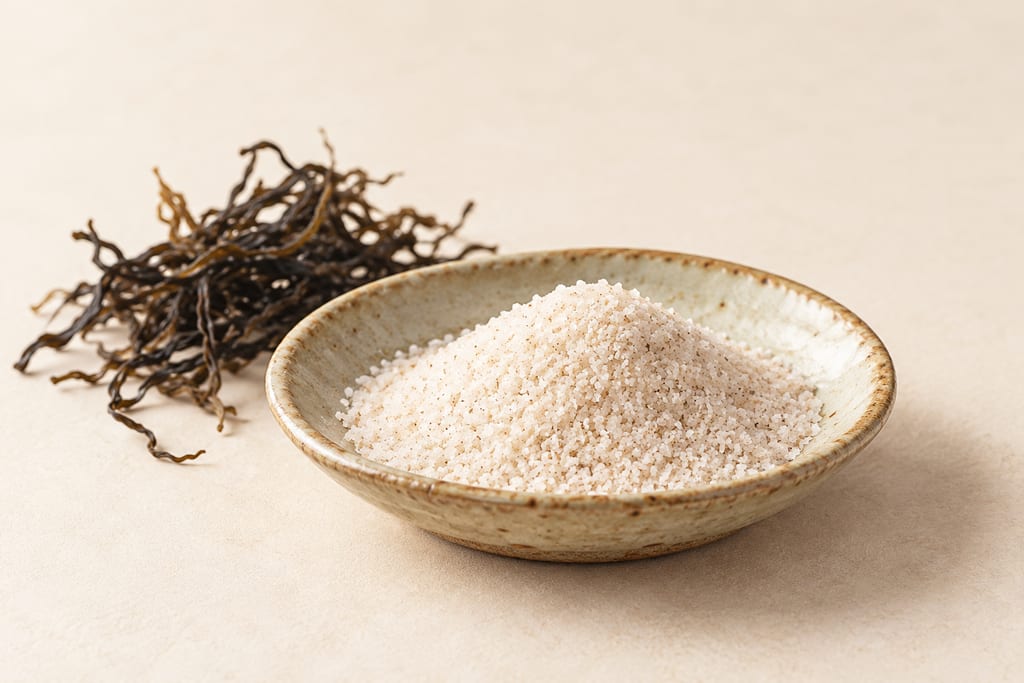
Amabito no Moshio is a modern, pale beige Japanese seaweed salt made from Seto Inland Sea water and hondawara seaweed. Its documented factory method concentrates filtered brine in kettles, then separates and dries the salt.
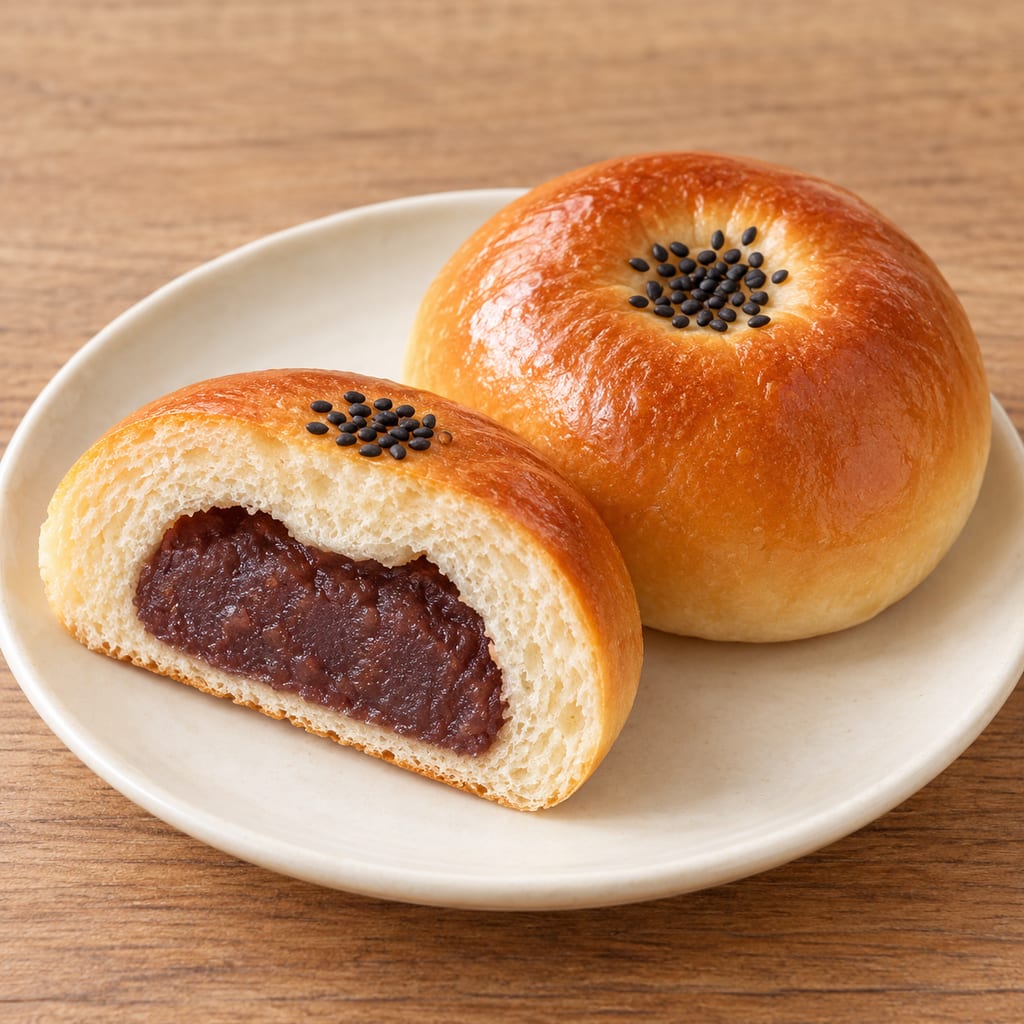
Anpan is a soft wheat bun filled with sweet red-bean paste and finished with egg wash and black sesame. This dough rises with commercial instant yeast.

Japanese skipjack tuna cooked, then repeatedly smoked and dried over a wood fire by the hand-fired tebiyama method into a hard block for shaving into dashi: the first stage of katsuobushi.
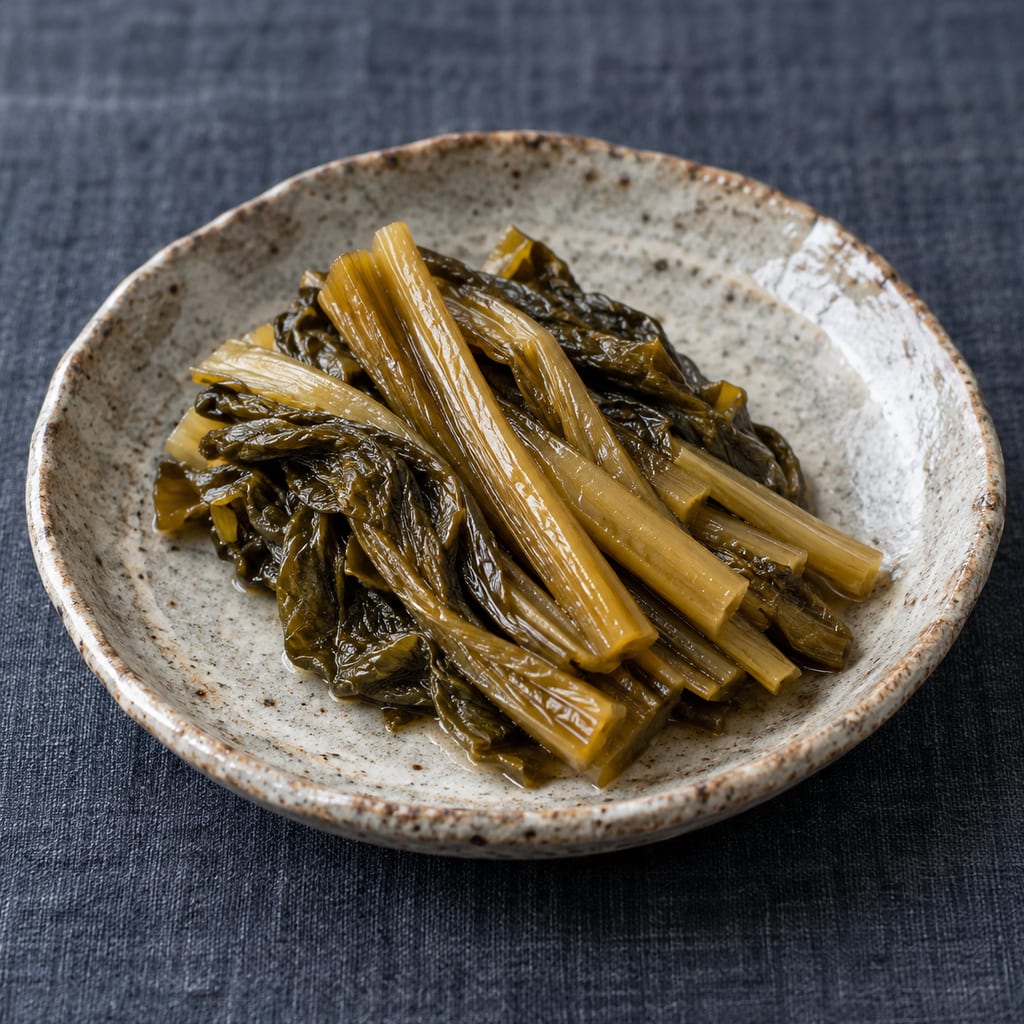
Takana mustard greens from Aso in Kumamoto are salted and pressed into a fresh spring pickle, or aged into a sour furuzuke that is fried and mixed into takana rice.
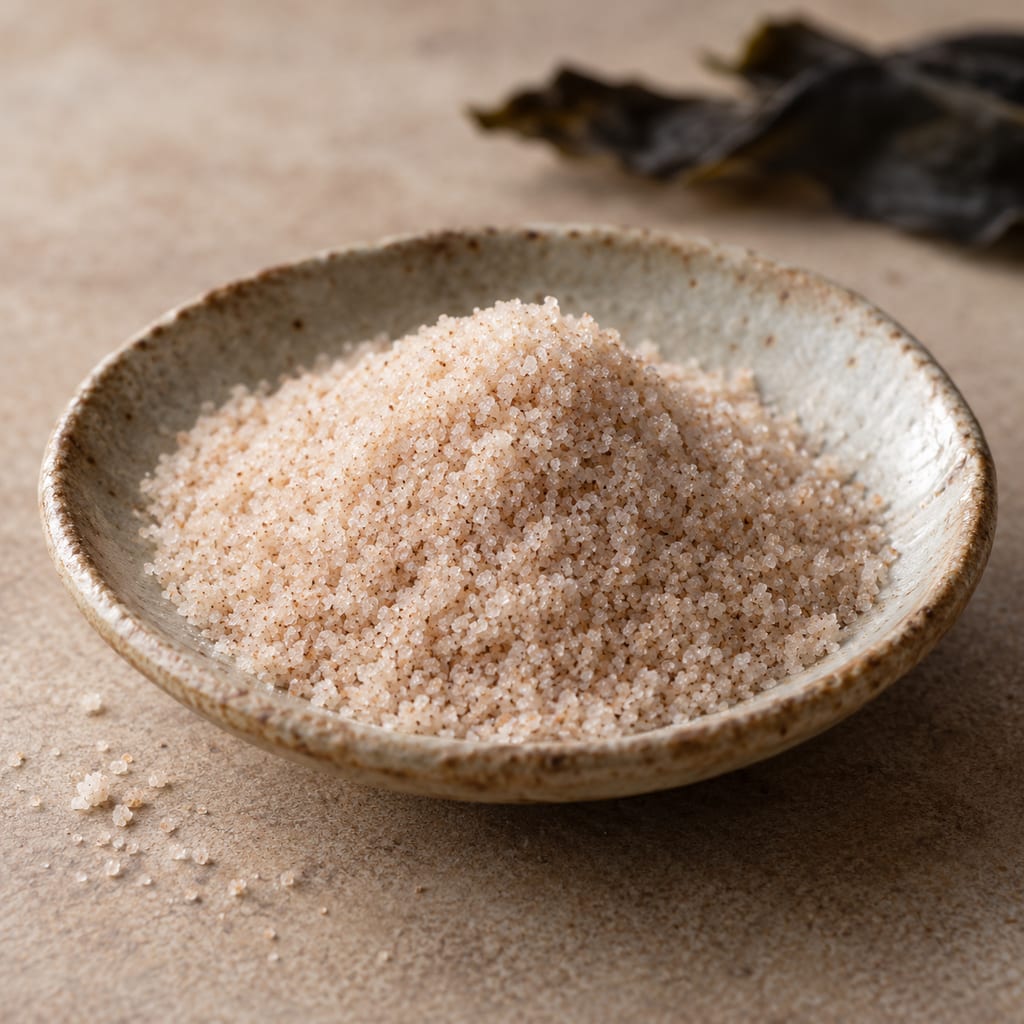
Awaji moshio is a modern Japanese seaweed salt made by TaDa PHILOSOPHY from Awaji Island seawater and seaweed. Its premium process concentrates brine, extracts seaweed flavor, then crystallizes, separates, dries and grades the salt.
An Okinawan rice spirit made by turning all the rice into black koji, fermenting it with water and yeast, then pot-distilling and maturing the spirit.
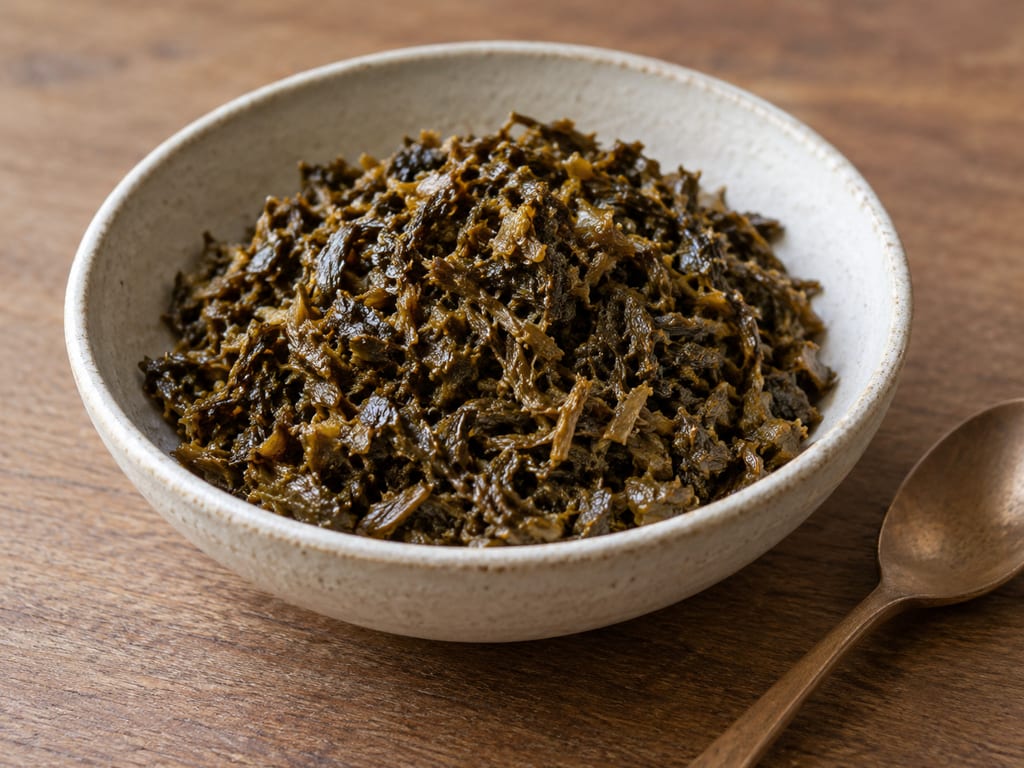
Laphet is Myanmar’s fermented tea-leaf food, associated with ceremony and hospitality. This entry documents cultural context and regional production accounts; it is not a household fermentation recipe.

Northern Thai fermented tea leaf: Assam tea leaves tied in bundles, steamed, packed in a lined tank and held under weight for three to four months. Eaten after meals.

A Cap-Pelé boucanière is an Acadian herring-smoking building. The documented Willie Niles example is a one-storey wood-frame structure with a ridge smoke vent and interior bays for hanging fish-bearing cannes.

Achcharu is a family of Sri Lankan vinegar pickles made with mixed vegetables or seasonal fruit and a piquant spice dressing. This version is a quick, refrigerated, non-fermented mixed-vegetable pickle.

The acocote is a long, hollowed and dried gourd used to draw aguamiel from a mature maguey. It is a harvesting tool: the sap is transferred to a separate vessel before it ferments into pulque.

Adrak murabba preserves young ginger in sugar syrup, a sweet South Asian preparation recorded in Indian cookery and food-processing sources.

Parkia biglobosa seeds are fermented into regional West African seasonings, including nététou, iru, dawadawa and soumbala. The yellow fruit pulp is a separate food, and names and methods vary by place.

A refined common-wheat flour blended for a broad range of baking; its protein and behavior vary with wheat, milling and market.

The almond mushroom, Agaricus subrufescens, was cultivated in eastern North America in the 1800s, lost its market, and returned as a cultivated mushroom from Brazil, where it is grown under several names.

A source-based account of Appalachian meat-curing outbuildings, centered on the Henry Whitehead Place smokehouse at Cades Cove, Tennessee. Regional practice and this one building are kept distinct.
No community contributions have been published for this entry yet.
Sign in to contribute. Published comments and photos are free to read.
Asahi Town Tourism Association, あさひ暮らし旅Method · History · Use
山村で続く暮らしの文化バタバタ茶Primary modern Asahi batabata-cha manufacturing description
Traditional production in Birudan, Asahi, Toyama Prefecture
Harvesting from late July
Contemporary use of Yabukita and Fushun tea cultivars
Coarse chopping of harvested leaves and branches
Steaming to inactivate native tea-leaf oxidative enzymes
Removal of substantial woody branches after steaming
Fermentation in an established muro enclosure
Managing fermentation around 60°C
Turning the leaves approximately once every two to three days
Approximately 35 days of aerobic leaf fermentation
Sun-drying around early September
Example of approximately 1000 kg fresh harvested material yielding 200 kg dried tea
Historical purchase of fermented tea from Wakasa and Kosugi
Local cultivar changes from 2016 and use of Fushun from 2020
Long-simmering beverage preparation for at least 30 minutes
Traditional community tea gatherings and the paired whisk
Photographs of harvesting, processing, fermentation and drying
Cited in: What it is; History; How it works; How it is made and why each ingredient and step matters; Regional and historical variations; How it is eaten and used; Reading results and problems
Ministry of Agriculture, Forestry and Fisheries of JapanMethod · History
味わいや香りもさまざまなお茶の種類Government description of batabata-cha as a Japanese post-fermented tea
One-stage predominantly aerobic fermentation
Harvesting mature leaves from late July to early August
Coarse cutting and steaming of harvested tea
Removal of thicker woody branches
Fermentation in a large wooden-sided enclosure
Turning every two to three days to manage temperature around 60°C
Approximately 40 days of fermentation in this account
Final outdoor sun-drying
Thermotolerant fungi and bacteria as important fermentation microorganisms
Traditional use of the gorohachi-jawan bowl and paired bamboo whisk
Distinction from Japanese teas using pressed lactic-acid fermentation
Cited in: What it is; How it works; How it is made and why each ingredient and step matters; Regional and historical variations; Reading results and problems
Asahimachi Monogatari, Mypl Kurobe, Nyuzen and AsahiHistory · Context
バタバタ茶 vol.2First-hand documentation of an Asahi production campaign in 2021
Initial harvesting and processing on 30–31 July 2021
Turning operations between 5 and 30 August
Final drying on 31 August
Use of Yabukita and Fushun leaves
Mechanical harvesting and coarse cutting
Steaming and cooling to approximately body temperature before fermentation
Two fermentation enclosures for an observed harvest of approximately 1700–1800 kg
Initial turning approximately four to five days after fermentation began
Approximately twelve turning operations at two-day intervals in the observed campaign
Reported cooling from approximately 65°C towards 40°C during turning
Heat monitoring and sensory judgement by experienced workers
Post-fermentation sorting and drying
Modern revival and transfer of production knowledge
Photographs documenting handling, fermentation and outdoor drying
Cited in: History; How it is made and why each ingredient and step matters; Regional and historical variations; Reading results and problems
あさひまち物語〜文化と風景〜, note.comHistory · Context
#10 バタバタ茶製造と朝日町生産の経緯Parallel publication of the 2021 production account
Photographs of local workers handling harvested tea
Photographs of outdoor sorting and drying
Relationship between the modern Asahi manufacture and the local community
Documented production schedule
Historical transfer of manufacturing knowledge from former Kosugi producers
Distinction between local consumption history and the later reconstruction of local manufacture
Global Japanese Tea AssociationMethod · Context
Batabatacha (バタバタ茶)English-language overview of batabata-cha manufacture
Aerobic heap fermentation rather than pressed anaerobic fermentation
Yabukita tea leaves and traditional harvesting periods
Steaming and initial handling of harvested leaves
Use of a large straw-lined fermentation enclosure called a muro
Fermentation heat reaching approximately 60–70°C in the described method
Removal and cooling of leaves to approximately 35°C before returning to the enclosure
Turning approximately once every two to three days
Approximately ten to fifteen turning operations
Completion judged partly by declining heat generation and leaf softness
Approximately one month of fermentation
Half a day of shade-drying followed by two to three days of sun-drying
Comparison with other Japanese fermented teas
Whisked serving practice
Cited in: What it is; History; How it is made and why each ingredient and step matters; Regional and historical variations
Journal of the Japanese Society for Taste TechnologyScience · Safety
Microorganisms involved in fermentation of Batabata-chaPeer-reviewed microbiological study published in 2019
Isolation of Aspergillus fumigatus from fermented batabata-cha
Isolation of Bacillus coagulans by culture
Dominance of Aspergillus fumigatus in the investigated fungal sequencing results
Thermomyces lanuginosus as another prominent fungal species
Approximately 85% of fungal sequences assigned to Aspergillus and Thermomyces
Detection of Saccharomyces cerevisiae and additional fungi
Niabella terrae representing 23.1% of investigated bacterial sequences
Identification of Actinomadura keratinilytica, Sphingobacterium thermophilum, Pseudoxanthomonas taiwanensis and Caenibacillus caldisaponilyticus
Fermentation temperatures approaching 70°C
Heat tolerance and spore formation as relevant microbial selection pressures
Importance of temperature management for consistent production
Distinction between species detection and proof of safe starter status
Cited in: How it works; Reading results and problems
Proceedings of the Japanese Society for Food Science and Technology, 72nd Annual MeetingHistory · Context
バタバタ茶の発酵に伴う各種成分および微生物叢の変化Conference research presented at the August 2025 annual meeting
Abstract released on J-STAGE on 2 September 2026
Sampling tea leaves during successive manufacturing stages
Approximately 30 days of aerobic fermentation
Measurements of amino acids, organic acids and catechins
Volatile-compound analysis using GC/MS/O
Viable microbial counting and DNA-based microbial identification
Decreased microbial counts after steaming
Substantial growth of viable microorganisms during fermentation
Decreased counts after final sun-drying
Detection of Aspergillus through processing
Detection of Bacillus and Paenibacillus after drying
Observed decline in laboratory-measured ACE-inhibitory activity during fermentation
Conference abstract rather than a complete published food-safety validation study
Cited in: How it works; How it is made and why each ingredient and step matters; Reading results and problems
Asahi Town Chamber of Commerce and Asahi Co., Ltd.History · Context
『バタバタ茶』要略Traditional association with the Birudan community
Retrospective claim connecting the tea with Rennyo in 1472
Historical uncertainty concerning the origin of the fermented tea
Local use of the name tate-cha or whisked tea
Connection between the name batabata and rapid side-to-side whisk movement
Description of the paired bamboo whisk
Distinction between local historical interpretations and directly dated manufacturing evidence
Cited in: What it is; History; Regional and historical variations; Reading results and problems
Asahi Town Chamber of Commerce and Asahi Co., Ltd.History · Context
バタバタ茶の点て方Traditional boiled-tea preparation
Use of a cotton bag to contain dried fermented leaves
Tea boiled in a kettle or traditional hearth-side vessel
Serving in a gorohachi-jawan bowl
Filling approximately one-quarter to one-third of the bowl before whisking
Optional addition of a small amount of salt
Use of a double bamboo whisk
Whisking side to side several dozen times to create foam
Alternative serving without added salt
Sancha as tea drunk without frothing
Variation between fermented black tea and other materials used in regional whisked-tea customs
Cited in: What it is; How it is made and why each ingredient and step matters; Regional and historical variations; How it is eaten and used
Asahi Town Tourism AssociationHistory · Context
バタバタ茶伝承館Identification of the Batabata-cha Tradition Hall in Birudan
Continuation of traditional community tea gatherings
Whisked serving with gorohachi-jawan and paired whisk
Contemporary use of fermented black tea
Local dishes, wild plants and pickles served with tea
Preservation of regional tea culture
Distinction between beverage preparation and manufacturing
Cited in: What it is; How it is made and why each ingredient and step matters; Regional and historical variations; How it is eaten and used
Niigata Cultural StoryHistory · Context
バタバタ茶Whisked-tea tradition associated with Itoigawa
Regional writings by Soma Gyofu
Use of the name batabata-cha for a serving custom
Possible use of different tea leaves or botanical ingredients
Evidence that the whisked-tea name does not always establish use of Toyama's fermented leaves
Cited in: What it is; History; Regional and historical variations; How it is eaten and used; Reading results and problems
Asahi Co., Ltd. and Asahi Town Chamber of CommerceHistory · Context
日本で唯一の後発酵茶 バタバタ茶(黒茶)Local producer and community overview
Distinction between frothing and non-frothing presentation
Reported historical origin traditions
Commercially produced fermented black tea
Local use of paired whisk and bowl
Cited in: History; How it is eaten and used
Journal of Agricultural and Food Chemistry, American Chemical SocietyScience
Characterization of corrinoid compounds from a Japanese black tea (Batabata-cha) fermented by bacteria2004 investigation of vitamin B12-related compounds in batabata-cha
Reported vitamin B12 concentration of 456 ± 39 ng per 100 g dry tea
Reported concentration of 2.0 ± 0.3 ng per 100 ml prepared drink
Chromatographic comparison with reference vitamin B12
Feeding experiment using vitamin-B12-deficient rats
Evidence of a biological effect in the experimental animals
Absence of a corresponding human clinical demonstration
Importance of distinguishing laboratory nutritional findings from claims of dietary adequacy
Cited in: Reading results and problems
Food Science & Nutrition, WileyHistory · Context
Comparison of antioxidant activities among four kinds of Japanese traditional fermented teaComparative analysis first published online in 2016 and included in the 2017 volume
Batabata-cha classified as an aerobically fermented tea
Comparison with goishicha, Ishizuchi-kurocha and Awa-bancha
Use of 1.5 g finished tea and 100 ml boiling water for a five-minute laboratory extraction
Measurements of caffeine and catechin concentrations
Very low catechin concentrations in the investigated batabata-cha sample
Low measured antioxidant activity relative to the other teas in the study
Detection of caffeine
Distinction between standardised research extractions and traditional long-simmering beverage preparation
No direct demonstration of human health benefits
Centers for Disease Control and PreventionHistory · Context
Aspergillosis BasicsAspergillosis associated with exposure to Aspergillus spores
Medical significance of Aspergillus fumigatus
Greater risk among immunocompromised people
Greater risk among people with certain lung diseases
Distinction between ordinary environmental exposure and deliberate uncontrolled fungal cultivation
Cited in: Reading results and problems
Ministry of Agriculture, Forestry and Fisheries of JapanSafety
これで解決!食中毒予防のポイントGeneral food-hygiene measures
Cleaning hands and food-contact equipment
Prevention of contamination during preparation and handling
Importance of appropriate temperature management
General hygiene guidance rather than a validated batabata-cha manufacturing procedure
Asahi Town Tourism Association, Photo LibraryHistory · Context
バタバタ茶製造 乾燥Photograph of outdoor drying of fermented batabata-cha
Use of broad drying surfaces
Approximately one month or longer fermentation before drying
Documented conditional image-reuse terms
Commercial-use enquiry requirement
Tourism-association attribution guidance
Asahi Town Tourism Association, Photo LibraryHistory · Context
バタバタ茶製造 裁断Photograph of coarse chopping and processing harvested tea leaves
Manufacture at the Batabata-cha Tradition Hall
Distinction between raw-material preparation and microbial fermentation
Photo-library reuse terms and credit requirements
DraPla, East Nippon Expressway CompanyHistory · Context
黒茶を嗜む富山の茶会 室町時代より受け継がれた「バタバタ茶」Photograph of finished dry batabata-cha leaves
Modern reportage of the regional tea custom
Distinction between fermented black leaves and whisked beverage presentation
Photograph credit assigned to Numa
Description of the tea's relationship to Japanese post-fermented-tea traditions
Toyama Tourism Navigation, Toyama Prefecture Tourism AssociationHistory · Context
朝日町でバタバタ茶会を体験。地域のおじいちゃんおばあちゃんと心温まるひと時を。Contemporary tea-whisking experience in Asahi
Photograph of the paired bamboo whisk and foamed tea
Distinction between fermentation of the leaves and frothing of the brewed beverage
Contemporary continuation of traditional community tea service
Cited in: How it is eaten and used
Hotel Chinzanso Tokyo Online StoreHistory · Context
絶滅危惧茶 和紙パッケージ3個入りセットPhotograph of finished dried Toyama batabata-cha leaves
Commercial presentation of the tea as a regional specialty
Distinction between loose dried leaves and compressed post-fermented tea blocks
Contemporary retail packaging and promotion
Bioscience of Microbiota, Food and Health (J-STAGE)Science
バタバタ茶の発酵に関与する微生物Fungi and bacteria in fermented batabata-cha, in Japanese
Cited in: What it is; How it works; How it is made and why each ingredient and step matters; Reading results and problems
ShizenjinContext
Batabata-cha (Hokuriku food guide)Batabata-cha among Hokuriku foods
Cited in: History
Food Science & Nutrition, 2016, via PubMed CentralScience
Comparison of antioxidant activities among four kinds of Japanese traditional fermented teaLow catechins and antioxidant activity of batabata-cha infusion
Cited in: How it works; Regional and historical variations; How it is eaten and used; Reading results and problems
Fermentation, MDPI, 2023Science
Relationship between the Physiological Activity of Japanese Post-Fermented Teas and Lactic Acid BacteriaPhysiological activity and lactic acid bacteria in Japanese post-fermented teas
Cited in: How it works
Japan Society for Bioscience, Biotechnology, and AgrochemistryScience
バタバタ茶 (JSBBA article)Microbes of batabata-cha
Cited in: How it works; Reading results and problems
CHAMARTContext · Use
バタバタ茶(日本富山県)Batabata-cha of Toyama and how it is drunk
Cited in: How it is eaten and used
あさひまち物語, Kurobe myplHistory · Context
バタバタ茶 vol.1Local history of batabata-cha
Cited in: How it is eaten and used
US Centers for Disease Control and PreventionSafety
Preventing aspergillosisAspergillus fumigatus as an opportunistic pathogen
Cited in: Reading results and problems