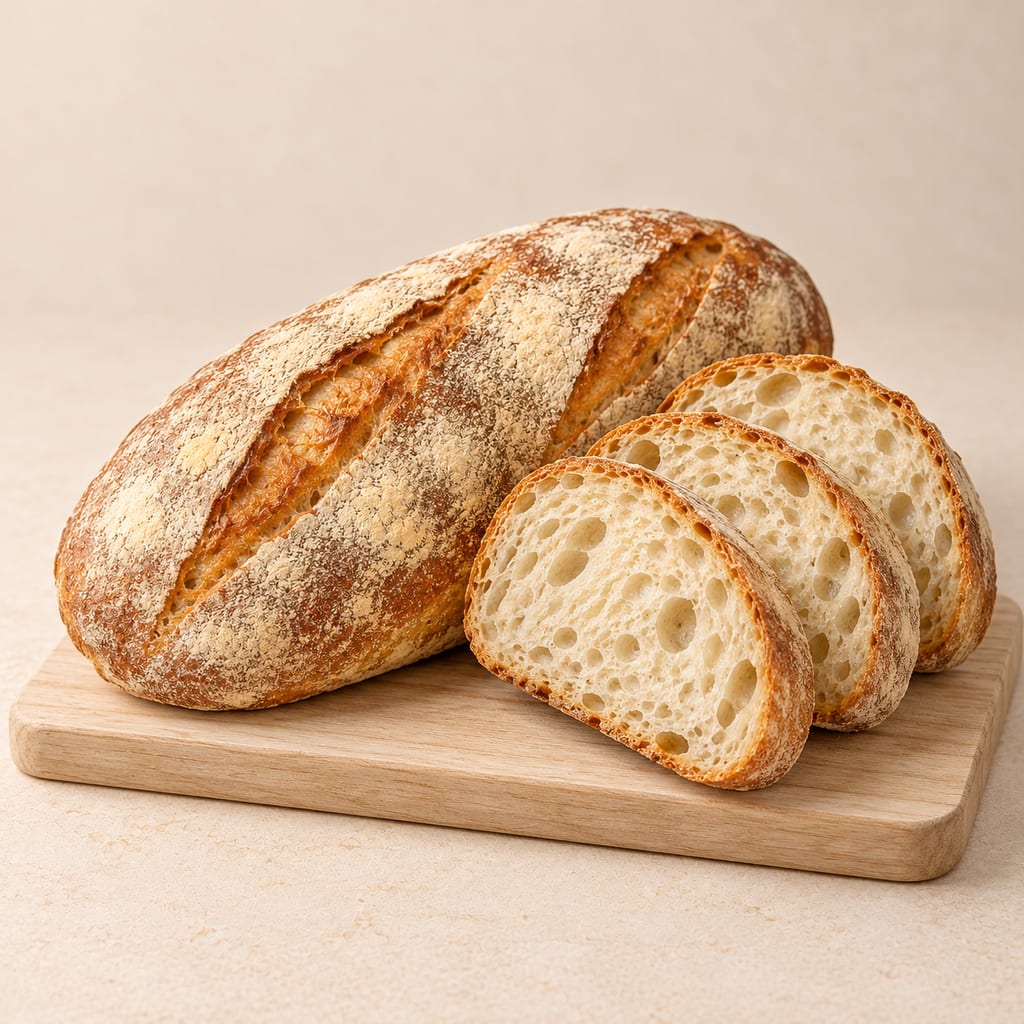
Pane toscano
Tuscany's saltless wheat bread, leavened with a sourdough biga: a mild loaf with a crisp dark crust that was made to sit beside salty meats, cheeses and stews.
 FermenteaWhere food goes to change
Modern method
biga · biga classica · biga tradizionale · preimpasto biga · biga liquida
Biga is an Italian bread preferment of flour, water and a little yeast, usually a stiff unsalted mass of about 45 per cent water, fermented ahead and then mixed into the final dough.
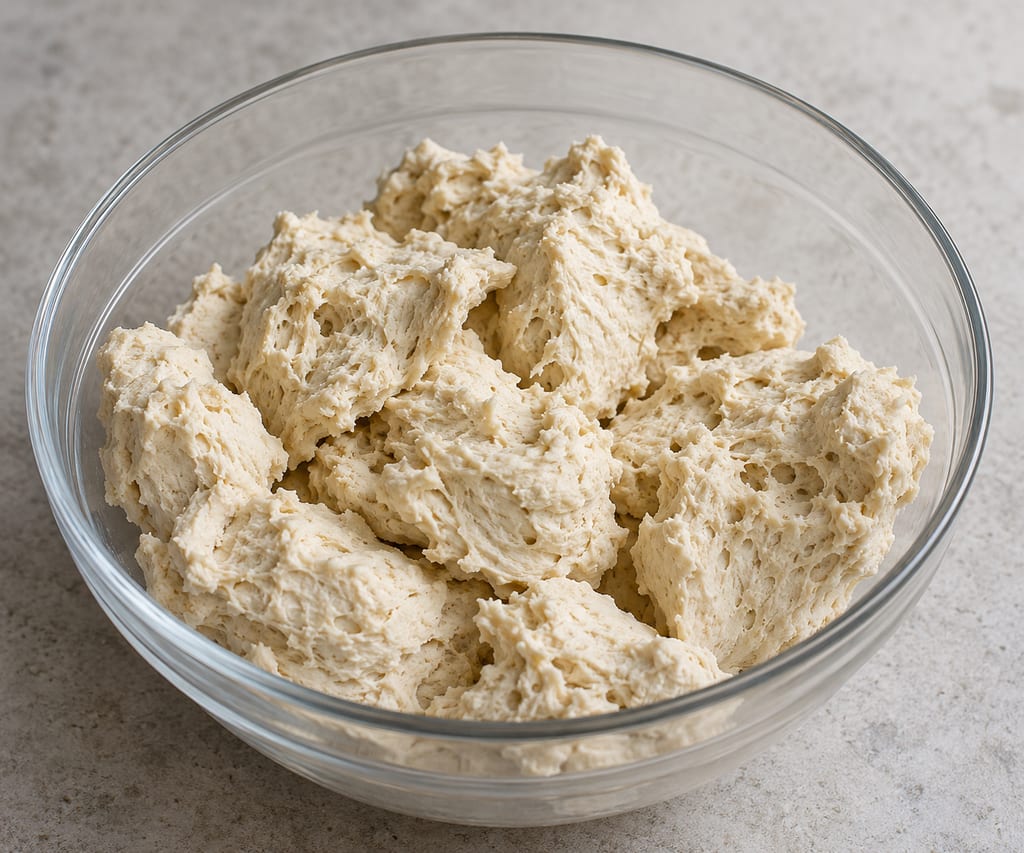
Biga is the Italian bread baker's preferment: a mixture of flour, water and a little yeast that is made ahead, left to ferment, and then broken up into the final dough. In present-day Italian professional baking the word usually means a stiff, unsalted, yeast-driven mass. Its purpose is to give part of the flour a separate stretch of fermentation and enzyme action before the full dough is mixed. It is a working stage, not a loaf and not something to eat from the bowl.
The classic stiff biga holds much less water than ordinary dough. Molino Vigevano gives flour at 100 per cent, water at 45 and fresh compressed yeast at 1, all by flour weight, and Molino Rachello describes a related method at 45 to 50 per cent water. At that hydration the mixture is firm and ragged, rough pieces rather than a smooth elastic dough. It is mixed only until the water and yeast are spread through it, since developing the gluten is not the goal. That consistency is what separates it from poolish, where flour and water are equal in weight.
Biga has no single hydration, though. Jeffrey Hamelman treats it as a generic Italian word for a preferment, made sometimes at 50 to 60 per cent and sometimes as a liquid at 100, and King Arthur uses the same broad definition. Its professional ciabatta formula has a 60 per cent biga, and its home Rustic Italian Ciabatta uses one of about 75. These are documented practice, not errors to be corrected toward some assumed traditional ratio, and a page about a particular biga should say which formulation it means.
The leavening in a conventional biga is commercial baker's yeast, Saccharomyces cerevisiae, so it is not sourdough. A starter is a maintained community of yeasts and lactic acid bacteria, whereas a standard biga is made fresh with a measured dose of commercial yeast. Some modern preparations called biga do use a sourdough inoculum, and their microbiology has to be judged separately. Pâte fermentée is a different thing again, usually a piece of earlier dough that already contains salt. The word names a method of preparing flour ahead of the final mix, not a strain or a finished bread.
Biga belongs to Italian professional baking, but nobody has pinned down when or by whom it was first used. The American Society of Baking links it to the nineteenth-century spread of commercial baker's yeast and the move by some European bakers away from sourdough alone. That is a plausible setting, since yeast made faster dough possible while an advance-fermented mixture could keep some of the benefit of a long ferment. The account names no dated Italian recipe or document, so the first baking use of the term is not established.
The Italian word biga also means a two-horse chariot, a sense inherited from Latin. Molino Vigevano suggests the baking name comes from the way the preferment pulls the later dough along, as a team pulls a load. That is a trade explanation and the derivation has not been independently established. It is no ground for saying Roman bakers made biga, because the age of a word says nothing about the age of a recipe.
The modern technique is better documented. Piergiorgio Giorilli is associated with standardising and teaching the stiff biga of strong wheat flour, little water and commercial yeast; a 2025 account of his career credits him with an influential standard, and Italian mills still publish formulas built on his proportions of 100 per cent flour, 45 water and 1 fresh yeast. That shows the weight of his contribution to current practice and does not make him the inventor of every kind of biga.
One documented modern link is ciabatta, developed by Arnaldo Cavallari at Adria in the Veneto in 1982. Later accounts of the original method describe a yeast biga made ahead of a much wetter final dough. The date belongs to the bread, not to the preferment, which was a method used in making it. In his 2004 book Bread, Hamelman then described biga as a general Italian category covering both stiff and liquid versions. The evidence therefore supports an Italian association, professional standardisation in recent decades and wide international use, with the earliest attestation left open.
In conventional biga the organism that matters is Saccharomyces cerevisiae. Commercial baking strains ferment the sugars in the hydrated flour: glycolysis turns glucose into pyruvate with a yield of ATP and reduced NADH, pyruvate decarboxylase releases carbon dioxide to leave acetaldehyde, and alcohol dehydrogenase reduces that to ethanol while regenerating the NAD+ glycolysis needs. The carbon dioxide forms gas pockets. A stiff biga holds little water and is barely mixed, so its gas is spread and held differently from the way it is in a fluid preferment.
Flour holds starch, proteins, minerals, a little soluble sugar and its own enzymes. Amylases work on accessible starch and release smaller carbohydrates, including maltose. Baker's yeast can bring maltose in and use it, and that matters because bread flour has little free sugar compared with a sweet dough. Much of the yeast's later fuel is therefore made by starch breakdown as the biga stands. Proteases and other enzymes also act in the hydrated flour, and how far they go depends on water, temperature, flour, acidity and time.
The low hydration changes both the speed of the ferment and the structure of the dough. With less free water, enzymes and microbes reach their substrates more slowly, and the American Society of Baking names slower fermentation as a result of the stiff consistency. A 2015 University of Bologna study by Balestra and colleagues compared a long-fermented, yeasted dough of biga type at 60 per cent hydration with other fermentation systems and found it stiffer and more resistant to extension under the study conditions. That is a measured difference in dough rheology, not proof that biga beats other preferments.
Yeast also makes glycerol, organic acids, higher alcohols, aldehydes and esters that shape the aroma of the preferment and the loaf. A 1992 study of yeasts and lactobacilli in preferments and doughs found ethanol, acetaldehyde and ethyl acetate among the volatiles. Lactic bacteria can grow in a biga, especially with long incubation, but are not necessarily added on purpose. A 2023 study found that a sourdough-inoculated biga supported a different bacterial population from yeast preparations, and its Fructilactobacillus sanfranciscensis isolates came from the sourdough culture, so they cannot be assigned to every conventional biga. Acid, protein breakdown and fermentation can change gluten behaviour, and over-maturing weakens the dough and its gas retention.
A traditional stiff biga is wheat flour, water and commercial yeast. The flour supplies starch, enzymes and gluten-forming proteins, the water allows hydration and microbial work, and the yeast starts a predictable alcoholic fermentation. Molino Vigevano and Molino Moras both give 100 per cent flour, 45 water and 1 fresh yeast. Strong bread flour is usual because the mixture has to tolerate a long ferment before the second mixing, and Molino Rachello recommends flour of W300 to W350 for its method.
The mixing is short. Molino Vigevano adds the water gradually at low speed, aiming to wet every particle and leave irregular pieces; it gives about four minutes for the water to go in. Molino Moras suggests two to three minutes by hand for a small batch. The aim is to spread yeast and water and hydrate the flour without developing gluten as fully as in the finished bread. Dry pockets matter, because they take up less water and ferment unevenly.
Temperature sets the pace. Molino Vigevano wants a mixed temperature of 16 to 20 C and then about 20 hours at an ambient 18 C, with the rough mass broken into pieces in a covered container. Molino Moras suggests 18 to 20 C for about 24 hours and brings in refrigeration for longer schedules. These are procedures from particular mills, not universal limits. More yeast, a warmer room or a different flour changes the ripening rate a good deal.
The method below is the stiff biga taught by Rai Scuola: 1 kg of strong type 0 flour, 450 ml of water and 10 g of fresh compressed yeast. The mixing follows Molino Vigevano, which uses the same 45 per cent and 1 per cent: half the yeast is dissolved in the water and half is crumbled into the flour, water goes in slowly at low speed to a rough mass, the temperature is checked at 16 to 20 C, and the pieces are torn up and covered with perforated film. It then ferments 18 to 24 hours at 16 to 18 C, the Rai Scuola figures, close to Vigevano's 20 hours at 18 C. Fresh compressed yeast is specified, and 10 g of instant or active dry cannot simply replace it.
Once ripe, the biga is torn into pieces, sometimes softened with some of the final-dough water, and mixed with the remaining flour, water, salt and any extra yeast the loaf calls for. King Arthur's professional ciabatta shows another scale: its biga is 3 kg of flour, 1.8 kg of water and 0.003 kg of yeast, 60 per cent hydration with 0.1 per cent yeast, left about 16 hours at room temperature before it enters the final dough. The finished bread follows its own mixing, bulk ferment, shaping, proof and bake.
Italian sources describe biga in several related ways. The best-known contemporary method is low hydration, strong flour, brief mixing and a cool, long maturation, and the Giorilli approach is influential in professional baking and pizza. Molino Moras gives 45 per cent water for plain wheat flour and 50 for some wholemeal flours and remilled durum semolina, Molino Rachello describes 45 to 50, and the American Society of Baking gives a wider 50 to 60. The spread reflects flour absorption, purpose and school of practice.
Professional writing also records liquid biga. Hamelman describes formulas near 100 per cent hydration, physically like poolish, under the same Italian name, and Michel Suas likewise treats biga as a general term whose hydration and conditions can vary. The phrase biga liquida marks the liquid version, but it does not show that every liquid preferment is traditionally a biga or that biga and poolish were ever interchangeable names.
Ciabatta is the best-known modern use. Cavallari's bread appeared at Adria in 1982, and later accounts describe a biga in its making, but not every ciabatta uses one, and direct-dough versions exist. Bakers also use biga in focaccia, rolls and other wheat breads. Molino Vigevano discusses its use in Neapolitan-style pizza, pizza alla pala and high-hydration bread.
Outside Italy biga has entered English-language baking. King Arthur publishes a 60 per cent biga for ciabatta, a wetter one for Rustic Italian Ciabatta, and a fairly stiff one for American-Style Panettone, made from 180 g of flour, 113 g of water and 1/16 teaspoon of instant yeast and left overnight. They are modern interpretations, not evidence of what Italian bakers once mixed. Researchers have also studied biga inoculated with sourdough, which shows the name covering different fermentation systems whose microbiology should not be confused with commercial-yeast biga.
Biga is nearly always used as an ingredient. The baker makes it ahead, lets it ferment, then mixes it with the remaining flour, water, salt and whatever else the formula needs. It brings hydrated, partly fermented flour and an active yeast population into the final mix, and the dough then goes through its own fermentation, shaping, proof and bake.
Ciabatta is its best-documented use. King Arthur's professional formula puts 30 per cent of the total flour in the biga and ferments it about 16 hours before the final mix. The finished dough is much wetter than the preferment and is handled gently when shaped, and the loaves have an open irregular crumb and a crust built by steam. Those results rest on the whole formula, the mixing, the proofing and the oven, so biga helps but cannot by itself guarantee big holes or a given crust.
In pizza a baker can use biga to move part of the fermentation out of the final-dough schedule. Molino Vigevano recommends it for several styles, among them pizza alla pala and doughs with a high final hydration. Handling depends on flour strength and how much flour was fermented ahead, and too much maturation can make the same dough hard to handle. A recipe from Farina Petra, for instance, makes a 50 per cent biga from 800 g of flour, 400 g of water and 8 g of fresh yeast, mixed briefly and chilled overnight for at least 18 hours.
Other uses include focaccia, enriched breads and panettone-style baking. King Arthur's American-Style Panettone ferments its biga before the eggs, butter, sugar, salt and fruit go in, so those ingredients do not interfere with the early yeast activity. In a bakery biga can also move part of the required fermentation into an earlier shift. The breads are eaten fresh, as sandwiches, with meals or as pizza bases.
A correctly ripened stiff biga does not look like a risen bread dough. Because it is stiff and barely mixed it stays rough and irregular, but small gas pockets form inside, it becomes less dense and the smell changes. Molino Moras describes a ripe biga as aerated, fragrant, fairly pale and neither very soft nor sticky. Molino Vigevano describes its own as about doubled, with a pungent acidic-alcoholic smell and few shiny patches on the surface. That doubling belongs to the documented procedure and is not a rule for every biga.
An under-ripe biga stays dense and compact with little fermented aroma. Likely causes are too little time, tired yeast, a cold room or dry flour pockets left by incomplete mixing. A low-hydration mass is naturally rougher than poolish, so lumps alone prove nothing; what counts is whether all the flour was wetted and whether the ferment has advanced as the recipe expects. Molino Moras notes that an under-ripe biga can leave the final dough rough and slow to develop.
An over-ripe biga can turn soft, sticky or darker with a strong smell. Long fermentation, acid and protein breakdown change its water absorption and protein structure, and Molino Moras reports that such a biga makes the final dough harder to develop and less able to hold its shape. The American Society of Baking warns that wrong maturation hurts the bread. Yeast dose and temperature have to suit the schedule, and a formula written for a cool bakery will not behave the same in a much warmer kitchen.
Water distribution is a diagnostic in its own right. Molino Vigevano separates a properly wetted rough biga from one with dry flour that has not taken up the water. Mixing harder is not necessarily the answer, since it can develop the dough too early and warm it. Make sure the water reaches the flour while keeping the short mixing of the method being followed. Flours absorb differently, so a change in consistency does not by itself signal contamination.
Do not taste raw biga to judge it. The CDC warns that raw flour can carry pathogenic E. coli or Salmonella, and bubbles or a pleasant smell do not show they are gone. Throw out visibly mouldy or obviously contaminated batches. Wash utensils, hands and surfaces after handling raw dough and keep it from ready-to-eat food. Biga made from wheat contains gluten, and fermentation does not make it suitable for coeliac disease. No time, aroma, volume increase or pH in these baking sources is a validated microbiological safety limit.
The earliest baking use of the word is not established; the modern stiff method was standardised in recent decades.
Flour is a raw agricultural product and can carry pathogenic E. coli; yeast fermentation does not show it is gone.
Hazard sourceRaw flour can carry Salmonella, and raw biga should not be tasted or eaten.
Hazard sourceFlour dust, hands, utensils, surfaces and containers can carry microorganisms to other foods.
Hazard sourceTemperature, yeast dose, hygiene and time shape the preferment; a ripe look does not show unwanted microbes are absent.
Hazard sourceUse food-grade flour, potable water, commercial yeast and clean equipment.
Control sourceDo not taste or eat raw biga; mix it into a dough that will be properly baked.
Control sourceWash hands, utensils, containers and surfaces after handling raw flour or dough, and keep them from ready-to-eat food.
Control sourceFollow a documented schedule matched to flour, yeast type, dose and temperature.
Control sourceWet all the flour but avoid excessive mixing and warming.
Control sourceThe 16 to 18 C range for 18 to 24 hours is a documented baking method, not a validated pathogen-control process.
Do not eat biga raw; bubbles, rise, acidity and a fermented smell do not prove it is safe.
The recipe uses fresh compressed yeast; an equal weight of instant or active dry yeast changes the dose.
A commercial-yeast biga is not a sourdough starter; do not assume lactic bacteria are present or dominant.
A stiff biga is rough and unkneaded by design; a ragged texture alone is not spoilage.
An over-ripe biga may be sticky, soft, darker or strongly acid and can lower the dough quality.
Discard biga with visible mould, odd colour or obvious contamination; do not scrape off the surface.
Contains wheat gluten; fermentation does not make it suitable for coeliac disease.
The source establishes no shelf life, pH limit, water-activity limit or ethanol concentration.
It must go into a complete bread or pizza formula before baking; this recipe gives no final-dough ingredients or oven conditions.
Italian bakery tradition; a country-level statement.
Ciabatta was developed here using a biga; the date is the bread's, not the preferment's.
Molino Vigevano publishes the documented procedure.
Molino Moras publishes a related method.
King Arthur ciabatta and panettone formulas.
Tuscany's saltless wheat bread, leavened with a sourdough biga: a mild loaf with a crisp dark crust that was made to sit beside salty meats, cheeses and stews.
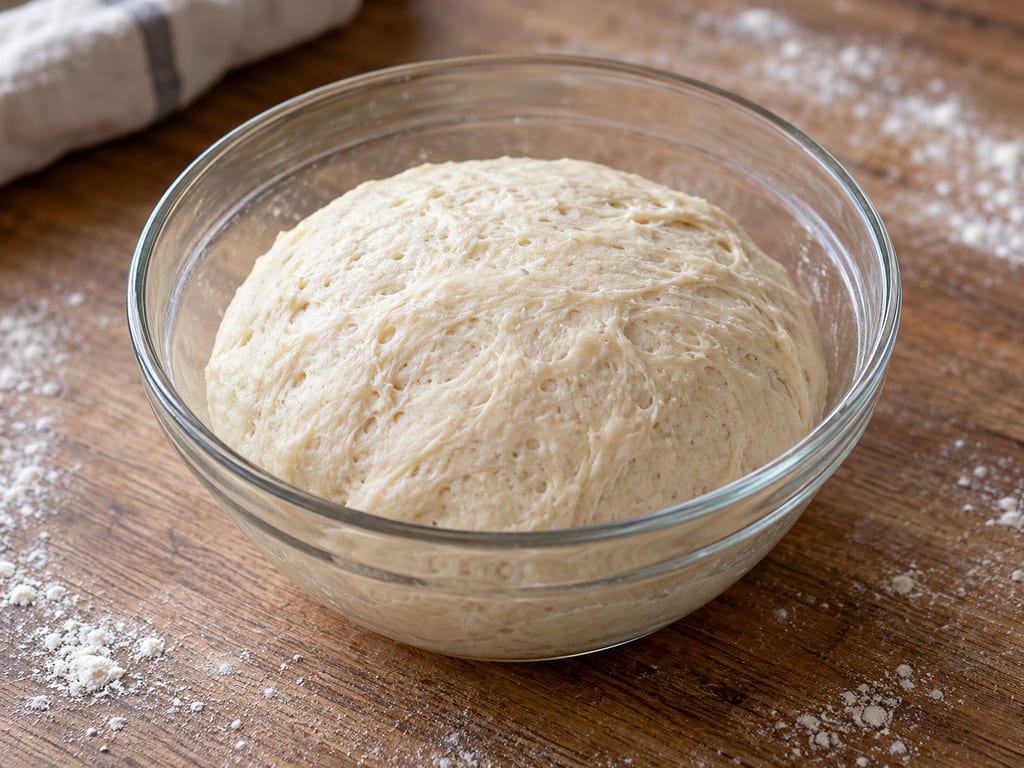
Pâte fermentée is a bread preferment made from salted, yeasted dough set aside to ferment and mixed into a later batch, carrying developed dough and fermentation products with it.
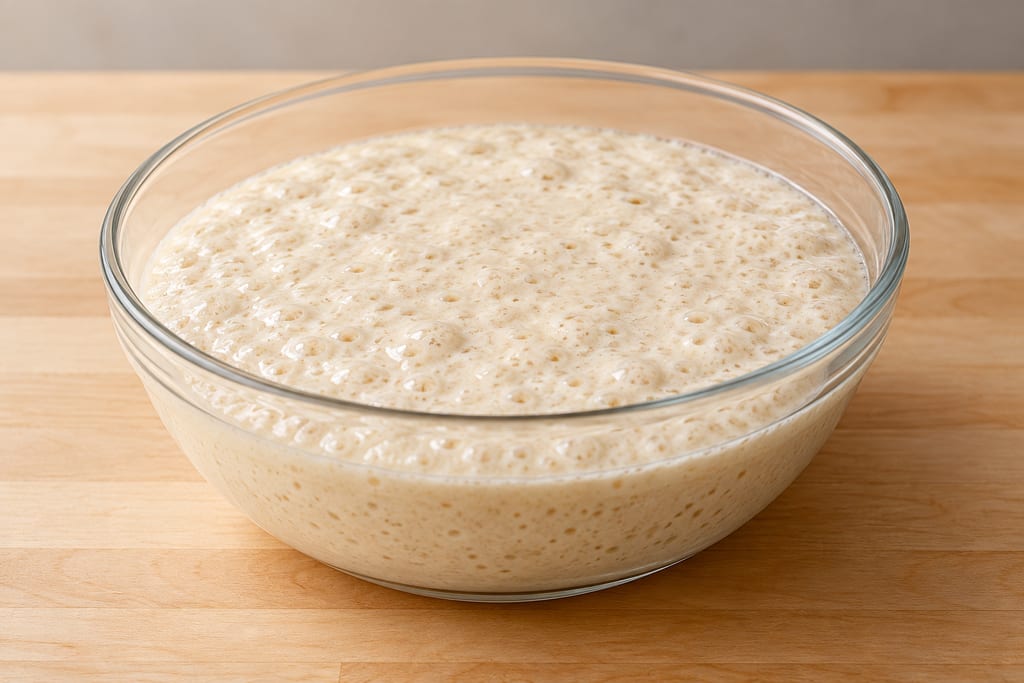
Poolish is a loose, unsalted bread preferment of roughly equal weights of wheat flour and water with a pinch of baker's yeast, left to ripen before it goes into the final dough.
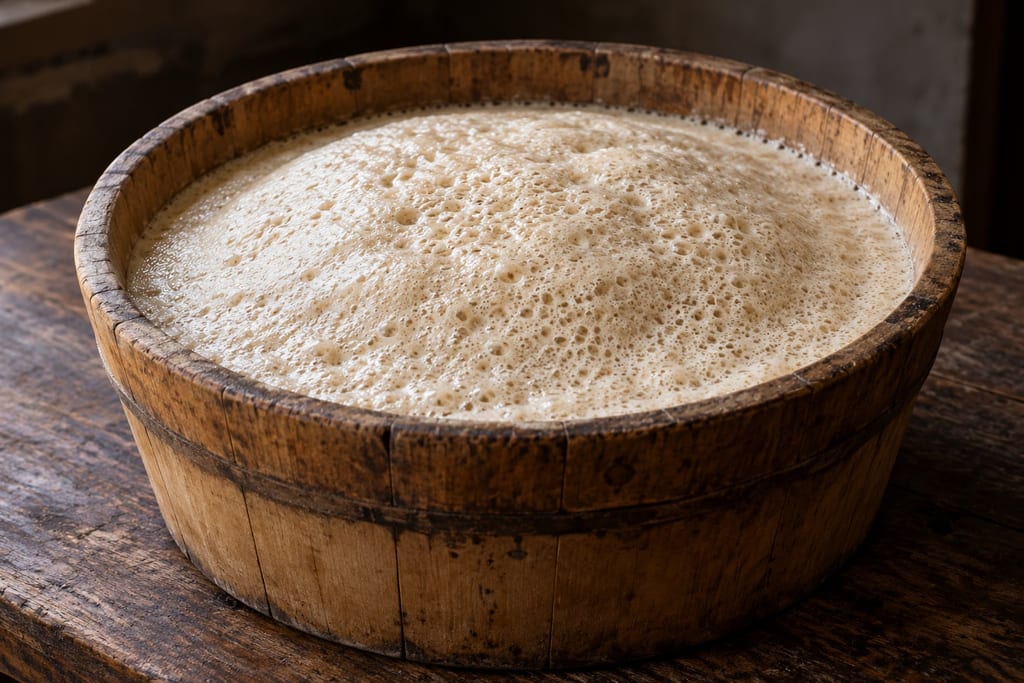
Scotch barm is a Scottish bakery ferment grown in a malt-and-scalded-flour medium and renewed with mature barm from the last batch to leaven successive bread sponges.
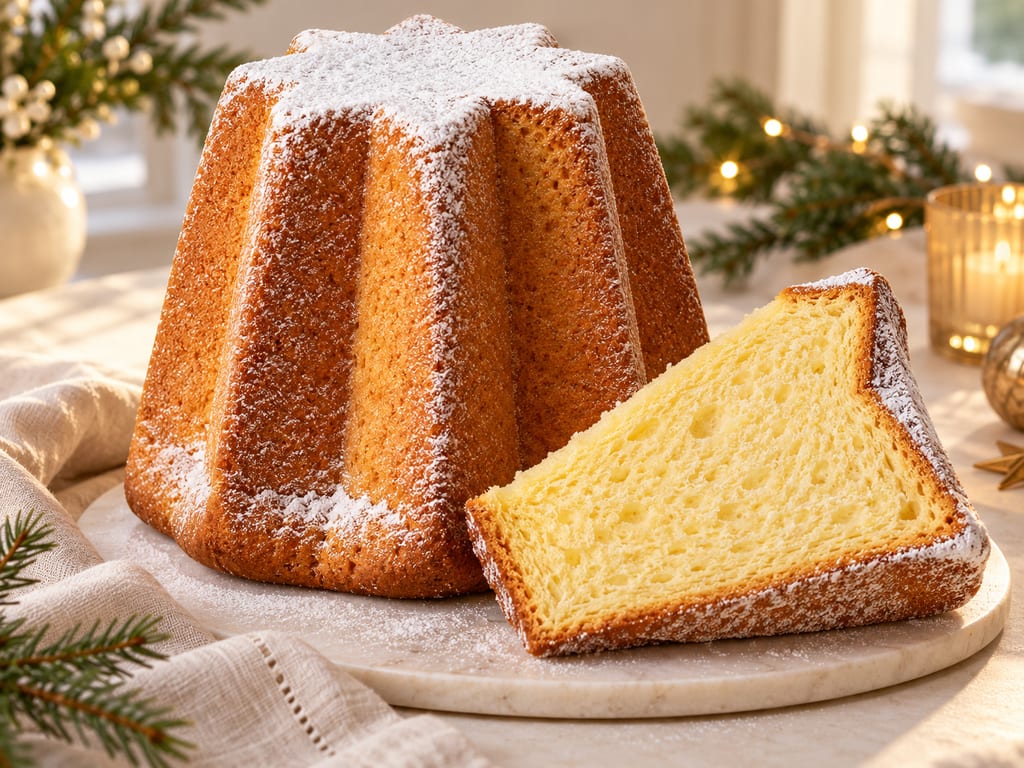
A fruit-free Italian festive enriched bread, baked in a tall star-shaped mould and finished with powdered sugar. This home batch follows one published baker’s-yeast method; it does not represent every pandoro formula.
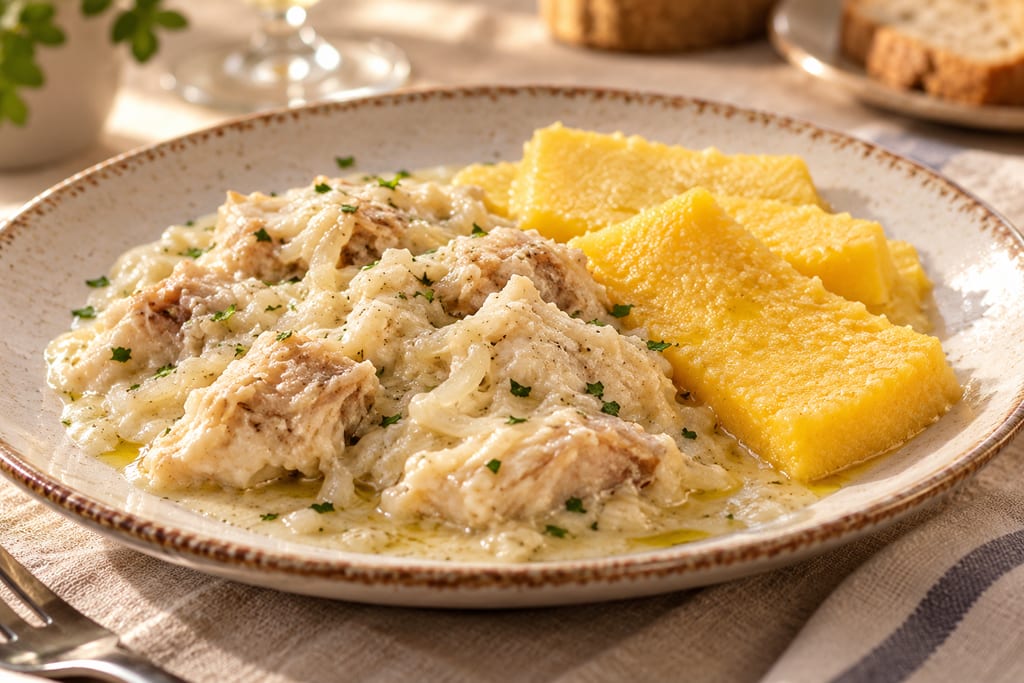
Stockfish from Vicenza, left barely bubbling for hours with onion, preserved anchovy, olive oil, milk and a little cheese until it is tender under a dense pale sauce, and eaten with polenta.
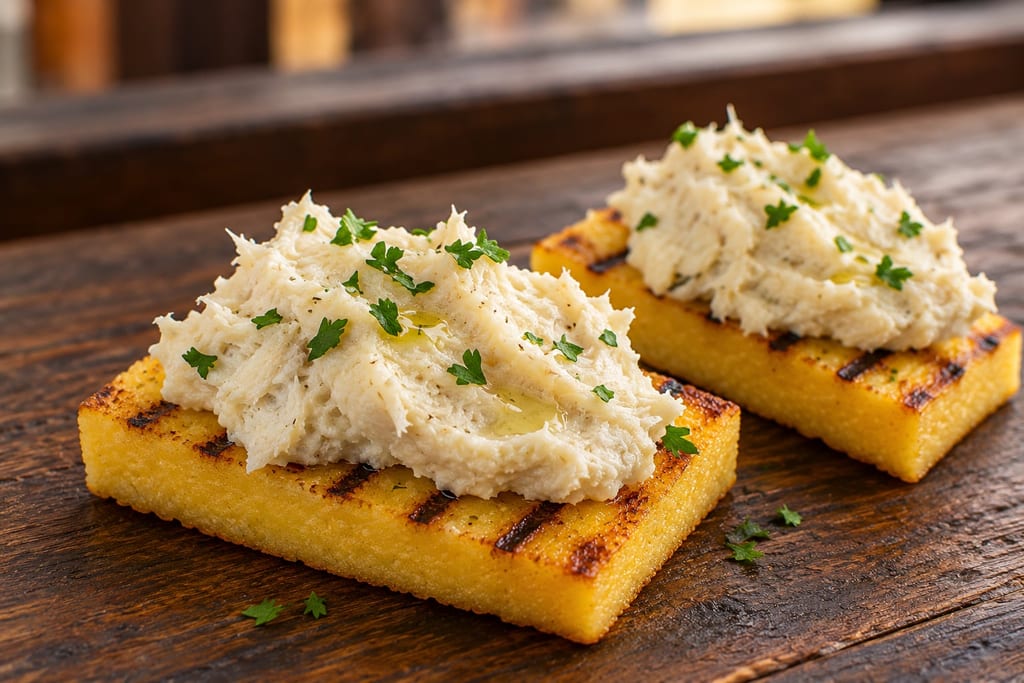
A Venetian cicchetto of cooked unsalted stockfish beaten with oil until it turns into a pale, aerated cream, spooned onto grilled polenta in the city's wine bars.
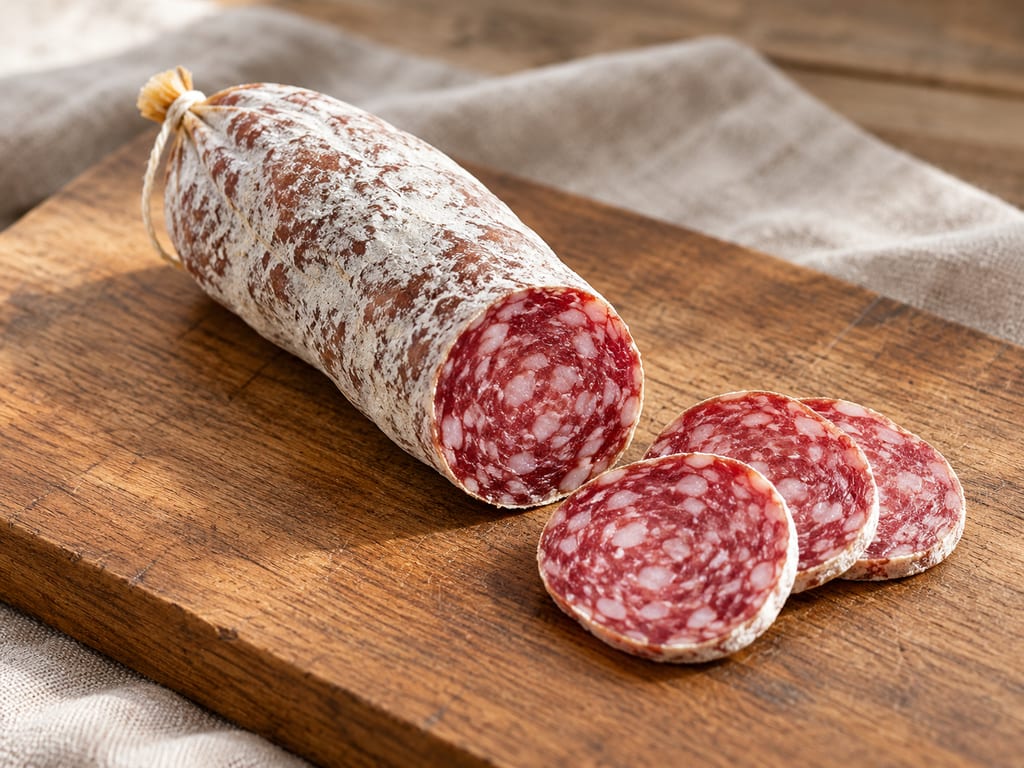
Small Italian hunter-style salami of lean pork, firm fat, salt, pepper and garlic, mildly acidified and dry-matured; protected as Salamini Italiani alla Cacciatora DOP.
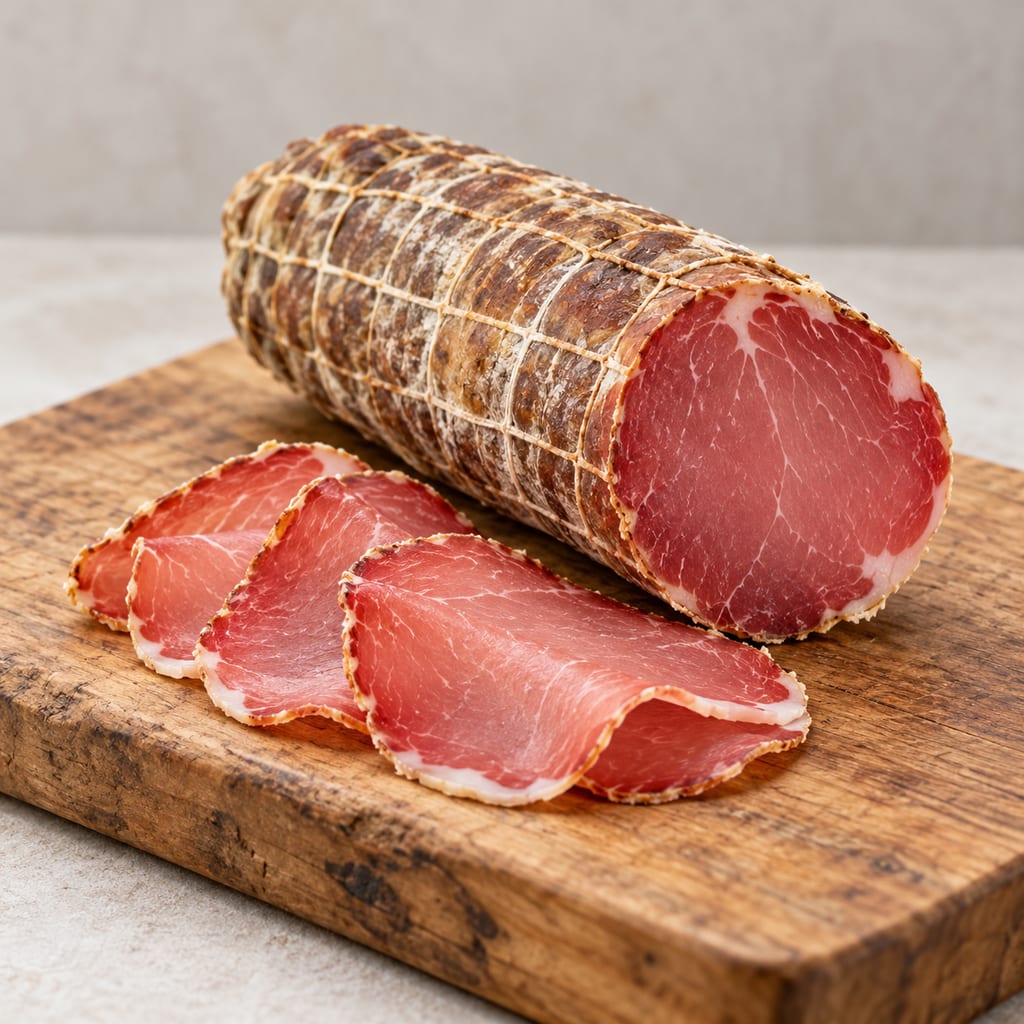
Documentary account of Italian regional cured-loin traditions, including Tuscan and Marche variations; no home-cure instructions are provided because the published professional methods lack validated safety controls.
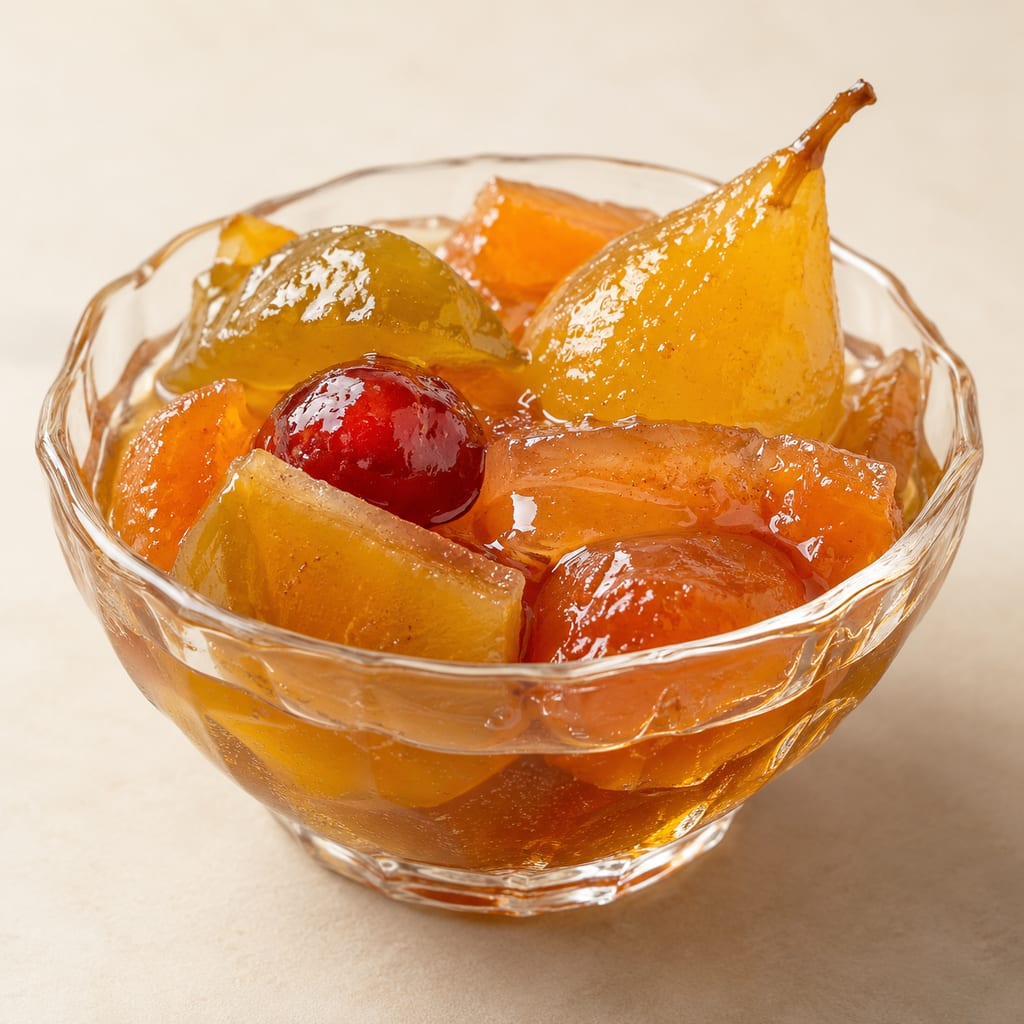
Mostarda is a northern Italian condiment of candied fruit in a mustard-flavoured syrup, served with boiled meats and cheeses.
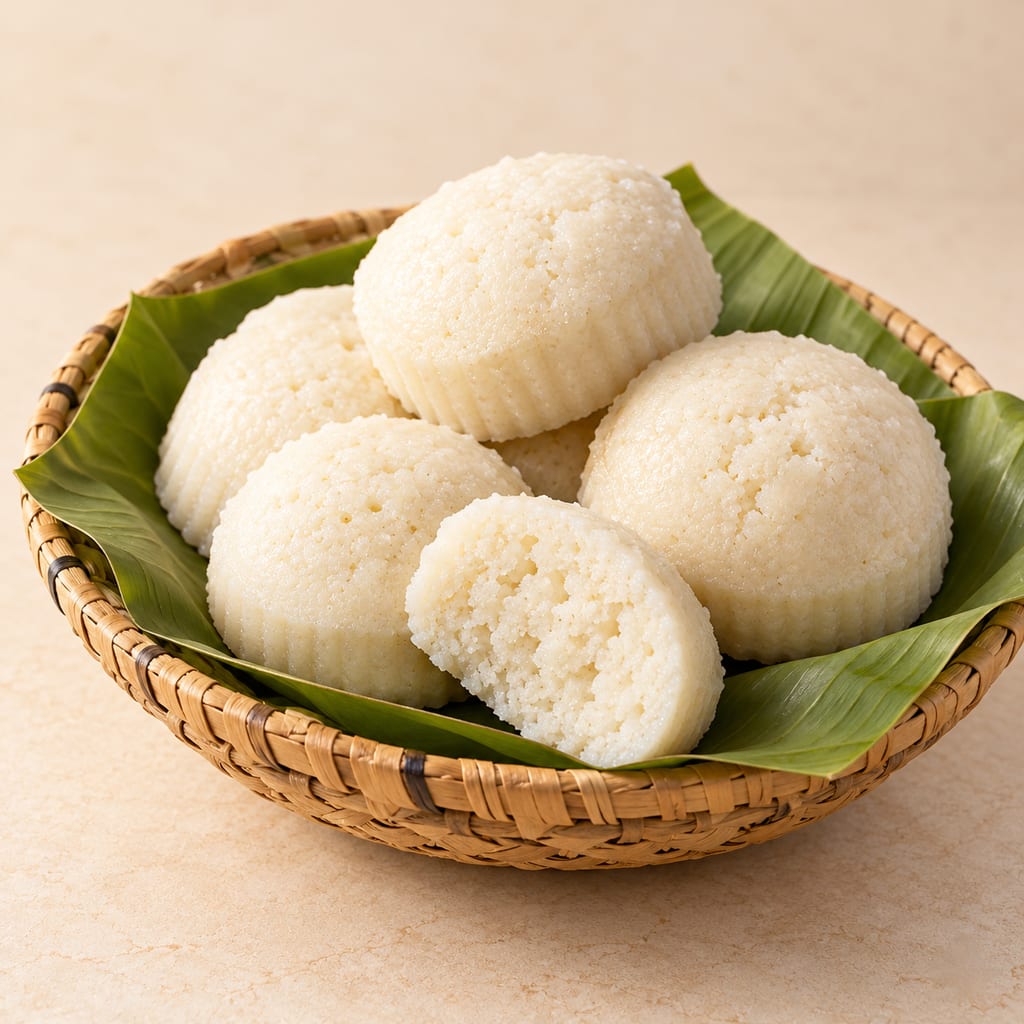
Soft, lightly tangy steamed cereal bread documented across Benin and Togo. This page gives one measured rice-flour research method; maize-based Ablo and mixed-grain versions remain distinct traditions.
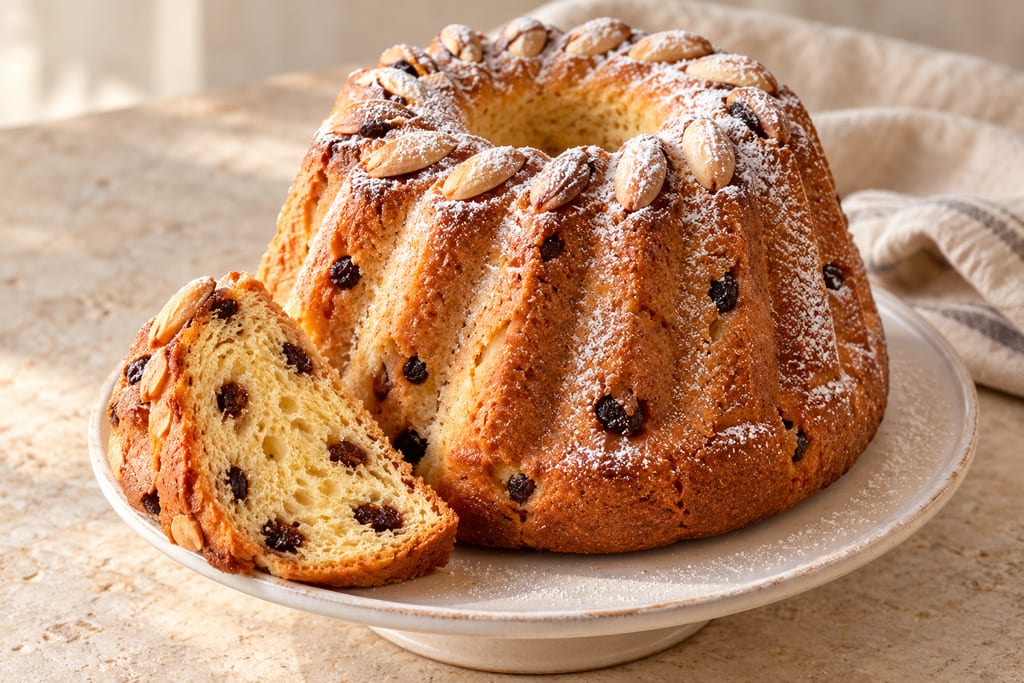
An enriched Alsatian yeast ring with raisins and almonds, kneaded with butter, proofed in a fluted mould and baked until browned.

Anpan is a soft wheat bun filled with sweet red-bean paste and finished with egg wash and black sesame. This dough rises with commercial instant yeast.
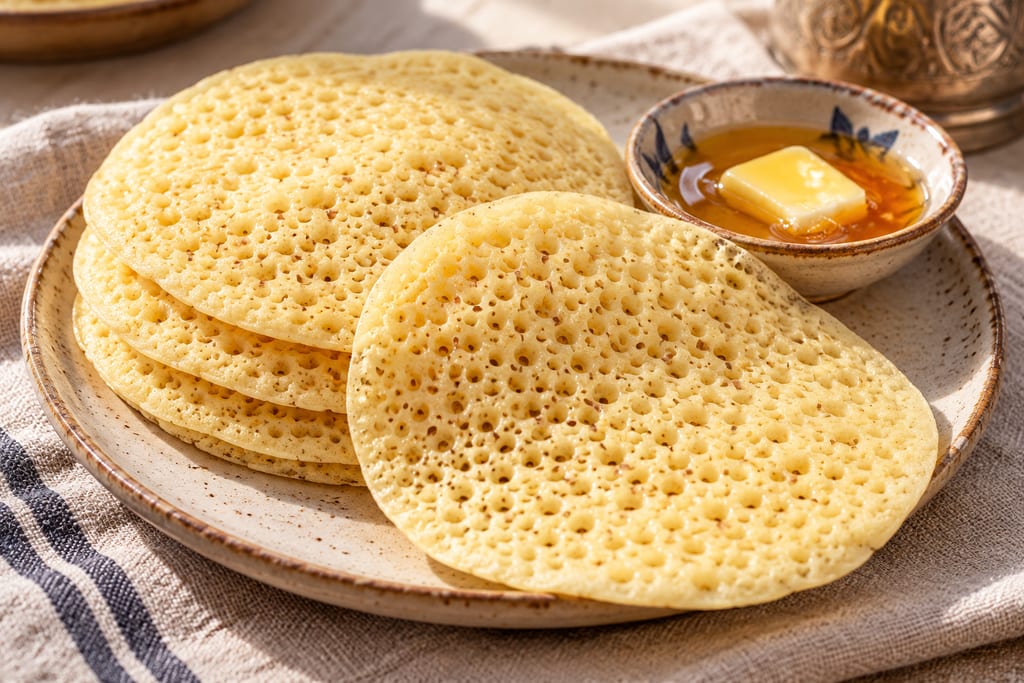
Moroccan semolina pancakes made from a thin yeast batter, rested until foamy and cooked on one side until the surface sets with a honeycomb of holes. This source-specific batch makes sixteen 5-inch pancakes.
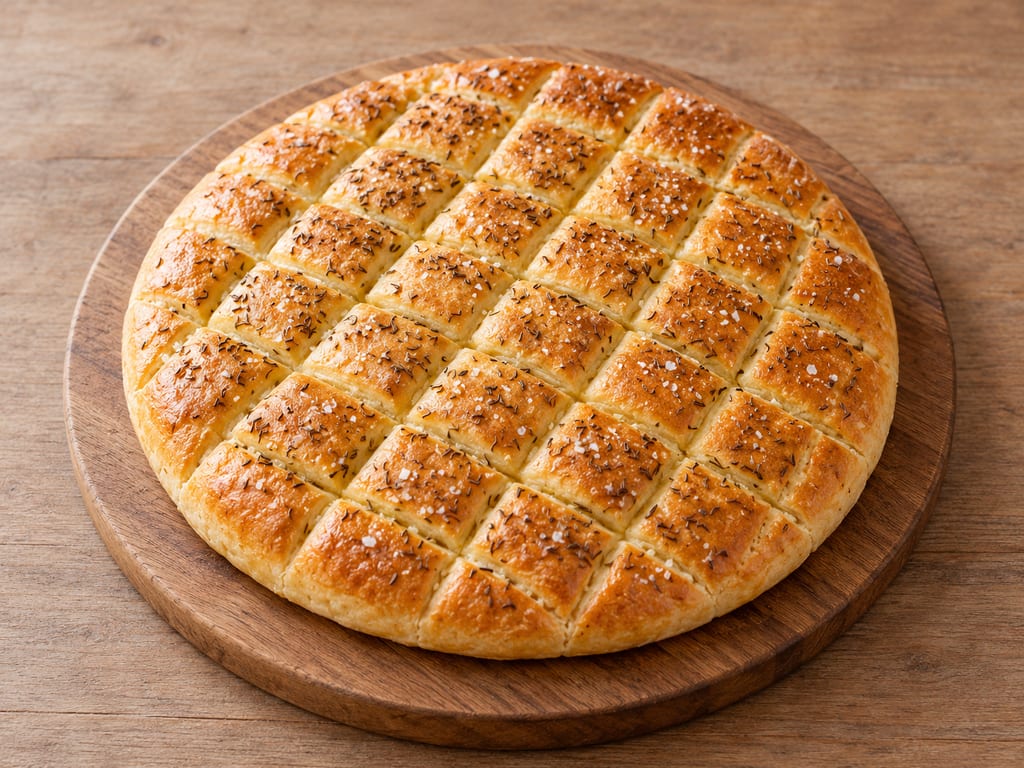
A round Slovenian flatbread scored in a grid and topped with caraway and coarse salt.
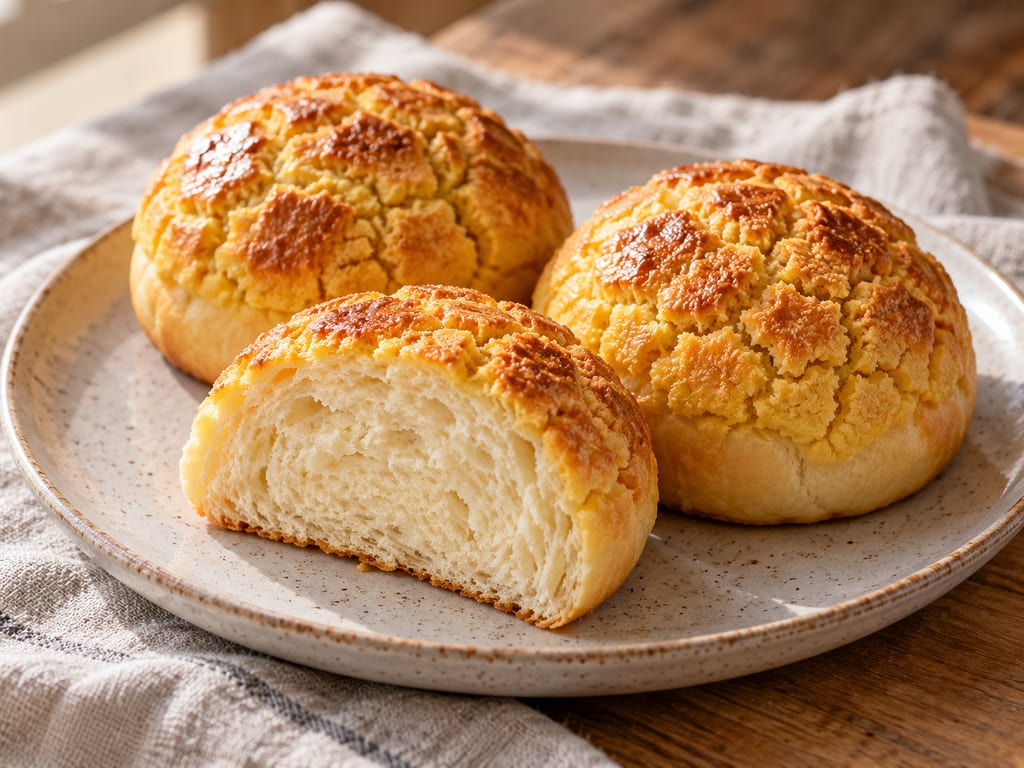
Hong Kong-style pineapple buns have soft yeast dough beneath a crisp, sweet pastry topping.
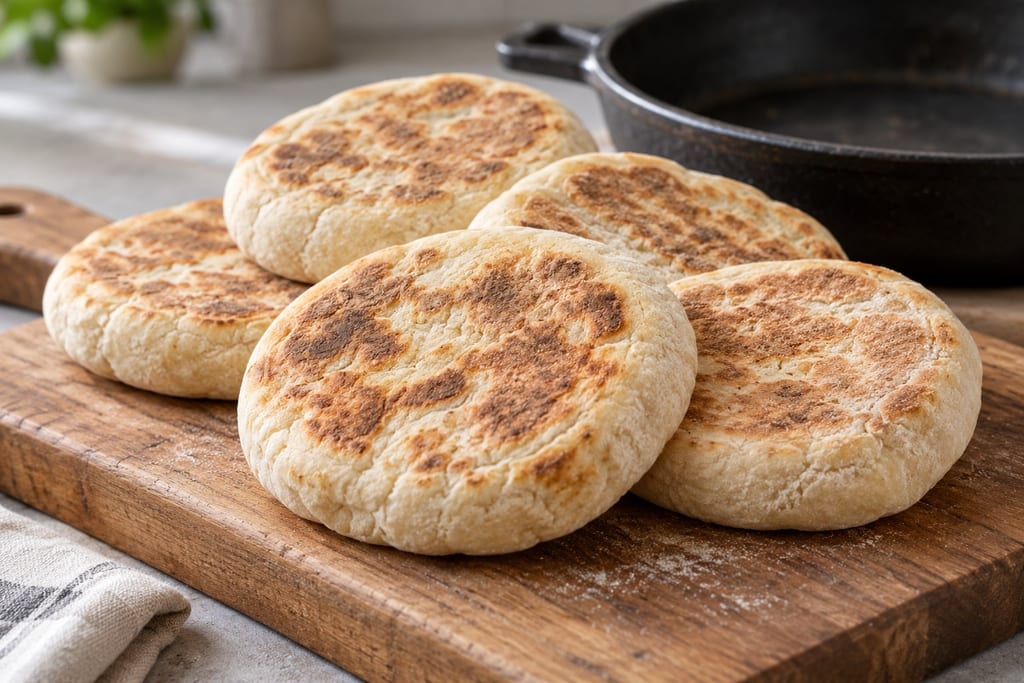
Sweet-potato wheat breads with fresh yeast, browned in a pan and finished in the oven. This is the bread component of Teleculinária's scrambled-egg dish.
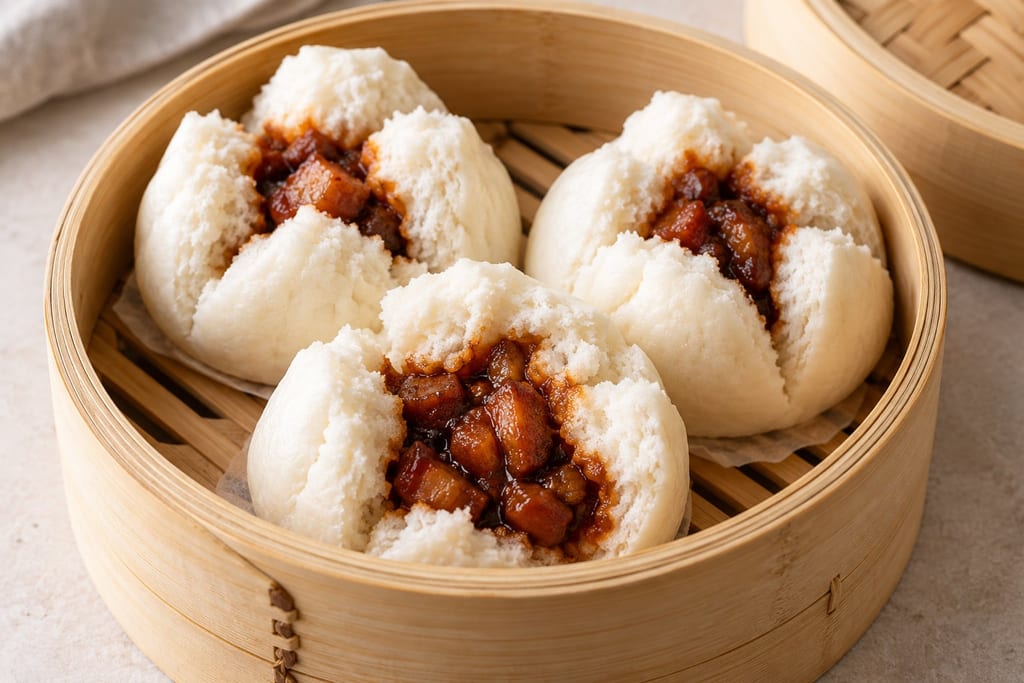
Fourteen fluffy steamed buns filled with cooked char siu and a thickened oyster-soy sauce.
No community contributions have been published for this entry yet.
Sign in to contribute. Published comments and photos are free to read.
Rai ScuolaMethod
La lievitazione e i preimpasti1 kg strong type 0 flour, 450 ml water, 10 g compressed yeast
fermentation at 16 to 18 C for 18 to 24 hours
distinguishes biga, poolish, old dough and sourdough
Cited in: How it is made and why each step is there
Molino VigevanoMethod · History
La biga: come realizzare l'impasto indiretto per pizza100% flour, 45% water, 1% fresh yeast
half the yeast dissolved, half crumbled into flour; water over about four minutes
mixed temperature 16 to 20 C; about 20 hours at 18 C
maturity signs; rationale for the name
Cited in: What biga is; Where the word and the method come from; How it is made and why each step is there; Variations; In the finished bread; Reading results and problems
Molino MorasMethod · Variation
Biga: cos'è, a cosa serve e come preparare questo pre-impastoGiorilli proportions 100:45:1
50% water for some wholemeal and semolina flours
24 hours at 18 to 20 C; under- and over-ripe signs; focaccia recipe
Cited in: Where the word and the method come from; How it is made and why each step is there; Variations; In the finished bread; Reading results and problems
Molino RachelloMethod
Cos'è la Biga e come prepararla45 to 50% hydration; flour strength W300 to W350
Cited in: What biga is; How it is made and why each step is there; Variations; Reading results and problems
American Society of BakingDefinition · Science · History
Bigaunsalted preferment of 50 to 60% hydration
slower fermentation at low hydration
nineteenth-century yeast context; no dated invention document
Cited in: What biga is; Where the word and the method come from; What the yeast and the flour do; How it is made and why each step is there; In the finished bread; Reading results and problems
King Arthur BakingDefinition
Prefermentbiga as an Italian term of variable hydration
difference from poolish and pâte fermentée
Cited in: What biga is; Variations; Reading results and problems
King Arthur BakingMethod · Use
Ciabattabiga of 3 kg flour, 1.8 kg water, 0.003 kg yeast at 60% hydration
about 16 hours at room temperature; 30% of total flour
Cited in: What biga is; How it is made and why each step is there; In the finished bread
King Arthur BakingMethod · Variation
Rustic Italian Ciabatta226 g flour, 170 g water, 1/8 tsp yeast, about 75% hydration, 12 to 16 hours
Cited in: What biga is; Variations; In the finished bread
King Arthur BakingMethod · Use
American-Style Panettone180 g flour, 113 g water, 1/16 tsp instant yeast, about 62.8% hydration, overnight
Cited in: Variations; In the finished bread
Farina PetraUse
Impasto Pizza con Biga di Farina Petra 1 HP800 g flour, 400 g water, 8 g fresh yeast; chilled overnight for at least 18 hours
Cited in: In the finished bread
ckbkDefinition · Variation
Biga (in Bread: A Baker's Book of Techniques and Recipes)biga as a generic Italian preferment term, stiff or liquid
Cited in: What biga is; Where the word and the method come from; Variations
Treccani VocabolarioHistory
bigabiga as a two-horse chariot
Cited in: Where the word and the method come from
Luciano PignataroHistory
Piergiorgio Giorilli protagonista del libro L'uomo che ha cambiato la panificazioneGiorilli credited with standardising the stiff biga method
Cited in: Where the word and the method come from
Fodor's TravelHistory
Italy's ciabatta bread was invented in 1982ciabatta developed by Arnaldo Cavallari at Adria in 1982
Cited in: Where the word and the method come from; Variations
Ventaglio NovantaHistory
I 30 anni della ciabattaoriginal ciabatta method with a biga
Cited in: Where the word and the method come from
Frontiers in GeneticsScience
History and Domestication of Saccharomyces cerevisiae in Bread Bakingyeast fermentation and maltose use
Cited in: What the yeast and the flour do
Food Science & NutritionScience
Hydrolytic enzymes and their directly and indirectly effects on gluten and dough properties: An extensive reviewamylase and protease action in dough
Cited in: What the yeast and the flour do; Reading results and problems
NutrientsScience · Variation
Sourdough "Biga" Fermentation Improves the Digestibility of Pizza Pinsa Romana: An Investigation through a Simulated Static In Vitro Modelsourdough-inoculated biga supports a different bacterial population
Cited in: What the yeast and the flour do; Variations
International Journal of Food MicrobiologyScience
Headspace flavour compounds produced by yeasts and lactobacilli during fermentation of preferments and bread doughsvolatile compounds in preferments
Cited in: What the yeast and the flour do
Journal of Texture StudiesScience
Evaluation of the Effects of Different Fermentation Methods on Dough Characteristicslong-fermented 60% hydration biga-type dough was stiffer and more resistant to extension
Cited in: What the yeast and the flour do
Centers for Disease Control and PreventionSafety
Raw Flour and Doughraw flour can carry E. coli and Salmonella
do not taste or eat raw dough
Cited in: Reading results and problems
U.S. Food and Drug AdministrationSafety
Handling Flour Safely: What You Need to Knowraw flour hazards
keep flour away from ready-to-eat food
Cited in: Reading results and problems