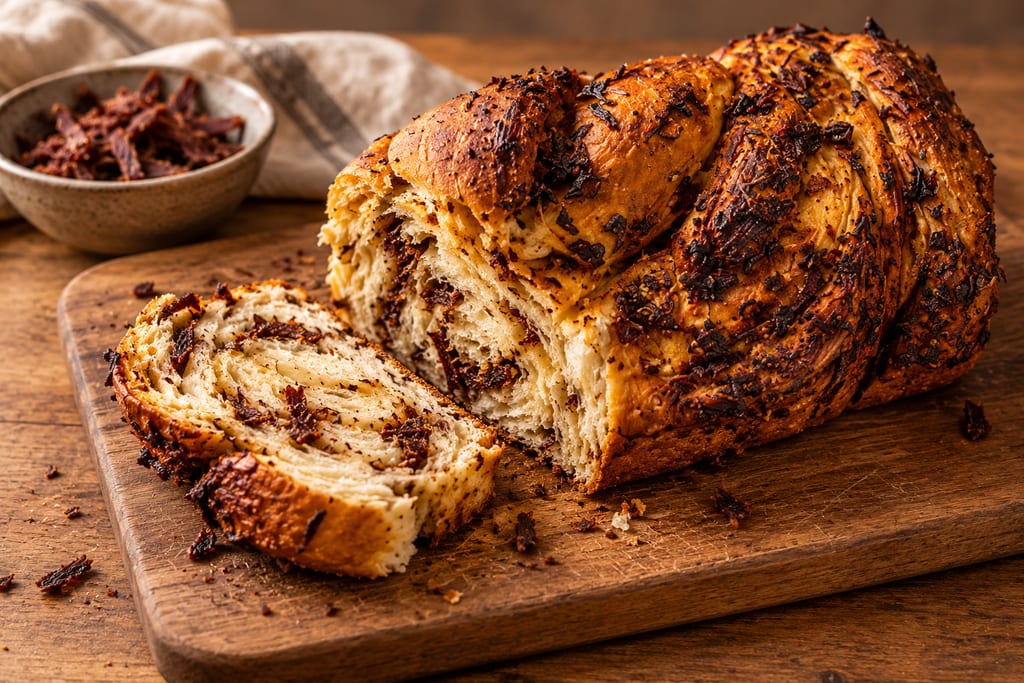
Braided biltong loaf
Yeasted bread wrapped around biltong, tomato pesto, Cheddar and feta, split lengthwise into a braid and baked; served with chilli-biltong butter.
 FermenteaWhere food goes to change
Substrates
Bread flour is wheat flour chosen for dough strength and gas retention. Its protein level and baking performance vary by wheat, mill and product.
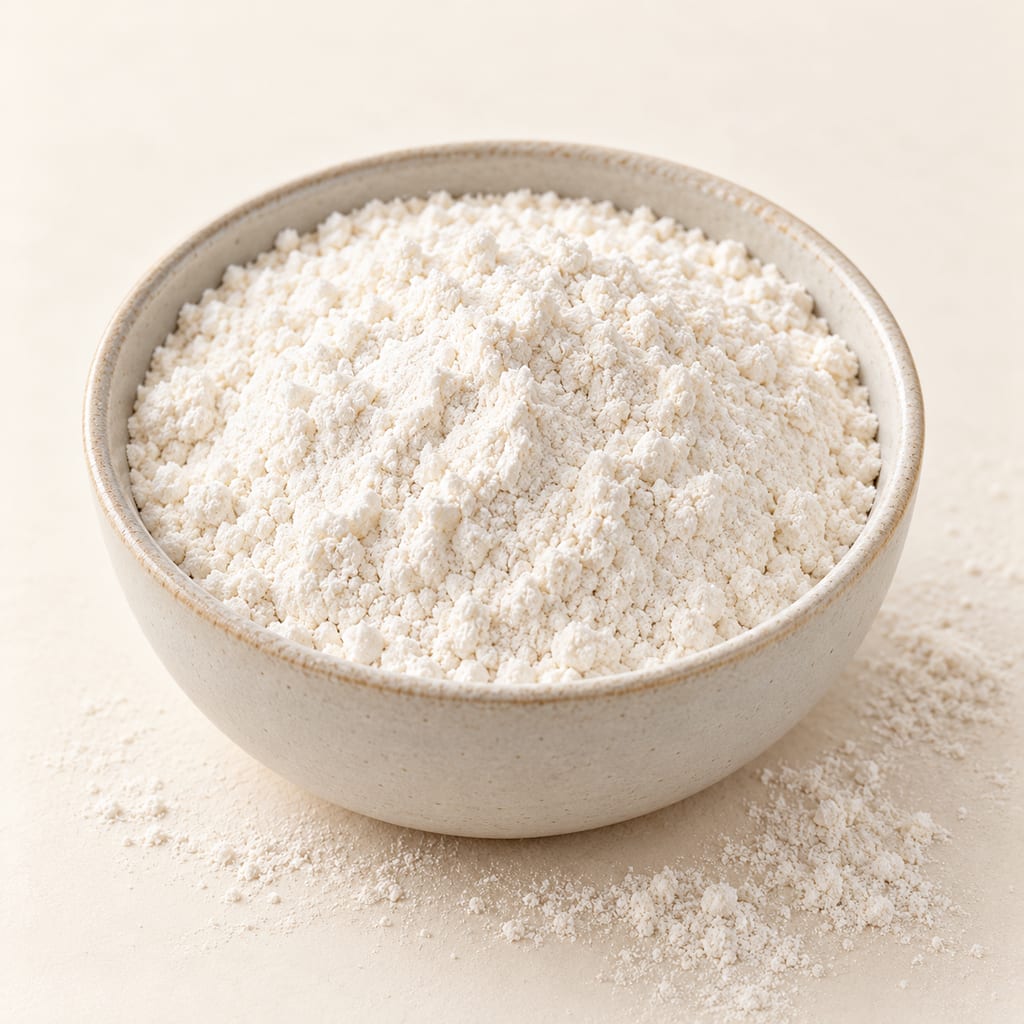
Bread flour is wheat flour sold for doughs that benefit from strength and extension. In North American usage, it is commonly a white flour milled from hard wheat, often hard red spring or hard red winter wheat; British “strong white flour” is a close functional counterpart. Neither label names one cultivar. Millers can blend wheats from different crops to meet a baking target, and products differ by country, brand, and intended customer. In United States government purchasing, bakers' wheat flour is grouped separately from cake and pastry flour and all-purpose flour, and lists hard red spring, hard red winter, and hard white wheat among bread-flour classes. A separate export purchasing specification sets a higher protein minimum for bread flour than for all-purpose flour. Those are purchasing rules, not a worldwide legal definition for every retail bag.
A familiar retail example shows why a label alone does not set a universal number: King Arthur bread flour is labelled 12.7% protein, compared with 11.7% for its all-purpose flour. Other makers can offer different levels, while some all-purpose flours are strong enough for many bread doughs. Protein percentage is useful, but it does not fully predict baking behavior. Wheat variety and the quality and balance of gluten-forming proteins matter too. Read the package's protein declaration and product information as a description of that product, not a fixed standard for every bread flour.
In the bag, white bread flour is a fine, pale powder with a mild cereal smell; it is not visibly “stronger” than all-purpose flour. Its performance becomes apparent only after water is added and the dough is mixed. Whole wheat bread flour is a distinct choice when the label explicitly says whole wheat: it retains bran and germ or has them recombined, and its color, flavor, water interactions, and dough behavior differ from refined white flour. “High extraction,” “stoneground,” “wholemeal,” “strong,” and “bread” do not mean the same thing. A high-extraction flour retains a greater share of the kernel than refined patent flour; it may be made from strong wheat, but the terms describe different properties.
Bread flour is a recent commercial category applied to a much older crop and an even older practice of grinding grain. Bread wheat, *Triticum aestivum*, is hexaploid: it carries six sets of chromosomes, arranged as three related pairs of sets known as the A, B and D genomes (AABBDD). Its ancestry reflects hybridization between earlier wheat and goatgrass lineages; its precise formation and early movement remain subjects of genomic and archaeological research. Domesticated wheat cultivation began in the Fertile Crescent roughly ten millennia ago. Einkorn was among the earliest domesticates, but it is not bread wheat and should not be treated as the direct equivalent of the modern bread-flour crop. The oldest known bread-like foods predate farming and were made with wild grains, a reminder that bread's story does not begin with today's flour categories.
For most of that history, people ground grain with handstones, querns, and later water- or wind-powered millstones. Sifting could separate coarser plant parts, but a stone-ground flour's composition depended on how the grain was milled and sifted. The modern white flour category took shape with more controlled separation and reduction. The gradual-reduction system used in contemporary milling emerged in nineteenth-century Hungary: grooved rollers break open kernels, while later smooth rolls reduce separated endosperm particles. Sieves and purifiers separate bran fragments from finer endosperm streams. Roller milling spread unevenly; in Britain it advanced during the later nineteenth century alongside rising demand for white bread and imports of hard wheats. In the United States, roller milling and purification suited hard spring wheats and supported larger, more uniform mills.
This history explains how a mill can produce a pale, consistent flour from hard wheat, but it does not mean all roller-milled flour is bread flour or that stone milling cannot make strong flour. Milling method, wheat class, blend, extraction, and the mill's specification are separate variables. Modern bread flour is the result of crop selection, grain blending, and milling aimed at a baking use, rather than a direct survival of one ancient flour type.
Wheat flour contains starch, proteins, lipids, minerals, enzymes, and other grain components. In refined white flour, most bran and germ are removed, leaving starchy endosperm as the main material. Gluten-forming proteins, especially gliadins and glutenins, are dispersed through it. When flour hydrates, these proteins associate into a viscoelastic network. “Viscoelastic” means it can stretch and flow under force while also springing back; the balance lets bread dough expand without simply tearing or spreading.
The shorthand “more protein means more gluten” is incomplete. Total protein is a useful guide because breadmaking performance often rises with gluten-protein quantity, but protein composition and wheat genotype influence network quality. Dough also depends on water level, mixing, temperature, salt, fats, sugars, enzymes, fermentation, and the flour's starch and non-starch polysaccharides. A strong flour can absorb more water in some formulations and resist extension more than a weaker flour, but the recipe and specific flour govern the result. A dough that feels tight is not automatically better; excessive strength can make shaping difficult or produce a chewier result than desired.
Mixing distributes water, hydrates proteins and starch, and develops dough structure. Kneading or mechanical mixing brings the hydrated material into a continuous mass. Resting allows water to continue moving through the flour and can make dough easier to handle, though the effect depends on formula and rest. During fermentation by baker yeast, *Saccharomyces cerevisiae* rapidly converts carbohydrates into carbon dioxide, which raises the dough; it also produces ethanol. Grain enzymes, including amylases, can release fermentable sugars from starch; in sourdough, lactic acid bacteria and yeasts carry out additional, culture-dependent conversions. Gas inflates air cells incorporated during mixing. Gluten's extensible network helps hold those cells as they enlarge.
Flour is not itself the leavening organism. It supplies substrate and the structure that makes gas useful. A weak or poorly developed dough may let bubbles merge and escape; stronger dough can retain gas and support a taller loaf, although handling and fermentation remain decisive. In the oven, heat expands gases and vapor, yeast activity stops, proteins change, and starch gelatinizes. These changes set a crumb structure that was only temporarily flexible in raw dough. Flour choice affects the capacity to hold shape, not the amount of gas the flour creates.
White bread flour and whole wheat flour are not interchangeable by a simple protein comparison. Whole wheat flour includes bran and germ, either retained through whole-kernel milling or recombined after separation. Bran interferes with gluten development: it dilutes the gluten-forming proteins, binds water that gluten would otherwise take up, and disrupts the network, which then holds gas less well. In bread studies, finer bran did more harm than coarse bran. The germ contributes lipids and other constituents scarce in refined white flour. Whole wheat dough can therefore need different hydration or mixing, but no universal adjustment applies across all flours and recipes.
Some bakers add strong white flour to a wholegrain dough to improve its lift; manufacturers also sell whole wheat bread flours. Such products combine two descriptions: whole-kernel composition and breadmaking intent. Conversely, a high-extraction flour is not automatically whole wheat, and not every whole wheat flour is called bread flour. Durum, rye, einkorn, and spelt flours have their own grain identity and baking behavior; a high protein number does not make them direct equivalents to common wheat bread flour. Vital wheat gluten is concentrated wheat protein added to dough, not flour and not a substitute for the starch-rich flour base.
Use bread flour when a recipe is designed around a resilient wheat dough: lean hearth loaves, many pan breads, rolls, bagels, pizza, and doughs carrying oats, seeds, or other ingredients that weaken or interrupt gluten structure. These are common uses, not exclusive rules. All-purpose flour can make excellent bread, especially when its protein level and dough development suit the formula. A lower-protein flour can be desirable in tender enriched or delicate breads where a very chewy structure is not wanted. Bread flour can be used beyond loaves, but in cakes, pastries, or quick breads its stronger network may make the result firmer or chewier if the recipe relies on a tender crumb.
Two King Arthur formulas show different reasons to reach for it. Their oatmeal sandwich bread contains oats, which do not contribute the wheat gluten network needed for a tall loaf; the flour supplies the structure while the oats change the bread's character. Their Pan de Cristal starts so wet that the mixed dough looks more like batter, then develops strength through a series of folds. Those examples do not imply that all oat breads or very wet doughs require the same flour. They show why a baker chooses strength in relation to the rest of a formula. The same resilient texture can be welcome in chewy noodles, where a flour marketed for bread has a use far from a loaf pan.
When choosing, check the stated flour type, protein percentage if provided, whether it is bleached or unbleached, and whether it is refined or wholegrain. A numeric comparison is meaningful only when label bases are comparable; moisture basis and rounding can differ, and some labels show grams per serving rather than percentage. Look for flour that is dry, free-flowing, and without an off or rancid smell. A product specification may also state ash, moisture, falling number, or other miller measurements; these describe additional quality dimensions, not synonyms for strength. Flour does not become bread flour simply because a home baker adds extra gluten, and two flours at the same protein percentage can still behave differently.
For a substitution, let the dough rather than the word on the bag provide practical feedback. All-purpose flour in place of bread flour may make a softer dough or loaf, but the magnitude depends on flour and recipe. If the formula specifies a particular hydration, adding water by habit can overshoot: flour absorption varies. Mix to the specified method, observe whether dough becomes cohesive and extensible, and adjust only where the recipe or experience supports it. Replacing refined white flour with whole wheat or another grain is a larger change because both composition and structure shift.
Keep flour sealed against moisture, insects, and strong odors, and store it in a cool, dry place according to the maker's directions. Bran and germ contain more lipids than refined white flour; in stored whole wheat flour the enzyme lipase releases free fatty acids (hydrolytic rancidity), and the lipids can also oxidize, so wholegrain flour generally keeps less well than white flour. Treating the kernels with steam before milling cut lipase activity by up to 81% in one study and slowed free fatty acid build-up in the stored flour. Colder storage can extend the keeping of whole wheat flour, though useful storage times vary with packaging and temperature. Use the package date and directions rather than assigning one shelf life to every bag. If flour smells musty, sour, or rancid, or shows insects or moisture damage, do not use it.
Flour is a raw agricultural product, not a ready-to-eat food. Wheat flour can carry harmful bacteria even when it looks and smells normal. Do not taste raw dough or batter; cook or bake flour-containing foods thoroughly, and follow public-health guidance for raw flour and recalls. Wheat is one of the major food allergens under U.S. labeling rules, and gluten, the protein in wheat, barley and rye, triggers celiac disease, which is treated with a strict gluten-free diet. Wheat allergy is a separate immune reaction that does not cause the lasting small-intestine damage of celiac disease. Bread flour is therefore not suitable for people with either condition. “Strong” is a baking property, not a health claim.
Chewy wheat noodles show what bread flour can do when no leavening is involved. Biang biang noodles offer one such use: the hydrated gluten-forming proteins help a rolled or stretched sheet hold together and give the cooked strands their bite. In a loaf, the same kind of network surrounds expanding gas cells; in a noodle, there are no proofing bubbles to retain. The flour supplies texture through hydration and handling in both foods, while yeast and sourdough organisms supply gas only in fermented dough. That distinction makes the name "bread flour" less restrictive than it sounds: its strength can be useful wherever a dough needs stretch and chew, though the amount of development still belongs to the particular preparation.
wheat
The procurement classification spans wheat classes; it does not establish one growing, milling or origin location for bread flour.
Yeasted bread wrapped around biltong, tomato pesto, Cheddar and feta, split lengthwise into a braid and baked; served with chilli-biltong butter.
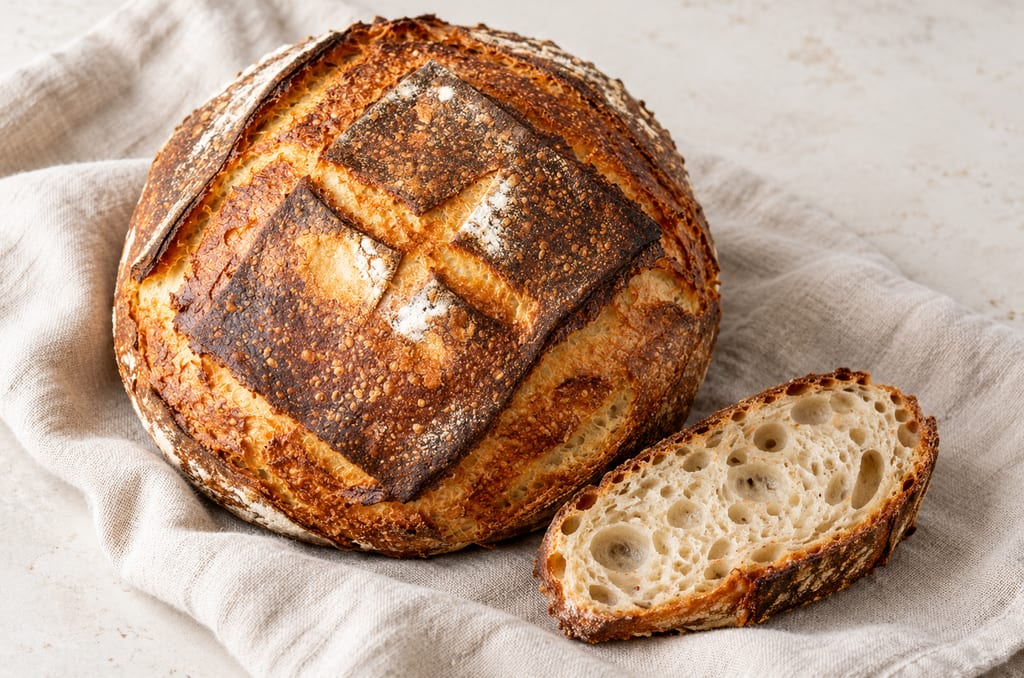
A ripe sourdough starter leavens this modern low-handling loaf. Three hourly folds organize the sticky dough before a long refrigerator rest, final proof and covered bake.
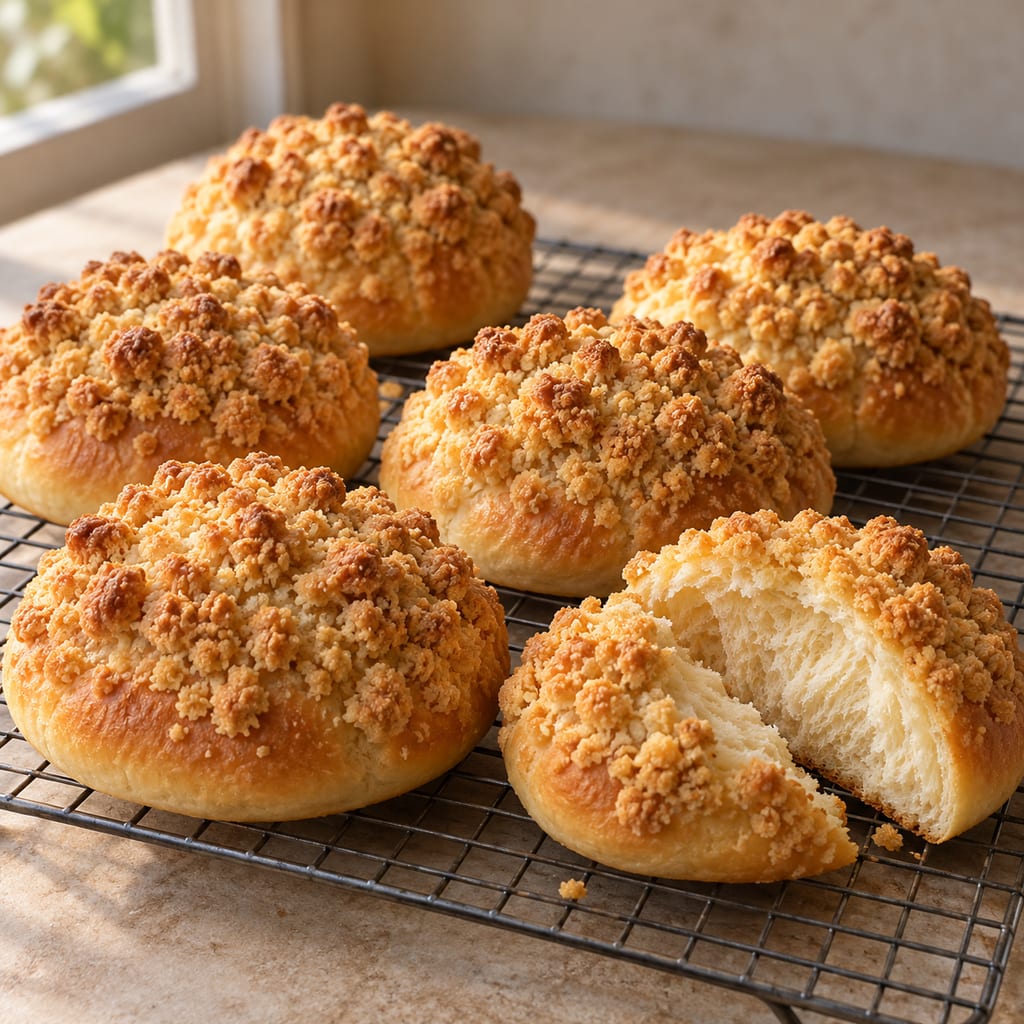
Ten soft, sweet yeast buns with a crisp, peanut butter streusel topping, shaped by hand and baked until golden.
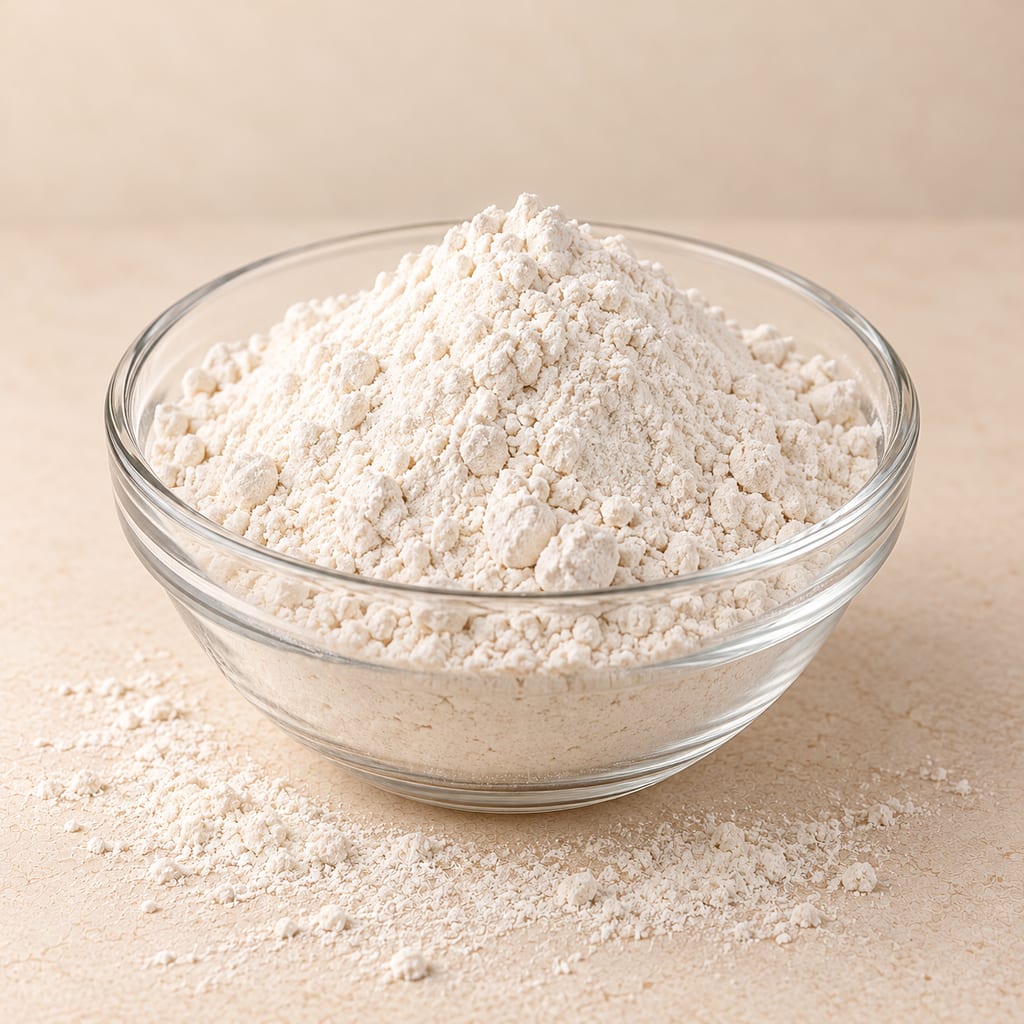
Wheat flour is milled wheat grain, from whole meal to fine white flour, used to make bread, thicken liquids and appear as an optional ingredient in fruit pastes such as Georgian mulberry tklapi.
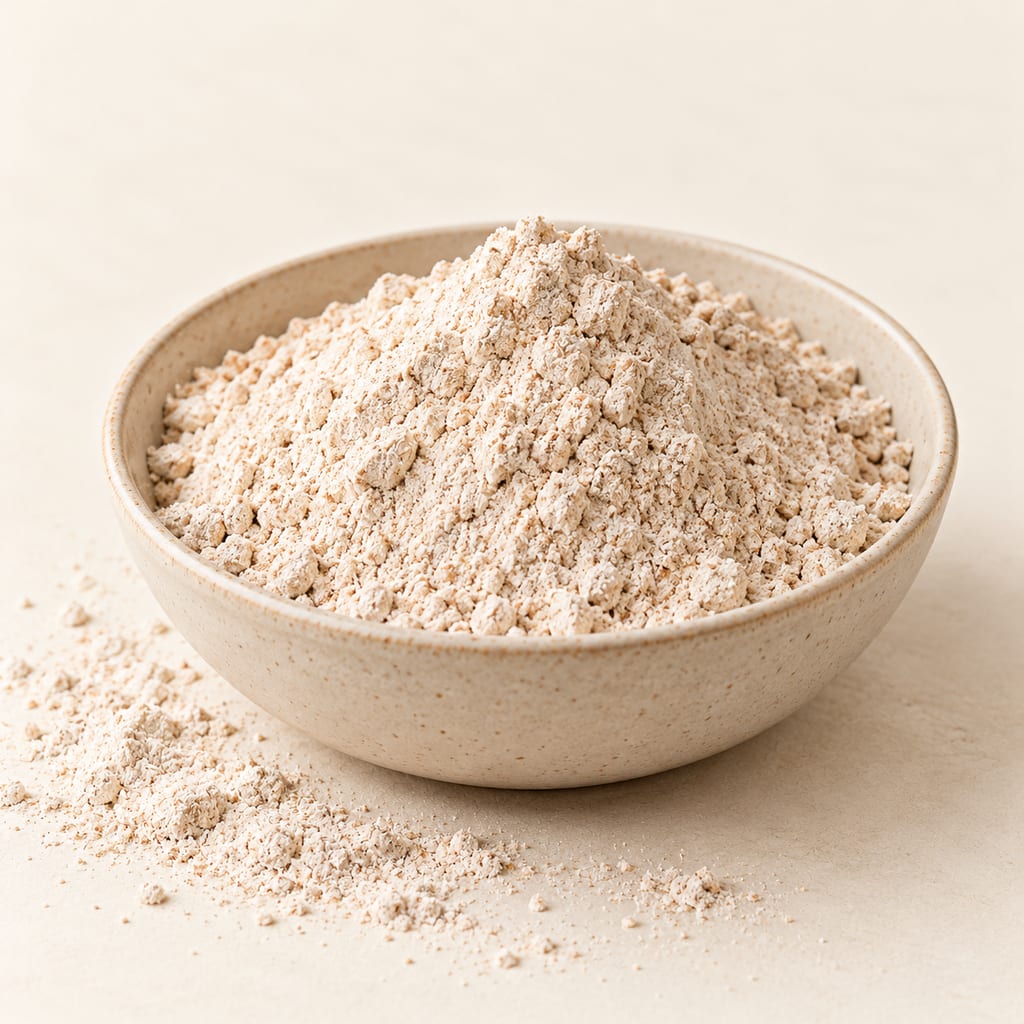
Whole-wheat flour contains the bran, germ and endosperm of wheat in their original proportions. Its fuller grain flavour and dough behaviour depend on the wheat and milling.

A refined common-wheat flour blended for a broad range of baking; its protein and behavior vary with wheat, milling and market.
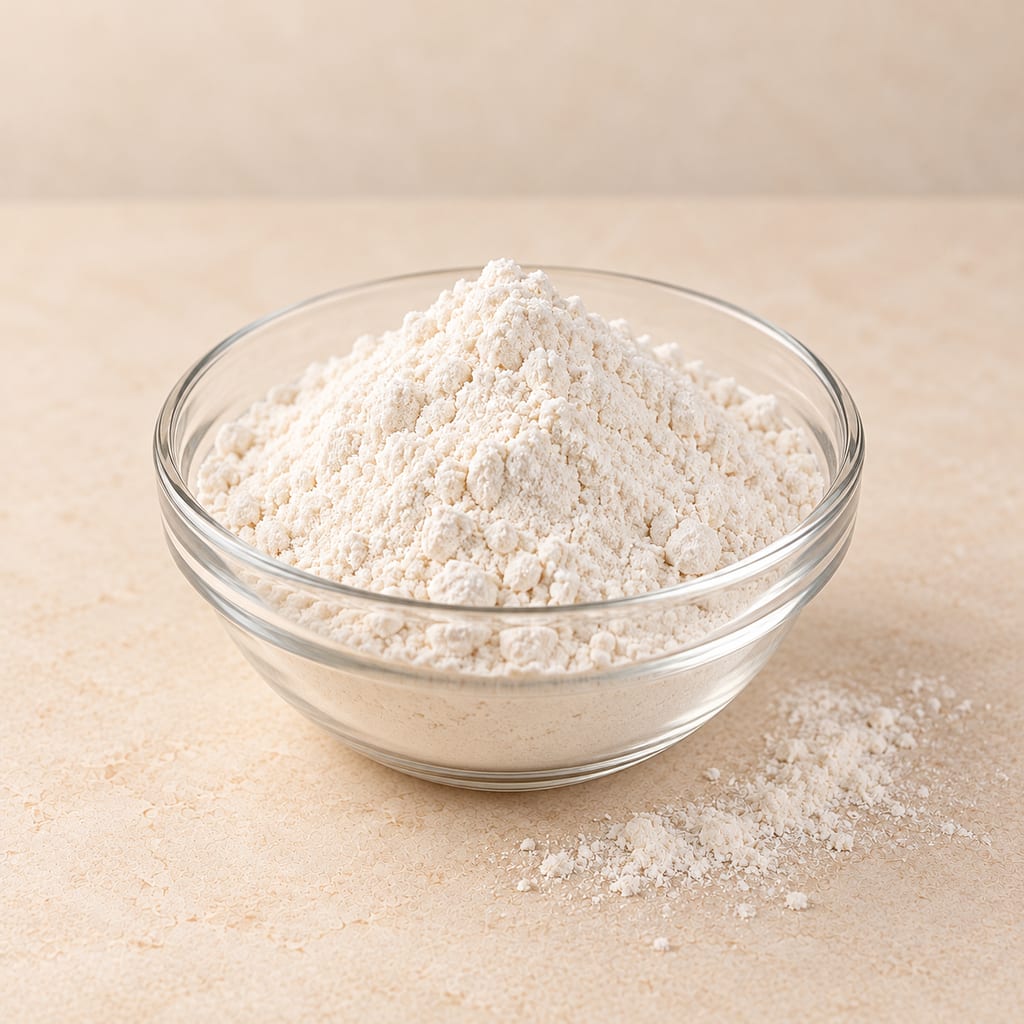
Bread flour and all-purpose flour give yeast dough its gluten network; pan de cristal and pain de mie use them in different ways.
No community contributions have been published for this entry yet.
Sign in to contribute. Published comments and photos are free to read.
USDA Agricultural Marketing ServiceIngredient · Editorial
Flours, Cereal Grain, A-A-20126Hinstitutional flour types and classes and the distinction among bakers', cake/pastry, all-purpose, and whole wheat flour.
Cited in: A name for performance, not a single grain; Choosing a flour for the bread in front of you
USDA Farm Service AgencyIngredient · Editorial
WFBF3 All Purpose Wheat Flour/Bread Flour for use in Export Programsthe wheat classes and protein minima used for this export procurement specification; not presented as universal retail law.
Cited in: A name for performance, not a single grain
King Arthur Baking CompanyIngredient · Editorial
Bread Flourthe maker's own 12.7% protein declaration and example uses.
Cited in: A name for performance, not a single grain; Bran, germ, and the limits of a simple swap; Choosing a flour for the bread in front of you
King Arthur Baking CompanyIngredient · Editorial
What is bread flour?the maker-specific 12.7% versus 11.7% product comparison, gluten-forming proteins, water absorption, and recipe examples; treated as a knowledgeable producer source, not an independent general standard.
Cited in: A name for performance, not a single grain; Choosing a flour for the bread in front of you; Beyond the loaf: structure without leavening
NatureIngredient · Editorial
Einkorn genomics sheds light on history of the oldest domesticated wheatearly wheat domestication context, the distinction of einkorn, bread wheat's ancestry, and Fertile Crescent context.
Cited in: From ancient wheat to the modern flour trade
Proceedings of the National Academy of SciencesIngredient · Editorial
Archaeobotanical evidence reveals the origins of bread 14,400 years ago in northeastern Jordanthe specific statement that bread-like preparations from wild grains predate agriculture; it does not identify the wheat flour sold as bread flour today.
Cited in: From ancient wheat to the modern flour trade
Cereals & Grains AssociationIngredient · Editorial
Chapter 2: Milling, abstract and introductionancient grinding and sieving and the nineteenth-century Hungarian gradual-reduction concept.
Cited in: From ancient wheat to the modern flour trade
Mills Archive TrustIngredient · Editorial
Roller milling: A gradual takeoverthe dated sequence for European roller-mill development, technology, British diffusion, and market context.
Cited in: From ancient wheat to the modern flour trade
Frontiers in NutritionIngredient · Editorial
Wheat quality: A review on chemical composition, nutritional attributes, grain anatomy, types, classification, and function of seed storage proteins in bread making qualitywheat-kernel components, gluten's viscoelastic and gas-retaining role, protein quality, and interactions with non-gluten components.
Cited in: What water reveals: gluten and dough strength; Bran, germ, and the limits of a simple swap; Beyond the loaf: structure without leavening
Cereal ChemistryIngredient · Editorial
Chemistry of wheat gluten proteins: Qualitative compositionhydrated gluten's cohesivity, viscosity, extensibility, elasticity, gas retention, and distinction between gluten concentrate and flour.
Cited in: What water reveals: gluten and dough strength
Food MicrobiologyIngredient · Editorial
Enzymatic and bacterial conversions during sourdough fermentationCereal enzymes convert flour carbohydrates during sourdough fermentation, and the sourdough bacteria carry out further, culture-dependent conversions.
Cited in: What water reveals: gluten and dough strength
Annual ReviewsIngredient · Editorial
Genetic and Phenotypic Characteristics of Baker's Yeast: Relevance to BakingBaking strains of Saccharomyces cerevisiae convert carbohydrate to carbon dioxide, which leavens dough.
Cited in: What water reveals: gluten and dough strength
Cereal ChemistryIngredient · Editorial
The entrainment and evolution of gas bubbles in bread dough—A reviewgas-cell incorporation, expansion, and stabilization mechanisms in breadmaking.
Cited in: What water reveals: gluten and dough strength; Beyond the loaf: structure without leavening
Food HydrocolloidsIngredient · Editorial
Effects of ingredient and processing conditions on the rheological properties of whole wheat flour dough during breadmaking—A reviewReview of how ingredients and processing conditions affect the rheology of whole wheat flour dough in breadmaking.
Cited in: Bran, germ, and the limits of a simple swap
Utah State University ExtensionIngredient · Editorial
Ask an Expert – Gearing Up for Holiday Bakingkeeping flour sealed from heat and moisture, using newer flour in bread, and freezing whole wheat flour for longer quality retention. Its stated advice is source-specific, not generalized as a universal expiry.
Cited in: Storage, freshness, and safety
U.S. Food and Drug AdministrationIngredient · Editorial
Flour Is a Raw Food and Other Safety Factsthe raw flour hazard, field/milling contamination pathway, and advice not to taste raw flour, dough, or batter.
Cited in: Storage, freshness, and safety
U.S. FDAAllergen
What is a major food allergen?Wheat is one of the nine major food allergens under U.S. allergen labeling requirements (milk, egg, fish, crustacean shellfish, tree nuts, wheat, peanuts, soybeans, sesame).
Cited in: Storage, freshness, and safety
U.S. National Institute of Diabetes and Digestive and Kidney DiseasesDietary context
Definition & Facts for Celiac DiseaseCeliac disease is triggered by gluten, a protein in wheat, barley and rye; treatment is a strict gluten-free diet.
Wheat allergy is a different immune reaction and does not cause long-term damage to the small intestine.
Cited in: Storage, freshness, and safety
Foods (MDPI); Alzuwaid, Pleming, Fellows, Laddomada and SissonsMechanism
Influence of Durum Wheat Bran Particle Size on Phytochemical Content and on Leavened Bread Baking QualityAdded bran can dilute gluten-forming proteins, restrict the water available to gluten and disrupt gluten development, leaving a network less able to hold gas; finer bran fractions had the largest negative effect on bread quality.
Cited in: Bran, germ, and the limits of a simple swap
Food Chemistry; Poudel and Rose (University of Nebraska-Lincoln record)Storage mechanism
Changes in enzymatic activities and functionality of whole wheat flour due to steaming of wheat kernelsWhole wheat flour stored after milling develops free fatty acids through lipase activity (hydrolytic rancidity); steaming the kernels cut lipase activity by up to 81% and reduced free fatty acid build-up in storage, but did not change lipid oxidation in the stored flour.
Cited in: Storage, freshness, and safety
University of Nebraska-Lincoln; Doblado-Maldonado (master's thesis, 2012)Storage
New Technologies for Whole Wheat Processing: Addressing Milling and Storage IssuesMilling and storage of whole wheat flour present particular difficulties; lipolytic activity limits its shelf life, and salt added at tempering inhibited lipase and gave better baking performance after six months of storage.
Cited in: Storage, freshness, and safety