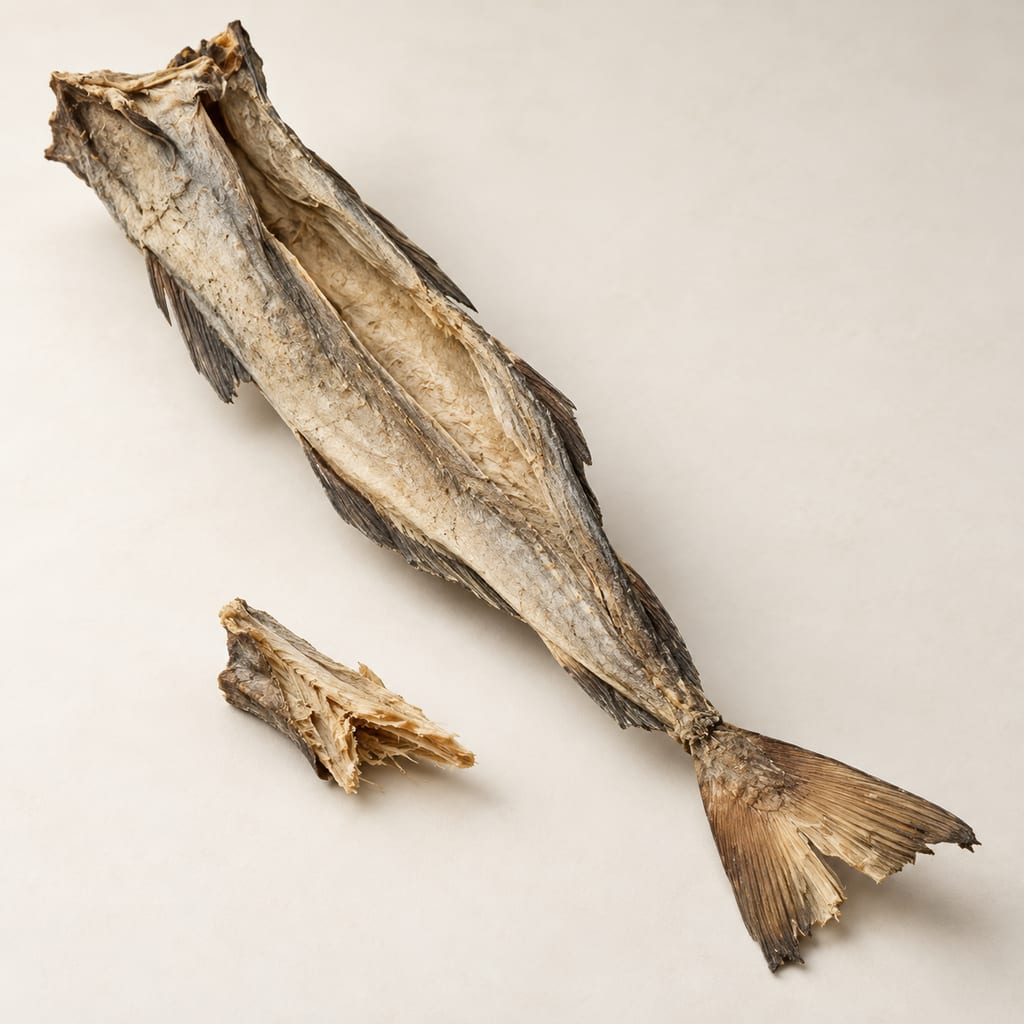
Stockfish
Cod hung on open racks in cold northern air until most of its water has gone, leaving a hard, light, unsalted fish that keeps and travels and must be soaked for days before cooking.
 FermenteaWhere food goes to change
Traditional method
Stocco all'anconetana · Ancona-style stockfish
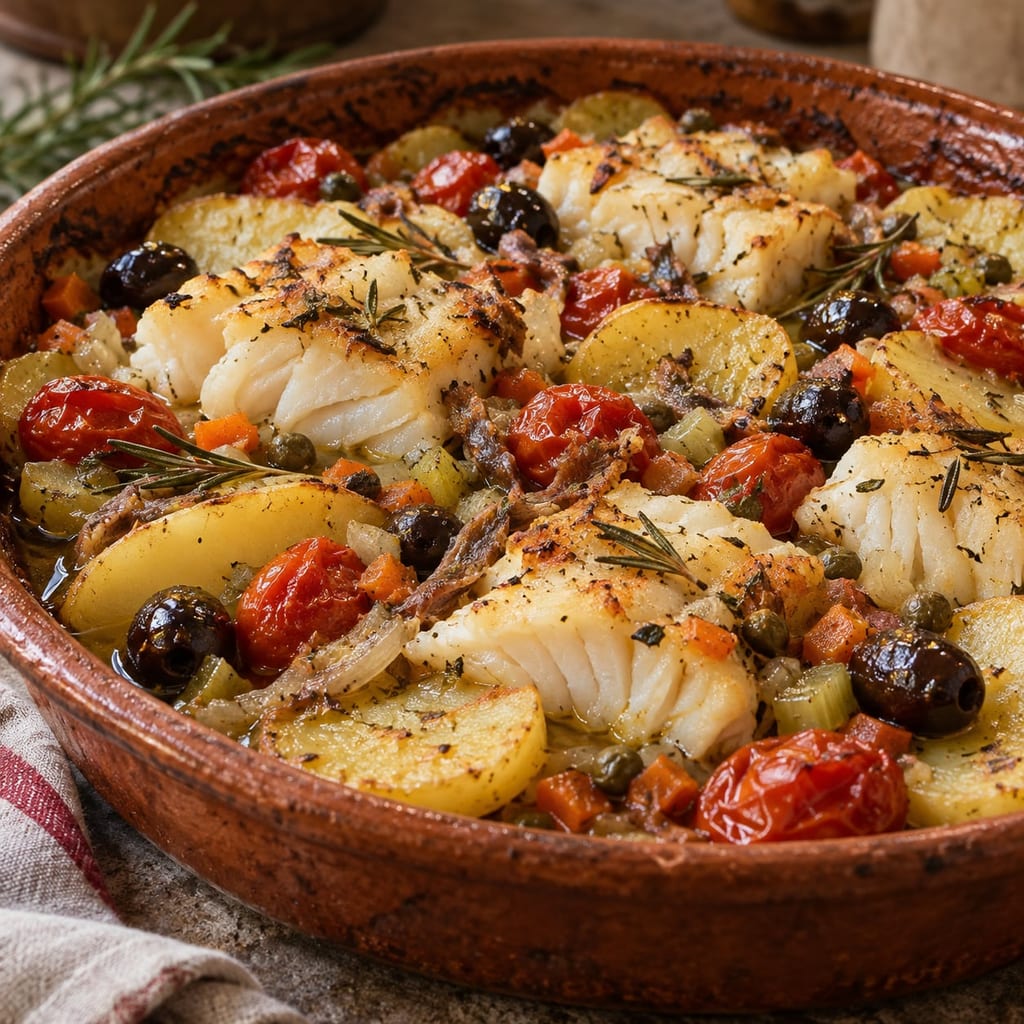
Ancona's baked stockfish: thick pieces layered with potatoes, tomatoes, olives, capers and anchovy under olive oil and white wine, cooked slowly in a covered dish.
Ancona is a port city on Italy's Adriatic coast, and its most characteristic stockfish preparation reflects the movement of goods through that port.
Stoccafisso all'anconitana, also written stocco all'anconetana, combines rehydrated Norwegian-style stockfish with potatoes, tomatoes, olives, olive oil, white wine and aromatic vegetables.
It is a substantial, slowly cooked dish in which the fish and vegetables share a concentrated cooking liquid.
Unlike Venetian mantecato, the fish is not beaten into a cream. Unlike Vicentine bacalà, the dominant sauce is based on oil, vegetables, tomato and wine rather than milk.
The characteristic appearance is a deep casserole with fish pieces, potatoes and olives, carrying red and green highlights from tomatoes and herbs.
The combination is strongly associated with Ancona's local culinary identity.
The name identifies the prepared dish and its city, not a particular grade or species of fish.
Use unsalted air-dried stockfish. Substituting salted cod changes the desalting requirements and seasoning.
Italian — Stoccafisso all'anconitana
Local alternative — Stocco all'anconetana
English — Ancona-style stockfish
Italian ingredient — Stoccafisso
Norwegian — Tørrfisk
Scientific name — Usually Gadus morhua
Ancona's maritime trade made imported dried fish economically practical.
The city's tourism authority associates the local tradition with the seventeenth century, describing stockfish as part of family and maritime cookery from around the 1600s.
It identifies northern European trade routes, including vessels engaged with English and North Sea ports, as relevant to the fish's arrival.
One named merchant is Balthasar Van der Goes, a Flemish trader associated with Ancona and the importation of stockfish.
These details provide a more specific commercial context than simply attributing every Italian dried-fish dish to Venice.
However, the presence of stockfish in Ancona during the seventeenth century does not establish that the complete contemporary recipe, including its present proportions of tomatoes, potatoes and olives, was already prepared identically.
The formula developed within a changing food economy.
Tomatoes, for example, became increasingly important in Italian cooking after their introduction from the Americas. The presence of tomato in the modern casserole cannot be used as evidence that precisely this dish existed in earlier medieval centuries.
What can be established is the long association between Ancona, northern imported stockfish and a rich local fish preparation.
The dish remains particularly associated with family meals and festive occasions, including Christmas.
Several features distinguish the Ancona style.
The first is the use of stockfish in substantial pieces.
The second is the combination of fish with potatoes. Potatoes absorb the cooking liquid while contributing starch as they soften.
The third is the aromatic base of onion, carrot, celery and garlic.
The fourth is the inclusion of preserved savoury ingredients such as anchovies and capers, which provide concentrated salt and flavour.
Olives add a separate briny and slightly bitter dimension.
Tomatoes provide acidity, sweetness, colour and moisture.
White wine adds further acidity and aroma.
Rosemary gives the finished dish a resinous herbal character that stands up to the preserved fish.
The traditional municipal recipe additionally includes tuna in the chopped seasoning mixture. The simplified editorial version omits it.
This omission should be acknowledged, since it changes the depth and composition of the aromatic base.
Ancona's municipal recipe specifies, for four people:
The published recipe arranges the stockfish in a deep baking dish and incorporates the finely chopped aromatics.
Potatoes are placed over the fish, with tomatoes and olives distributed through the dish.
The cooking liquid must reach the bottom of the vessel.
The municipal instructions call for oven cooking lasting more than two hours, but do not give a precise oven temperature.
The high quantity of oil is an important feature of that particular formulation. A reduced-oil interpretation is possible, but it is not the same recipe.
Already soaked and cleaned stockfish — 1 kg
Potatoes — 1.5 kg
Small round tomatoes — 400 g
Olives — 250 g
Extra-virgin olive oil — 500 g
White wine, preferably Verdicchio — 2 glasses
Celery, carrot, onion, garlic, rosemary, anchovies, tuna, capers — Not individually quantified
The dish depends upon slow heat transfer through a layered mixture of fish, vegetables, oil and liquid.
As the casserole heats, water from the tomatoes, wine and added liquid becomes a major cooking medium.
The oil disperses around the ingredients, coating fish and vegetables while carrying oil-soluble aromatic compounds.
The vegetables soften because heat changes their cellular structure. Cell walls lose rigidity, and components of the plant tissue begin to disperse.
Potato starch gelatinizes as the potatoes cook and absorb water. Some starch can escape from the cut surfaces, contributing body to the surrounding sauce.
Fish proteins denature as their temperature rises, changing the flesh from relatively translucent to opaque and flaky.
The preserved fish contributes dissolved flavour compounds and protein fragments to the liquid.
This is not a microbial fermentation during cooking. The dish uses preservation-derived flavour from the stockfish, followed by conventional heat cooking.
Acidity from tomatoes and wine changes the flavour balance but does not make the preparation microbiologically safe at room temperature.
Serves 4 · Approximately 2 hours after rehydration · Not kitchen-tested
1. Prepare the oven. Heat to 160°C.
2. Make the aromatic mixture. Finely chop the onion, carrot, celery and garlic. Combine them with rinsed capers, chopped anchovies and rosemary.
Mix in half the olive oil.
3. Build the first layer. Spread half the aromatic mixture across the bottom of a deep, covered baking dish.
4. Add the fish. Arrange the stockfish pieces above the vegetables.
Distribute the remaining aromatic mixture over the fish.
5. Add tomatoes and olives. Halve the tomatoes and arrange them with the olives around the fish.
6. Cover with potatoes. Lay the potato slices over the fish, creating a fairly even upper layer.
7. Add the cooking liquid. Pour the wine and water around the edges. Drizzle with the remaining olive oil.
The liquid should reach the lower part of the casserole without washing all the seasoning from the fish.
8. Bake. Cover tightly and cook for 90 minutes.
9. Test tenderness. Check a thick fish piece and a potato slice. Continue covered for another 15–30 minutes if necessary.
Add a little hot water if the bottom begins to dry.
10. Finish. If the sauce is excessively watery, uncover briefly to allow controlled evaporation.
Taste before adjusting salt, then rest for 10 minutes before serving.
This method differs from the traditional reference both in cooking temperature specification and oil quantity. The covered baking method is an editorial simplification.
The vegetables and liquid at the bottom form a protective cooking environment for the fish.
The potato layer helps retain moisture while allowing the upper surfaces to cook through.
If the casserole dries excessively, the bottom vegetables may burn before the fish becomes tender.
If too much liquid is added, the dish can become a thin stew rather than a rich baked preparation.
The intended result is moist and cohesive.
Layering also reduces the need for stirring. This helps preserve the shape of the stockfish pieces.
When portions are served, the fish should remain identifiable among potatoes and vegetables.
Versions of Ancona-style stockfish differ in the proportions of olives, tomatoes and potatoes.
Some cooks use more oil, while others prepare relatively restrained modern versions.
Some include tuna in the seasoning mixture, in keeping with the municipal reference. Others omit it.
Different olive varieties affect both saltiness and bitterness.
Verdicchio is a locally meaningful wine choice, but the precise characteristics of the final sauce also depend on the wine's acidity and aroma.
Fresh tomatoes can vary substantially with season. A preparation made with ripe summer tomatoes will differ from one using comparatively acidic or watery fruit.
The dish can be prepared with different stockfish grades. However, that introduces differences in texture and cooking time rather than a separate regional dish.
The casserole is normally presented as a main course.
The potatoes make it relatively complete, although bread can be useful for absorbing the cooking liquid.
The finished fish should separate into firm but tender flakes.
The potatoes must be cooked through, without a chalky centre.
The sauce should be savoury and aromatic, with enough liquid to coat the ingredients but not so much that everything floats separately.
The olives should remain recognizably intact or in pieces, depending on preparation.
The potatoes remain hard. Check thickness, liquid and heat. Continue cooking rather than increasing heat abruptly.
The fish is chewy. Rehydration may have been incomplete. Continue gentle cooking where appropriate, but recognize that an inadequately hydrated centre may remain problematic.
The sauce tastes aggressively salty. Anchovies, olives and capers all contribute salt. Add final seasoning only after tasting.
The bottom scorches. The casserole may have become too dry or the cooking vessel may be poorly suited to prolonged heating.
The sauce is thin. Uncover briefly and reduce carefully. Avoid vigorous stirring, which can break up the fish and potatoes.
The fish falls apart excessively. Overcooking or mechanical disturbance may be responsible. Use a wide serving spoon and lift rather than mix.
Keep stockfish refrigerated below 4°C throughout rehydration.
Cook the fish thoroughly, using 63°C as the published safe internal-temperature reference.
Do not treat the wine, tomato acidity or olive oil as substitutes for temperature control.
Prepared leftovers contain perishable seafood and must be cooled and refrigerated promptly.
Allergens include fish and potentially celery. Check commercial anchovy and other prepared ingredients for additional allergen declarations.
Ancona is a port, and its best-known stockfish dish reflects what moved through that port. Maritime trade made imported dried fish economically practical, and the routes named run north rather than through Venice: northern European trade, including vessels engaged with English and North Sea ports, and at least one named merchant, the Flemish trader Balthasar Van der Goes. What can be established is a long association between the city, imported northern stockfish and a rich local preparation of it; what cannot is that the present formula existed in that form, because it developed inside a changing food economy and its tomatoes arrived from the Americas. The dish's identity is built from four decisions. The fish stays in substantial pieces rather than being beaten or flaked. It is cooked with potatoes, which absorb liquid and give up starch as they soften. It rests on an aromatic base of onion, carrot, celery and garlic, strengthened with concentrated savoury preserved ingredients, anchovies and capers in this version and tuna as well in the municipal one. And it carries olives, tomatoes, white wine and rosemary, which between them bring brine, acidity, sweetness, colour and a resinous herbal note robust enough to stand beside preserved fish. Compared with its Veneto relatives the difference is structural: Venetian mantecato beats the fish into a cream, Vicentine bacalà builds its sauce on milk, and Ancona's is built on oil, vegetables, tomato and wine. It remains a dish for family meals and festive occasions, Christmas among them.
Scaling: source batch only
Soaking reverses the drying that made the fish stable, so for the days it takes, the fish is perishable raw seafood and has to be kept cold and the water changed.
Hazard sourceThe potato layer traps moisture and hides the fish, so the centre of a substantial piece can still be short of temperature when the surface of the dish looks finished.
Hazard sourceTomato, wine and olive oil change the flavour balance but do nothing to make a seafood casserole safe at room temperature, and a dish left out after baking is not protected by them.
Hazard sourceBesides the fish itself, the dish contains celery, and commercial anchovy and other prepared ingredients can carry further allergen declarations of their own.
Hazard sourceKeep the stockfish refrigerated throughout rehydration
Control sourceCheck the thickest piece of fish rather than judging the dish by its surface
Control sourceCool and refrigerate leftovers promptly, treating them as perishable cooked seafood
Control sourceKeep the liquid at a level that reaches the lower part of the dish, topping up with hot water if the bottom dries
Control sourceThe wine, the tomato acidity and the olive oil are not substitutes for cooking the fish through and chilling the leftovers.
This dish contains fish and celery, and commercial anchovies and other prepared ingredients may carry further allergen declarations.
The municipal recipe's 500 g of oil and this version's 70 ml are two different formulations; picking a figure in between produces a dish neither source describes.
The municipal reference gives no oven temperature, and the 160°C here belongs to the simplified version alone.
An inadequately hydrated centre stays chewy however long the casserole bakes, and raising the oven temperature will not fix it.
This simplified version has not been kitchen-tested.
A locality-level association: the dish carries the city's name and the municipality publishes a reference formulation for it. The seventeenth-century date attaches to stockfish arriving and being eaten in Ancona, not to this recipe's proportions.
A region-level association for the household versions and the local wine choice. Verdicchio is meaningful locally but is a preference in the municipal recipe rather than a requirement, and no single regional formulation is implied.
Cod hung on open racks in cold northern air until most of its water has gone, leaving a hard, light, unsalted fish that keeps and travels and must be soaked for days before cooking.
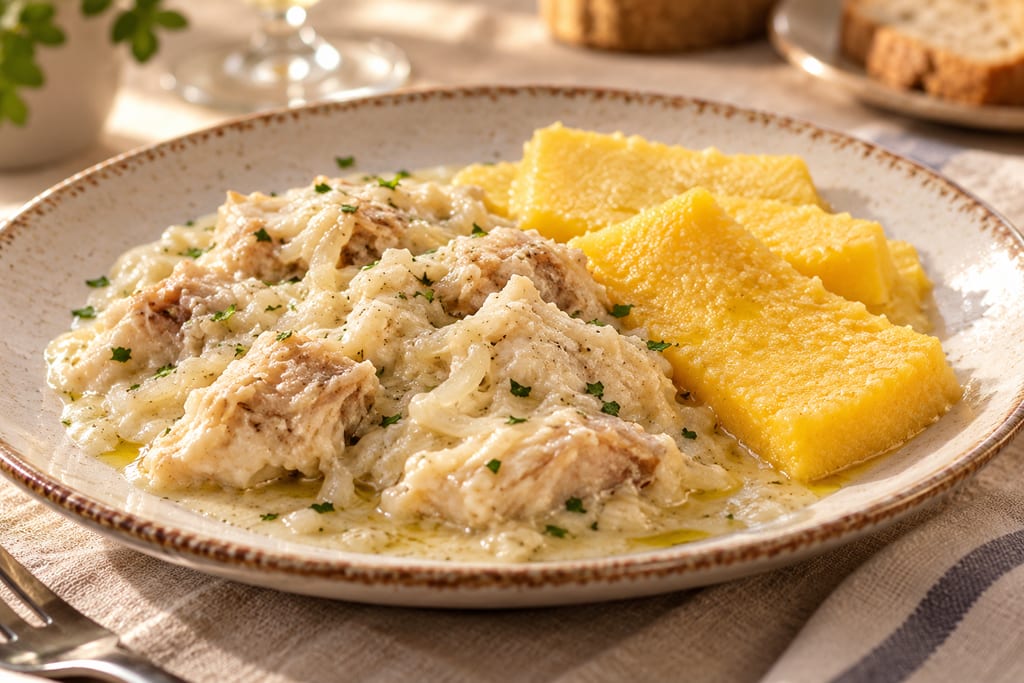
Stockfish from Vicenza, left barely bubbling for hours with onion, preserved anchovy, olive oil, milk and a little cheese until it is tender under a dense pale sauce, and eaten with polenta.
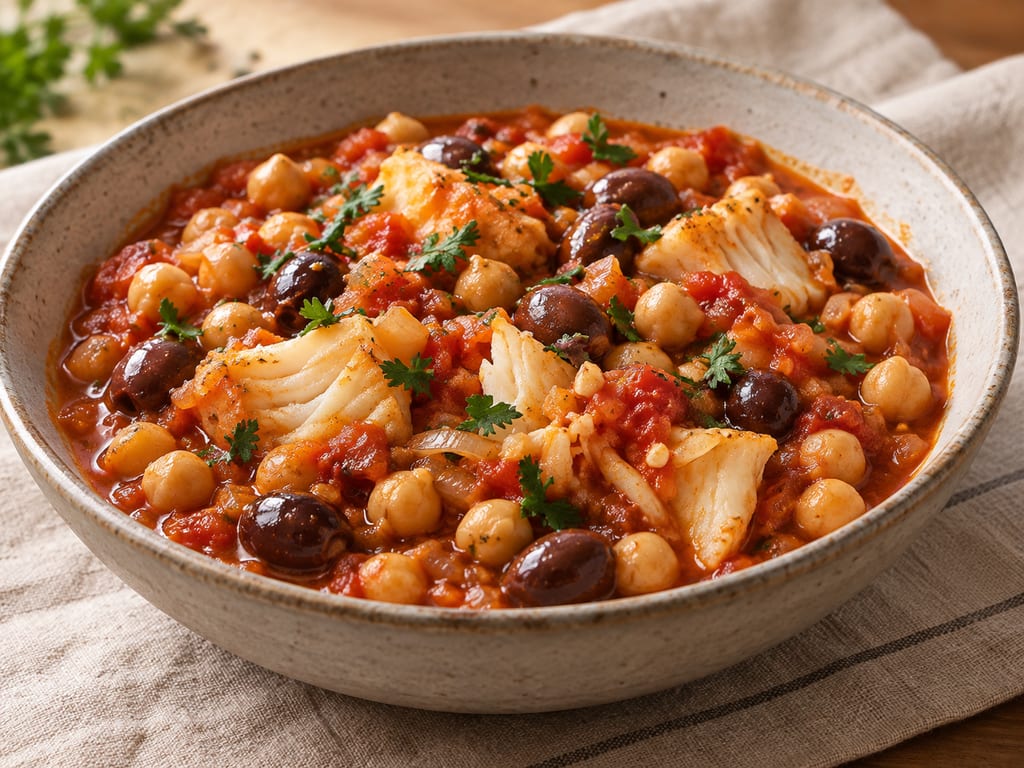
A contemporary Mediterranean-style stew in which poached stockfish flakes are folded into a paprika-spiced tomato sauce with cooked chickpeas and olives.
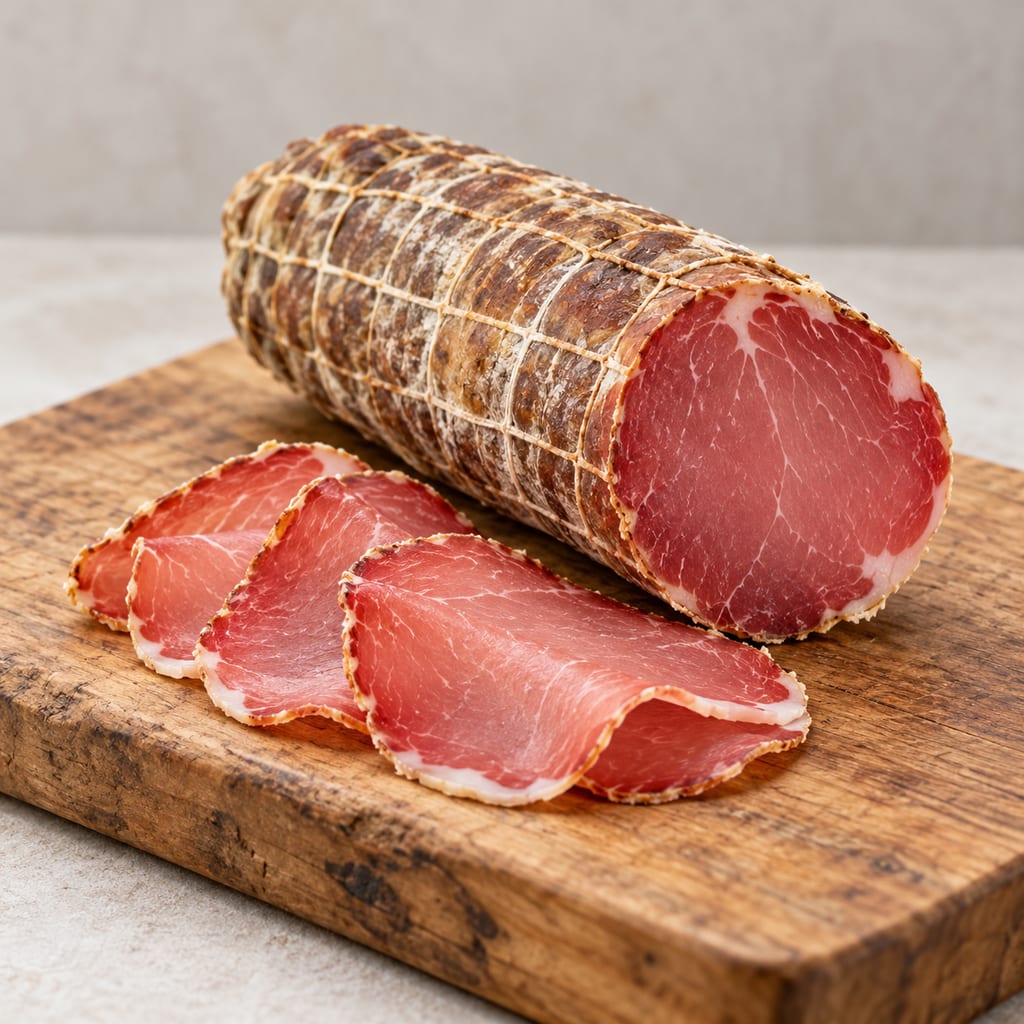
Documentary account of Italian regional cured-loin traditions, including Tuscan and Marche variations; no home-cure instructions are provided because the published professional methods lack validated safety controls.
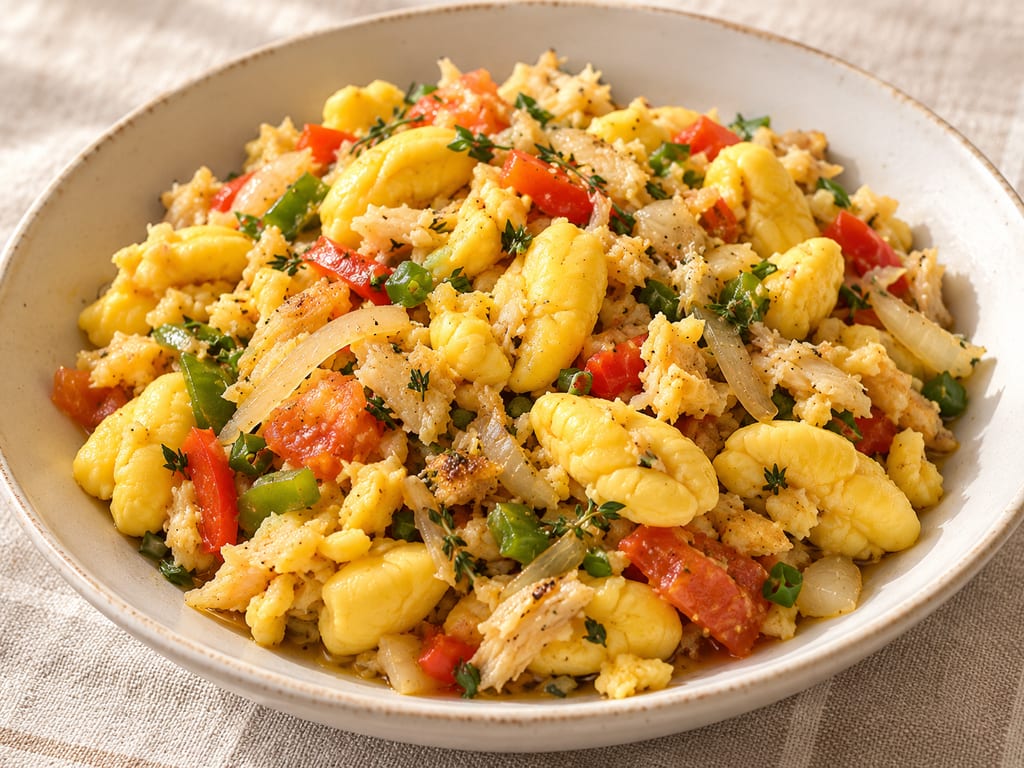
Jamaica's best-known dish: salt-cured cod desalted and flaked, then folded through ackee arils with onion, tomato, sweet pepper, thyme and Scotch bonnet.
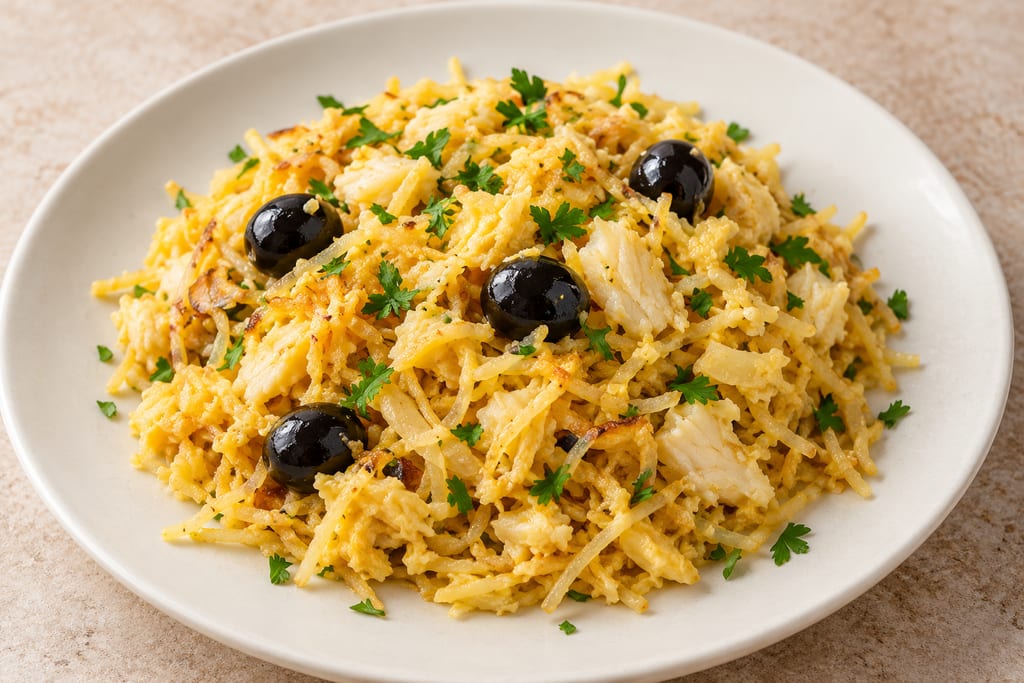
Lisbon's salt cod dish: shredded desalted cod and fine fried potato matchsticks folded through softened onion and bound with beaten egg, finished with parsley and black olives.
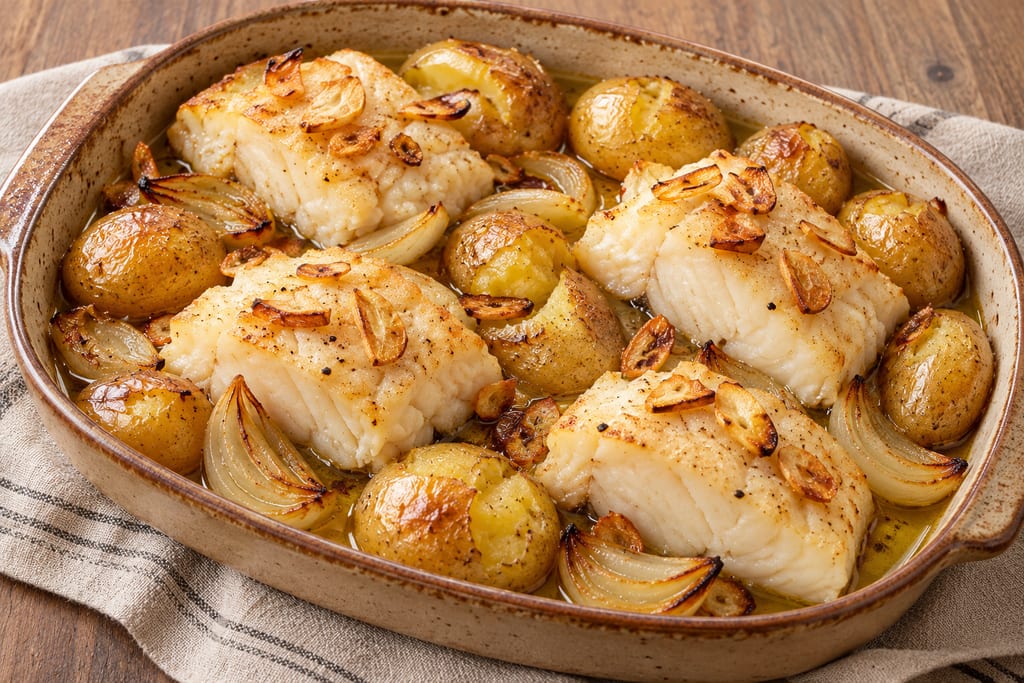
Thick pieces of desalted salt cod roasted in olive oil with garlic and onion, served with small potatoes cooked and then crushed until their skins split.
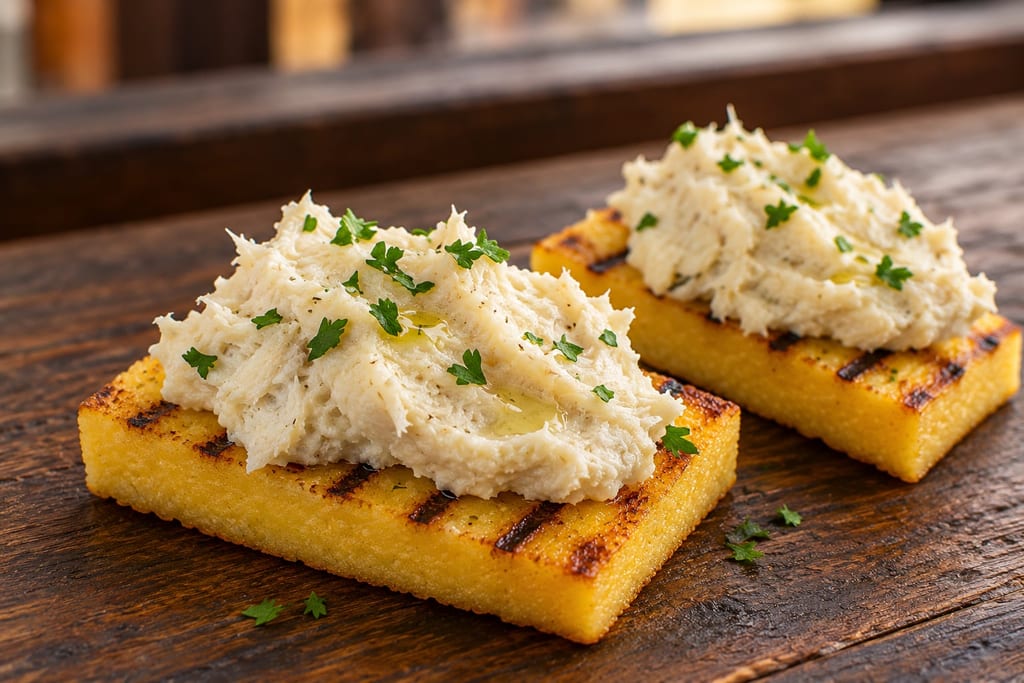
A Venetian cicchetto of cooked unsalted stockfish beaten with oil until it turns into a pale, aerated cream, spooned onto grilled polenta in the city's wine bars.
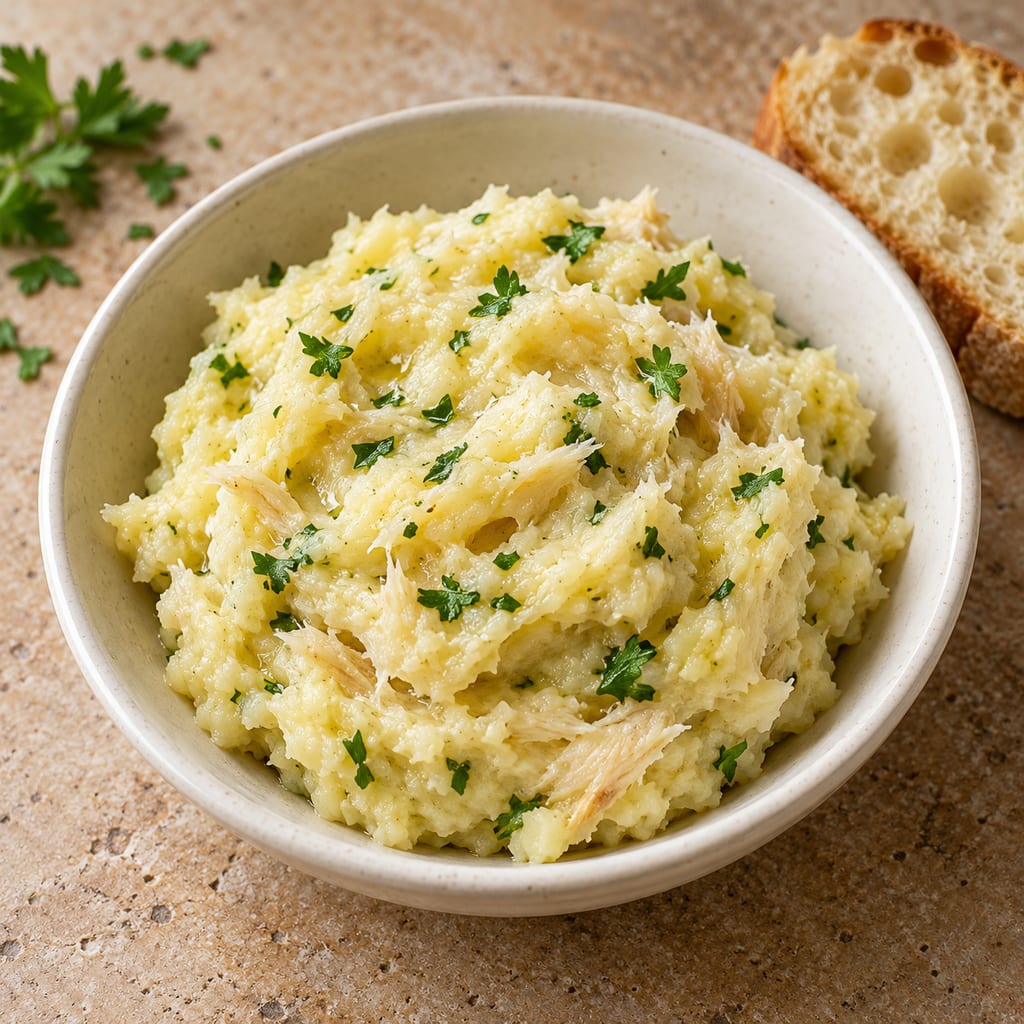
An Istrian festive spread of cooked stockfish beaten with olive oil and garlic until pale and cohesive, here bulked out with hand-mashed floury potato.
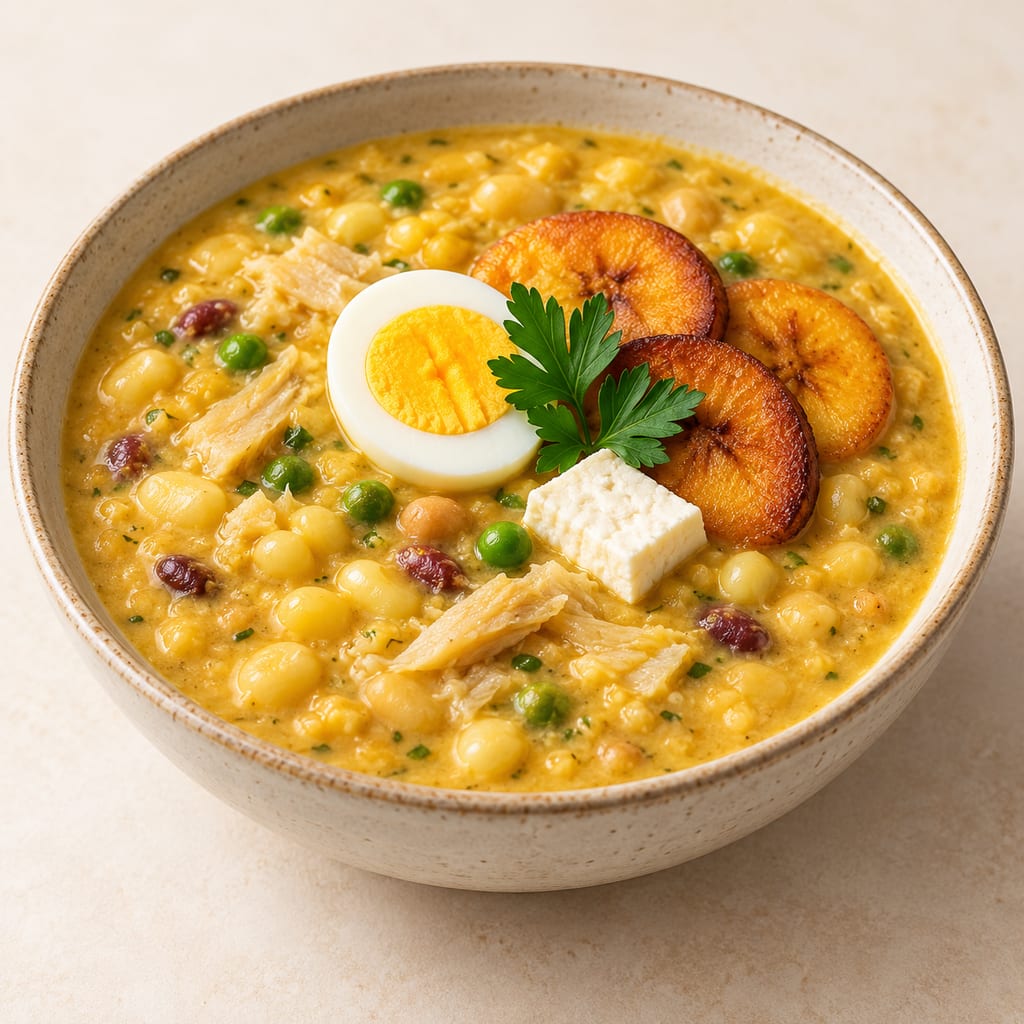
Ecuadorian Holy Week soup of tender grains and pulses, squash, milk and salted fish, thickened with peanut paste and served with contrasting garnishes.
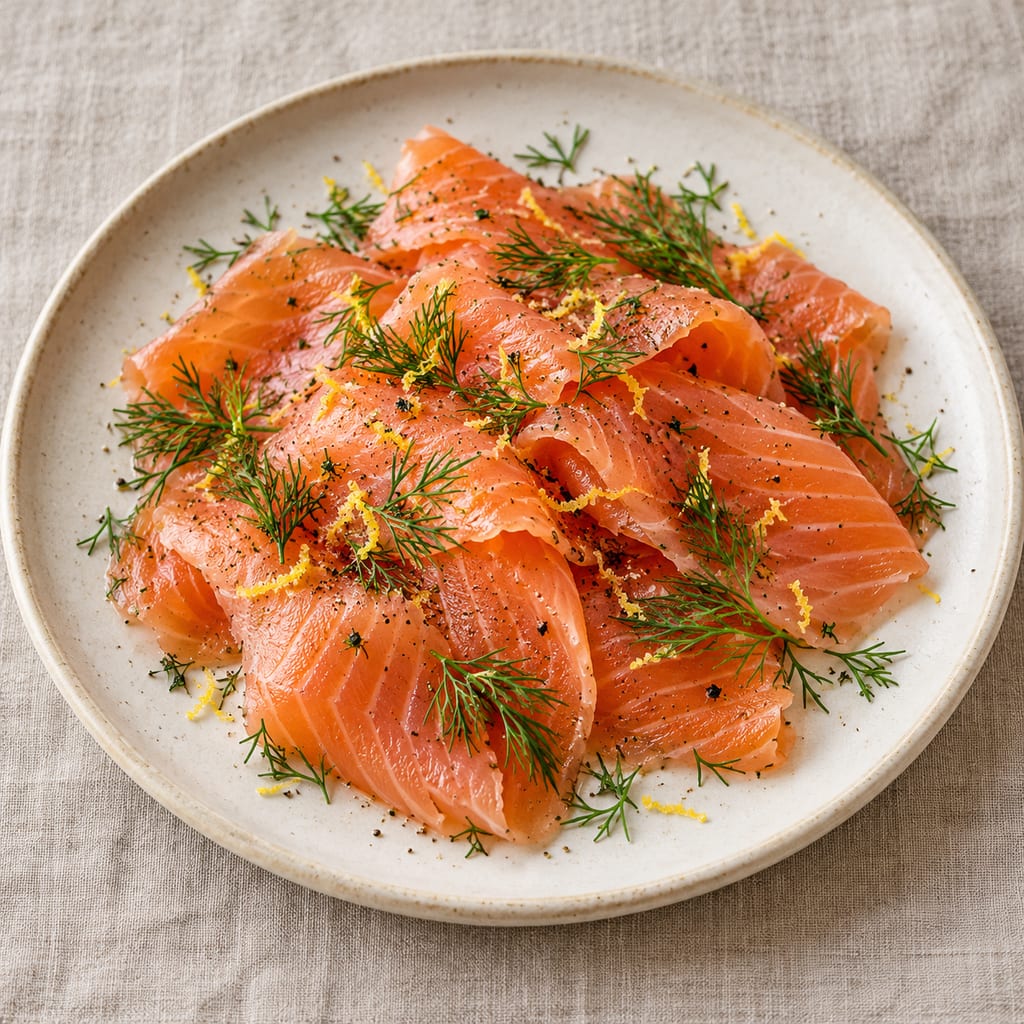
Salmon is cured with salt, sugar, pepper, dill and lemon zest under refrigeration.
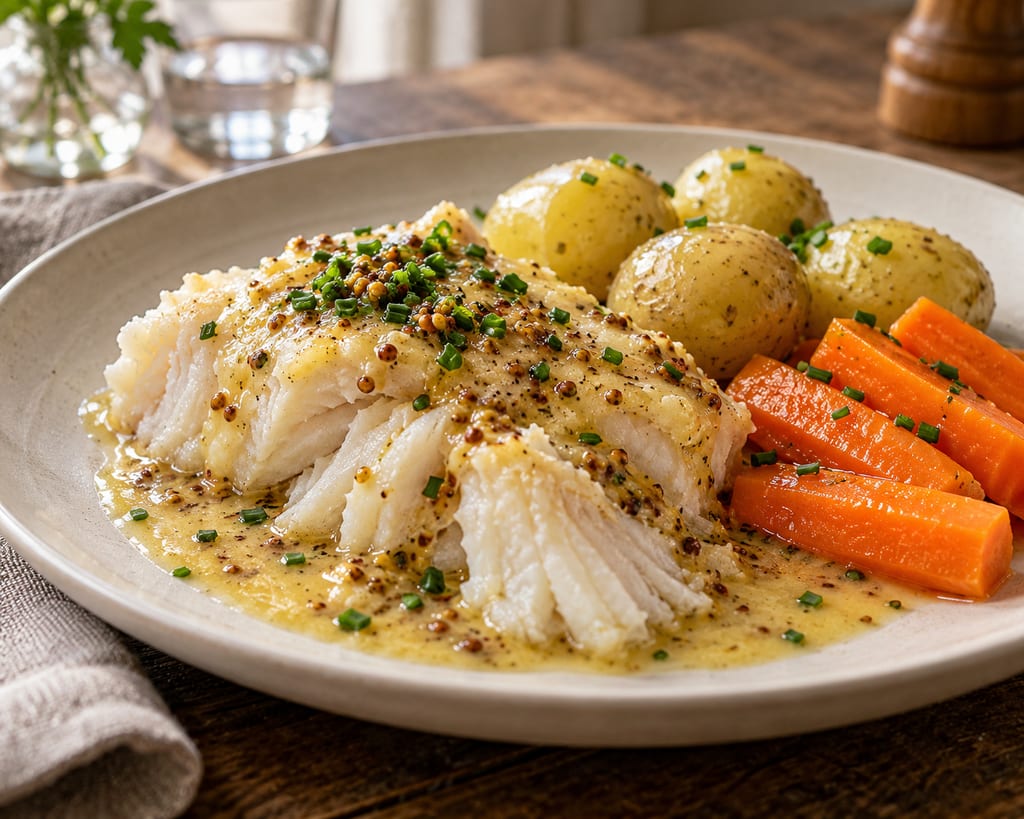
Rehydrated air-dried Norwegian cod simmered until it flakes, served with boiled potatoes and carrots under a wholegrain-mustard butter whisked from the fish's own poaching liquid.
No community contributions have been published for this entry yet.
Sign in to contribute. Published comments and photos are free to read.
Comune di AnconaMethod
Comune di Ancona — Stoccafisso all'anconitanaThe municipal reference formulation for four people: 1 kg already soaked and cleaned stockfish, 1.5 kg potatoes, 400 g small round tomatoes, 250 g olives, 500 g extra-virgin olive oil, two glasses of white wine preferably Verdicchio, and celery, carrot, onion, garlic, rosemary, anchovies, tuna and capers without individual quantities.
Its construction: the stockfish arranged in a deep baking dish with the finely chopped aromatics worked in, potatoes placed over the fish, tomatoes and olives distributed through the dish, and the cooking liquid reaching the bottom of the vessel.
Oven cooking lasting more than two hours, with no precise oven temperature given.
Tuna belongs to the chopped seasoning mixture in this reference recipe.
Cited in: The stockfish dish of Ancona; A distinctive combination; The municipal reference formulation; The chemistry of the casserole; Recipe: simplified Ancona-style stockfish; Method; Why the layers matter; Regional and household variations; Troubleshooting
Ancona TourismHistory
Ancona Tourism — Local fish dishes and historical trading connectionsThe local stockfish tradition associated with the seventeenth century, described as part of family and maritime cookery from around the 1600s.
Northern European trade routes, including vessels engaged with English and North Sea ports, as the route by which the fish arrived, and the Flemish trader Balthasar Van der Goes as a named merchant associated with Ancona and the importation of stockfish.
The dish's continuing association with family meals and festive occasions, including Christmas.
Cited in: The stockfish dish of Ancona; How stockfish reached the Adriatic; Serving and recognition
La Cucina ItalianaMethod
La Cucina Italiana — Stocco all'anconetanaA published stocco all'anconetana, used for the alternative local spelling and for the range of household versions, which differ in the proportions of olives, tomatoes and potatoes, in how much oil they use and in whether tuna is included.
Cited in: Names and ingredients; Method; Regional and household variations; Serving and recognition
Norwegian Seafood CouncilMethod · Safety
Norwegian Seafood Council — Stockfish preparationPreparation of dry unsalted stockfish: soaking in cold water with regular changes over 7 to 8 days, up to 10 for particularly dry fish, with the fish and water below 4°C, and the skin and bones removed after hydration.
Substituting salted cod changes the desalting requirement and the seasoning, because it is a different product.
Cited in: Names and ingredients; Food safety
FoodSafety.govSafety
FoodSafety.gov — Fish cooking temperaturesThe published safe minimum internal temperature for fish, 63°C.
Cited in: Food safety