Equipment

626 sourced equipment pages: vessels, tools, appliances and built structures.

Everything

19 items

Built structures

Evenki log-lined ground store (saiva)

A saiva is an Evenki log-lined ditch used to hold meat containers at summer reindeer camps. Contemporary fieldwork documents its use in Buryatia and Zabaikal, but gives no standardized plan or food-safety validation.
Pits and cavities
Buryatia
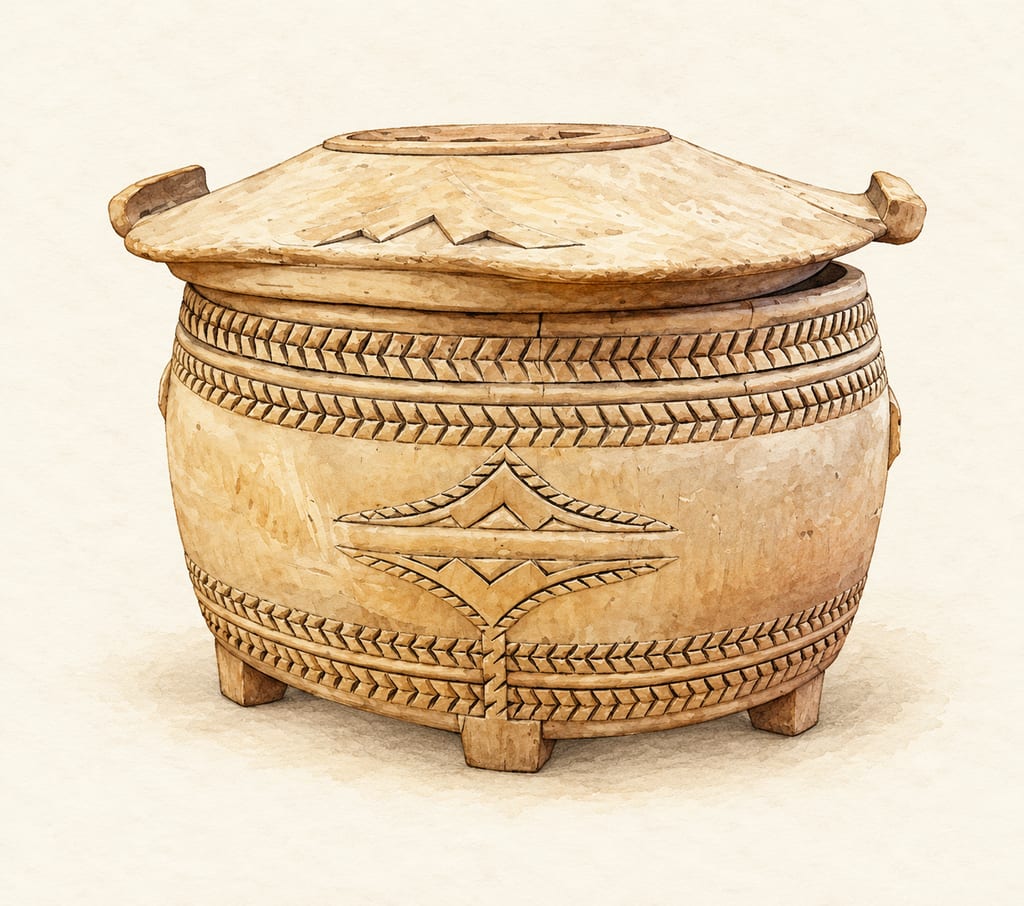
Historical watercolor illustration of one Bashkir tepen, a low pale lindenwood serving tub with a fitted lid, carved bands, four feet and projecting handles.
Equipment

Tepen (Bashkir limewood serving tub)

Tepen (тәпән) is a low Bashkir hollowed-linden tub used for serving kumys. A National Museum of Bashkortostan object preserves one carved, lidded example; the taller siläk tub had a different preparation role.

Tanks and vats
Bashkortostan
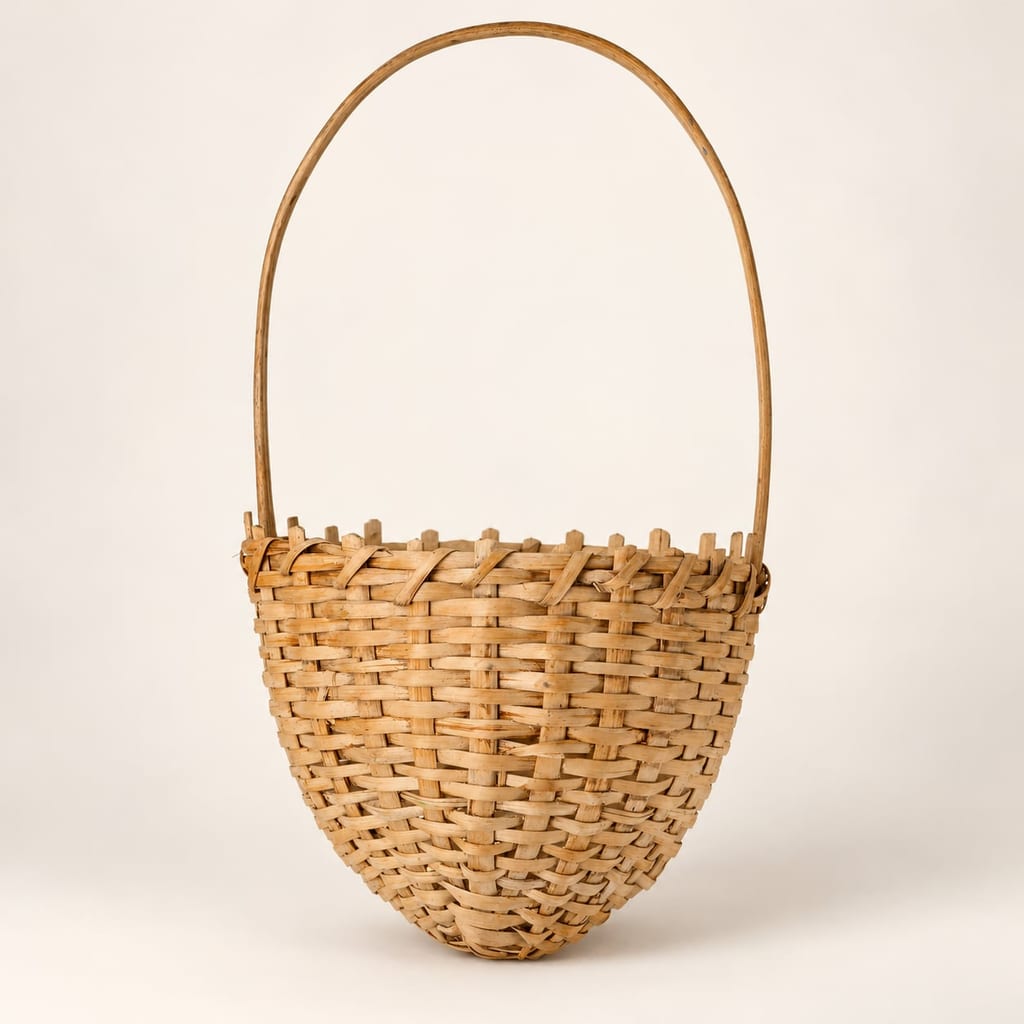
Reference-grounded image of a traditional Adyghe cheese basket woven from willow, with an open tapered body and tall arching handle.
Equipment

Woven cheese basket

An Adyghe cheese mould of woven willow drains fresh curd and leaves a ridged impression; a museum specimen records the traditional wooden form.

Strainers, moulds and hoops
Adygea
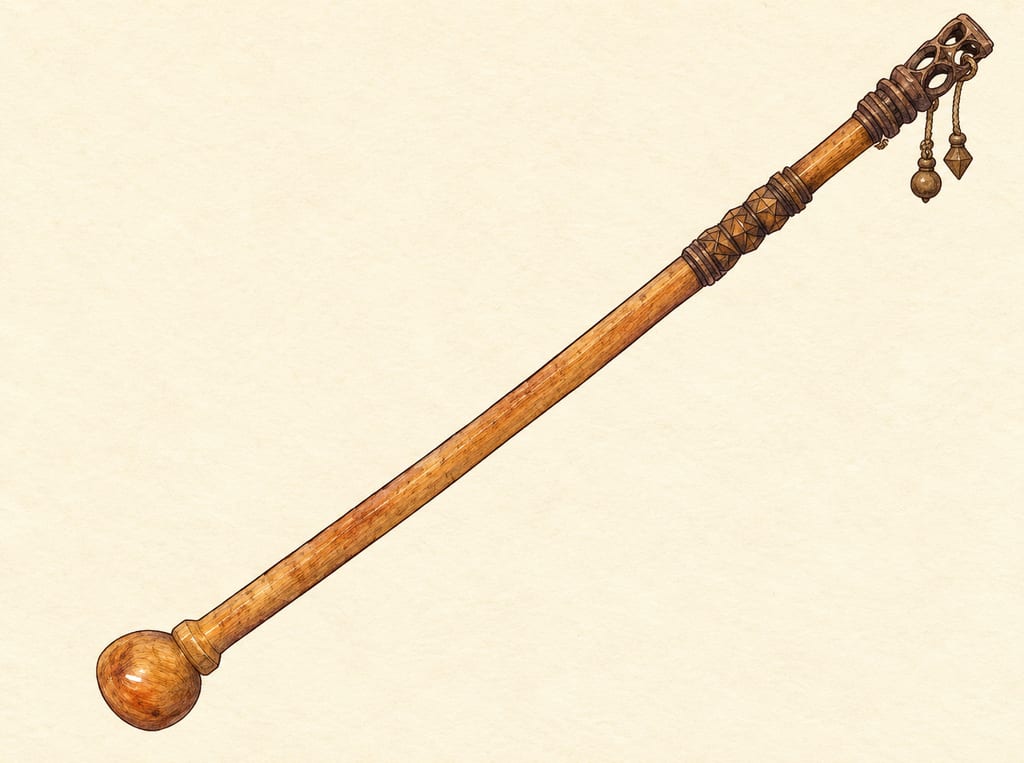
Historical illustration of the Sakha hamnatar kumys agitator, with a long carved wooden handle, pierced cap and small pendants described by the Yakut State Museum; exact dimensions and wood species are unspecified.
Equipment

Hamnatar (Sakha kumys agitation whisk)

The Sakha hamnatar (хамнатар), also called bülüür (бүлүүр), is a two-part wooden implement for agitating kumys: a carved handle joined to an openwork cap, used through a funnel into the vessel.

Handheld mixing and whipping tools
Sakha Republic (Yakutia)
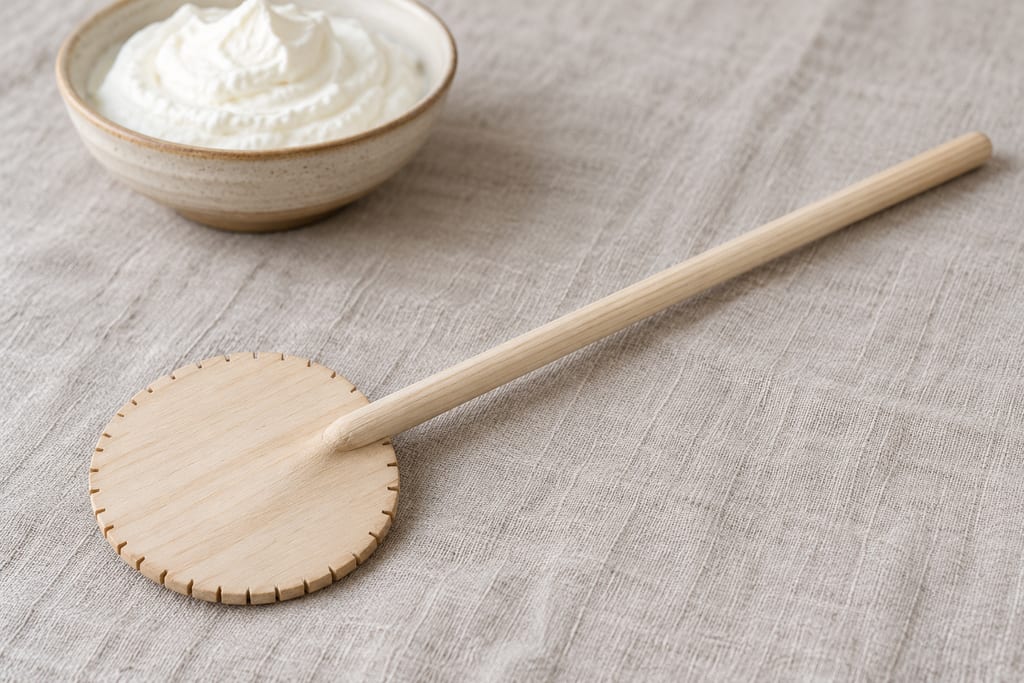
Generated editorial image of a Sakha ytyk: a flat, round wooden whisk head with small shallow notches around its rim and a long handle, with whipped cream in a bowl behind it. The utensil is an illustrative current-day example, not a dated historical artifact.
Equipment

Traditional wooden whisk for kuorchekh

The Sakha ytyk (ытык) is a flat, round wooden whisk with small notches around its head, used to aerate kuorchekh and other cream preparations. Its exact dimensions and historical origin are not established by the sources here.

Handheld mixing and whipping tools
Sakha Republic (Yakutia)
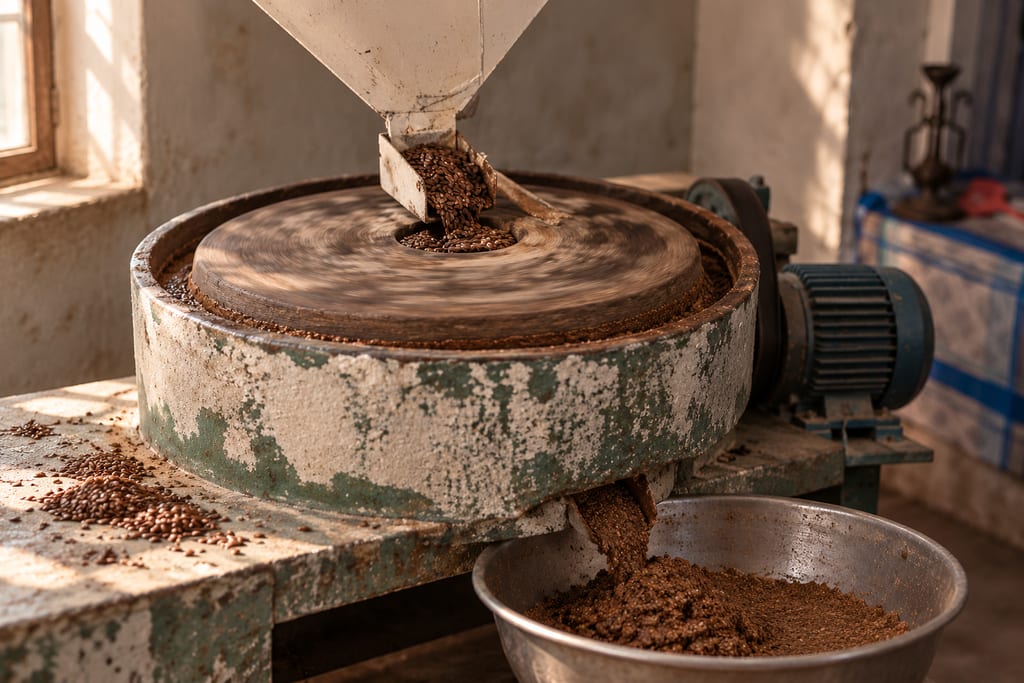
Reference-guided illustration of a Dagestani-style stone grinding mill: a hopper feeds seeds into the millstones, and ground material falls into a receiving bowl. Illustrative, not a photograph of the specific documented mill.
Equipment

Grinding mill for paste, meal and flour

Mills grind seeds, nuts and grain into flour, meal or oil-rich paste. Stone, feed and power arrangements differ by tradition and model; the Dagestani example is one documented form, not a universal design.

Mills, mortars and crushers
Dagestan
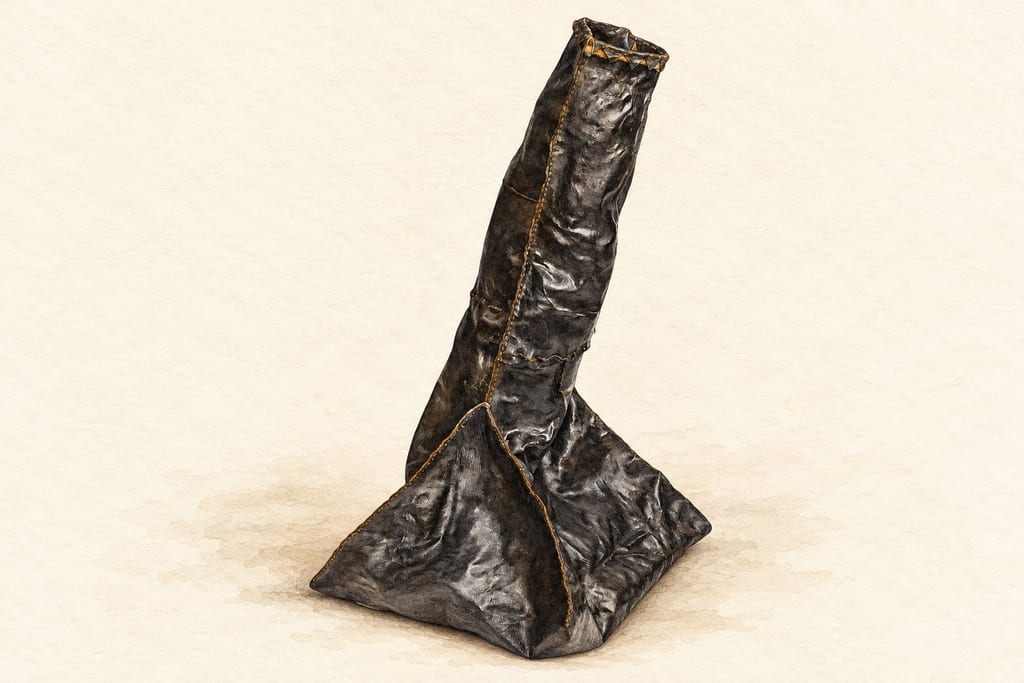
Watercolor illustration based on the Omsk museum saba: a smoke-darkened horsehide vessel with a long neck, broad gusseted body and visible hair-thread seams.
Equipment

Saba

Saba is a large Kazakh horsehide vessel used to prepare and keep kumis. An Omsk museum specimen shows a tall, narrow neck above a broad, gusseted body, with seams stitched in hair thread and hide smoked to make it water-resistant.

Skins and bladders
Kazakhstan
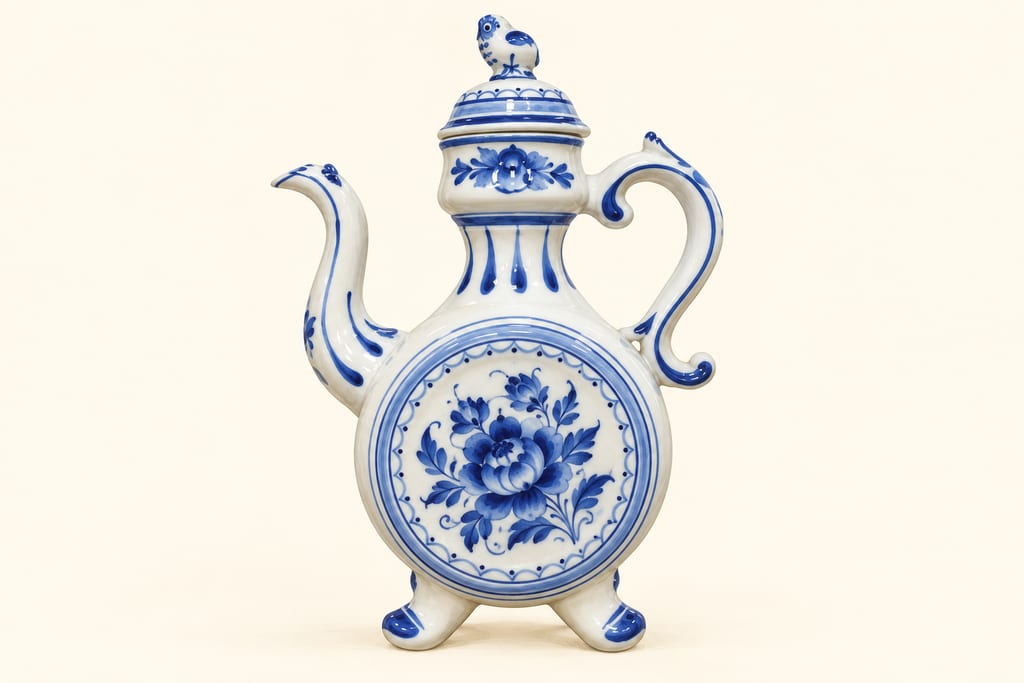
Historical editorial illustration of an empty white Gzhel-painted kumgan with a rounded disk-like body, narrow lidded neck, curved spout, handle and four foot-like supports; based on a museum specimen dated to the early 21st century.
Equipment

Kumgan

A kumgan is a handled pouring vessel with a narrow spout. This Sosnovsky museum example is Gzhel-painted porcelain made in Rechitsy in the early 21st century, representing a form used in Russia to serve historic drinks.

Jars, pots and crocks
Rechitsy
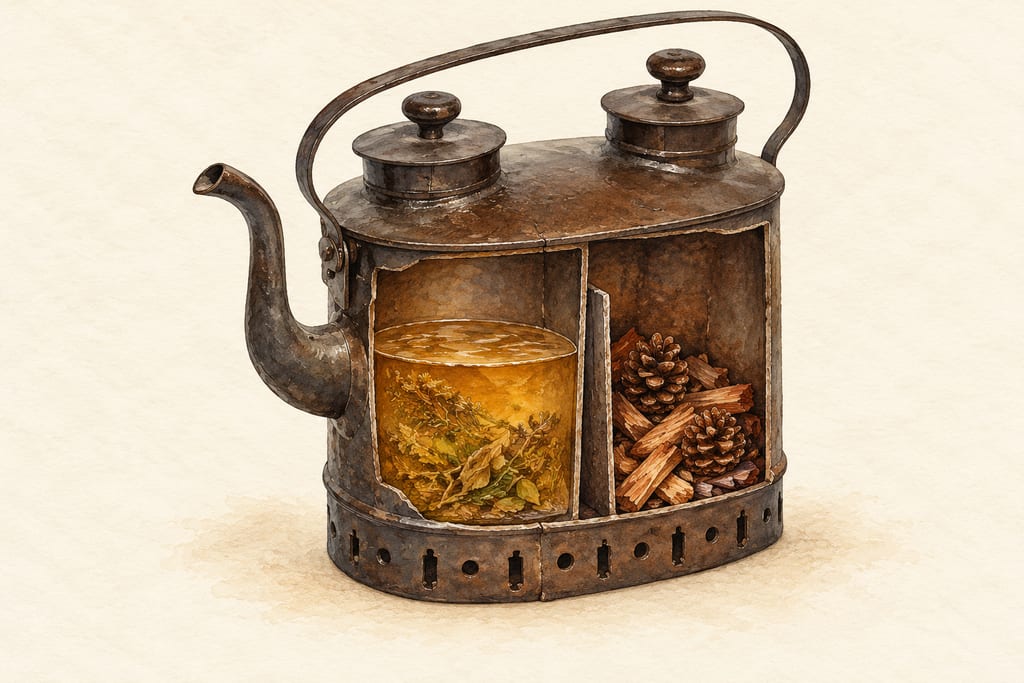
Cutaway watercolor illustration of a documented late nineteenth-century sbitennik form, with separate drink and fire chambers.
Equipment

Sbitennik

A sbitennik is a portable vessel for heating and pouring sbiten. Museum records show a divided fire-and-liquid chamber and several nineteenth-century forms, from Nevyansk ironwork to copper and brass examples.

Kettles, coppers and boilers
Nevyansk
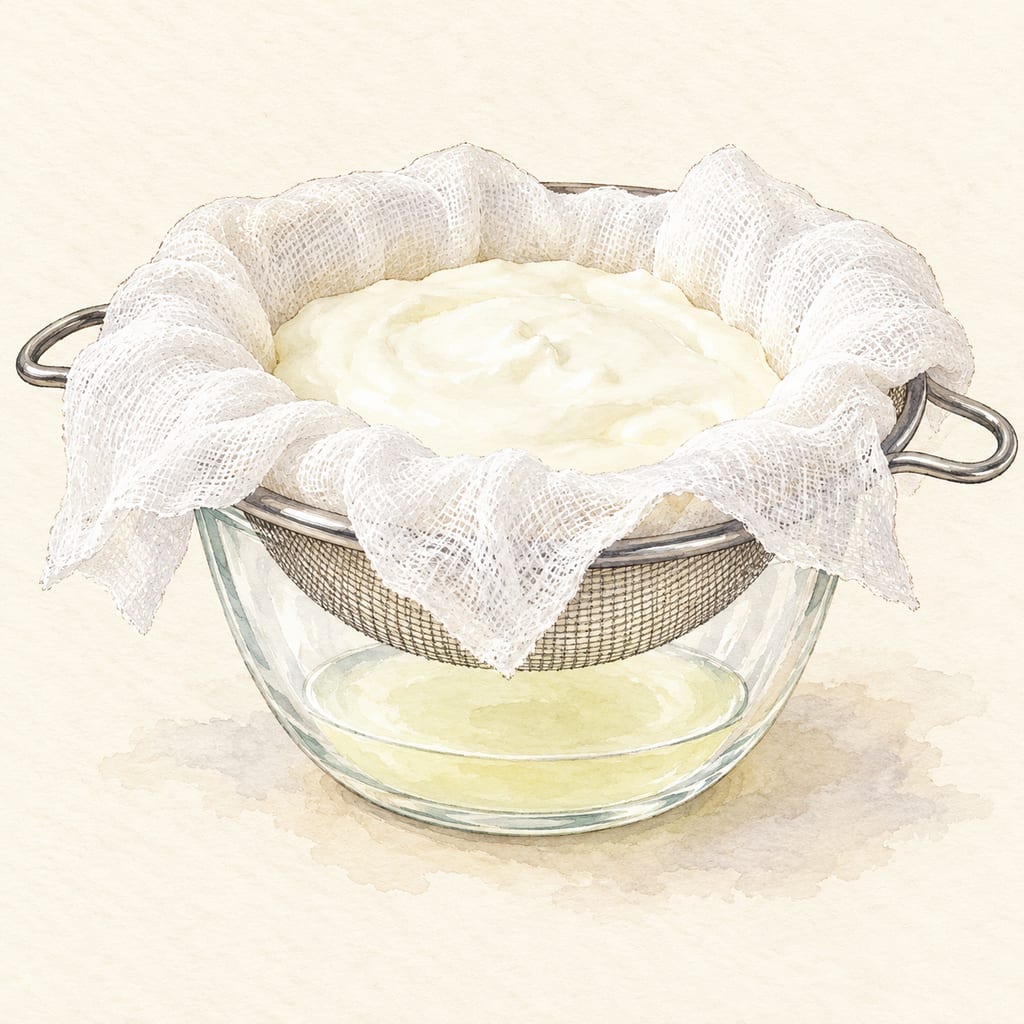
Watercolor illustration of a contemporary fine-mesh strainer lined with cheesecloth over a bowl, holding soft cultured dairy as whey drains.
Equipment

Cheesecloth-lined strainer

A kitchen strainer lined with cloth holds soft curd while whey passes through into a bowl. It is a modern, general-purpose setup; Sakha sources record strained suorat but do not specify this tool or its materials.

Strainers, moulds and hoops
Sakha Republic (Yakutia)
Equipment

Leather bags for Tofalar plant reserves

Leather bags stored dried wild onion, sarana and kandyk for winter use in Tofalaria. The traditional plant store is documented, but the bag's shape, construction and hide species are unknown.

Bags, sacks and casings
Tofalaria, southern Nizhneudinsk District, Irkutsk Oblast
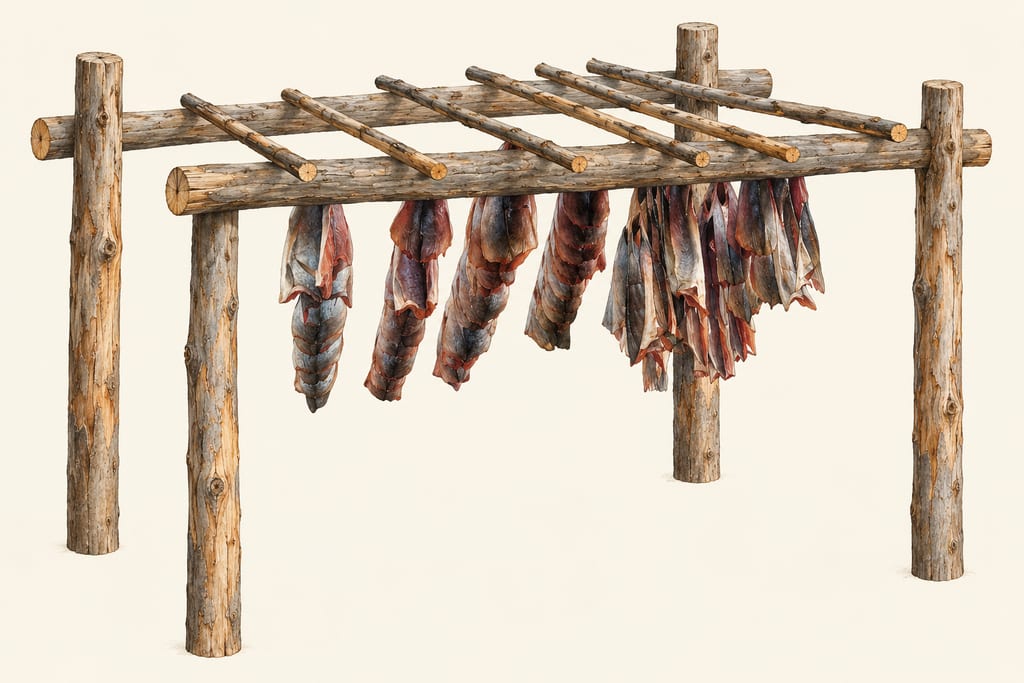
Historical-style illustration of a documented Daguma rack: a timber frame with upright posts, horizontal rails and cross-poles holding fish to dry.
Equipment

Daguma

Daguma is an Udege open-air rack for hanging fish to dry, including yukola. The documented frame has four upright posts, two rails and cross-poles; its dimensions are not recorded.

Drying poles and racks
Primorsky Krai
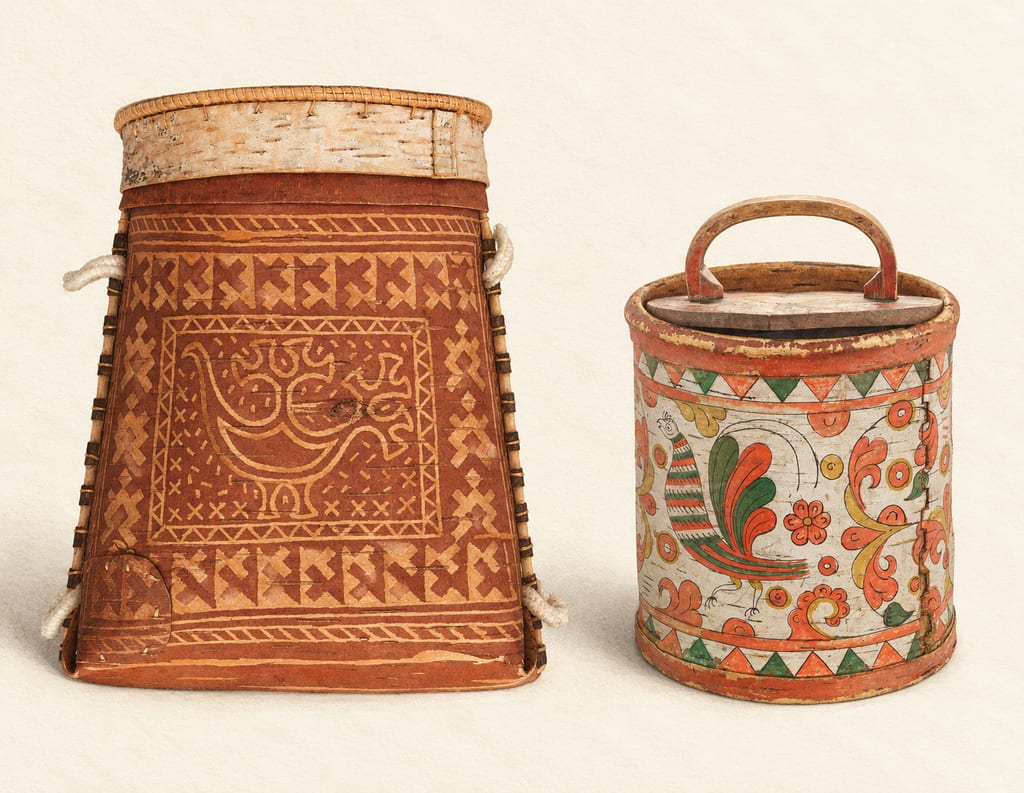
Historical illustration of two distinct birch-bark tuyes forms: a tall box-like Khanty example and a painted cylindrical Northern Dvina example, each based on a documented museum object.
Equipment

Birch-bark containers

Ket sources describe frozen lingonberries in birch-bark containers; Shor sources describe salted wild garlic in birch-bark tuyes. Their exact forms are not documented.

Bark vessels
Central Siberia (Ket communities)
Equipment

Smoked sheep stomach

A cleaned sheep stomach, inflated and briefly smoked, served as a light, one-use Tuvan container for carrying and storing chökpek. Sources describe its form and use in Tuva, but give no standard size or modern reuse guidance.

Bags, sacks and casings
Tuva
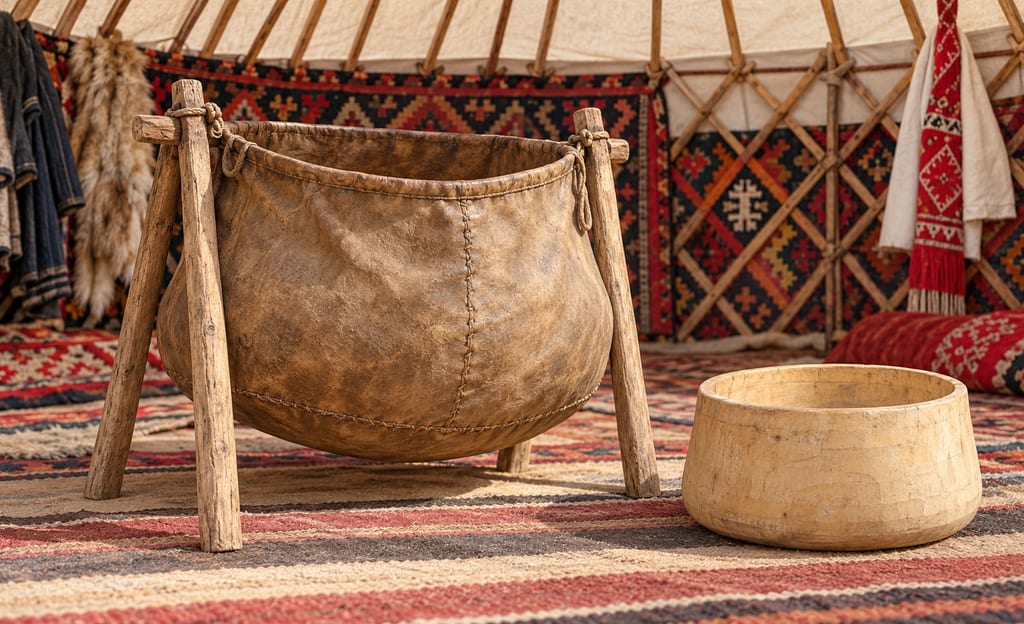
Interpretive illustration of a Bashkir leather һаба on a wooden stand beside a low limewood serving kadka; the source does not establish that the depicted kadka is the exact kumys-preparation silək.
Equipment

Haba (leather kumys vessel) and limewood tubs

A Bashkir household account describes a large leather һаба for kumys, with one or two limewood tubs as alternatives; exact vessel dimensions and schedule are unspecified.

Skins and bladders
Bashkortostan
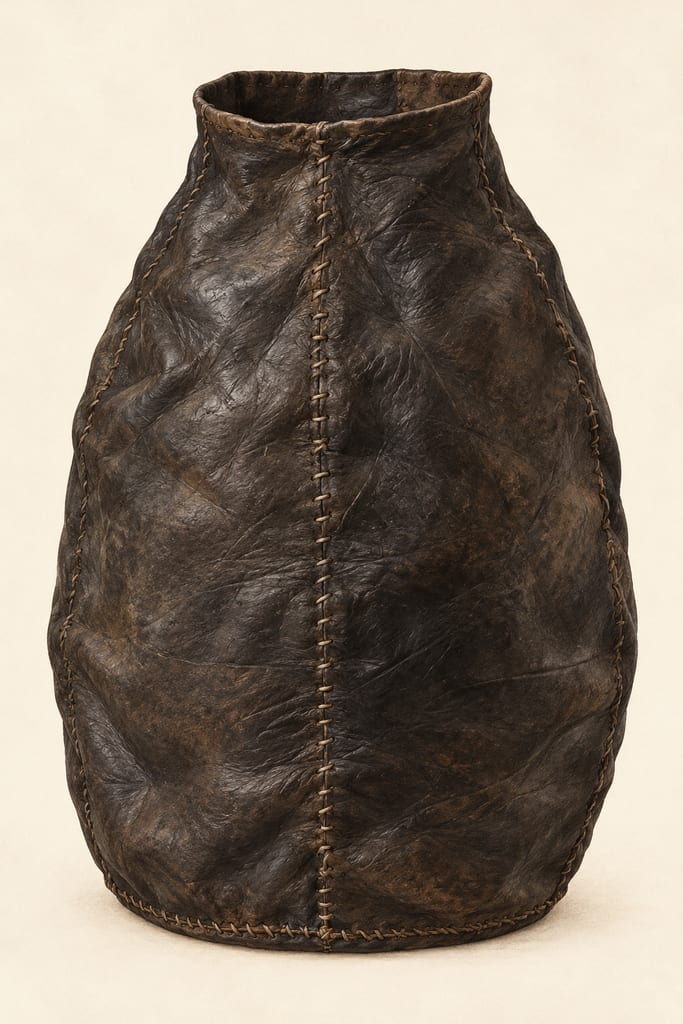
Interpretive illustration of a large, plain Altai arkhyt made from sewn hide; its exact historical silhouette is not established.
Equipment

Altai arkhyt (chegen vessel)

Arkhyt is a traditional Altai sewn-hide vessel used to hold and periodically mix chegen. Sources describe a very large vessel, but do not establish one standard shape, measured capacity, or dimensions.

Skins and bladders
Altai
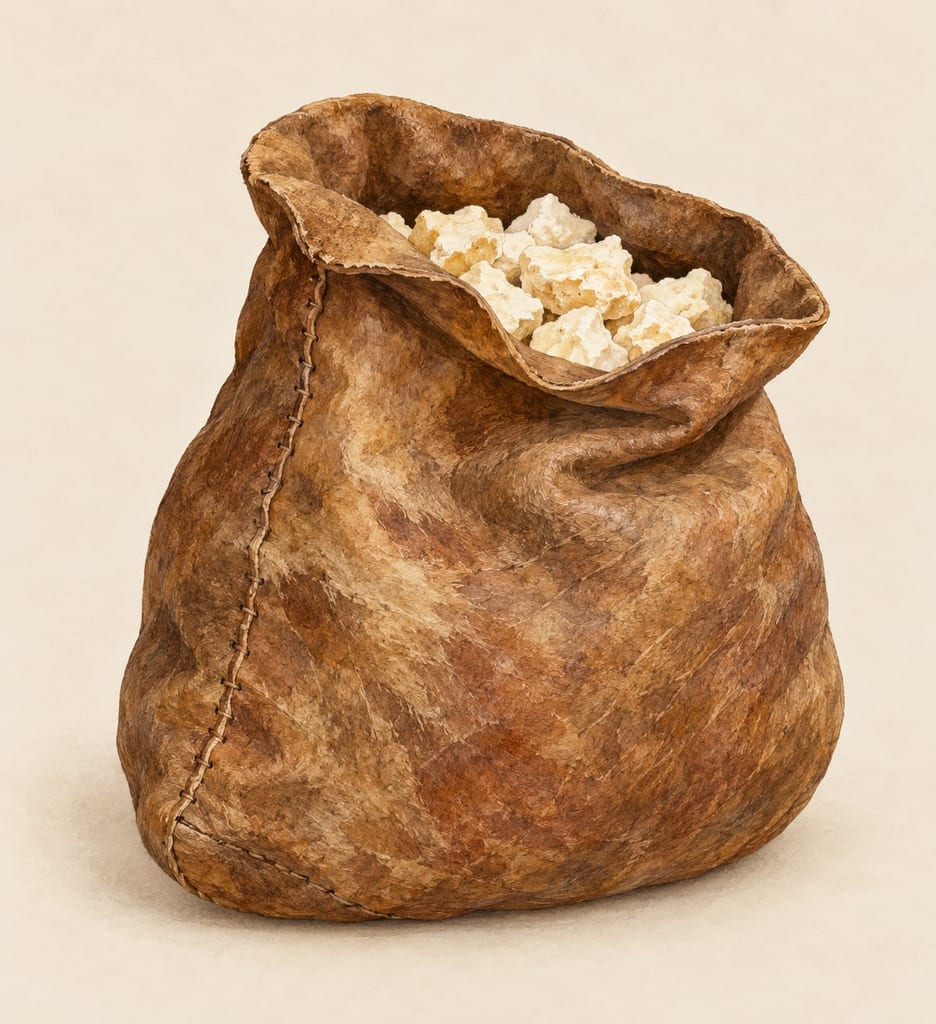
Interpretive watercolor-and-ink illustration of a plain sewn hide bag containing dried aarchy curd. The source documents hide bags as storage but does not establish this exact bag shape or seam layout.
Equipment

Hide bags for storing aarchy

In Altai, dried aarchy was traditionally stored in bags sewn from animal hides. The surviving description establishes the material and use, but not a standard shape or present-day practice.

Bags, sacks and casings
Republic of Altai
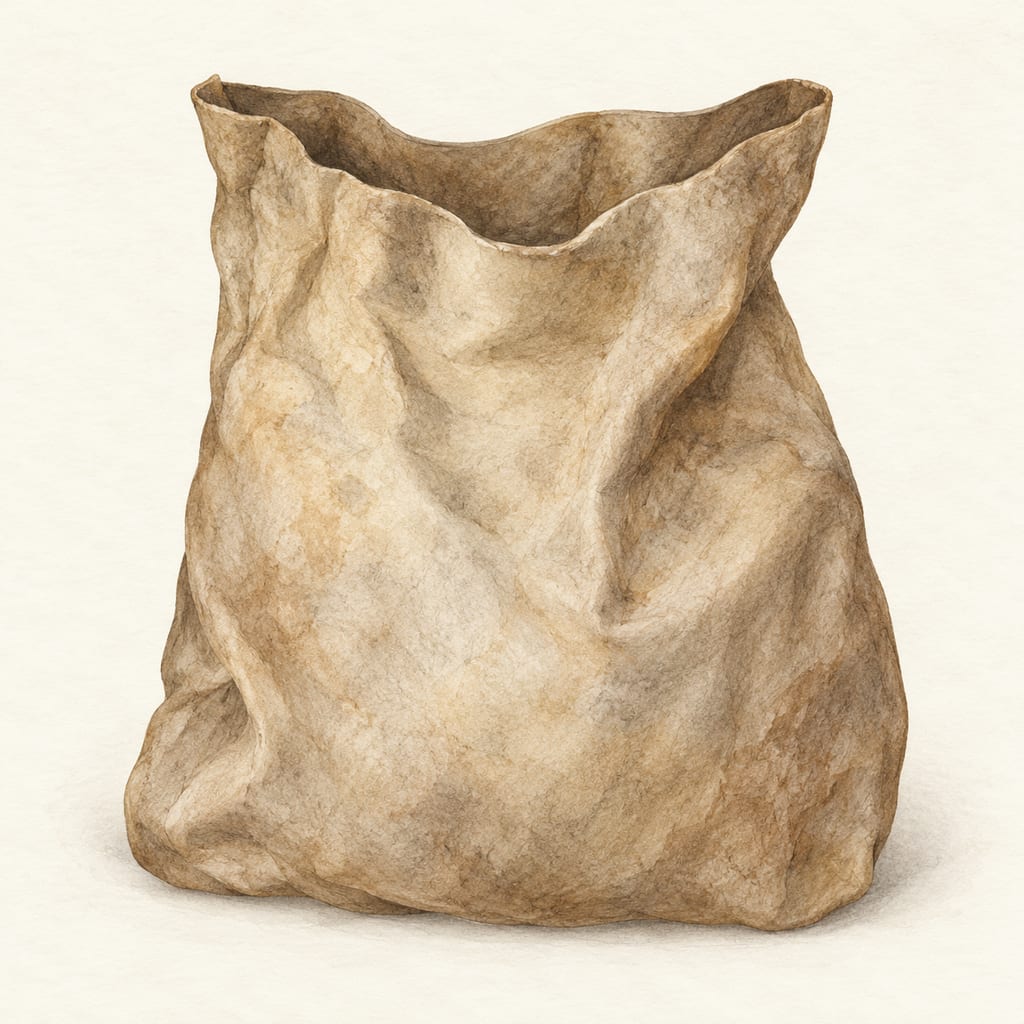
Interpretive watercolor illustration of a plain, empty calfskin bag; the source identifies the material and winter storage use but gives no exact profile.
Equipment

Calfskin bags

A Kalmyk interview describes dried sheep meat packed into calfskin bags for winter. The account identifies the material and storage use, but not the bag’s construction or dimensions.

Bags, sacks and casings
Kalmykia
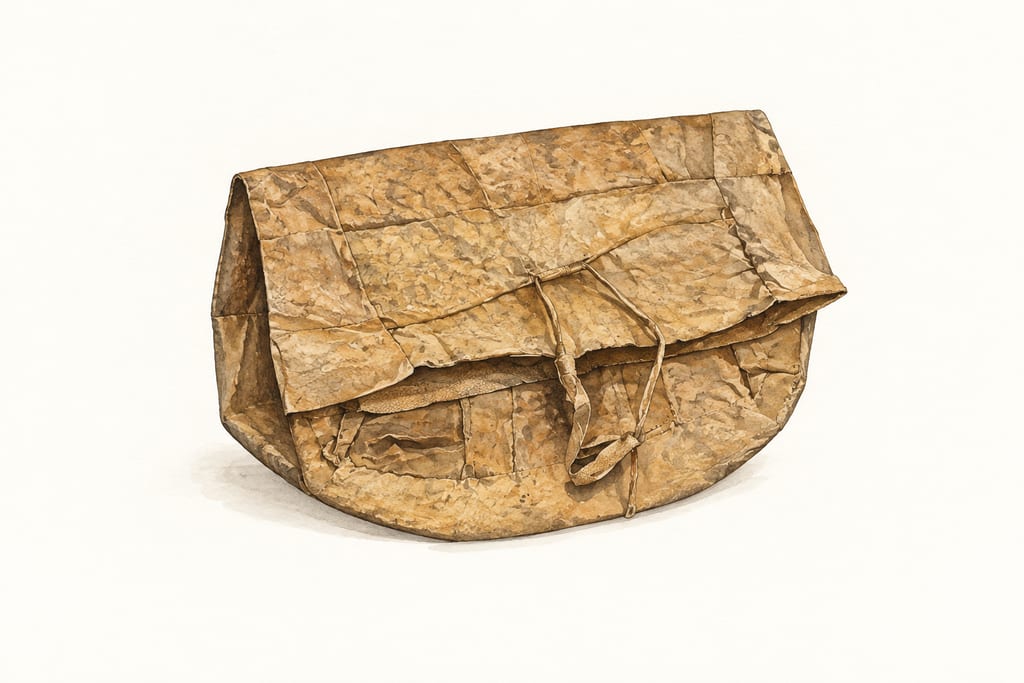
Editorial watercolor illustration of a broad, semi-oval pieced burbot-skin bag with folded opening and ties, based on a late-19th-century Evenk household bag from Yeniseysk; it is a comparison object, not the Enets porsa bag.
Equipment

Fish-skin bags

An Enets account records fish meal called porsa stored in burbot-skin bags. Museum records from the Yenisei and Ob regions document related fish-skin sacks, while keeping each community’s object and use distinct.

Bags, sacks and casings
Russia