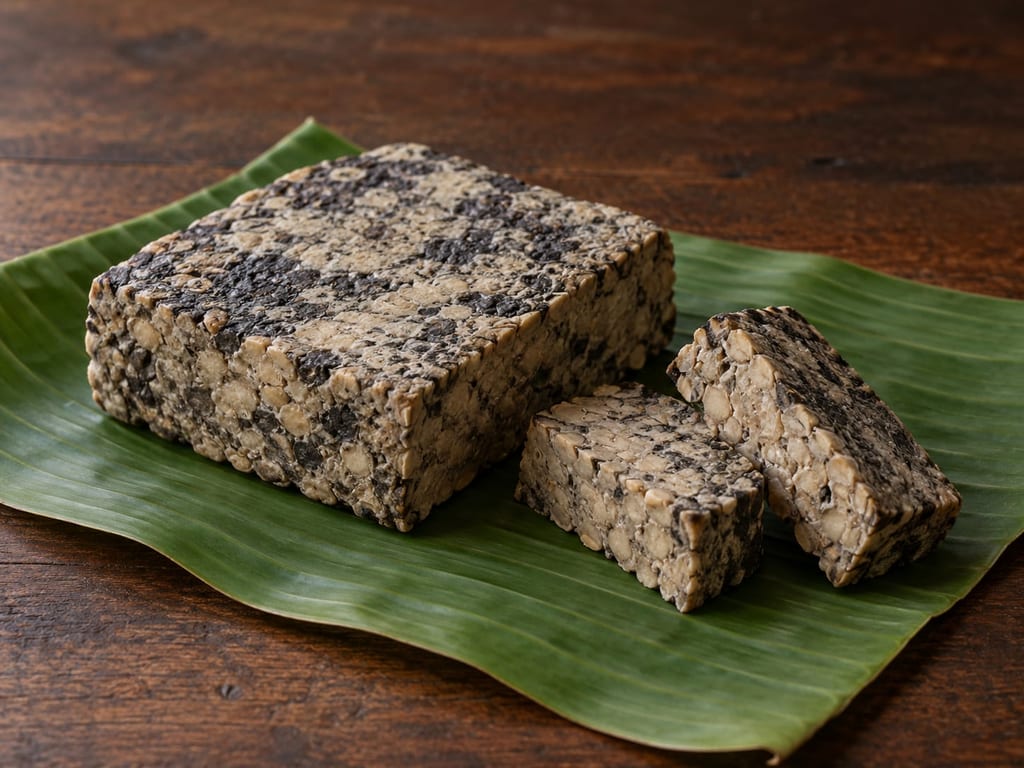
Black oncom from defatted peanut cake
Black oncom is a mould-fermented cake made from defatted peanut cake, pressed to about 2 cm, steamed and then incubated for a day at ambient temperature.
 FermenteaWhere food goes to change
Traditional method
tauco (豆醬)
An Indonesian savoury soybean paste built in two stages: cooked beans and roasted flour carry a mould fermentation, then mature in salt brine into a thick, salty seasoning.
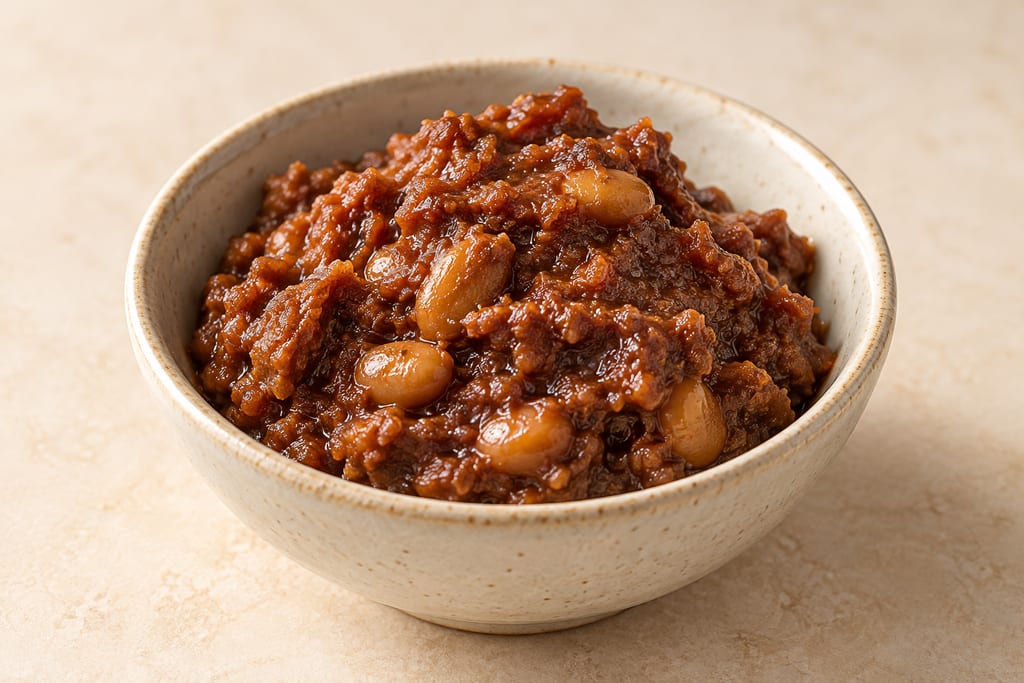
Tauco is an Indonesian fermented soybean condiment used to season vegetables, fish, soups, stir-fries and sauces.
It belongs to the broad East and Southeast Asian family of fermented soybean pastes, alongside products such as Chinese jiang, Japanese miso and Korean doenjang.
However, tauco is not simply Indonesian miso.
Its flavour, texture, sweetness, salt concentration and processing can differ substantially.
Some products retain recognizable soybean pieces. Others are thick pastes or relatively liquid sauces.
Tauco develops its distinctive character through two stages: an initial mould fermentation of cooked soybeans and roasted flour, followed by maturation in concentrated salt brine.
The first stage generates enzymes that break down soybean components. The second allows further chemical and microbiological changes in a strongly salted environment.
Language — Name
Indonesian — Tauco
Alternative Indonesian spelling — Taoco
Chinese characters associated with the name — 豆醬
Hokkien-derived term — Tau-co or related regional pronunciation
Bangka regional term — Theu-chiong
Soybean — Glycine max
Koji-related mould — Aspergillus oryzae
Tempeh-related moulds — Rhizopus species
The Chinese characters 豆醬 broadly mean bean paste or bean sauce.
They describe the linguistic ancestry of the condiment rather than establishing that modern Indonesian tauco is chemically identical to every Chinese bean paste.
Tauco developed in Indonesia through interaction with Chinese fermented-soybean traditions.
Hokkien-speaking communities were especially important in the history of its introduction and adaptation.
Cianjur in West Java became one of the best-known centres of tauco production.
Historical records discussed in modern scholarship identify tauco in Cianjur during the nineteenth century, when Chinese and Sundanese culinary traditions interacted.
Tauco subsequently became established in other Indonesian regions.
Production occurs in West Java, Central Java, Bangka, North Sumatra, West Sumatra, South Sumatra and West Kalimantan.
Different regions developed their own preferred texture, saltiness and sweetness.
The resulting condiment has become an important ingredient in local dishes rather than remaining exclusively associated with Chinese-Indonesian cooking.
Ingredient — Documented amount or ratio
Cooked soybeans — 2 parts
Roasted flour — 1 part
Mixed food-production mould starter — Quantity not specified
Salt brine — Approximately 17–20%
Mould-fermented material and brine — Approximately 1:3
Palm-sugar solution, optional finishing — Approximately 50% in the described finishing approach
The source gives ratios rather than a complete household batch.
It does not clearly establish the unit basis for every ratio.
No mould inoculum dose or exact second-stage fermentation duration is given.
These details prevent the published description from functioning as a validated, directly reproducible recipe.
Soybeans are rich in protein and contain significant fat.
Their proteins provide the basis for many of tauco's savoury flavour compounds.
However, intact proteins do not have the same taste as free amino acids and smaller peptides.
Fermentation enzymes break proteins into smaller components.
Some of these, including glutamic acid, contribute strongly to savoury taste.
Soybeans also contain carbohydrates that can be transformed by microbial enzymes.
Cooking changes the bean structure and makes components more accessible.
Roasted flour supplies additional carbohydrate and contributes flavour.
The source does not establish one obligatory cereal species for the flour in every Indonesian tauco preparation.
The roasting stage changes the flour's flavour and physical properties.
Heating can generate toasted aromas and alter starch structure.
The flour also provides material supporting the initial fermentation.
The documented proportion is two parts cooked soybean to one part roasted flour.
The initial fermentation uses a mould culture.
The research describes starter populations including Rhizopus oligosporus, Rhizopus oryzae and Aspergillus oryzae.
Modern taxonomy may classify some historically named Rhizopus strains differently.
The important point is that the starter is a defined food-production culture rather than an unidentified mould growing accidentally.
These fungi can produce enzymes capable of degrading soybean proteins and carbohydrates.
The first fermentation creates an enzyme-rich material for the later brine stage.
The mould-fermented soybean mixture is dried and then combined with strong brine.
Salt influences water activity and selects for microorganisms capable of functioning in a salty environment.
Enzymes developed during the first stage can continue modifying the substrate.
Protein breakdown releases amino acids and peptides.
Further changes affect aroma, acidity, colour and texture.
The second stage develops the characteristic savoury condiment.
Because the process uses high salt concentrations and active microbial cultures, it requires proper process control.
Cook the soybeans until suitably softened for fermentation.
The source does not give a complete measured cooking duration or bean hydration schedule.
Roast the flour used in the preparation.
No universally fixed flour type, roasting temperature or duration is established in the recorded formula.
Combine cooked soybeans and roasted flour at the documented 2:1 ratio.
The source does not state an unambiguous weight-or-volume basis.
Add a suitable food-production starter containing the relevant moulds.
The required inoculum amount is not reported.
An unidentified wild mould must not be used as a substitute merely because it looks similar to a known food-fermentation culture.
Ferment for three to five days at 30°C.
This is the documented production condition for the mould stage.
It does not establish the necessary humidity, oxygen management, container geometry or food-safety endpoint.
Break the mould-fermented mass into pieces.
Dry it in sunlight.
The source does not give a final water-activity target or an exact drying schedule.
Use concentrated brine of approximately 17–20% salt.
The source does not fully specify whether every percentage and process ratio is expressed by mass or volume.
Mix the fermented material with brine at approximately 1:3.
The precise basis of this ratio requires clarification before calculating a batch.
Leave at room temperature for several weeks.
No exact duration, numerical maturation temperature or final safety endpoint is given.
Raw tauco can be cooked with palm-sugar solution.
A finishing process using approximately 50% palm-sugar solution is described.
The source does not fully define a universal final sugar-to-tauco ratio.
Commercial products may be processed to different moisture levels.
Drying at 60–80°C is discussed as a method used to obtain different product consistencies.
This is not a validated household preservation schedule.
The initial mould fermentation generates proteolytic enzymes.
These enzymes cleave peptide bonds within soybean proteins.
Large proteins are broken into smaller peptides and free amino acids.
Glutamic acid and aspartic acid contribute savoury taste.
The total profile depends on soybean composition, starter, enzyme activity and maturation.
The production process therefore develops flavour by changing the substrate itself, not merely by adding salt.
A 2022 study analyzed 24 tauco products from seven Indonesian provinces.
The products differed considerably.
Product type — Measured moisture
Solid — 29.2–35.3%
Semisolid — 42.2–54.5%
Liquid — 56.2–68.1%
The study measured pH values ranging from 4.38 to 5.91.
These results demonstrate how varied tauco can be.
They are measurements of commercially sampled products, not safety requirements for a household recipe.
Glutamic and aspartic acids were major contributors to the analyzed amino-acid profiles.
An important historical centre of Indonesian tauco.
Tauco is incorporated into regional foods, including tauto, a local soup preparation.
Regional fermented-soybean products include preparations identified as theu-chiong.
Commercial tauco styles may differ in sweetness, texture and consistency.
The product can be solid, semisolid or liquid, reflecting differing raw materials and production choices.
Small differences in sweetness or texture belong on this page as variants rather than requiring separate records.
Tauco is used as a seasoning.
It may be incorporated into stir-fried vegetables, bean sprouts, soups and fish dishes.
Named Indonesian foods using tauco include tauge goreng, sambal tauco, sayur tauco, ikan tauco and tauto Pekalongan.
A small quantity can provide substantial savoury flavour.
Because salt concentrations vary, seasoning should be adjusted after tauco has been added.
A mature tauco product should have a developed fermented-soybean aroma.
Its colour and consistency depend on regional style.
Visible soybean pieces may remain.
Excessive saltiness can make the product difficult to use.
Poor mould development in the first stage can affect enzyme generation.
Uncontrolled mould growth can create contamination risks.
Unexpected coloured or fuzzy growth cannot be assumed to be a safe production organism.
A sour smell, brown colour or visible mycelium is not enough to identify the microorganisms present.
The main concerns are starter identity, the completeness of first-stage fermentation, brine concentration and maturation controls.
Use only an appropriate food-production mould culture.
No starter dose is given.
The second-stage duration and full temperature controls are not given.
A strong brine concentration is not proof that every pathogen is eliminated.
This preparation requires a validated process before it can be recommended as a home-production recipe.
Commercially prepared tauco can be used directly according to its manufacturer's instructions.
Tauco is an Indonesian paste related to, but distinct from, miso and doenjang. The account sets out historical introduction through Chinese/Hokkien communities and multiple Indonesian regional styles.
Scaling: source batch only
The tauco paper lists several dominant molds but does not give an inoculum dose or a strain-level culture specification; mold identity cannot safely be inferred from appearance.
Hazard sourceUse a food-production starter with a documented identity and follow its supplier's process specification; do not identify or substitute a wild mold by color or texture.
Control sourcethe source does not give enough process detail to reconstruct a complete formula. The cited review does not validate tauco.
The study reports tauco products from several Indonesian provinces and a historical introduction through Chinese, especially Hokkien, communities; it does not claim a single origin.
The source identifies Cianjur as a well-known tauco-producing area.
Black oncom is a mould-fermented cake made from defatted peanut cake, pressed to about 2 cm, steamed and then incubated for a day at ambient temperature.
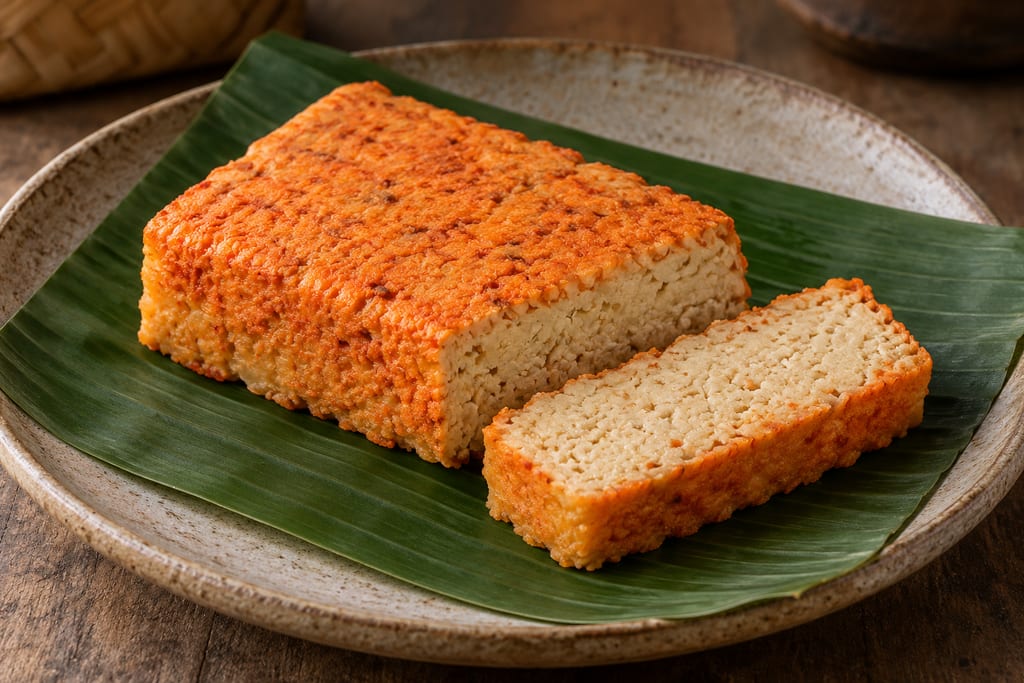
Red oncom is a West Javanese cake fermented from pressed soy pulp with a Neurospora starter, a little tapioca starch and vinegar. It is a different food from black oncom, made on another substrate with another mould.
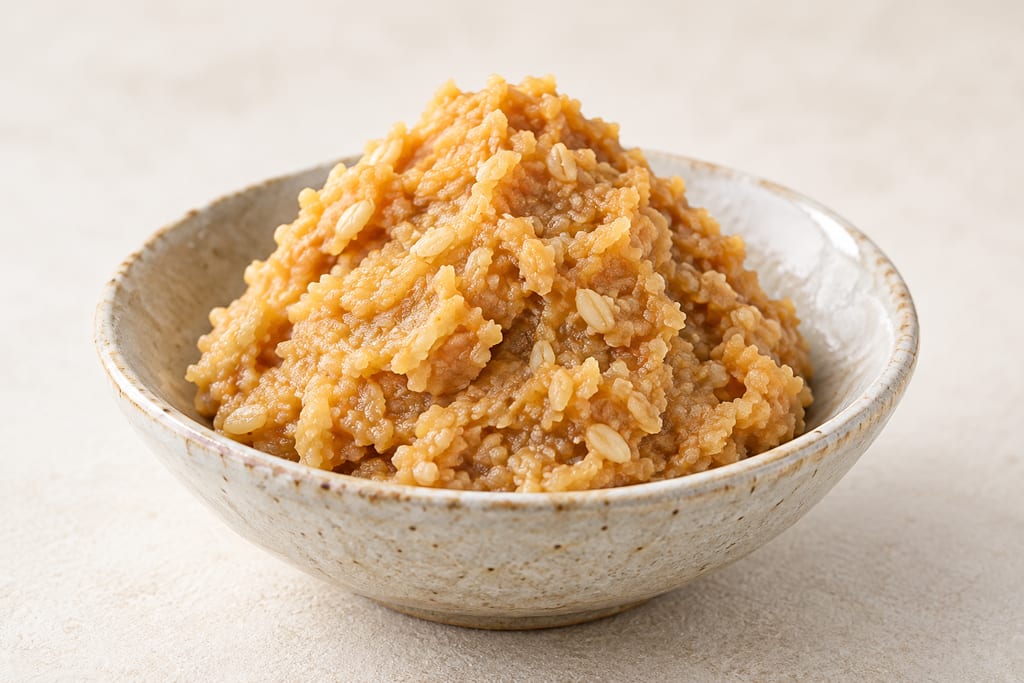
A Japanese soybean paste fermented with barley koji and salt, made mostly in Kyushu, Shikoku and western Japan. It is sweet, savoury and grainy.
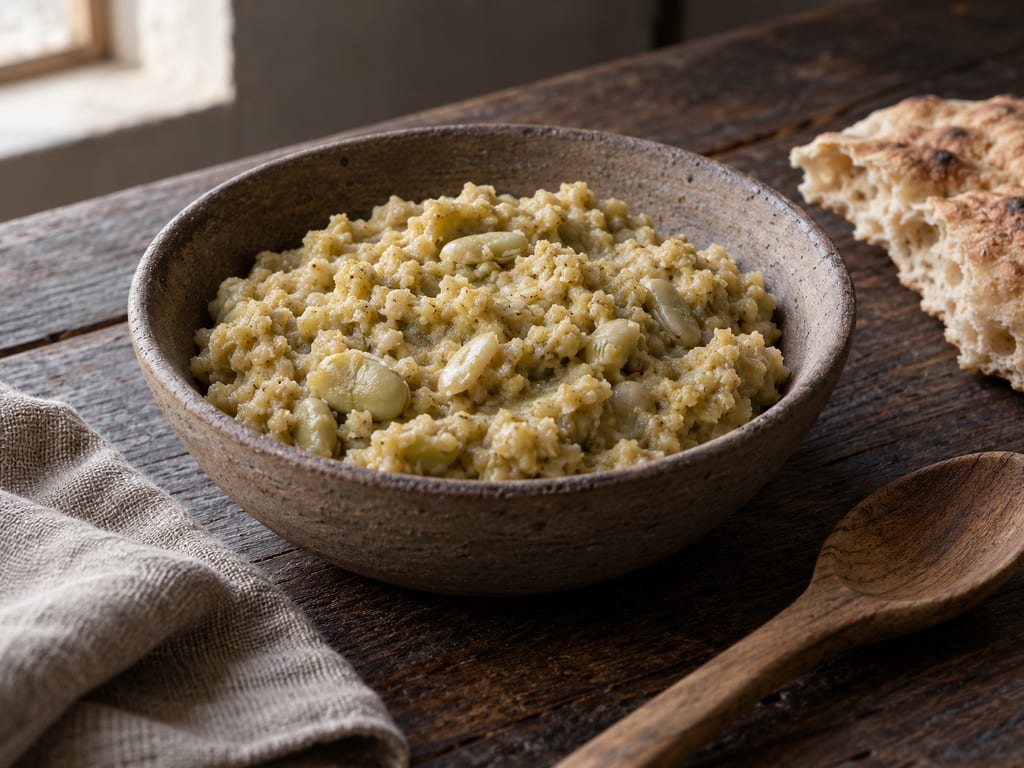
Cooked broad beans crushed to a thick paste with garlic and salt, a museum preparation built on the one European pulse that was already old when the Viking Age began.
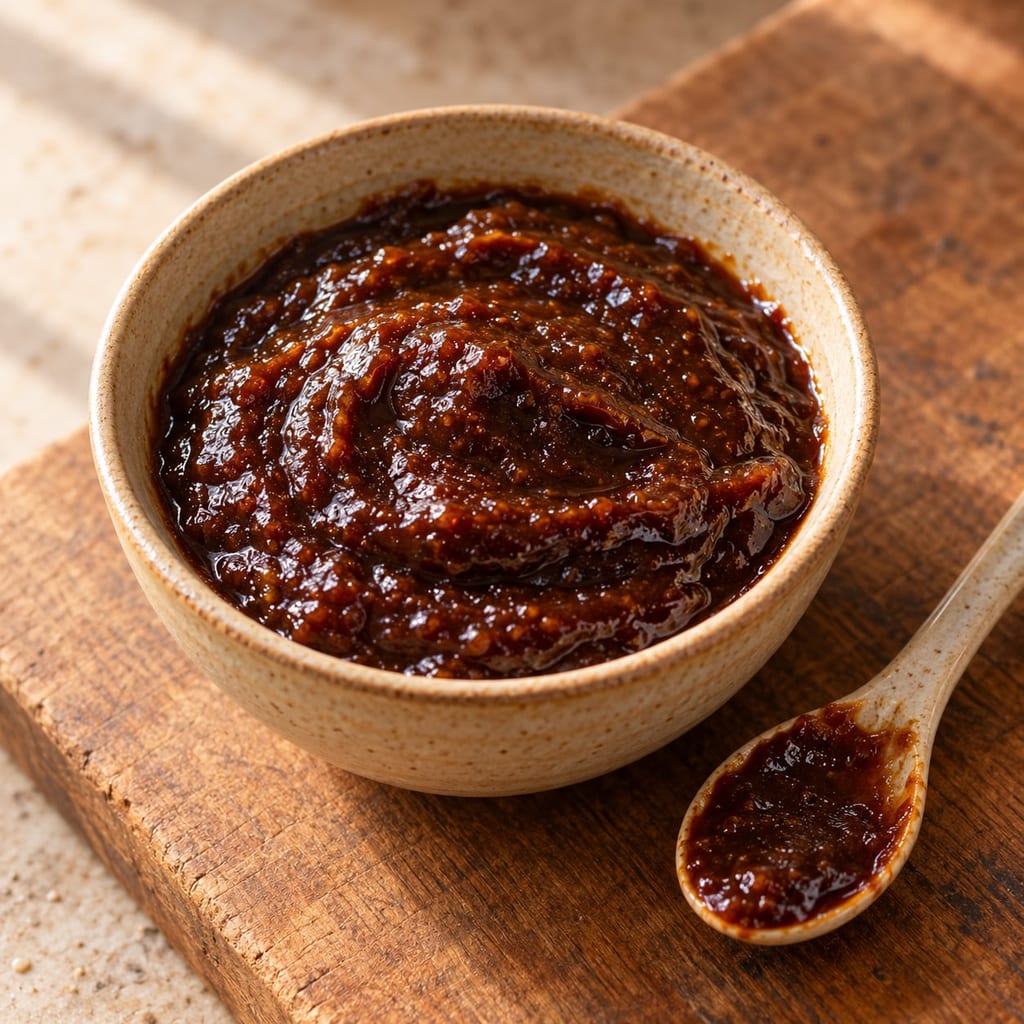
Chu hou is a sweet, savoury Cantonese paste of fermented soybeans, fermented bean curd, garlic, ginger and sesame, used mainly to braise meat.
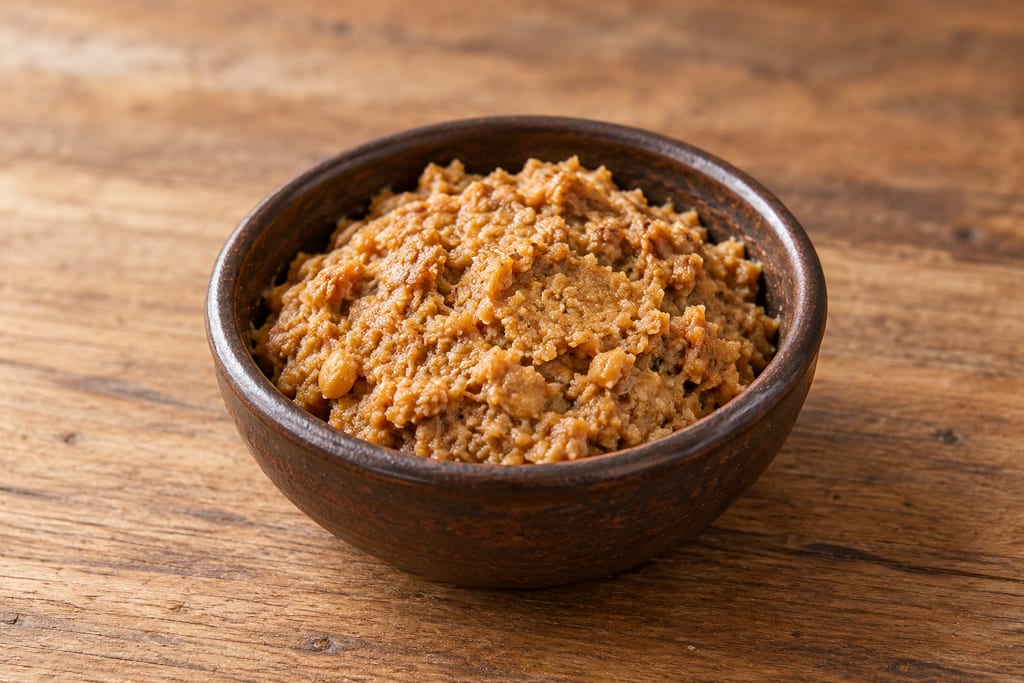
Doenjang (된장) is a Korean fermented soybean paste made by brining meju, separating ganjang, then mashing and aging the solids. This recipe follows one documented Sunchang processing study.
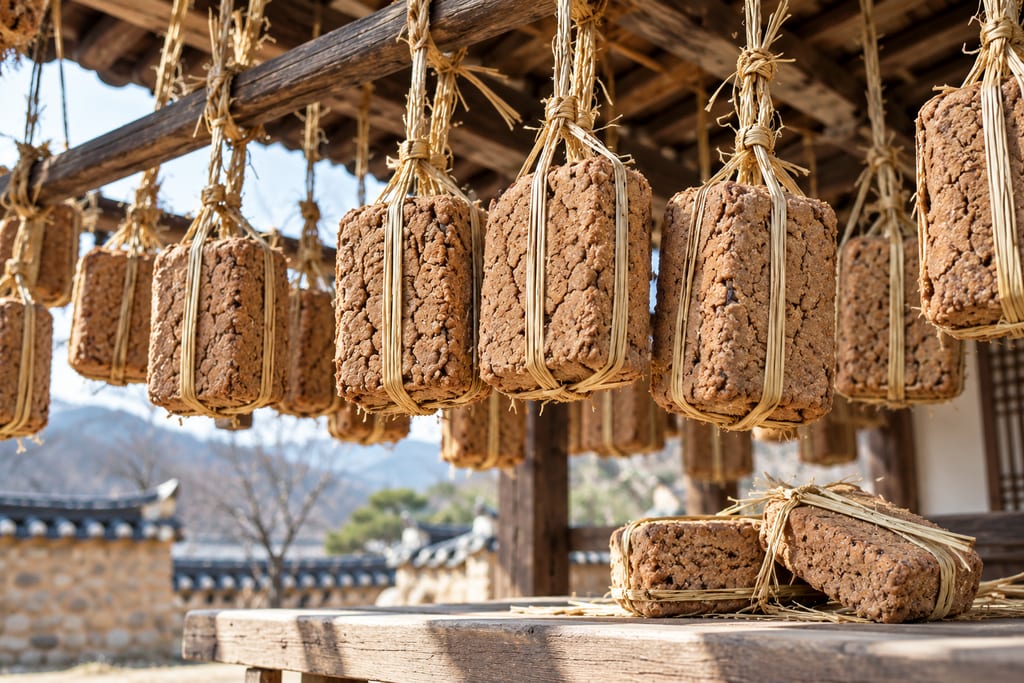
A cooked soybean brick, shaped and dried, that is fermented as a solid and later brined to make the Korean soy paste doenjang and the soy sauce ganjang.
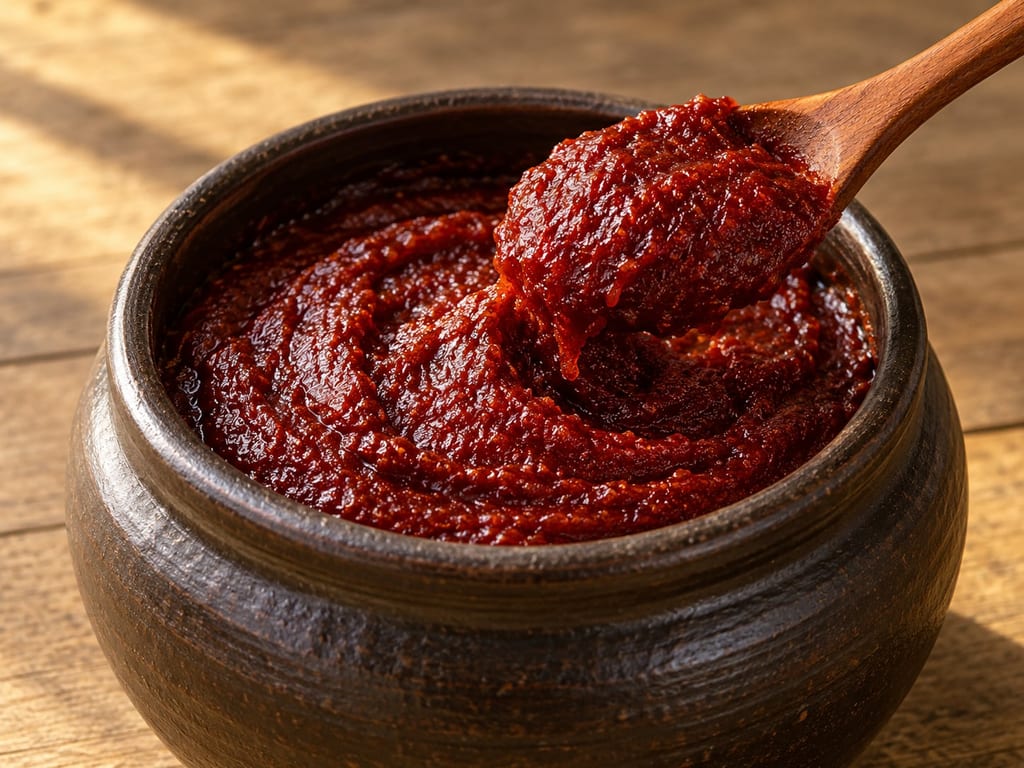
Korea’s sweet, savoury and fiery red paste of glutinous rice, barley-malt enzymes, fermented soybean meju powder and chilli powder, matured in earthenware.
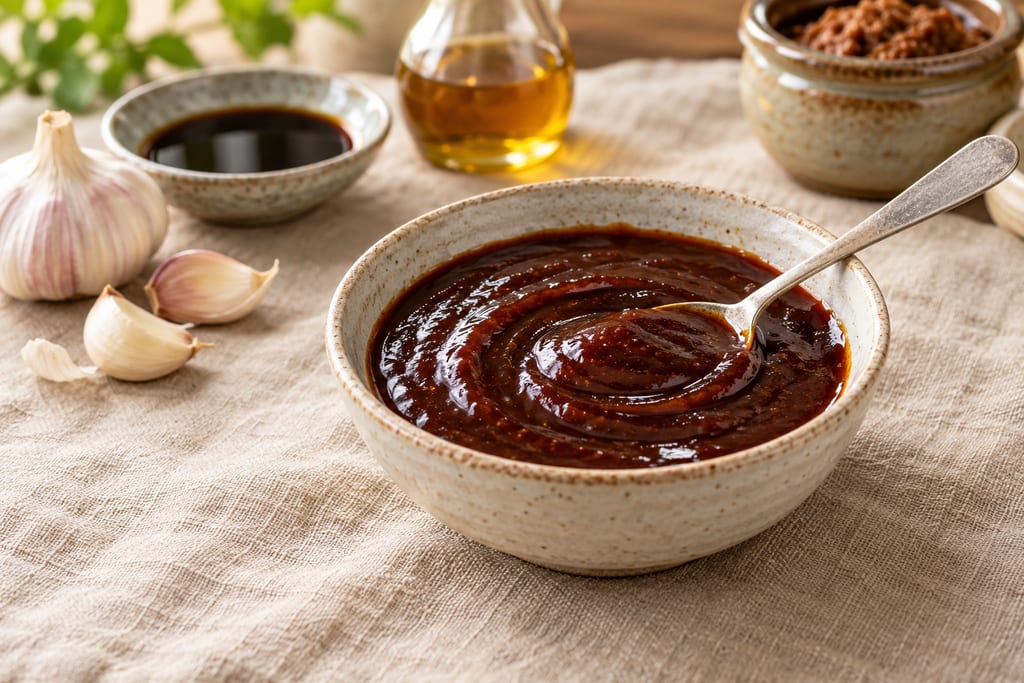
A thick, dark, sweet-salty Chinese condiment built on fermented soybean paste. This page gives one quick home version and records how commercial formulas differ.
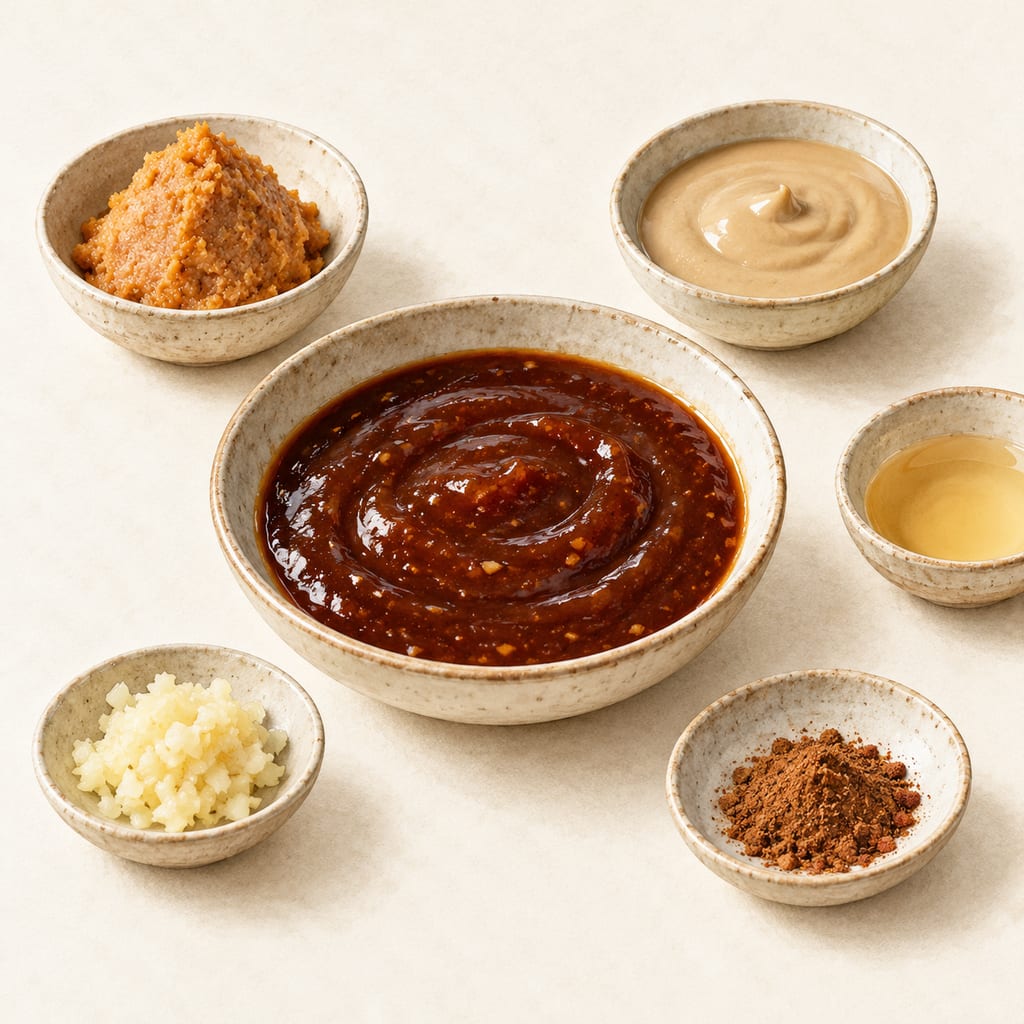
An untested modern miso-based sauce inspired by hoisin's sweet, savory profile; this prototype is not traditional hoisin or a copy of a commercial brand.

A Cap-Pelé boucanière is an Acadian herring-smoking building. The documented Willie Niles example is a one-storey wood-frame structure with a ridge smoke vent and interior bays for hanging fish-bearing cannes.

Achcharu is a family of Sri Lankan vinegar pickles made with mixed vegetables or seasonal fruit and a piquant spice dressing. This version is a quick, refrigerated, non-fermented mixed-vegetable pickle.

The acocote is a long, hollowed and dried gourd used to draw aguamiel from a mature maguey. It is a harvesting tool: the sap is transferred to a separate vessel before it ferments into pulque.

Adrak murabba preserves young ginger in sugar syrup, a sweet South Asian preparation recorded in Indian cookery and food-processing sources.

Parkia biglobosa seeds are fermented into regional West African seasonings, including nététou, iru, dawadawa and soumbala. The yellow fruit pulp is a separate food, and names and methods vary by place.

Japanese reddish-brown vinegar from sake lees matured about three years, turned to vinegar by acetic bacteria; the vinegar of Handa and Edomae sushi rice.

A refined common-wheat flour blended for a broad range of baking; its protein and behavior vary with wheat, milling and market.

The almond mushroom, Agaricus subrufescens, was cultivated in eastern North America in the 1800s, lost its market, and returned as a cultivated mushroom from Brazil, where it is grown under several names.
No community contributions have been published for this entry yet.
Sign in to contribute. Published comments and photos are free to read.
Journal of Ethnic FoodsInspiration · Process · History · Geography
Nutritional composition of tauco as Indonesian fermented soybean paste2:1 cooked soybean-to-roasted-flour ratio; mixed Rhizopus/Aspergillus culture; 3–5 days at 30°C; sun drying; 1:3 brine ratio at 17–20%; room-temperature fermentation for several weeks; Indonesian distribution and Hokkien historical association
Cited in: Indonesia's savoury fermented soybean paste; Names and identity; History and cultural development; The principal ingredients; Why soybeans are used; The role of roasted flour; The first fermentation: mould development; The second fermentation: salted maturation; Stage 1 — Cook the soybeans; Stage 2 — Prepare roasted flour; Stage 3 — Mix; Stage 4 — Inoculate; Stage 5 — First fermentation; Stage 6 — Break and dry; Stage 7 — Prepare brine; Stage 8 — Combine with brine; Stage 9 — Mature; Stage 10 — Optional sweet finishing; Stage 11 — Adjust finished consistency; Understanding protein breakdown; Measured composition of Indonesian tauco; Cianjur; Pekalongan; Bangka; Medan; Other Indonesian regions; How tauco is eaten; Quality and failure signs; Safety
BC Centre for Disease ControlSafety
Safety of fermented foods: Koji and misoProcess-specific use of identified food cultures; the cited guidance covers koji and miso, not tauco validation
Cited in: The first fermentation: mould development; The second fermentation: salted maturation; Quality and failure signs; Safety