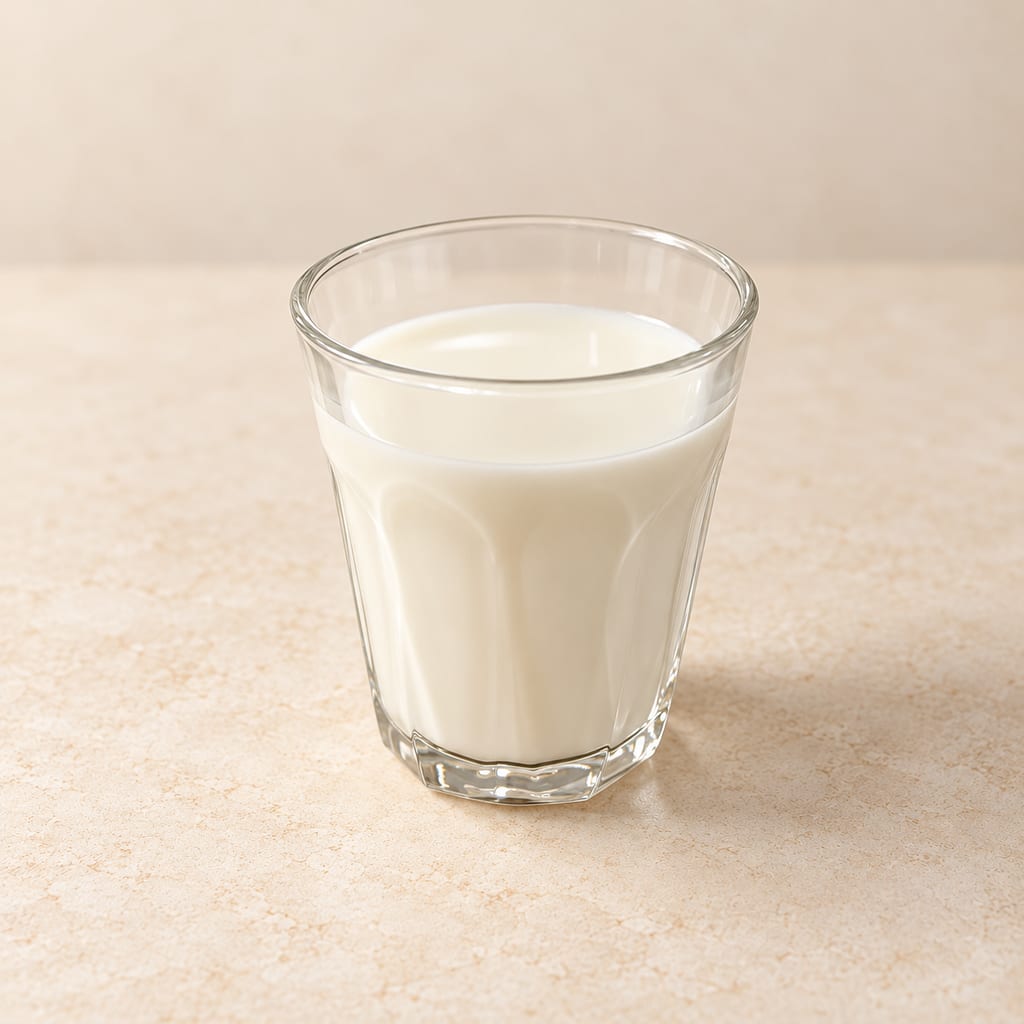
Milk species and the cheesemaking substrate
Milk supplies protein, fat and lactose for cultured drinks and cheese. Animal species, composition and processing each affect how it behaves.
 FermenteaWhere food goes to change
Modern method
Yoghurt
This plain yogurt is heated, cultured warm and stirred smooth after chilling. A Canadian home method uses fresh plain yogurt to start the lactic fermentation.
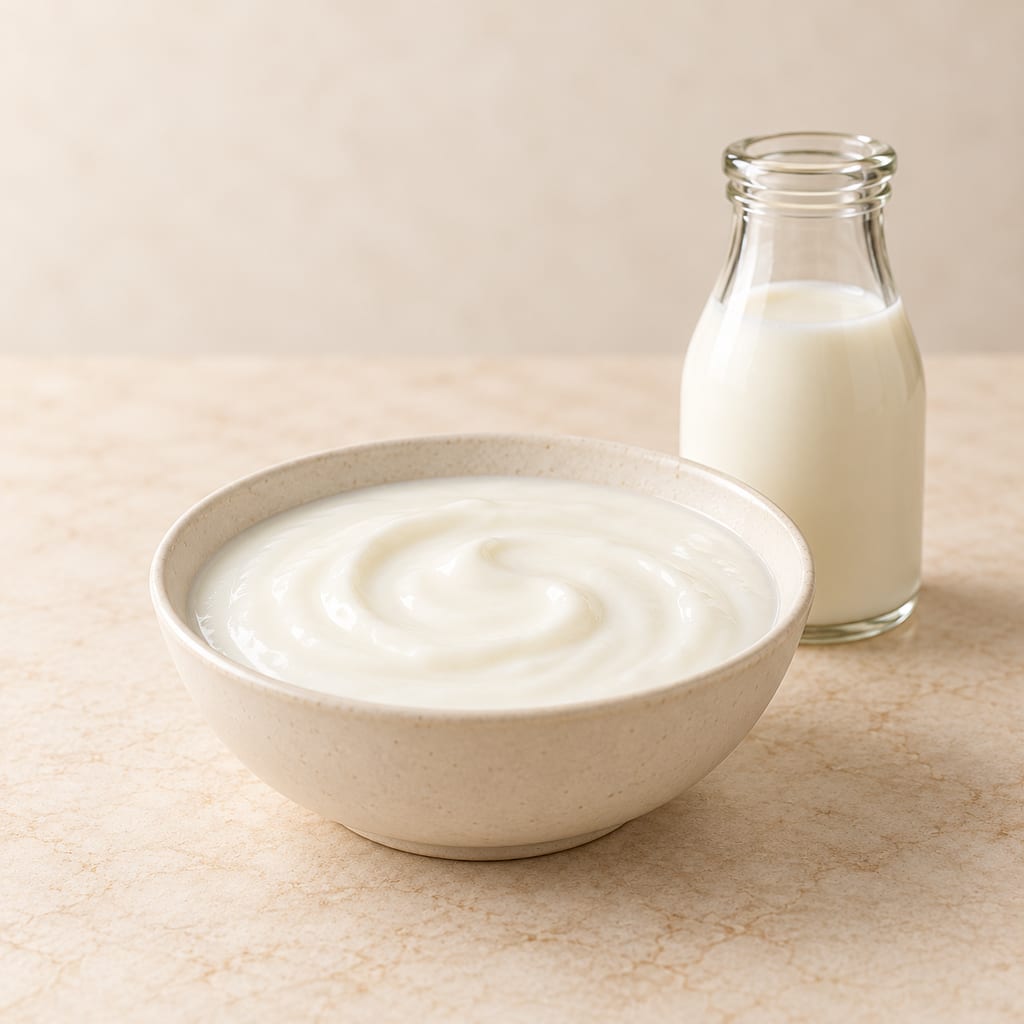
Stirred yogurt begins by becoming a gel. Its smooth, flowing body comes later, when that gel is broken. In this Canadian household method the yogurt is chilled first, then stirred with a clean spoon. The result belongs to the familiar family of plain spoonable yogurts, but its finishing sequence differs from both an untouched pot-set yogurt and a factory's stirred-yogurt line.
The distinction is easiest to see in the first spoonful. An intact set breaks along the spoon's path and leaves a cut surface. A stirred yogurt has already been worked into a more uniform mass. It may flow more readily and show less of the original curd structure. The culture made the acid and helped establish the gel; the cook then changed that structure through movement. Stirring is part of finishing the food, rather than a second fermentation.
The food's smoothness depends on two structures: the protein network made during fermentation and the fragments left after that network is worked. Milk composition, heating, culture and handling all influence them. A spoonable yogurt can feel cohesive without retaining the single continuous set in which it first formed.
Yogurt has a written history much older than the Canadian method used here. Medieval Turkic references to yogurt are reported in Kutadgu Bilig and Divanü Lugati't-Türk. They attest to a named food in those settings, rather than describing one inventor discovering fermentation. A word appearing in a text shows that the food was known in that setting; it does not date the first household that cultured milk.
The Agriculture Canada manual describes yogurt becoming popular in Canada in the years before its publication. Its home method uses pasteurized milk and yogurt as a starter, with a pan for heating and smaller vessels for setting. The familiar retail food becomes a process the household can observe: fluid milk, warm culture, chilled curd and finally a smooth stirred mass.
That process sits alongside food traditions in which yogurt has many further uses. Türkiye's Ministry of Culture and Tourism describes ayran as a cold yogurt drink served with kebabs, köfte, meat dishes and pilaf. Its preparation deliberately blends yogurt with liquid. Here the smoothness of a stirred dairy food is useful in another form, rather than evidence that every yogurt is intended to be eaten as a firm pot set.
Yogurt also enters a larger sequence of dairy work in Malatya, eastern Türkiye. A cream layer is eaten on bread, while yogurt becomes ayran, butter or çökelek. Yogurt also enters vegetable and herb dishes, soups and köfte, giving it a place in the wider meal as well as in the dairy bowl. This is a regional repertoire of transformations, rather than a single instruction to preserve every pot's original set.
Yogurt cultures commonly include Streptococcus thermophilus and Lactobacillus delbrueckii subsp. bulgaricus. Both are lactic-acid bacteria. They use milk sugar and contribute to acidification, but their partnership involves more than two organisms doing exactly the same job. Research on mixed cultures describes exchanges of useful nutrients and metabolites that can support growth.
Proteolysis means the breakdown of proteins into smaller pieces. In familiar yogurt partnerships, proteolytic activity can release peptides and amino acids that help the companion organism grow. Other metabolites, including formate, can be part of the reciprocal support. This explains why a mixed culture can behave differently from either organism grown alone. It does not mean every jar contains the same strain pair or makes acid at an identical rate.
The milk offers different kinds of nourishment to the organisms. Lactose supplies a fermentable sugar, while protein breakdown makes smaller nitrogen-containing compounds available. Acidification and proteolysis are therefore separate activities with connected consequences for growth. The exchange of useful compounds helps the mixed culture develop in a substrate whose proteins are otherwise large, complex molecules.
Starter activity is consequential because the inoculum must grow and acidify the milk. Adding more finished yogurt is not simply a way to add more preformed thickness. The amount, condition and handling of the starter belong to the documented method. A stale or contaminated starter is not made suitable by the fact that it still looks like yogurt.
Milk carries casein in small organized particles called micelles, with whey proteins in the surrounding liquid. As lactic acid accumulates, the conditions that keep casein dispersed change. The protein particles begin to associate into a connected network. That network traps liquid, producing a gel even though no liquid has been drained away.
The watery portion held within the gel is often called serum or whey. Its presence is normal: yogurt is not a dry mass of protein. A set that holds liquid well appears smooth and cohesive. If the network contracts, is damaged or does not retain liquid effectively, some serum can become visible. This release is called syneresis. The term describes a physical event, rather than a diagnosis of its cause.
Heating the milk before inoculation helps determine the later network. Whey proteins unfold under appropriate heating and can interact with casein. Dairy research connects these interactions with gel strength and water holding. The extent depends on the milk, its composition and the heating conditions. A general mechanism does not establish an exact measured improvement for this particular household batch.
This is why a recipe can start with already-pasteurized milk and still call for substantial heating. The milk's earlier pasteurization and its preparation for yogurt texture are different parts of its history. The heating instruction here is not a replacement raw-milk pasteurization recipe. It prepares the specified dairy ingredient before a living starter is introduced.
Milk fat contributes richness and changes mouthfeel, but it is not the sole source of yogurt's structure. Casein remains important even in skim milk. This preparation permits several milk-fat choices, so its starting ingredient does not have one fixed composition or eating quality. A leaner milk and a richer milk can both form yogurt while feeling different on the tongue.
Additional milk solids are another documented way of changing body. Optional milk-solid additions include nonfat milk powder, which can produce a firmer set by increasing the material available within the milk. This is a change in the amount and composition of material available to form the gel. It is different from adding fat and different again from straining liquid out after fermentation.
Those distinctions help when reading thick-yogurt advice. More cream, added milk solids and whey removal can all lead to a fuller product, but through different routes. They are not interchangeable operations. Nor does an especially thick finished yogurt show that it contains more living culture or has undergone a more successful fermentation.
Comparative work with cow and buffalo milk makes the influence of the starting dairy visible. In a Turkish study, the buffalo-milk yogurt had greater dry matter and fat than the cow-milk yogurt, along with differences in measured acidity and appearance. The comparison concerns those study milks and preparations. It illustrates why milk identity belongs beside processing in an account of texture, rather than assuming the culture alone determines the result.
The recipe's stages have a clear sequence: heat the milk, cool it before adding the starter, incubate under the specified warm conditions, then chill after coagulation. Cooling before inoculation protects a living culture from the preceding high heat. Warm incubation then provides conditions in which the intended yogurt organisms can develop. These are different temperature tasks, so a vessel that merely feels warm is not enough information.
A thermometer is useful throughout that sequence. Milk continues to exchange heat with its pan, containers and surroundings. The temperature of an appliance or water bath is not automatically identical to that at the centre of the milk. Checking the actual process helps distinguish a culture problem from an incubation setup that has become too hot or too cool.
The gel forms as acid changes the casein particles' interactions. The network is mostly liquid-filled space, held within a connected protein structure. Its firmness is therefore different from the thickness of a concentrated liquid. Breaking the network changes the way the material moves even though no ingredient has been removed. That is the structural basis for turning a set yogurt into a stirred one.
Chilling follows coagulation and slows further culture activity. Before chilling, continued acid development can make yogurt sharper and contribute to whey release. The cold finish then allows the cook to work a formed yogurt rather than disturb milk while its gel is still developing.
The final cold stirring is the defining operation in this version. The spoon applies force to the continuous gel, dividing and moving it into a smoother mass. Bacteria have already carried out the fermentation that made the set possible. The spoon changes how that set behaves; it does not create acid or restore an inactive starter.
Industrial stirred yogurt commonly develops in a bulk vessel before agitation, cooling and packaging. That manufacturing sequence can apply controlled mechanical forces quite unlike hand stirring. The Canadian home method fills its vessels, incubates and chills, then asks for a clean spoon. Calling both products stirred yogurt identifies a structural family, not an assurance of identical viscosity or storage stability.
Handling can also affect liquid separation. Once a network has been disrupted, it does not simply return to its original untouched arrangement. The aim is a smooth finished consistency, rather than endless whisking in pursuit of ever greater thickness. A runny result cannot necessarily be fixed by further agitation, because the structure being worked is already a gel rather than fluid milk awaiting coagulation.
Liquid retention depends on the arrangement of the gel as well as its amount of protein. A dense network, a rearranging network and one cut by handling can release liquid differently. Research distinguishes forces arising within the gel from external actions such as shaking and cutting. Syneresis is consequently a useful name for the release of whey, while the particular milk and handling history help explain why it occurred.
Malatya's sırım offers a concrete savoury use for smoothly mixed yogurt. The regional account describes cooked flatbread paired with garlic yogurt and melted fat, either layered or rolled and cut. In another dish, small cooked bulgur köfte meet garlic yogurt and herbs. Mixing is purposeful in both: the yogurt becomes a coating and an accompaniment, no longer an intact gel to be preserved in its pot.
A batch that fails to set deserves investigation rather than an indefinite extension of the warm hold. Starter condition, starter quantity, contamination, milk quality and temperature control can all contribute to a failed set. These causes can overlap. Writing down the ingredients and actual temperature sequence gives more useful information for the next attempt than judging the starter by smell alone.
Ayran extends that same ability to flow. The drink mixes yogurt with liquid and serves it cold with kebabs, köfte, meat dishes or pilaf. Its consistency is deliberately thinner than a spoonable yogurt. The word drink describes a serving form, while the base still owes its acidity and dairy character to the fermentation that preceded dilution.
The spoon's final work can be understood as a balance between retaining some body and creating uniform flow. The gel must first exist before that operation makes sense. Stirred yogurt therefore gives milk proteins two physical histories in one preparation: a continuous network forms during acidification, then that network is divided and rearranged for the texture wanted at the table.
This starter's strains, microbial counts and batch acidity were not measured. Commercial agitation studies do not provide a measured viscosity for cold spoon stirring. Use the recipe's complete conditions and prompt refrigeration at 4°C or lower; the historical source supplies no validated modern shelf life. Sensory qualities cannot establish safety.
Yogurt appears by name in medieval Turkic writing, including Kutadgu Bilig and Divanü Lugati’t-Türk. Those texts attest the food rather than its invention. In Canada, a 1978 household manual described both stirred yogurt and a set style whose gel is left intact. Stirring the cooled yogurt produces a smooth paste.
Scaling: source batch only
Raw dairy can carry Listeria and other harmful germs.
Hazard sourceUnsanitized vessels, utensils or contaminated starter can introduce unwanted organisms into cultured dairy.
Hazard sourcePoor starter activity can allow competing organisms, including pathogens, to grow during warm incubation.
Hazard sourceStart with pasteurized dairy and wash and sanitize the container and utensils before inoculation.
Control sourceUse active starter, monitor the specified incubation conditions and investigate a failed set rather than continuing an uncontrolled warm hold.
Control sourceRefrigerate promptly after culturing, with the refrigerator set to 4°C (40°F) or lower.
Control sourceThe cooled yogurt is handled again when stirred. Use a clean spoon, prevent contact with raw milk or dirty equipment, and return it promptly to refrigeration.
Plain yogurt with live cultures — Standard yogurt cultures pair Streptococcus thermophilus with Lactobacillus delbrueckii subsp. bulgaricus, both lactic-acid bacteria. The starter brand and strains for this batch are not specified.
A Canadian home-dairy method; the publication does not establish the food’s birthplace.
Milk supplies protein, fat and lactose for cultured drinks and cheese. Animal species, composition and processing each affect how it behaves.
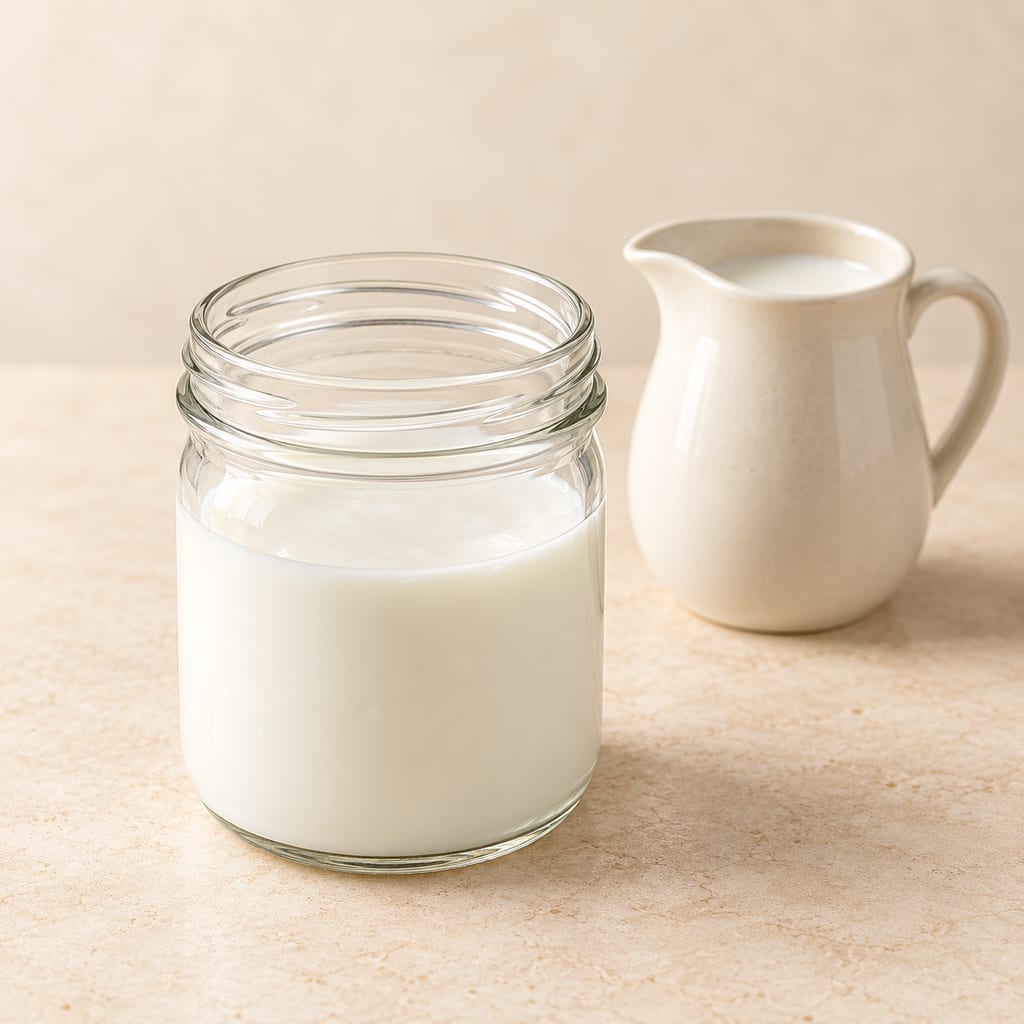
Set yogurt keeps the milk’s cultured gel intact in its final container. This Canadian home method follows the same heating and inoculation as stirred yogurt, without the final stirring.
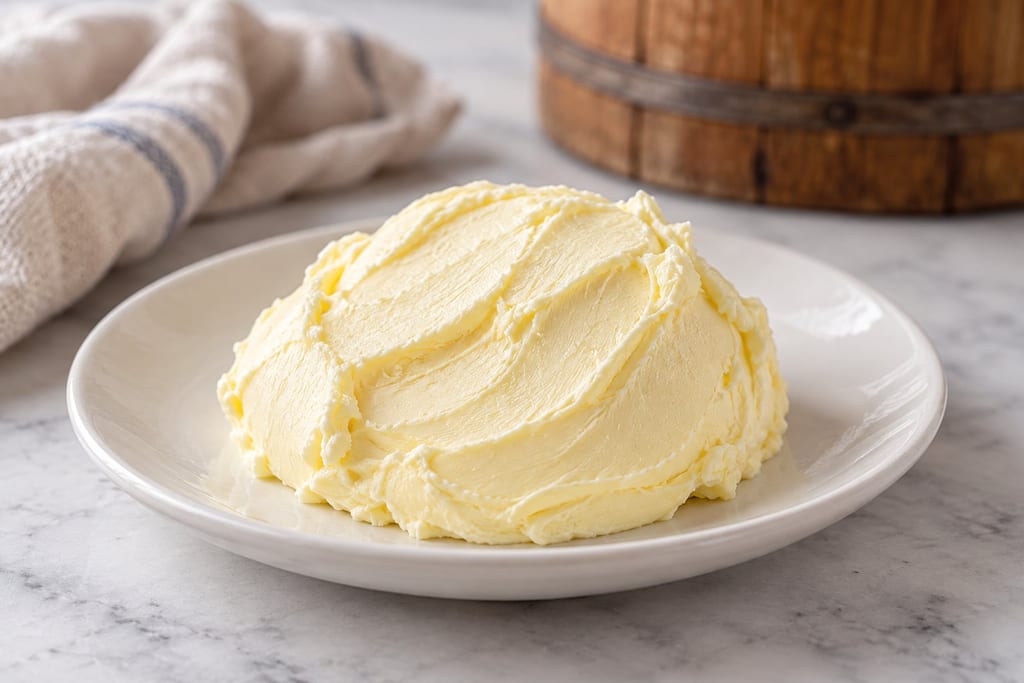
Sweet-cream butter is made by churning unsoured cream until its butterfat globules join, then draining, washing, salting and packing the butter.
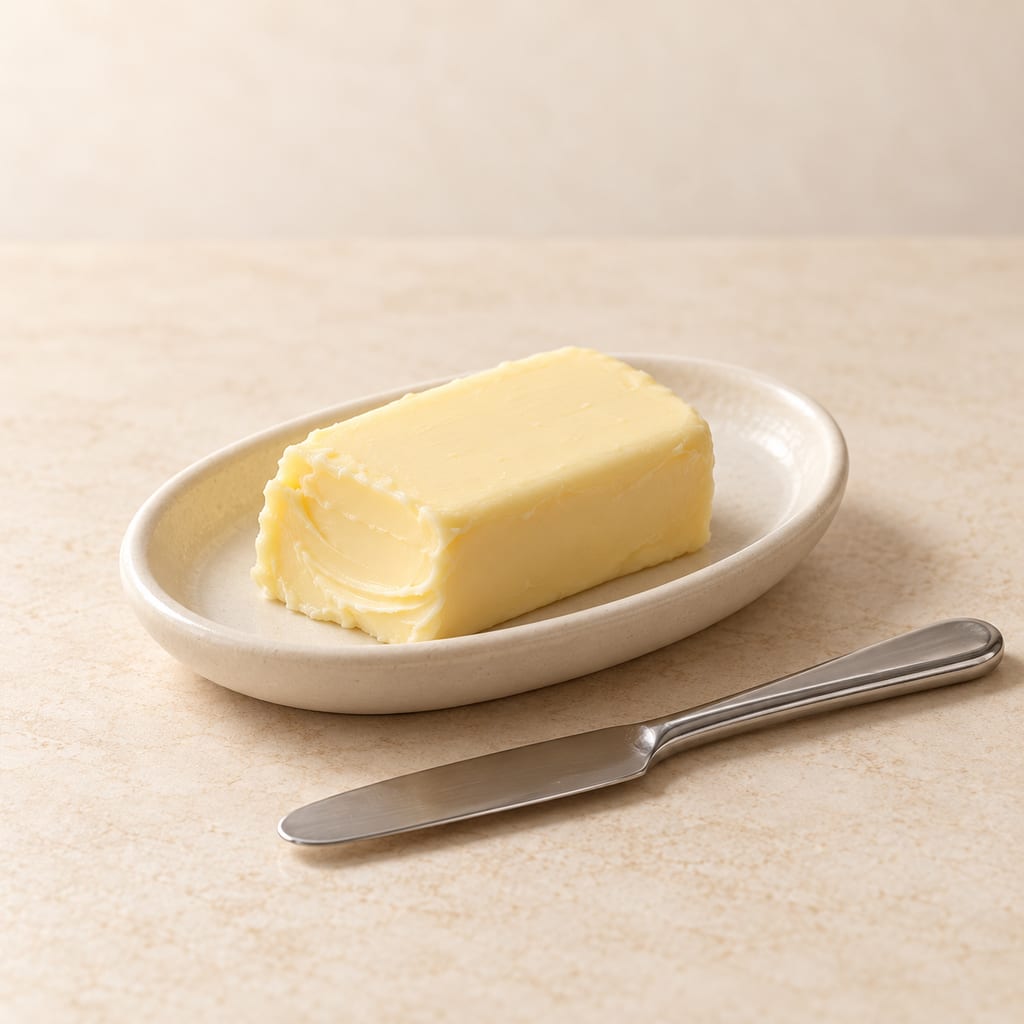
Cultured butter is churned from cream soured with lactic cultures. Its lightly tart flavour comes from the cultured cream, which separates into butter grains and buttermilk.
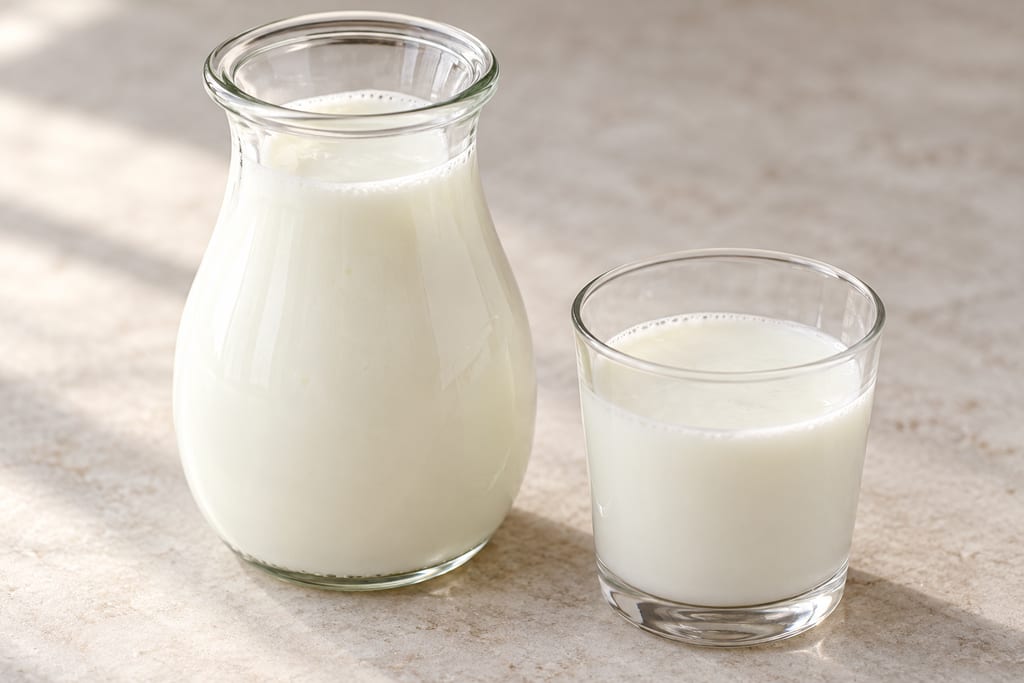
Cultured buttermilk is skim milk soured with a lactic starter into a tangy drink. This Canadian home method sets the milk without churning cream.
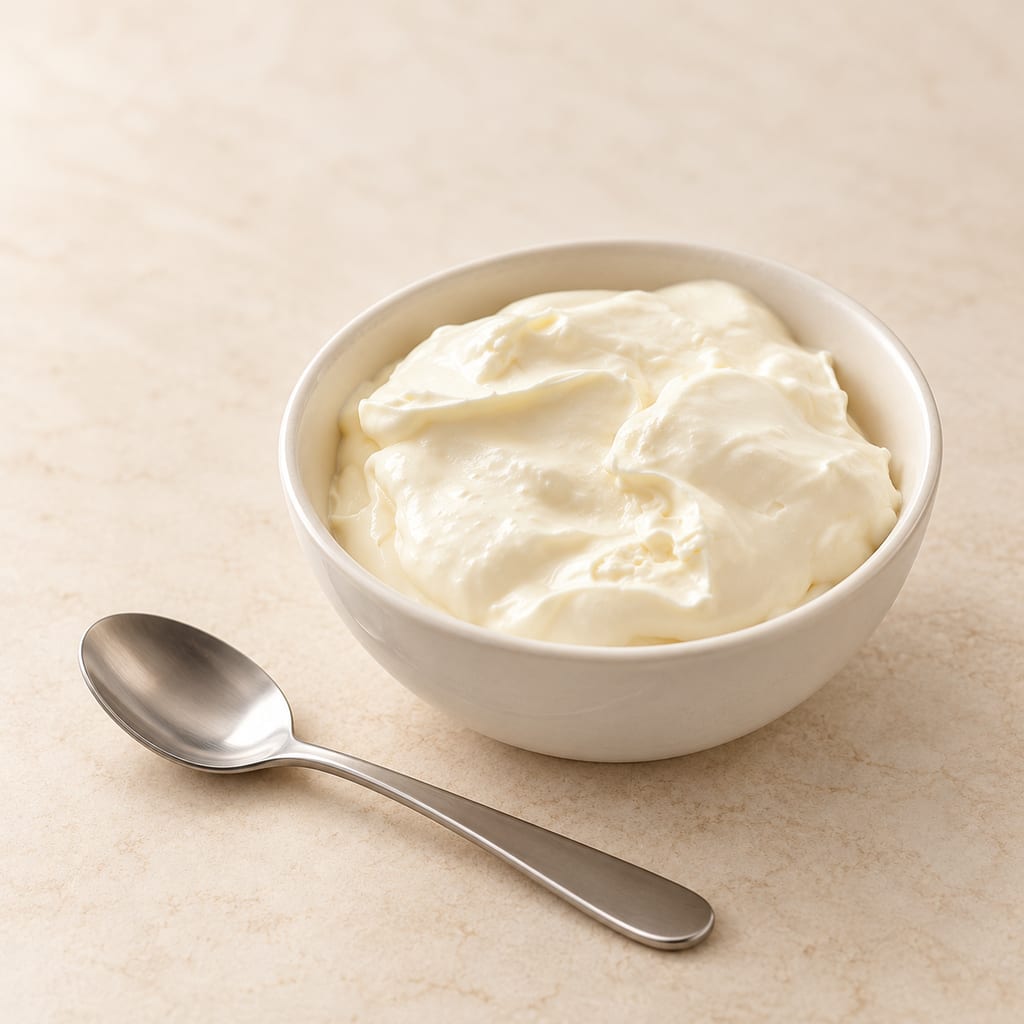
Sour cream is light cream thickened and soured by a lactic starter. This Canadian method uses homogenized cream and lets the gel form in its storage container.
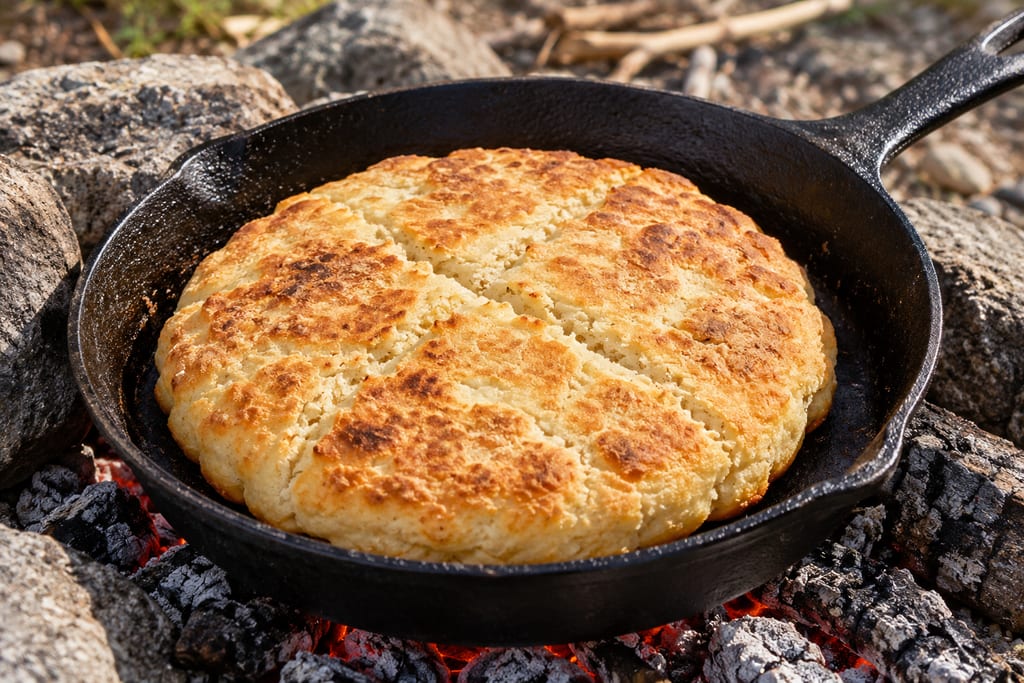
This flour, baking-powder and oil dough is Parks Canada’s contemporary Métis-interpreter version prepared at Rocky Mountain House; its specific recipe origin is unknown.
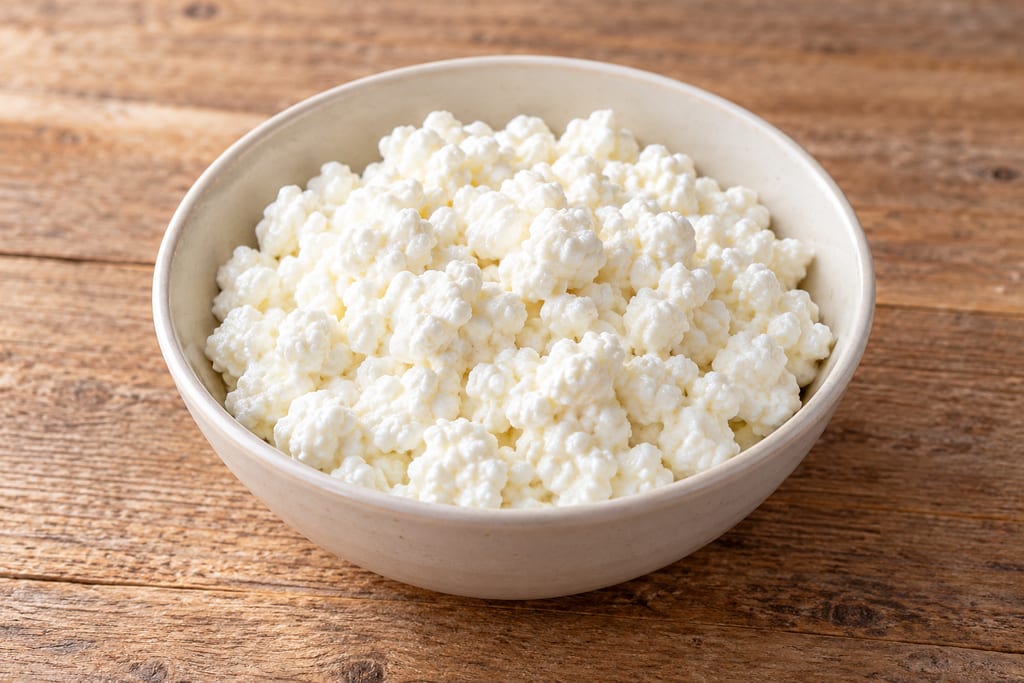
Skim milk is cultured slowly, cut into curds, warmed and drained to make fresh cottage cheese. Cold-water washing softens its flavour before cream and salt are added.
Cranberry sauce is a sauce of cranberries cooked in sugar syrup until the berries burst and thicken, served with roast turkey, pork, chicken and ham.
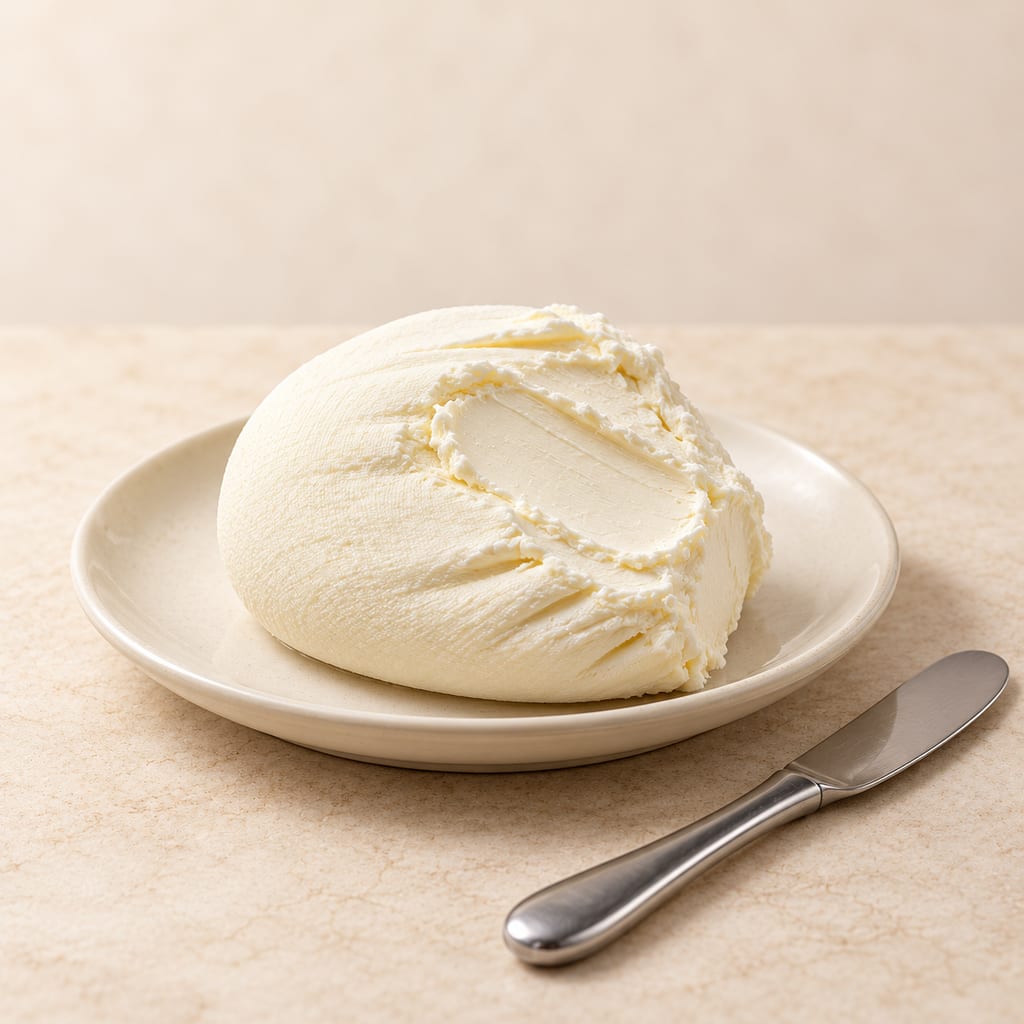
A fresh cultured-cream spread, set gently and drained in muslin in the refrigerator. This home method uses light cream and a small amount of cultured buttermilk.
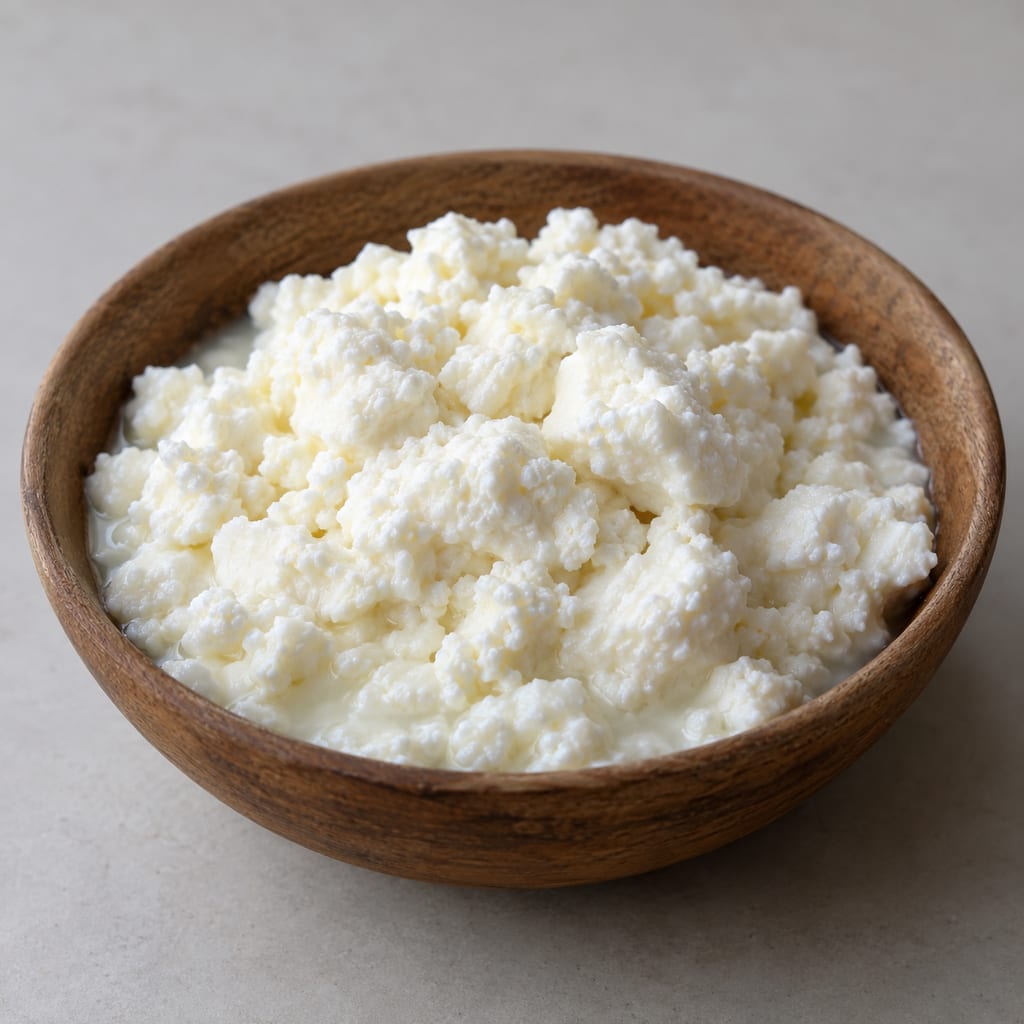
Aarts is a soft Mongolian curd made by draining boiled fermented yogurt; it remains wet, unlike aaruul, which is dried.
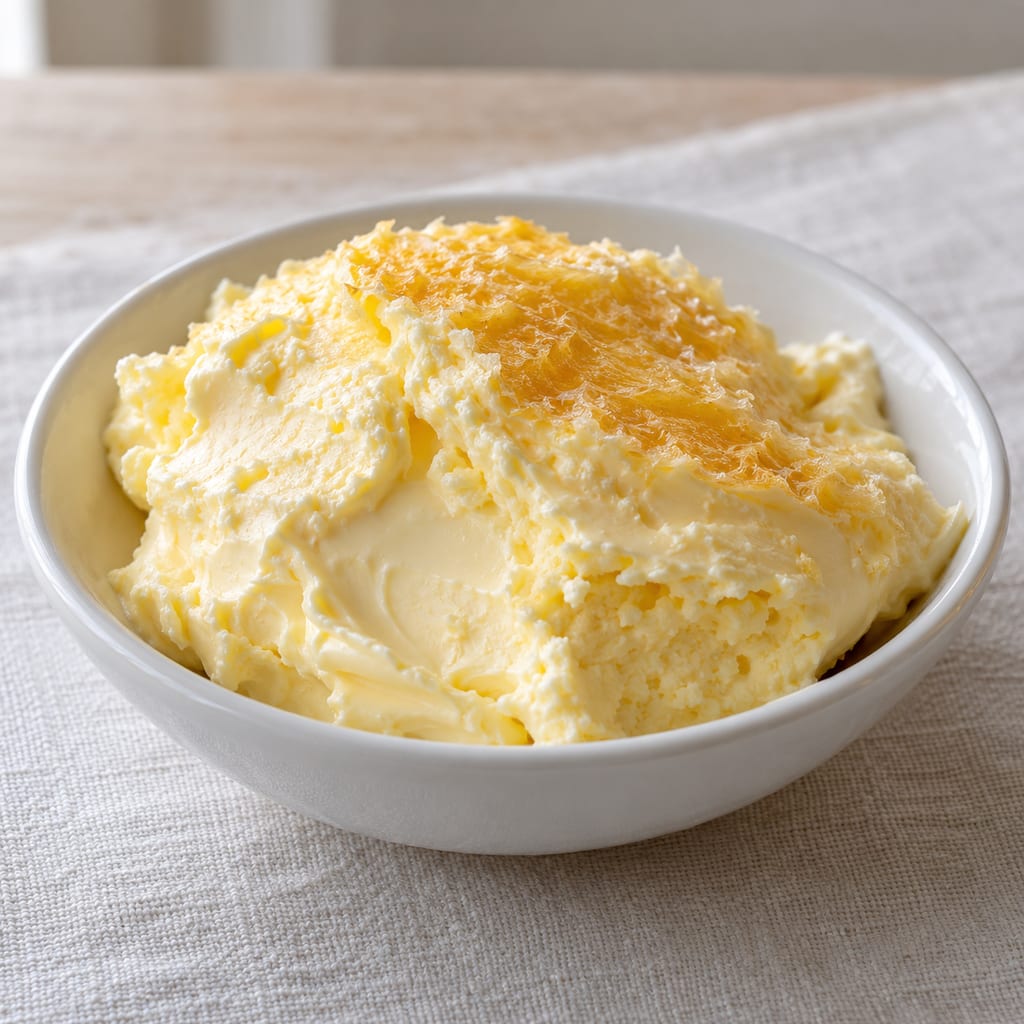
High-fat cream scalded below boiling for at least an hour until a thick crust forms, then cooled hard so the crust sets and the cream beneath thickens.
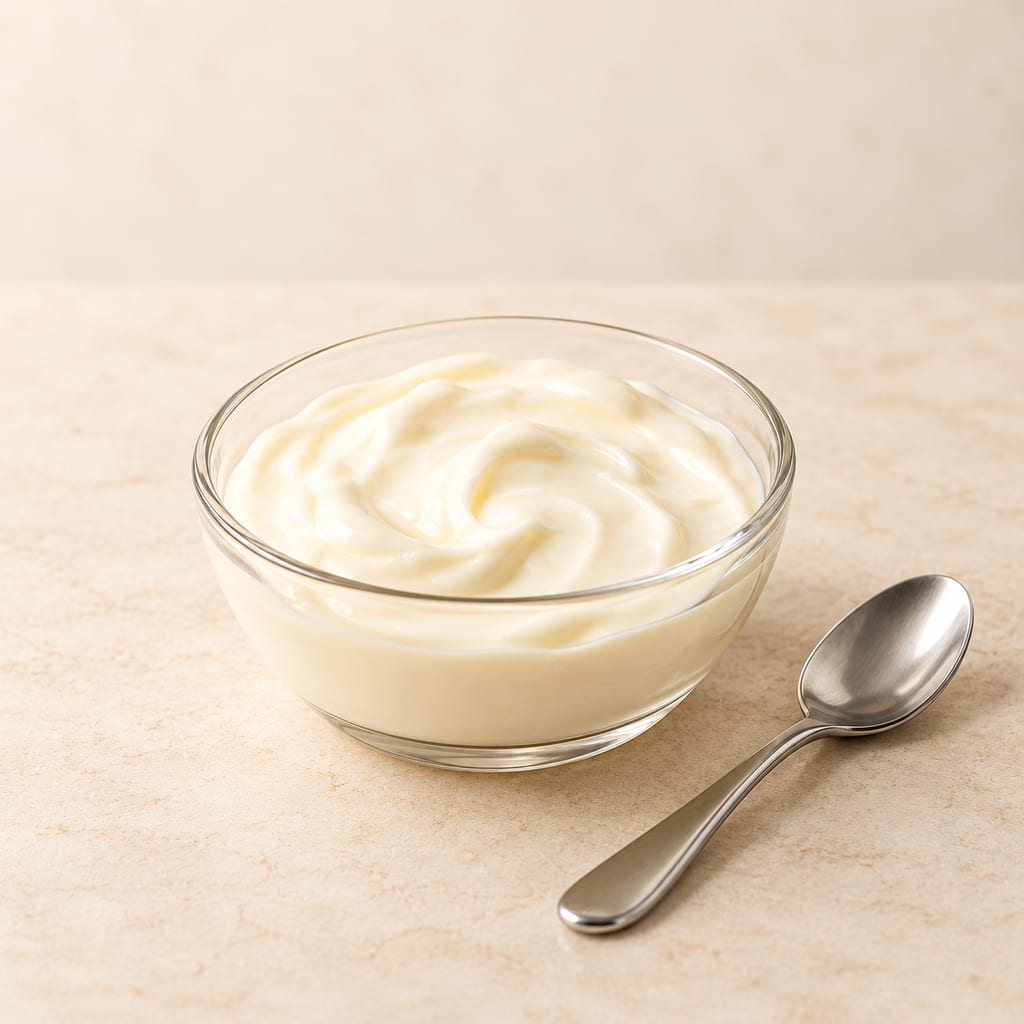
Crème fraîche is cream soured by lactic cultures into a thick, mild topping. It suits fruit and desserts as well as soups, sauces and other savoury dishes.
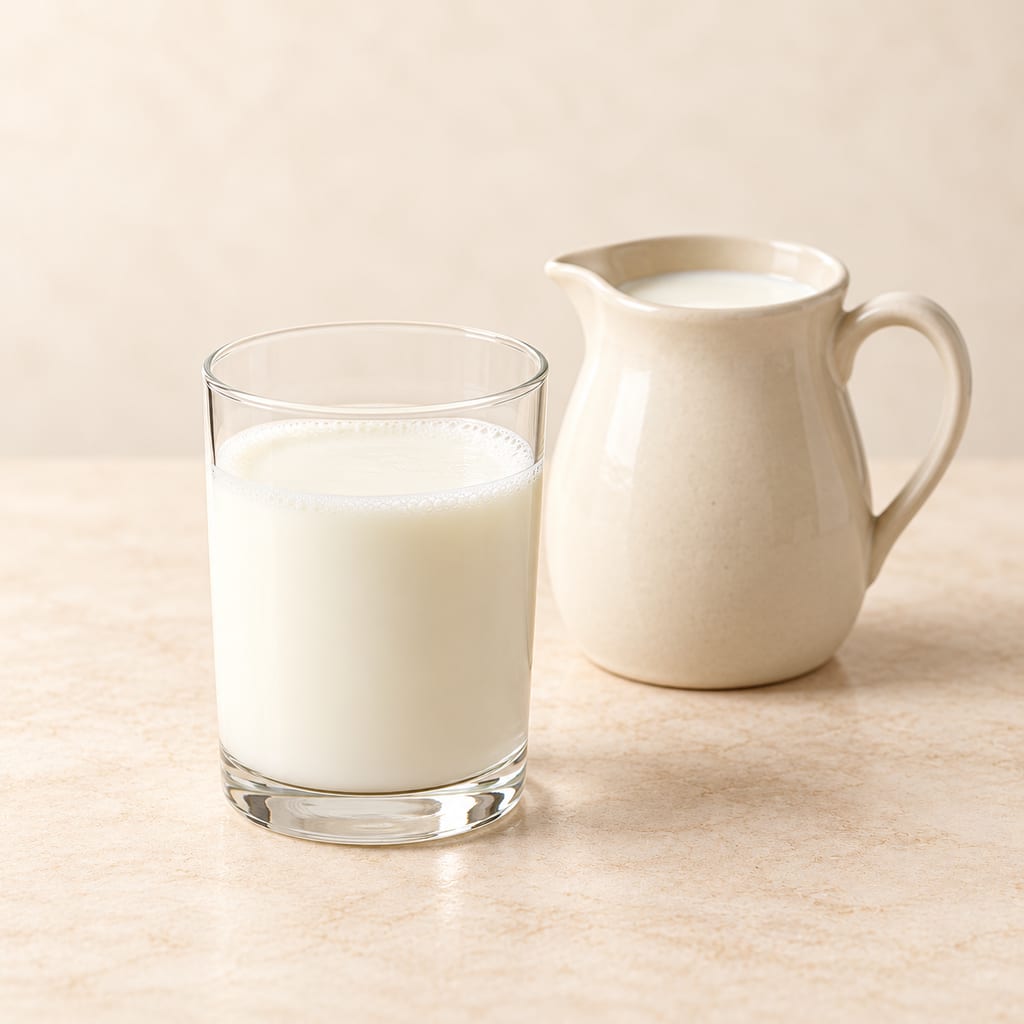
Milk thickened with a packet of buttermilk culture makes a tangy drink and a baking ingredient. This warm-incubated version uses whole milk.
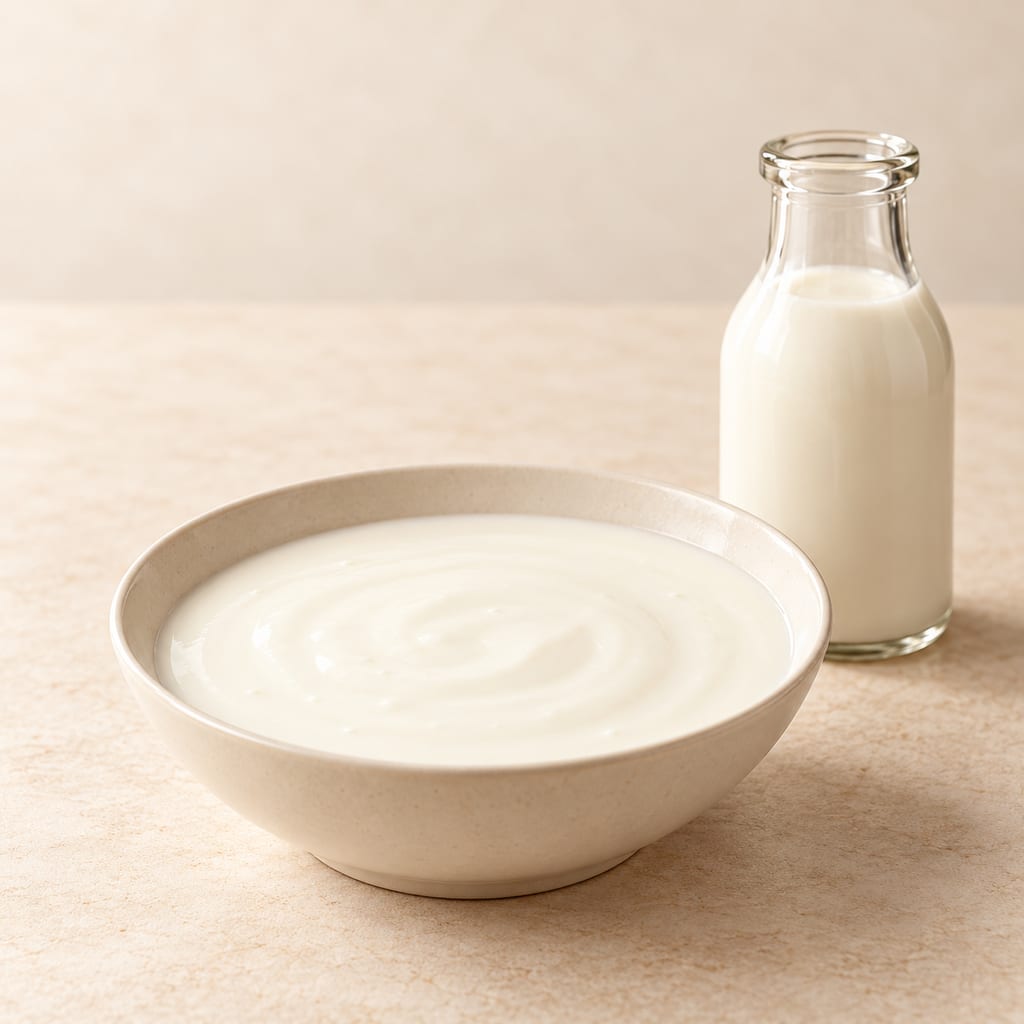
Filmjölk is a Swedish cultured milk with mild acidity and a spoonable body. This recurring batch uses filmjölk from the previous batch to culture fresh milk.
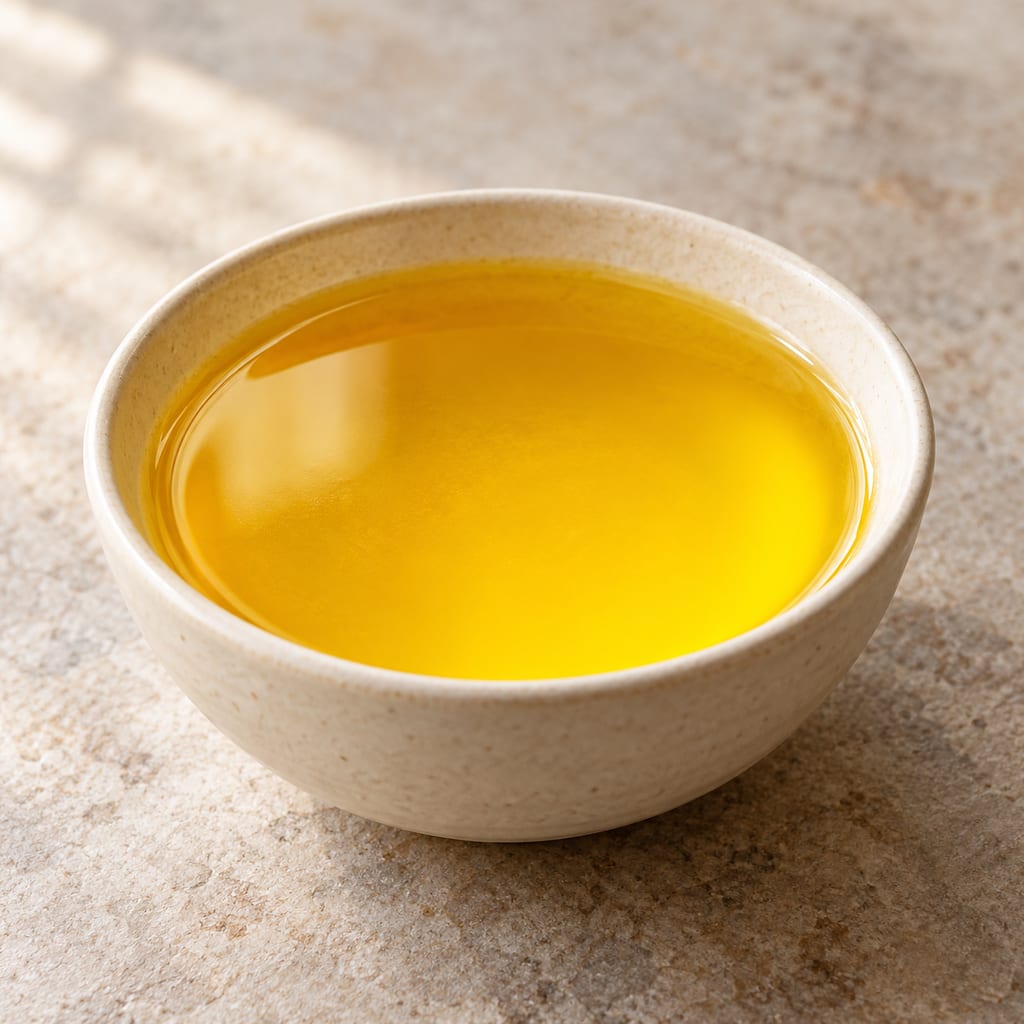
Butter heated until most water leaves and the milk solids separate, giving a fat that keeps far longer than butter. Rendering applies the same heat to animal tissue to make lard and tallow.
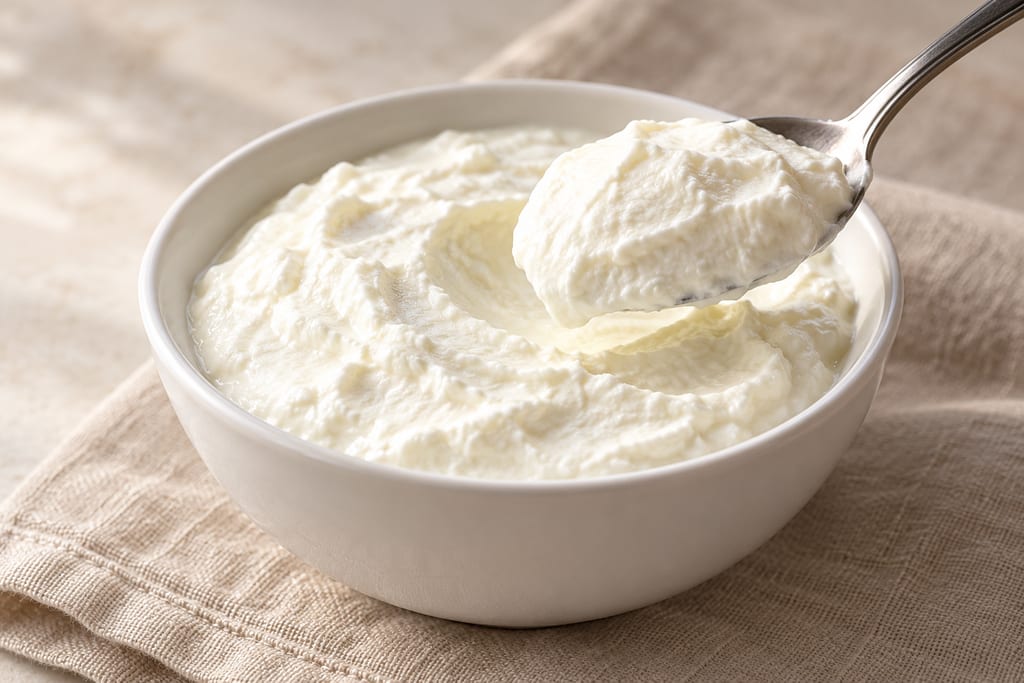
Greek-style strained yogurt is cultured whole milk drained through cloth to remove whey. This modern Utah home method makes a thick yogurt from a gallon batch.
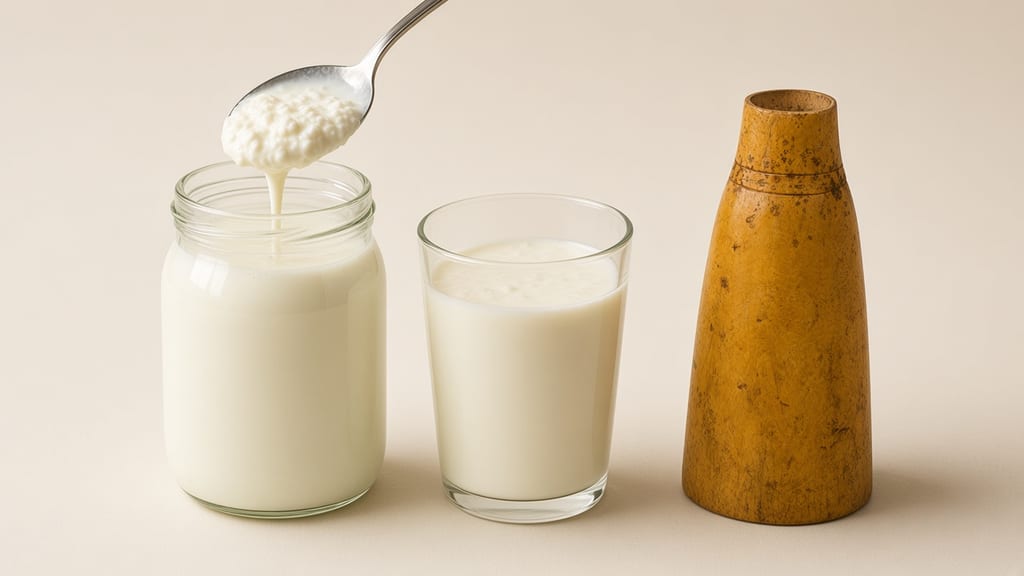
Ikivuguto is Rwanda's thick soured milk. This home version sets pasteurised whole milk with cultured buttermilk overnight at about 21 °C, then chills it for a mild, spoonable drink.

Protected Italian vinegar made only from cooked grape must, fermented and aged in a battery of wooden barrels for at least 12 years: sweet, sharp and syrupy.

Airag is Mongolia’s fermented mare’s-milk drink, traditionally churned with saved starter in a reusable cowhide khokhuur.

Appam, or hoppers, are South Indian and Sri Lankan rice pancakes made from a fermented coconut-and-rice batter and cooked in a curved pan to a crisp lacy rim and a soft, spongy centre.

Auricularia tremellosa is a wood ear fungus of the genus that supplies most dried wood ear sold in China; its own food record is thin, and the culinary practice described here comes from the closely related wood ear species.

Ayran is Turkey’s cold, savoury yogurt drink: plain yogurt is loosened with water and lightly salted, then whisked smooth or aerated into a soft cap of foam.
A thin stone griddle used over an open hearth. Norwegian archaeology documents the established tradition from the early Middle Ages; a Viking-period origin is only a cautious suggestion linked to Shetland.

Crushed or milled barley cooked in water until the starch softens and the mixture thickens, the plainest way a northern household turned stored grain into a meal, here with apple and hazelnut.

Black carrot is the anthocyanin-pigmented Eastern carrot (Daucus carota var. atrorubens), the purple root that preceded orange types and still colours kanji and şalgam.
No community contributions have been published for this entry yet.
Sign in to contribute. Published comments and photos are free to read.
Agriculture CanadaInspiration · Process
Home-made dairy products, Publication 1669Cultured dairy methods, utensils and contamination prevention; copyright 1978, reprinted 1981.
Stirred yogurt, printed page 12: 1 L pasteurized milk, 30 mL plain yogurt; 82°C for 30 minutes, cool to 45°C, culture at 42–45°C for 2½–3 hours until coagulated, chill immediately and stir smooth cold.
Selected household formulas and sequence; pasteurized dairy; active cultured starter; milk options; homogenized cream; temperature control; quiet set; buttermilk cooling/agitation; yogurt cold stirring versus intact set; possible starter/milk faults.
Cited in: A set that is deliberately broken; Yogurt before the supermarket pot; Milk choices, richness and solids; Following the temperatures through the vessel; What the spoon does after chilling; At the table and at the next attempt; Evidence and handling notes
Health CanadaSafety
Safe food handling in the homeRefrigerators at 4°C (40°F) or lower; clean food-contact surfaces and utensils.
Refrigerator at 4°C or lower; hygiene and clean food-contact equipment.
Cited in: Evidence and handling notes
Centers for Disease Control and PreventionSafety
How Listeria Spread: Soft Cheeses and Raw MilkRaw milk and raw-milk yogurt can carry Listeria and other harmful germs; choose pasteurized dairy.
Canadian Food Inspection AgencySafety
Dairy processing: Non-thermal processing systemsFermentation and slow vat: slow acidification can allow competing organisms including pathogens; monitor acidification and address failed starter activity. Commercial guidance, not a household critical limit.
Slow acidification can permit competing organisms, including pathogens; commercial control context, not a validated household endpoint.
Cited in: Evidence and handling notes
Applied and Environmental MicrobiologyIngredient context · Process
Unraveling Microbial Interactions in Food Fermentations: from Classical to Genomics ApproachesYogurt cultures commonly pair Streptococcus thermophilus with Lactobacillus delbrueckii subsp. bulgaricus, both lactic-acid bacteria; general product organisms, not a strain identification of this starter.
Common S.thermophilus and L.delbrueckii subsp.bulgaricus partnership; proteolysis, peptide/amino-acid support and metabolite/formate exchange. General organisms, not starter assay.
Cited in: The living partnership in the milk
GIDAHistory
A comparative study on the shelf life of the yogurts produced from cow and buffalo milksPrinted page 484: yoğurt is a Turkish name; yogurt attestations in Kutadgu Bilig (1069–1070) and Divanü Lugati’t-Türk (1072–1074). Reported textual attestations, not an invention date.
Reported medieval Turkic name attestations in Kutadgu Bilig and Divanü Lugati’t-Türk; comparative cow/buffalo milk trial found composition/appearance differences. Manuscripts themselves not inspected.
Cited in: Yogurt before the supermarket pot; Milk choices, richness and solids
Journal of Food Science and Technology60(6):1656–1665Process
A comprehensive review on yogurt syneresis: effect of processing conditions and added additivesSet/stirred distinction; gel matrix and serum expulsion; internal stresses and external cutting/shaking; milk formulation and process affect texture.
Cited in: A set that is deliberately broken; How fluid milk becomes a gel; What the spoon does after chilling
Türkiye Ministry of Culture and TourismProcess
Turkish Buttermilk (Ayran)Yogurt mixed with liquid and served cold; accompaniment to kebabs, köfte, meat, pilaf. Apparent salt-unit typo excluded.
Cited in: Yogurt before the supermarket pot; At the table and at the next attempt
Türkiye Ministry of Culture and TourismHistory
Süt ve Sütten Elde Edilen ÜrünlerMalatya dairy repertoire; cream layer on bread; yogurt as ingredient and source for further dairy products; garlic yogurt with bulgur köfte and sırım flatbread.
Cited in: Yogurt before the supermarket pot; At the table and at the next attempt
University of Alaska Fairbanks Cooperative Extension ServiceProcess
Making Yogurt at Home, FNH-00062Milk solids and set; heating/cooling; culture and temperature faults; over-incubation/agitation and syneresis; sanitation. Its alternate method/keeping period not transferred.
Cited in: The living partnership in the milk; Milk choices, richness and solids; Following the temperatures through the vessel; At the table and at the next attempt
International Journal of Food Science, article5569917Process
Heat-Induced Interaction of Milk Proteins: Impact on Yoghurt StructureCasein acid gel, serum retention; whey-protein unfolding and interaction with casein; protein-complex location and effects depend on conditions.
Cited in: How fluid milk becomes a gel; Following the temperatures through the vessel