
Preservation
After Halloween: how the world saves its pumpkins
A full harvest-to-pantry guide to keeping pumpkins whole, drying and freezing them, and making pickles and sweet preserves around the world—with the exact distinction between tested canning and cold storage.
A harvest worth keeping
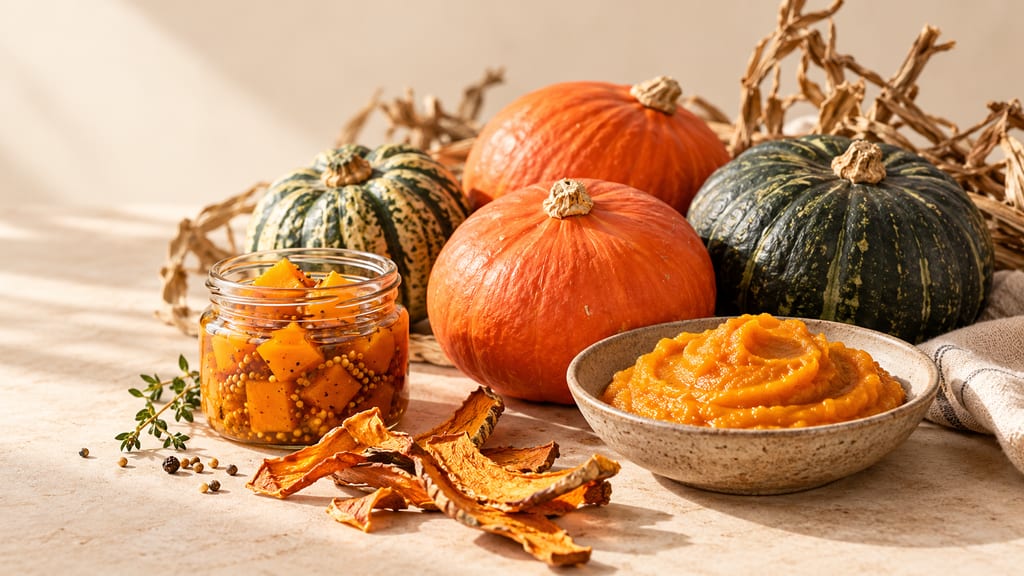
The pumpkins left in a shop after Halloween are still part of the harvest. The date on the calendar has changed their retail appeal, not necessarily their usefulness. A sound, mature pumpkin can become a winter store of plain flesh, a sharp pickle, a spiced preserve, a dried ingredient or a freezer spread. Some of the best candidates need very little intervention: their hard skins already provide the first stage of preservation.
The opportunity starts with sound, edible, uncarved pumpkins. A lantern that has stood outdoors with a candle inside belongs to a different category from untouched surplus in a shop. Clean flesh removed during carving can be saved immediately; a displayed, deteriorating lantern should not be reclaimed for food. British food-waste charity Hubbub distinguishes edible carving varieties from the deterioration that follows carving and display.
Saving pumpkins also opens a much larger story. Indigenous American gardeners dried squash long before domestic freezers. Baltic households turned it into sweet-sour pickles. Across the Mediterranean and Latin America, sugar transformed it into pieces suspended in syrup or thick preserves. In parts of Africa, keeping the harvest also meant drying its leaves; in Korea, dried squash became a winter ingredient in its own right. These are different solutions to a shared problem: a crop arrives faster than a household can use it.
Pumpkin season continues after the decorations come down
In Britain, pumpkin growing follows the warm part of the year, with mature fruit harvested in autumn before damaging frost. The Royal Horticultural Society recommends allowing fruit to ripen fully and keeping a section of stalk attached when harvesting. “Winter squash” generally means squash harvested mature and capable of storage into winter; it does not mean a crop growing outside through a British winter.
This timing makes Halloween a useful collection point, but a poor expiry date. Some fruit may already have been harvested and stored for weeks. The purchase date does not restart its storage life. A discounted pumpkin needs the same inspection as a full-price one: firm rind, sound stalk attachment, no wet patches or leakage, and no evidence of rot.
The global calendar is different. The Diggers Club's Australian advice uses Halloween as a prompt for spring planting, illustrating how misleading a single northern-hemisphere “pumpkin season” can be. Tropical production and storage follow local rainfall, heat and varieties rather than an October deadline. For preserving, the useful season is the local period of mature, abundant, sound fruit.
The economics depend on usable flesh and available storage. A very large fruit can have a substantial seed cavity and a watery texture. Cheap whole weight is not the same as cheap prepared pumpkin. Before buying a trolley-load, work out whether there is room to store whole fruit, cool a batch of cooked pulp, run a dehydrator, or freeze finished portions. Buying more than can be handled simply moves the waste from the shop to the kitchen.
An effective surplus strategy therefore has two stages. First, keep the best storage fruit intact. Second, process the sound fruit that is less suitable for keeping whole. Cutting everything on the day it arrives removes the protection provided by the rind and creates a large, immediate processing job.
What counts as a pumpkin?
“Pumpkin”, “squash” and “gourd” are common names that overlap. Kew identifies several cultivated Cucurbita species sold under pumpkin or squash names, including C. pepo, C. maxima, C. moschata and C. argyrosperma. A large orange carving pumpkin and a butternut squash need not belong to the same species. Nor does a pale or green skin mean the flesh is unsuitable for preserving.
For practical work, texture matters alongside the label:
Fruit characteristic: Firm flesh that holds its shape; Particularly useful preparations: Vinegar pickles and syrup preserves; What to allow for: Consistent cutting helps the pieces cook evenly.
Fruit characteristic: Dense, relatively dry flesh; Particularly useful preparations: Puree, butter, leather and drying; What to allow for: Less initial water usually means less reduction.
Fruit characteristic: Watery, fibrous carving flesh; Particularly useful preparations: Plain freezer puree or a strained/concentrated preparation; What to allow for: More drainage or evaporation; less predictable texture.
Fruit characteristic: Fully mature fruit with an intact rind; Particularly useful preparations: Whole winter storage; What to allow for: Cultivar and previous handling determine remaining life.
Fruit characteristic: Long, thread-forming flesh of C. ficifolia; Particularly useful preparations: Spanish cabello de ángel; What to allow for: An ordinary orange pumpkin will not reproduce its characteristic strands.
These are preparation choices, not permission to substitute ingredients in a tested canning recipe. Where a recipe specifies a particular class of pumpkin, cube size or jar size, those instructions still apply. The last row is an especially useful botanical distinction: Spain's ethnobotanical records associate cabello de ángel with Cucurbita ficifolia, also called cidra or fig-leaf gourd.
Other apparent pumpkin traditions concern different genera entirely. Japanese kanpyō is dried yūgao, a bottle gourd, rather than ordinary pumpkin. Indian “white pumpkin” can mean ash gourd. A preservation method for one of these should not be silently relabelled as a pumpkin recipe. Japan's agricultural authorities identify the raw material for kanpyō, while Kew records the ambiguous common name “white pumpkin”.
Edible carving pumpkins should also be distinguished from decorative gourds sold only for display. France's food-safety agency ANSES warns that ornamental gourds and unexpectedly bitter edible-looking squash can contain cucurbitacins. A bitter pumpkin should be discarded; cooking is not a way to make it suitable for food. A familiar shape or attractive colour is not sufficient identification.
A crop with an American history and a global pantry
American origins and Indigenous preservation.
Pumpkins and squashes in the genus Cucurbita originate in the Americas. Archaeological work at Guilá Naquitz in Oaxaca documents domesticated C. pepo around 10,000 calendar years ago. This is evidence for the crop's deep history, not a date for a modern pumpkin pickle or a claim that all present varieties existed then. Domestication, diversification and the invention of particular preserves are separate questions.
The preservation record becomes more detailed when named people describe their own work. Maxi'diwiac, widely known as Buffalo Bird Woman, recounted Hidatsa gardening and storage practices in the account published by Gilbert L. Wilson in 1917. Squashes were harvested repeatedly, sliced, spaced on willow rods and dried. The account also explains the attention paid to rain, the handling of dried pieces and their protection in storage. Its value lies in that practical detail and in recognising the knowledge of the gardener whose account it records.
These were not necessarily enormous, fully mature Halloween pumpkins. Buffalo Bird Woman describes small, young squash selected at a suitable stage for slicing. That distinction matters when a historical picture is used as a modern instruction. Crop, maturity and climate all affect the result.
A related but different practice was the making of woven pumpkin mats. A 2024 experimental archaeology paper by Crystal Dozier and Arland Wallace examines Great Plains accounts and recreates plaited strips. It connects food preparation with tools, skilled labour and the difficulty of detecting perishable food technologies archaeologically. The experiment is evidence about a technique; it is not a tested home food-storage schedule.
The sixteenth-century dispersal.
The early European record helps separate Cucurbita from older Old World gourds. Researchers identify a Cucurbita image in the Grandes Heures d'Anne de Bretagne, painted in 1503–1508. The image represents a gourd form, so it should not be treated as proof of a familiar edible pumpkin dish. The fruit garlands at Rome's Villa Farnesina, painted in 1515–1518, include Cucurbita forms among other cucurbits. These are useful dated attestations of arrival and diversity, rather than dates of recipe invention.
As the crop travelled, cooks fitted it into techniques they already understood: drying, storing mature fruit, using vinegar, and concentrating fruit or vegetables with sugar. Similar-looking pumpkin preserves in different countries do not, by themselves, prove a single origin or a direct chain of borrowing.
Pumpkin in the British preserving pan.
In 1861, Mrs Beeton printed a preserved-pumpkin recipe based on sugar, lemon juice and optional ginger and lemon rind. She placed it in the September–October season and preferred the later month for ripeness. That is a concrete British attestation, well before the present retail Halloween surplus.
The method also shows why historical documentation and modern instructions need different treatment. Long standing periods and a final covering of syrup were normal features of the recipe as written. Repeating those directions does not supply a measured acidity, a validated heat process or a reliable present-day shelf life. The companion recipe retains its flavour and visible pumpkin pieces while using refrigeration during preparation and freezing for winter.
The first preservation method is keeping the fruit whole
Whole storage deserves equal billing with a shelf of attractive jars. It keeps the flesh flexible for later use and postpones peeling, cutting and cooking. The RHS recommends a ventilated space around 10–15°C, with fruits separated so they do not touch; depending on variety and conditions, sound fruit may keep for several months. For newly harvested suitable pumpkins, curing helps the rind harden before storage. It cannot repair rot, reverse frost damage or restore a fruit that has already begun to collapse.
Commercial postharvest research adds the reason for avoiding both a damp cellar and excessive cold. UC Davis describes pumpkin and winter squash as sensitive to chilling below 10°C and gives moderate humidity, with ventilation, for good storage. The fruit remains alive, continues to lose water and changes during storage. The challenge is to limit both decay and excessive drying.
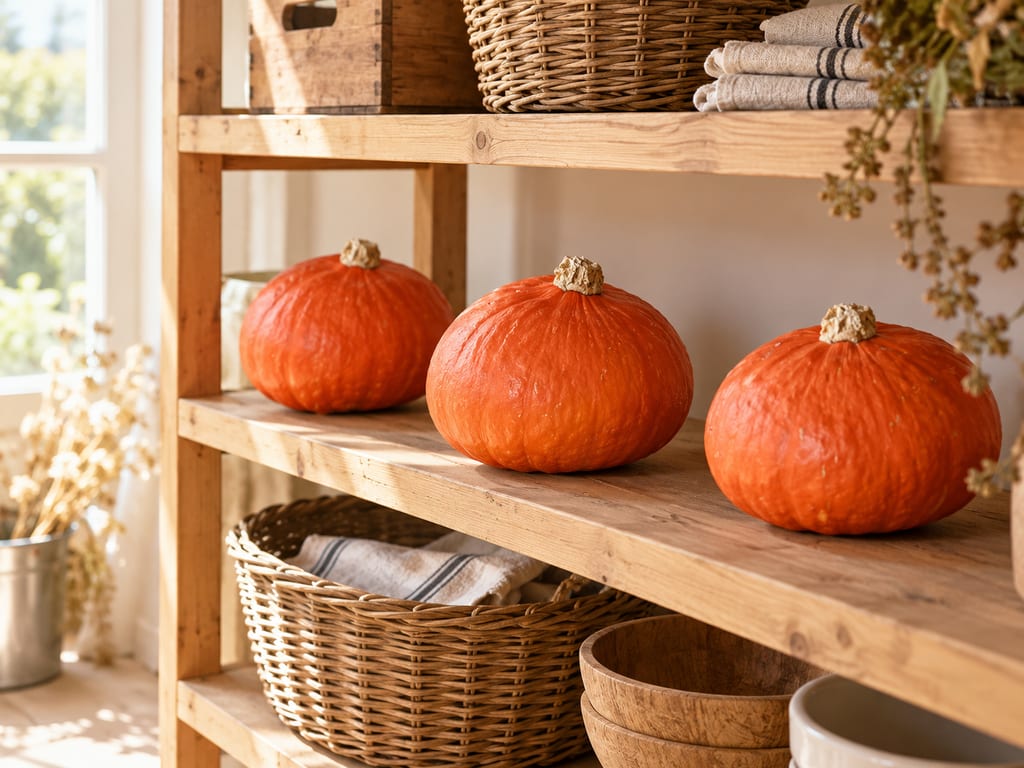
For a British household, an airy spare room, suitable utility area or protected store may work better than an unmonitored shed. “Frost-free” alone is not the whole specification. Put a thermometer where the fruit will actually sit, and inspect it regularly, including the underside and stalk attachment. Keep it off a damp floor. Fruit with a damaged rind should be assessed and used promptly if still sound, rather than returned to the long-term store.
Storage advice is not a guarantee for an unknown supermarket cultivar. A six-month possibility for a well-kept storage squash cannot be transferred automatically to a discount carving pumpkin with an uncertain harvest date. Plan to check and use the less promising fruit first.
What changes when a pumpkin is cut?
The rind no longer separates the moist flesh from handling, equipment and the surrounding environment. From this point, preservation needs an active control: cold, water removal, a validated acid treatment, or a heat process appropriate to the food.
Pumpkin is a low-acid food for canning purposes. The National Center for Home Food Preservation uses pH 4.6 as the relevant boundary in explaining the problem. In a moist, sealed, low-acid environment, surviving Clostridium botulinum spores can become a serious hazard. A vacuum seal demonstrates a pressure difference; it does not demonstrate that the food received the process it needed.
This is why several familiar instructions are insufficient on their own: pouring pumpkin into a hot jar, turning a jar upside down, adding a spoonful of vinegar, or cooking a puree until it is very thick. Thick puree introduces an additional issue because heat penetration differs from that in intact cubes surrounded by liquid. Commercial canned pumpkin is not evidence that an arbitrary home pressure-canning time will work for puree.
The available routes can be compared without treating them as interchangeable:
Route: Whole storage; Main preservation control: Mature rind plus suitable temperature and ventilation; Suitable outcome: Uncut pumpkin for later preparation; Practical limit: Only sound storage fruit; monitor condition.
Route: Freezing; Main preservation control: Continuous low temperature; Suitable outcome: Puree, butter, relishes and sweet preserves; Practical limit: Texture can soften; pack in usable portions.
Route: Drying; Main preservation control: Removal of available moisture; Suitable outcome: Brittle pieces, powder, leather or seeds; Practical limit: Each product needs its own drying endpoint and packaging.
Route: Pressure canning; Main preservation control: Validated process for low-acid food; Suitable outcome: Plain pumpkin cubes in water; Practical limit: Cube size, packing, jar size and pressure schedule matter.
Route: Tested acidified canning; Main preservation control: Exact formulation plus boiling-water process; Suitable outcome: Specified pumpkin pickles or compote; Practical limit: A process belongs to its recipe, not to all similar preserves.
Route: Refrigerated pickling; Main preservation control: Cold storage with the specified pickling preparation; Suitable outcome: Small batches and short-term condiments; Practical limit: Does not automatically provide a winter-long shelf life.
Sugar, acid and dryness all change the conditions in which microbes can grow. Their effects depend on the finished food. A very sweet taste does not measure water activity, and the pH of the liquid alone does not necessarily describe the centre of a thick pumpkin piece. The practical home solution is to use a complete tested process where one exists, and an explicit cold-storage method elsewhere.
Three ways to put pumpkin in the cupboard
Plain pressure-canned cubes.
USDA/NCHFP publishes a process for hot-packed pumpkin and winter squash cut into 1-inch cubes. It includes different processing times for US pint and quart jars and pressure adjustments for elevation and gauge type. The separate method in this collection reproduces the operational details, including the distinction between a proper pressure canner and a small pressure cooker.
This is useful when a plain ingredient is wanted later. The cubes can be drained and mashed after opening. Making the puree at that stage preserves the applicability of the tested process. Putting puree into the jar first does not.
Sweet pumpkin pickles.
Ball's Complete Book of Home Preserving includes sweet pumpkin pickles; University of California Master Food Preservers republishes the recipe with its vinegar, sugar, lemon and spices. The formulation uses small cubes and a boiling-water process. The original book supplies the pint/500 ml jar specification omitted from the short university post.
This is a particularly useful answer to the surplus: a ready-to-use preserve that does not occupy freezer space. Its existence also prevents an overcorrection. It would be inaccurate to say that pumpkin can never be water-bath canned. This is an established published canning process from Ball, republished by UC Extension; its formulation and instructions apply to this particular pickle, not to any pumpkin preserve with vinegar added.
Pumpkin–pineapple compote.
Bernardin's Pumpkin Pineapple Autumn Glory Compote combines pumpkin pieces with fresh pineapple, dried apricots, raisins, lemon and sugar. UC Master Food Preservers republishes it with bottled lemon juice and a full altitude table. The companion entry preserves that exact formulation and explains the acidification and jar requirements.
The pineapple and lemon are part of the formulation, not optional decoration. Replacing pineapple with extra pumpkin, omitting lemon, making a puree or increasing the jar size creates a different product. Keep the exact recipe for cupboard storage and make other flavour experiments as freezer preparations.
The world's pumpkin pickles
Estonia and Poland: sweet, sour and spiced.
Estonian marineeritud kõrvits provides one of the clearest seasonal examples. Pille Petersoo's family account places clove-scented pickled pumpkin on the Christmas table alongside other familiar winter foods. Her recipe is a contemporary household version, not a universal national formula. It shows how an autumn crop can acquire a specific festive identity.
Polish dynia marynowana follows a related sweet-sour direction. Chef Jakub Kuroń's version uses vinegar, sugar and warming spices, with a relatively modest amount of sugar compared with many syrup preserves. Its regional interest lies in its balance and use of firm cubes. A culinary source can document that preparation without validating every bottling instruction attached to it.
The strength of vinegar deserves attention when adapting European recipes. Some specify 10%, 12% or even 30% products, whereas many home pickling recipes assume 5%. These are not interchangeable spoon for spoon. The collection uses ordinary labelled household vinegar where a cold-storage adaptation is made and documents the conversion. None of that arithmetic creates a new canning validation. For tested recipes, use the vinegar specification they give.
Britain: a mustard pickle rather than a smooth chutney.
Cassie Best's pumpkin pickle combines pumpkin with apple, onion, mustard, coriander, nigella, ginger and vinegar. The pieces remain recognisable in a thickened sauce. This makes a useful contrast with the simple spiced cubes of northern Europe: the intended result is a finished pickle preparation, not plain pumpkin ready for a later recipe. The companion version changes the storage and overnight handling instead of assuming that hot filling alone provides cupboard stability.
South Africa and Kerala: atchar and achar.
Mariana Esterhuizen's South African pumpkin atchar and a Kerala mathanga achar published from a named local caterer show a different flavour family, using chilli, mustard and other spices. They establish real pumpkin examples rather than relying on an assumed substitution into mango pickle.
The visible oil or abundant spice in a pickle should not be confused with a complete preservation control. In the modern versions supplied here, the unvalidated products receive cold storage. Their winter-keeping route is freezing, with the likely softening of the pumpkin made explicit. They remain useful preservation preparations, but should not be advertised as jars that can sit in a warm cupboard for months.
Japan: pumpkin in a fermented rice-bran bed.
Japanese nukazuke broadens what “pickling” can mean. MUJI's recipe uses thin pumpkin slices in a prepared fermented rice-bran bed under refrigeration. Here the vegetable meets an existing seasoned fermentation medium rather than a pan of vinegar.
This is included as a small-batch, short-use pickle, not counted as a way to store a whole autumn crop until spring. The distinction matters: a long-lived, well-maintained pickling bed and the storage life of a piece of pumpkin removed from it are different things. Instructions for a specific commercially prepared bed should not be used to justify a homemade bed with unknown salt, acidity or maintenance.
Niigata has another documented squash pickle: ito-kabocha kasuzuke, spaghetti squash kept in sake lees. Joetsu’s municipal product programme records a producer’s refrigerated preparation with a two-month life. That describes the commercial product under its stated conditions. It neither supplies a complete home formula nor extends the keeping time of the pumpkin removed from a rice-bran bed.
Pumpkin jams and sweet preserves
Portugal and Brazil.
Pumpkin makes several kinds of sweet preserve: spreadable jam, soft paste, distinct pieces in syrup and thread-like strands. Their names describe different finished textures, so they are useful alternatives when deciding how to save a surplus.
Portuguese doce de abóbora can reduce pumpkin to a thick jam scented with warm spices or citrus. Joana Roque's Christmas version includes cinnamon, clove, ginger, star anise and clementine. Brazil's doce de abóbora spans both pieces and softer preparations; Panelinha's published recipes demonstrate the distinction rather than presenting a single fixed texture. , ,
These traditions are useful for different surplus fruit. Dense flesh can hold an attractive shape, whereas a collapsing pumpkin can still make a good soft preserve. In this collection, freezing supplies the long storage for those unvalidated household formulations. A sugar-to-pumpkin ratio, even an apparently generous one, is not offered as proof of shelf stability.
Greece, Cyprus and Turkey.
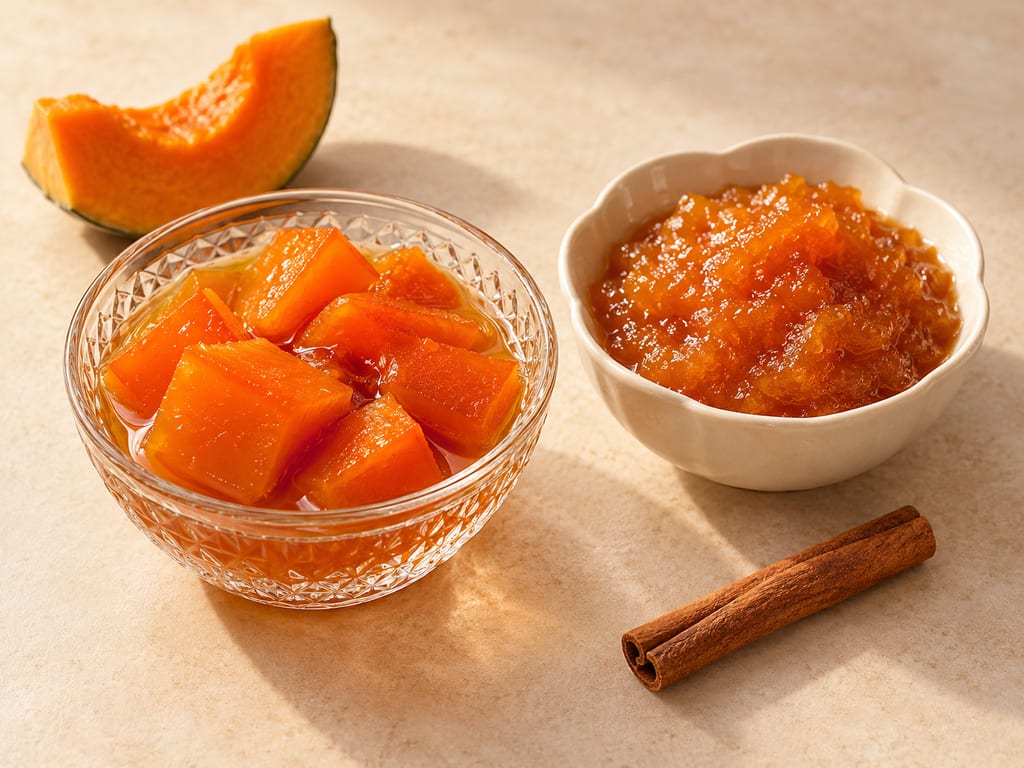
Pumpkin spoon sweets preserve the identity of the piece as much as its flavour. The Cyprus Food Museum records butternut-squash versions, including different household methods. A Greek no-lime recipe uses an acid soak; a Turkish kireçsiz balkabağı reçeli likewise provides a documented version without a lime bath. , ,
Traditional lime treatments concern texture. Their role should not be confused with acidifying a preserve: lime is alkaline. Omitting lime changes the bite and appearance, so a no-lime recipe should be described honestly as such. The supplied recipes follow documented no-lime approaches rather than recommending builders' lime, improvised wood ash or an unspecified chemical soak.
Mexico, Spain and a South African–French example.
Mexican calabaza en tacha puts pumpkin pieces into a dark sugar syrup. Casa de México supplies a contemporary recipe, and Mexico's agriculture ministry documents its association with the Day of the Dead season. It belongs here as a syrup preserve, with its freezer-storage adaptation made explicit, rather than as a complete plated dessert.
Spain's cabello de ángel depends on thread-forming squash flesh and illustrates the importance of matching a preserve to the correct raw material. It is an additional world example, not a solution that can be reproduced exactly with every Halloween pumpkin.
Jan Hendrik van der Westhuizen's pumpkin-and-apricot jam provides a contemporary South African–French connection. Dried apricots give another route to texture and flavour. It is presented as an authored recipe with a modern freezing adaptation, rather than assigned an unsupported ancient or national origin.
Drying: portable, concentrated pumpkin
Drying changes the logistics of the harvest. Removing water reduces the space needed to keep it, and dried pieces can later be rehydrated. Powder is a further preparation of properly dried flesh; grinding is not an alternative to completing the drying process.
Historical outdoor drying depended on climate, weather knowledge, spacing and protection. For a present-day British kitchen, controlled drying is the more dependable route. NCHFP does not recommend drying vegetables outdoors because their low acid and sugar levels increase spoilage risks under uncontrolled conditions. That includes pumpkin flesh even though botanically it is a fruit.
Use the pumpkin-specific method in the companion collection: prepare uniform thin pieces, apply its blanching step, dry to the stated endpoint and pack against moisture. An elastic snack, a brittle dried vegetable and a soft fruit leather are different products. Their storage instructions should not be borrowed from one another.
Oregon State University's pumpkin guidance adds a useful quality qualification: dried pumpkin can develop an undesirable flavour after one or two months at room temperature. Its separate guidance on dried vegetables recommends moisture-proof freezer packaging for longer keeping. This still has value because the dried product occupies much less freezer space than the original flesh. “Dry” does not automatically mean “best kept for a year in a warm cupboard”.
Korean sources document both ripe pumpkin dried in long strips and young summer squash dried in thin slices. Similar names can refer to different raw materials and preparations, so a recipe needs to identify which form it means.
Chinese nánguā gān also covers more than one product. An agricultural bureau's documented Chinese method includes drying, steaming and a starch coating, producing a chewy preparation rather than plain brittle flakes. Those differences explain why a photograph of dried pumpkin is not enough to reconstruct its preservation process.
In Africa, the preserved crop can extend beyond the fruit. Plant Resources of Tropical Africa records drying ripe pumpkin flesh in Zambia and the importance of leaves in southern African food systems. FAO separately documents preservation of edible leafy vegetables. These are relevant to a home-grown crop, though supermarket Halloween surplus usually offers flesh and seeds rather than leaves.
Korean hobak goji also appears in documented winter rice-cake making. A Rural Development Administration food record for Chungcheongnam-do identifies pumpkin dried for use through winter; other accounts distinguish ripe autumn ogari from dried tender summer squash. Danhobak-mallaengi is steamed and dried to a chewy snack. Its intentionally soft endpoint should not be treated as the brittle endpoint of a long-stored vegetable.
Jiangxi cooks document another sequence: dry pumpkin rings, steam them, coat them with a seasoned glutinous-rice-flour paste, then dry again. A contemporary Shangrao version adds chilli and sugar. The resulting glossy, chewy food contains cooked starch as well as pumpkin. These accounts document a regional preparation; they do not supply a controlled drying endpoint or a household winter-storage guarantee.
Freezing, leather, seeds and concentrated preparations
Plain cooked puree is the most adaptable way to process a pumpkin that has already been cut. Cook sound flesh until tender, remove the rind, mash or puree, cool quickly and freeze in small usable portions. NCHFP publishes this as a standard freezing method. Keeping it plain avoids committing the entire supply to a particular sweet or spiced preparation.
Pumpkin butter takes the opposite approach: it deliberately makes a finished, concentrated spread before storage. A University of California freezer recipe combines pumpkin puree with apple juice, sugar and spices. Its preservation destination is explicit in its name. There is no need to invent a jar process when the freezer provides a documented route.
Pumpkin leather makes a flexible sheet from cooked puree and sweetener. It is prepared and dried as a sheet, rather than bottled as a thick mass. Follow the published leather instructions for thickness, temperature and storage. The flexibility that makes a good leather is a different endpoint from the brittleness wanted for powdered pumpkin.
Seeds deserve their own preparation. Separate them from the fibres, wash and dry them using a seed-specific method before storage. Their oil content means keeping quality is not identical to that of dried flesh; appropriate packaging and cold storage help with longer keeping. The companion method distinguishes drying for storage from optional later roasting.
The Philippines supplies another useful idea: kalabasa catsup. The Department of Agriculture publishes a squash-based condiment formula drawing on the Department of Science and Technology. It is evidence of a real preparation and a productive use for puree. The version in this collection omits the loosely specified commercial additives and uses freezing, rather than interpreting a general processing leaflet as a complete validated home-bottling process.
Can pumpkin itself be fermented?
Yes. A 2008 FAO-supported processing manual for Afghanistan includes pumpkin pickle within its fermented-pickle section. Contemporary research also investigates pumpkin fermentation using selected lactic-acid bacteria, including Lactiplantibacillus plantarum. It would therefore be wrong to say that pumpkin cannot ferment.
However, evidence that fermentation occurs is not the same as a complete, dependable household preservation method. A recipe needs a coherent salt basis, temperature, acidification trajectory, endpoint, handling and subsequent storage. A laboratory study may involve inoculated cultures and controlled conditions that an open jar on a kitchen counter does not reproduce. Nor do bubbles stopping or a sour smell establish safe storage on their own. University of Minnesota Extension emphasises tested recipes and acidity monitoring in its general fermentation guidance.
For this collection, the Afghan method and laboratory studies are documented as research leads. Their gaps are not filled with an invented percentage or a confident shelf-life claim. The practical fermented-medium entry is the refrigerated Japanese pumpkin pickle made according to the prepared bed's instructions. A separately validated pumpkin lactic-fermentation procedure would make a valuable future addition.
The same distinction applies to pumpkin vinegar. The Philippine Department of Agriculture describes a pumpkin-peel and core extract followed by alcoholic and acetic fermentation. That documents a possible use for processing remnants, but the finished vinegar needs appropriate analytical control. Its pH is not a substitute for its measured acid concentration when it is to be used in a tested canning recipe. Household pickles should use the labelled vinegar their recipe specifies.
The Philippine squash-processing booklet also describes nata from a squash-based medium. Alongside pumpkin-scrap vinegar, it is a useful direction for further development, requiring a defined food-grade starter, a clear substrate formula, appropriate measurements and a storage process. These leads remain part of the research rather than recipes with invented quantities or a promised shelf life.
A practical plan for the post-Halloween surplus
Begin with sorting, not peeling. Keep good storage pumpkins whole; set aside sound fruit that needs earlier processing; reject decay and fruit unsuitable for food. Wash before cutting so a knife does not carry dirt from the rind into the flesh.
Then choose products by capacity and intended use. A household with a suitable storage room can keep much of the harvest intact. Someone with freezer room can make plain puree and a few distinctive preserves. A dehydrator can reduce volume. A canner equipped for the correct process can prepare the published cupboard-stable recipes.
One useful allocation for 10 kg of prepared edible flesh might be 4 kg for plain freezer puree, 2 kg for drying, 2 kg for a tested preserve and 2 kg for one or two regional freezer recipes. This is a planning example, not a tested mixed process, a prediction of final yield or a reason to resize a canning recipe. Make each canned recipe at its specified formulation and process.
Process only as much cooked food as can be cooled safely. The Food Standards Agency advises refrigeration within one to two hours, a refrigerator at 5°C or below and a freezer around -18°C. For cooked preparations without a validated longer chilled life, this collection adopts its conservative 48-hour refrigerator rule; frozen portions are thawed in the fridge and used within 24 hours of complete defrosting. Those are handling rules, not claims that every acidic jam necessarily spoils on the third day.
Label the actual preservation route. “Pumpkin pickle” is incomplete; “pumpkin atchar — keep frozen” or “sweet pumpkin pickles — Ball boiling-water process, prepared [date]” communicates what matters. Give a recipient the storage instruction as well as the ingredients. A ribbon and a sealed lid should never be the only information accompanying a preserve.
For future harvests, take notes on variety, prepared yield, texture and remaining quality. The best winter-storage pumpkin, the best pickle pumpkin and the best puree pumpkin need not be the same fruit. A small, well-labelled trial teaches more than turning every discounted pumpkin into the same recipe.
The result can be a varied winter supply: intact fruit waiting to be opened, plain portions for later preparation, a few jars made by tested processes, and preserves whose flavours connect the harvest with other places and histories. Halloween then becomes one useful moment in the pumpkin season, rather than its end.
Four more ways to use the pumpkin store
Pumpkin and apple chutney gives a softer, longer-cooked alternative to the chunky British mustard pickle. The apple, sugar, vinegar and aromatic proportions belong to this formulation; its cold-storage directions stay separate from a published canning process.
The simpler sweet-sour refrigerator pickle combines pumpkin cubes with cinnamon, cloves and cardamom. It is useful for a small fresh batch. Its lighter vinegar mixture must not be substituted into Ball’s recipe while keeping Ball’s boiling-water schedule.
Doce de abóbora with walnuts offers another Portuguese preparation, using cooked, drained pumpkin and cinnamon, with walnuts as an optional addition. It remains distinct from the clementine-and-star-anise jam, preserving the different source method as well as its flavour.
The earlier spiced pumpkin butter uses a different apple-juice, sugar, lemon and spice formula from the University of California freezer version. Choose one complete formulation and follow its handling instructions; neither provides a home-canning process for dense pumpkin spread.
Related
Equipment
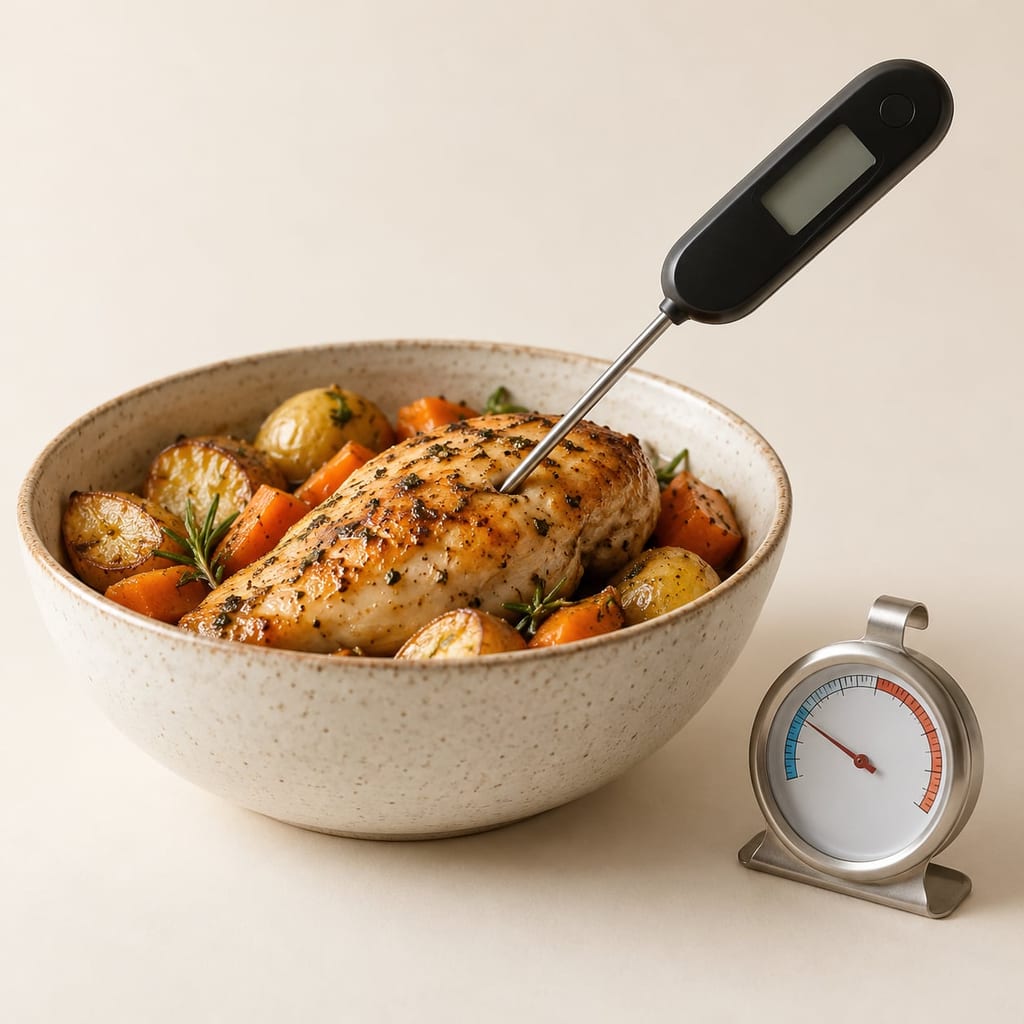
Food thermometer and refrigerator thermometer
A food probe measures the temperature inside food at the probe tip; a refrigerator thermometer measures the cold storage environment. They answer different questions and cannot establish acidity or validate a preservation process.
Discussed in this article
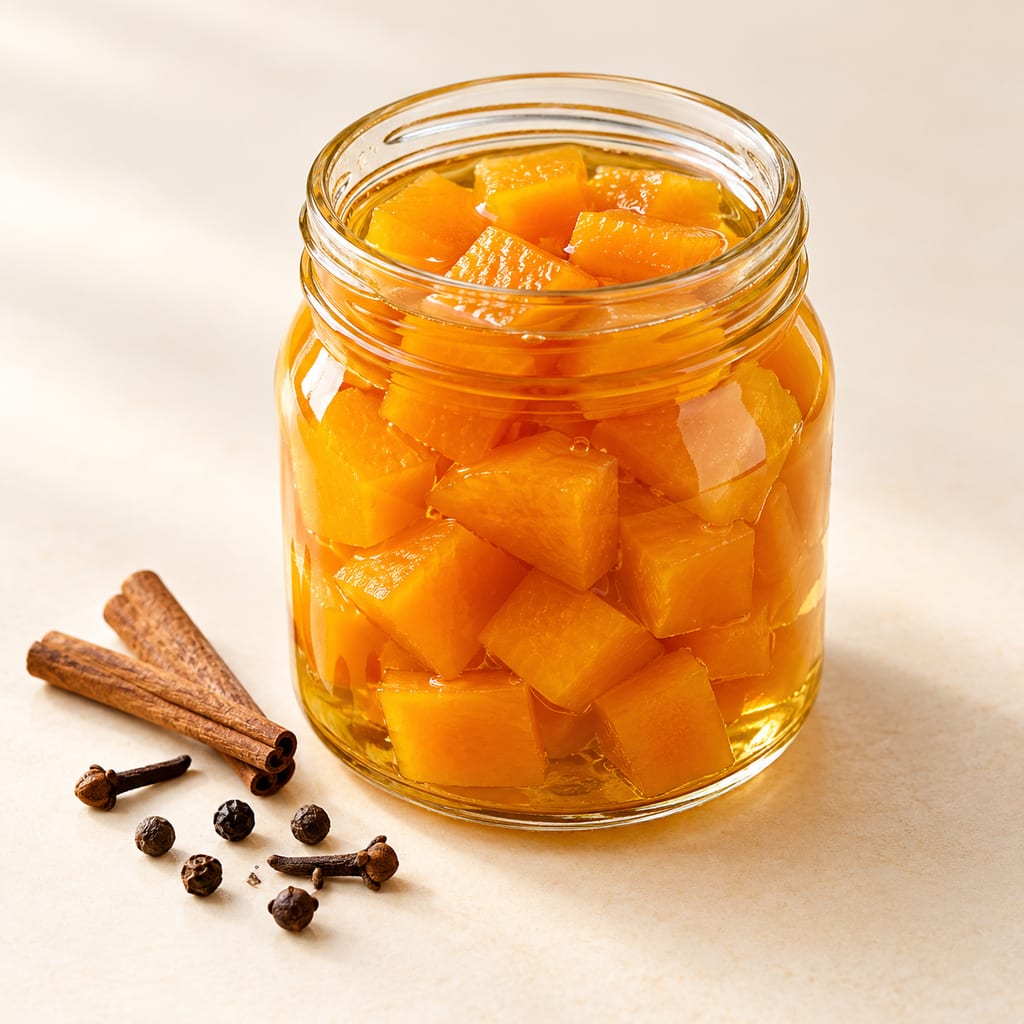
Ball sweet pumpkin pickles
Ball sweet pumpkin pickles: Cupboard: exact published Ball formulation and water-bath process.
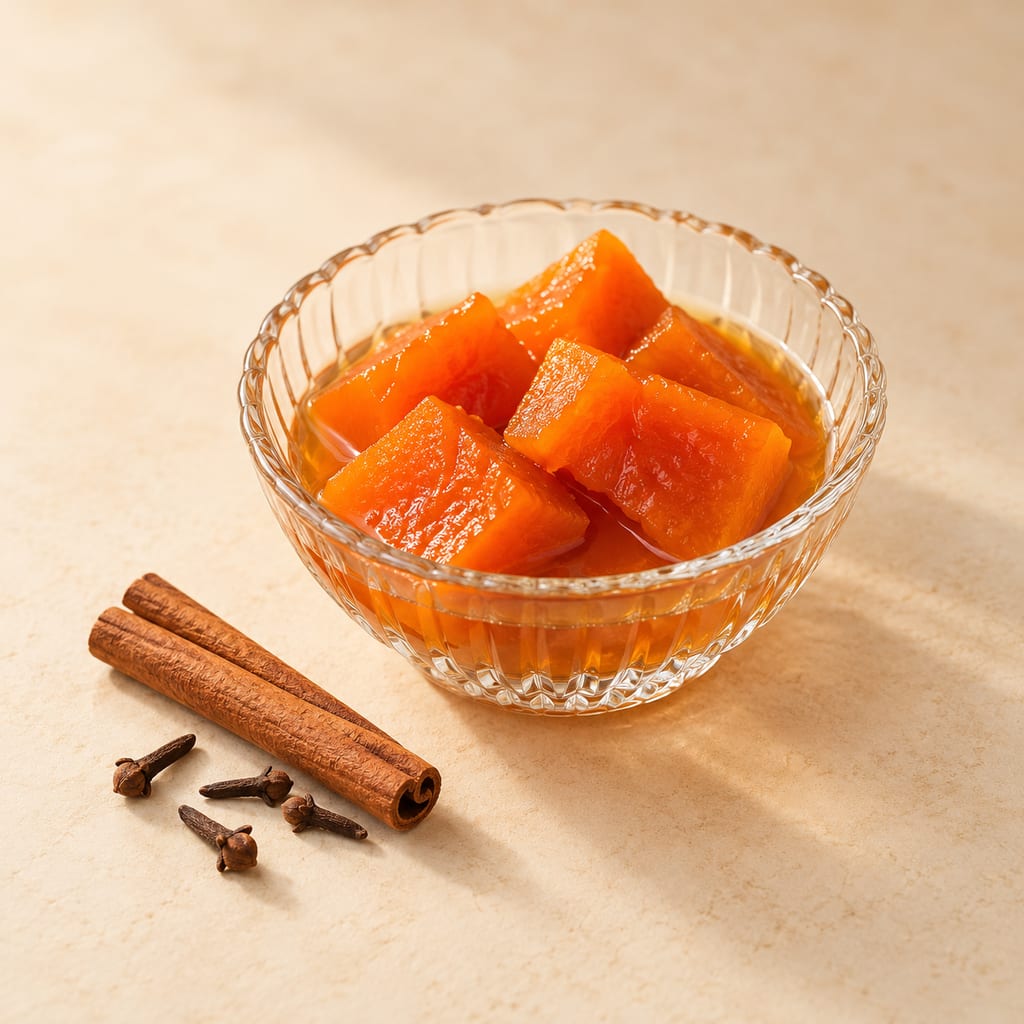
Brazilian doce de abóbora: a preserve of small pumpkin pieces
Brazilian doce de abóbora: Freeze for winter; small fresh portion refrigerated up to 48 hours.
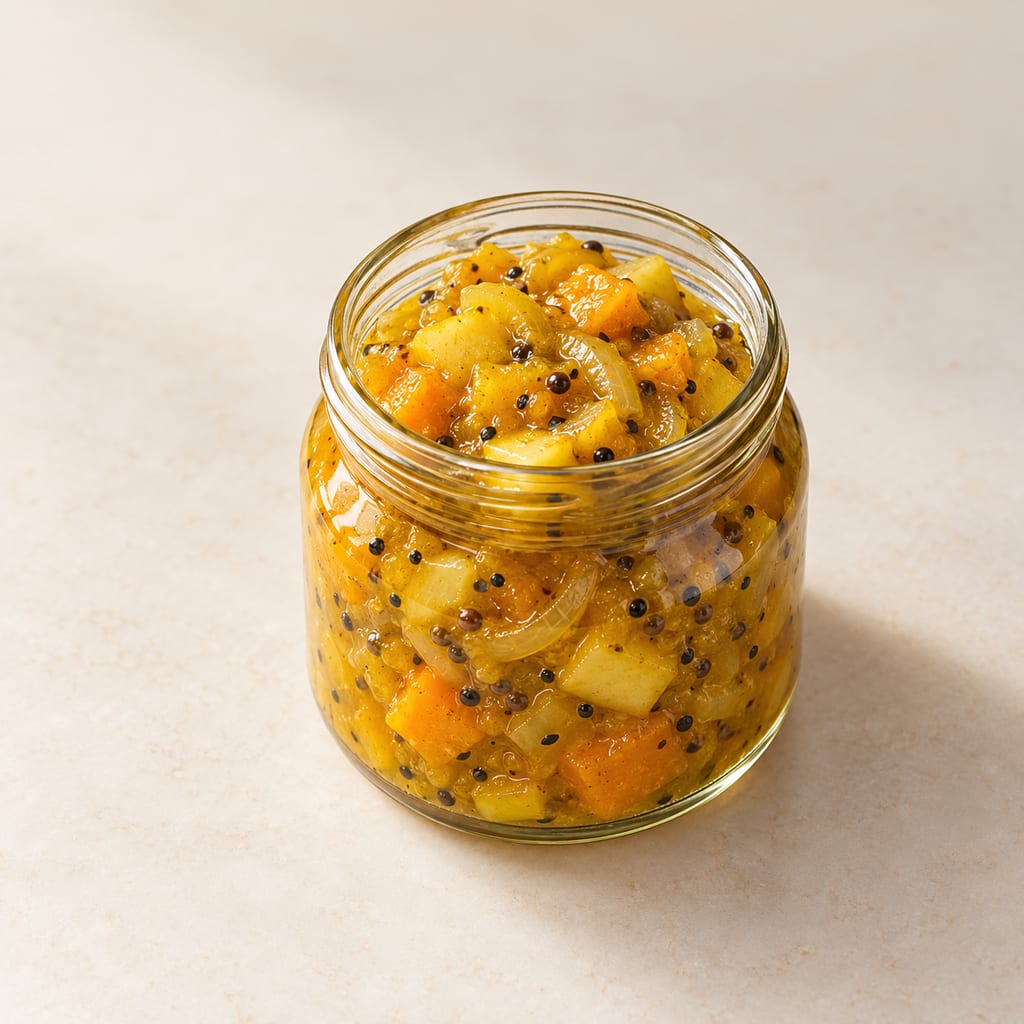
British pumpkin, apple and mustard pickle
British pumpkin, apple and mustard pickle: Freeze for winter; small fresh portion refrigerated up to 48 hours.
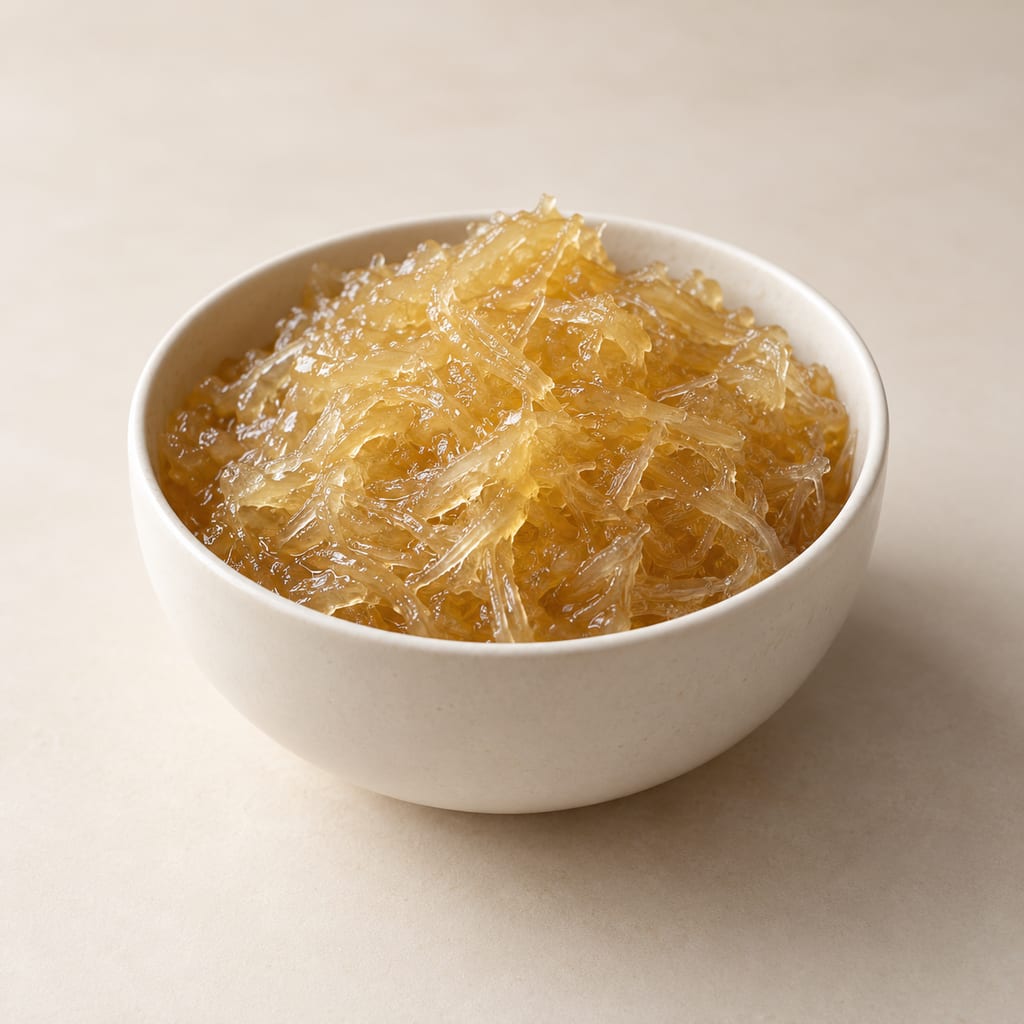
Cabello de ángel (figleaf-squash freezer preserve)
Fine strands of Cucurbita ficifolia cooked in an equal weight of sugar, then portioned for refrigerator or freezer storage. Ordinary orange pumpkin does not give the same fibres.
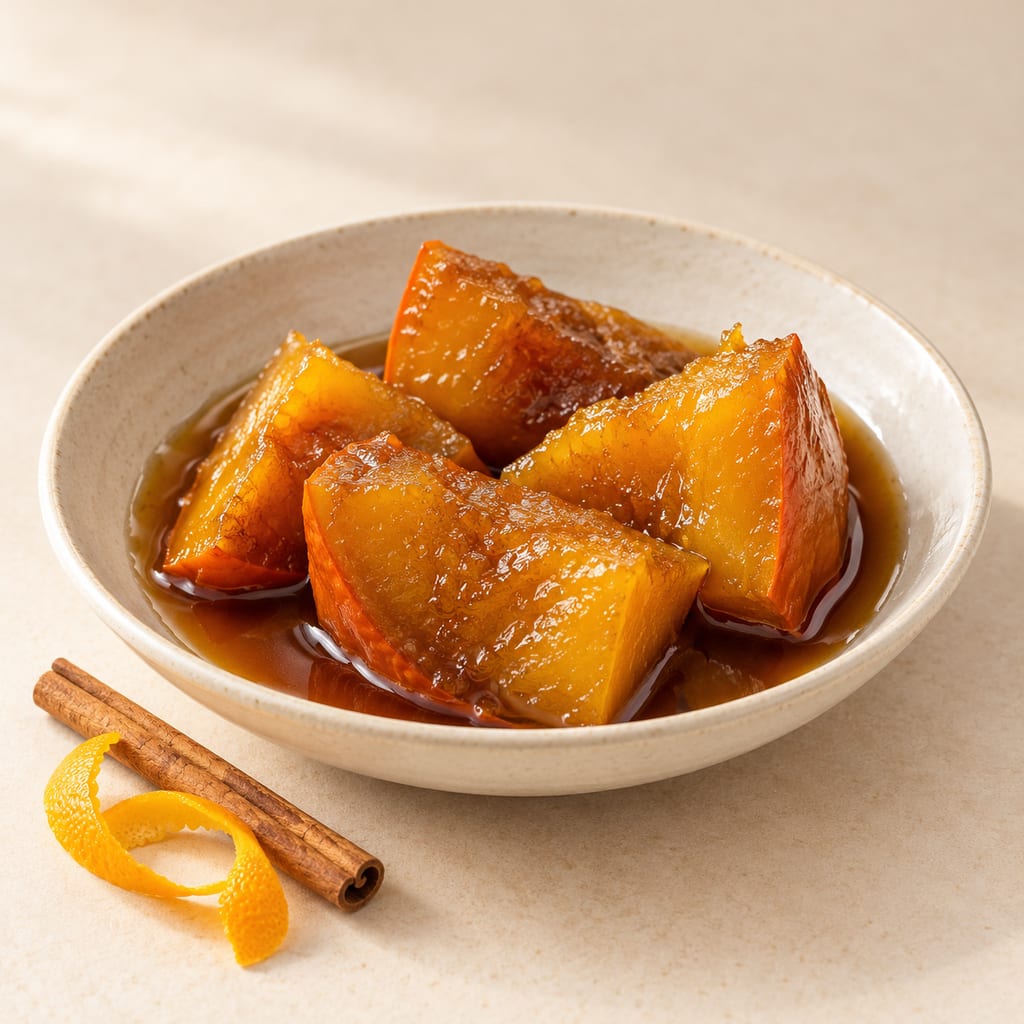
Calabaza en tacha
Rind-on pumpkin simmered with piloncillo, orange and cinnamon until glazed. This Mexican sweet keeps refrigerated for up to one week.
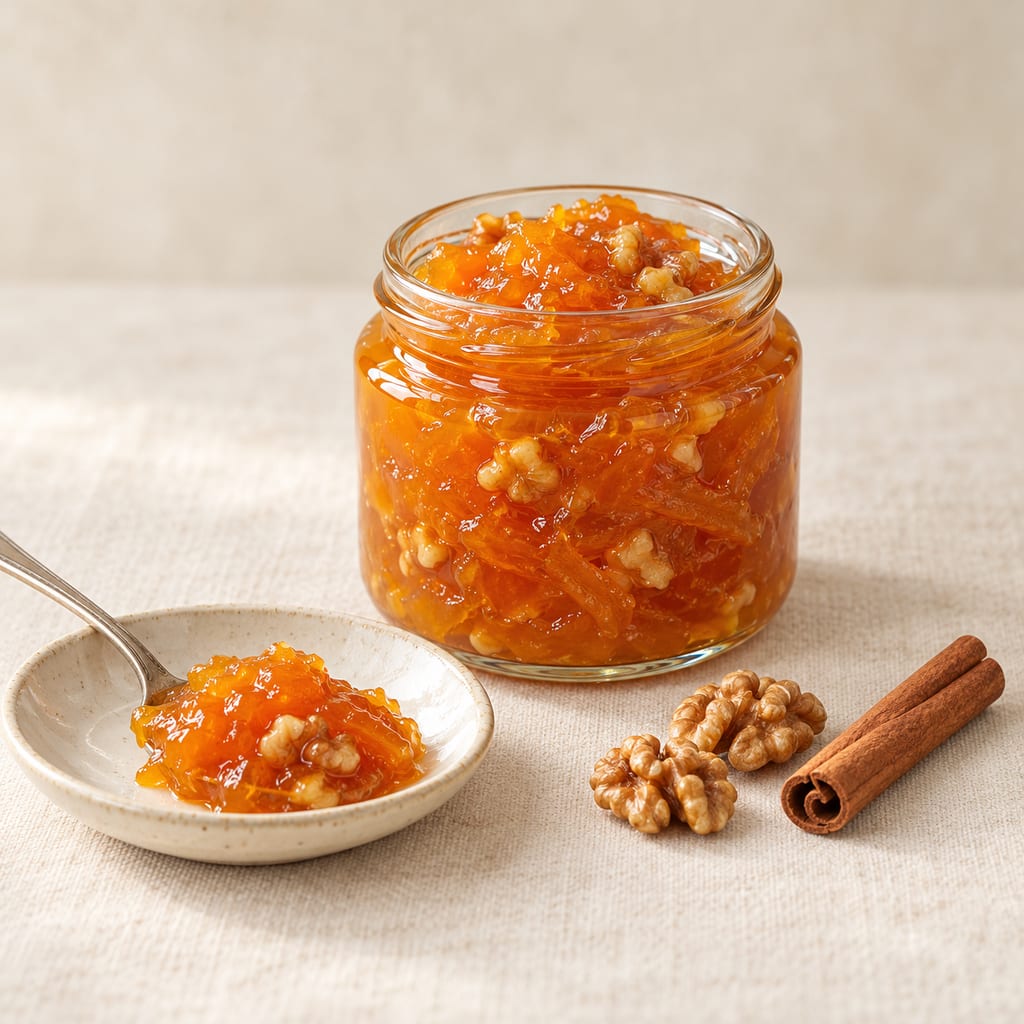
Doce de abóbora with walnuts
Portuguese pumpkin jam cooked with cinnamon and optional walnuts. A sweet spread to refrigerate or freeze, rather than a home-canned preserve.
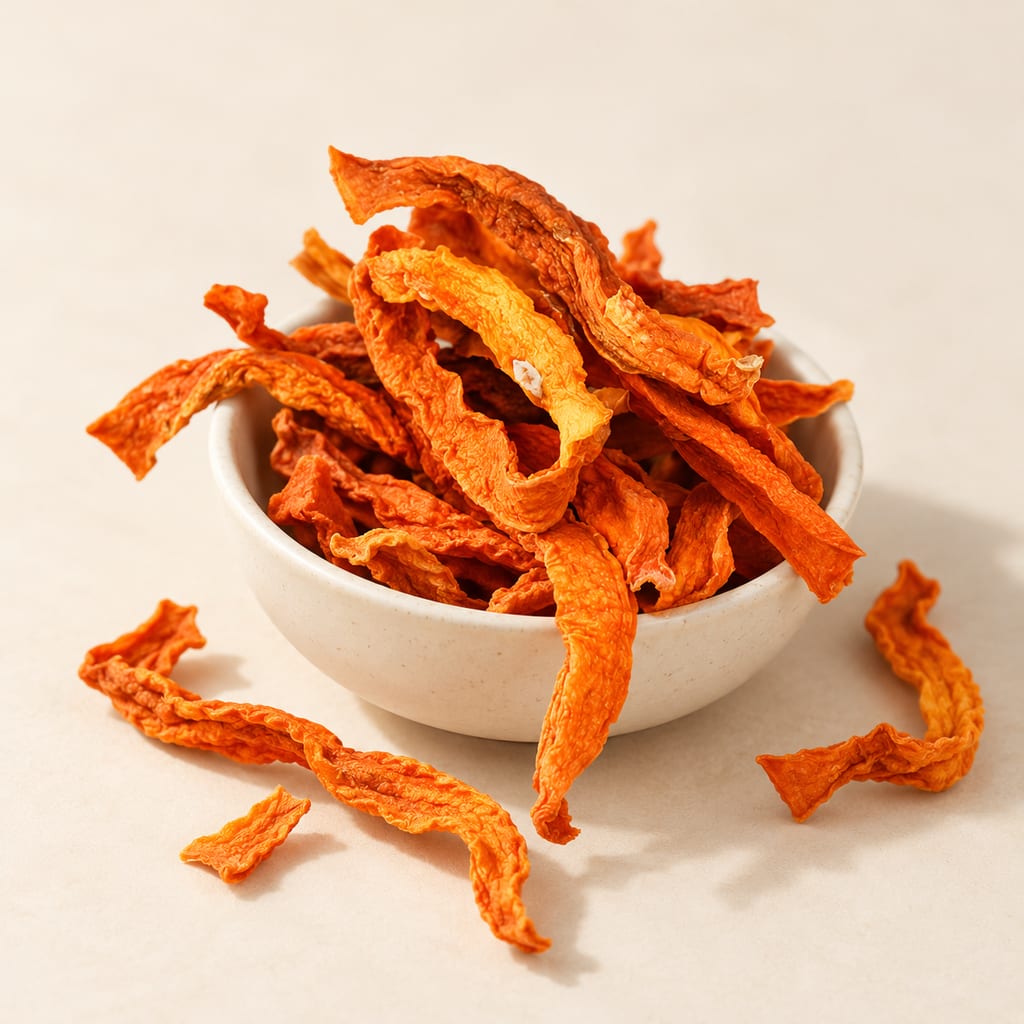
Dried pumpkin pieces and powder
Steam-blanched pumpkin dried until brittle, kept as pieces or ground into powder, with pumpkin-specific packaging and quality guidance.
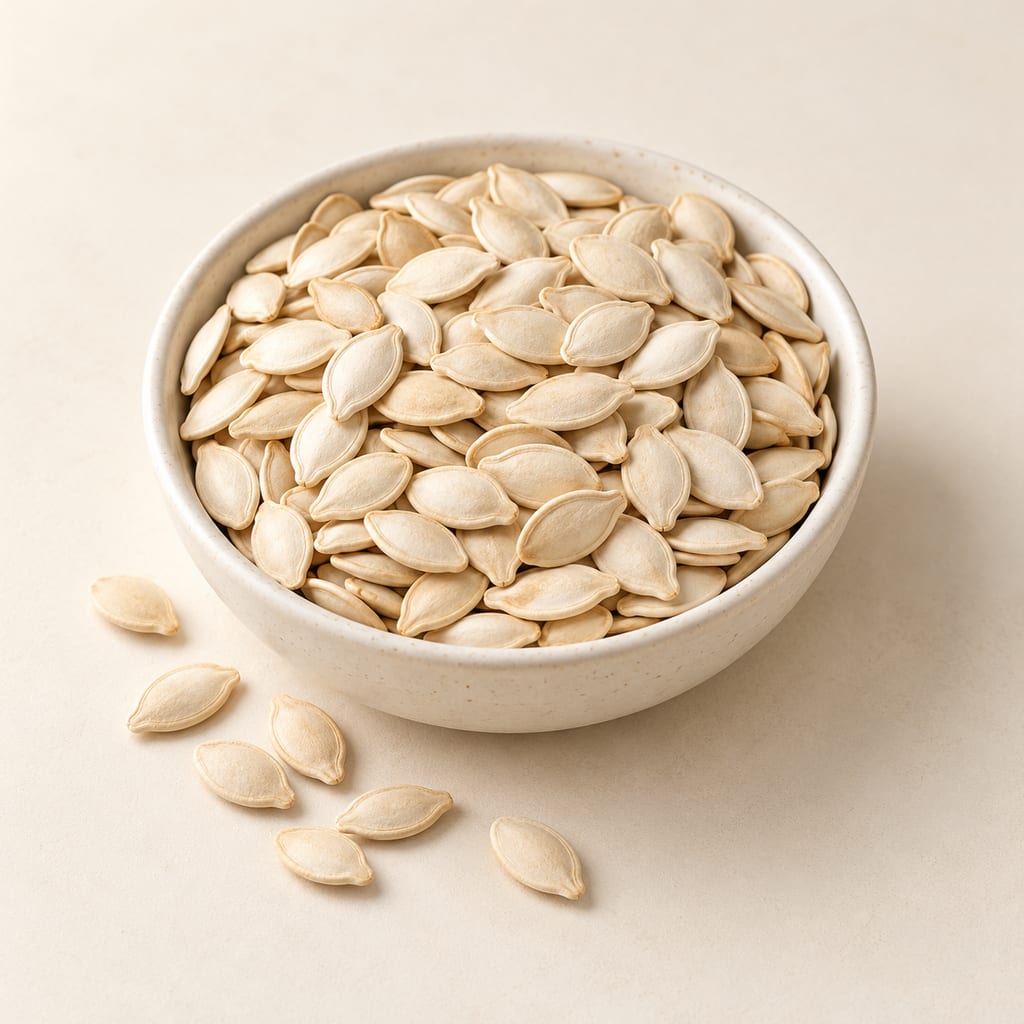
Dried pumpkin seeds
Washed pumpkin seeds dried gently for storage, with an optional roasting step before eating. Refrigerate or freeze the cooled seeds.
Community
No community contributions have been published for this entry yet.
Share what you made
Sign in to contribute. Published comments and photos are free to read.
Sources
Royal Horticultural Society
Royal Horticultural Society: How to grow pumpkinsCited in: Pumpkin season continues after the decorations come down; The first preservation method is keeping the fruit whole
Royal Horticultural Society
Royal Horticultural Society: How to grow squashesCited in: Pumpkin season continues after the decorations come down
The Diggers Club
The Diggers Club: Plant your pumpkins by HalloweenCited in: Pumpkin season continues after the decorations come down
Plant Resources of Tropical Africa
Plant Resources of Tropical Africa: Cucurbita moschataCited in: Pumpkin season continues after the decorations come down; Drying: portable, concentrated pumpkin
Kew Plants of the World Online
Kew Plants of the World Online: Cucurbita pepoCited in: What counts as a pumpkin?
CONECT-e
CONECT-e: Cucurbita ficifolia, traditional uses and cited ethnobotanical recordsCited in: What counts as a pumpkin?; Pumpkin jams and sweet preserves
Japan Agriculture and Livestock Industries Corporation
Japan Agriculture and Livestock Industries Corporation: kanpyo and yugaoCited in: What counts as a pumpkin?
Piperno and Flannery, 2001
Piperno and Flannery, 2001: direct dates from Guila Naquitz, including domesticated squashCited in: A crop with an American history and a global pantry
Maxi'diwiac/Buffalo Bird Woman, recorded by Gilbert L. Wilson
Maxi'diwiac/Buffalo Bird Woman, recorded by Gilbert L. Wilson: Agriculture of the Hidatsa Indians, 1917Cited in: A crop with an American history and a global pantry
Dozier and Wallace, 2024
Dozier and Wallace, 2024: Experimental Recreation of a Pumpkin Leather MatCited in: A crop with an American history and a global pantry
Paris et al., 2006
Paris et al., 2006: First known image of Cucurbita in Europe, 1503-1508Cited in: A crop with an American history and a global pantry
Janick and Paris, 2006
Janick and Paris, 2006: The Cucurbit Images (1515-1518) of the Villa Farnesina, RomeCited in: A crop with an American history and a global pantry
Beeton, 1861
Beeton, 1861: Book of Household Management, recipe 1584, Preserved PumpkinCited in: A crop with an American history and a global pantry
UC Davis
UC Davis: Pumpkin and Winter Squash, postharvest fact sheetCited in: The first preservation method is keeping the fruit whole
NCHFP
NCHFP: Vegetables and fruits FAQs, pumpkin butter and pureeCited in: What changes when a pumpkin is cut?
Oregon State University
Oregon State University: Potatoes, pumpkins and squash, how do I can them?Cited in: What changes when a pumpkin is cut?
University of Minnesota Extension
University of Minnesota Extension: Pickling produceCited in: What changes when a pumpkin is cut?
NCHFP/USDA
NCHFP/USDA: Pumpkins and winter squash, cubedCited in: Three ways to put pumpkin in the cupboard
UC Master Food Preservers
UC Master Food Preservers: Sweet Pickled Pumpkin, 2020, from Ball Complete Book of Home Preserving p301Cited in: Three ways to put pumpkin in the cupboard
Kingry and Devine, eds
Kingry and Devine, eds: Ball/Bernardin Complete Book of Home Preserving, p301, original book text consulted for jar sizeCited in: Three ways to put pumpkin in the cupboard
Bernardin
Bernardin: Pumpkin Pineapple Autumn Glory CompoteCited in: Three ways to put pumpkin in the cupboard
UC Master Food Preservers, 2025
UC Master Food Preservers, 2025: compote with bottled lemon juice and altitude scheduleCited in: Three ways to put pumpkin in the cupboard
Pille Petersoo, Nami-Nami, 2007
Pille Petersoo, Nami-Nami, 2007: Estonian Christmas pickled pumpkinCited in: The world's pumpkin pickles
Penn State Extension
Penn State Extension: Advice about vinegarCited in: The world's pumpkin pickles; Can pumpkin itself be fermented?
Mariana Esterhuizen, 2009, Woolworths Taste
Mariana Esterhuizen, 2009, Woolworths Taste: Pumpkin atcharCited in: The world's pumpkin pickles
Onmanorama, 2020
Onmanorama, 2020: Kerala pumpkin pickle, from a named local catererCited in: The world's pumpkin pickles
Cyprus Food Museum
Cyprus Food Museum: Butternut squash spoon sweetsCited in: Pumpkin jams and sweet preserves
Greek Cooking Made Easy
Greek Cooking Made Easy: no-lime pumpkin spoon sweetCited in: Pumpkin jams and sweet preserves
Evimin Yemekleri
Evimin Yemekleri: Kirecsiz balkabagi receliCited in: Pumpkin jams and sweet preserves
Fundacion Casa de Mexico en Espana
Fundacion Casa de Mexico en Espana: Calabaza en tachaCited in: Pumpkin jams and sweet preserves
Spain official tourism portal
Spain official tourism portal: Cabello de angelCited in: Pumpkin jams and sweet preserves
Jan Hendrik van der Westhuizen
Jan Hendrik van der Westhuizen: Potiron Means PumpkinCited in: Pumpkin jams and sweet preserves
Oregon State University Extension SP50-767
Oregon State University Extension SP50-767: Preserving pumpkins and winter squashCited in: Drying: portable, concentrated pumpkin; Freezing, leather, seeds and concentrated preparations
Xilingol League Agriculture and Animal Husbandry Bureau, 2020
Xilingol League Agriculture and Animal Husbandry Bureau, 2020: dried-pumpkin production stepsCited in: Drying: portable, concentrated pumpkin
FAO TECA
FAO TECA: preserving green leafy vegetables and fruitsCited in: Drying: portable, concentrated pumpkin
UC Master Food Preservers
UC Master Food Preservers: Freezer Pumpkin Butter and Other GoodiesCited in: Freezing, leather, seeds and concentrated preparations
NCHFP
NCHFP: Vegetable leathers, pumpkin leather recipeCited in: Freezing, leather, seeds and concentrated preparations
Philippines Department of Agriculture ATI
Philippines Department of Agriculture ATI: Kalabasa catsup, with DOST technical-brochure linkCited in: Freezing, leather, seeds and concentrated preparations
Susan Azam Ali, FAO/Afghanistan, 2008
Susan Azam Ali, FAO/Afghanistan, 2008: Home-based Fruit and Vegetable Processing, book2, pumpkin pickle pp67-68Cited in: Can pumpkin itself be fermented?
2024 experimental study
2024 experimental study: ultrasound and lactic-acid fermentation of Cucurbita pepoCited in: Can pumpkin itself be fermented?
University of Minnesota Extension
University of Minnesota Extension: Preserving food at home, fermentationCited in: Can pumpkin itself be fermented?
Food Standards Agency
Food Standards Agency: Chilling, freezing and defrostingCited in: A practical plan for the post-Halloween surplus
Food Standards Agency
Food Standards Agency: Cooking your food, leftoversCited in: A practical plan for the post-Halloween surplus
Glenda Hyde, Oregon State University Extension, 2023
Glenda Hyde, Oregon State University Extension, 2023: Safety tips for dehydrated produceCited in: Drying: portable, concentrated pumpkin
Academy of Korean Studies
Academy of Korean Studies: Ogari, ripe pumpkin dried in stripsCited in: Drying: portable, concentrated pumpkin
Korea Tourism Organization
Korea Tourism Organization: Dried Zucchini Salad, identification of dried summer squashCited in: Drying: portable, concentrated pumpkin
Mexico Secretariat of Agriculture, 2016
Mexico Secretariat of Agriculture, 2016: Calabaza en tacha and the Day of the DeadCited in: Pumpkin jams and sweet preserves
Kew Medicinal Plant Names Services
Kew Medicinal Plant Names Services: white pumpkin, including Benincasa hispida and Lagenaria sicerariaCited in: What counts as a pumpkin?
Philippines Department of Agriculture ATI
Philippines Department of Agriculture ATI: AgriHain Kalabasa VinegarCited in: Can pumpkin itself be fermented?
Korean Traditional Knowledge Portal
Korean Traditional Knowledge Portal: Hobak Goji TteokCited in: Drying: portable, concentrated pumpkin
Korea Tourism Organization
Korea Tourism Organization: DanhobangmallaengiCited in: Drying: portable, concentrated pumpkin
Xiachufang
Xiachufang: Jiangxi pumpkin paste and dried pumpkin, 2014Cited in: Drying: portable, concentrated pumpkin
DOST–ITDI
DOST–ITDI: Kalabasa Food Products, third edition, 2013Cited in: Can pumpkin itself be fermented?
Good Food / Jane Hornby
Spicy squash & apple chutneyCited in: Four more ways to use the pumpkin store
North Dakota Department of Public Instruction
Grandma’s Pumpkin Butter: Recipe Analysis WorkbookCited in: Four more ways to use the pumpkin store

Gaps
- A complete validated home pumpkin lactic-fermentation method was not established; the documented laboratory and Afghan manual examples remain research leads.
Updated 2026-11-01