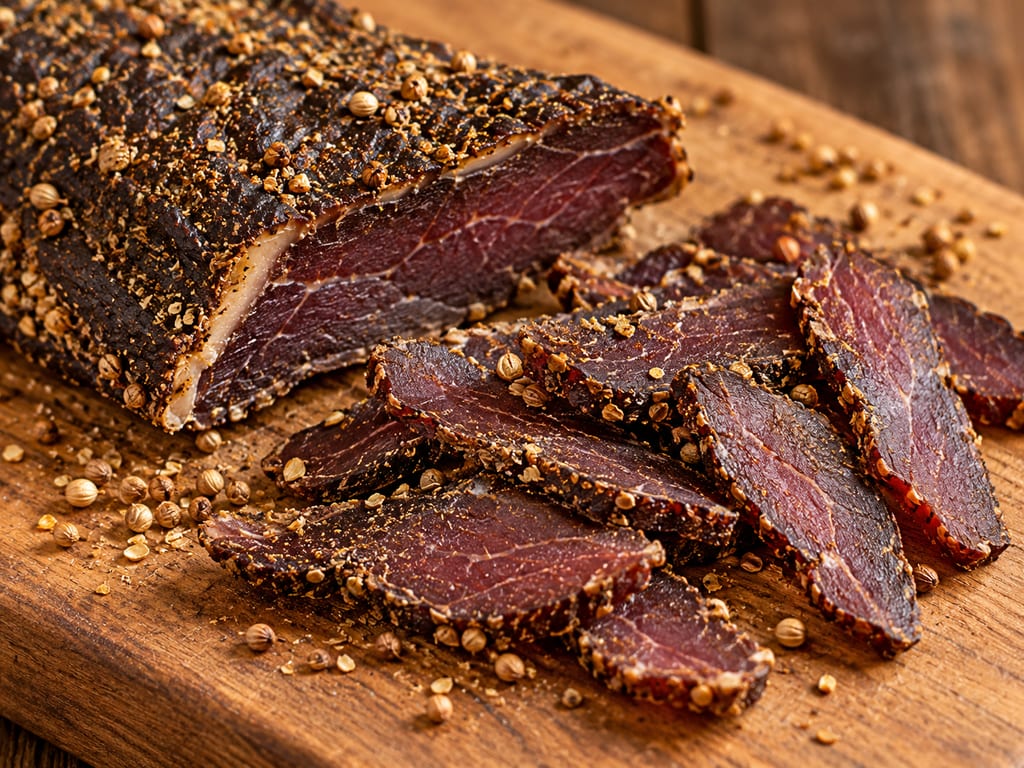
Biltong
Strips of whole-muscle beef or game seasoned with salt, vinegar, roasted coriander and pepper and air-dried without cooking, sold anywhere from soft and moist to hard and very salty.
 FermenteaWhere food goes to change
Traditional method
Se'i · Se’i · Sei · Daging se’i · Daging asap se’i · Se’i sapi · Se’i babi · Se’i ayam · Se’i ikan · Se’i Baun · Lalolak
Smoked meat of Timor and Rote in eastern Indonesia: salted strips of beef or pork cooked over kosambi-wood embers under fresh kosambi leaves, served warm with rice, sambal lu'at and greens.
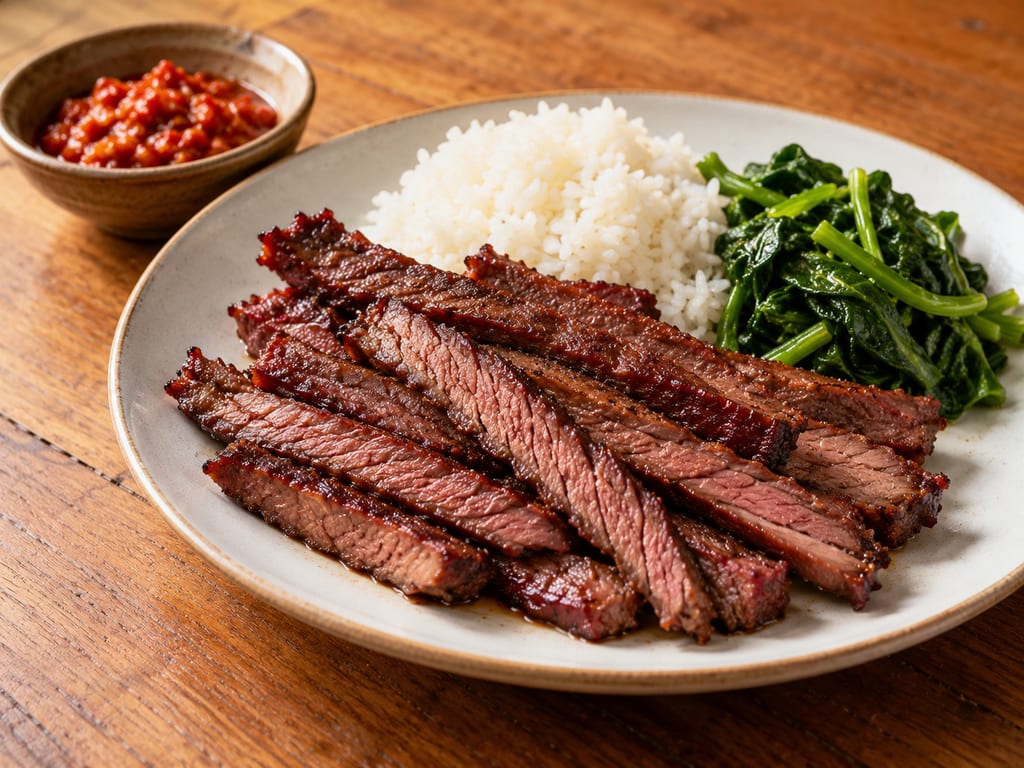
Se'i is smoked meat from East Nusa Tenggara in eastern Indonesia, above all from the islands of Timor and Rote. The meat is cut into long strips, seasoned, rested and cooked with heat and smoke from slowly burning wood. The wood that marks it is kosambi (also written kusambi or kesambi, Schleichera oleosa). In the documented traditional method the strips lie on a rack over the embers and are covered with fresh kosambi leaves while they smoke.
The name is usually explained from the Rote language as meat cut into long narrow strips and smoked. Indonesian cultural authorities tie it to the Rote people, and other accounts name the Mollo of Timor as early makers. They are overlapping local traditions and no single place of origin is agreed.
Beef (se'i sapi) and pork (se'i babi) are the two main kinds, with chicken and fish versions and old accounts of deer and wild pig. Beef and pork are the best documented in production and science.
The shape is a long strip. An Indonesian agricultural training publication gives pieces about two fingers wide and three centimetres thick, and another account calls the strips lalolak. Even thickness helps the meat cook evenly.
Se'i differs from long-aged smoked meats because it often keeps a lot of moisture. Strips are reddish brown, tender and slightly chewy with a clear smoke aroma. Studies of traditional products find high residual moisture and a short shelf life, so it is not a dry, shelf-stable cured meat.
It is a salted, smoke-cooked meat and not a deliberate ferment. A 2025 review speaks of spontaneous fermentation in some accounts, but the better-documented traditional and experimental methods describe curing followed by smoking, and no obligatory lactic starter or fermentation endpoint has been established. Some se'i is served as soon as it is cooked, and an Indonesian agricultural source describes some traditionally processed se'i as a semi-finished product that needs more cooking. What a given se'i is depends on how it was made.
Se'i belongs to smoking and preserving meat in eastern Indonesia, above all on Rote and in western Timor, where livestock, wood fuel and household hearths were part of daily food production. Smoking kept meat before refrigeration, especially when a slaughtered animal gave more than could be eaten at once.
The Balai Pelestarian Nilai Budaya published an account on 17 October 2017 describing se'i as a traditional food of Rote Ndao that became popular across East Nusa Tenggara, explaining the word through the Rote language and the old practice of meat cut lengthwise and smoked over embers. It rests on regional intangible heritage documentation, not a dated ancient recipe.
A rival origin story ties se'i to the Mollo people of Timor around the Mutis Mountains. A 2023 tourism account describes an early unsalted wild-meat preparation offered at rituals and says pork or wild boar was used before other meats and modern seasoning. Neither the sequence nor the claim of a first invention rests on a dated primary document, so neither Rote nor Mollo is the sole proven source and the wider tradition is Timor and Rote.
The commercial history is clearer for pork. The cultural authority names Gasper Tiran, called Om Ba'i, who sold pork in the 1980s and started a smoked pork business at Teunbaun (Se'i Baun) in 1997, becoming widely known by about 2000. It dates one influential producer and not the invention of pork se'i.
Science arrived around 2000. Bachtaruddin Badewi's 2002 IPB University thesis studied smoked beef from household processors in West Kupang, covering curing, residual nitrate and nitrite, smoking and microbial contamination. A 2015 cultural inventory, Inventarisasi Perlindungan Karya Budaya Kuliner Se'i di Kupang Provinsi Nusa Tenggara Timur, was written by Hartono, I Made Sumerta, A. A. Gde Rai Gria, I Komang Purna Wiadnyana Putra and I Wayan Sukadana. Its date records official documentation and not the start of the tradition.
Since then se'i has spread through restaurants and packaged-meat producers and attracted smoking research on temperatures, woods, citrus marinades, liquid smoke and storage. It is a living food and not one fixed recipe.
Se'i changes through salting, heat-induced protein change, smoke and some loss of water. It is mainly a smoke-cooked meat and neither a ferment nor a dried sausage. Its preservation depends on how well it was cooked, the salt, the moisture, handling and storage, and a smoky flavour does not show the meat is safe.
Salt dissolves in the meat's moisture and moves into the muscle, changing protein solubility and water holding and lowering water activity. Some traditionally cured versions add saltpetre, potassium nitrate. Microbes can reduce nitrate to nitrite, and nitric oxide from it reacts with myoglobin to give a cured pink that differs from the brown of heated uncured meat.
During smoking the muscle proteins set and the meat firms, collagen affects tenderness, and some moisture evaporates. Unlike a dry-cured salami, se'i keeps enough water to stay soft and perishable. A study cited in 2020 reported about 63 percent moisture in smoked beef se'i, a figure for that sample and not a standard.
Smoke adds phenols, carbonyls and organic acids. Phenols give smoky aroma with some antioxidant and antimicrobial effect, and carbonyls add colour and aroma. A 2021 University of Nusa Cendana study found that liquid smoke from kusambi, bidara and guava woods contained different amounts of phenols, carbonyls and acids and gave different sensory results.
Kosambi wood is central. Its wood or charcoal gives the heat and smoke and its fresh leaves cover the meat, retaining or moderating heat and smoke and influencing aroma. The leaves have no known universal chemical level or antimicrobial value, and they are no substitute for controlled cooking.
Se'i is not normally inoculated with a starter. The 2025 review proposes spontaneous lactic fermentation and names Latilactobacillus sakei, L. curvatus and Pediococcus from wider meat fermentation, yet the directly documented methods describe salting or curing then smoking, and the review establishes no regular succession, strain or fermentation endpoint.
Microbes can still grow while raw meat is held, cured or stored, which is not necessarily helpful. Research on commercial se'i found coliform and E. coli contamination, and storage experiments show bacterial numbers rising after processing. The real distinction is between smoke flavour, actual cooking lethality and stability of the finished product: a strip can be smoky and under-cooked, or cooked but too moist to keep at room temperature.
Beef or pork is cut into long, fairly even strips. The Indonesian agricultural guidance gives slices about two fingers wide and three centimetres thick. Cutting spreads seasoning and heat better than a large joint, some methods cut across the fibre for easier chewing, and fat and connective tissue may be trimmed or tough meat tenderised.
Salt is the main seasoning and curing ingredient. Some methods add saltpetre, usually potassium nitrate, though not universally. A 2020 agricultural training article cures with salt and saltpetre while other accounts only salt. The additive, amount and legal use are safety-critical, and traditional amounts cannot simply be copied.
The experimental method documented here is the 2022 University of Nusa Cendana study by G. E. M. Malelak and I. G. N. Jelantik, which used beef from cull Bali cows. The meat was cut into rope-like strips, mixed by hand with 2 percent salt and 300 milligrams of potassium nitrate per kilogram of raw meat, and marinated for about twelve hours. Separate treatments added 3 percent lime or kaffir-lime juice by volume.
The Kupang training centre describes curing periods of about six to twelve hours in some local preparations. The strips are hung or drained to remove surface liquid before smoking, and not draining enough may affect colour. Methods differ on garlic, lime, papaya and other ingredients.
The smoking set-up defines the food. The strips sit on a rack above glowing kosambi wood or charcoal, in the 2022 study in a drum smoker, and fresh kosambi leaves may be laid over them to limit direct heat. The fire is managed to avoid flames that scorch the meat. It is indirect smoking and cooking and not grilling over flame. The study smoked the strips for about 45 to 60 minutes until well done, with no measured internal temperature.
Published smoking times vary a lot: fifteen to thirty minutes in one Kupang guide, thirty to forty-five in another, one to two hours in Badewi's 2002 work. A 2021 Padjadjaran study compared 70, 80 and 90 degrees C for 60, 80 and 100 minutes and preferred 80 degrees C for 80 minutes on physical, chemical and sensory grounds, and a pork se'i study preferred 60 minutes over 70 and 80. They reflect different equipment and meats, and none is a guaranteed pathogen kill.
After smoking the meat is cooled and cut or packed for its use. Some is served as cooked food, while a 2024 agricultural publication calls se'i a semi-finished ingredient needing more cooking. Safety depends on a verified internal cooking temperature, cooling, water activity, packaging and storage, and not on time and smoke.
The oldest forms are linked to Rote and Timor, without a secure date. Indonesian cultural authorities name Rote as a source of the name and the preparation, and other accounts name the Mollo of the Timor interior. Some describe earlier unsalted wild meat, while modern se'i has salt and sometimes curing agents or spices.
Se'i sapi has been studied widely around Kupang, with long strips of beef smoked over kosambi by traditional makers and smoking drums or controlled chambers in commerce. Kupang studies look at beef from Bali cattle of different body condition scores, whose muscle and condition affect tenderness, moisture and appearance.
Se'i babi belongs to the pork-eating communities of Timor and the Se'i Baun tradition, with Om Ba'i's business documented from the late twentieth century. Pork may keep more visible fat, which changes mouthfeel and behaviour in the smoke, and a 2020 study looked at how smoking time affected pork tenderness, moisture loss and acceptance.
Game such as deer and wild pig appears in accounts of preservation before domestic beef and pork became common. They give no verified recipe, and protected wildlife is not an available ingredient because older accounts mention it.
Se'i ayam (chicken) and se'i ikan (fish) are modern adaptations with other cooking, hygiene, parasite or histamine hazards, so the beef and pork process cannot be moved to them unchanged.
Equipment ranges from masonry or open hearths with racks above kosambi embers to metal smoking drums and enclosed chambers, and universities have compared open and closed smoking with liquid smoke. A 2022 study put lime or kaffir-lime juice on beef se'i from cull Bali cows, affecting acidity, lipid oxidation, residual nitrite and microbial counts, with kaffir lime helping some aroma and sensory results, which does not make lime part of the traditional method. Commercial versions add spices, other fuels, sauces and packaging and should be recorded apart from the traditional strip smoked over kosambi.
Se'i is usually served warm as part of a meal, cut into shorter pieces with rice, vegetables and chilli condiments, and not eaten like a dry snack. Smoke gives the flavour, and the sides give moisture, acidity and contrast.
The best-known pairing is sambal lu'at, a hot and tangy Timorese condiment of small chillies, lime or other citrus, salt and aromatic leaves such as basil. It is a separate preparation and its ingredients do not belong in the curing mix.
Jagung bose, a Timorese maize dish with beans or other pulses and sometimes coconut milk, gives a mild base for the strong meat. Some accounts add klesong, rice wrapped in leaves. Vegetable sides include stir-fried papaya leaves or flowers, whose bitterness contrasts with the meat, and cassava leaves, water spinach and banana blossom.
In Kupang, specialised restaurants and roadside stalls sell beef and pork se'i with full meals, Se'i Baun being linked with pork. Modern uses put se'i in rice bowls and sandwiches with prepared sauces, and tourism accounts mention black pepper, green chilli, rica-rica and sambal matah variations, added at serving and not part of the meat's seasoning.
Some se'i is ready to eat when smoked and some, as the Kupang training centre's 2024 publication says, needs more cooking before it is eaten. The name does not decide which.
Do not assume it is shelf-stable. The meat may stay moist, and studies found bacterial contamination and growth in storage, so store it as its manufacturer specifies. Serving warm, adding chilli or reheating briefly does not make an under-processed product safe.
Finished se'i is reddish brown with visible fibres and a smoke aroma, tender to moderately chewy, and darker outside than inside. A pleasant smell, a red colour or a cooked look does not show the centre reached a safe temperature.
Uneven cooking is a concern on traditional hearths, since heat depends on distance from the embers, fire strength, rack position and leaf cover. A strong fire scorches the surface before the middle is cooked, and too little heat leaves smoke flavour without validated bacterial kill. Turning the meat and avoiding flames are documented, and neither replaces measuring the internal temperature.
A single smoking time cannot be prescribed. The 2021 experiment of 60, 80 and 100 minutes at 70, 80 and 90 degrees C chose 80 degrees C for 80 minutes on physical, chemical and sensory grounds and not as a validated lethality. Thickness, starting temperature and the actual temperature at the centre are what count.
The product may keep a lot of water. Badewi's 2002 work reported that traditional smoking of one to two hours could leave beef se'i moist enough to limit storage life, and a 2020 study describes about 63 percent water and a short shelf life, so smoking does not make dry meat.
Microbiological findings are worrying. Bontong, Suada and Mahatmi studied beef se'i from five traditional Kupang makers and found Escherichia coli in all five, at 6.2 to over 2,400 MPN per gram. They are measurements from those businesses, not a prevalence for all se'i. A study of pork se'i from four Kupang retailers saw more growth at room temperature than refrigerated over five days, with one retailer's samples over the total-count standard, and a 2024 Kefamenanu study followed bacterial change over one to three days at 27, 32 and 37 degrees C. They give no support to warm storage.
Nitrite and nitrate need control. Some processors use saltpetre for colour and preservation, and a 2020 study of six commercial samples measured residual nitrite of 22.28 to 110.19 milligrams per kilogram, a wide spread. Those are residues and not safe addition rates, and the study's references to old Indonesian regulatory limits need checking against current law.
Smoke can also make polycyclic aromatic hydrocarbons, with fat dripping into the fire and direct flame making it worse. Liquid smoke studies measure flavour and antimicrobial effects and do not show that a direct-fired product meets contaminant limits.
The 2025 Journal of Ethnic Foods review describes several days of spontaneous fermentation, helpful lactic bacteria and possible room-temperature storage, which a matching primary study with species, pH, water activity and pathogen controls would be needed to support. They also differ from the short curing and smoke-cooking in Indonesian agricultural research.
Salmonella, pathogenic E. coli, Listeria monocytogenes and Staphylococcus aureus all matter, pork adds parasites, and chicken needs a different cooking from intact beef. FoodSafety.gov gives 63 degrees C with a three-minute rest for intact beef and pork and 74 degrees C for poultry, which is consumer cooking advice and not validation of se'i manufacture or storage.
A production record needs the meat's origin, thickness, salt and curing-agent amounts, curing conditions, smoking equipment, chamber and internal meat temperatures, cooling, water activity, microbiological and chemical checks, packaging and shelf life. Salt, kosambi leaves and a smoking time alone are not enough. A source that calls se'i semi-finished must be read that way until adequate cooking is shown, and a maker's ready-to-eat claim needs its own production controls.
Cultural accounts tie se'i to the Rote people and to the Mollo of Timor, with competing stories and no dated primary record. The Balai Pelestarian Nilai Budaya described it on 17 October 2017 as a traditional food of Rote Ndao that spread across East Nusa Tenggara.
The cultural authority records Gasper Tiran selling pork in the 1980s and starting a smoked pork business at Teunbaun in 1997. Bachtaruddin Badewi's 2002 IPB thesis studied smoked beef from household processors in West Kupang, and a cultural inventory was published in 2015.
E. coli was found in all five traditional beef se'i products tested in Kupang, at 6.2 to over 2,400 MPN per gram.
Hazard sourceMoist smoked meat that is not cooked through can carry both, and bacteria grow during storage.
Hazard sourceGrowth during curing or holding can make toxin that cooking does not remove.
Hazard sourceSlow cooling and warm storage let spore-formers grow in moist cooked meat.
Hazard sourceResidual nitrite in commercial samples ranged from 22.28 to 110.19 mg/kg, and legal limits must be checked.
Hazard sourceFat dripping into the fire and direct flame increase PAHs.
Hazard sourceA strong fire scorches the outside before the centre is cooked.
Hazard sourceStorage studies found greater growth at room temperature than refrigerated.
Hazard sourceCheck the centre with a thermometer.
Control sourceCool and refrigerate cooked meat promptly.
Control sourceKeep the meat cold during the marination.
Control sourceKeep nitrate and nitrite within current legal limits.
Control sourceAvoid direct flame and fat dripping into the fire.
Control sourceSe'i is moist (about 63% water in one study) and perishable. Keep it refrigerated and do not store it at room temperature; bacterial counts rose at room temperature in storage studies.
Smoke flavour and a red colour do not show that the centre is cooked. Check at least 63 degrees C with a three-minute rest for beef and pork (74 degrees C for chicken).
Some traditional se'i is semi-finished and needs more cooking before it is eaten.
The saltpetre amount in the 2022 study (300 mg/kg) is experimental; check the legal limits and do not guess amounts.
Do not rely on kosambi leaves, lime or chilli to make under-cooked meat safe.
Pregnant people, young children, older people and people with weak immunity should eat only thoroughly cooked, freshly made and refrigerated se'i.
The Rote account of the name and preparation; no earliest date is established.
Includes the Mollo account of early practice.
Centre of commercial se'i and most research.
Gasper Tiran's pork se'i business.
Strips of whole-muscle beef or game seasoned with salt, vinegar, roasted coriander and pepper and air-dried without cooking, sold anywhere from soft and moist to hard and very salty.
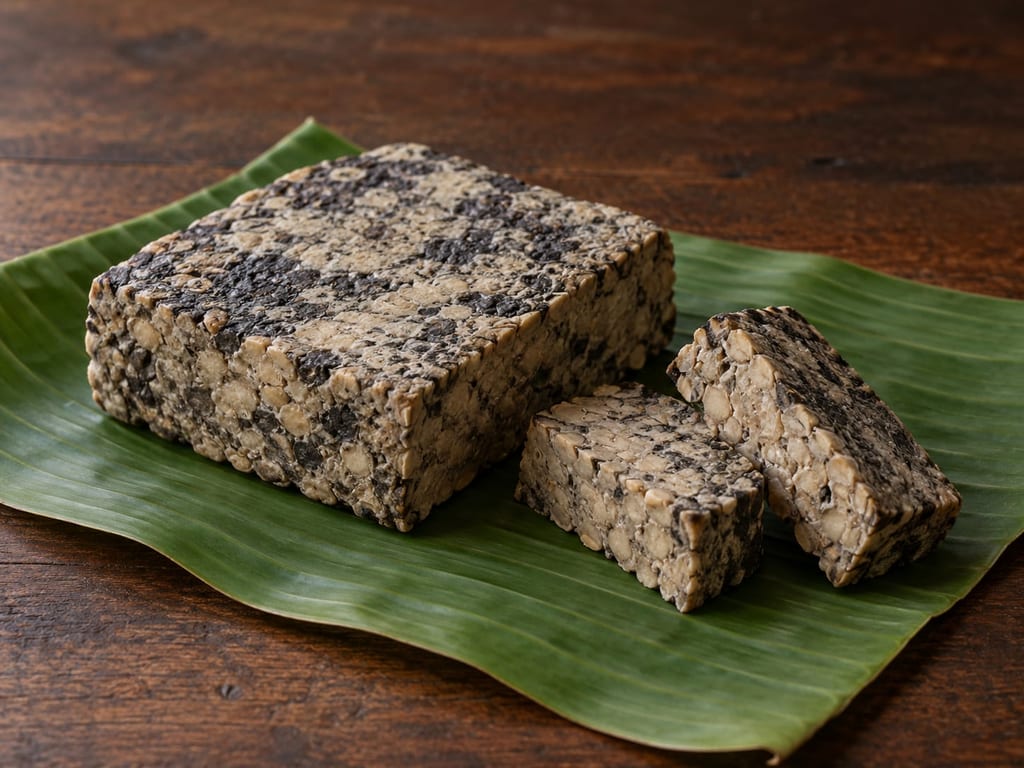
Black oncom is a mould-fermented cake made from defatted peanut cake, pressed to about 2 cm, steamed and then incubated for a day at ambient temperature.
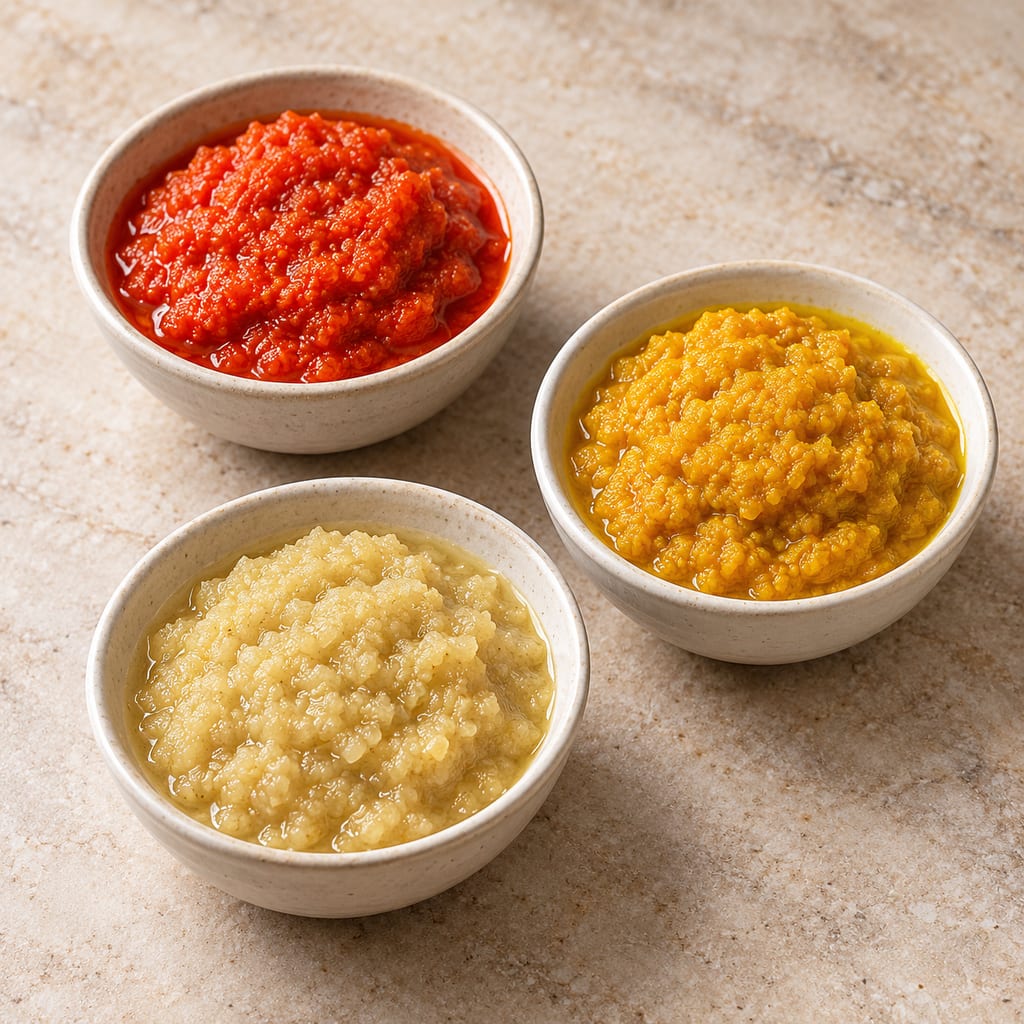
Bumbu dasar are the ground spice bases of Indonesian cooking: a white paste of shallot, garlic and salt, with chile added for red and turmeric for yellow, cooked into dishes.
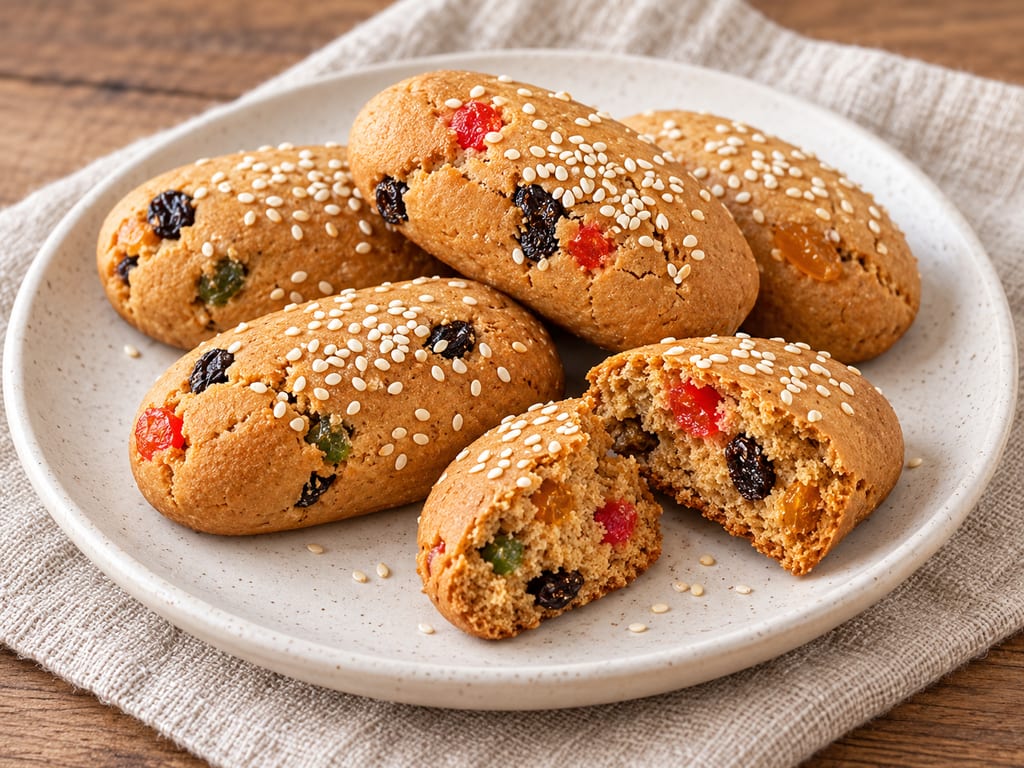
An Indonesian palm-sugar and cinnamon quick bread with dried fruit and sesame.
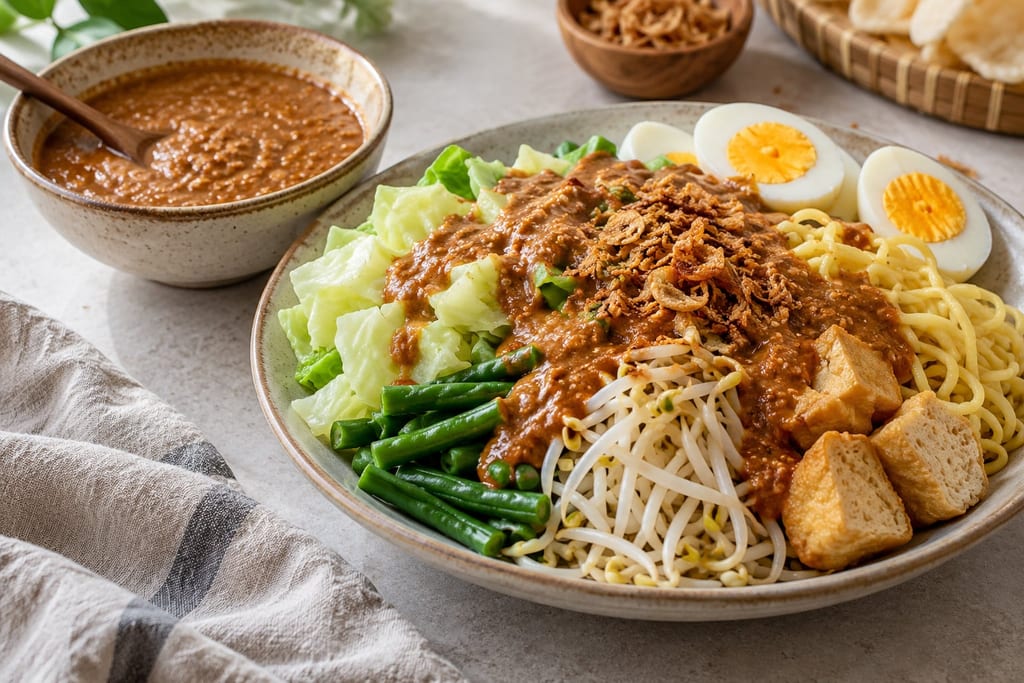
A cooked peanut sauce of ground roasted peanuts, aromatics, shrimp paste and coconut cream, as made for gado-gado; pecel and Malaysian satay sauces are close relatives with different formulas.
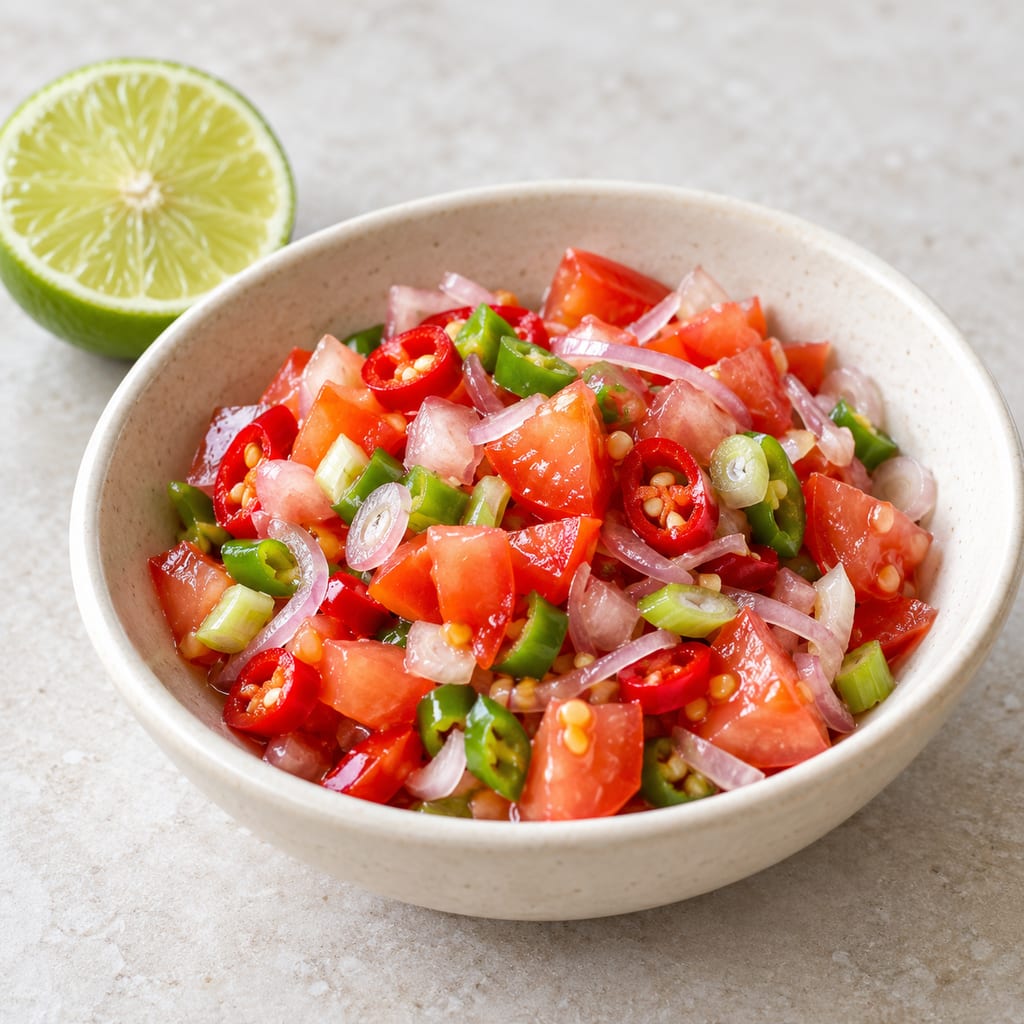
Dabu-dabu is a raw North Sulawesi relish of chopped chillies, shallot, scallion and tomato, dressed with salt and lime juice or coconut oil.
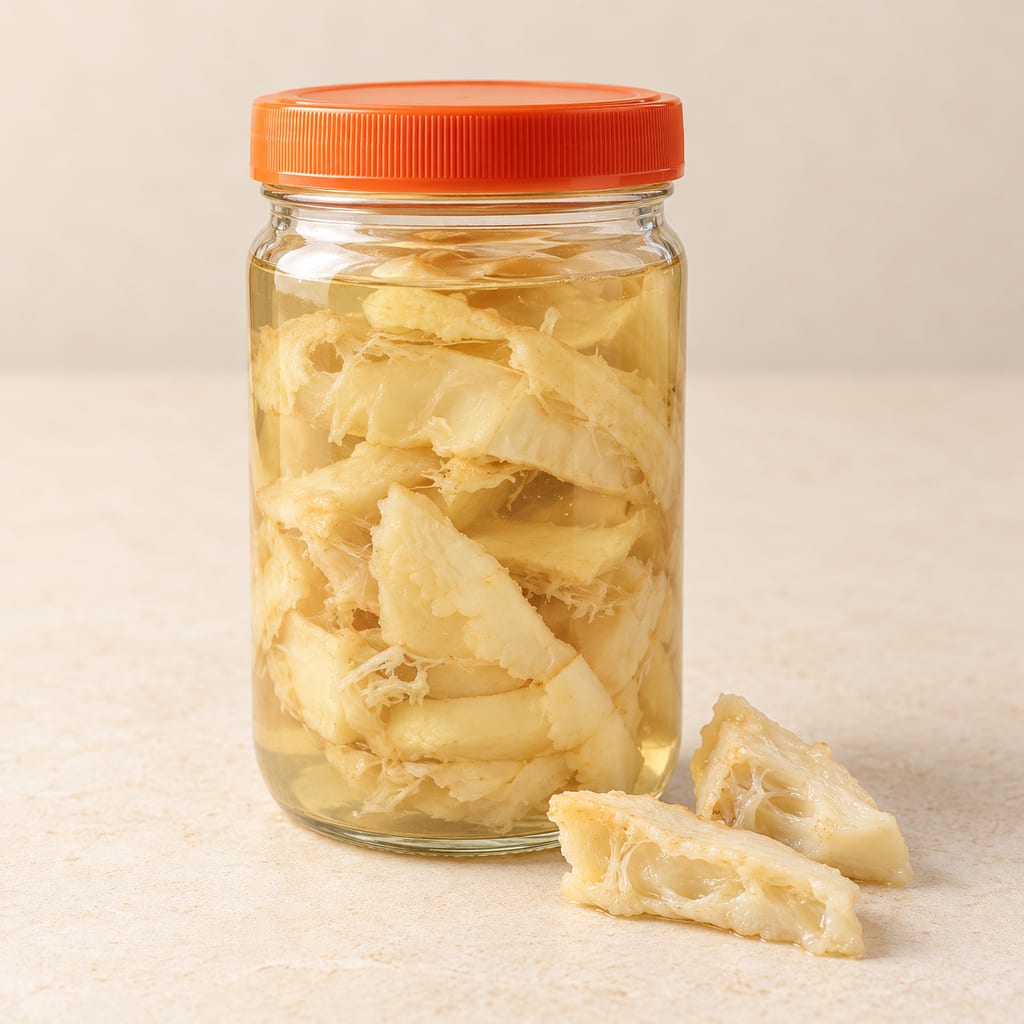
Cempedak inner rind is cut, salted and submerged in water for a short spontaneous fermentation used in Kalimantan home cooking.
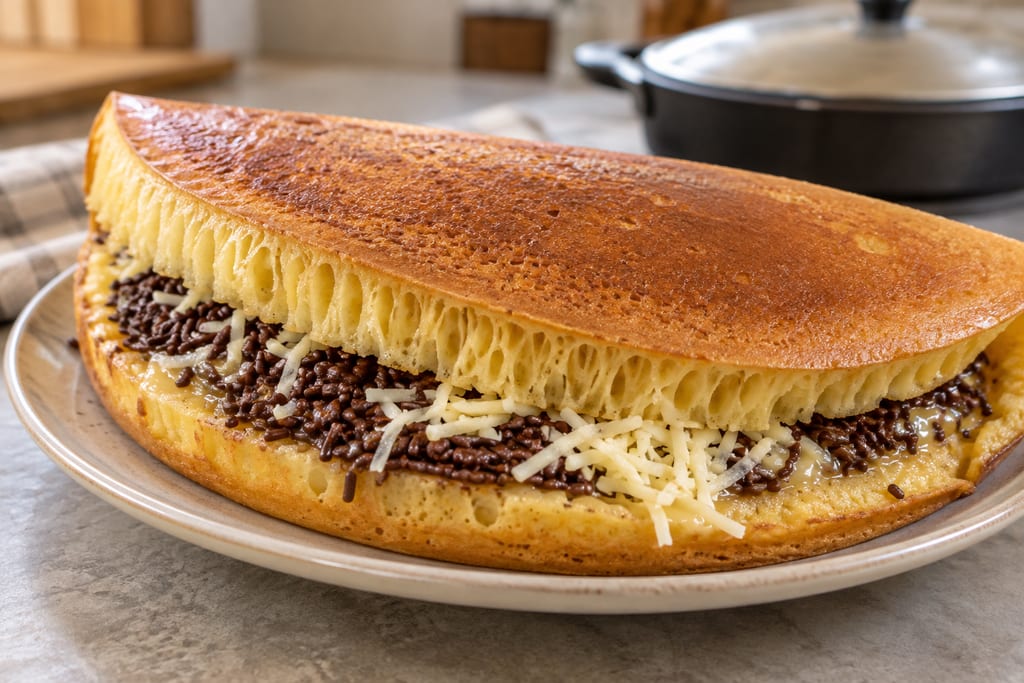
Martabak manis is a thick Indonesian griddle pancake with a porous, honeycomb crumb, cooked under a lid and finished with butter and sweet toppings.
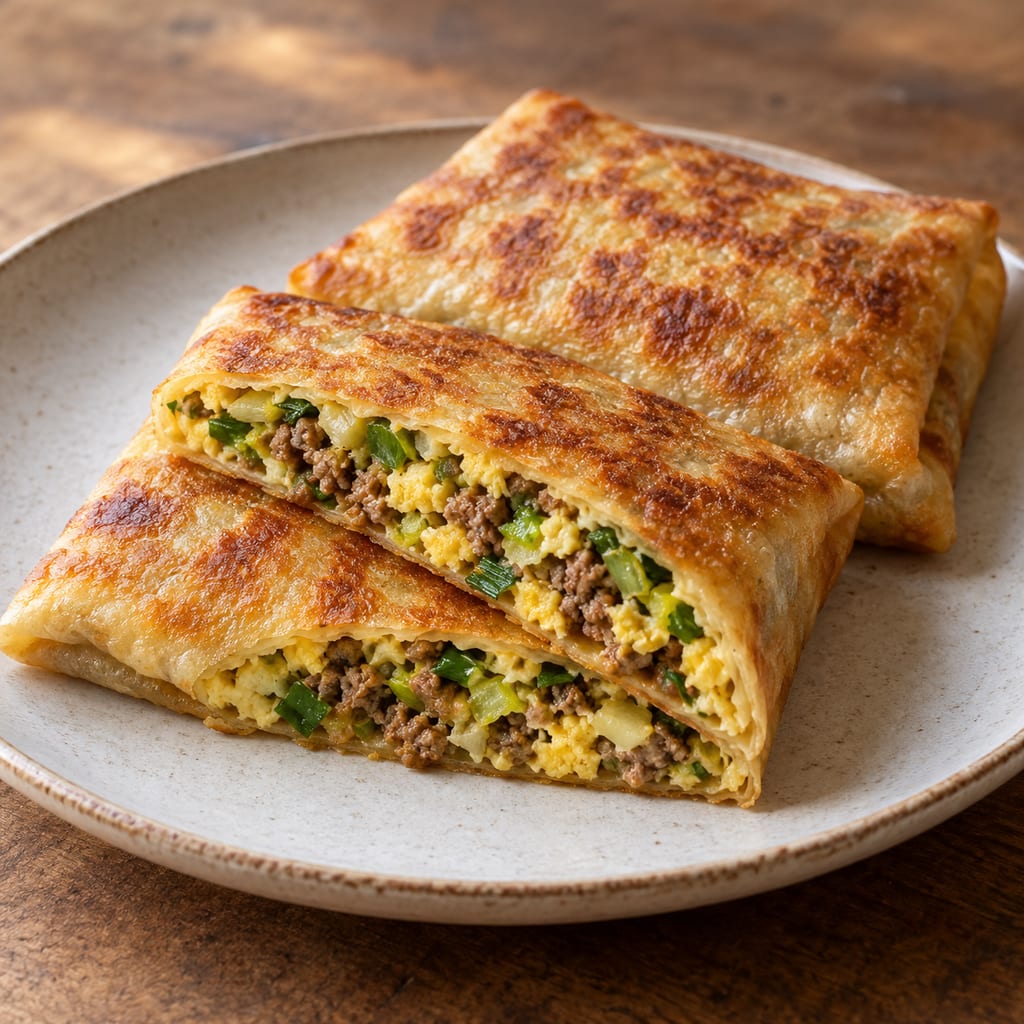
A Javanese-style Indonesian savoury parcel of thin rested wheat dough folded around curry-seasoned beef and egg, then cooked in an oiled skillet.
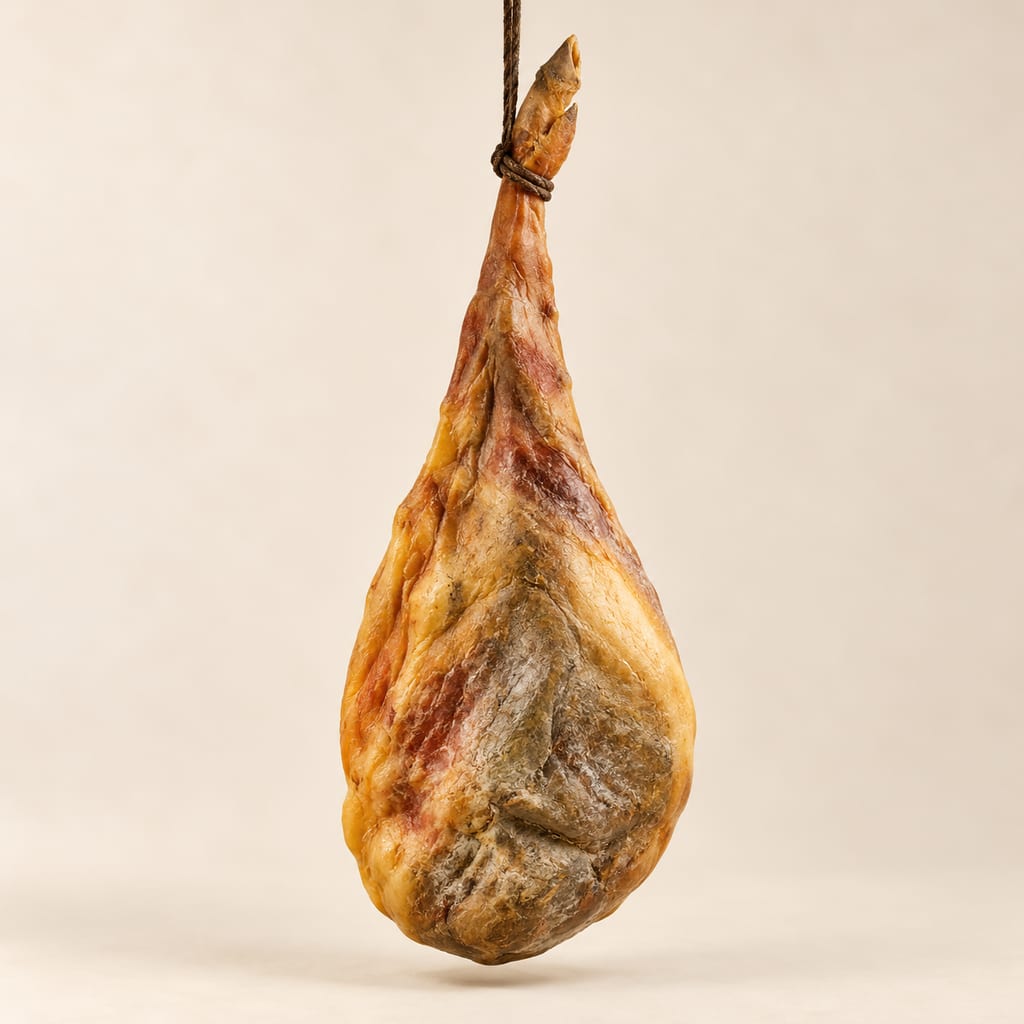
Cato the Elder records a second-century BCE sequence for salting, air-drying, and smoking ham. This historical account is not a validated modern curing protocol.
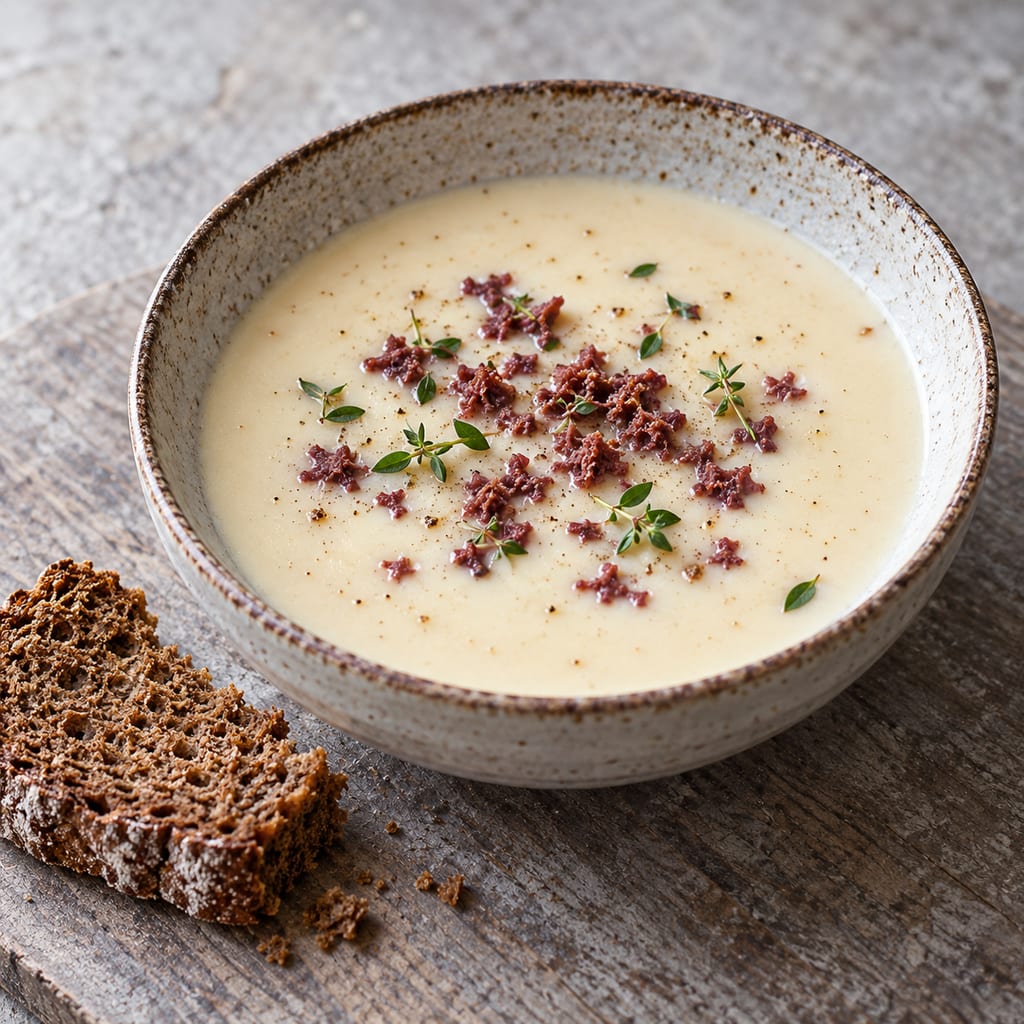
Kylmäsavuporokeitto is a creamy cold-smoked reindeer soup with onion, stock and cheese, served with bread.
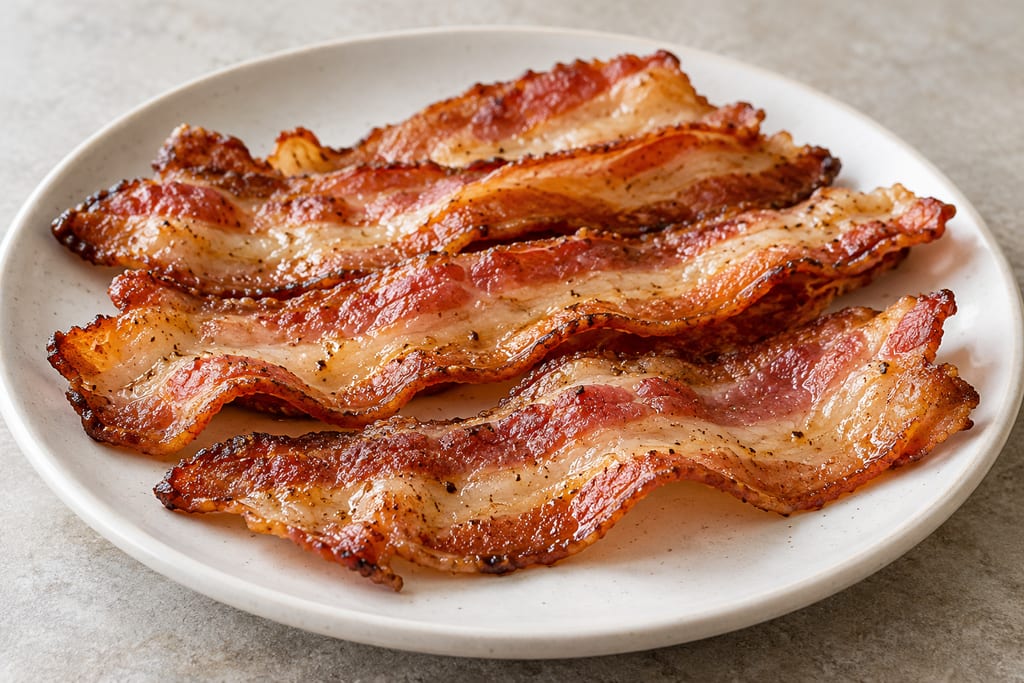
Pork belly receives a measured salt-and-sugar cure with coffee and spices, then is refrigerated before cooking or hot smoking.

Finnish pea soup simmers dried peas with palvikinkku or a vegetable alternative, then is served with mustard and chopped onion.
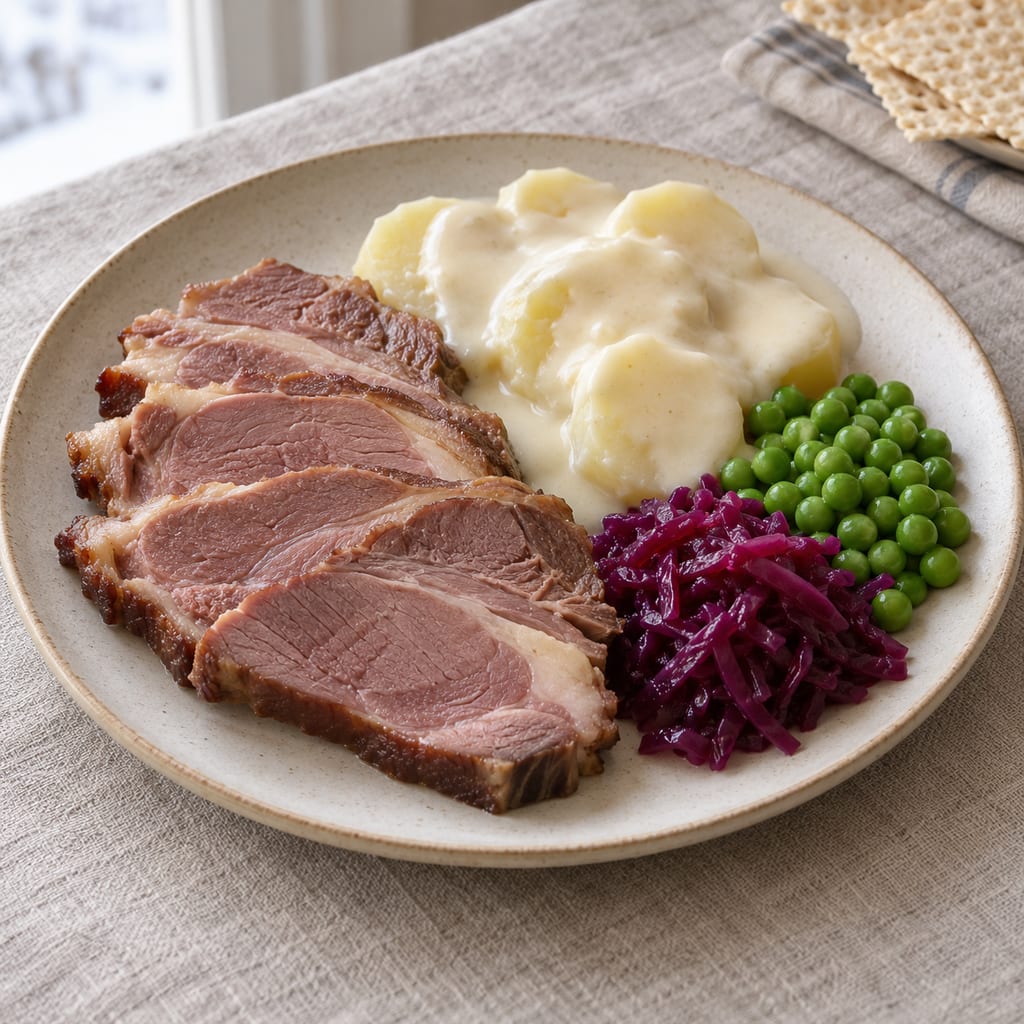
A six-person Icelandic Lamb serving recipe for deboned hangikjöt with potato bechamel, pickled cabbage, peas and laufabrauð. It cooks the product; it does not smoke or cure it.
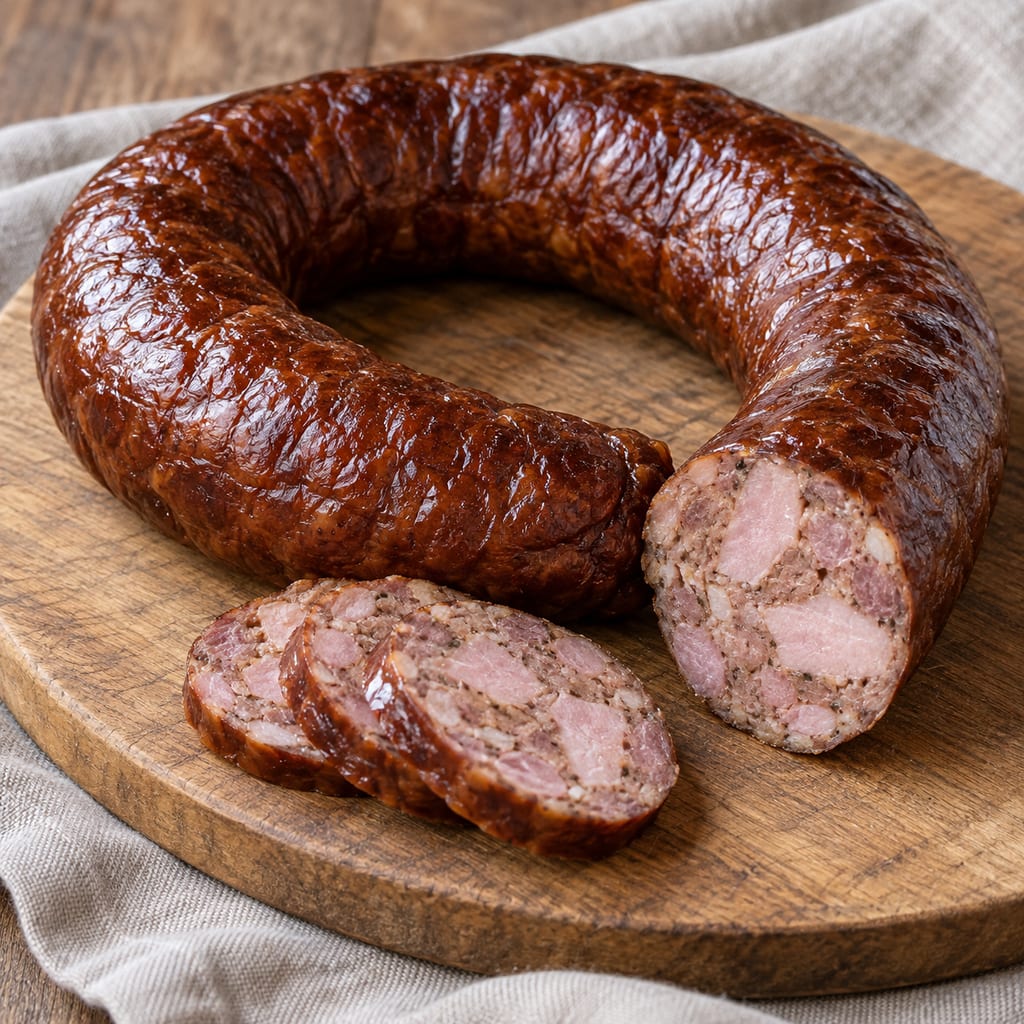
A protected pork sausage associated with Liszki and Czernichów; its application describes commercial curing and smoking, not a home batch.
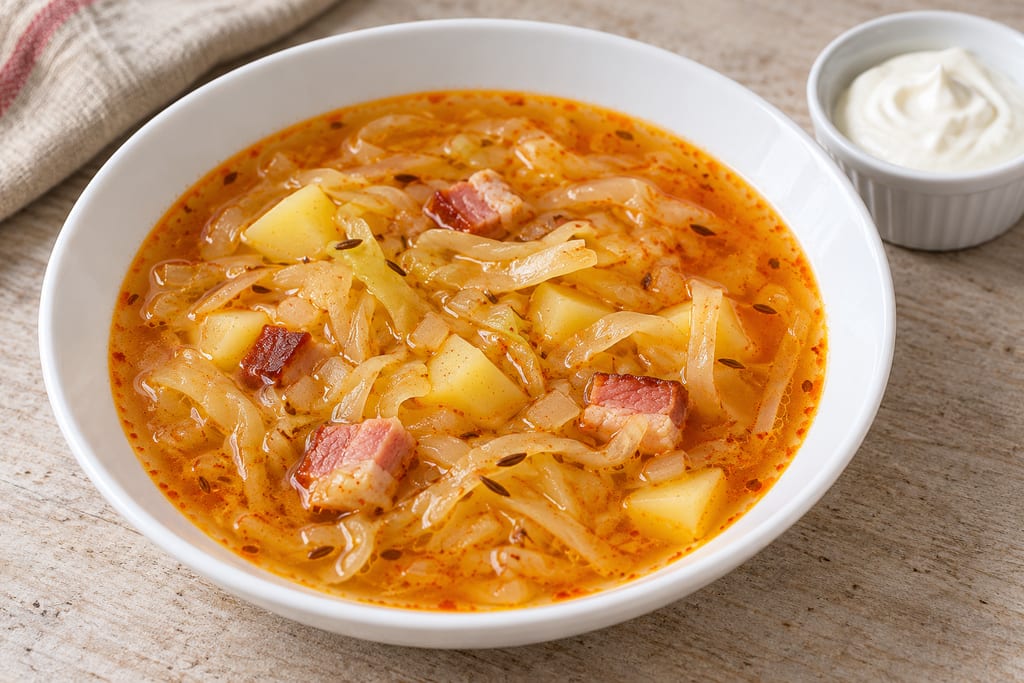
A two-portion cabbage soup with onion, potato and finished Geselchtes, served with garlic sour cream.
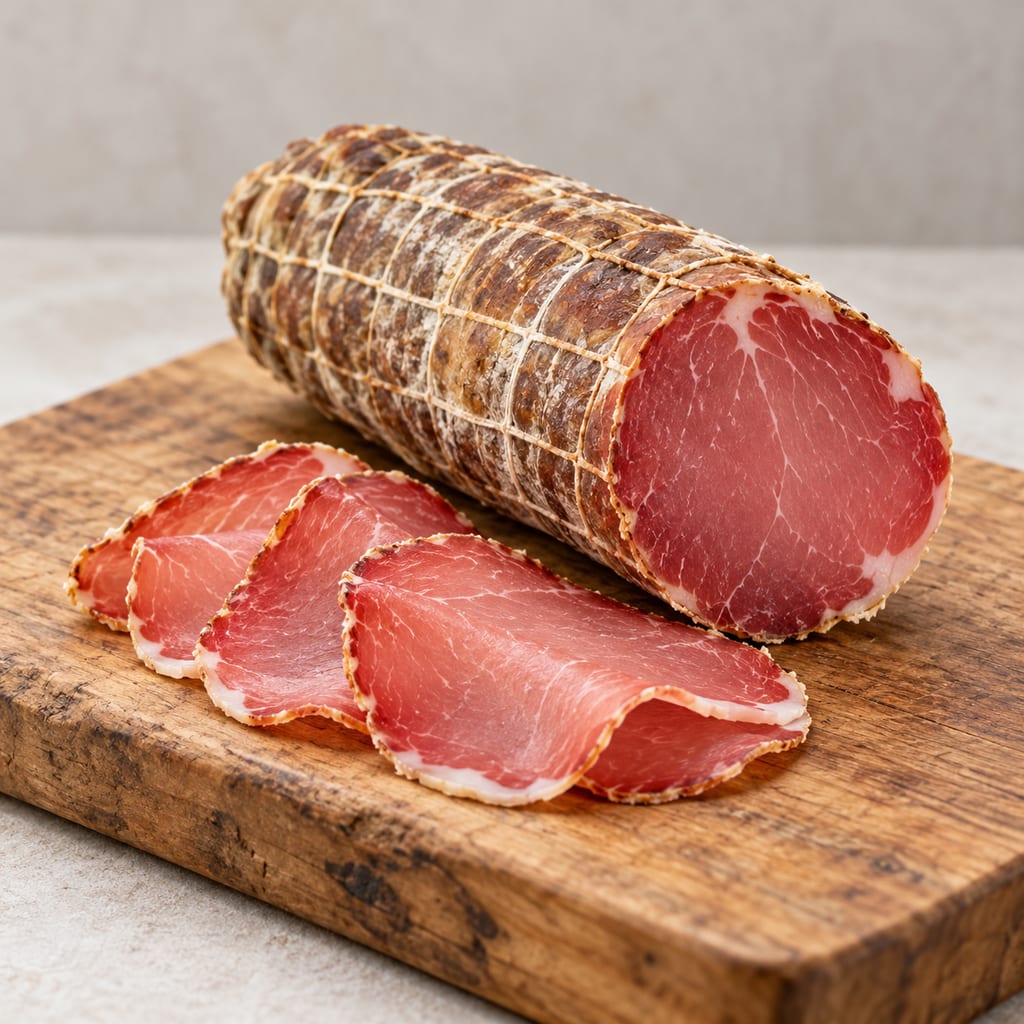
Documentary account of Italian regional cured-loin traditions, including Tuscan and Marche variations; no home-cure instructions are provided because the published professional methods lack validated safety controls.

Soft, spreadable Calabrian pork sausage made with a great deal of red chilli and fatty pork, stuffed into natural casings, sometimes smoked and matured while staying soft.

A way to add independent temperature logging to an existing food dehydrator without changing its built-in controls or protections. It is a monitoring method, not a rewiring plan.

Pleurotus cystidiosus is the abalone mushroom, a cultivated oyster-type fungus with dark brown caps that grows more slowly and is more demanding than other Pleurotus species.

A dark, balanced vinegar from Emilia-Romagna made by combining cooked or concentrated grape must with wine vinegar, then acetifying and refining it in wood under a protected specification.

A living dairy inoculum that starts controlled cream fermentation, developing acidity and aroma before sour cream or cultured butter is finished.

A small electric incubator holds jars at a selected temperature for yogurt and other documented warm food preparations. Controls, capacity and vessel arrangement vary by model.

Adygean salt is a seasoned table salt associated with Adygea and the wider North Caucasian culinary tradition. Salt is blended with garlic and a variable selection of herbs and spices; the exact mix depends on the named style and maker.

The African Caesar-group mushroom, Amanita masasiensis, is a wild ectomycorrhizal species of central and southern African woodlands, eaten locally. The genus contains deadly poisonous species, so identification needs care.
No community contributions have been published for this entry yet.
Sign in to contribute. Published comments and photos are free to read.
Journal of the Indonesian Tropical Animal Agriculture, 2022Method
Effect of addition of different citrus juice on the quality of se'i made from the meat of cull Bali cows with different body condition scores2% salt, 300 mg/kg potassium nitrate, 12 hours of marination, 45 to 60 minutes of smoking over kosambi
Cited in: How it is made; Variations
Balai Besar Pelatihan Peternakan KupangMethod
Pengolahan se'i sapi khas NTTStrips about two fingers wide and 3 cm thick; curing and draining
Cited in: What it is; How it is made; Variations
Balai Besar Pelatihan Peternakan KupangMethod · History
Pembuatan se'i sapi khas NTT ala BBPP KupangKupang practice
Cited in: History; How it is eaten and used
Balai Besar Pelatihan Peternakan KupangMethod
Membuat se'i sapi: agricultural training moduleSemi-finished product needing more cooking
Cited in: What it is; How it is made; How it is eaten and used
Jurnal Ilmu Ternak, Universitas Padjadjaran, 2021Method · Chemistry
Karakteristik mutu sei sapi yang diolah secara tradisional70, 80 and 90 C for 60, 80 and 100 minutes; 80 C for 80 minutes preferred
Cited in: What it is; History; How it works: salt, nitrate and smoke; How it is made; Variations; Reading results and problems
Jurnal Ilmu dan Teknologi Peternakan, Universitas HasanuddinMethod
Pengaruh lama pengasapan menggunakan kayu kosambi pada se'iSmoking time with kosambi on pork se'i
Cited in: History; How it is made; Variations; Reading results and problems
Indonesia Medicus Veterinus, Universitas UdayanaSafety
Kontaminasi bakteri Escherichia coli pada daging se'i sapiE. coli in beef se'i from five Kupang makers
Cited in: How it works: salt, nitrate and smoke; How it is eaten and used; Reading results and problems
Open Chemistry, 2020Safety
The effect of nitrite food preservatives added to se'iResidual nitrite 22.28 to 110.19 mg/kg
Cited in: How it works: salt, nitrate and smoke; Reading results and problems
Journal of Ethnic Foods, 2025History · Microbiology
Exploring the historical and food technology aspects of se'iReview of se'i history and proposed spontaneous fermentation
Cited in: What it is; History; How it works: salt, nitrate and smoke; How it is eaten and used; Reading results and problems
FoodSafety.gov, US Department of Health and Human ServicesSafety
Safe minimum internal temperatures63 C with a three-minute rest for intact beef and pork; 74 C for poultry
Cited in: Reading results and problems
FoodSafety.gov, US Department of Health and Human ServicesSafety
People at risk of food poisoningGroups at higher risk
Cited in: Reading results and problems
USDA Food Safety and Inspection ServiceSafety
FSIS ready-to-eat fermented, salt-cured, and dried products guidelineComparative guidance on validated lethality