Equipment

626 sourced equipment pages: vessels, tools, appliances and built structures.

Vessels and containers

219 items

What the food sits in while it changes: jars, barrels, tanks, skins, gourds, baskets and wraps.

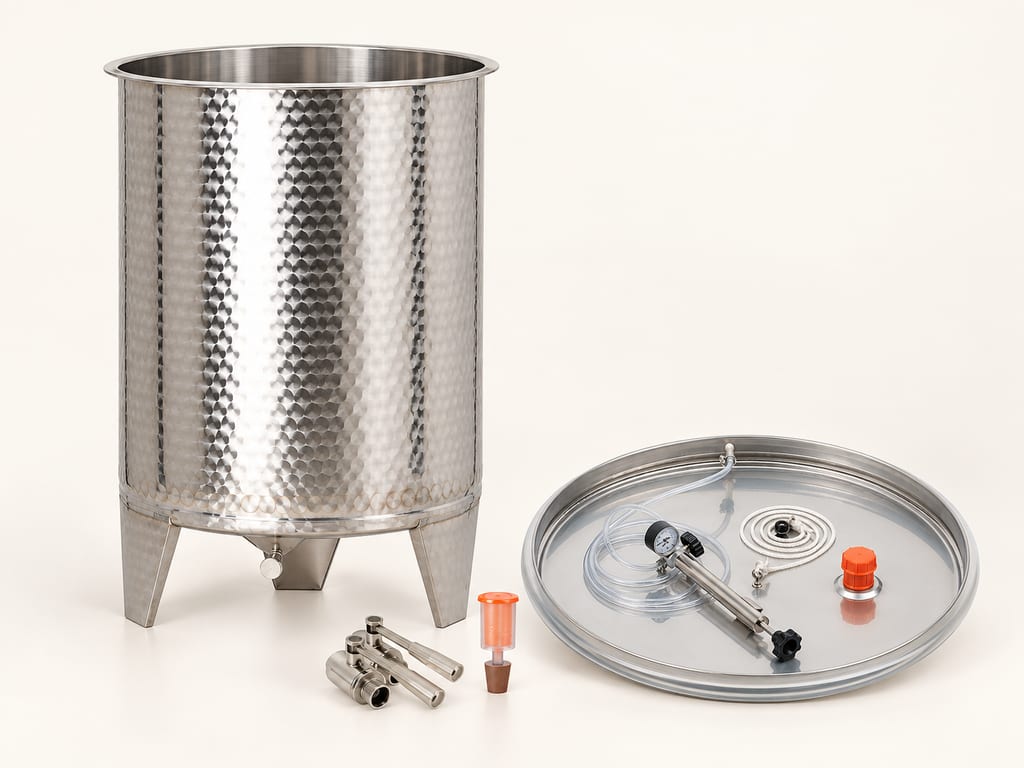
Photorealistic product illustration of an open-top stainless floating-lid tank, with the separate lid kit, pump, gauge and fittings shown beside the empty tank.
Equipment

Floating-lid tank

A floating-lid tank is an open-top vessel whose separate lid rests at the liquid level. In contemporary stainless-steel models, an inflatable perimeter seal reduces the air space above a variable volume of wine, cider or juice.
Tanks and vats
Ofterdingen
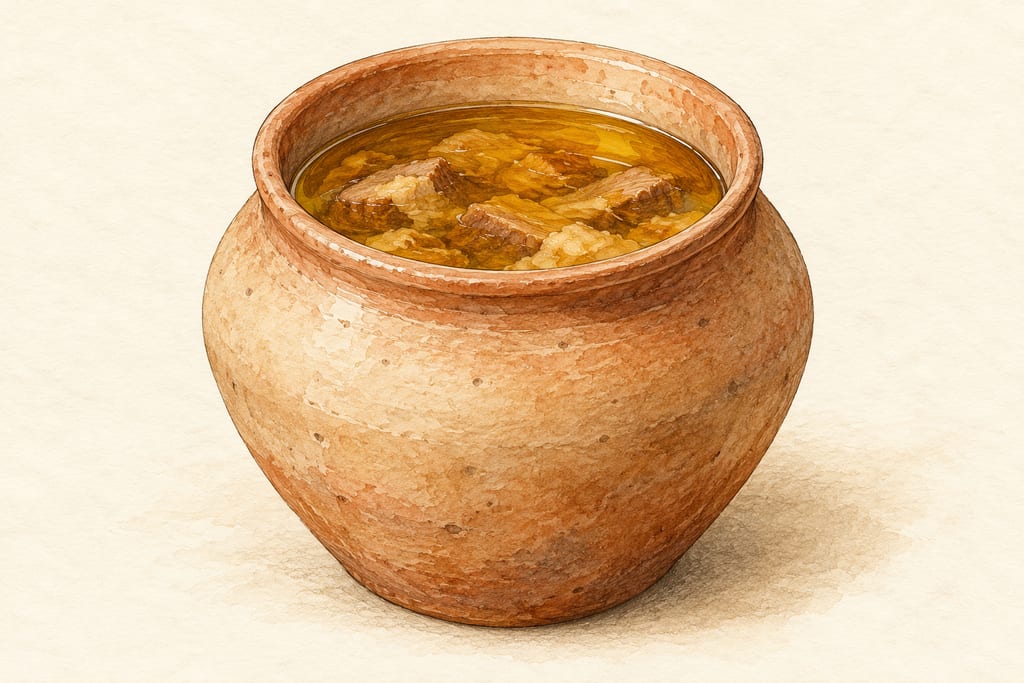
Interpretive watercolor of a generic earthenware jar used for Khliaa ezir, with cooked meat below a layer of olive oil and rendered fat; the exact ezir form is undocumented.
Equipment

Ezir

Ezir is the earthenware jar used in northeastern Algeria to ripen Khliaa ezir, a cooked meat kept in olive oil and rendered fat. Its standard shape, capacity and construction are not documented.

Jars, pots and crocks
Northeastern Algeria
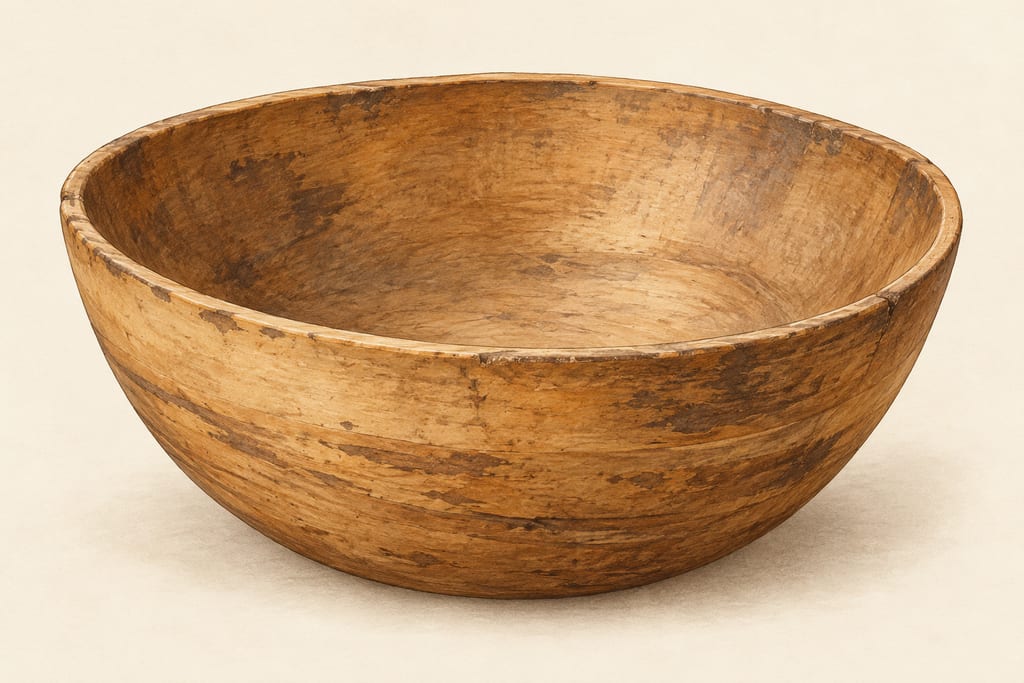
Historical illustration of an open wooden lahal bowl used in northern Senegalese household lait caillé preparation.
Equipment

Lahal

A lahal is a wooden bowl used in household lait caillé preparation in northern Senegal. Repeated use leaves a surface biofilm that the documented household process uses as part of its fermentation ecology.

Gourds, calabashes and carved bowls
Saint-Louis
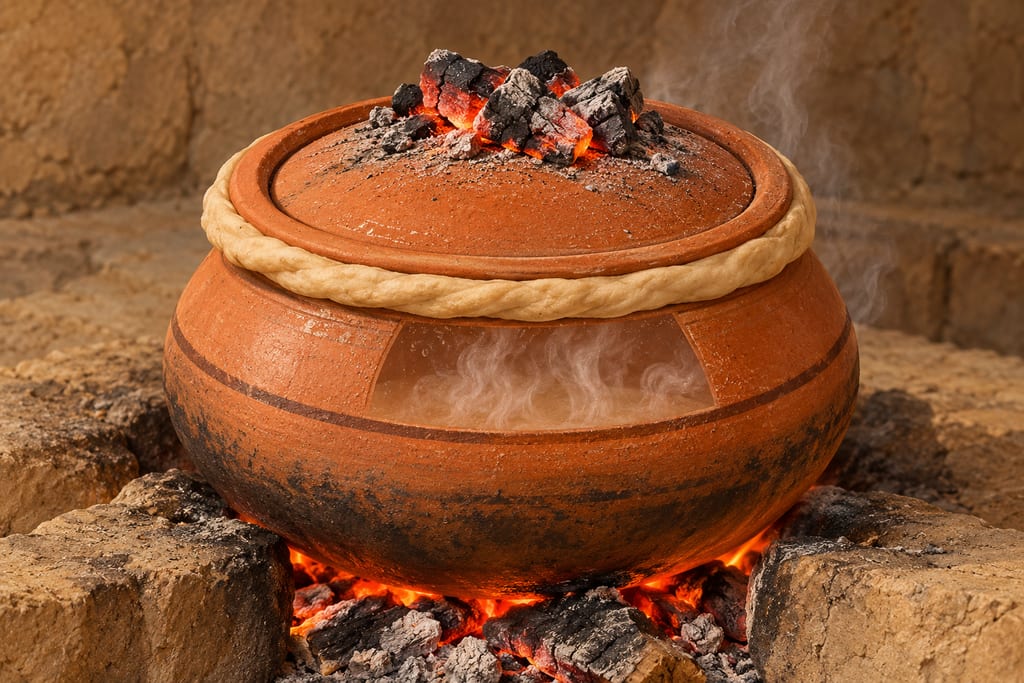
Illustrated clay handi with a dough-sealed lid, embers above and gentle fire below, showing the enclosed-steam dum arrangement.
Equipment

Handi

A handi is a cooking pot used in dum, a slow-cooking method documented in northern India. Sources record earthenware handis in a Delhi village and dough-sealed cooking pots in Awadhi and Delhi food traditions.

Jars, pots and crocks
India
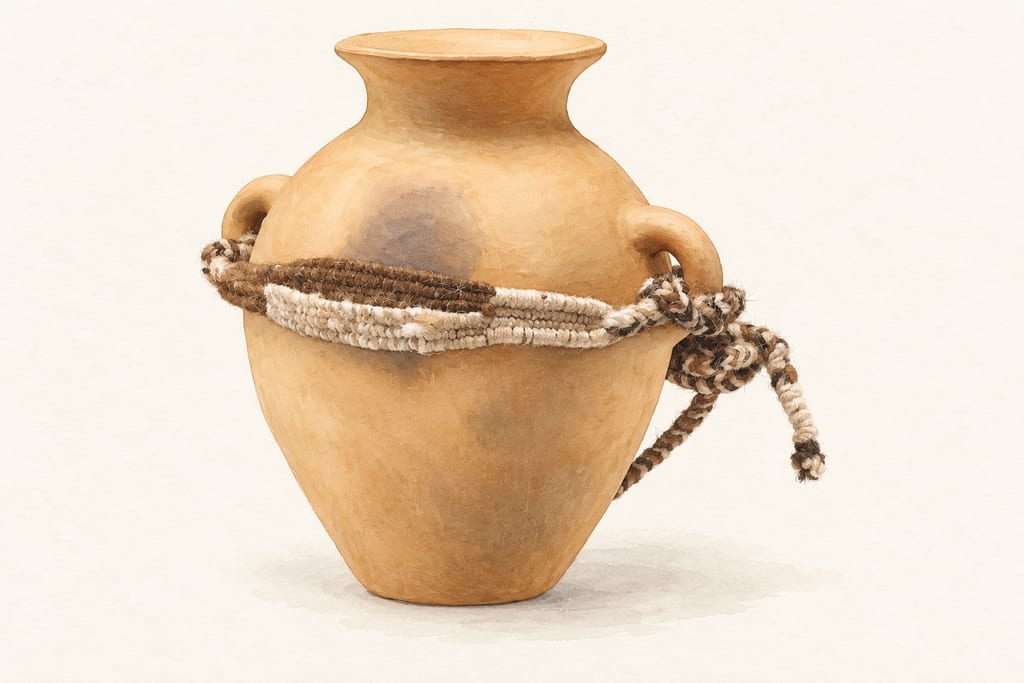
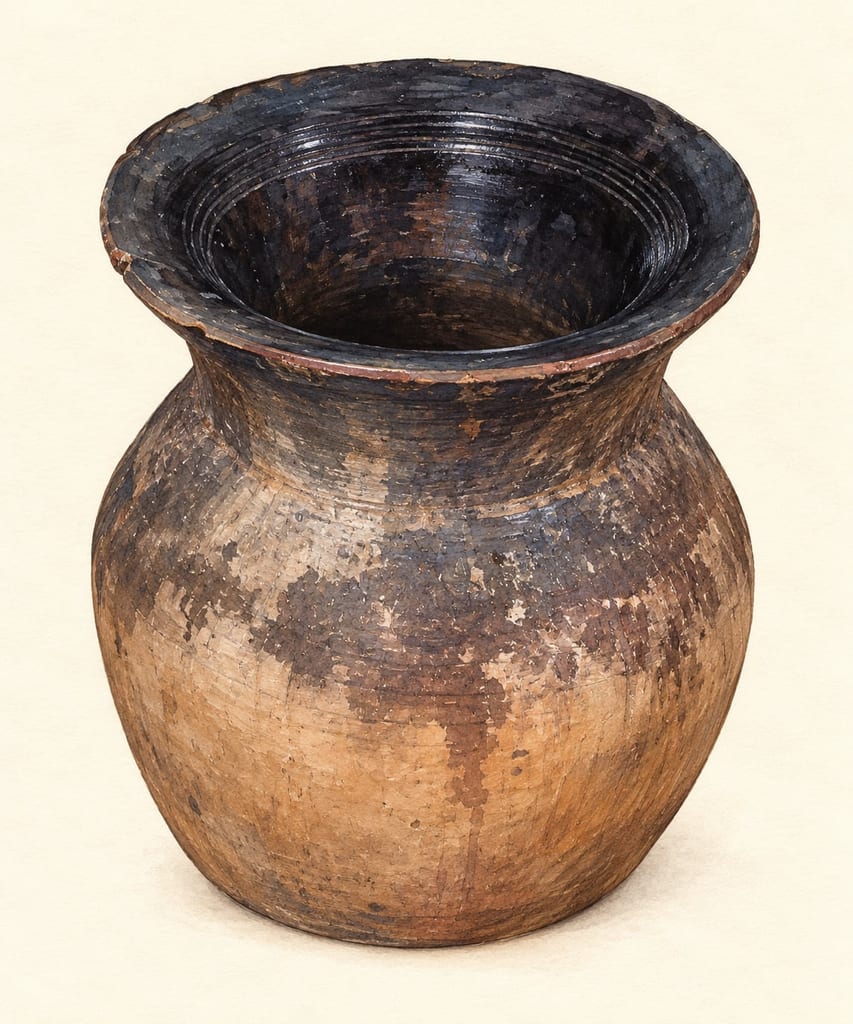
Watercolor illustration of a pottery chicha storage vessel with a woven alpaca-yarn sling around its upper body.
Equipment

Mak'as with wool sling

A Quechua pottery vessel catalogued by the Smithsonian’s National Museum of the American Indian for storing chicha. This 2003 Pisac example has an alpaca-hair-yarn sling; the catalog does not establish that it was used to ferment the drink.

Jars, pots and crocks
Pisac
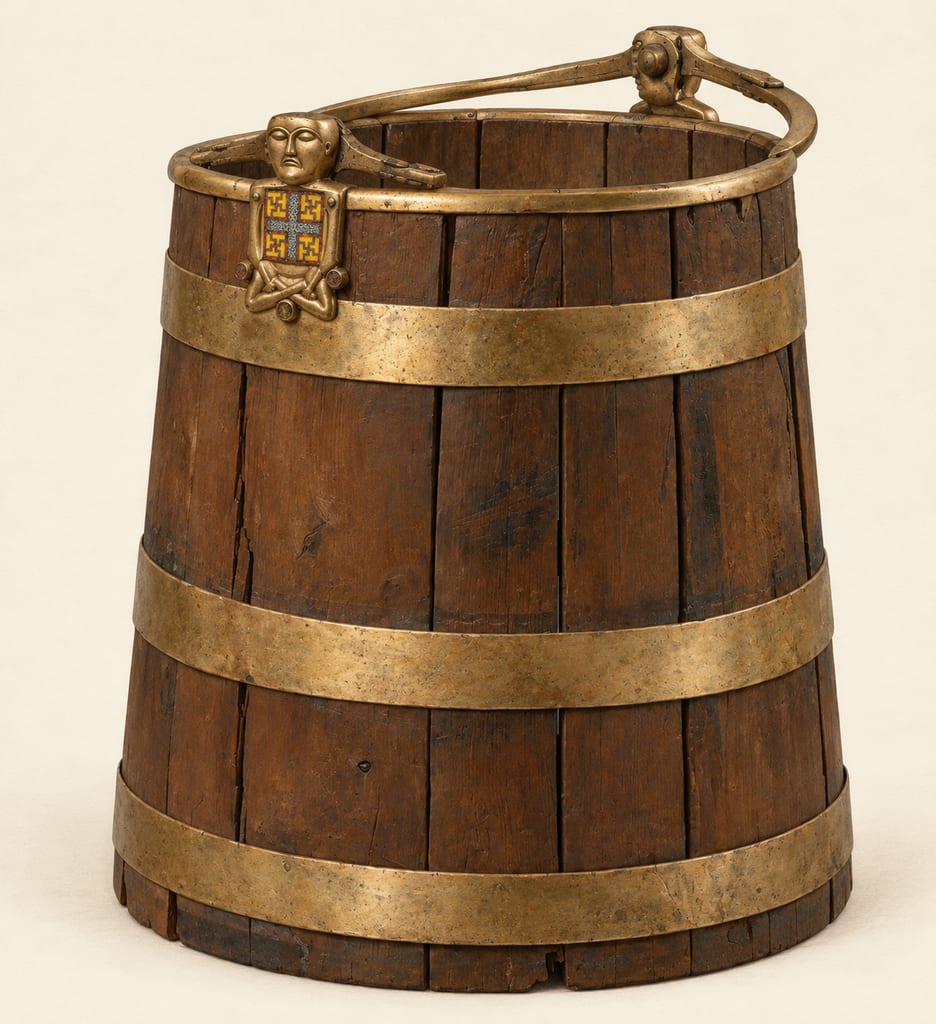
Historical illustration of the Oseberg bucket, showing its yew stave body, bronze bands and rim, carrying handle, and enamelled figure fitting.
Equipment · Historical object

Oseberg decorated bucket

The Oseberg bucket is a 36 cm yew stave vessel bound in bronze, its enamelled human fittings a rare record of skilled craft and elite display.

Show on map
buckets-and-pails
Oseberg, Vestfold, Norway
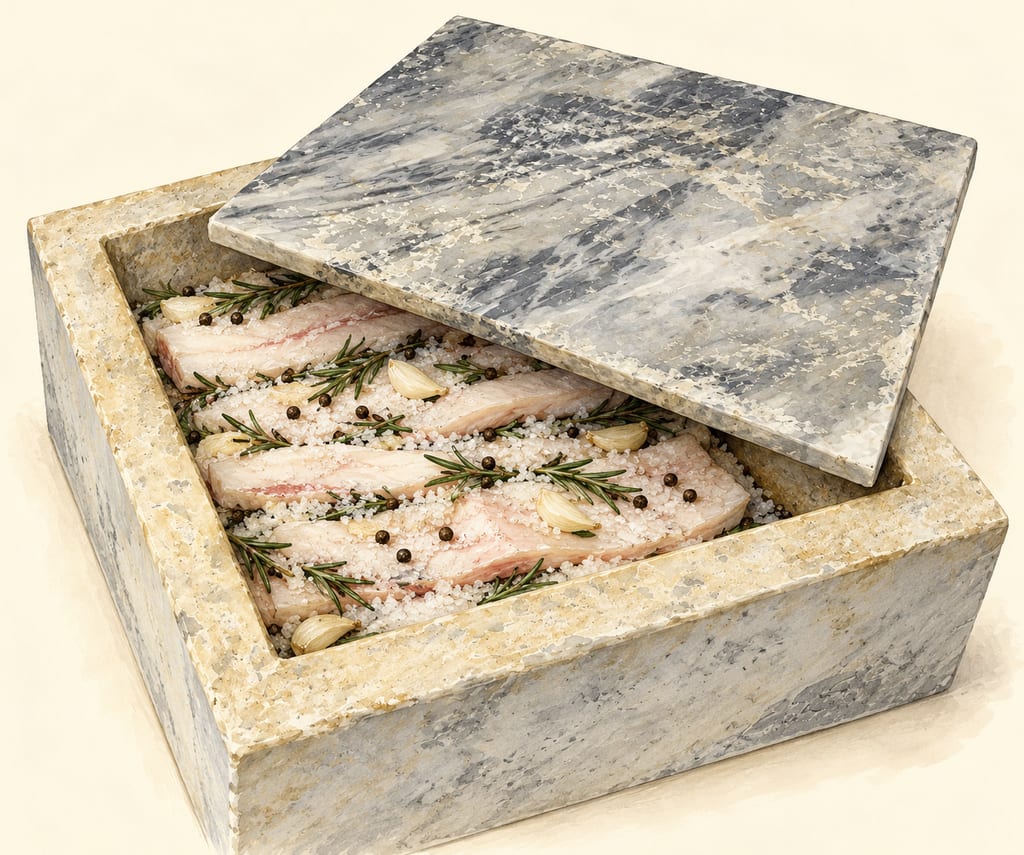
Hand-painted illustration of a thick-walled veined marble conca with its heavy lid partly covering layers of salted pork fat and herbs.
Equipment

Marble conca

A conca is a thick-walled marble basin used in Colonnata, Tuscany, to salt-cure and mature lardo. Its local white marble and close-fitting stone lid form the documented vessel for Lardo di Colonnata IGP.

Tanks and vats
Colonnata, Carrara, Tuscany
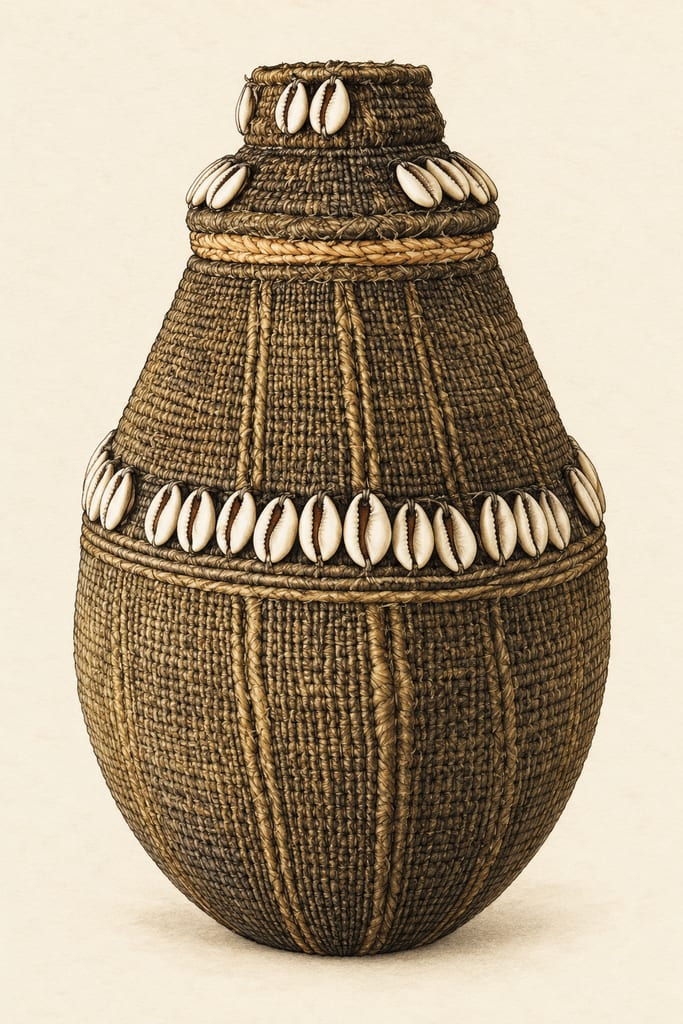
Illustration of an empty pear-shaped Borana gorfa, hand-woven from plant fiber, with a lid and cowrie-shell bands following one museum specimen.
Equipment

Gorfa (Borana woven milk vessel)

The Borana gorfa is a pear-shaped milk vessel used in southern Ethiopia to sour milk and churn it into butter. Sources document woven fiber and smoke treatment; one museum specimen also records gourd and cowrie-shell materials.

woven-liquid-vessel
Borana pastoral area
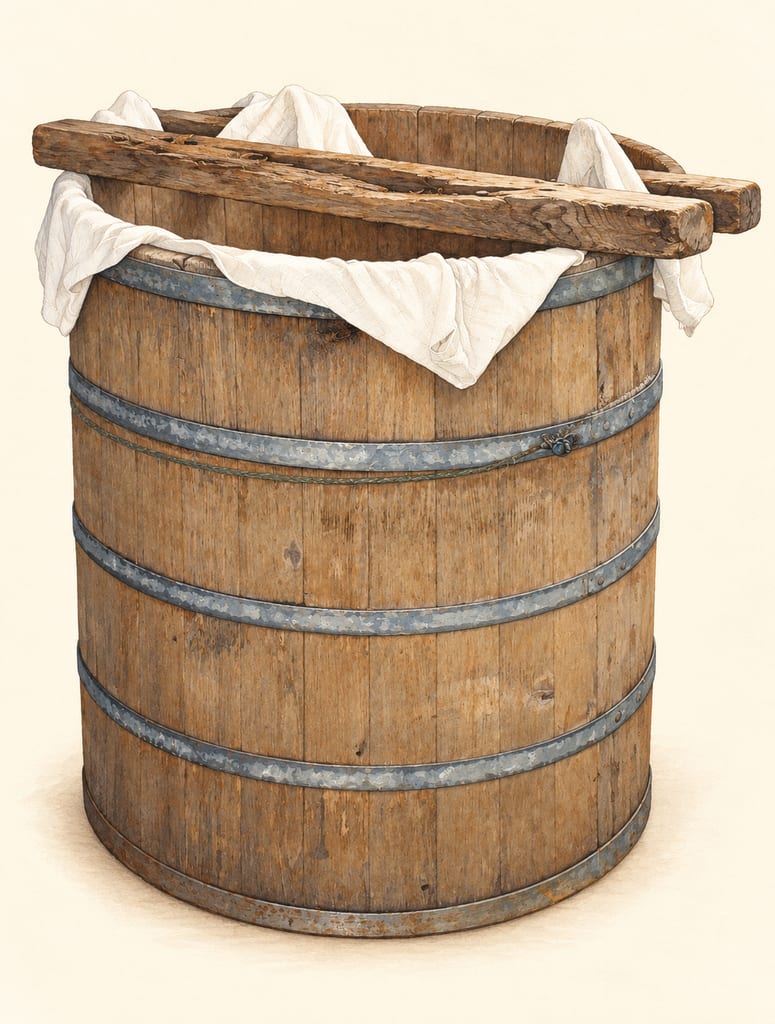
Historical illustration of a broad coopered wooden gerle with metal hoops, cloth over part of its mouth and wooden bars across the opening.
Equipment

Gerle

The gerle is a broad wooden vat used to receive and work milk for Salers cheese in its French AOP area. Its coopered form and microbial role are documented, but sources do not establish when this particular vessel first appeared.

Tanks and vats
Salers AOP production area
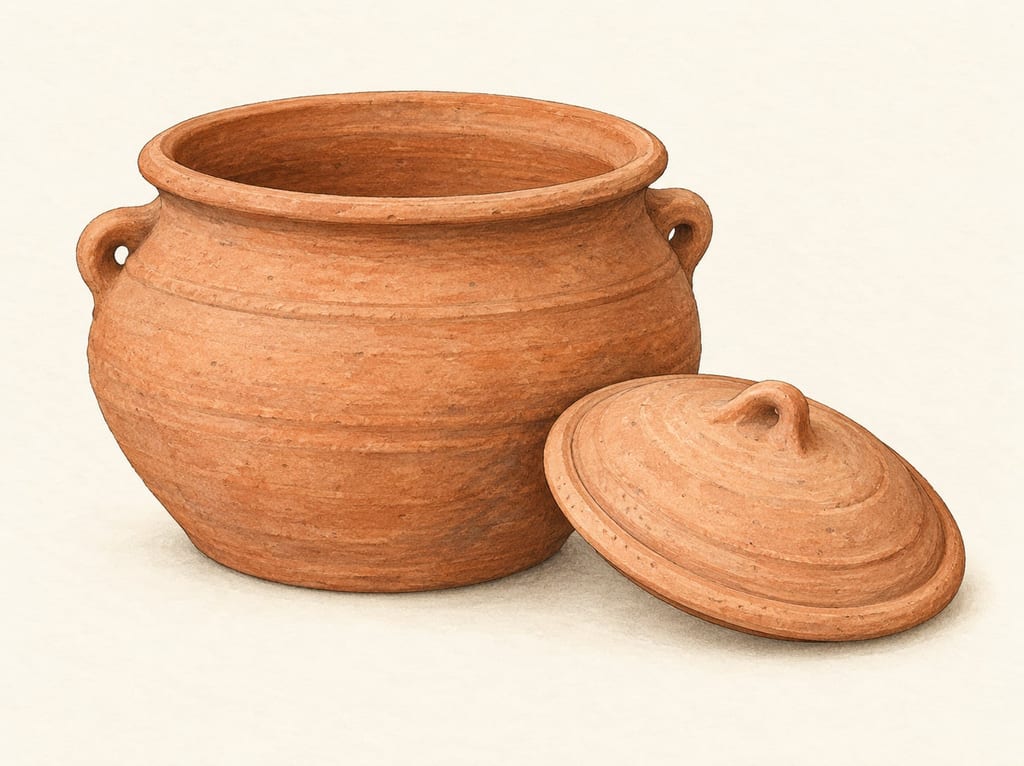
Historical illustration of an unglazed Zlakusa cooking pot with rounded body, short flared rim, side handles and its separate fitted lid.
Equipment

Zlakusa pot

A hand-formed, unglazed clay-and-calcite cooking pot from Zlakusa in western Serbia. Potters make varied forms for cooking and baking through a living hand-wheel craft.

Jars, pots and crocks
Zlakusa
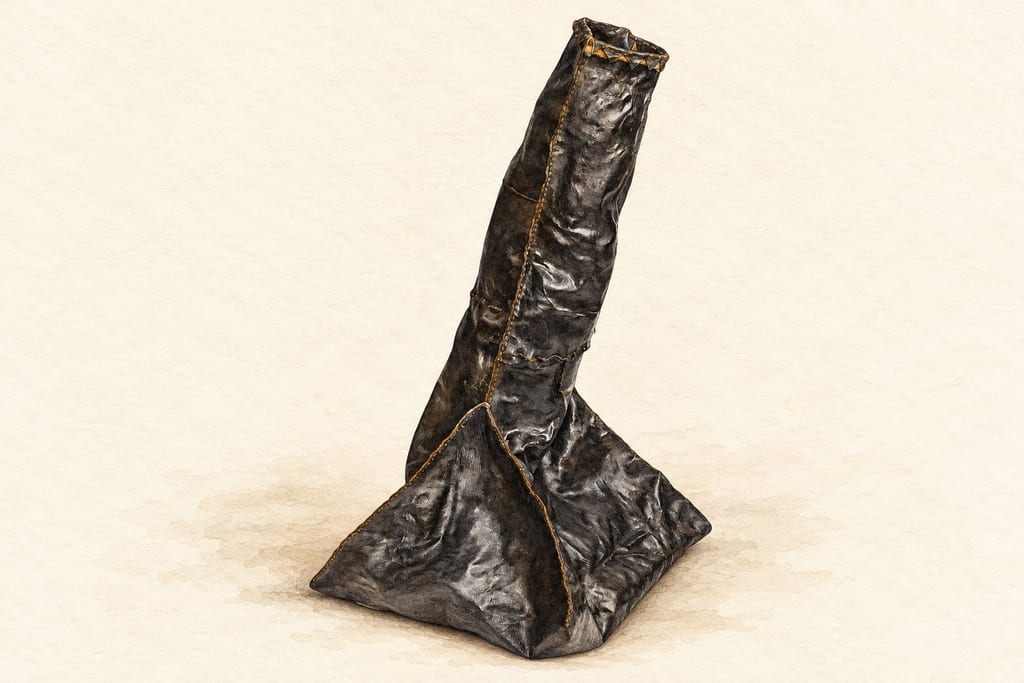
Watercolor illustration based on the Omsk museum saba: a smoke-darkened horsehide vessel with a long neck, broad gusseted body and visible hair-thread seams.
Equipment

Saba

Saba is a large Kazakh horsehide vessel used to prepare and keep kumis. An Omsk museum specimen shows a tall, narrow neck above a broad, gusseted body, with seams stitched in hair thread and hide smoked to make it water-resistant.

Skins and bladders
Kazakhstan
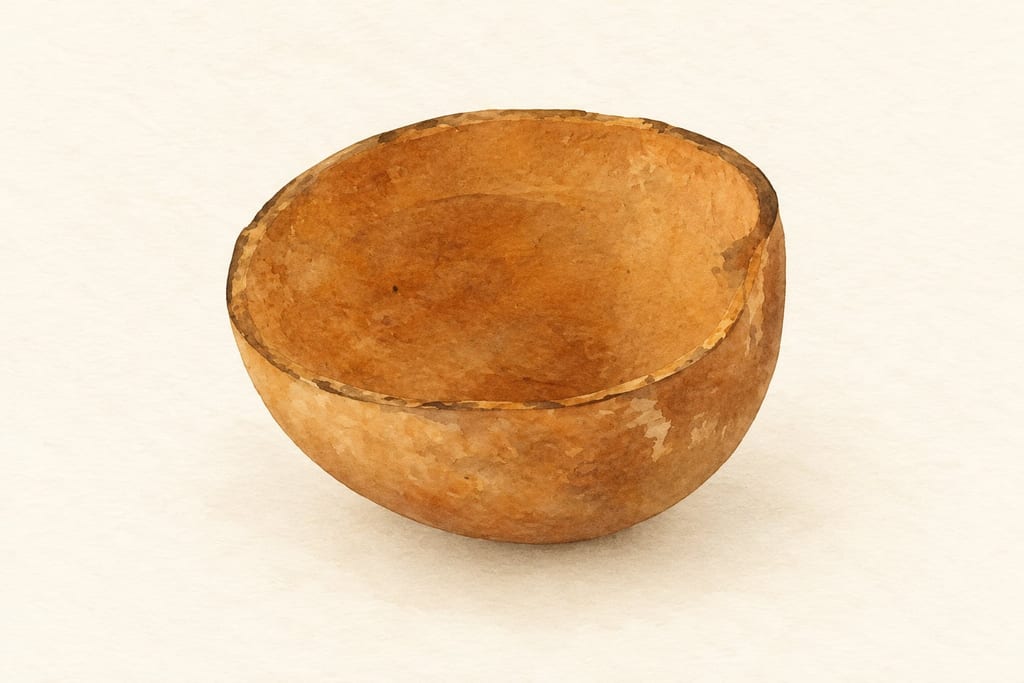
Watercolor illustration of a plain, shallow half-gourd drinking cup, matching the form of Sierra Leone National Museum accession SLNM.1965.34.01.
Equipment

Poyo cup

A plain drinking cup made from a dried gourd cut in half, catalogued by Sierra Leone’s National Museum as a Kono poyo cup associated with Yengema.

Gourds, calabashes and carved bowls
Yengema
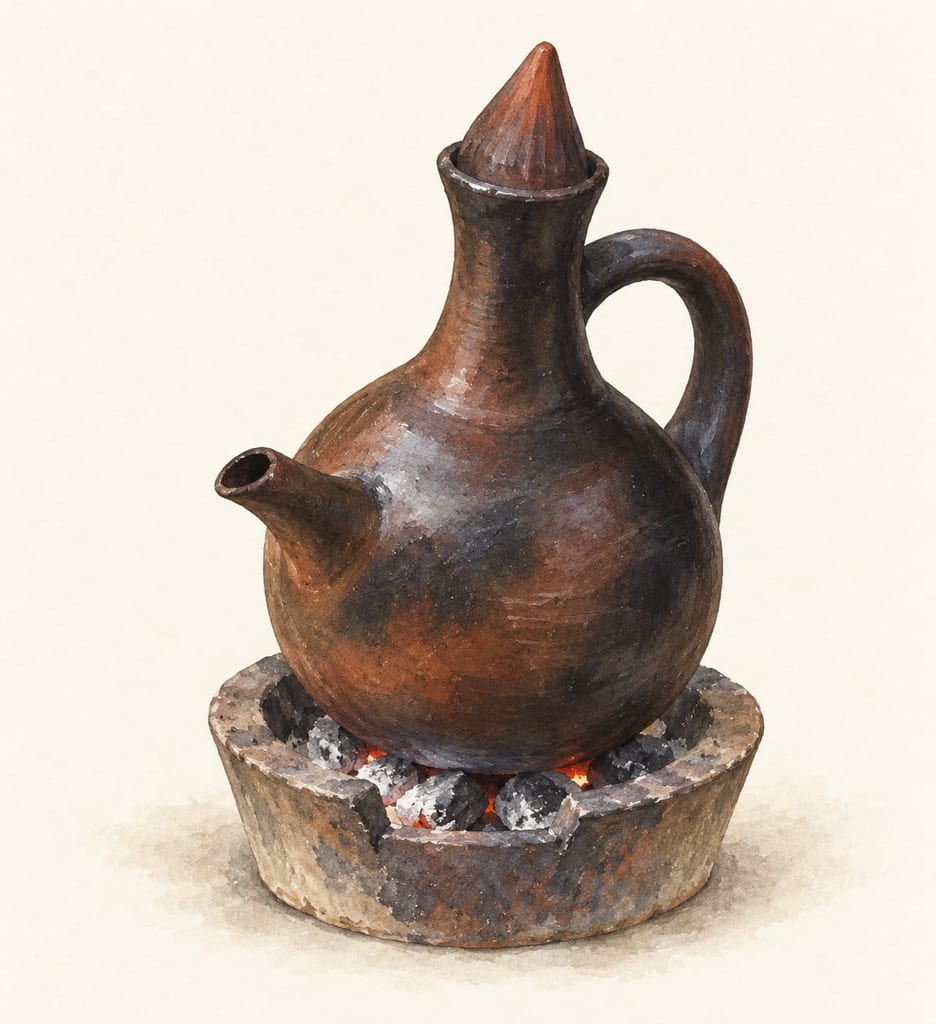
Illustration of an Ethiopian terracotta jebena with a rounded body, long neck, side handle and spout over charcoal embers.
Equipment

Jebena

The jebena is an Ethiopian terracotta coffee pot, typically rounded at the body and narrow through the neck. It brews coffee over a fire and serves a communal ceremony; materials, profiles and household practices vary.

Jars, pots and crocks
Ethiopia
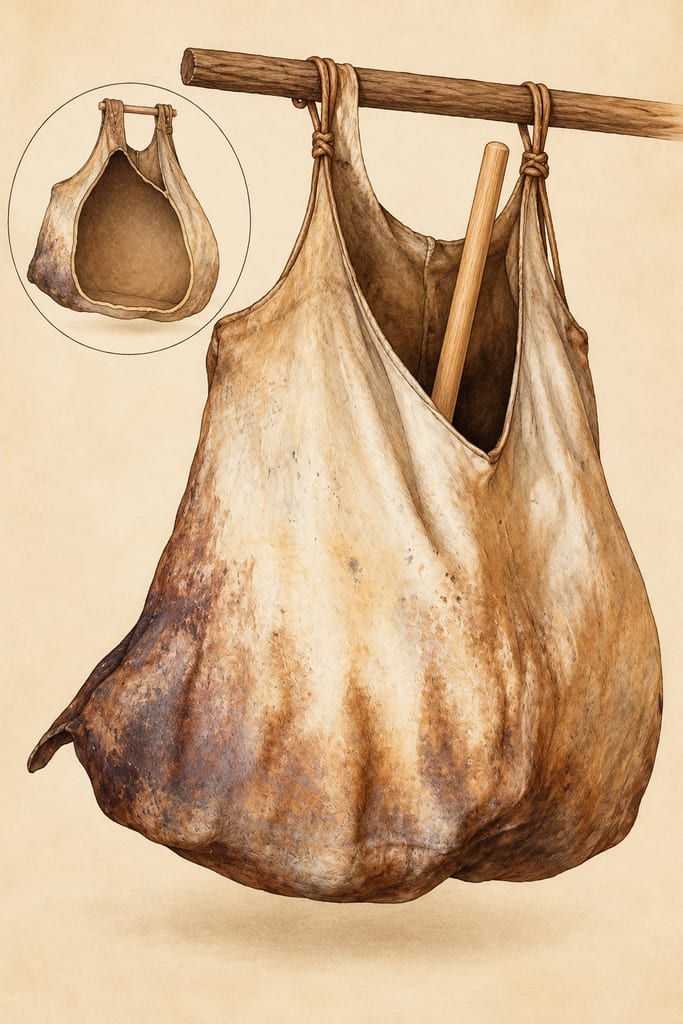
Historical illustration of a traditional Mongolian khokhuur, a large flexible hide vessel hanging from a wooden support with a separate paddle and a small cutaway showing its hollow bag form.
Equipment

Khokhuur

The khokhuur is a traditional Mongolian airag vessel made from prepared cowhide. Its flexible leather body holds mare’s milk while it is churned with a separate wooden buluur paddle.

Skins and bladders
Mongolia
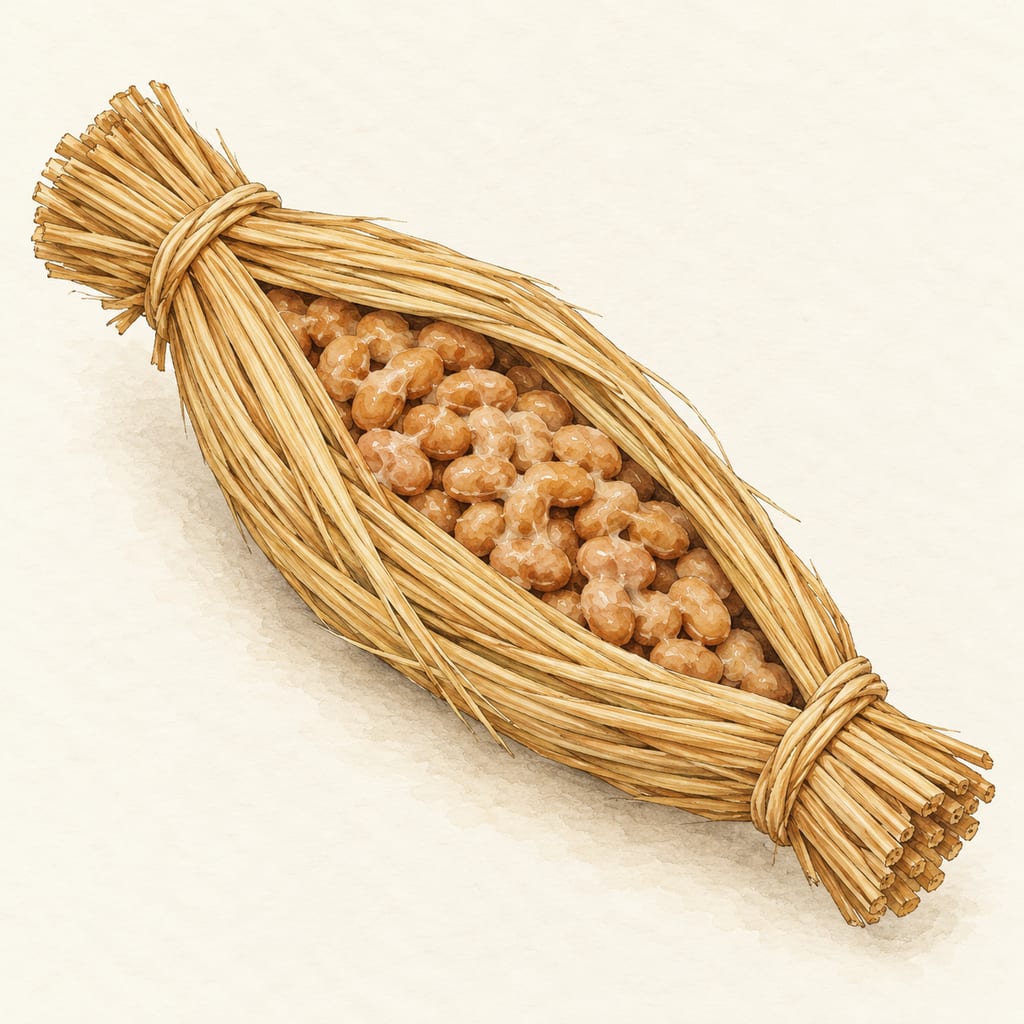
Watercolor illustration of an open, tapered rice-straw warazuto bundle holding sticky soybeans, tied near both ends.
Equipment

Natto warazuto (rice-straw bundle)

A natto warazuto is a rice-straw bundle that encloses soybeans during natto fermentation. Documented Japanese forms vary by region: Ibaraki examples include boat-like bundles, while Yamagata accounts describe straw tubes.

Bamboo, leaf and wraps
Ibaraki Prefecture
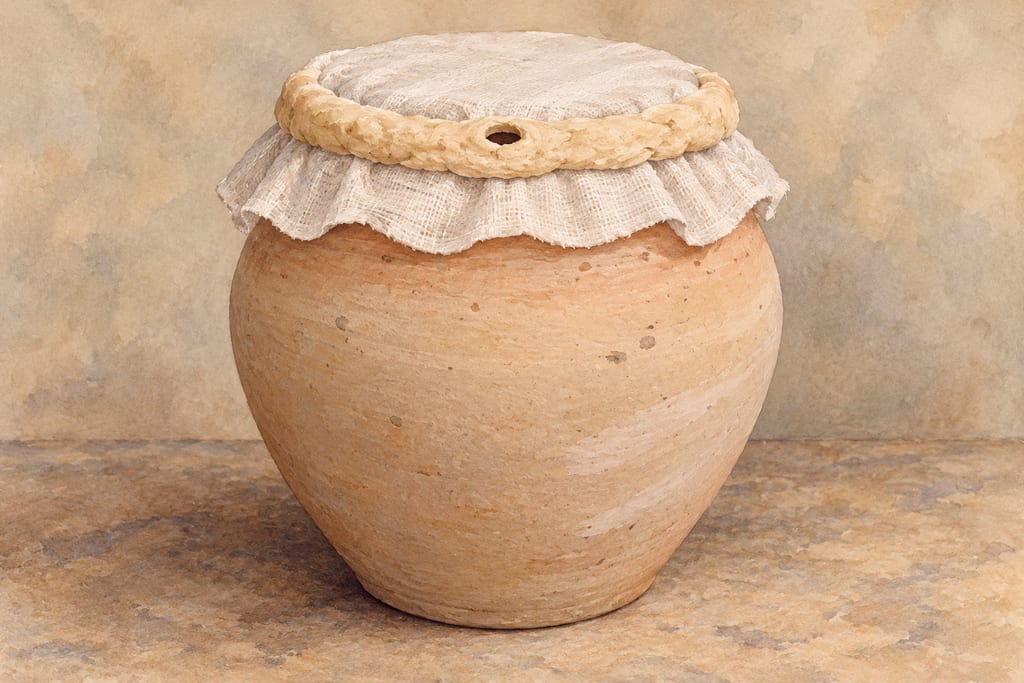
Watercolor illustration of an intact earthenware testi kebab jug closed with cloth and a small-vent dough seal.
Equipment

Testi kebab jug

A purpose-made earthenware testi jug acts as the cooking chamber for testi kebabı. A documented Nevşehir account describes a cloth-and-dough closure with a small vent; size and craft specifications are not established.

Jars, pots and crocks
Nevşehir Province
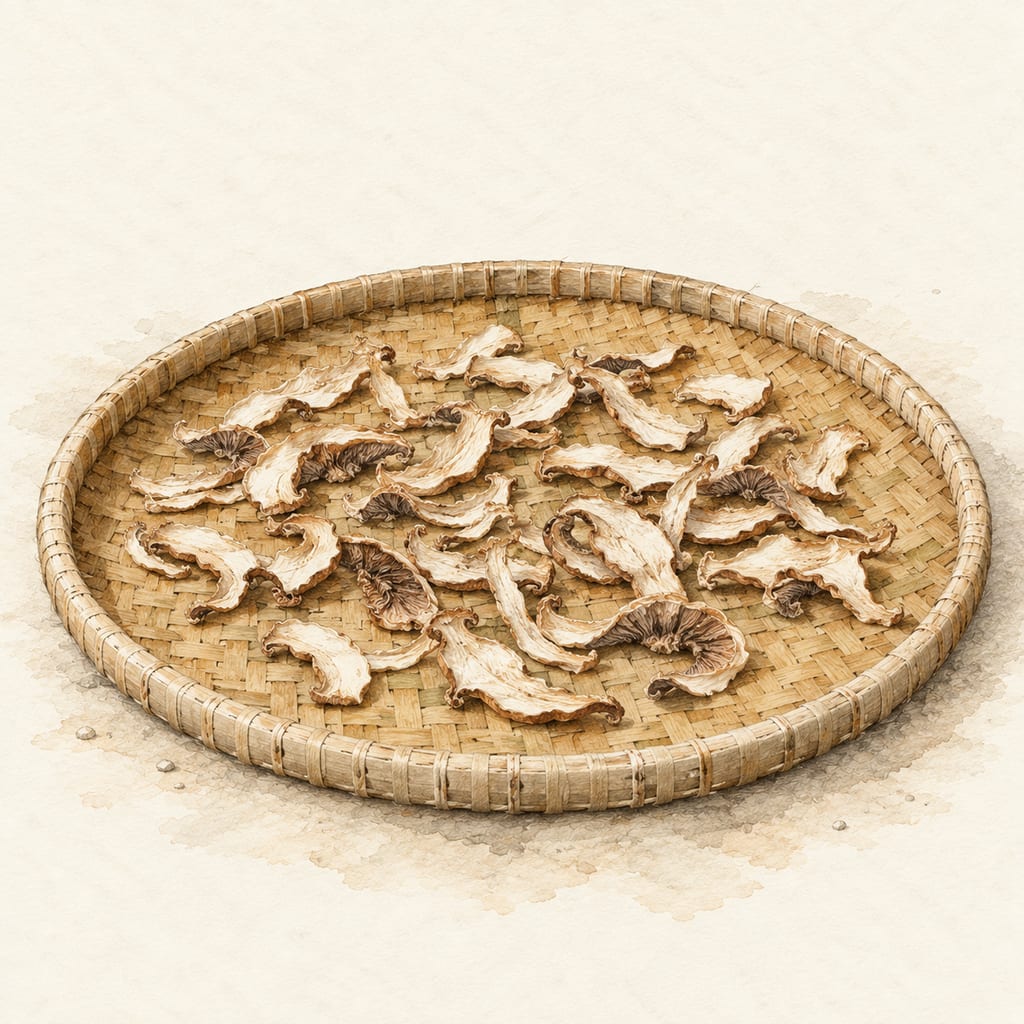
A woven bamboo Nanglo tray with a modest scatter of sliced mushrooms laid out on it, in watercolor-pencil illustration on warm ivory paper.
Equipment

Nanglo

A Nepali woven bamboo tray used for winnowing and drying foods. A Sagarmatha field report records mushrooms drying on nanglo above Namche; contemporary sources also document its ongoing manufacture and sale.

Baskets, trays and beds
Sagarmatha National Park and buffer zone
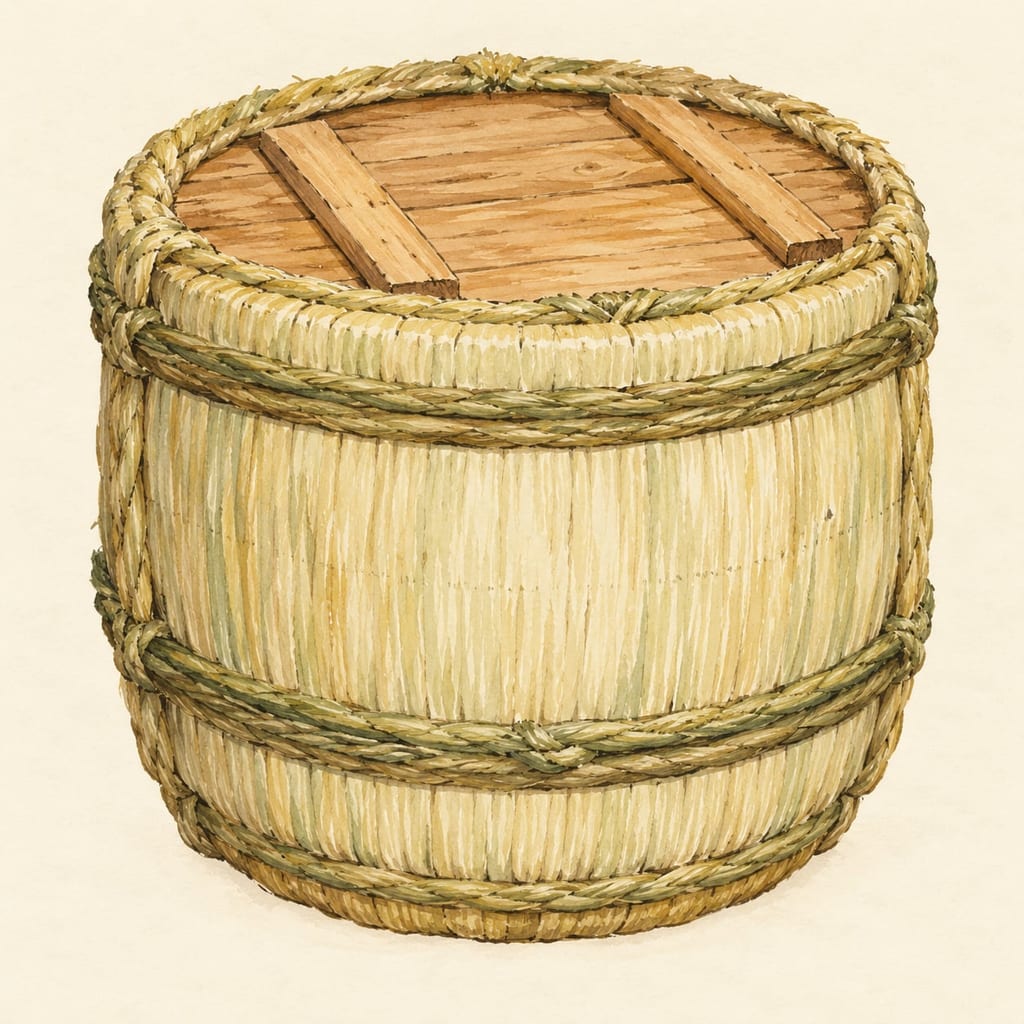
Hand-painted illustration of a short straw-wrapped cedar sake cask with a closed wooden top.
Equipment

Sake taru

A sake taru is a short wooden cask for holding and presenting finished sake; traditional examples may show bare cedar or a woven-straw covering.

Barrels and casks
Japan
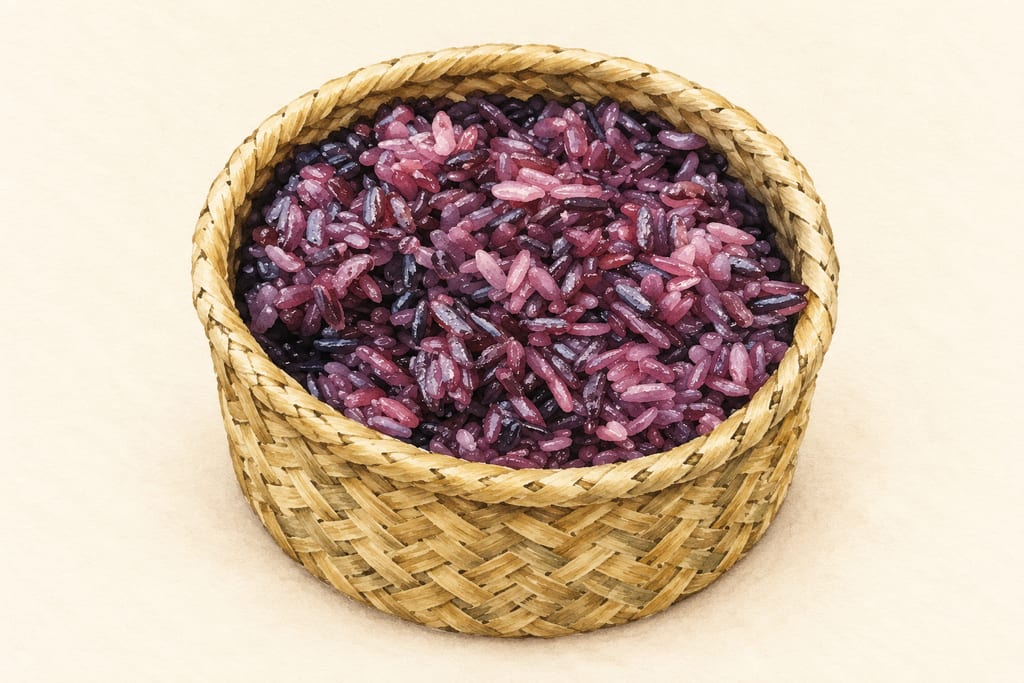
A woven katip khao basket holding purple sticky rice in an open serving stage.
Equipment

Katip khao

A lidded woven bamboo or rattan basket used in Laos to hold steamed sticky rice and keep it warm and soft for serving.

Baskets, trays and beds
Laos
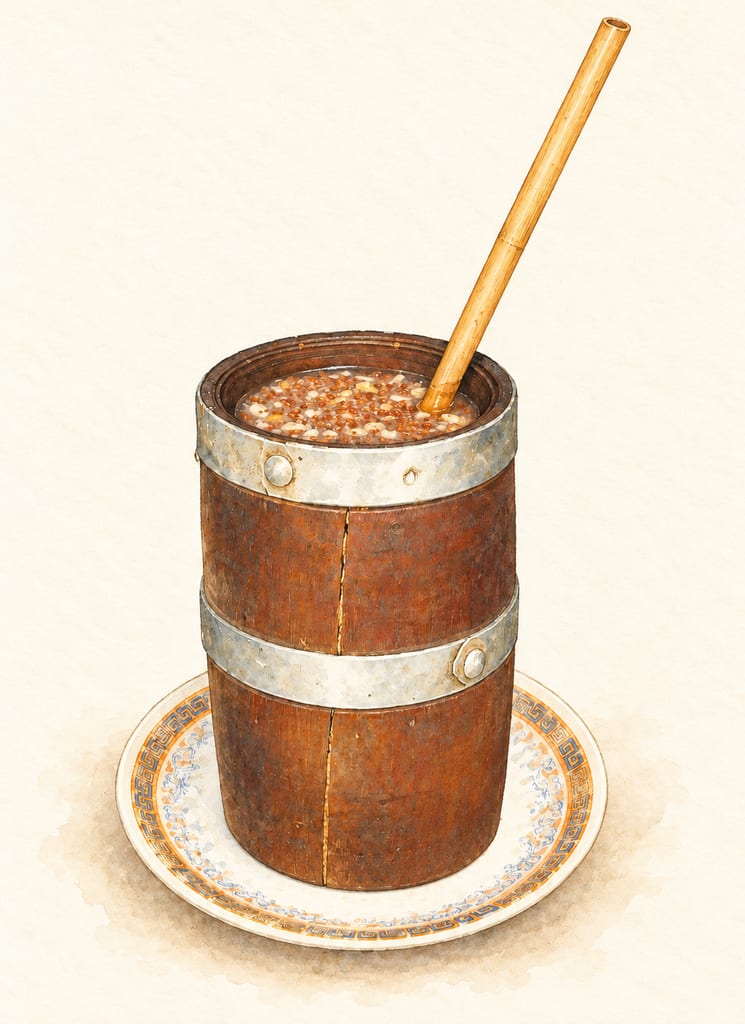
Editorial illustration of a wooden tongba serving vessel with two metal hoops, fermented millet and water, and a bamboo drinking straw on a warm ivory background.
Equipment

Tongba vessel

A tongba is a serving vessel for fermented millet drink: it holds the grain as water is added while a narrow bamboo straw draws off the liquid. Documented forms include bamboo and wood, with no single standard design established.

Barrels and casks
Eastern Himalaya
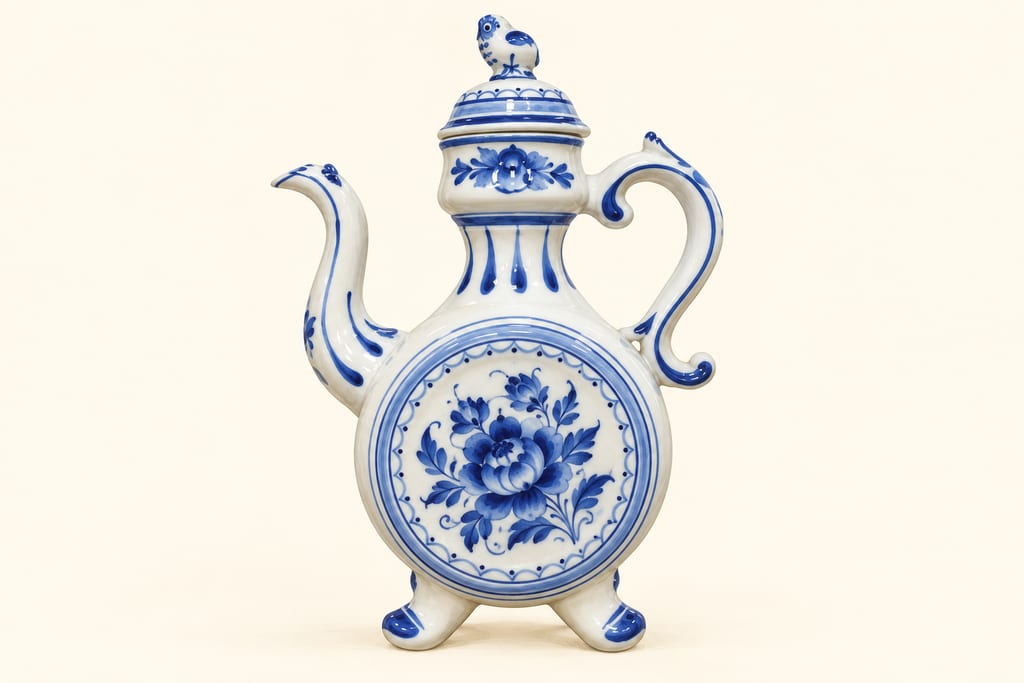
Historical editorial illustration of an empty white Gzhel-painted kumgan with a rounded disk-like body, narrow lidded neck, curved spout, handle and four foot-like supports; based on a museum specimen dated to the early 21st century.
Equipment

Kumgan

A kumgan is a handled pouring vessel with a narrow spout. This Sosnovsky museum example is Gzhel-painted porcelain made in Rechitsy in the early 21st century, representing a form used in Russia to serve historic drinks.

Jars, pots and crocks
Rechitsy
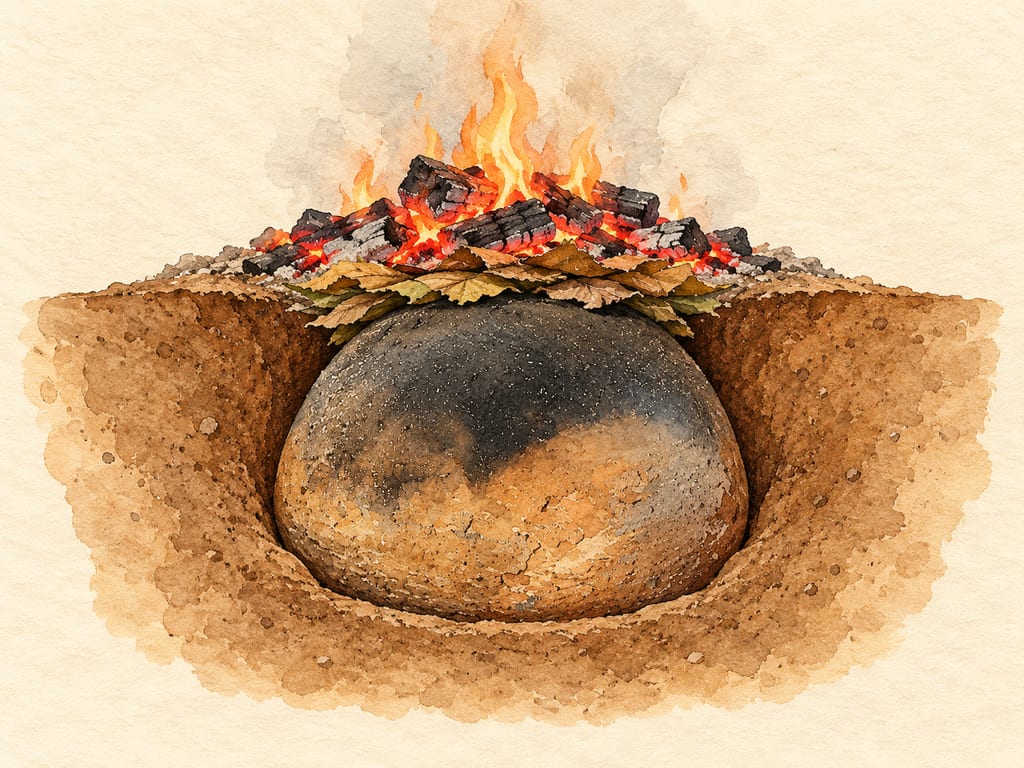
Watercolor cutaway showing an inverted earthen matlu in surrounding soil with leaves and a modest fire above, as described for traditional undhiyu.
Equipment

Matlu

An earthen cooking pot associated with Gujarati undhiyu: Gujarat Tourism describes it turned upside down and fired. A field report documents a related ubadiyu matlu near Dungri in South Gujarat.

Jars, pots and crocks
Gujarat
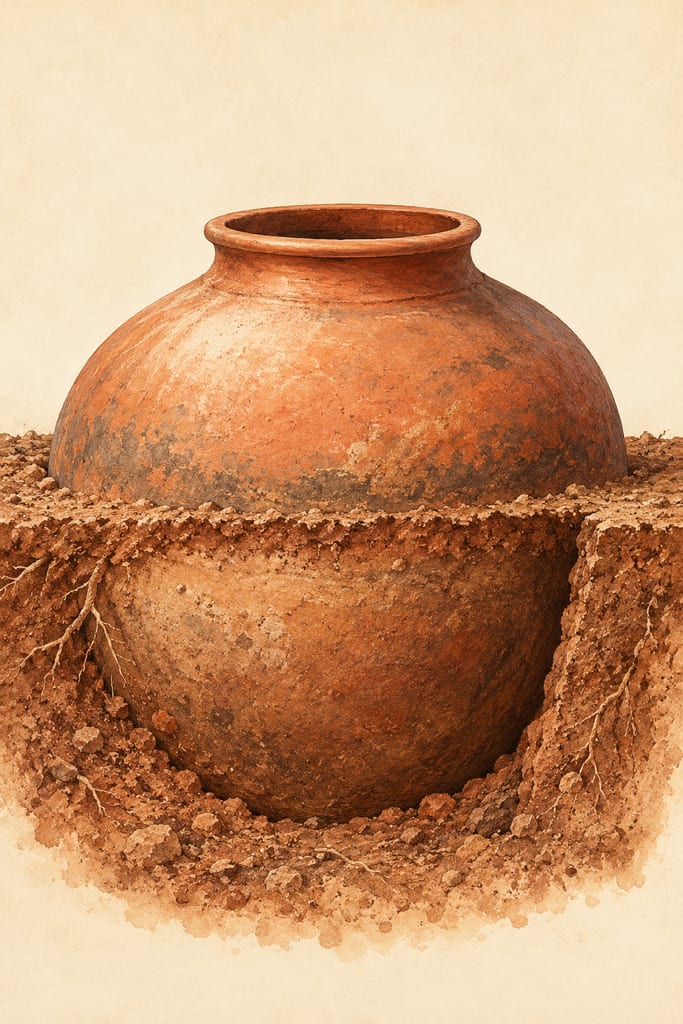
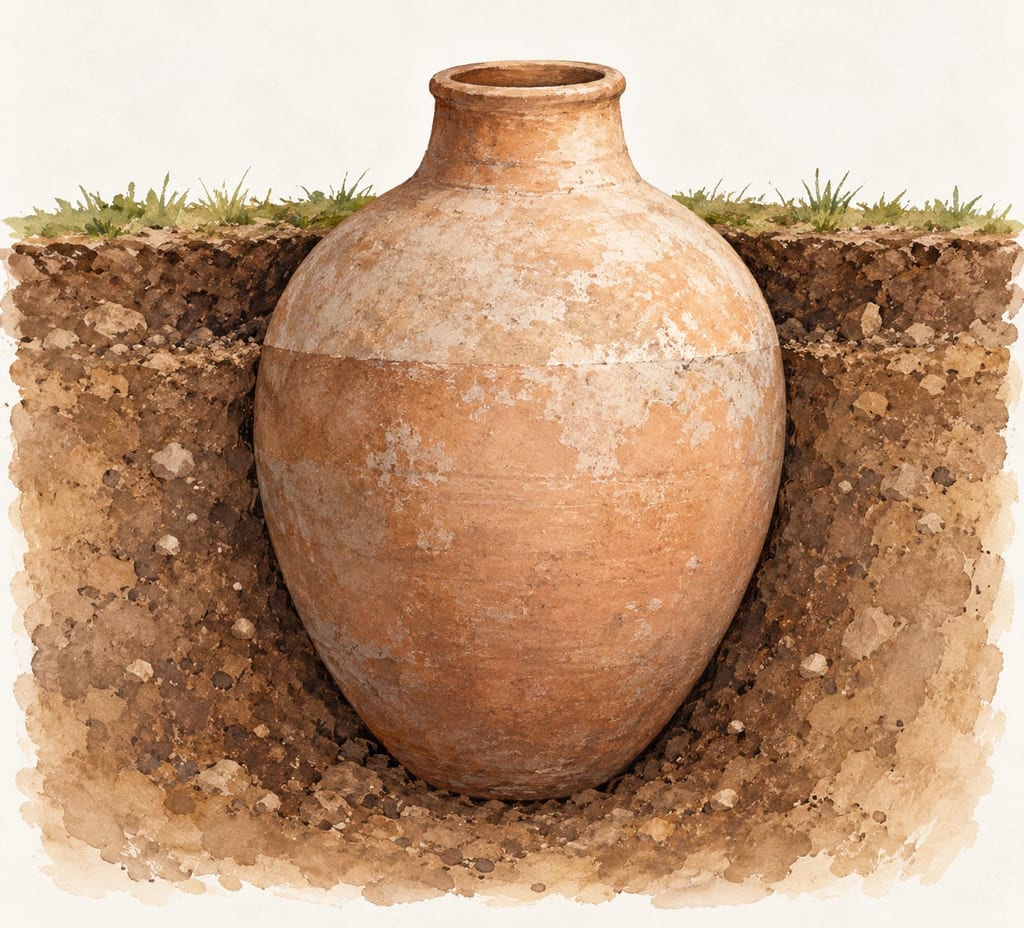
Editorial cutaway illustration of a large Goan earthen kodem half-buried in soil, with a schematic view of the below-ground vessel.
Equipment

Kodem

A large earthen fermentation vessel used for cashew-apple juice in Goa; sources describe underground burial, with one recent field account showing pots partly set into the soil.

Jars, pots and crocks
Goa, India
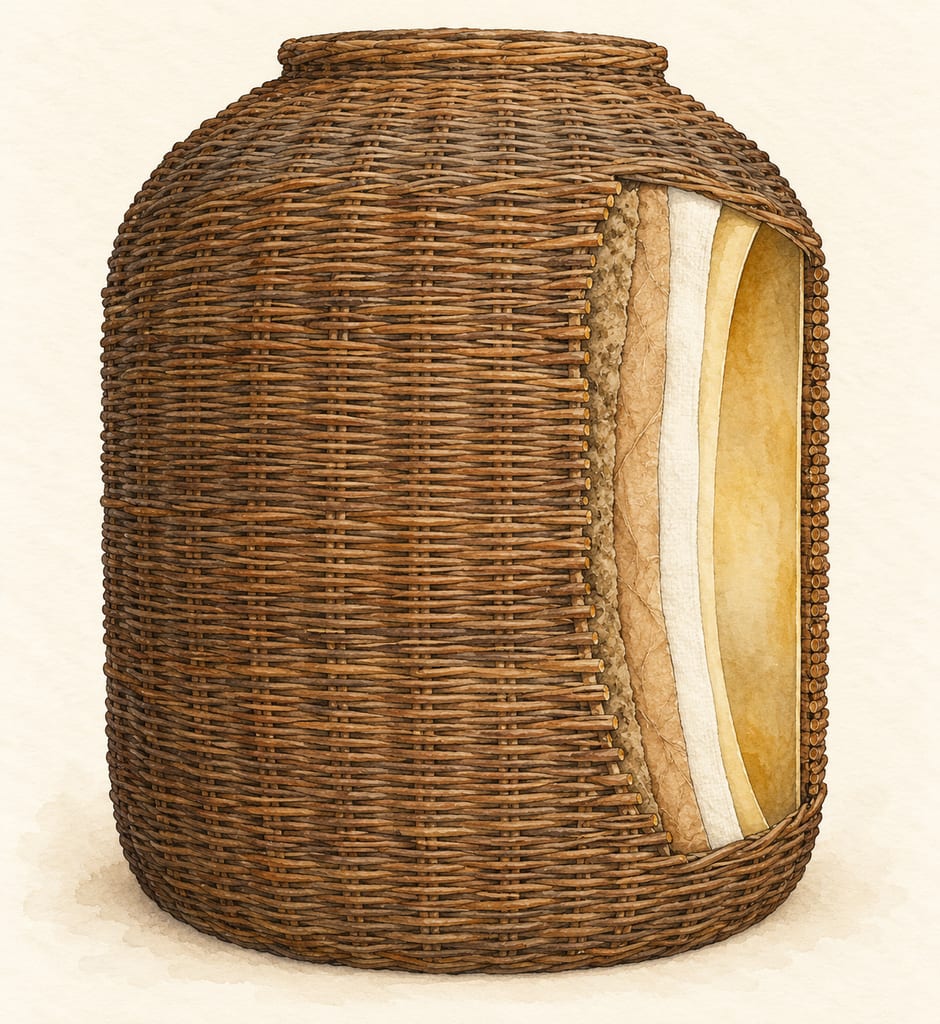
Watercolor cutaway illustration of a large Xifeng jiuhai with a woven local-twig outer shell and simplified interior lining layers.
Equipment

Jiuhai

A jiuhai is a large vessel for storing and maturing baijiu. This entry focuses on a documented Xifeng example: a giant basket woven from local twigs and lined with layered paper, cloth and coatings. Other jiuhai use different materials.

Tanks and vats
Liulin Town, Fengxiang County
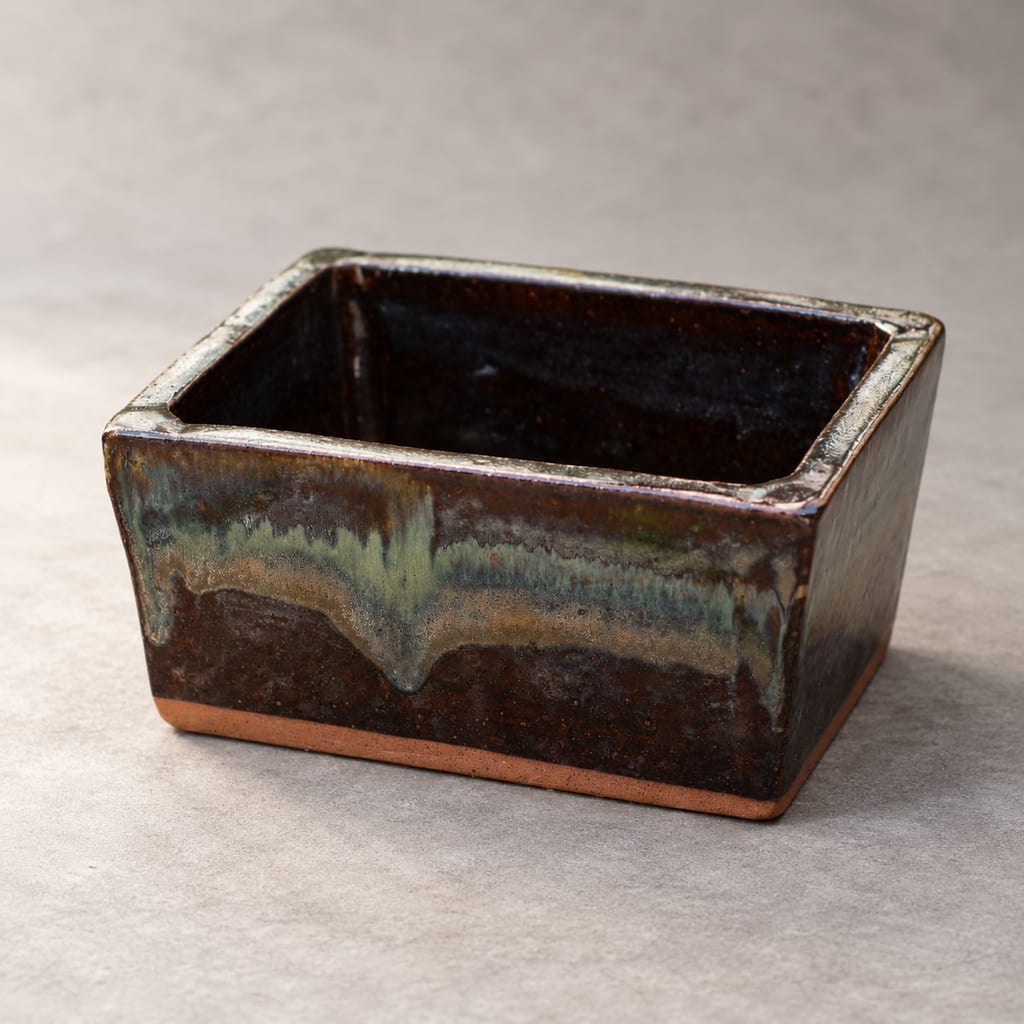
Empty rectangular Aizu Hongo-yaki nishin-bachi with a thick rim, glossy dark brown glaze and muted green drips.
Equipment

Nishin-bachi (Aizu herring bowl)

A rectangular Aizu Hongo-yaki ceramic bowl made for layering Hokkaido dried herring with sanshō leaves in Aizu's nishin no sanshōzuke; it is documented as a marinating dish, not fermentation equipment.

Jars, pots and crocks
Aizu region
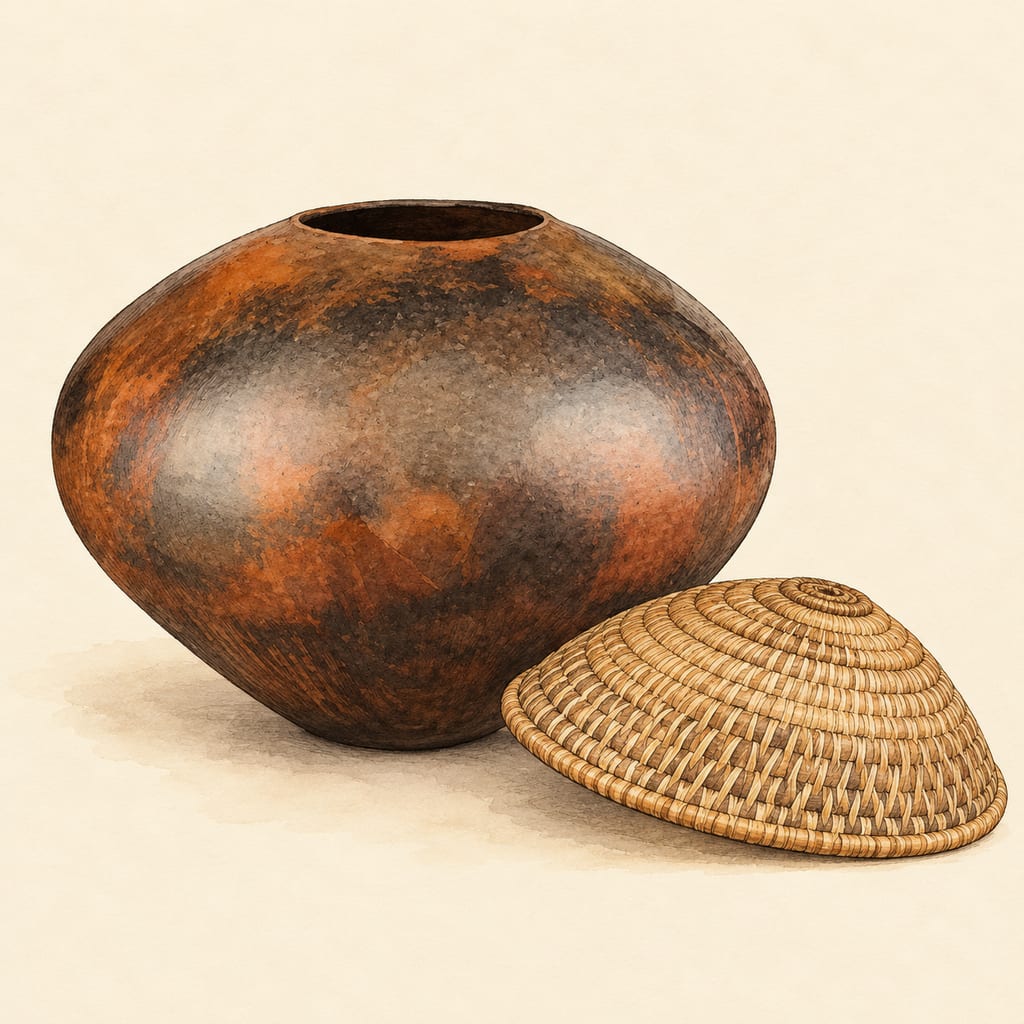
Editorial illustration of a traditional Zulu imbiza: a broad rounded earthenware beer-brewing pot with an open rim and separate woven basket cover, grounded in a documented late-twentieth-century Imbiza form.
Equipment

Imbiza

A Zulu earthenware brewing vessel used for grain beer; a woven basket cover keeps out dirt and insects. Imbiza is a distinct pot class, not the serving ukhamba or transport uphiso.

Jars, pots and crocks
South Africa
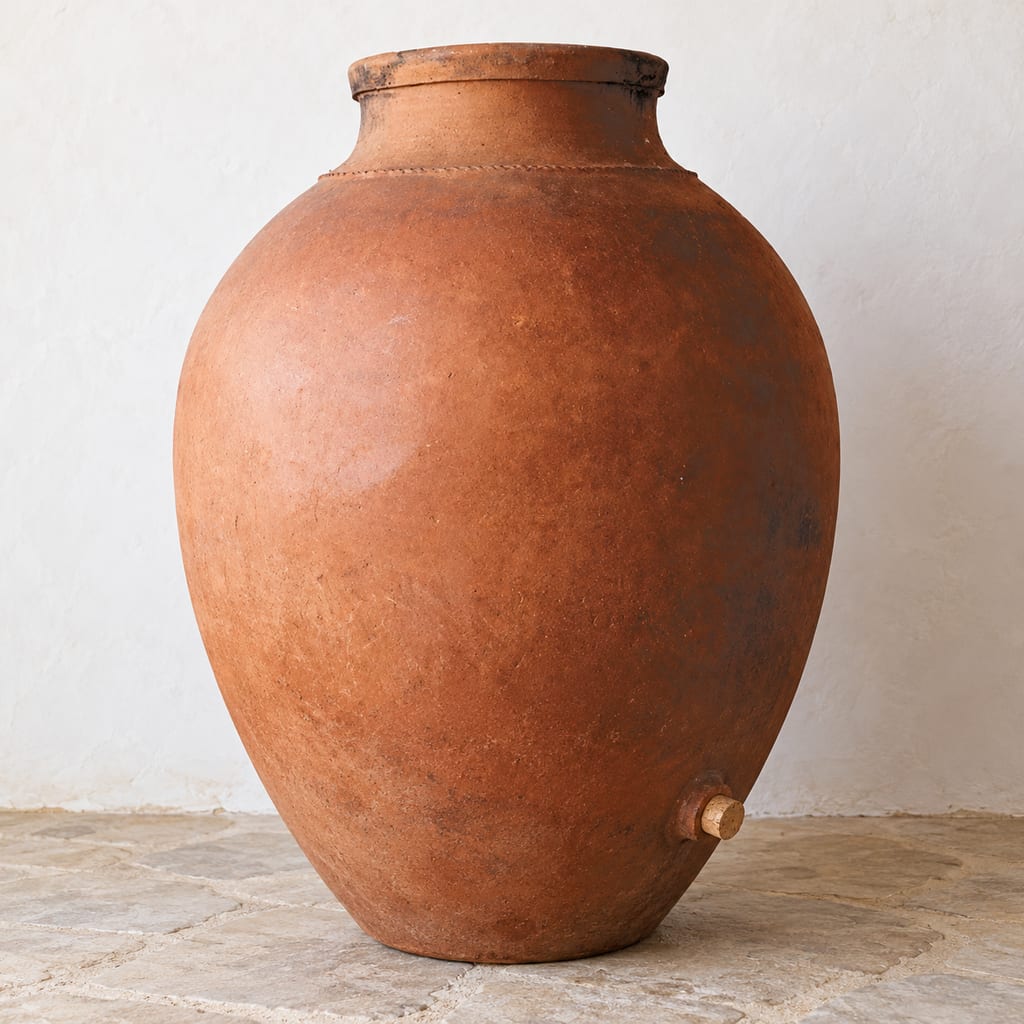
A tall reddish-brown clay Alentejo wine talha with a rounded body, short neck and low cork-stoppered outlet, standing above floor level.
Equipment

Alentejo wine talha

A large fired-clay jar for Alentejo wine, the talha has a wide mouth for grape-cap management and a low outlet for drawing wine. Its form and lining vary by maker and locality.

Jars, pots and crocks
Alentejo
A historical illustration of an empty one-piece wooden theki, with a rounded body, narrowed neck and flared mouth.
Equipment

Theki

A carved, close-necked wooden vessel used for dahi in Nepal. Established thekis could be used without added starter; new vessels were conditioned.

Gourds, calabashes and carved bowls
Eastern Nepal
Watercolor cutaway illustration of an intact Armenian karas partly embedded in soil, showing one modern producer-specific arrangement.
Equipment

Karas

A karas is a large Armenian clay wine vessel used in several documented practices. Placement and use vary; one modern producer reports maturing wine in karasi buried about three-quarters of their height.

Jars, pots and crocks
Armenia
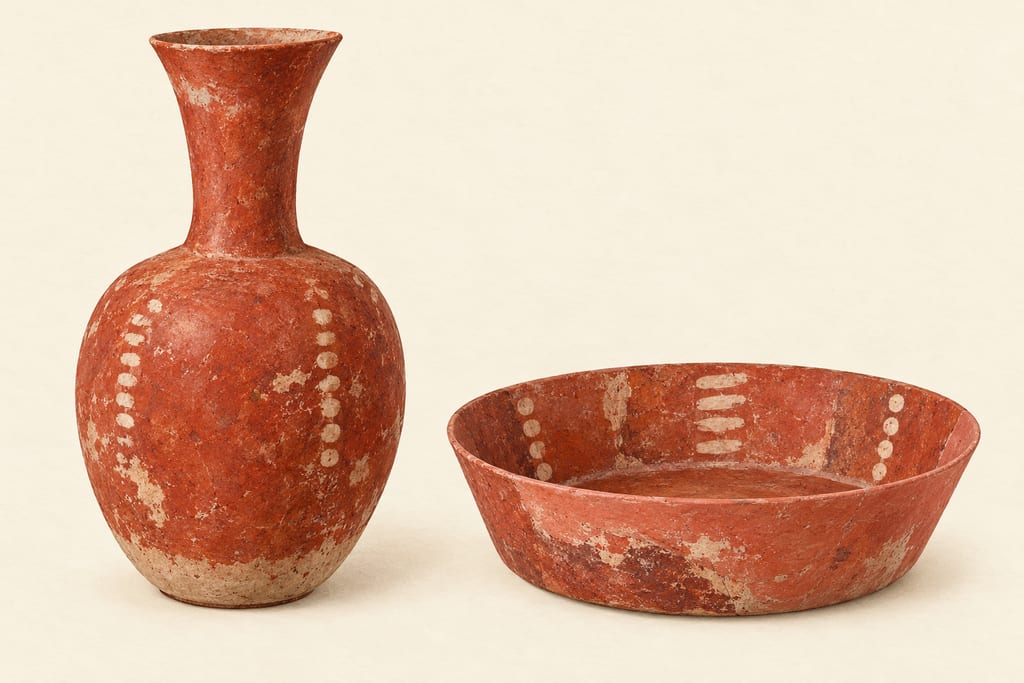
Editorial illustration of a slip-painted long-necked hu and broad bowl from Qiaotou, based on the forms shown in the published archaeological figure.
Equipment · Historical object

Qiaotou painted hu and bowls

Painted long-necked hu vessels and bowls from Qiaotou, Zhejiang, associated with residues the researchers interpret as beer; the evidence concerns drinking and serving, not proof that these vessels were fermenters.

Show on map
Jars, pots and crocks
Zhejiang, China
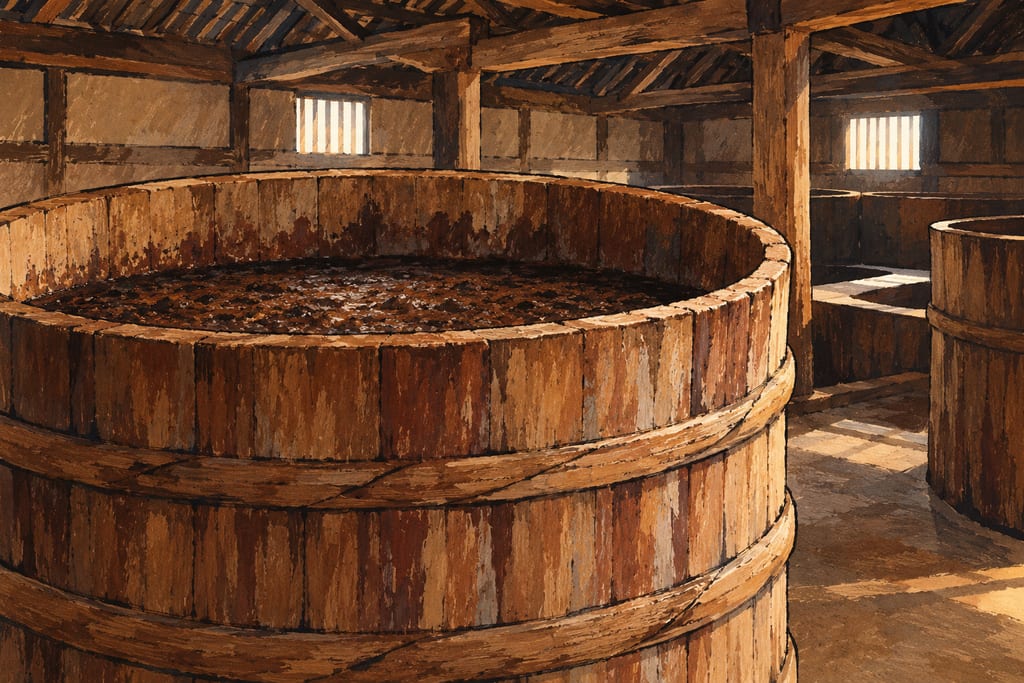
Hand-painted illustration of a huge upright cedar kioke filled with dark moromi in a timber soy-sauce brewery.
Equipment

Shoyu kioke

A shoyu kioke is a very large upright wooden vat for fermenting and ageing soy-sauce mash; Japanese sources document cedar-stave examples held together by hoops.

Barrels and casks
Japan
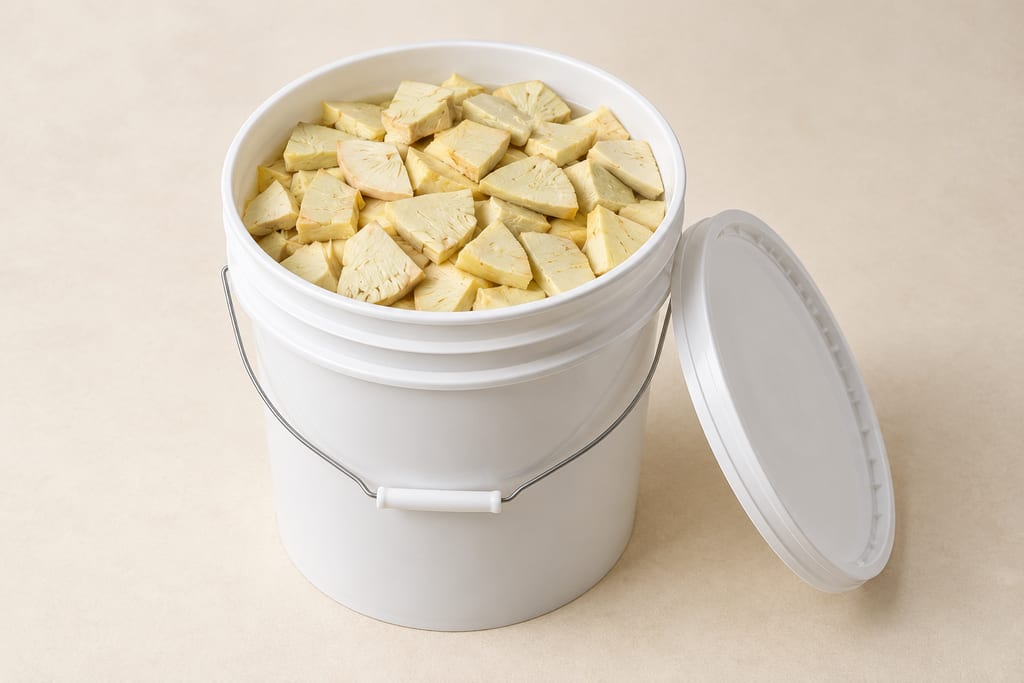
A white food-safe bucket holding prepared breadfruit, with its lid beside it.
Equipment

Breadfruit bucket, cooler or bag

A contemporary household enclosure for preparing mā, fermented breadfruit, documented in Hawai‘i using food-safe buckets, coolers or large sealable bags in place of a pit.

Tanks and vats
Hawai‘i
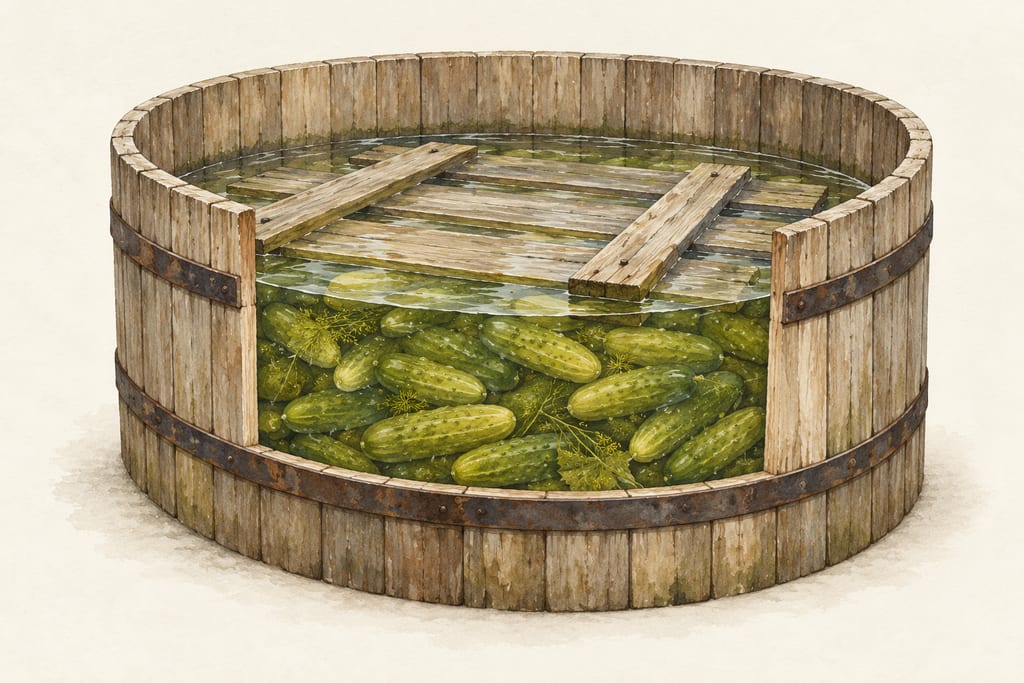
Historical-style illustration of a broad wooden stave brining vat with cucumbers submerged beneath a board restraint and cover brine.
Equipment

Bulk vegetable brining vat

A bulk brining vat holds cucumbers and other vegetables under cover brine for fermentation and storage. North Carolina sources document a mid-century wooden tank yard and later outdoor fiberglass systems.

Tanks and vats
United States
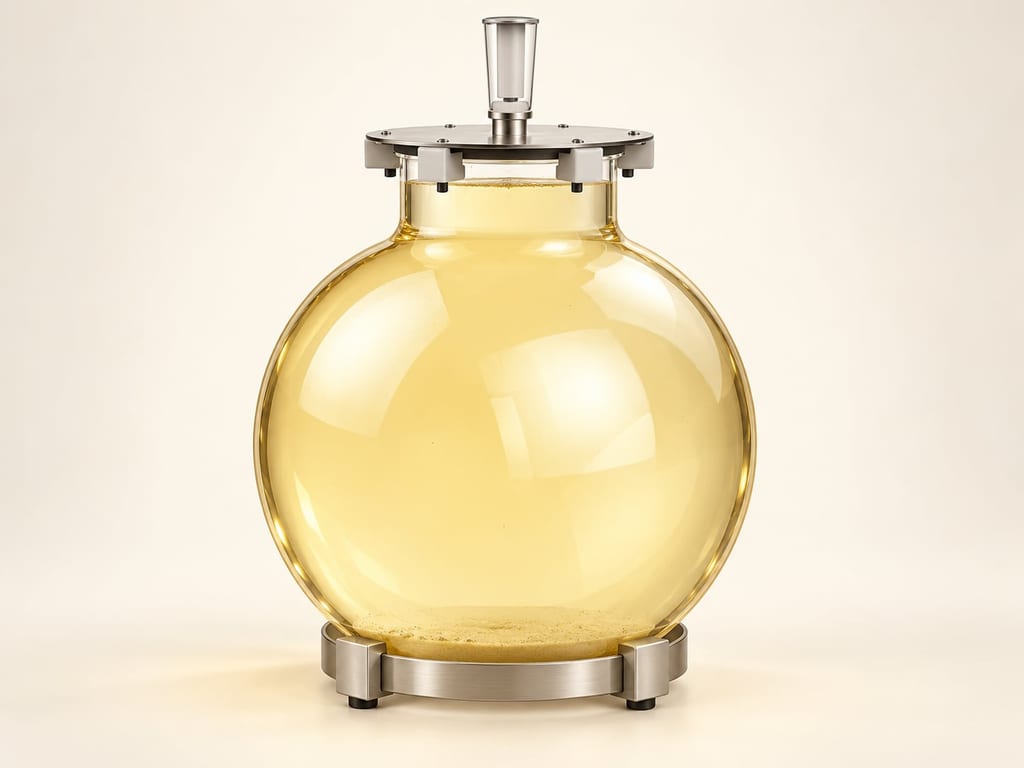
Photorealistic editorial illustration of a modern transparent glass wine globe, filled with pale wine and a fine settled lees layer, with a fitted lid, bubbler and support on warm ivory.
Equipment

Large glass wine globe

A large, transparent, spherical borosilicate-glass vat designed for modern wine fermentation and maturation. The 220-litre Wineglobe model has a wide neck, fitted lid and support; its use and fittings vary by model.

Tanks and vats
Bordeaux
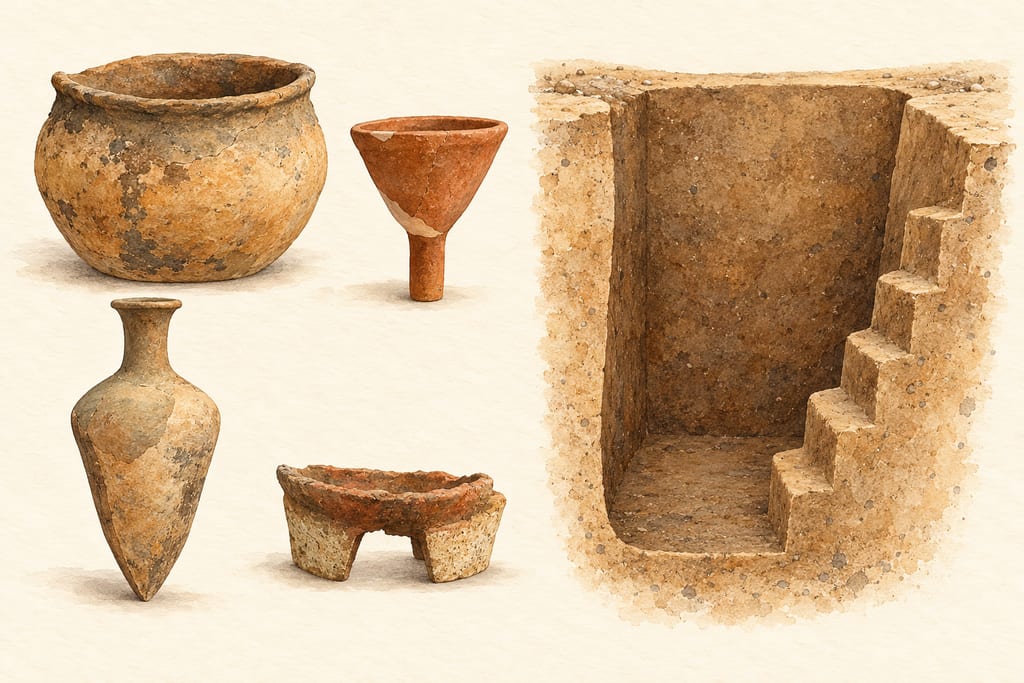
Watercolor archaeological reconstruction showing Mijiaya pottery forms separate from an empty cutaway of stepped Pit H82, clarifying portable equipment and fixed feature.
Equipment · Historical object

Mijiaya brewing suite

Excavated Mijiaya pottery includes wide-mouth pots, funnels, pointed-bottom jiandiping jars and pottery stoves. Residue analyses support a beer-making interpretation; exact vessel roles remain uncertain.

Show on map
Jars, pots and crocks
Mijiaya archaeological site
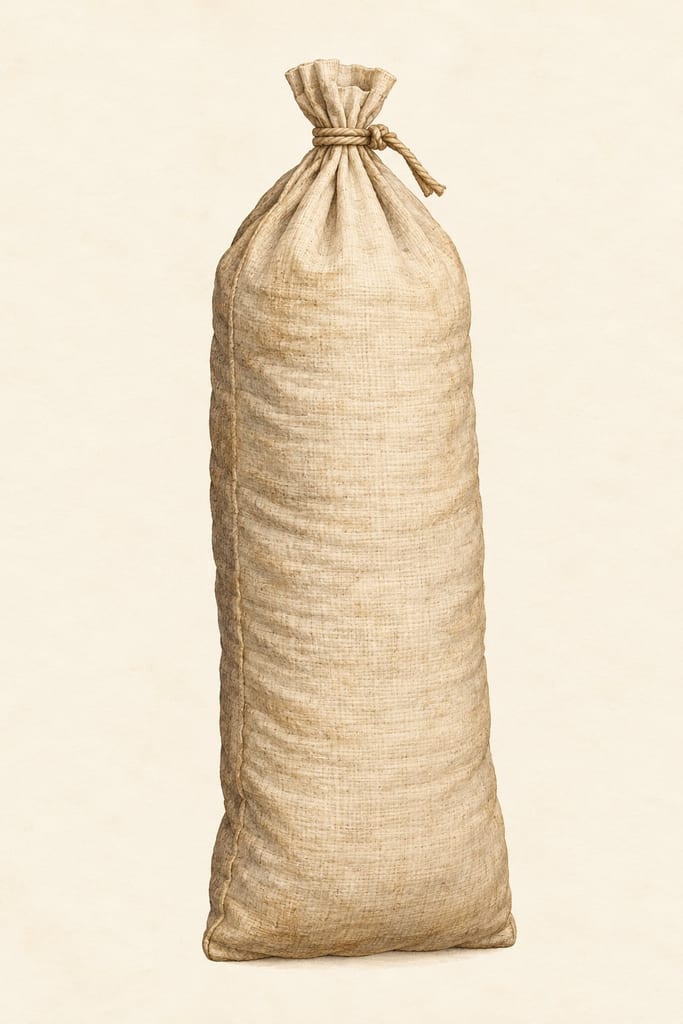
Illustrative long coarse-woven cotton saka-bukuro for a fune press, with one gathered and tied mouth.
Equipment

Sake pressing bag (saka-bukuro)

A sake pressing bag holds moromi while cloth separates liquid sake from rice-and-yeast lees. Traditional fune presses stack filled bags; material and shape vary by method and period.

Bags, sacks and casings
Japan
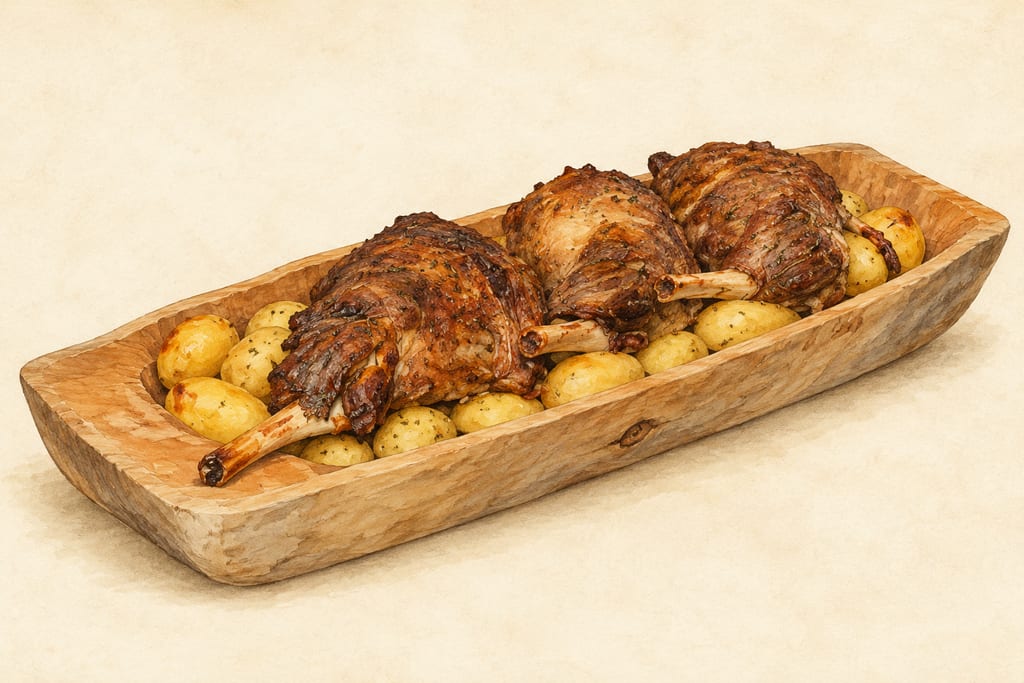
Särä lamb and potatoes served in a shallow carved birch-log trough.
Equipment

Särä trough

A long birch-log roasting trough used for Lemi särä, the slow-roasted lamb and potato dish of South Karelia, Finland.

Gourds, calabashes and carved bowls
Lemi
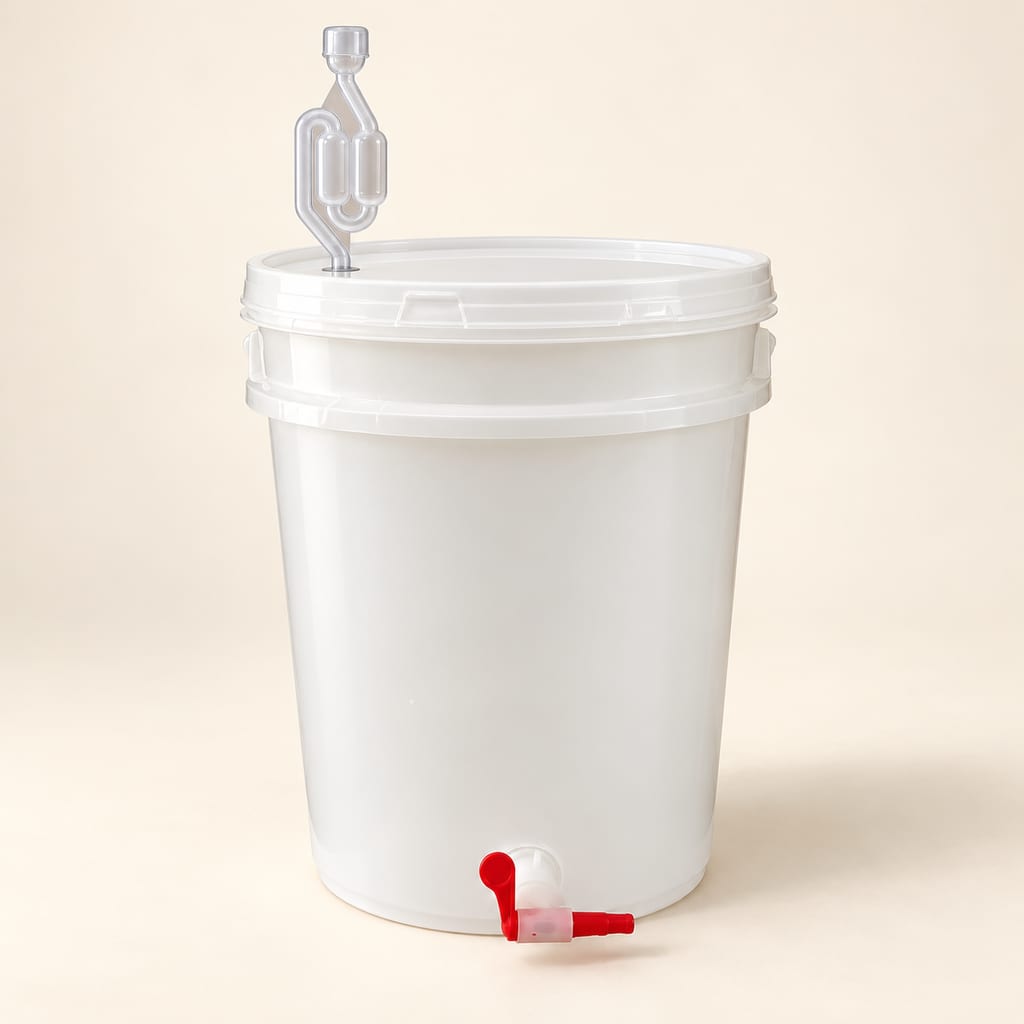
Photorealistic unbranded translucent polymer homebrewing fermentation bucket with snap lid, airlock and lower spigot on a warm ivory background.
Equipment

Polymer fermentation bucket

A wide-mouth polymer pail used to ferment homebrew, commonly sold with a removable lid and sometimes a tap; materials, closures and capacities vary by model.

Tanks and vats
Modern and global
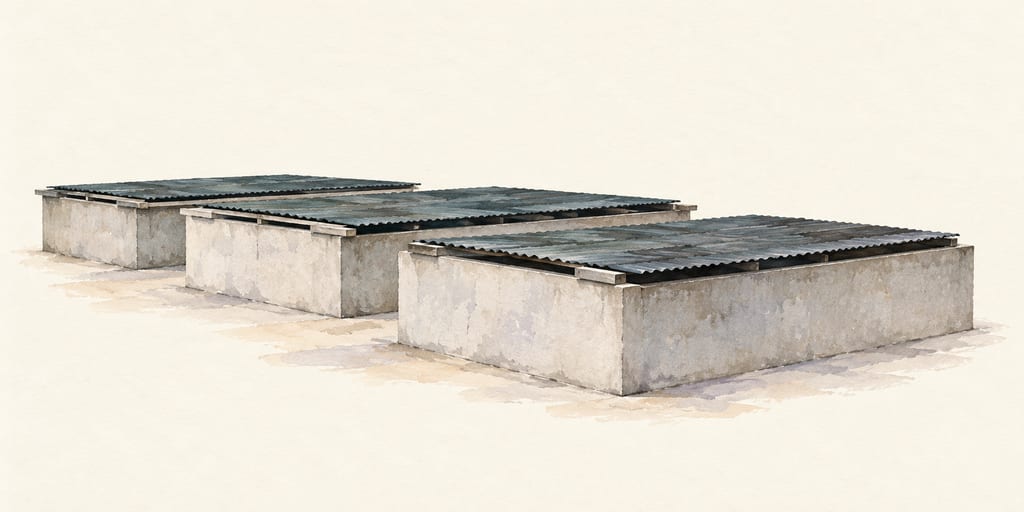
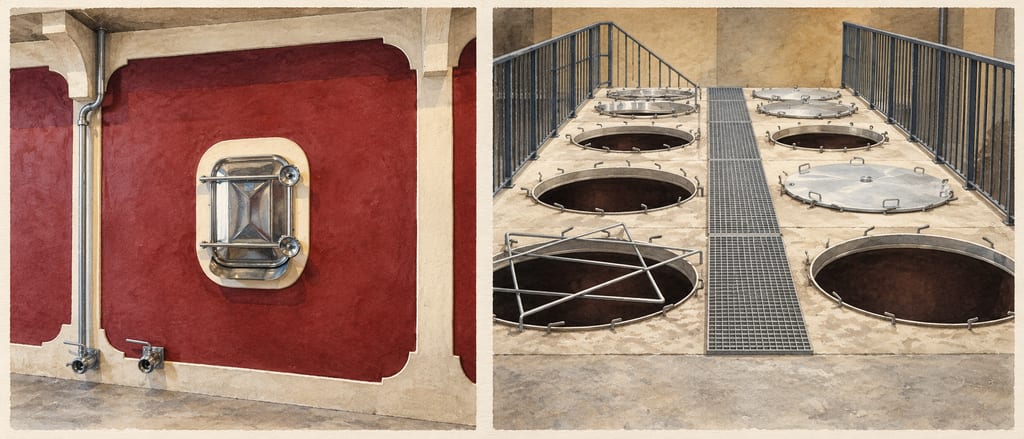
Watercolor comparison of a rectangular concrete wine tank with a stainless access door and a row of open-top concrete fermentors with broad rims.
Equipment

Concrete wine tank

Concrete wine tanks are heavy, fixed vessels in rectangular, cylindrical and tapered forms. Their thermal response and wine contact depend on mix, wall construction and interior finish.

Tanks and vats
Igualada
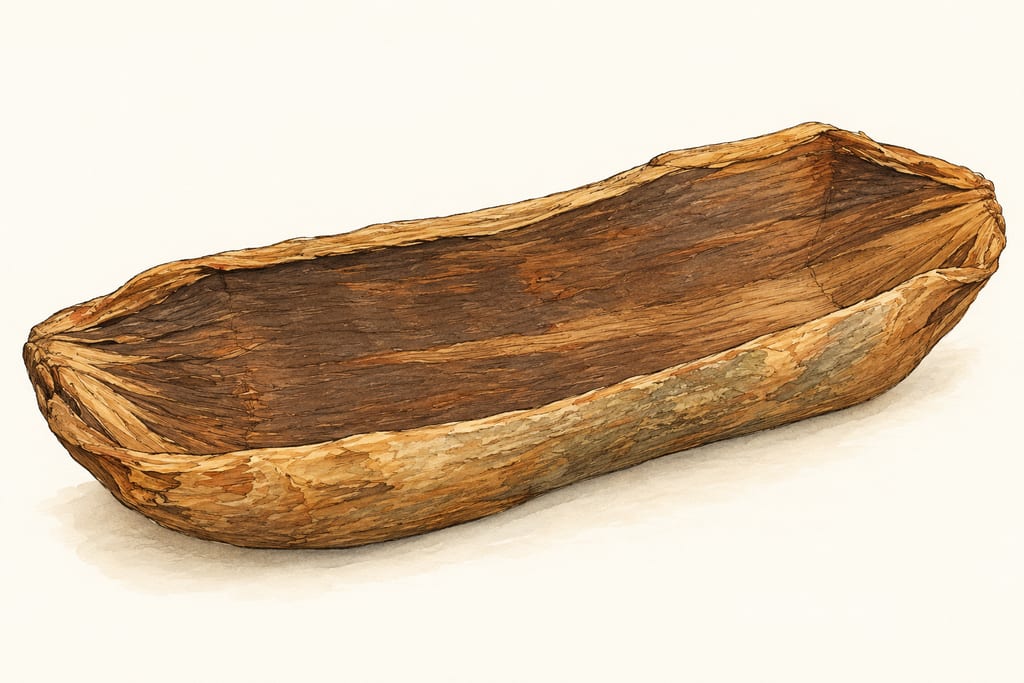
Hand-drawn illustration of one empty, shallow wooden coolamon in an elongated trough form. It represents one documented functional form, not a specific community's artwork or a universal design.
Equipment

Coolamon

A wooden carrying dish used in Aboriginal food, water and seed work. Western Desert examples are called piti or ngurti; the general term does not imply one uniform form or fermentation use.

Gourds, calabashes and carved bowls
Western Desert
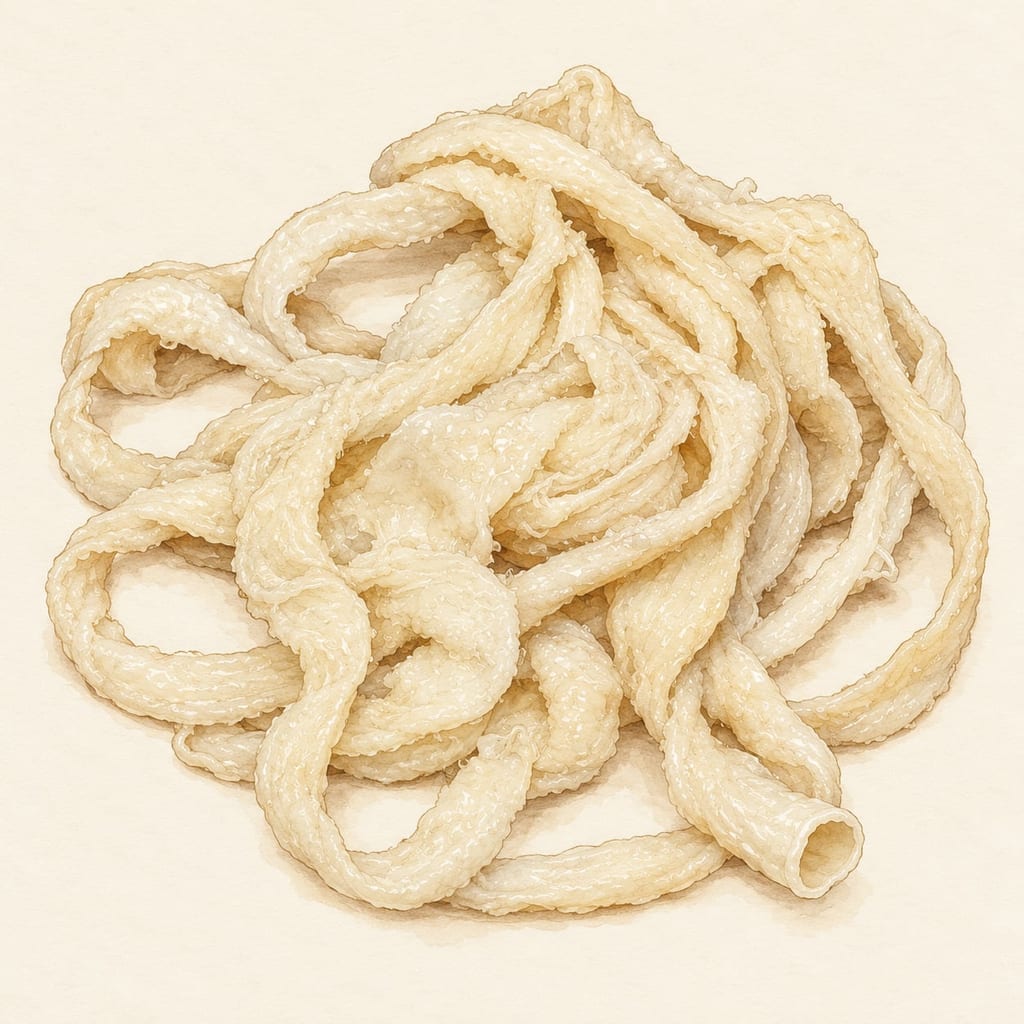
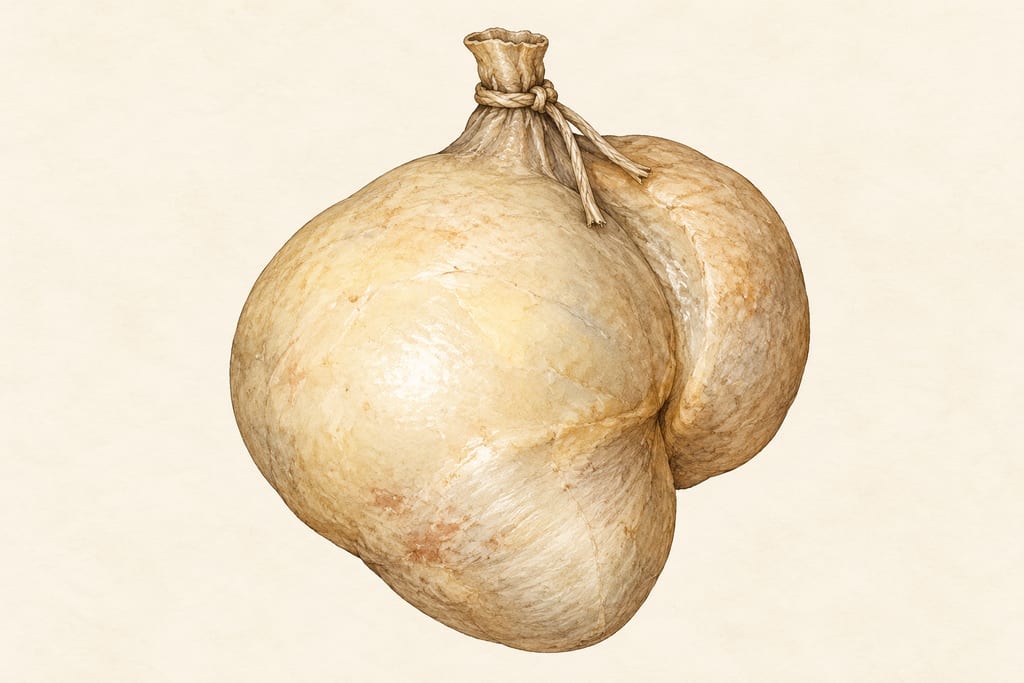
Warm-ivory watercolor illustration of a loose coil of pale natural intestine casing, showing the flexible hollow tube form.
Equipment

Natural sausage casing

A natural sausage casing is a cleaned animal intestine or, for some products, another prepared organ used as an edible envelope. Its anatomy shapes the sausage, while diameter and material affect stuffing and drying.

Bags, sacks and casings
South Africa
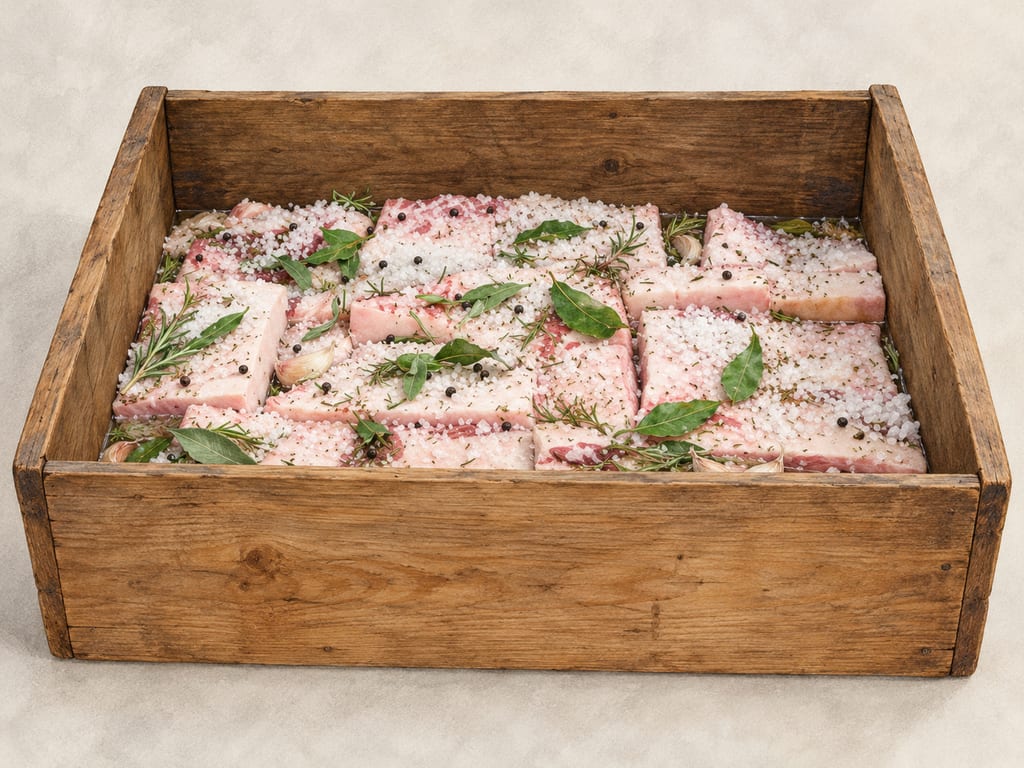
Illustration of an open rectangular wooden doil holding layered lardo with salt and mountain herbs, based on photographs of Arnad curing.
Equipment

Doil

A wooden curing vessel used for Valle d’Aosta Lard d’Arnad: 1763 records already list four old doils in Arnad Castle, and the current DOP process uses native hardwood containers.

Tanks and vats
Arnad
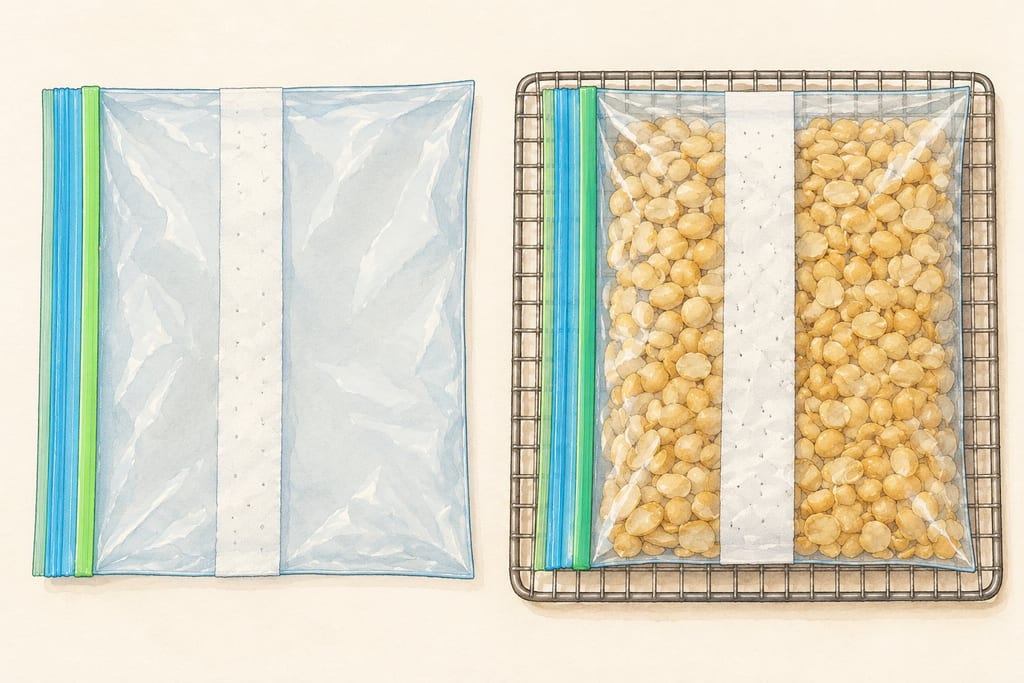
Illustration of an empty clear perforated tempeh bag beside a similar bag with loose dehulled soybean halves on a wire rack; no finished cake is shown.
Equipment

Perforated tempeh bags or ventilated containers

Perforated plastic bags and covered trays hold tempeh in a thin shape while admitting air; they are modern packaging options, distinct from the documented leaf wrapper.

Bags, sacks and casings
Equipment

Leather bags for Tofalar plant reserves

Leather bags stored dried wild onion, sarana and kandyk for winter use in Tofalaria. The traditional plant store is documented, but the bag's shape, construction and hide species are unknown.

Bags, sacks and casings
Tofalaria, southern Nizhneudinsk District, Irkutsk Oblast
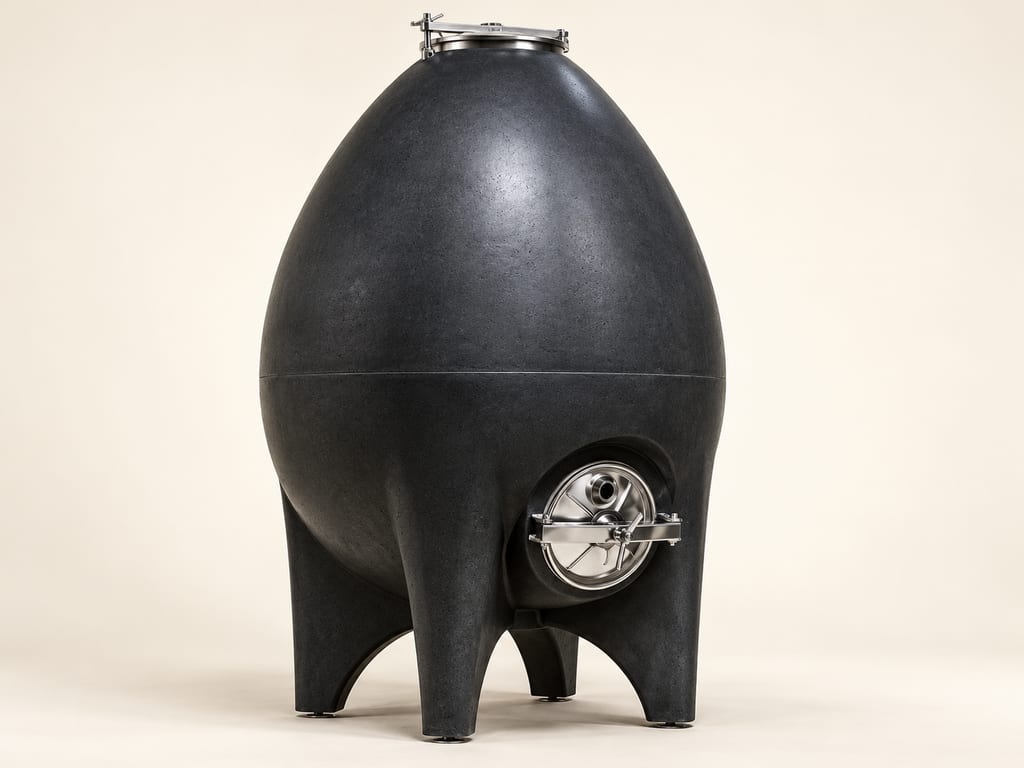
Photorealistic illustration of one dark concrete egg wine vat with a top hatch, lower stainless access fitting and stable integrated feet, on a warm ivory studio background.
Equipment

Concrete egg

A modern ovoid concrete wine vat with smooth curved walls, made in several sizes and fitted according to model. Used for wine fermentation and maturation; support, access, cooling and interior treatment vary.

Tanks and vats
Burgundy
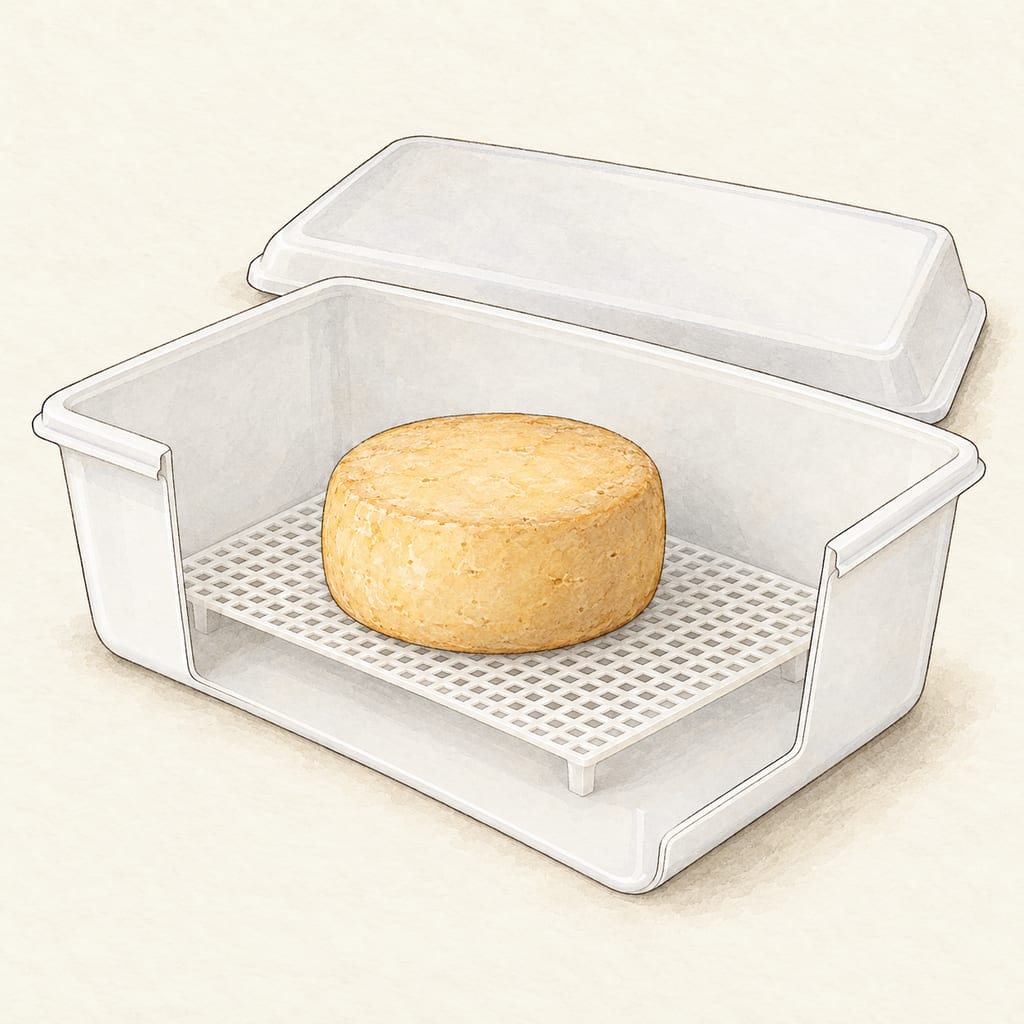
Watercolor illustration of a modern white lidded cheese-ripening box opened to show a cheese wheel raised on an open-grid mat.
Equipment

Cheese ripening box with raised mat

A lidded box used inside a cheese cave or cool cellar to create a small humid ripening space. A raised mat keeps cheese off the base so its underside can breathe and drain.
Boxes and cases
New Zealand
Equipment

Oval coopered pig-salting trough

An open sycamore trough bound with iron hoops, recorded in use for salting pork at Penally, Wales, between 1850 and 1900.

Barrels and casks
Penally
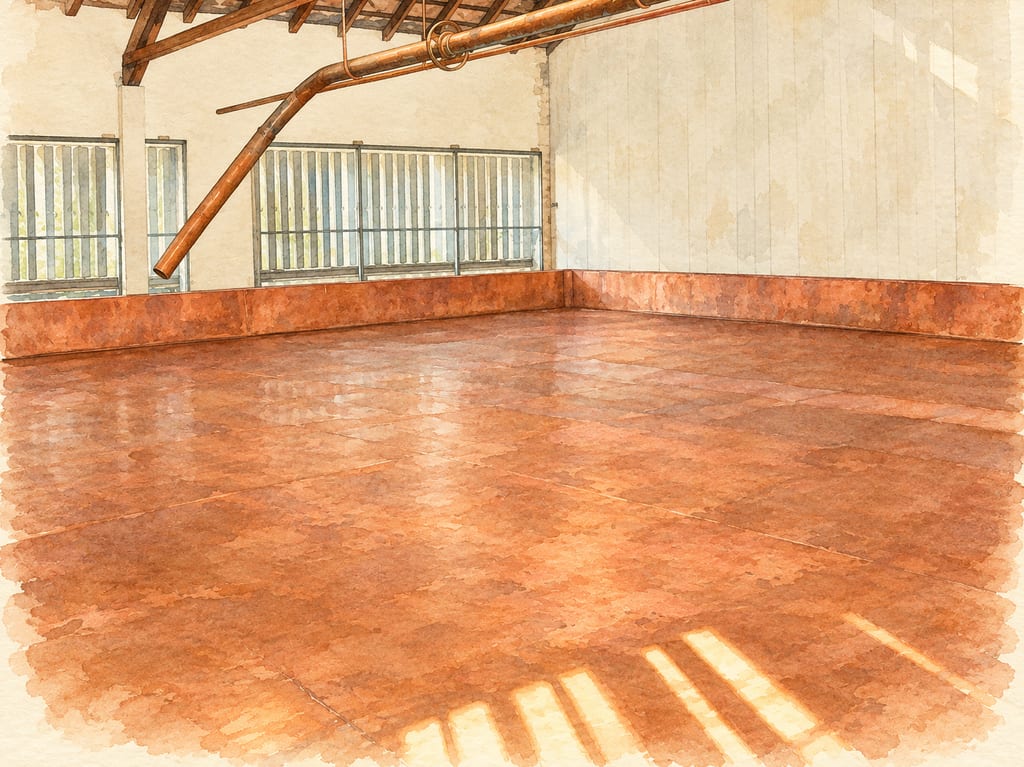
Watercolor illustration of an empty, broad, shallow copper-lined coolship beneath louvred brewery windows, with a gravity feed pipe overhead.
Equipment

Coolship

A coolship (Dutch koelschip) is a broad, shallow, open vessel that cools hot wort before fermentation. In Belgian lambic brewing, its open surface exposes wort to the brewhouse environment; materials and results vary.

Tanks and vats
Senne River Valley
Hand-painted editorial illustration of covered rectangular cement fish-sauce fermentation vats, following a documented Thai producer example.
Equipment

Thai fish-sauce tank and jar

Thai nam pla ferments fish and salt in more than one kind of vessel. Sources document earthenware jars alongside larger wooden or cement tanks; no single shape, capacity or construction detail applies to every maker.
Tanks and vats
Thailand
Archival watercolor illustration of a rounded animal-stomach qaryn pouch tied closed for butter storage.
Equipment

Qaryn butter stomach

A prepared animal-stomach pouch holds butter in Kazakh and Kyrgyz traditions. Field images document empty and filled qarın in southern Kyrgyzstan, while a Kazakh tutorial distinguishes animal-specific qaryn forms.

Bags, sacks and casings
Pamir-Alai, southern Kyrgyzstan